Our Top Picks




What's inside
- How a Wireless Headset Microphone System Actually Works
- UHF vs 2.4G: The Wireless Choice That Shapes Everything
- One Speaker or Two: Matching the System to Your Format
- The Eight Systems, Compared in Depth
- Plugs, Receivers, and Your Existing Speaker
- Battery Habits That Keep You Audible
- Fit, Comfort, and Sounding Like Yourself
- Which System Fits Your Presenting Life?
- Check prices on Amazon
- Final Thoughts Before You Present
As an Amazon Associate I earn from qualifying purchases. This post may contain affiliate links at no extra cost to you.
Let’s clear up the name before anything else, because it changes every buying decision that follows. When shoppers search for wireless headsets for presentations, the products that actually solve the presentation problem on Amazon are not music headphones, not gaming headsets, and not the earbuds you wear on a train. They are wireless headworn microphone systems: a slim microphone that sits on a headband or ear hook in front of your mouth, a small transmitter that sends your voice through the air, and a receiver that plugs into a powered speaker, a PA system, or a portable voice amplifier. Your audience hears your voice, amplified and clear, while your hands stay completely free to advance slides, hold a pointer, write on a board, demonstrate a product, or move around a classroom.
That distinction matters because a brilliant pair of listening headphones does nothing for a presenter. Headphones play sound into your ears. A presentation headset microphone does the opposite job: it captures sound from your mouth and delivers it to a speaker so a room full of people can hear you. Teachers use these systems to protect their voices across a full school day. Tour guides use them so a group can follow along outdoors without shouting. Fitness instructors, auctioneers, pastors, trainers, market demonstrators, and conference speakers all rely on the same basic arrangement. If you need to be heard by people in the room with you, this is the product class you want, and every system in this guide belongs to it.
Our research for this guide focused on complete, ready-to-use systems rather than loose components. Each pick below includes a headset microphone as its centerpiece, and most add useful extras such as a bodypack transmitter, a lavalier option, or support for two speakers at once. We checked how each system connects, which wireless band it uses, what range its listing states, and which kind of presenter it suits best. The result is a shortlist that covers solo teachers, co-presenters, panel hosts, and anyone who simply wants a dependable plug-and-present setup without renting professional audio gear.
How a Wireless Headset Microphone System Actually Works
Every system in this guide follows the same signal path, and understanding it makes the differences between models much easier to judge. First, the headset microphone picks up your voice at very close range. Because the capsule sits a short, consistent distance from your mouth, it captures a strong, steady signal even when you turn your head, look down at notes, or walk across a stage. That consistency is the single biggest advantage a headworn microphone holds over a handheld microphone, which drifts closer and farther away as your hand moves, and over a microphone on a stand, which only sounds right while you stay in one spot.
Second, a transmitter sends that voice signal wirelessly. In some designs the transmitter is a small bodypack that clips to a belt or waistband, with a thin cable running up to the headset. In others the electronics are more integrated. Either way, the transmitter converts your voice into a radio signal on either a UHF band or a 2.4G band, a choice we will unpack in detail shortly because it affects range, interference behavior, and how many systems can share one room.
Third, a receiver catches the signal and passes it to your sound system through a cable connection, most commonly a 1/8 inch or 1/4 inch plug. That receiver might plug straight into a portable voice amplifier worn at your waist, into a powered PA speaker at the front of a classroom, or into a mixer that feeds a larger installed system. The receiver is the bridge between the wireless world and the speaker world, which is why plug compatibility deserves as much attention as the microphone itself. A wonderful microphone that cannot connect to your speaker is not a solution at all.
Finally, the speaker does the loud work. None of the microphone systems in this guide, apart from the one amplifier kit we flag clearly below, includes the speaker itself. You pair the system with a voice amplifier or PA speaker you already own, or you choose the kit that bundles an amplifier in. Keeping that boundary clear helps you budget correctly and avoids the classic disappointment of opening a box and discovering you still need something to plug it into.
UHF vs 2.4G: The Wireless Choice That Shapes Everything
The two wireless families in this guide behave differently, and neither is simply better. UHF systems operate on ultra-high-frequency radio bands that have served wireless microphones for decades. UHF signals tend to travel well through rooms, handle obstacles gracefully, and offer multiple selectable channels on many models, so if one channel sounds busy you can move to another. Several systems below lean on exactly that flexibility, including designs with 15 channels and designs with automatic scanning that hunt for a clear channel for you. For venues where other wireless gear is already running, that channel choice is a genuine practical advantage.
2.4G systems use the same general frequency neighborhood as many everyday wireless devices. Their appeal is simplicity and modern pairing behavior: compact receivers, straightforward setup, and designs that often feel closer to consumer electronics than to traditional stage gear. The dual-speaker 2.4G system at the top of our list shows the appeal clearly, offering two headset microphones for two people in one package aimed at speakers, voice amplifiers, and PA systems. In a small classroom, training room, or meeting space, that simplicity can be the difference between a system that gets used every day and one that stays in a drawer.
Range interacts with the band choice, but the honest way to compare range is to use the figures each listing actually states. In this guide you will see stated ranges of 200 FT, 160ft, and 130ft on specific models, and we attribute each figure only to the model that claims it. Treat every stated range as a best-case, open-space figure: walls, metal shelving, human bodies, and other electronics all shorten real-world distance. A sensible buying rule is to choose a system whose stated range comfortably exceeds the farthest distance you will ever stand from your speaker, so the inevitable real-world reduction still leaves you covered.
Interference deserves a calm, realistic word as well. Any wireless system can meet interference; what separates thoughtful designs is how they help you escape it. Selectable channels, automatic scanning, and quick infrared sync, all of which appear on models below, are tools for finding and locking onto a cleaner connection quickly. In a quiet suburban classroom you may never need them. In a conference center with dozens of wireless devices running at once, they can save your session.
One Speaker or Two: Matching the System to Your Format
Presentation formats split neatly into solo and duo work, and this guide covers both deliberately. Solo systems serve the teacher alone in a classroom, the single trainer leading a workshop, or the guide walking at the front of a group. They are simpler, usually lighter, and quicker to set up each morning. If you always present alone, a solo system keeps your routine clean and your bag light.
Dual systems serve co-teachers, interview formats, worship teams, sales pairs, and panel conversations where two voices need amplification at the same time. Three of our picks are built expressly for two people: a 2.4G dual headset package, a dual UHF system with automatic scanning, and a double professional headset design whose microphones can also work as handheld units. Running two wireless voices at once is exactly where channel management and clean pairing stop being luxuries, so duo buyers should weigh those features heavily rather than treating them as fine print.
There is also a middle path worth noticing. Two systems below pair a headset microphone with a lavalier, or lapel, microphone through a bodypack transmitter. That pairing gives one presenter two wearing styles: the headset for active, moving delivery, and the discreet lapel clip for seated conversation, video recording, or formal dress where a headband looks out of place. If your work mixes standing presentations with seated interviews or recordings, that flexibility can matter more than raw range.
The Eight Systems, Compared in Depth
1. Wireless Microphone System for 2 People, 2.4G Dual Wireless Headset Mics
This opening pick is the clearest expression of the duo idea in the whole guide. It is a 2.4G wireless microphone system built for two people, with dual wireless headset microphones in one package, and its listing names exactly the jobs this guide cares about: speakers, voice amplifiers, PA systems, and teachers. If your presenting life involves a partner, this is the concept to beat.
The 2.4G approach suits buyers who value straightforward setup. Rather than thinking like a stage technician, you think like a teacher with ten minutes before class: charge the gear, switch it on, plug the receiver into your amplifier or PA speaker, and start talking. For schools, community halls, training rooms, and small venues where the same two people present together regularly, that daily ease compounds into real value across a school year or a season of events.
Two headset microphones also solve a social problem that one microphone never can. Passing a single handheld microphone back and forth breaks the rhythm of a conversation, invites handling noise, and leaves one speaker unamplified while they wait. Two headworn microphones let both voices stay at a consistent level, let both speakers keep their hands free, and let a dialogue sound like a dialogue. Co-teachers can trade explanations naturally, an interviewer and guest can respond without delay, and a presenting pair can demonstrate together while both stay audible.
Who should choose it? Teaching teams, married or partnered presenters who run workshops together, worship and community speakers who share a stage, and trainers who work in pairs. Who should look further down the list? Solo presenters paying for a second microphone they will never use, and buyers who specifically want UHF channel selection for crowded radio environments. Judged on its own terms, as a simple two-person 2.4G package aimed squarely at speakers and teachers, it earns its place at the top of this guide.
2. TONOR UHF Wireless Microphone System with Bodypack and Lavalier Mic
The TONOR system takes the flexible route. It is a UHF wireless microphone system supplied as one set built around a bodypack transmitter, and it gives you both wearing styles in the box: a headset microphone and a lavalier lapel microphone. A rechargeable receiver and 15 channels round out a package clearly designed for presenters whose work changes shape from day to day.
The bodypack concept deserves explanation for first-time buyers. The bodypack is a small transmitter that clips to your belt, waistband, or pocket. The headset or lavalier plugs into it with a short cable, and the bodypack sends your voice to the receiver. This arrangement keeps the microphone itself light, because the battery and radio live at your waist rather than on your head, and it makes swapping between the headset and the lavalier as simple as unplugging one and plugging in the other.
Fifteen channels is the headline practical feature. In practice, channels are your escape routes: if the channel you start on picks up interference or clashes with another system nearby, you move to a different one. For presenters who work in schools, offices, houses of worship, or event venues where other wireless equipment may already be running, that choice is reassuring rather than excessive. Combined with the rechargeable receiver, which removes the small daily friction of swapping disposable batteries in the half of the system that lives at the speaker, the TONOR feels designed for regular, repeated use.
Choose the TONOR if your calendar mixes lectures, seated panels, video segments, and formal talks, and you want one system that adapts its wearing style to each. The headset serves your active sessions; the lavalier serves your polished ones. If you know you will only ever present standing and moving, a headset-only system below may be simpler. If your format genuinely varies, this dual-mic flexibility is the smartest kind of versatility, because it solves real scheduling variety rather than adding features for their own sake.
3. LYAIXZE Wireless Microphone Headset, UHF, 200 FT Transmission Range
The LYAIXZE system leads with distance. Its listing states a 200 FT transmission range, the longest figure in this guide, and pairs that reach with a UHF headset microphone system designed for PA use and supplied with both 1/8 inch and 1/4 inch plugs. For presenters whose rooms are genuinely large, that combination of reach and plug choice is the whole story, and it is a compelling one.
Think about where 200 FT of stated range actually matters. A gymnasium assembly, a warehouse training session, an outdoor tour stop, a large lecture hall, an agricultural demonstration, or a community event in a park all push a presenter far from the speaker. In those settings the receiver usually stays with the PA speaker at a fixed point while the presenter roams. A generous stated range gives you headroom: even after walls, bodies, and outdoor conditions take their share, you are more likely to stay connected at the distances your work demands.
The dual plug provision is equally practical. PA equipment varies enormously: portable amplifiers and smaller speakers commonly accept a 1/8 inch input, while larger PA gear and mixers commonly use 1/4 inch connections. A system that arrives ready for both spares you the adapter hunt and lets the same microphone serve a small classroom amplifier on weekdays and a bigger hall system on weekends. Presenters who work across multiple venues, or whose venue upgrades its sound gear over time, benefit from that built-in compatibility every time the setup changes.
Choose the LYAIXZE if distance is your defining constraint and your speaker setup could be either plug size. It is the natural pick for large-space and outdoor presenters. If your world is a single small classroom where you never stand far from the amplifier, its reach is more than you need, and a simpler or dual-speaker model below may fit your format better. Range you never use is harmless, but format fit is what you feel every day.
best bluetooth headsets for noisy office
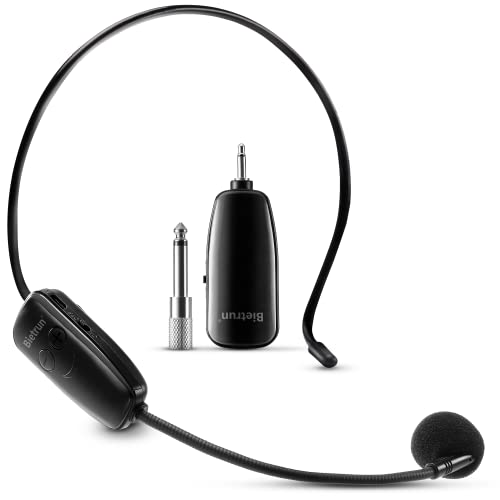
4. Bietrun Wireless Microphone Headset, UHF, 160ft Range
The Bietrun system occupies the sensible middle of this guide, and for a great many presenters the middle is exactly right. It is a UHF wireless headset microphone system with a stated 160ft range and both 1/8 inch and 1/4 inch plugs, and its listing names speakers and voice amplifiers as its intended partners. Nothing about it is extreme, and that balance is its strength.
A stated 160ft range comfortably covers the realistic geography of most presenting: classrooms, training rooms, meeting spaces, small halls, places of worship, and retail or exhibition floors. You can place the voice amplifier or PA speaker where the audience hears it best, then move through the room, work a whiteboard, circulate among tables, or demonstrate at a distance without planning your movement around the microphone. Freedom of movement is the entire point of going wireless, and this range delivers it for typical room sizes with room to spare.
The two plug sizes repeat the compatibility advantage described above. Voice amplifiers, the waist-worn portable speakers beloved by teachers and guides, commonly pair with headset systems through compact inputs, while PA speakers and mixers lean on the larger connection. Arriving ready for both means the Bietrun can start life with a personal amplifier and later graduate to a room system without replacement. For individual buyers spending their own money, that kind of forward compatibility protects the purchase.
Choose the Bietrun if you are a solo presenter who wants one dependable UHF headset system for a voice amplifier today and possibly a PA system tomorrow. Teachers, guides, instructors, and small-venue speakers are its natural audience. Duo presenters should look at the two-person systems instead, and buyers who want a lavalier alternative in the same box should look at the bodypack models. As a focused, single-presenter headset system with honest mid-range reach, it is easy to recommend.
5. MELONARE Dual UHF Wireless Headset Microphone System, Auto Scan MWL-2
The MELONARE MWL-2 is the technician’s duo system, built for two presenters who work in radio-busy places. It is a dual UHF wireless headset microphone system with automatic scanning, quick infrared sync, rechargeable headset microphones, and a stated 130ft range. Every one of those details points at the same goal: getting two wireless voices connected cleanly, quickly, and without fuss, even when the airwaves around you are crowded.
Automatic scanning changes the setup experience. Instead of manually stepping through channels and listening for a clear one, the system searches for you and selects a workable channel. Quick IR sync then pairs the transmitters to that choice rapidly, using the infrared pairing method familiar from professional wireless gear. For a presenting pair setting up in an unfamiliar venue, a conference hotel, an exhibition hall, or a school where another class next door also runs wireless microphones, that automated housekeeping removes the most intimidating part of dual wireless audio.
The stated 130ft range is the shortest figure in this guide, and context makes it perfectly respectable. Duo formats are usually conversational formats staged in defined spaces: a stage, a front-of-room area, a studio corner, a sanctuary platform. Two speakers in dialogue rarely wander far apart or far from the receiver, which typically sits with the PA system at the front. Within that realistic geography, 130ft of stated range provides comfortable headroom, and the scanning and sync features arguably matter more to a duo than extra distance would.
Rechargeable headset microphones complete the picture for regular users. A pair that presents weekly will feel the convenience of simply recharging the same gear rather than managing a stock of disposable batteries for two transmitters. Choose the MELONARE if you present as a duo in varied or crowded venues and want the system to handle channel-finding for you. Solo presenters do not need its dual capacity, and presenters in one fixed, quiet room may never stress its scanning features, but for mobile pairs it is the most purpose-built option here.
6. Wireless Microphone Headset Double Professional, 2 in 1, USB-C Rechargeable
This double professional system adds a trick none of the other duo options offer: its microphones work two ways. It is a wireless headset microphone system for two people whose cordless microphones can serve as headworn units and as handheld microphones, a genuine 2 in 1 design, with USB-C rechargeable convenience. For presenters whose events mix formats inside a single session, that convertible design solves a real staging problem.
Picture a community event, a class celebration, a workshop with audience participation, or a ceremony with several speakers. The main presenters want headsets so they can move and gesture. But then comes the audience question, the guest remark, the student answer, the award acceptance: moments where a handheld microphone passed to a standing speaker is the natural tool. A 2 in 1 system covers both moments with the same gear, instead of forcing you to buy, carry, and connect a separate handheld setup for a few minutes of use.
USB-C recharging is the modern detail that makes the package feel current. Many presenters already carry USB-C cables and chargers for phones, tablets, and laptops, so a microphone system that charges the same way slots into an existing routine and an existing cable bag. Fewer proprietary chargers means fewer forgotten chargers, and for a two-person system that gets packed and unpacked constantly, that small standardization is worth more than it first appears.
Choose this system if your presenting blends hosted segments with audience or guest participation, if you run events where different speakers rotate through, or if you simply want the insurance of handheld flexibility alongside your headsets. If your format is a fixed pair who always present together and never hand a microphone to anyone else, the MELONARE’s automatic scanning may serve you better. If you always present alone, both duo systems are more than you need. Judged as a flexible event tool, though, the convertible design stands alone in this guide.
7. Hotec Wireless System with Dual Headset Microphones and Lavalier Lapel Mics
The Hotec system is the maximalist option: a wireless package with dual headset microphones, lavalier lapel microphones, bodypack transmitters, and one mini rechargeable receiver. Where other picks ask you to choose a format, the Hotec tries to cover several formats at once, and for institutions and shared-equipment buyers that breadth can be exactly the right answer.
Consider who buys this way. A school department, a training company, a community theater, a house of worship, or an event team often serves presenters with different preferences. One teacher loves a headset, another prefers a discreet lapel clip, a third session needs two speakers amplified together. A kit containing dual headsets, lavaliers, and bodypacks lets one purchase cover those rotating needs, with the bodypacks acting as the shared engine that either microphone style plugs into. The single mini rechargeable receiver keeps the speaker end of the chain compact and simple, which matters when different staff set the system up on different days.
The bodypack architecture, as with the TONOR, keeps the worn microphones light and makes style-swapping easy. The lavalier option deserves its moment here: for seated panels, recorded talks, ceremonies, and any occasion where a visible headband would distract, a small lapel microphone clipped to clothing preserves the wireless freedom while nearly disappearing from view. Having that option in the same box as your headsets means the formal event next month does not require a second purchase.
Choose the Hotec if you are equipping a shared space, a team, or a varied calendar rather than one person’s fixed routine. Its value is coverage: two speakers, two wearing styles, one receiver. A solo presenter with a single fixed format will use only a fraction of the box, and for that buyer a focused system is better value. But as a one-purchase answer to unpredictable presenting needs, nothing else in this guide casts as wide a net.
8. WinBridge Voice Amplifier with Bluetooth and Wireless Mic Headset
The WinBridge entry is different in kind, and we present it exactly as what it is: not a standalone microphone system, but a complete voice amplifier kit. The package combines a portable Bluetooth speaker and amplifier with a wireless microphone headset, aimed at teachers and tour guides. If every other pick in this guide assumes you already own something to plug a receiver into, this one removes that assumption entirely.
That completeness is a genuine advantage for the right buyer. A teacher whose classroom has no PA system, a guide who works outdoors far from any installed audio, a coach, a market demonstrator, or a presenter who moves between venues with unreliable equipment can carry one kit and know the whole chain is covered: microphone on your head, amplifier and speaker at your side, voice projected to the group. There is no compatibility question to research, no plug to match, and no borrowed equipment to depend on, because the microphone and the speaker were packaged to work together.
The Bluetooth speaker side adds everyday usefulness beyond your own voice. A teacher can play audio from a lesson, a guide can share a clip, and a trainer can add background audio to a session through the same portable unit that amplifies their speech. For buyers comparing total cost, remember to compare fairly: this kit’s competition is not a bare microphone system but a microphone system plus the amplifier you would otherwise buy separately. Viewed that way, the bundle can simplify both the shopping and the carrying.
Choose the WinBridge if you need the entire voice amplification chain in one purchase, especially for classrooms without installed audio and outdoor guiding. If you already own a good PA system or voice amplifier, a dedicated microphone system above will integrate with it more directly. The WinBridge earns its place in this guide honestly, as the kit option, clearly labeled, for presenters starting from zero equipment.
Plugs, Receivers, and Your Existing Speaker
Compatibility questions decide whether a purchase works on day one, so let us make the plug story concrete. The 1/8 inch plug is the compact connection familiar from everyday audio cables; portable voice amplifiers and smaller speakers commonly use it. The 1/4 inch plug is its larger, sturdier sibling, standard on PA speakers, mixers, and instrument-style inputs. Neither is better in the abstract. What matters is which socket your speaker offers, and the safest purchases, as the LYAIXZE and Bietrun show, arrive ready for both.
Before ordering any system, do one simple piece of research: look at your amplifier or PA speaker, find its microphone input, and note its size. Then match that observation against the system you are considering. If you present in several venues, note the inputs at each. This five-minute check prevents the most common and most avoidable disappointment in this entire product category, and it costs nothing.
Receiver style matters to your routine as well. Compact receivers that plug in at the speaker keep setups tidy, and rechargeable receivers, featured on the TONOR and Hotec systems, remove a recurring battery chore from the end of the chain that presenters most often forget. Whatever the style, give the receiver a sensible home: line of sight to the presenter where possible, away from being buried behind metal equipment, and positioned so its cable is not a trip hazard in a busy classroom or stage area.
Battery Habits That Keep You Audible
Wireless freedom runs on batteries, and presenters feel battery discipline more than any specification. Several systems in this guide emphasize rechargeable designs, from rechargeable receivers to rechargeable headset microphones to USB-C charging, and the pattern reflects how these products are actually used: daily, repeatedly, by busy people. Build a charging routine that matches your presenting routine. Gear that charges overnight in a fixed spot, in the same bag or on the same shelf, is gear that is ready when the audience arrives.
Two habits protect you further. First, start sessions charged rather than hoping yesterday’s remainder is enough; a presentation is a poor place to discover otherwise. Second, if your work includes long events, confirm how your chosen system handles extended days and keep whatever charging cable it uses in the same kit bag. Duo systems double everything, so pairs should treat charging as a shared checklist rather than an assumption. None of this is complicated, but the presenters who never lose their voice mid-session are simply the ones who made charging boring and automatic.
Fit, Comfort, and Sounding Like Yourself
A headworn microphone succeeds or fails at the point where it meets your head. You may wear it for a full teaching day, a long tour, or a multi-hour training, so comfort is not a luxury feature. Look for a headset that sits securely without pinching, that stays put when you turn, nod, and move, and that positions its microphone at a consistent spot near the corner of your mouth. That consistent position is also a sound feature: your volume stays even because the distance between your voice and the capsule never changes, which is precisely the advantage that makes headsets the presenter’s favorite tool.
Speaking technique adapts slightly with a headset. Because the microphone is always close, you can speak at a natural conversational level and let the amplifier do the projecting. Teachers in particular describe this as voice-saving: instead of pushing your voice to the back row for hours, you talk normally and the system carries it. If you are new to headworn microphones, give yourself one low-stakes session to find your comfortable volume and placement before an important event.
Feedback, the squeal that happens when a microphone hears its own amplified output, is managed with simple awareness. Keep some distance between yourself and the speaker where the room allows, avoid standing directly in front of the speaker while wearing a live microphone, and set volume sensibly rather than maximally. These are standard habits of amplified presenting, quickly learned, and they apply equally to every system in this guide.
Which System Fits Your Presenting Life?
Let us gather the threads into direct guidance. If you present with a partner and want the simplest shared setup, the 2.4G dual system for two people is your starting point. If you present as a pair in varied, radio-crowded venues, the MELONARE MWL-2 with automatic scanning and quick sync is built for your reality. If your events mix hosting with audience participation, the convertible double professional system, whose microphones work as headsets or handhelds, covers both moments.
If you present alone, your choice turns on style and space. The TONOR suits presenters who alternate between headset and lavalier across different kinds of sessions. The Hotec suits teams and shared spaces that need dual headsets and lavaliers in one box with a mini rechargeable receiver. The LYAIXZE suits large spaces and roaming presenters who need the longest stated range here, 200 FT, with both plug sizes. The Bietrun suits the classic solo setup, a teacher or guide with a voice amplifier, at a stated 160ft range. And if you own no amplification at all, the WinBridge kit supplies the amplifier, Bluetooth speaker, and wireless headset together.
Notice what did not decide these recommendations: exaggerated claims, invented specifications, or features no listing states. Every range figure above belongs to the model that published it, every plug and channel detail comes from the systems themselves, and the WinBridge is presented as the amplifier kit it is rather than dressed up as something else. That honesty is deliberate. A presenter choosing equipment that their voice, their job, and their audience depend on deserves a guide that respects the difference between one product and another, and between a microphone system and a complete kit.
Check prices on Amazon
Live listings for the shortlist in this guide are pulled from Amazon below, so prices and availability are always current at the moment you look.


Final Thoughts Before You Present
The right wireless headset microphone disappears into your work. It lets a teacher reach the back row without strain, a guide hold a group’s attention outdoors, a trainer move among tables while staying heard, and a presenting pair hold a real conversation in front of an audience. Start from your format, solo or duo, headset only or lavalier too, your own speaker or a complete kit, and let those honest answers point to the system above that matches. Check your speaker’s input, respect the stated range of the model you choose, keep the gear charged, and the technology will do the quiet part while you do the presenting.
As an Amazon Associate, this site earns from qualifying purchases made through links in this guide, at no added cost to you; those earnings help keep our research independent and our buying guides freely available to every presenter who needs one.
FAQ
Which System Fits Your Presenting Life?
Related guides
- Best Mono Bluetooth Headsets: One Ear on the Call, One on the World
- Best Affordable Bluetooth Headsets: Earpieces and Light Work Headsets That Earn Their Keep
- Best Aviation Headsets With Noise Canceling: ANR Flagships and the Honest Passive Pair
- Best Audiophile Gaming Headsets: Open-Back Greats, Honest Microphone Warnings


