What's inside
- Where a trucker actually buys a cab TV — and why the listing’s voltage line comes first
- Key Takeaways
- Quick Picks
- How We Chose These Picks
- Why does voltage range matter more in a truck than any picture specification?
- How big a television does a sleeper cab actually fit?
- The Six Truck Televisions, Reviewed from the Driver’s Seat
- How do you power and mount a cab television without draining the truck?
- What does a driver’s entertainment system look like beyond the screen itself?
- All six truck sets in one comparison
- What mistakes do drivers make when they put a TV in the cab?
- Final Recommendation
- Frequently Asked Questions
- Related Guides
As an Amazon Associate I earn from qualifying purchases. This post may contain affiliate links at no extra cost to you.
gizmoverdict.com is reader-supported. When you buy through links on our site, we may earn an affiliate commission.
Where a trucker actually buys a cab TV — and why the listing’s voltage line comes first
Every set ranked in this guide is sold on Amazon under the verified listing named in its review, and the links here point to those exact listings. With the best tvs for semi trucks, the listing matters more than the brand on the bezel, because the specification that decides whether a television can live in a cab is printed in the title or nowhere: the power input. A household television expects a wall outlet delivering clean, steady household current. A semi truck offers a 12-volt DC system — 24 volts in some fleets and in many trucks outside North America — that surges when the engine cranks, sags under load, and punishes electronics designed for a living room. The televisions in this guide are the ones whose titles state a wide-voltage DC input, and that is not a coincidence; it is the entry ticket to the category.
Let us be plain about the shape of this market before the reviews begin, because a buyer deserves to know it: SYLVOX dominates this class on Amazon. Five of the six picks below are SYLVOX models, not because this guide favours the brand, but because SYLVOX is the maker that has built out a full range of 12-volt, wide-voltage, vibration-resistant televisions in cab-appropriate sizes, while most television brands ignore the truck entirely and most rival specialists field one or two models. The single non-SYLVOX pick, from FREE SIGNAL, earns its place as the off-grid alternative. When one brand is the category, the useful comparison becomes which of its models fits your cab — and that is how the reviews are written.
Life in a sleeper cab imposes a second and third test after power. The second is vibration: a television in a truck is shaken for thousands of hours at highway frequency, on mounts that flex, in a box that idles, bumps and brakes — and the listings here answer with words like seismic and anti-vibration, which this guide reports as the design claims they are. The third test is size discipline. A sleeper berth is a small room that is also a bedroom, an office and a restaurant booth; the screens that work are the ones measured against the berth’s actual dimensions, and they cluster between 22 and 32 inches, with a 40-inch outlier for the largest sleepers. Judge the picks in that order — power, toughness, size — and the right one usually identifies itself.
Key Takeaways
- SYLVOX dominates this class on Amazon — five of these six picks are SYLVOX models, because it builds the widest range of 12V wide-voltage truck and RV televisions in cab sizes.
- The specification that matters most is the input range: the SYLVOX picks state 9–32V wide voltage, which covers 12V and 24V truck systems and shrugs off cranking surges that a fixed-voltage set cannot.
- Vibration resistance is a stated design feature in this class — seismic and anti-vibration language appears in the titles — because a cab shakes its electronics for a living.
- Two picks build in a DVD player, including a non-smart 22-inch SYLVOX for drivers who want discs and broadcast TV without depending on data coverage.
- The FREE SIGNAL Transit is the non-SYLVOX alternative: a 22-inch 12-volt set aimed at RVs, boats and off-grid use, with HD rather than Full HD resolution.
- Only one pick states an integrated ATSC tuner in its title — the non-smart SYLVOX 22 — so antenna viewers should read the tuner lines in the spec lists carefully.
Quick Picks
| Pick | Badge | Why it earns its place |
|---|---|---|
| SYLVOX 24″ Smart RV TV 12V | Best All-Round Cab Pick | 9–32V wide voltage, seismic shock resistance and low power consumption in a 24-inch 1080P smart set sized for a standard sleeper. |
| SYLVOX 32″ RV TV 12V | Best Big-Screen Sleeper Pick | A 32-inch Google OS television with voltage protection and a 178° viewing angle for larger sleepers where the berth doubles as a lounge. |
| SYLVOX 22″ RV TV with DVD (12V) | Best No-Data Pick | A non-smart 22-inch set with a built-in DVD player, FM radio and an integrated ATSC tuner — entertainment that works where coverage does not. |
| SYLVOX 40″ RV TV 12V | Best for the Biggest Sleepers | A 40-inch 1080P smart panel on 9–32V power with a seismic design, for condo sleepers and team drivers with room to spare. |
| FREE SIGNAL Transit 22″ 12V TV | Best Non-SYLVOX Alternative | A 22-inch AC/DC set with HDMI and USB inputs, built for RVs, boats and off-grid applications beyond the truck. |
| SYLVOX 22″ Smart RV TV 12V/24V with DVD | Best Compact Smart Pick | The Limo Series pairs a built-in DVD player with Google TV, anti-vibration design and 9–32V protection in a 22-inch ultra-narrow-bezel frame. |
How We Chose These Picks
Power came first, and it was a hard filter. A pick had to state a DC input suited to vehicle electrical systems in its verified listing title — ideally the 9–32V wide-voltage range that covers both 12-volt and 24-volt trucks and tolerates the voltage swings of cranking and charging. A household television with an external brick, however good its picture, did not qualify; the brick expects household current, and the inverter workaround is a compromise this guide treats in the mistakes section rather than building a ranking on.
Second, we looked for stated toughness. The titles in this class use the vocabulary of the road — seismic, shock-resistant, anti-vibration — and while those are design claims rather than laboratory certifications, a maker who prints them is at least engineering for the environment, which is more than a household set’s maker ever promises. Third came cab realism: sizes from 22 to 40 inches, low power consumption where stated (a television that drains the batteries during a 34-hour restart helps nobody), and entertainment that survives a dead zone — which is why two DVD models and an explicitly tuner-equipped non-smart set sit alongside the streaming models.
Finally, we kept the SYLVOX concentration visible rather than disguising it. A guide that pretended this class had six equal brands would be lying about the market. Instead, the reviews differentiate the SYLVOX models from each other — by size, by smart platform, by disc player, by tuner — because for most buyers the real decision is which SYLVOX, or whether the one alternative fits better. Every specification below comes from the verified listing titles; anything a title does not state is marked as unstated in the spec list.
One category of product was excluded on principle: the portable television designed for camping and tailgating, with a battery and a handle. Those sets have their own guide elsewhere on this site, and while a driver could use one, their design centre is the picnic rather than the thousand-hour vibration and voltage life of a working truck. A semi’s television is infrastructure, installed and lived with for years, and this ranking reserves its places for sets built to that standard.
Why does voltage range matter more in a truck than any picture specification?
Because a truck’s electrical system is a hostile place wearing a friendly voltage. The nominal figure — 12 volts, or 24 in some trucks — is only the average of a much rougher reality. Cranking the engine drags the system voltage down hard for a few seconds. The alternator’s charging pushes it above nominal. Loads switching on and off — the bunk heater, the inverter, the fridge — ripple through the same circuits the television drinks from. Electronics designed for a fixed, clean input meet all of that unfiltered, and the failures are rarely dramatic: a set that reboots when the engine starts, a board that ages in a year, a screen that flickers under load.
A stated 9–32V input range is the manufacturer’s answer to that whole paragraph. It says the power supply was designed to keep working while the input wanders across the full span a vehicle can produce, from a sagging crank to a charging surge, and to do so on either a 12-volt or a 24-volt system without adapters or settings. For an owner-operator who might change trucks, or a fleet driver assigned whatever is in the yard, that range is also portability: the same television works in the next cab too. When the SYLVOX titles repeat “9–32V wide voltage” like a refrain, that refrain is the most important sentence in the listing, and this guide treats it that way.
Voltage protection, named in the 32-inch model’s title, is the companion idea — the set defending itself against the spikes rather than merely tolerating the range. Neither claim should be oversold: no television makes a failing alternator harmless, and a truck with serious electrical faults will find the weakest electronics in the cab eventually. But the distance between a set designed for vehicle power and a set adapted to it with a cheap inverter is the distance between equipment and improvisation, and over a hundred thousand miles that distance shows.
There is a diagnostic habit worth adopting from this: when a cab television misbehaves, note what the truck was doing at that moment. A set that flickers as the bunk heater cycles, reboots as the engine cranks or buzzes when the inverter runs is reporting on the electrical environment, not merely failing. Wide-voltage sets forgive most of that environment by design; where a problem persists through a forgiving set, it is often the truck asking for attention — a tired battery, a corroded ground — and the television has done the driver a favour by noticing first. Electronics in a cab are witnesses as much as appliances, and the ones built for the environment give the most trustworthy testimony.
How big a television does a sleeper cab actually fit?
Measure the berth, not the ambition. The viewing distance in a sleeper is short — typically the length of the bunk, a few feet from pillow to panel — and at that distance a 22- or 24-inch screen fills the field of view the way a 55-inch screen does across a living room. That is why the class clusters at the small end: the 22-inch models are not economy compromises, they are the correct optical size for a standard sleeper, with the bonus that they mount on the berth’s limited wall space, draw little power and leave room for the rest of a driver’s life in the cab.
The case for the larger screens is about cab size and cab use, not about picture greed. A 32-inch set suits the bigger sleepers — the raised-roof condos with a dinette or a swivelling passenger seat — where the viewing distance stretches and the berth doubles as a lounge during a long reset. The 40-inch SYLVOX is the honest outlier: it exists for the largest custom sleepers and for team operations where the television is genuinely shared furniture. In a standard fleet sleeper it would be a wall of screen a metre from the driver’s face, which is not luxury but fatigue. Match the diagonal to the bunk’s length and the mount’s location, and remember that in a cab, every inch of screen is also an inch of something else given up.
There is a subtler measurement that experienced drivers take and newcomers skip: the sightline from the pillow with the berth made up. Pillows, bedding and the bunk’s own contours raise the viewer’s head and shift the eye point by inches that matter at cab distances, and a screen mounted for a bare-bunk measurement can end up a fraction too high for comfortable viewing through a whole film — a small, nightly neck ache that drivers blame on the mattress. Sit in the made-up bunk, have the screen’s position marked at eye level from that posture, and mount to the mark. The five minutes of theatre involved are repaid every single evening of the set’s life.
Mounting geometry deserves its sentence here because it interacts with size: the screen should sit where it can be watched from the bunk without a twisted neck through a whole film, which usually means the foot or the side wall at pillow height rather than high in a corner. A tilting, locking mount matters more in a truck than anywhere else in this guide’s world — the set must not swing, rattle or work its fasteners loose over corrugated highway, and the anti-vibration design claims in these listings assume a mount that holds the panel the way the maker intended.
The Six Truck Televisions, Reviewed from the Driver’s Seat

SYLVOX 24″ Smart RV TV 12V — Best All-Round Cab Pick
This 24-inch model is the centre of the class, and its title reads like the category’s checklist written by someone who has lived with the problem: 12V DC power for camper and truck, a 9–32V wide voltage range across DC and AC, seismic shock resistance, low power consumption, 1080P Full HD, WiFi and Bluetooth. Each phrase answers a specific cab reality. The wide voltage covers the electrical roughness described above. The seismic claim addresses the shaking. Low power consumption addresses the restart weekend, when the television runs off batteries that also have to start the truck on Monday. And 24 inches is the size that fits a standard sleeper’s wall and a bunk-length viewing distance without compromise in either direction.
As a smart set with WiFi and Bluetooth, it assumes the modern driver’s setup: a phone hotspot or a cab data plan for streaming, and Bluetooth for the headphones or speaker that keep a film private in a truck-stop row at midnight. The listing’s tail — RV, yacht, home, kitchen — reveals its dual life as a small-space television generally, but the truck credentials in the title are specific rather than decorative, and they are why this model, rather than any household 24-inch set, belongs in a cab. If a driver asked this guide for one recommendation with no further questions, this is the one that would be named.
Its limits are the class’s limits, honestly shared. A smart platform is only as good as the data behind it, and a driver whose routes run through dead zones will lean on downloaded media or look at the DVD picks below. The title does not claim a disc player or name a broadcast tuner, so neither should be assumed. Within the brief it actually states — the all-round 12-volt cab television — it is the most complete single answer in this guide.
- Screen size: 24 inches
- Resolution: 1080P FHD
- Power: 12V DC; 9–32V wide voltage DC/AC power
- Durability claim: Seismic shock-resistant, as stated in the listing title
- Power draw: Low power consumption, as stated in the listing title
- Connectivity: WiFi, Bluetooth; smart TV
- Broadcast tuner: Not stated in the listing title — verify with the maker’s documentation
Strengths
- The full truck checklist in one model: wide voltage, seismic design and low consumption at the classic cab size.
- 1080P at 24 inches is sharp at bunk distance — the resolution and the size are correctly matched.
- Bluetooth suits the midnight film watched on headphones in a crowded rest row.
Trade-offs
- No disc player in the title, so dead-zone entertainment depends on downloads and storage.
- A smart platform presumes data coverage that long rural routes cannot always promise.
- Drivers wanting a lounge-scale screen in a big sleeper will find 24 inches modest.
Best for: the standard sleeper and the solo driver who wants one set that answers every cab requirement at once. Not suited for: a data-free routine built on discs and broadcast, where the non-smart DVD pick below is the honest tool.
Check the SYLVOX 24-inch listing on Amazon for the current price
SYLVOX 32″ RV TV 12V — Best Big-Screen Sleeper Pick
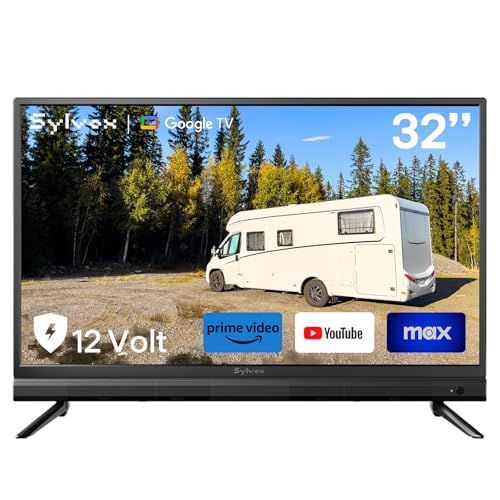
Thirty-two inches is where a cab television stops being a bunk accessory and becomes the sleeper’s furniture, and this SYLVOX is built for the cabs that can honestly host it. The title leads with the 12-volt identity and Google OS, then lists the working details: a 178° wide viewing angle, HDMI and USB ports, AC/DC power and voltage protection for camper, motorhome and RV use. The viewing angle is the sleeper-specific gem in that list. A berth is watched from odd positions — propped on pillows, sideways across the bunk, from the dinette seat in the big sleepers — and a panel that holds its picture at an angle serves all of them instead of demanding the one cinema seat a cab does not have.
Google OS gives this model the fullest streaming identity in the guide, with the app catalogue and voice habits most drivers already know from home. HDMI and USB are named outright, which matters for the driver who carries a game console, a laptop-as-media-player or a drive of films for the dead zones — wired entertainment that no coverage map can take away. Voltage protection stands in the title where the 24-inch model puts its seismic claim; the two are siblings with different emphases, this one leaning toward the connected, larger-cab life.
Choose it by measuring first. In a raised-roof sleeper with a real seating position a metre and a half from the wall, 32 inches is immersive in the good way. In a mid-roof fleet cab it will crowd the berth and sit too close to the pillow. The model is not better than the 24-inch pick; it is bigger, and in a truck, bigger is a property of the cab before it is a property of the television.
- Screen size: 32 inches
- Power: 12 volt; AC/DC power with voltage protection
- Smart platform: Google OS smart TV
- Viewing angle: 178° wide viewing
- Inputs: HDMI and USB ports, as stated in the listing title
- Resolution: Not stated in the listing title — verify with the maker’s documentation
- Intended use: Camper, motorhome and RV use, as titled
Strengths
- The largest screen that still makes sense in a big sleeper, with the viewing angle a berth’s odd seats need.
- Google OS plus named HDMI/USB covers both the streaming life and the wired, offline library.
- Voltage protection is stated in the title — the truck credential is printed, not implied.
Trade-offs
- Too much screen for a standard mid-roof sleeper; the cab must be measured before the order.
- The title does not state the resolution, so Full HD should be confirmed on the product page rather than assumed.
- No disc player — offline viewing runs through USB or downloads instead.
Best for: a large sleeper with a dinette or lounge seat, where the television is shared furniture for resets and team downtime. Not suited for: a compact fleet cab, where its size would crowd the bunk it is meant to serve.
Open the SYLVOX 32-inch Google OS listing on Amazon to check price and stock

SYLVOX 22″ RV TV with DVD (12V) — Best No-Data Pick
This is the television for the parts of the map where the data runs out, and its title is admirably blunt about the philosophy: a 22-inch 1080P set with a DVD player built in, an FM radio, a 9–32V wide voltage input, an integrated ATSC tuner, HDMI, USB and AV inputs — and the words “Non-Smart” printed as a feature, not an apology. For a driver whose evenings happen at rural shippers, in mountain dead zones or at rest areas where the hotspot crawls, entertainment that depends on a network is entertainment that fails exactly when the day has been longest. A shelf of discs and whatever the antenna can pull from the local air never fail that way.
The integrated ATSC tuner deserves its spotlight: it is the only tuner claim stated in any title in this guide, which makes this the one pick a driver can buy for broadcast television on the strength of the listing alone. Local news and weather at the end of a driving day — the information a driver actually needs in tornado season — arrives through that tuner without a byte of data. The FM radio is a smaller version of the same virtue. None of this is nostalgia; it is redundancy engineering for a workplace that moves through coverage gaps as a matter of routine.
The compromises are the mirror image of the smart sets’. There is no app catalogue, no voice search, no Bluetooth in the title; a driver who lives on streaming will feel the absence nightly. The screen is 22 inches, the compact end of the class. But judged against its own brief — the self-sufficient cab television — it is the most honestly specified model in this guide, and for a certain kind of route it is not the budget choice but the correct one.
- Screen size: 22 inches
- Resolution: 1080P flat screen
- Power: 12V; 9–32V wide voltage, DC/AC power
- Disc and radio: DVD player built in; FM radio
- Tuner: Integrated ATSC tuner, as stated in the listing title
- Inputs: HDMI, USB, AV
- Smart platform: Non-smart, as stated in the listing title
Strengths
- Built-in DVD plus an integrated ATSC tuner makes it fully entertaining with zero data coverage.
- The only explicit tuner claim in this guide — broadcast news and weather on the strength of the listing.
- Compact 22-inch frame and wide-voltage power keep the full truck credentials intact.
Trade-offs
- Non-smart by design: no apps, no streaming, no voice control without adding a separate device.
- The smallest screen class here — fine at bunk distance, limiting for a shared lounge cab.
- A disc library takes physical space that a small cab counts carefully.
Best for: rural and mountain routes, dead-zone evenings, and any driver who wants the news and a film with no network involved. Not suited for: a streaming-first driver whose cab life runs on apps and voice search.
See the SYLVOX 22-inch DVD listing on Amazon and check the current price

SYLVOX 40″ RV TV 12V — Best for the Biggest Sleepers
Forty inches in a truck sounds like a misprint until you have stood inside a modern custom sleeper — the extended condos with a dinette, a wardrobe wall and enough floor to turn around in — and then it sounds like the obvious size for the room. This SYLVOX is the class’s maximum: a 40-inch 1080P smart panel running on DC/AC power across the same 9–32V range, with low energy consumption, a seismic design, Bluetooth and WiFi in the title. The engineering point is that the truck credentials did not get traded away for the size; the voltage range and the vibration language scale up with the diagonal, which is precisely what separates a big truck television from a household set that wandered into the wrong catalogue.
Low energy consumption matters more here, not less. A 40-inch panel in a sleeper is a real load across a long restart, and the listing’s emphasis on efficiency acknowledges that the set’s owner thinks in battery hours. Bluetooth and WiFi cover the shared-cab reality: a team operation’s television is social equipment, watched from two bunks and the dinette, paired to whoever’s speaker or headphones are in use. The title’s tail reaches beyond the truck — car, RV, camper, home kitchen — but the truck case rests on the stated voltage and seismic claims, and those are printed where they should be.
The warning is purely geometric. Measure the wall, the viewing distance and the swing of every door and cabinet in the sleeper before ordering; a 40-inch panel that fits on paper can still block a wardrobe or hang where a head will find it in the dark. In the right cab — and they exist, in growing numbers — this is the definitive screen. In the wrong one it is an expensive lesson in why this class normally stops at 32.
- Screen size: 40 inches
- Resolution: 1080P smart flat screen
- Power: 12V; DC/AC power, 9–32V range
- Power draw: Low energy consumption, as stated in the listing title
- Durability claim: Seismic design, as stated in the listing title
- Connectivity: Bluetooth, WiFi; smart TV
- Broadcast tuner: Not stated in the listing title — verify with the maker’s documentation
Strengths
- The largest screen in the class with the full wide-voltage, seismic truck specification intact.
- Low energy consumption is stated — a real consideration for a big panel across a 34-hour restart.
- Bluetooth and WiFi suit team cabs where the television is shared equipment.
Trade-offs
- Only the largest custom sleepers can host it; in a standard cab it is simply too much television.
- 1080P at 40 inches and short range is adequate rather than luxurious — the size, not the sharpness, is the point.
- Its mounting demands are the most serious in the guide; the wall and the mount must be planned.
Best for: extended condo sleepers and team operations with the wall, the distance and the battery bank to support it. Not suited for: any standard fleet sleeper, where it would consume the berth it was bought to entertain.
View the SYLVOX 40-inch listing on Amazon to check price and delivery

FREE SIGNAL Transit 22″ 12V TV — Best Non-SYLVOX Alternative
The Transit is the guide’s proof that the class is a market and not a monopoly: a 22-inch flat screen from FREE SIGNAL, AC/DC powered, with an LED panel, HD resolution and HDMI/USB inputs, described for RVs, campers, boats and off-grid applications. Its identity is broader than the truck — this is the off-grid television that also works in a cab — and for some buyers that breadth is the appeal. A driver who splits life between the truck and a boat, a cabin or a camper may prefer one set that is at home in all of them over a truck specialist.
Read its title with the same discipline as the others and the differences are instructive. It states 12-volt power and AC/DC flexibility, but it does not print a 9–32V range, a seismic claim or a voltage-protection line, so this guide credits it with none of those: the wide-voltage and vibration credentials that define the SYLVOX picks are simply not claimed here, and a buyer whose truck runs a 24-volt system or whose routes are brutally rough should notice the silence. Its resolution is stated as HD rather than the 1080P the SYLVOX 22s claim — at 22 inches and bunk distance the practical gap is small, but it is a real specification difference and it is reported as one.
What the Transit offers in exchange is simplicity and an established off-grid niche: the essentials — vehicle power, the two inputs that matter, a compact LED panel — without a smart platform’s appetite for data or a specialist’s price structure. As the alternative pick, it does the guide a service beyond its own sales: it shows exactly which claims the SYLVOX range makes that the wider market does not, and lets a buyer decide how much those claims are worth in their own cab.
- Screen size: 22 inches
- Panel and resolution: LED screen, HD resolution
- Power: 12 volt; ACDC powered
- Inputs: HDMI and USB inputs, as stated in the listing title
- Intended use: RVs, campers, boats and off-grid applications, as titled
- Wide-voltage range: Not stated in the listing title — verify with the maker’s documentation
- Vibration-resistance claim: Not stated in the listing title — verify with the maker’s documentation
Strengths
- The one established non-SYLVOX route in the class, with an off-grid brief that spans truck, boat and cabin.
- Simple, essential specification — vehicle power plus HDMI and USB — with no platform demanding data.
- Compact 22-inch size fits the same standard sleeper walls as the class’s other small sets.
Trade-offs
- HD rather than the 1080P the same-size SYLVOX models state in their titles.
- No wide-voltage range is printed, so 24-volt truck owners cannot confirm fit from the listing.
- No vibration or seismic design claim is made in the title.
Best for: the driver whose screen splits its life between the cab and another off-grid place, on a 12-volt system. Not suited for: a 24-volt truck, where the unprinted voltage range leaves the essential question unanswered.
Read the FREE SIGNAL Transit listing on Amazon and check the current price
SYLVOX 22″ Smart RV TV 12V/24V with DVD — Best Compact Smart Pick
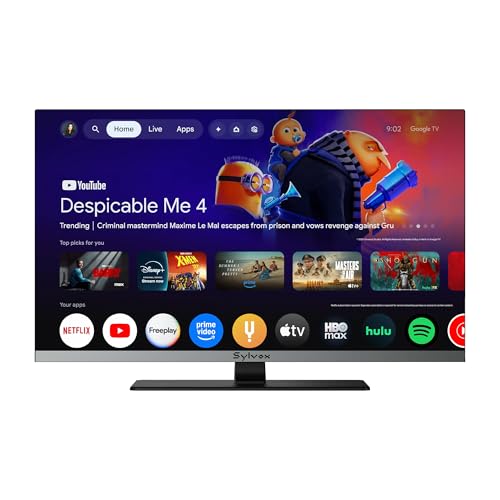
The Limo Series entry is what happens when the two philosophies in this guide — the connected smart set and the self-sufficient disc set — are built into one 22-inch cabinet. The title stacks them without embarrassment: 12V/24V Google TV with a built-in DVD player, 1080P Full HD, anti-vibration design, wide voltage protection across 9–32V, and ultra-narrow bezels. A driver can stream through the hotspot where coverage is good, drop a disc in where it is not, and never change hardware between the two evenings. For a compact cab that cannot spare the space for both a television and a separate player, that consolidation is the whole argument.
The 2026 Limo Series designation makes this the newest design in the guide, and the ultra-narrow bezel is more than styling in a small cab: at 22 inches, bezel width is a meaningful fraction of the total footprint, and a slim frame is how a modern set fits a wall that was measured for an older, smaller television. Anti-vibration is the stated durability language here, paired with the wide voltage protection that a 12/24V title promises. Google TV is the platform, so the app and voice experience matches the 32-inch pick’s, scaled to the berth where most solo drivers actually live.
Set it beside the non-smart DVD model and the fork is philosophical. That set is simpler, tuner-explicit and proud of having no platform; this one is the connected superset, and its title notably does not repeat the ATSC tuner claim, so broadcast viewers should verify the tuner on the product page rather than assume the DVD sibling’s specification carries over. Neither is the better television in the abstract. They are two answers to the question of what a cab evening is made of, and the Limo’s answer — everything, in the smallest current frame — is the one most solo drivers will recognise as their own.
- Screen size: 22 inches
- Resolution: 1080P Full HD
- Power: 12V/24V; wide voltage protection (9–32V)
- Disc: Built-in DVD player
- Smart platform: Google TV
- Durability claim: Anti-vibration design, as stated in the listing title
- Design: Ultra-narrow bezels (Limo Series 2026)
- Broadcast tuner: Not stated in the listing title — verify with the maker’s documentation
Strengths
- Streaming and discs in one compact cabinet — the dead-zone problem and the app catalogue solved together.
- The full protection brief is printed: anti-vibration design plus 9–32V wide voltage for 12V and 24V trucks.
- Ultra-narrow bezels make the 2026 frame the easiest 22-inch fit for tight sleeper walls.
Trade-offs
- The title does not state an ATSC tuner, unlike its non-smart DVD sibling — broadcast-first drivers must verify.
- A compact screen remains a compact screen; shared lounge viewing belongs to the larger picks.
- Google TV’s richness presumes data, so the disc half of its personality will carry the rural routes.
Best for: the solo driver in a standard sleeper who wants streaming at the truck stop and a disc in the dead zone, in one frame. Not suited for: a broadcast-and-disc purist who wants the tuner claim in writing and no platform at all.
Check the SYLVOX Limo Series listing on Amazon for today’s price
How do you power and mount a cab television without draining the truck?
Wire the television to the truck the way the truck’s own accessories are wired: a fused DC circuit, sized for the set’s draw, run from a point that stays live during rest periods without depending on an inverter. The picks in this guide are DC-native, which is the entire point — every conversion between DC battery power and AC and back again wastes energy as heat, and across a long restart those wastes are measured in the battery reserve the driver needs on Monday morning. Where a pick states low power consumption, that claim belongs in the restart arithmetic alongside the bunk heater and the fridge; a television is a hotel load, and hotel loads are a budget.
The mount is a safety component in a vehicle, full stop. Use a locking or fixed mount rated for the panel, through-bolt or anchor it into the sleeper’s structure rather than its trim, and check the fasteners on the same rhythm as other cab hardware — vibration loosens what it does not break, and it is always working. Route the power cable so it cannot chafe against the mount’s moving parts or be pinched by the berth’s folding furniture, and leave a service loop rather than a guitar-string run. Finally, think about the crash and the panic stop, because a truck’s television lives in a vehicle: nothing mounted above the bunk should be able to become a projectile, and the anti-vibration design of the panel itself assumes it stays attached to the wall it was mounted on.
Antenna and data complete the installation. For broadcast viewing, the one pick whose title states an integrated ATSC tuner still needs an antenna positioned with some thought — a small amplified indoor antenna in the sleeper window is the usual answer, and its performance will vary with every parking spot’s geography, which is a fact of broadcast life rather than a product flaw. For streaming, the honest plan is a data source the driver controls: a dedicated hotspot line or a phone plan whose hotspot allowance survives a film habit. The television is the visible part of the system; these invisible parts decide whether it delights or disappoints.
Keep the paperwork, too. A truck television’s warranty conversation happens far from home by definition, and the driver who can produce a purchase record and the model’s exact name from the cab’s document wallet resolves in one call what otherwise takes a week of messages at truck-stop WiFi speeds. It is a dull paragraph in an exciting purchase, and it is included because every experienced driver has lived the alternative.
What does a driver’s entertainment system look like beyond the screen itself?
The television is the visible third of a cab entertainment system. The second third is data. Streaming picks in this guide — the 24-inch, the 32-inch Google OS set, the 40-inch and the Limo — all presume a connection, and the drivers who are happiest with them treat data as a planned utility: a dedicated hotspot device on its own line, or a phone plan chosen for its hotspot allowance rather than its handset price. The arithmetic is worth doing once, honestly: a film habit consumes data the way a bunk heater consumes diesel, steadily and without drama, and the plan that looked generous in the shop can feel thin by the third week of evening viewing. Downloading over truck-stop or home WiFi for the road ahead is the veteran’s supplement, and the USB ports named on the 32-inch model exist precisely for the drive full of films that strategy produces.
The final third is courtesy, which in a truck is also self-interest. A sleeper row at midnight is a dormitory of working people on irregular clocks, and the driver whose television leaks dialogue through thin cab walls at full volume is making enemies of the neighbours he will park beside again. Bluetooth — stated on the 24-inch and 40-inch SYLVOX models — is the technology of that courtesy: headphones or a small paired speaker near the pillow keep the film intimate and the row silent. It also solves the cab’s own acoustics, because a truck at idle is not a quiet room, and a voice in the ear beats a speaker fighting the engine’s hum from across the berth.
None of this requires buying everything at once. The sensible order is the screen first — chosen by power and fit, as this guide insists — then the data plan matched to the viewing habit, then the audio courtesy. Drivers who build in that order end up with a system; drivers who start with accessories end up with a drawer of gadgets and a television that still reboots when the engine cranks.
It is also worth saying that the system view protects the purchase itself: a driver who has planned data and audio knows exactly which television features will actually be used, and stops paying for the ones that will not.
All six truck sets in one comparison
| Pick | Size | Power in title | Toughness claim in title | Entertainment identity |
|---|---|---|---|---|
| SYLVOX 24″ Smart RV TV | 24″ | 9–32V wide voltage DC/AC | Seismic shock-resistant | Smart, WiFi/Bluetooth streaming |
| SYLVOX 32″ RV TV | 32″ | 12V AC/DC, voltage protection | Not stated in the listing title | Google OS, HDMI/USB |
| SYLVOX 22″ with DVD | 22″ | 9–32V wide voltage DC/AC | Not stated in the listing title | DVD, FM radio, ATSC tuner, non-smart |
| SYLVOX 40″ RV TV | 40″ | 9–32V DC/AC | Seismic design | Smart, WiFi/Bluetooth |
| FREE SIGNAL Transit 22″ | 22″ | 12V ACDC | Not stated in the listing title | HD panel, HDMI/USB, off-grid |
| SYLVOX 22″ Limo with DVD | 22″ | 9–32V wide voltage protection, 12V/24V | Anti-vibration design | Google TV plus built-in DVD |
What mistakes do drivers make when they put a TV in the cab?
The expensive classic is the household television on an inverter. It works on the first evening, which is what makes it a trap: the inverter wastes power as heat, the set’s power supply meets truck electricity it was never designed for, the panel’s mountings meet vibration they were never designed for, and the arrangement fails by inches over months — a rebooting set, a drained battery, a cracked mount — until the driver buys the 12-volt television that should have been bought first. The inverter has legitimate uses in a cab; being the foundation of the entertainment system is not one of them.
Second is buying the screen before measuring the sleeper. Cab walls, cabinet swings and bunk geometry veto more televisions than any specification does, and the return of an oversized set is a hassle measured in truck-stop logistics, not doorstep convenience. Third is ignoring the restart arithmetic — a set without a thought for its draw, left running through a long reset alongside the heater and fridge, can turn Monday’s start into a jump-pack story. Fourth is assuming every pick has a tuner: in this guide only one title states one, and the driver who plans evenings around broadcast news should buy on that printed claim or verify the others on their product pages. And fifth is the mount bought as an afterthought — in a moving vehicle, the mount is not an accessory but the difference between equipment and cargo.
A sixth mistake belongs to fleet drivers specifically: fitting a television beautifully to a truck that is not theirs to keep. Company drivers change assigned tractors, and a set hard-wired and permanently mounted into one cab can become a gift to the next driver. The portable virtues — a mount that releases, a power lead that unplugs cleanly, a size that fits the next sleeper too — are worth weighing when the truck belongs to the fleet. The wide-voltage ranges in this guide help here as well: the same television that tolerated this tractor’s electrics will tolerate its replacement’s, whether that replacement runs 12 volts or 24.
Final Recommendation
For most solo drivers in standard sleepers, the SYLVOX 24-inch is the complete answer: wide voltage, seismic design, low consumption, the right size. The Limo Series 22 is the smarter compact buy when discs matter alongside streaming, and its non-smart DVD sibling is the correct set for routes where the network is a rumour. Bigger sleepers take the 32-inch Google OS model or, in genuine condo cabs, the 40-inch. The FREE SIGNAL Transit serves the driver whose screen also lives on a boat or in a cabin. Whichever you choose, choose it by the power line in its title and the measurements of your berth — because out on the road, a television earns its place not by the picture it shows on the first night, but by still working, still mounted and still welcome on the five-hundredth.
Frequently Asked Questions
Can I run a normal household TV in my truck with an inverter?
You can, and it is the most common way drivers start — but it is a compromise with three costs: the inverter wastes battery power as heat, the household set’s power supply was not designed for a vehicle’s voltage swings, and its construction was not designed for constant vibration. A 12-volt television with a stated wide-voltage input removes all three problems at once, which is why every pick in this guide is DC-native.
What does 9–32V wide voltage actually protect against?
It means the set is designed to keep working while its input wanders between 9 and 32 volts — covering the sag when the engine cranks, the rise when the alternator charges, and the difference between 12-volt and 24-volt truck systems. It is the single most important line in a truck television’s listing, because vehicle electricity is never the clean, steady supply a household set expects.
What size TV fits a standard sleeper?
The 22- and 24-inch picks are the standard sleeper’s natural sizes: at bunk distance they fill the view like a large living-room screen, they fit the available wall, and they sip power. Thirty-two inches suits the larger raised-roof sleepers with a dinette or lounge seat, and the 40-inch model is reserved for extended custom sleepers. Measure the wall and the pillow-to-screen distance before ordering.
Do these TVs work where there is no data coverage?
The smart models depend on a hotspot or downloaded media, so their streaming stops where coverage does. That is exactly why this guide includes two DVD models: the non-smart SYLVOX 22 with its integrated ATSC tuner and FM radio, and the Limo Series 22, which pairs Google TV with a built-in DVD player. Discs and broadcast are the entertainment that a dead zone cannot take away.
Will a 12V TV drain my batteries during a 34-hour restart?
Any television is a hotel load, and the total depends on hours watched and the size of your battery bank. The picks that state low power consumption — the 24-inch and 40-inch SYLVOX models — are the ones designed with that arithmetic in mind. Sensible practice is the same as for any cab load: know your draw, watch the battery gauge, and let the set’s efficiency claim be one factor among several rather than a licence to run everything all weekend.
Can I take the TV out of the truck and use it at home or in an RV?
Several picks are explicitly dual-life designs — the SYLVOX titles name RV, camper and even home kitchen use alongside the truck, and their AC/DC power means they run from a household adapter as happily as from the cab’s DC circuit. The 24-inch model is the natural traveller of the group. Just remember the mount and the power lead are the installation; the panel moving between vehicles is easy exactly in proportion to how cleanly those were planned.
Why are most of the picks from one brand?
Because that is the honest shape of this market on Amazon: SYLVOX builds the broad range of 12-volt, wide-voltage, vibration-designed televisions in cab sizes, while most brands ignore trucks entirely. Rather than disguise that, this guide says it plainly and differentiates the SYLVOX models by size, platform, disc player and tuner — with the FREE SIGNAL Transit included as the established alternative for off-grid use beyond the truck.
Related Guides
For more small-screen and mobile viewing research, see our guides to best portable tvs for gaming, best laptops for truck drivers and best tailgating tvs.
Cab entertainment runs on the same legacy inputs as the cartridge shelf, and our guide to the best flat screen tvs for retro gaming maps those routes.
Compact screens earn their keep in two small rooms — the cab and the dorm — and our guide to the best tvs for a dorm covers the dorm.
Weather sealing learned in the cab applies verbatim under the patio roof, as our guide to the best tvs for covered patio shows.


