Our Top Picks



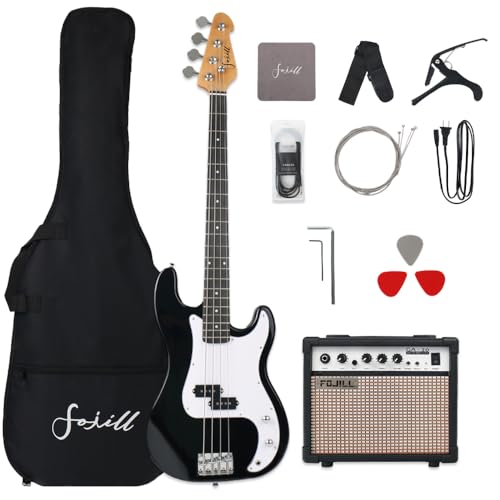

What's inside
- What a starter bass set actually bundles
- The bass: scale length and the size of your hands
- Pickup layouts: split-coil, single-coil and dual-pickup basses
- Necks, nut width, frets and hardware
- The practice amplifier: watts, speaker and honest volume
- Headphones, aux input and the practice features that matter
- Setup out of the box: the work that makes a cheap bass play well
- Tuners: the clip-on in the box and the pedal you may meet later
- Straps, bags, cables and picks under a harder light
- Left-handed packs and the question of playing right-handed
- The upgrade path: strings, then amplifier, then instrument
- Body shapes, balance and comfort standing or seated
- Strings in depth: gauges, materials and lifespan
- The first month: building a practice habit the pack can support
- Faults a beginner can diagnose without fear
- Reading a pack listing like a specification sheet
- Check prices on Amazon
- Choosing the right pack for the player in front of you
As an Amazon Associate I earn from qualifying purchases. This post may contain affiliate links at no extra cost to you.
What a starter bass set actually bundles
This guide is built only from published specifications, manufacturer documents and reference sources, not from hands-on use of any instrument or amplifier. Sizes, layouts and feature claims are drawn from maker documentation and established setup references, so each point can be checked against the paperwork for the exact set you are considering. Readers who buy after following a retail link from this page may generate a commission for this site from that retailer, at no additional cost to them.
A starter bass set, also sold as a bass pack or bundle, wraps a first instrument and the essentials for making sound into one box: an electric bass guitar, a small practice amplifier, an instrument cable, an electronic tuner, a strap, a padded or unpadded gig bag, a few picks, and in some sets a spare set of strings, a stand or a short lesson voucher. The appeal is real. A beginner who buys an instrument alone discovers at home that it makes almost no sound worth hearing without an amplifier and cannot be connected to one without a cable, and the pack solves that first evening completely.
The honest way to judge a pack is to price its parts in your head, not by any figure printed on the box, but by asking which parts you would still choose if you were assembling the kit yourself. In nearly every pack the bass itself is a genuine instrument built on the same production lines as the maker’s standalone entry models, and the amplifier is a real, if small, practice amp. The economies hide in the accessories. The strap may be a thin woven strip with unfinished ends, the cable short and prone to crackle, the gig bag little more than a dust cover, and the tuner occasionally a basic model with a slow response. Knowing this in advance turns disappointment into a plan: play the pack as it arrives, then upgrade the weak links in a sensible order.
Manufacturers build packs around their best-known beginner basses because the instrument is the part that stays. Amps get outgrown when a player joins a band, straps and bags get replaced as taste and travel demands grow, but a decent first bass can serve for years as a backup or a modding platform. That is why this guide spends the most words on the bass itself, the next most on the amplifier, and treats the accessories as a checklist to be scored quickly rather than agonised over. A pack whose instrument is right and whose extras are flimsy is a better buy than a pack with a plush bag wrapped around a bass with a poor neck.
One more expectation is worth setting. A pack bass is set up at the factory to a general standard, shipped across climates, and stored in a warehouse, so it will almost certainly benefit from the setup work described later in this guide. Budgeting attention, if not money, for that setup matters more than stepping up a tier within the same maker’s pack range, because the tiers usually differ in finish and bundled extras far more than in the playability of the instrument once it has been adjusted properly.
The bass: scale length and the size of your hands
Scale length is the vibrating length of the string, measured from the nut to the bridge, and it shapes both the feel and the sound of a bass more than any other single specification. The full-size standard, settled decades ago and used on the great majority of basses, is 34 inches. On a 34-inch bass the frets are spaced for adult hands at full stretch, the strings carry enough tension to speak with a firm, clear fundamental, and the instrument balances like the classic designs it descends from. Most starter packs are built around this scale because most players, including teenagers, adapt to it within weeks.
Short-scale basses shorten that length to 30 inches, give or take a fraction, and the difference is larger in the hands than the numbers suggest. The first frets sit noticeably closer together, stretches that span four frets become comfortable for smaller hands, and the whole instrument feels less like furniture and more like a guitar. The trade-offs are physical rather than imaginary: shorter strings at the same pitch run at lower tension, so they feel looser, can sound warmer and rounder with less top-end snap, and demand a slightly gentler right-hand attack to avoid rattling against the frets. For children, smaller adults, and guitarists doubling on bass who want familiar dimensions, a short-scale pack is often the difference between practising and not practising.
Between the two poles sit a few medium-scale designs around 32 inches, less common in packs but worth knowing about so a listing does not confuse you. What matters at buying time is matching scale to the player honestly. Measure nothing elaborate: if the player can comfortably stretch from the first to the fourth fret position on a friend’s full-size bass, 34 inches will serve. If that stretch is a strain, short scale removes a daily friction that no amount of enthusiasm fully compensates for. Weight follows scale to a degree, since a shorter neck and often a smaller body reduce the load on a young player’s shoulder across a practice session.
String gauge interacts with scale. Short-scale basses need strings made for their length, wound to the correct speaking length so the tapered ends sit properly at the tuner posts, and fitting full-length strings cut down in haste can leave the thick winding at the nut. Packs that include a spare set sometimes overlook this detail, so check the spare set’s stated scale before relying on it. The point generalises: with a short-scale instrument, every later string purchase must specify short scale, a small discipline that becomes automatic.
Pickup layouts: split-coil, single-coil and dual-pickup basses
The pickup is the microphone of the bass, a magnet-and-coil device under the strings that turns their vibration into the signal the amplifier works with, and starter basses copy three classic layouts. The Precision-style layout uses a split-coil pickup: two half-size coils, one under the two lower strings and one under the two higher, wired so their hum cancels while their combined voice delivers the thick, mid-focused thump that underpins countless recordings. It is a single-pickup design with one volume and one tone control in its classic form, and its simplicity is a feature for a beginner, because every position of the controls sounds usable.
The Jazz-style layout uses two long single-coil pickups, one near the bridge and one nearer the neck, each with its own volume control and a shared tone. Blending them changes the character of the bass considerably: both full gives a scooped, articulate sound with clear highs, favouring the neck pickup warms and rounds the note, and favouring the bridge pickup tightens it into a nasal, cutting growl. The cost of that flexibility is the single-coil’s susceptibility to electrical hum when one pickup is used alone, a faint buzz in rooms with dimmer switches and old wiring that disappears when both pickups are balanced. Beginners who play with headphones notice it most and should know it is normal, not a fault.
Dual-pickup packs now commonly pair a split-coil in the middle position with a single-coil at the bridge, a combination often labelled PJ. This layout gives a first bass two distinct native voices, the round split-coil foundation and the brighter bridge bite, blended with two volume controls or a master volume and a blend. For a player who does not yet know what music they will settle into, that breadth is genuinely useful, and it explains why so many starter instruments have converged on it. Whichever layout a pack offers, the controls should turn smoothly, the pickups should sit secure in their routs, and all four strings should sound at comparable volume, since a string that whispers next to its neighbours points to a pickup tilted too far away on that side.
Pickup height is part of the first setup rather than a fixed factory truth. Raising a pickup toward the strings increases output and bass response up to the point where the magnets begin to pull the string’s vibration out of tune, a warbling effect most noticeable on the lowest string at the highest frets. Lowering it softens and clarifies. The maker’s manual gives a starting measurement from string to pole piece with the string pressed at the last fret, and small screwdriver turns from there let a player season the instrument to taste once the basics are in place. Students who later branch into home recording on a tablet can compare suitable models in best affordable tablets for musicians when that stage arrives.
Necks, nut width, frets and hardware
A bass neck is handled more than any other part of the instrument, and its profile decides whether practice feels inviting or like work. Profile describes the shape of the back of the neck, from slim modern curves that suit smaller hands to fuller, rounder vintage shapes that fill the palm. Specification sheets rarely describe the curve in words a beginner can use, but they do give nut width, the measurement across the fingerboard at the nut, and that number is a fair proxy for how spacious the neck feels. Full-size basses commonly sit between about 38 and 42 millimetres at the nut, with the narrower end typical of Jazz-style necks and the wider end of Precision-style necks.
Fret count and fingerboard radius complete the feel. Most starter basses carry 20 or 21 frets, enough for the overwhelming majority of bass lines ever recorded, and a few carry 24 for players drawn to higher-register work. Radius, the curvature across the fingerboard, is quoted in inches; a smaller radius curves more and can feel cosy for simple lines, while a flatter board suits low action and even string response. None of this needs to be optimised by a beginner. It needs to be comfortable, and the quickest check is simply holding the instrument: the hand should wrap the neck without the thumb straining, and the first-position notes should be reachable without the wrist bending sharply.
Fretwork quality is where cheap instruments historically cut corners and where modern production has improved most. Run a fingertip along both edges of the fingerboard: fret ends should feel smooth, not like a row of tiny hooks waiting for skin. Sight down the board and the fret tops should form an even surface without obvious high spots that will buzz when the action is set low. A single slightly high fret is a routine fix during a professional setup, not a reason to reject a pack, but a board full of sprouting ends in a dry showroom warns that the wood was not well seasoned or the finishing was rushed.
Hardware is the collective name for the tuning machines, bridge and control fittings, and its job is to hold tuning and intonation without drama. Sealed tuners with a stated gear ratio turn smoothly and resist dust; open-gear vintage-style tuners work just as well and are easier to service. The bridge should offer saddle adjustment for each string’s height and length, with screws that turn without wobbling, and the strings should pass over the saddles in clean, centred lines. Jack sockets on starter basses are often the first hardware to loosen, so a socket that sits tight in its plate or body, and a cable that clicks home positively, are worth ten seconds of checking before the box is carried home.
The practice amplifier: watts, speaker and honest volume
The amplifier in a starter pack exists to make practice audible and enjoyable in a bedroom, and its specification should be read with that room in mind. Pack amplifiers are small solid-state combos, an amplifier and speaker sharing one cabinet, typically rated between 10 and 25 watts and driving a speaker of 6.5 to 8 inches. Those numbers produce more volume than a beginner expects. Bass frequencies need power and speaker area to reproduce at length, so a small combo will not reproduce the lowest notes of the E string with the authority of a stage rig, but at practice distances it delivers a clear, satisfying representation of pitch and rhythm, which is what learning requires.
Wattage figures deserve their reputation for confusion. They describe electrical power, not loudness, and loudness also depends on speaker efficiency and cabinet design, so two amps with the same rating can differ noticeably in a room. What a beginner actually needs is enough clean volume to play along with a phone or a quiet television without the amp straining into distortion, plus a tone that makes the bass sound like itself. An amp that must be run at its limit for ordinary practice will sound harsh and teach the player’s ears the wrong lesson about their own technique, so within the pack world, the larger end of the small-amp range is the safer match for a full-size bass.
Speaker size shapes tone as much as volume. A 6.5-inch speaker in a compact cabinet gives a focused, mid-forward sound that flatters practice and keeps the footprint small on a desk or floor corner. An 8-inch speaker moves more air, extends the sense of low end, and usually lives in a slightly larger cabinet that doubles as a stool-height object in the room. Neither will be heard outside the house at practice levels, which neighbours count as a virtue. The cabinet should feel solid, with corners that are finished rather than raw, because a combo that buzzes sympathetically on certain notes is maddening to diagnose when you are also learning to mute strings.
Controls on a pack amp are deliberately simple: gain or volume, and equalisation knobs that boost and cut bands of the sound. A three-band layout with bass, middle and treble covers everything a beginner needs, and the middle control is the one that most shapes audibility, since adding a little midrange helps a bass line sit clearly against other sounds while cutting it produces the hollow, distant tone that vanishes in any mix. Some amps add a simple shape or contour preset. Treat presets as starting points, learn what each knob does at moderate volume, and remember that the tone in a small room changes with where the amp sits: on the floor against a wall it will sound bass-heavier than on a chair in the middle of the room.
Headphones, aux input and the practice features that matter
Two sockets on a practice amp matter more than any other feature for a beginner’s first year. The headphone output silences the speaker and sends the sound to headphones, which makes late-night practice possible in any household and lets a player hear their own muting and fret noise with unforgiving clarity. Check whether the socket is the larger quarter-inch size, the smaller 3.5 millimetre size, or both, and whether your headphones match or need an adapter, because that small detail decides whether the feature gets used on the first night or postponed indefinitely.
The auxiliary input is the headphone socket’s partner. It accepts a phone, tablet or computer so the player can practise along with songs, lessons and backing tracks, mixing the external sound with the bass. Some newer practice amps receive that signal over a wireless connection instead, which is convenient but introduces a slight delay that is harmless for playback. What matters is having a separate level balance, either a dedicated aux volume or a phone volume that sits sensibly against the amp’s own volume, so neither drowns the other. A metronome or drum pattern built into the amp, found on some models, is worth more than it sounds: rhythm is the bass player’s first job, and a built-in beat removes the friction of setting one up.
Weight and size decide where the amp lives, and an amp that lives within arm’s reach gets used. Pack combos generally weigh only a few kilograms and carry with one hand, which suits bedrooms and shared spaces. Ventilation slots should be unobstructed wherever it sits, and the power supply is either a standard mains cable or, on the smallest models, an external adapter whose lead length determines how far from the socket the amp can perch. A handful of amps in this class can also run from batteries, a pleasant extra for garden practice that should never outweigh tone and the two key sockets when choosing.
A line output or recording output appears on some practice amps and is easy to overlook until the day a player wants to record a lesson performance or send their bass to a computer. It is not essential in a first pack, since inexpensive audio interfaces handle recording duties well later, but its presence extends the amp’s useful life. Players who eventually build a small computer-based setup often compare interface and sound card options in guides such as best pci sound cards for music production once the practice stage gives way to recording.
Setup out of the box: the work that makes a cheap bass play well
A setup is a series of small mechanical adjustments that bring a bass to its best playing condition, and a first setup matters more than the difference between pack tiers because the tiers share the same factories while the setup is unique to your instrument. The sequence professionals follow has a logic: adjust the neck’s relief first, then string height, then intonation, then pickup height, because each step assumes the previous ones are settled. A beginner does not need to perform all of it alone on day one, but understanding what each step does turns a vague feeling that a bass is hard to play into specific, fixable observations.
Action is the height of the strings above the frets, set mainly at the bridge saddles. High action makes every note an effort, slows the left hand and pushes notes sharp when they are pressed hard to the fret; very low action plays effortlessly but buzzes when the player digs in. Between those poles sits a range most players find comfortable, measured in millimetres at a stated fret and given in the maker’s setup guide. Because bass strings are thick and vibrate in a wide arc, bass action is set higher than a guitar’s, and a faint acoustic rattle when playing hard unplugged is normal and disappears through the amplifier. Judging action by amplified sound, not by bedroom silence, prevents endless hunting for a problem that is not one.
Intonation is the adjustment that makes the bass play in tune along the whole neck rather than only on the open strings. Each bridge saddle moves forward or back, lengthening or shortening its string, until the note at the twelfth fret matches the open string’s pitch an octave up, checked with the tuner the pack provides. A bass with poor intonation teaches a beginner’s ear the wrong geography of pitch and makes playing with recordings quietly frustrating, since the bass drifts sharp or flat as lines climb the neck. Of all setup steps, this is the one a new player can learn fastest and verify objectively, because the tuner gives a verdict no opinion can argue with.
The truss rod is a steel rod inside the neck that counteracts string tension, adjusted at the nut end or through the body on some designs, and it sets relief, the slight forward bow that lets strings vibrate without striking the middle frets. Its adjustment is measured in small fractions of a turn with the correct Allen key, checked by holding a string down at the first and last frets and observing the gap midway. This is the step to approach with the most respect: the rod is strong, the neck is wood, and a quarter turn is a large adjustment. Many first setups are best handed to a shop or an experienced player, and there is no shame in that division of labour, since the same professionals also spot the loose jack socket and high fret that a beginner would live with for a year.
Fresh strings complete the picture more often than beginners expect. Pack strings may have sat on the instrument through shipping and storage, losing brightness and intonation stability, and a new set of the correct scale length and gauge restores both. The gauges fitted at the factory, commonly a medium set running from about .045 to .105 inches across the four strings, are a sensible default; lighter gauges ease the left hand at a small cost in fullness, heavier gauges firm up the feel and the low end while demanding more from the fingers and a check of the setup afterwards. Changing one string at a time keeps tension on the neck roughly constant and gives the player a reference for winding the new string neatly onto its post.
Tuners: the clip-on in the box and the pedal you may meet later
The tuner in a starter pack is usually a clip-on model that senses vibration through the headstock rather than listening through a microphone. Clip-ons are ideal for a first instrument: they work in noisy rooms, need no cable, and their displays have become clear and quick. Their weaknesses are a slower response on the lowest string, where the vibration is broad and slow, and a tendency to hesitate between closely spaced readings when the battery tires. Plucking the string gently near the twelfth fret, or sounding its harmonic there, gives a clip-on a cleaner signal and settles the display faster, a trick worth learning in the first week.
Accuracy is quoted in cents, hundredths of a semitone, and any tuner in a current pack is accurate enough for practice and setup work. What separates a pleasant tuner from an annoying one is display readability and how steadily it holds a reading. A tuner that dances wildly teaches the player to distrust it, and a distrusted tuner stops being used, which is how intonation quietly leaves a beginner’s life. If the bundled tuner frustrates, replacing it is one of the cheapest genuine upgrades in the whole pack, and the old one still serves as a spare in a gig bag pocket.
Pedal tuners belong to the stage world a beginner may grow into: they sit in the signal chain, mute the output while tuning, and read the pickup’s signal directly with great stability. No pack includes one, and none should, since the money belongs in the instrument at this level. Knowing they exist completes the map, though, and explains the tuner output found on larger amplifiers. For the first year, the clip-on, used every session until tuning becomes a reflex, is exactly the right tool. Players who also sing or play guitar in the household sometimes end up comparing speaker choices for other instruments, and a guide like best 10 guitar speakers belongs to that later, wider stage of the hobby.
Straps, bags, cables and picks under a harder light
The strap decides whether standing practice is comfortable, and basses are heavier than guitars, which exposes a thin pack strap quickly. Look for width: a strap around two inches wide spreads the load, and a little padding transforms longer sessions. The ends matter as much as the webbing, since the strap button holes are what keep the instrument off the floor; firm leather or reinforced synthetic ends that grip the buttons are the minimum standard. Strap locks, small devices that clamp the strap to enlarged buttons, are a modest later upgrade that many players adopt after the first time a soft strap end slips. Until then, a simple rubber washer over the button, sold for the purpose, is a traditional and effective safeguard.
Gig bag padding is quoted in millimetres and the number predicts protection honestly. A bag with about 5 millimetres of foam is a dust and scratch cover for carrying across a room. Ten millimetres begins to absorb knocks, and bags in the 15 to 20 millimetre range, with a neck support block and a rigid panel, approach real travel protection. Most pack bags sit at the thin end, which is acceptable for home storage and short car journeys laid flat, and inadequate for a boot full of other gear. The zips tell the truth about a bag’s overall quality faster than the fabric does: run them fully both ways, because a zip that catches in the shop will fail at home.
Cable length in packs is usually modest, around three metres, which is enough for a bedroom where the amp sits near the chair, and the cable’s real quality shows in its connectors and its behaviour. A decent cable lies flat rather than coiling into springs, its plugs are moulded or screwed together solidly, and it passes signal without crackling when the player moves or the plug is gently rotated. Cable crackle is the most common first fault in a whole pack, and because a cable is cheap to replace, it should be the first suspect whenever noise appears, tested by substitution before the amp or bass is blamed. A longer, better cable is often the very first upgrade a pack owner makes, usually within the first month.
Picks in a bass pack puzzle some beginners, since many bassists play with their fingers, but both approaches are legitimate and the included picks cost nothing to keep. Bass picks are heavier than guitar picks, commonly a millimetre or more thick, because thin picks flex and click against heavy strings. Fingerstyle gives a rounder attack and is the default in most tuition, while a pick delivers the defined, aggressive edge heard in much rock and punk. A spare set of strings, where included, should be checked for scale length and gauge as described earlier; where it is absent, buying one early is wise, because a broken string without a spare ends practice for days rather than minutes.
Left-handed packs and the question of playing right-handed
Left-handed players face a thinner market, and starter packs are no exception: most makers offer a left-handed version of one or two of their beginner basses, sometimes bundled into a pack and sometimes sold as the instrument alone with the accessories bought separately. A true left-handed bass is a mirror image, with the body contours, controls, nut slots and side dot markers arranged for a player who frets with the right hand and plucks with the left. That mirroring matters beyond comfort. The nut is cut for the thick string to sit on the opposite side, the bridge and pickup orientation follow, and the control layout falls under the correct hand.
Restringing a right-handed bass upside down, the famous improvised solution, works after a fashion but carries compromises a beginner does not need: the nut slots are wrong for the reversed gauges until a technician recuts them, the body contours dig in where they were shaped to clear an arm, the controls sit awkwardly, and the strap button geometry fights the player. For a first instrument bought to encourage practice, the genuine left-handed model, even with a smaller choice of finishes, is the sound purchase. Availability fluctuates, so a left-handed buyer may need to assemble the pack from the instrument plus a separate amp and accessory kit, which the rest of this guide equips them to do with confidence.
Whether a left-handed beginner should simply learn right-handed is a question teachers debate honestly. Some left-handers adapt without difficulty and gain access to every instrument in every shop for life; others find fretting with the dominant hand natural and plucking with it essential to their rhythm. There is no specification that settles it, and a few weeks of trial with borrowed instruments, where possible, teaches more than argument. What should not happen is a left-handed child being handed a right-handed pack by default because it was in stock, with the decision made by inventory rather than by the player.
The upgrade path: strings, then amplifier, then instrument
A good starter pack is bought with its future in mind, and the natural upgrade order follows the parts that limit the player soonest. Strings come first because they are consumables: a fresh, well-chosen set restores brightness, tuning stability and intonation, and experimenting with gauge teaches a player what their hands prefer at trivial cost. Flatwound strings, with their smooth outer wrap, offer a different and legitimate direction, giving a deep, soft attack and an easy glide for the fretting hand that many players fall in love with; roundwounds remain the brighter, more common default. Either way, strings are the cheapest laboratory in music.
The amplifier comes second, because the pack amp’s limits are the ones a growing player meets next: playing with a drummer, even a quiet one, or in a school hall, asks for power and speaker area a bedroom combo does not have. The step up usually means a larger combo with a 10 or 12 inch speaker and power rated for small-group rehearsal, or a separate head and cabinet for players who expect to move around venues. Everything learned on the small amp transfers, including the discipline of midrange and the headphone habit for home. The pack amp retires gracefully to the bedroom rather than being discarded, which is a fair return on its place in the bundle.
The instrument itself comes last, and for a well-chosen pack that day may be years away. When it arrives, the first bass remains useful as a backup, a home for an alternate string type such as flatwounds, or a platform for learning maintenance: pickup swaps, new tuners, a different bridge. Skills grow in that order too, and a player who has set up, restrung and intonated their starter bass reads the specification of a second instrument with completely different eyes. They know their scale, their pickup preference, their nut width and their action, which is another way of saying the starter pack has done its whole job.
Accessories upgrade in the gaps between those milestones: a wider padded strap when standing practice lengthens, a thicker bag when the bass starts travelling to lessons, a longer cable when the room layout demands it, strap locks when confidence makes the player move more. None of these purchases is glamorous and all of them remove a specific friction, which is the correct test for any upgrade. Gear bought to remove friction gets used; gear bought to imitate a hero’s rig often gets stored. Readers interested in how low frequencies behave in the listening room itself, beyond the instrument, can explore best bass response bookshelf speakers for the playback side of the same subject.
Body shapes, balance and comfort standing or seated
Bass bodies in starter packs copy a small family of classic shapes, and the differences between them are ergonomic before they are visual. The Precision-style body carries its upper horn and offset waist in proportions that hang a bass comfortably on a strap and rest a forearm naturally across the top edge. The Jazz-style body is larger and more deeply offset, which many players find settles the instrument lower and shifts the neck outward, changing the angle at which the fretting hand approaches the first frets. Smaller contoured bodies on short-scale models reduce weight and bring everything closer, one more reason younger players take to them quickly.
Balance is the property to test with a strap fitted, because a bass that dives neck-first the moment the hands let go will fight its owner through every practice session. Neck dive comes from a heavy neck and tuners on a light body, and it is cured in design, by body mass and strap button placement, rather than by any effort of the player. Seated, the body should rest on the leg without the player gripping it into position, and the forearm contour, where the top edge is carved away, decides whether the plucking arm works relaxed or perched on a hard corner. These checks take two minutes and predict months of comfort.
Finish and colour are the least consequential choices in the box and the ones most visible in photographs, which is why packs are so often sold on them. A gloss finish is durable and easy to wipe down; a satin finish feels less sticky under a warm hand and shows fewer fingerprints. Beyond that, the colour a player likes is the colour that makes them pick the instrument up, and that effect on practice time is real even if it cannot be measured in a specification table. Choose the shape for the body, then allow the finish to be chosen by the heart.
Strings in depth: gauges, materials and lifespan
The strings fitted to a pack bass are roundwound almost without exception, meaning a core wire wrapped with round wire that gives a bright, textured surface the fingers can feel and faintly hear as they slide. Their gauges are printed on string packets as a set of four numbers, the diameters in thousandths of an inch from the thinnest string to the thickest. A medium set centres on a thickest string around .105; a light set steps down toward .100 and feels easier under both hands, while a heavy set toward .110 speaks with more authority and asks more of the fingers and of the setup, since greater tension pulls the neck further forward.
Winding material colours the sound and the lifespan. Nickel-plated steel, the most common wrap, gives a balanced brightness and is kind to frets. Stainless steel wraps sound brighter and harder, resist corrosion from perspiration better, and wear frets faster over years of use. Pure nickel sits warmer and softer. Coated strings add a thin polymer layer that keeps grime out of the windings and extends the bright period considerably, at a small cost in top-end sparkle and a higher price per set, which for a beginner who changes strings rarely can be a fair trade. None of these choices is permanent, and a first year is exactly the time to sample one variable at a time.
Strings die gradually, which makes their decline easy to miss. The signs are a loss of brightness that equalisation cannot restore, intonation that will not settle at the twelfth fret however the saddles move, and visible darkening or rough patches where the fingers work hardest. At that point the set has given its service. Changing strings is also the natural moment to clean the fingerboard with a dry or barely damp cloth, check that the tuner screws and nut slots are sound, and confirm the new set is the correct scale length before the old set comes off, so the bass is never stranded silent by a simple ordering mistake.
The first month: building a practice habit the pack can support
The equipment in a starter pack supports a simple, effective practice structure, and naming it helps a new player use the box fully. Begin every session by tuning, with the clip-on tuner, because the ritual takes a minute and trains the ear while it protects it. Spend the first block of time on slow, clean single notes and simple patterns, listening for even volume between strings and for the muted thud that means a finger is not pressing close enough behind a fret. The amplifier at moderate volume tells the truth about this work, which is why the practice amp, not the headphone alone, should carry most early sessions.
The aux input earns its place in the second block, playing along with recordings and lessons. Start with songs whose bass lines use few notes and clear rhythms, and value locking in with the drum beat over completing every note of a busier line. The third block is free exploration: turn the tone control, move the plucking hand toward the bridge and then toward the neck, and learn how much of the instrument’s voice lives in the hands rather than the controls. That discovery, that the same bass can sound round or aggressive depending on touch, is the moment a beginner starts becoming a bassist.
Short daily sessions beat occasional marathons for both hands and memory, and the pack’s portability supports them: bass on a stand or in its bag within reach, amp where it can be switched on without rearranging furniture, tuner clipped or in the bag pocket. Soreness in the fingertips is normal in the first fortnight and fades as light calluses form; pain in the wrist or forearm is information about posture, strap height or neck angle, and should be acted on by adjusting the setup of the body, not endured. A teacher, even for a handful of early lessons, can correct in minutes habits that recordings cannot see.
Faults a beginner can diagnose without fear
Most problems in a first year are small, mechanical and already described in this guide, and a calm order of checking finds them quickly. A buzz that appears on one fret only usually means a slightly high fret or a string that has settled lower in its nut slot, and it belongs to a setup. A buzz everywhere usually means the action has dropped, the neck has straightened as the seasons changed humidity, or the player is plucking harder than the setup allows. A hum that stops when a hand touches the strings points to the normal behaviour of single-coil pickups and room wiring rather than a broken instrument, and it is managed by pickup balance and by turning away from interference sources such as dimmer switches and screens.
Tuning that drifts during a session most often traces to new strings still stretching, which settles within days if the strings were pulled in gently at fitting, or to a tuner slipping because its mounting screw or gear has loosened, which a screwdriver settles in seconds. A crackle when the cable moves is the cable until proven otherwise. A note that sounds dead on one string at every fret suggests that string itself has failed internally, and a fresh single string restores it. Working through suspects in order of cheapness and likelihood is the whole method, and it keeps a beginner from returning a healthy pack or paying for repairs that a string, a cable or a quarter turn would have delivered.
Reading a pack listing like a specification sheet
Pack listings compress a lot of claims into a small space, and reading them in a fixed order prevents the eye from being captured by the least important numbers. Start with the instrument lines: scale length, pickup layout, nut width, fret count and the woods named for body and neck, which between them describe the bass you will actually live with. Move next to the amplifier lines: rated power, speaker size, and the presence or absence of the headphone output and auxiliary input, stated plainly rather than implied by a photograph. Only then read the accessory list, counting what is genuinely included against the essentials named at the start of this guide.
Woods deserve a calm word, because listings lean on them heavily. Bodies in this class are commonly poplar, basswood or similar light, consistent timbers, with maple necks and fingerboards of maple, laurel or other stable hardwoods chosen for supply as much as tradition. At starter level these materials are all serviceable, and construction quality, the fit of the neck pocket, the evenness of the fretwork, the cleanliness of the finish at the edges, separates a good example from a poor one far more than the species printed in the table. A familiar timber badly assembled loses to an unfamiliar one well assembled every time.
Model names within a maker’s range usually encode the bundle rather than the instrument: the same bass may appear in a standard pack, a pack with a larger amplifier, and a pack with added lessons or a stand. Comparing those variants is worthwhile, because stepping between them can be the cheapest route to the bigger amp, while stepping to a different bass entirely should be a decision about scale, pickups and neck, not about which box happens to include a thicker bag. Keep the hierarchy straight and the listing becomes a document you interrogate rather than an advertisement you absorb.
Weight deserves its own line in that interrogation, because a bass is worn as much as it is held. Starter basses commonly fall in a band around three and a half to four and a half kilograms, and the difference between the ends of that band is plainly felt across a half hour of standing practice. A heavier instrument is not a worse one; many players prefer the sense of substance and the way a solid body balances against the neck. But for a young player, or anyone with a shoulder or back that complains, the lighter end of the band protects the practice habit, and the listing’s stated weight, checked against the strap’s width and padding, tells you whether the two halves of that equation have been thought about together.
Try, where a shop allows it, to hear the actual pack amplifier with the actual bass rather than a larger shop amplifier, because the pairing in the box is the sound that will fill the practice room at home every day.
Check prices on Amazon
Live listings for the shortlist in this guide are pulled from Amazon below, so prices and availability are always current at the moment you look.


Choosing the right pack for the player in front of you
Bring the decision back to three questions. Who is playing: their hand size and strength point to scale length and nut width, and their handedness points to the correct mirror of the instrument. Where are they playing: a bedroom with thin walls makes the headphone socket and a modest amp the centre of the purchase, while a garage band forming at school argues for the larger end of pack amplifiers. What are they playing, or hoping to play: the music’s typical bass voice nudges the pickup choice, split-coil for a foundational thump, dual single-coils for articulation and flexibility, the combined layout for a bit of both.
Against those answers, score any candidate pack in the order this guide has used. The bass first: scale, neck comfort, fret finish, hardware that holds tune. The amp second: honest practice volume, a headphone output, an aux input, controls that teach rather than confuse. The accessories third, expecting to replace the strap, cable or bag in time and treating a good tuner as a small victory. Then plan the setup, whether by a shop, a teacher or a careful hour at home with the maker’s measurements, because that hour is where a budget instrument becomes a personal one.
A starter bass set is not a compromise to be apologised for; it is the standard doorway into an instrument that anchors every band it joins, and the packs on sale today contain basses more consistent and playable than the instruments many working players learned on. Choose the fit carefully, set the instrument up properly, keep it in tune and in reach, and the rest of the journey, lessons, songs, first rehearsals and first upgrades, follows from the playing rather than from the shopping. The best starter bass set is the one still being picked up, unforced and unhurried, on an ordinary evening a year after it came out of the box.


