Our Top Picks
 Polk Audio Signature Elite ES20 Bookshelf Speaker PairES2014.8 x 8.5 x 13.8 inches17 poundsCheck on Amazon
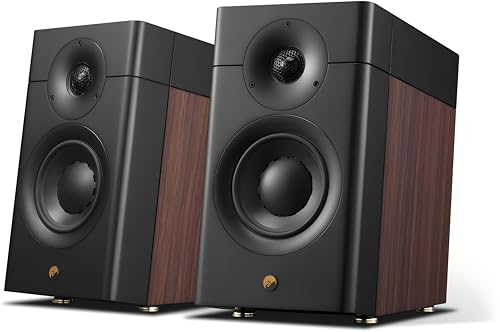 HiVi-Swans D3.1 MKII Passive Bookshelf Speakers14.17 x 8.58 x 14.88 inches48.5 poundsCheck on Amazon
 KEF Q1 Meta Passive Compact Hi-Fi Bookshelf Speakers10.9 x 7.1 x 11.9 inches13.4 poundsCheck on Amazon


What's inside
- How pairing works with an integrated amplifier
- What to look for in passive bookshelf speakers for the 8000A
- The active alternative: Edifier models and the line-level boundary
- Passive or active: settling the question for an 8000A system
- Setup notes for the passive route
- Frequently asked questions
- Our verdict
- Room size, finish, and living with the choice
- Check prices on Amazon
- A note on how this guide earns its keep
As an Amazon Associate I earn from qualifying purchases. This post may contain affiliate links at no extra cost to you.
The Audiolab 8000A is an integrated amplifier, which means it combines a preamplifier and a power amplifier in one box and is designed, first and foremost, to drive passive loudspeakers through its speaker outputs. That single fact organises this entire guide. Six of the eight speakers covered here are passive bookshelf models from Klipsch, Polk Audio, HiVi-Swans, and KEF, and those six are the natural partners for the 8000A: you run speaker cable from the amplifier to the speakers, and the amplifier does the work. The remaining two are active Edifier models with their own built-in amplification, and they belong in a clearly separate section of this guide, because an active speaker does not take its power from the 8000A at all.
That distinction is not a technicality. Connecting equipment in the wrong way wastes money at best, so this guide is explicit about scope throughout. The passive speakers are presented as amplifier-driven choices for the 8000A’s speaker outputs. The active Edifiers are presented only as a line-level alternative: a powered speaker can, in a system that provides a suitable line-level or pre-out feed, receive a signal and amplify it itself. We describe that as a different system architecture, not as a speaker that the 8000A powers, and we do not claim any special fit between the amplifier and the active models beyond that general line-level principle. Readers who keep that boundary in mind will find the rest of the guide straightforward.
Within the passive group, the real questions are about character, size, finish, and room. Bookshelf speakers for an integrated amplifier like the 8000A are typically used in small to medium rooms, on stands or shelves, for a mixture of music and, often, television and film sound in a two-channel setup. The six passive models here include two sizes from Klipsch, two distinct Polk Audio lines, a passive model from HiVi-Swans whose title stresses that it needs an amplifier or receiver to operate, and a compact passive hi-fi model from KEF. Our research describes only what the product titles state, plus general knowledge about how passive and active speakers work, and we do not invent specifications that the titles leave out.
How pairing works with an integrated amplifier
A passive speaker is a cabinet, drivers, and a crossover network, with no amplifier inside. It is entirely dependent on an external amplifier, which is exactly the role the Audiolab 8000A fills. The amplifier sends a powered signal through speaker cable, the crossover divides that signal between the drivers, and the drivers move the air. When people talk about pairing speakers with an amplifier, this is the relationship they mean: the amplifier’s output stage and the speaker’s electrical and acoustic character interacting. Every passive model in this guide, including the HiVi-Swans model whose title says plainly that it needs an amplifier or receiver to operate, is designed for precisely this arrangement.
An active speaker reverses the arrangement. The amplification is built into the speaker, so the speaker needs a line-level signal, the kind of low-level feed that comes from a source or from a pre-out, plus its own connection to mains power. The two Edifier models in this guide are active designs with their own stated power figures and wireless features. They are complete sound systems in speaker form. That is why they cannot be evaluated as if they were passive loads for the 8000A, and why this guide treats them as an alternative architecture for readers whose system includes a suitable line-level output, rather than as speakers the amplifier drives.
Between those two architectures sits the practical middle ground most 8000A owners actually need: a well-chosen pair of passive bookshelf speakers, sensibly placed. Placement does more for the sound of a bookshelf system than most specification differences. Speakers on stands, roughly at ear height when seated, given a little space from the wall behind them, and angled slightly toward the listening position will almost always outperform a theoretically finer speaker crammed into a corner of a bookcase. Keep placement in mind as you read the reviews below, because several of these models are described in their titles with wall use, surround use, or compact placement in mind, and those hints point to different rooms and different setups.
What to look for in passive bookshelf speakers for the 8000A
Start with the basics the titles actually give you. All six passive models here are sold as pairs, which matters because a stereo amplifier like the 8000A needs two speakers for a stereo image, and a pair listing guarantees matched left and right units. Several titles state a two-way design, meaning the sound is divided between two drivers, typically a woofer for bass and midrange and a tweeter for treble. Two of the titles state a 6.5-inch woofer size, which in bookshelf speakers is the larger common format, generally associated with fuller bass and a bigger sound than smaller-woofer models, at the cost of a larger cabinet. One KEF title describes a 2-way bass reflex design, which means the cabinet uses a port to extend the low-frequency output of a compact enclosure.
Finish and form factor are the other honest differentiators in these titles. The passive group spans black finishes, a contemporary walnut finish from Polk Audio, and a walnut brown finish from KEF, so the speakers can either disappear into a dark media setup or sit visibly as furniture. One Polk title positions its speakers as wall speakers to improve television audio in a living room, and the other Polk title describes surround speakers with room-filling audio for home theatre. Those use cases overlap with music use but are not identical to it. A reader building a pure two-channel music system around the 8000A and a reader improving living-room television sound with the same amplifier will weight these models differently, and the reviews below keep both readers in view. Readers comparing wider speaker categories may also find our guide to best 8 ohm bookshelf speakers a useful companion on the passive side.
Klipsch R-51M Bookshelf Speaker, Pair, Black (B07GDSL3NJ)
The Klipsch R-51M is the larger of the two Klipsch models in this guide, sold as a pair in black under the Klipsch bookshelf line. Its title is one of the shortest here, and that brevity itself tells a story: this is a mainstream, established bookshelf speaker that its maker expects buyers to recognise. Within the passive group, the R-51M is the natural starting point for a reader who wants a recognised name, a pair format ready for a stereo amplifier, and a black finish that suits a typical living-room or desk-adjacent setup.
As a passive speaker, the R-51M depends entirely on the amplifier in front of it, which makes it a true 8000A partner in the strict sense of this guide: connect with speaker cable, and the integrated amplifier supplies the power. Klipsch as a brand is generally associated in the wider audio world with a lively, forward presentation, and readers who already know they enjoy that house character will gravitate here, while readers who prefer a more relaxed sound may look harder at the Polk or KEF options below. We make that point as general category context rather than as a measurement of this specific model, since the title offers no performance figures to quote.
The pair format and bookshelf form make placement flexible: stands in a dedicated listening spot, a low media unit under a television, or a sturdy shelf in a study. Because the title gives no dimensions, measure your intended space against the product page details before ordering, as with every speaker in this guide. For an 8000A owner who wants the straightforward, recognised-name route into passive bookshelf sound, the R-51M is the first model to consider.
Polk Audio Signature Elite ES20 Bookshelf Speaker Pair, Contemporary Walnut (B09BMWF1NR)
The Polk Audio Signature Elite ES20 arrives with the most positioning language of any passive model here. Its title describes a bookshelf speaker pair in a contemporary walnut finish, calls the speakers passive speakers for clear sound, frames them as home speakers for movies and music, and adds that they can serve as wall speakers to improve television audio in a living room. That is a deliberate blend of roles: a stereo music speaker for an amplifier like the 8000A that also earns its keep every evening under the television.
The explicit use of the word passive in the title is genuinely helpful in a market where powered and passive models are often listed side by side with similar photographs. There is no ambiguity here about the architecture. The ES20 needs an amplifier, the 8000A is an amplifier, and the pairing works in the standard way through speaker cable. The walnut finish distinguishes it from the black models in this guide and suits rooms where the speakers will be seen as much as heard, on stands or mounted as the title’s wall-speaker language suggests.
For the mixed-use living room, this is arguably the most thoughtfully positioned passive option in the group. Many 8000A systems live exactly that double life: records and streaming through the day, film and television dialogue at night. A speaker whose own title addresses both music and television audio, in a finish designed for a furnished room, matches that reality. Readers whose priority is television clarity within a two-channel amplifier setup should give the ES20 particular attention, and those comparing passive formats more broadly can cross-check our research at best 2 0 passive speakers.
Klipsch R-41M Reference Bookshelf Speakers, Pair, Black (B07FKH3VPV)
The Klipsch R-41M is the smaller sibling in this guide’s Klipsch pair of options, sold as a pair in black under the Reference bookshelf name. Where the R-51M above is the larger model in the line as presented here, the R-41M is the compact route to the same brand and the same passive architecture. That size step is the main decision between them, and it maps onto room size and placement more than onto any difference in purpose.
Smaller bookshelf speakers earn their place in real rooms. A bedroom system, a study, a desk-adjacent setup, or a small flat may simply have no sensible place for larger cabinets, and a compact passive pair driven by an integrated amplifier is a classic answer. The trade-off is equally classic: smaller cabinets generally give up some bass weight and sheer scale compared with larger ones, which listeners may or may not miss depending on their music and their room. Readers who listen at modest volumes in a small space often find the balance of a compact speaker entirely satisfying, because the room itself reinforces what the cabinet cannot do alone.
Like the R-51M, the R-41M is a passive design that the 8000A drives directly through speaker cable, with no additional equipment needed beyond the amplifier and a source. Its black finish and Reference branding keep it visually consistent with the larger model, so a household could even use the two Klipsch sizes in different rooms with a matching look. If your room or furniture dictates a compact cabinet, the R-41M is the Klipsch expression of that requirement in this lineup.
HiVi-Swans D3.1 MKII Passive Bookshelf Speakers (B0FCFG9TTY)
The HiVi-Swans D3.1 MKII states its architecture more plainly than any other product in this guide. Its title describes passive bookshelf speakers as a pair, specifies a 6.5-inch 2-way design for home use, and then adds the unambiguous line that the speakers need an amplifier or receiver to operate. For a guide built around pairing speakers with a specific integrated amplifier, that sentence is a small gift. It confirms, in the maker’s own words, exactly the relationship the Audiolab 8000A provides.
The stated 6.5-inch woofer size places this model in the larger bookshelf format within this group, the format generally chosen by listeners who want the fullest bass a bookshelf cabinet can offer before a subwoofer enters the conversation. The 2-way description confirms the conventional division of labour between a woofer handling bass and midrange and a tweeter handling the top end. Neither figure is exotic, and that is the point: the D3.1 MKII presents itself as a substantial, conventional passive speaker whose requirements and layout are stated without flourish.
HiVi-Swans is a less familiar name to many buyers than Klipsch, Polk, or KEF, and the title leans on specification clarity rather than lifestyle language to make its case. For an 8000A owner who shops by stated facts, that approach is appealing. The model asks only for what the amplifier already does, it states its driver size and configuration openly, and it is sold as a pair ready for stereo use. Among the six passive options here, it is the one whose listing most explicitly describes the amplifier-driven arrangement this guide is about.
KEF Q1 Meta Passive Compact Hi-Fi Bookshelf Speakers, Pair, Walnut Brown (B0DH8GLXLF)
The KEF Q1 Meta carries the most hi-fi language in the passive group. Its title describes passive compact hi-fi bookshelf speakers as a pair in walnut brown, calls the model an entry-level passive hi-fi speaker, specifies a 2-way bass reflex design, and lists music, gaming, television, and movies as its territory. Each phrase does useful work. Passive confirms the architecture for the 8000A. Compact sets the size expectation. Bass reflex explains how a compact cabinet extends its low-frequency reach, through a ported enclosure rather than a sealed one. Entry level positions the model as the accessible step into its maker’s hi-fi range.
KEF’s presence in this guide matters because the brand’s identity is built around dedicated hi-fi loudspeakers, and the Q1 Meta is presented as the doorway into that world. For an 8000A owner whose system is primarily about music, with television and gaming as secondary uses, a compact passive hi-fi speaker in a furniture-friendly walnut brown finish is a coherent centrepiece. The title’s breadth of uses, music first among them, matches the mixed reality of most amplifier-based living-room systems without diluting the hi-fi positioning.
The bass reflex detail deserves a practical note that applies across this category. Ported compact speakers are often designed with some breathing room in mind, and placement very close to a wall can change their low-frequency balance. The general guidance in our earlier section, to give bookshelf speakers a little space where the room allows, applies here. As a passive pair, the Q1 Meta connects to the 8000A in the standard way and asks nothing else of the system. For the music-first reader who wants a recognised hi-fi name in a compact cabinet, this is the passive shortlist’s most focused option.
Polk Audio Monitor XT20 Bookshelf Surround Speakers, Pair, Midnight Black (B09BMVVDX5)
The Polk Audio Monitor XT20 is the second Polk line in this guide, and its title frames it differently from the Signature Elite model above. The XT20 is described as bookshelf surround speakers in midnight black, as passive bookshelf speakers and home theatre speakers with room-filling audio, with a stated 6.5-inch woofer, and as television speakers. The surround and home theatre language is prominent, which raises a fair question for this guide: what is a surround-designated speaker doing in a two-channel amplifier pairing article?
The answer is that a passive speaker does not know what role it is playing. The XT20 is a passive bookshelf pair, and in a stereo system driven by the 8000A it simply works as the left and right speakers, whatever else its title says about surround duty. Its stated 6.5-inch woofer matches the larger bookshelf format discussed elsewhere in this guide, and its room-filling description speaks to listeners who want a bigger, more enveloping presentation from a bookshelf cabinet, particularly for film and television sound. The same pair could later move to surround positions if its owner builds a separate home theatre system, which gives it a second life that purely stereo-positioned models do not advertise.
For the 8000A owner whose listening leans toward films, series, and games as much as albums, the XT20 is a legitimate and flexible passive choice, finished in midnight black for dark media rooms. Readers weighing compact cabinets against larger ones for small spaces may also want to scan best small bookshelf speakers alongside this review. Within this guide’s passive six, the XT20 is the home-theatre-leaning option, complementary to the ES20’s living-room television positioning rather than a duplicate of it.
The active alternative: Edifier models and the line-level boundary
The two speakers in this section are different in kind from everything above, and this guide will not blur that line. Both Edifier models are active bookshelf speakers, which means the amplification is built into the speakers themselves. The Audiolab 8000A does not power them, cannot power them, and should not be connected to them through its speaker outputs. Their inclusion here serves readers who are comparing architectures while shopping around an 8000A-based system: a powered speaker can be used in a setup that provides a suitable line-level feed, such as a pre-out, where the powered speaker receives the signal and does its own amplification. That is the full extent of the relationship, and any product copy suggesting a powered speaker simply plugs into an integrated amplifier’s speaker terminals should be treated with suspicion wherever you encounter it.
Why would a reader consider the active route at all? Because an active speaker is a complete system. It can take signals directly from sources and, in the two models here, from wireless connections, which makes it useful in a second room, at a desk, or alongside a system rather than inside the amplifier’s speaker chain. The reviews below describe each Edifier on its own stated terms, so that readers comparing a self-powered setup against the passive route can see what the active models actually offer.
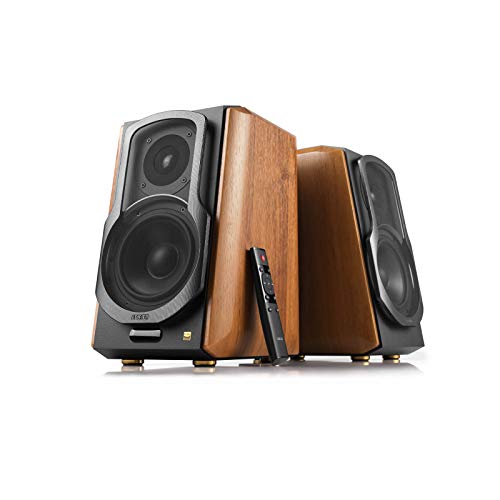
Edifier S1000MKII Audiophile Active Bookshelf Speakers (B07ZVPMR58)
The Edifier S1000MKII describes itself in its title as an audiophile active bookshelf speaker system of two speakers, with a stated 120w figure and Bluetooth 5.0. The word audiophile signals its intended audience: listeners who want a self-powered speaker built for music rather than a casual wireless box. The stated power figure belongs to its internal amplification, which is precisely why it does not draw on the 8000A. In a line-level arrangement, a speaker like this receives its signal at low level and its own amplifier does the rest, drawing mains power directly.
Bluetooth 5.0 gives the S1000MKII a direct wireless path from phones and computers, which is the feature that most clearly separates the active models from the passive six. A passive system plays what the amplifier’s sources provide; an active system with Bluetooth is its own source endpoint. For a reader whose 8000A system is settled and who wants a separate self-contained setup elsewhere in the home, that independence is the attraction. For a reader shopping for speakers for the 8000A itself, this model is not that product, and this guide says so plainly rather than dressing it up as a pairing.
Edifier S1000W WiFi Audiophile Active Bookshelf Speakers (B09NL64VM8)
The Edifier S1000W extends the same active concept into network streaming. Its title describes WiFi audiophile active bookshelf 2.0 speakers as a pair, with a stated 120W RMS figure, a wireless hi-fi Bluetooth sound system, support for Alexa, optical and dual RCA and coaxial inputs, and support for AirPlay 2 and Spotify and Tidal Connect. That is a long list, and nearly every item on it describes a source or a connection rather than a speaker in the passive sense. This is a streaming system that happens to be shaped like a pair of bookshelf speakers.
The input list is the practical heart of the model. Optical, coaxial, and dual RCA inputs let it accept digital and analogue line-level signals from televisions, streamers, and other sources, while the named streaming services and AirPlay 2 support let it pull music from a network without any separate source at all. In the context of this guide, the honest framing is the same as for its sibling: in a system with a suitable line-level or pre-out feed, a powered speaker of this kind can serve as the endpoint, amplifying the signal itself. It is not driven by the 8000A’s speaker outputs, and we claim no designed fit between the two products. Readers who like the idea of powered convenience but want it inside a conventional setup can compare the wider powered category in our guide to best 2 0 powered speakers.
Between the two Edifiers, the choice is about connectivity. The S1000MKII is the simpler Bluetooth-focused model, while the S1000W adds WiFi streaming, voice-assistant support, and a broader input panel. Neither changes the central recommendation of this guide, which is that speakers for the Audiolab 8000A, in the normal meaning of that phrase, are the passive models reviewed above.
Passive or active: settling the question for an 8000A system
If you own an Audiolab 8000A, you already own the amplification, and that fact should drive the decision. Buying passive speakers uses the amplifier you have, keeps the signal path simple, and lets you change speakers or amplifier independently in the future. Buying active speakers alongside an integrated amplifier means paying for a second set of amplification that sits outside the amplifier’s speaker chain, which only makes sense when the active speakers are serving a separate role: a desk, a second room, or a line-level-fed endpoint where their wireless and input features are the point. Neither route is wrong in the abstract, but they answer different questions, and the most common buying mistake in this area is answering the active question with money meant for the passive one.
Within the passive route, the six models divide by emphasis. The two Klipsch models split by size, with the R-51M as the larger pair and the R-41M as the compact pair. The two Polk models split by room role, with the Signature Elite ES20 positioned for living-room music and television in walnut, and the Monitor XT20 leaning toward home theatre scale with its stated 6.5-inch woofer in midnight black. The HiVi-Swans D3.1 MKII states its amplifier requirement and its 6.5-inch 2-way layout with unusual directness. The KEF Q1 Meta is the compact hi-fi entry, ported, walnut brown, and music-first in its stated uses. An 8000A owner can choose from that map by room, finish, and listening habits without needing any specification that the titles do not provide.
Setup notes for the passive route
- Use speaker cable, and keep runs tidy. Passive speakers connect to the amplifier’s speaker outputs. Keep left and right cable lengths broadly similar, and make sure bare wire ends are neat so strands cannot stray.
- Give bookshelf speakers a proper home. Stands are ideal where space allows. On furniture, bring the speakers toward the front edge to reduce reflections from the surface beneath them.
- Mind the wall behind ported designs. Bass reflex models such as the KEF Q1 Meta can sound heavier placed hard against a wall. A little distance usually balances the low end.
- Match the pair to the room, not the other way round. Compact models suit small rooms and nearfield listening; the larger-format models with stated 6.5-inch woofers suit bigger spaces and film sound.
- Keep active speakers on line-level feeds only. A powered speaker belongs on a suitable line-level or pre-out signal and mains power, never on an amplifier’s powered speaker outputs.
Frequently asked questions
Does the Audiolab 8000A need passive or active speakers?
Passive, in the standard arrangement. The 8000A is an integrated amplifier designed to power passive speakers through its speaker outputs, and the six passive models in this guide are built for exactly that connection. Active speakers contain their own amplification and are only relevant here as a separate line-level-fed alternative, not as speakers the amplifier drives.
Can I connect the Edifier speakers to the 8000A’s speaker outputs?
No. Powered speaker outputs must never feed an active speaker. An active speaker expects a line-level signal and its own mains power. The Edifier models in this guide are included for readers comparing architectures or planning a line-level arrangement through a suitable pre-out style feed, and this guide makes no claim of a designed fit between them and the amplifier.
Which passive model suits a living room used for both music and television?
The Polk Audio Signature Elite ES20 states that mixed role most directly in its title, naming movies and music and television audio improvement in a living room, in a walnut finish. The KEF Q1 Meta also lists music, gaming, television, and movies among its uses in a compact passive hi-fi format, while the Polk Monitor XT20 leans furthest toward home theatre presentation. Any of the three fits the amplifier in the same standard way; the choice is about emphasis and finish.
What does the HiVi-Swans note about needing an amplifier mean?
It means the D3.1 MKII is a passive speaker with no built-in amplification, so it only produces sound when an amplifier or receiver drives it. That is not a drawback or an extra requirement unique to that model; it is true of every passive speaker in this guide. The title simply states it openly, which makes the pairing logic with the 8000A especially clear.
Our verdict
For the Audiolab 8000A, start and finish with the passive six. Choose the Klipsch R-51M for the larger recognised-name pair, or the R-41M when the room demands a compact cabinet. Choose the Polk Signature Elite ES20 for a walnut-finished living-room system that splits its life between music and television, or the Monitor XT20 for a home-theatre-leaning presentation with a stated 6.5-inch woofer. Choose the HiVi-Swans D3.1 MKII for plainly stated passive specifications, or the KEF Q1 Meta for a compact hi-fi entry in walnut brown. Treat the two Edifier models as what they are: capable active systems for line-level or standalone use, described here for completeness, and not speakers the 8000A powers. That clear-eyed split is the most useful thing this guide can offer an 8000A owner.
Room size, finish, and living with the choice
Two practical themes run underneath every review above and deserve a direct treatment before any buying decision. The first is room size. Bookshelf speakers are often bought as if the room were an afterthought, yet the room is effectively part of the speaker. In a small room, a compact passive pair such as the Klipsch R-41M or the KEF Q1 Meta will usually sound more coherent at ordinary listening distances than a larger cabinet played at very low level, because the listener sits close and the walls reinforce the low frequencies. In a larger living room, the models with stated 6.5-inch woofers, the HiVi-Swans D3.1 MKII and the Polk Monitor XT20, have the format that generally fills space with more ease, particularly for film sound where effects and dialogue benefit from scale. None of this requires exotic knowledge; it requires honesty about the room the speakers will actually live in, measured in furniture and distance rather than in wishes.
The second theme is finish, which sounds superficial until a pair of speakers has sat in a room for a year. The passive group here offers black in the Klipsch models and the midnight black Polk XT20, contemporary walnut in the Polk ES20, and walnut brown in the KEF Q1 Meta. Black cabinets recede in media setups and match most amplifier-era equipment, including the period styling of an 8000A-based system. Walnut finishes read as furniture and suit rooms where the hi-fi shares space with books, plants, and daylight rather than a television wall. There is no acoustic argument between them in anything the titles state, so choose with your eyes open and your room in mind, because you will look at these speakers far longer than you will read their listings.
Living with the choice also means thinking about what happens next. A passive system grows gracefully: a better source, a subwoofer where a title’s format leaves room for one in your plans, or a future speaker upgrade all slot into the same amplifier-centred arrangement. That upgrade path is one of the quiet reasons integrated amplifiers like the 8000A remain in systems for decades. An active purchase, by contrast, is a finished decision, excellent within its role but not a step on the same ladder. Readers who value the ladder should stay passive for the main system, which is the recommendation this guide has maintained from its first paragraph.
Finally, a word about patience. Speaker and amplifier pairings reward a settled decision more than a restless one. Choose the passive pair that fits your room, finish preference, and listening habits, connect it carefully, place it thoughtfully, and then live with it through a few weeks of varied music and films before judging it. Positions can be adjusted, angles can be changed, and shelves can be rearranged, and those free adjustments often matter more than the gap between one good passive model and the next. The six passive speakers in this guide are all legitimate answers; the best one is the one matched most honestly to the room it will play in.
Check prices on Amazon
Live listings for the shortlist in this guide are pulled from Amazon below, so prices and availability are always current at the moment you look.


A note on how this guide earns its keep
This article contains affiliate links, and if you purchase a speaker through one of them, GizmoVerdict may receive a commission from the retailer at no additional cost to you. That support keeps our research independent and free to read. Speaking of that research: it is drawn from the product titles listed here and from established knowledge of how passive and active speakers work alongside an integrated amplifier. We have not presented listening impressions as if they were measurements, we have reported only the specifications the titles themselves state, and we recommend confirming full details on the retailer’s page before you buy, since line-ups and listings change over time.

