Our Top Picks
 Donner 35-Watt Electronic Drum Amplifier DA-3535W14.2 x 14.8 x 11.8 inches17.6 poundsCheck on Amazon
 Roland PM-100 Compact Electronic V-Drum Set Monitor80W output18 x 19 x 21 inches30 poundsCheck on Amazon


What's inside
- Why an Alesis Nitro Needs a Dedicated Drum Amp
- How to Choose: Power, Size, and Room
- The Products, From Rack-Mounted to Floor Wedge
- Rack-Mounted vs Floor Wedge: The Placement Decision
- Features That Actually Matter for Drummers
- Setting Up Your Nitro With a Drum Amp
- Common Mistakes When Buying a Speaker for Electronic Drums
- Which One Should You Buy?
- Check prices on Amazon
- Frequently Asked Questions
As an Amazon Associate I earn from qualifying purchases. This post may contain affiliate links at no extra cost to you.
The Alesis Nitro is one of the most approachable ways to start playing electronic drums, but it has a built-in limitation that surprises many new owners on the very first day. The module makes the sounds, the pads trigger them, and headphones let you hear them clearly, yet the kit itself does not give a room full of sound the way an acoustic drum set does. Play without headphones and the room mostly hears sticks tapping mesh and rubber, a faint thump from the kick pedal, and the physical noise of the rack. Anyone standing next to you hears very little of the actual kit voice you selected. That is why an external speaker is not an optional extra for most Nitro players. It is the piece that turns private practice into shared playing, lessons into something a teacher can judge properly, and a quiet electronic kit into an instrument that can sit alongside a guitar, a keyboard, or a backing track in the same room.
Choosing that speaker, however, is not the same as choosing any loud Bluetooth box that happens to be in the house. Drums are one of the hardest signals to reproduce well. A kick drum needs low-end weight and a fast attack. A snare needs crack in the midrange and a sharp transient that does not smear. Cymbals need clean high frequencies that stay detailed without turning harsh. Toms move between those extremes in a single fill. A small general-purpose speaker designed mainly for voices, podcasts, and background music will usually compress that range, lose the kick, and make cymbals sound thin or fizzy. A dedicated electronic drum amplifier is built for exactly this job. It pairs a woofer for the low and midrange foundation with a separate path for the highs, it accepts the line-level output from a drum module without fuss, and it is voiced to stay clear when short, loud drum hits arrive one after another.
This guide focuses on that dedicated category. Every product covered here is an electronic drum amp or monitor presented for drum and keyboard use, not a party speaker repurposed by hope. The range runs from compact 20-watt practice amps that sit beside a kit in a bedroom, through mid-sized 30-watt and 35-watt models for larger rooms, to 70-watt and 80-watt monitors that can hold their own as a floor wedge or a rack-mounted solution on the Nitro frame itself. Two of the options come from Alesis and are made specifically for the Nitro family. Others come from Donner, Roland, Coolmusic, and a 30-watt FED30 design, giving you different forms, mounting styles, and connection sets to match how and where you play.
Why an Alesis Nitro Needs a Dedicated Drum Amp
An acoustic kit moves air on its own. An electronic kit does not. The Nitro module is a sound source, much like a keyboard or a media player, and like those devices it needs amplification and speakers to fill a room. Headphones hide that fact because they place tiny drivers directly at your ears, where very little power is needed. Move the same signal into a room and the physics change completely. The sound has to travel, reflect, and compete with the natural stick noise of the kit itself. If the speaker is too small or voiced for the wrong job, the electronic part of the performance disappears behind the tapping, and the player ends up turning up, distorting, and still not hearing the kick properly.
Woofer and tweeter: why one small driver is not enough
The most important design idea in a drum amp is driver separation. Low drum sounds and high cymbal sounds ask opposite things from a speaker. A woofer moves more air and handles the body of the kick, the lower toms, and the weight of the snare. A tweeter, or a smaller dedicated high-frequency driver, handles the fast, delicate detail at the top: hi-hat ticks, ride pings, crash shimmer, and the snap that helps a snare cut through. When a single tiny driver tries to do both jobs, it usually compromises both. The lows become boxy rather than deep, and the highs lose definition just when a fill gets busy.
That is why the specifications in this guide pay attention to driver descriptions given by the makers. You will see a compact rack-mounted Alesis amp with a 3-inch woofer, a floor wedge with an 8-inch woofer, a Donner design described with 2×8 speakers, and a compact Donner model with 3-inch and 0.75-inch dual drivers. Those details matter because they describe how the amp divides the work. A dual-driver layout in even a small cabinet is a sign that the maker expects both kick weight and cymbal detail from the same box. A larger woofer generally suits larger rooms and lower, fuller reproduction, while a smaller woofer in a well-placed near-field position, close to the player, can still work very well for focused practice because the listener sits only a short distance away.
Why a regular Bluetooth speaker usually disappoints
Many players try a household Bluetooth speaker first, and the result is predictable. First, there can be timing delay on a wireless connection intended for music playback, and drumming exposes delay immediately because the stick hit and the sound must feel simultaneous. Second, those speakers are often tuned for pleasing background music, with boosted bass that blurs the kick and limited headroom that flattens snare hits. Third, inputs can be awkward. A drum amp is designed to sit in a playing setup, accept the module signal as its main job, and often add a second path for a phone, keyboard, or backing track. The products in this guide that list wireless audio or Bluetooth describe it as a feature alongside the main drum input, which is the right order of priorities: the kit stays the primary source, and the phone becomes the accompaniment.
How to Choose: Power, Size, and Room
Wattage is the number most buyers look at first, and it is useful as long as it is read as a guide to room size and headroom rather than as a promise of a specific loudness. The models in this guide span 20 watts, 30 watts, 35 watts, 70 watts, and 80 watts as stated in their product names. That spread maps neatly onto real Nitro use cases, from a single player in a small room late at night to a drummer who needs a monitor that can be heard over other amplified instruments.
20 watts: focused home practice
The 20-watt models from Donner and Coolmusic, and the 20-watt Donner dual-driver design, are the natural starting point for home practice. In a bedroom or a small practice corner, the listener sits close to the amp, the room is small, and the goal is clarity at modest volume rather than filling a hall. A compact 20-watt drum amp placed near the kit can reproduce the full kit voice at a level that feels present to the player without pushing sound through the whole house. Portability also matters here. Several of these small models describe themselves as portable, and that suits players who move the kit between rooms, take it to a lesson, or store the amp away when the space has to serve another purpose during the day.
30 and 35 watts: the middle ground for bigger rooms
Step up to the 30-watt FED30 design or the 35-watt Donner DA-35 and the use case widens. A larger living room, a garage practice space, or a room where a teacher sits across from the player all ask for more headroom, meaning the ability to play louder passages without the sound tightening up or losing the kick. The DA-35 also adds a two-channel layout and a DI output in its description, features that point toward more structured setups: a second source alongside the drums, and a way to send a signal onward to another system. The 30-watt model lists recording over OTG and a headphone output, which points toward a modern home setup where practice, recording ideas, and quiet sessions all happen at the same desk or kit.
70 and 80 watts: monitors that can work beyond the bedroom
At the top of this range sit the 70-watt Alesis Nitro Amp, the 80-watt Alesis Nitro Amp Pro, and the 80-watt Roland PM-100. These are monitor-class products. The Alesis Pro is described as a floor wedge monitor, a shape built to project up at the player from the floor while taking up little visual space, and the Roland PM-100 is described as a compact electronic V-Drum set monitor, reflecting Roland’s long-standing approach of matching a monitor to electronic kits. Power at this level is not about playing painfully loud at home. It is about clean headroom, a kick that stays solid when other instruments join, and a monitor that still sounds composed during fast, dense playing. If your Nitro shares a room with a guitar amp or a keyboard, or if you rehearse with others, this is the class to look at first.
- Small room, solo practice, close listening distance: start with the 20-watt compact models.
- Medium room, lessons, or playing along at fuller volume: look at 30-watt and 35-watt models.
- Rehearsing with others, floor wedge monitoring, or maximum headroom: look at 70-watt and 80-watt models.
- Kit stays in one place on its rack: consider the rack-mounted Alesis options before a separate floor box.
- Kit moves often: prioritise the portable models that describe themselves that way.
The Products, From Rack-Mounted to Floor Wedge
The eight products below are the complete set covered in this guide. Each entry sticks to what the maker states in the product name and to widely understood facts about this product category, so you can compare form, stated power, stated drivers, and stated features without guesswork. Read them by use case first and by brand second. The best choice for a Nitro in a small flat is rarely the same as the best choice for a Nitro used in a rehearsal room, even though both players own the same kit.
1. Alesis Nitro Amp — 70W rack-mounted drum amp with 3-inch woofer
The Alesis Nitro Amp is the most kit-specific idea in this guide. It is described as a 70-watt rack-mounted drum amp with a 3-inch woofer, supplied with cables and clamps, and made for the Nitro Max and Nitro Pro as well as the wider Nitro line. Instead of asking you to find floor space for a separate cabinet, it attaches to the drum rack itself. That single decision changes the whole playing experience. The speaker lives inside the footprint of the kit, points at the player from a short distance, and moves with the kit when the rack moves. For a Nitro set up in a corner, against a wall, or in a room where floor space is already spoken for, that matters more than almost any other feature.
Rack mounting also solves the near-field problem elegantly. A small woofer does its best work when the listener is close, and a drummer on the throne is always close to the rack. At that distance, the player hears direct sound before room reflections complicate it, which helps with timing, dynamics, and hearing the difference between a soft ghost note and a firm backbeat. The included cables and clamps, as stated in the product name, also reduce the friction of getting started: the mounting hardware is part of the package rather than a separate puzzle to solve after purchase.
Choose this amp if your Nitro is your main kit, it stays assembled, and you want the tidiest possible setup with no extra box on the floor. It is also a strong answer for shared spaces, because the whole kit, module, and monitor present as one unit. Players who want a big floor-filling sound for rehearsing with a band should compare it with the larger wedge below, but for dedicated Nitro practice and playing at home, the rack-mounted concept is hard to beat for convenience.
2. Alesis Nitro Amp Pro — 80W electric drum amp with 8-inch woofer and floor wedge design
The Alesis Nitro Amp Pro takes the opposite placement approach and adds more of everything stated in its name: 80 watts, an 8-inch woofer, a floor wedge monitor shape, Bluetooth, and EQ, made for electric drum sets. The larger woofer is the headline for sound. An 8-inch driver moves more air than the compact drivers in this guide, which suits the low end of the kick and the body of the toms, especially when the player wants the kit to feel physical in the room rather than simply audible. The wedge shape is equally important. A wedge sits on the floor and angles sound upward toward the drummer, keeping the cabinet low, stable, and out of the way of sticks, stands, and pedals.
Bluetooth, as listed for this model, is best understood as the backing-track path. A phone or tablet can send a song, a lesson track, or a metronome-style practice loop to the amp while the Nitro module feeds the drum sound, so the player hears both together from one well-placed source. EQ gives a further level of control once the amp is in the room, letting the player shape the balance to suit a carpeted bedroom, a reflective rehearsal space, or a corner placement that naturally emphasises bass.
Choose the Nitro Amp Pro if you want the Alesis option built for electric drum sets in general, with the largest stated woofer in the Alesis pair, wedge monitoring, and wireless accompaniment. It suits a kit that lives in one room, players who practise along with tracks every session, and anyone who expects to play with other musicians and needs a monitor that can keep up without being pushed to its limit.
3. Donner DA-35 — 35-watt electronic drum amplifier with 2×8 speakers, two channels, EQ, and DI out
The Donner DA-35 occupies the versatile middle of this guide. Its stated specification is unusually complete: 35 watts, 2×8 speakers, a two-channel layout, three-band EQ, a DI output, and wireless audio, in a black cabinet. Each of those details points to a slightly more developed setup than a basic practice box. Two channels mean the drums do not have to be the only source. A keyboard, a second module output path, or another instrument can share the amp in a structured way, which suits teaching rooms, shared practice spaces, and players who double on keys.
The DI output deserves special attention because it changes what the amp can be part of. A DI out sends a clean signal onward, for example toward a larger PA or a recording path, while the amp itself continues to work as the player’s local monitor. That split role — hear it here, send it there — is a standard idea in live and studio work, and finding it on a 35-watt drum amp makes the DA-35 interesting well beyond its power class. The three-band EQ, covering low, mid, and high shaping in the usual way for this category, lets the player correct the obvious problems in a room: too much boom, a snare that needs more presence, or cymbals that need taming.
4. Roland PM-100 — 80-watt compact electronic V-Drum set monitor
The Roland PM-100 is described simply as a compact electronic V-Drum set monitor with 80 watts. That brevity carries its own message. Roland’s V-Drums line is one of the reference points for electronic percussion, and a monitor built under that banner is designed from the start for the dynamics and frequency range of electronic kits. Although the name references V-Drums, the job it does — amplifying an electronic drum module cleanly in the room — is the same job a Nitro owner needs done, and module outputs do not care which badge is on the monitor.
At 80 watts in a compact monitor format, the PM-100 sits in the same headroom class as the Alesis Nitro Amp Pro. The appeal here is focus. This is a monitor for players who want a single, capable box whose whole purpose is electronic drum monitoring, without needing mounting hardware for a specific rack or a long list of extra features to justify it. In a practice room or rehearsal setup, that kind of single-purpose tool often earns its place by being easy to position, easy to set, and consistent from session to session.
Choose the PM-100 if you value a compact 80-watt monitor from a maker whose name is closely associated with electronic drums, and if your priority is clean, capable monitoring rather than rack integration or the longest feature list. It is a particularly sensible comparison point against the Alesis Pro: both state 80 watts, so the decision comes down to form, features as listed by each maker, and which approach fits your room and kit layout better.
5. Donner Mini Electric Drum Amp DDA-20 — 20W wireless, portable, for home practice
The Donner DDA-20 states its purpose plainly: a mini electric drum amp, 20 watts, wireless, described as an electronic drum amplifier and keyboard speaker, portable, and made for home practice. That combination defines the entry point to this category in the best sense. It is small enough to live beside a Nitro in a bedroom, light in concept enough to move when the room needs to change, and dual-purpose enough to serve a keyboard as well, which helps in households where one small amp is shared between instruments.
Choose the DDA-20 if your Nitro lives in a small space, if you move your setup often, or if you want the simplest route from headphones-only playing to hearing your kit in the room. It is also a sensible first amp for younger players and beginners, where portability and straightforward home use matter more than rehearsal headroom.
6. Coolmusic DM20 — 20W mini electric drum amp, wireless, portable for home practice
The Coolmusic DM20 covers very similar ground to the Donner mini above, and that similarity is useful because it gives buyers a genuine choice within the same clear use case. It is described as a mini electric drum amp, 20 watts, wireless, an electronic drum amplifier and keyboard speaker, model DM20, portable for home practice. Everything in that description points to the same daily reality: a compact box, close to the kit, making home practice audible without headphones and without taking over the room.
Choose the DM20 if you want a portable 20-watt drum and keyboard amp for home practice and its form suits your space. As with the DDA-20, think near-field: short distance, clear line from speaker to player, and volume set for clarity rather than for filling a large room. Used that way, a mini amp changes practice immediately, because dynamics, timing, and kit balance become things you can hear in the air, not just in headphones.
7. Donner Electric Drum Amplifier 20W — wireless Bluetooth, dual drivers, mini rack-mountable
This 20-watt Donner design combines ideas from both ends of the guide in a compact form. It is described as a wireless Bluetooth electronic drum amp with 3-inch and 0.75-inch dual drivers, and as mini rack-mountable. The dual drivers are the sound story. As discussed earlier, separating the low and high work between two drivers is the core technique that lets a drum amp reproduce kick and cymbals at the same time, and here that technique appears in a mini format. The smaller high-frequency driver handles the detail at the top while the 3-inch driver handles the foundation, which is exactly the division a Nitro signal needs.
The mini rack-mountable description is the placement story, echoing the Alesis rack idea at a smaller scale. Mounting or positioning the amp at the rack keeps the sound source close, the cables short, and the floor clear. Bluetooth covers the accompaniment path for tracks and lessons. Together, those stated features make this model a distinctive option among the 20-watt group: same home-practice power class, but with an explicit dual-driver layout and a rack-friendly form.
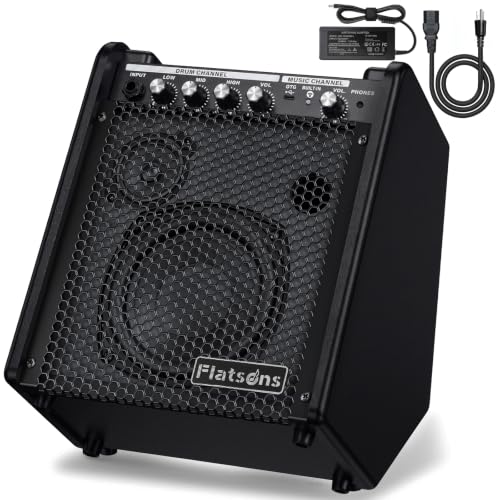
8. FED30 Drum Amp — 30W wireless drum speaker with 3-band EQ, OTG recording, 5.25-inch woofer and 2-inch tweeter
The 30-watt FED30 design has the most detailed driver description in this guide: a 5.25-inch woofer plus a 2-inch tweeter. That pairing makes the woofer-and-tweeter principle concrete. The woofer is sized for the body of the kit in a home or small rehearsal room, and the dedicated tweeter is there for hats, rides, and crashes. For players who have only heard their Nitro through headphones or a single small speaker, hearing that separation in the room is often the moment the kit starts to feel like a complete instrument.
Beyond the drivers, the stated features point toward a connected modern practice routine: wireless audio for backing tracks, three-band EQ for shaping the sound to the room, OTG recording for capturing ideas directly from the setup, and a headphone output for quiet sessions. That last feature closes an important loop. A drum amp with a headphone out lets the same box serve both modes of electronic drumming — loud in the room when the house is awake, silent to everyone else when it is not — without rewiring the kit or changing where you sit and play.
Rack-Mounted vs Floor Wedge: The Placement Decision
Placement shapes what you hear as much as power does, and this guide contains the two classic answers. A rack-mounted amp, like the Alesis Nitro Amp with its included clamps and cables, or the mini rack-mountable Donner, becomes part of the kit. The distance from speaker to drummer is short and fixed, the angle is consistent every session, and there is nothing extra on the floor to trip over or to move before vacuuming. Consistency is an underrated advantage for practice, because it removes one variable: you sit down, switch on, and the monitor sounds the way it sounded yesterday, so changes you hear are changes in your playing or your kit settings, not in speaker position.
A floor wedge, like the Alesis Nitro Amp Pro, uses the stage monitor tradition. The cabinet sits low, in front of or beside the kit, and projects upward. That geometry works well when the player wants more air movement from a larger woofer, when the kit shares the room with other players who also need to hear the drums, or when the amp doubles as a general monitor for an electric drum set beyond one specific rack. A wedge is also easy to reposition: nudge the angle, change the distance, and the balance at the throne changes with it, which can help in awkward rooms.
Features That Actually Matter for Drummers
Three-band EQ: fixing the room, not chasing tone
Several models in this guide list three-band EQ, and it is worth understanding what to do with it. EQ on a drum amp is mainly a correction tool. Rooms add their own character: corners boost bass, hard walls brighten cymbals, soft furnishings soak up highs. Start with the EQ centred and the kit at a sensible volume. If the kick feels boomy and indistinct, ease the low band down rather than turning everything up. If the snare lacks presence against a backing track, a small midrange adjustment usually helps more than raw volume. If crashes feel harsh in a reflective room, trim the high band slightly. Small moves, judged from the throne, keep the kit natural while fitting it to the space. Revisit the settings when you move the amp, because EQ that suited one position rarely suits another.
Bluetooth and wireless audio: the backing-track channel
Bluetooth on the Alesis Nitro Amp Pro and the Donner rack-mountable model, and wireless audio on the DA-35, the DDA-20, the Coolmusic DM20, and the FED30, all serve the same musical purpose: bringing songs, lessons, and practice loops into the same speaker as the drums. Playing along is where timing, dynamics, and musical listening develop, and hearing the track and the kit from one source keeps their balance honest. Keep the track volume slightly under the kit at first so your playing stays the focus, and remember that the wireless path is for accompaniment. The drum module itself should feed the amp by its normal direct connection, keeping the kit sound immediate and free of playback delay.
DI out, OTG recording, and headphone out
Three less common features in this guide each solve a specific problem. A DI output, listed for the Donner DA-35, sends your signal onward to a larger system or recording path while the amp monitors locally, which is the bridge from practice room to bigger rooms. OTG recording, listed for the FED30, offers a direct way to capture practice and ideas, which is valuable because listening back reveals timing habits that are hard to notice while playing. A headphone output, also listed for the FED30, protects the most important feature of an electronic kit: the ability to practise quietly at night. With a headphone out on the amp, late practice uses the same setup, the same seat, and the same kit balance, just delivered privately. For many Nitro owners, night practice is not an edge case; it is half of all practice, and any feature that makes it frictionless will be used constantly.
best sound cards for studio recording
Setting Up Your Nitro With a Drum Amp
Good results start with simple setup habits. Connect the drum module to the amp using the connection path described for your amp, keep cable runs tidy and away from pedals, and set levels in the right order. Start with the module at a moderate output and the amp volume low, then bring the amp up until the kit is clear at the throne. That order keeps the signal clean and leaves headroom for loud accents. If the sound distorts, work backwards: check whether the module output is too hot before assuming the amp is at fault, because a clipped signal stays clipped no matter how good the speaker is.
Position matters next. A rack-mounted amp is largely set by its mounting, but confirm it points toward your head position rather than at a wall or down at the floor. A wedge should aim at the player, not at the ceiling or across the room, and a compact amp on a stand, stool, or shelf beside the kit should sit near ear height if possible, or angle up if it sits low. Then play the whole kit, not just the snare: check the kick for weight without boom, the toms for pitch clarity, the hi-hat for definition at low volume, and the crash for shimmer without harshness. Adjust EQ only after placement is right, because no EQ setting fixes a speaker pointing the wrong way.
Common Mistakes When Buying a Speaker for Electronic Drums
- Buying a general portable speaker for its size or battery and expecting it to reproduce a kick drum and cymbals at the same time.
- Judging by wattage alone, without considering driver size, placement, and the distance between the amp and the player.
- Placing a floor amp behind the kit or pointing it away from the throne, then compensating with volume and EQ.
- Running the module output too hot, clipping the signal, and blaming the amp for distortion.
- Ignoring the quiet-practice path, then discovering that late-night sessions need a separate, awkward headphone arrangement.
- Forgetting the room: a reflective, empty space and a carpeted, furnished room need different EQ and different expectations.
Which One Should You Buy?
For the tidiest Nitro-specific setup, the Alesis Nitro Amp is the standout idea: 70 watts, rack-mounted with cables and clamps included, made for the Nitro family, and designed to disappear into the kit itself. For the most capable Alesis monitor, the Nitro Amp Pro adds an 8-inch woofer, a floor wedge shape, Bluetooth, and EQ at 80 watts, suiting bigger rooms and playing with others. For flexibility in the middle, the Donner DA-35 brings two channels, three-band EQ, DI out, and wireless audio at 35 watts, making it the growth-friendly choice. For a compact monitor with maximum stated power and a single clear purpose, the Roland PM-100 offers 80 watts in V-Drum monitor form.
For small-space home practice, the 20-watt group gives you three distinct flavours: the Donner DDA-20 as a portable wireless mini amp, the Coolmusic DM20 as a portable wireless alternative in the same class, and the Donner dual-driver model if rack-mountable form and separated drivers appeal most. Between them sits the FED30 at 30 watts, with its explicitly stated 5.25-inch woofer and 2-inch tweeter, three-band EQ, OTG recording, and headphone output, for players who want a connected practice hub rather than only a speaker.
Whichever you choose, the upgrade itself is the point. A Nitro heard properly in the room changes how you practise: dynamics become audible, lessons become shared, backing tracks become musical, and the kit takes its place as an instrument in the space rather than a silent frame with headphones. Pick the form that fits your room, the power that fits your playing company, and the features that fit your routine, and the speaker will stop being an accessory and start being part of the kit.
Check prices on Amazon
Live listings for the shortlist in this guide are pulled from Amazon below, so prices and availability are always current at the moment you look.

Frequently Asked Questions
Is 20 watts loud enough for an Alesis Nitro?
For close-range home practice in a small room, the 20-watt models in this guide are designed for exactly that job. Loudness at the throne depends on distance and placement as much as on the stated power, and a compact amp placed near the player can be clear and satisfying without needing rehearsal-room headroom. If you play with other amplified instruments, step up to the higher-powered monitors.
Should I choose a bigger woofer?
A larger stated woofer, such as the 8-inch woofer in the Alesis Nitro Amp Pro, generally suits fuller low-end reproduction in larger spaces. Smaller drivers in rack-mounted or near-field positions work well because the player sits close. Match the driver and form to the room and distance rather than chasing the largest number.
Do I still need headphones if I buy a drum amp?
Yes, for quiet hours you will still want a headphone path, whether through the module or through an amp that lists a headphone output like the FED30. The amp covers shared, in-room playing; headphones cover private practice. A complete Nitro setup plans for both from the beginning.
This article is based on published product information and manufacturer specifications for the models listed, including their stated power, driver, mounting, and feature descriptions, together with general knowledge of the electronic drum amplifier category. This site has not directly used or tried the products in person, and no first-hand usage claim is made for any model covered here. Specifications and included items can change, so check the current listing for the exact model before buying.

