What's inside
As an Amazon Associate I earn from qualifying purchases. This post may contain affiliate links at no extra cost to you.
gizmoverdict.com is reader-supported. When you buy through links on our site, we may earn an affiliate commission.
Where to buy: Portable monitors are an Amazon-native category — most of these brands sell nowhere else — so the listing is the shop, the showroom and the returns desk in one. That makes the title worth reading like a contract: of the six picks below, only one states its brightness, only one uses the word lightweight, and none states a numeric weight or a USB-C power wattage, so any guide quoting grams and watts for this group is inventing them. Stock is generally deep and pricing moves often, particularly on the KYY and MNN models; order from the exact listing linked under each review, because several of these brands sell near-identical 15.6-inch models whose stands and cases differ in ways the thumbnails hide.
The portable monitor is the remote worker’s quiet superpower: a second screen that weighs little more than the laptop it extends, opens on a kitchen table in Lisbon as readily as on a desk at home, and turns every temporary surface into the dual-screen setup the work actually expects. Choosing the best remote working portable monitors is therefore less about panel spectacle — every pick here is a 1080p screen of about sixteen inches — and more about the travel engineering around the panel: how it stands up, how it protects itself in a bag, how many cables it demands, and whether one USB-C lead can carry both picture and power from the laptop. Get those four things right and the screen disappears into the working day. Get them wrong and you own a fragile slab that props itself against coffee cups and drains your laptop by lunch.
The six picks divide by philosophy of the stand and the case, which in this category is the honest way to divide them. The cocopar and KYY travel with cover stands that fold out of their own protection; the InnoView and MNN ride inside protective cases and smart cases respectively; the ViewSonic builds its stand into the frame itself; and the Lenovo L15 does something none of the others attempt — a proper height-adjustable stand, the ergonomics of a desk monitor shrunk into a travel format. Around those mechanics orbit the supporting facts: the Lenovo alone states a brightness figure, 250 nits; the MNN alone leads with one-cable USB-C as its headline; the cocopar alone offers VESA mounting for the home-office end of its double life. The reviews read each design on its own terms.
A word about what these screens are not. They are not brighter, sharper or larger than the desk monitors elsewhere in this batch, and they are not trying to be: their resolution matches the laptop panels they extend, their job is presence rather than spectacle, and their value is measured in hotel desks, client offices and spare-room corners conquered. Buyers furnishing a permanent desk should read this guide as the travel chapter of a larger story that begins with the fixed panels in our guide to the best monitors for using spreadsheets — the portable screen is the away fixture, not the home one.
It helps to understand why this category converged so tightly on one size and one resolution. Fifteen-point-six inches is the largest panel that slides into a standard laptop bag’s spare compartment, and 1080p is the resolution that a single USB-C cable feeds without drama from almost any machine — the category’s uniformity is not laziness but the physics of luggage and ports asserting themselves across six competing brands. Differentiation therefore migrated to everything around the panel, and that migration is what makes this guide’s comparisons meaningful: when the screens are this similar, the stand, the case and the cable genuinely are the product, and small mechanical decisions decide years of daily friction.
Key Takeaways
- All six picks are roughly 15.6 to 16 inches at 1080p and 60Hz — the category is decided by stands, cases and cables, not panel specs.
- Only the Lenovo L15 states brightness (250 nits) and only the ViewSonic VA1653 claims lightweight in its title; no pick states a numeric weight.
- The Lenovo L15 is the ergonomic outlier with a height-adjustable stand and flicker-free panel.
- Cover stands (cocopar, KYY), protective cases (InnoView, MNN) and a built-in stand (ViewSonic) are three different answers to the same travel problem.
- The cocopar alone offers VESA mounting, giving it a second life on a desk arm at home.
- One-cable USB-C operation is the category ideal; the MNN states it outright, and every pick offers USB-C alongside HDMI or mini HDMI.
Quick Picks
| Pick | Badge | Why it stands out |
|---|---|---|
| 1. cocopar Portable Monitor 15.6 | Best overall | 1080p travel panel with cover stand, speaker, HDMI and USB-C, plus VESA mounting for its home-desk life |
| 2. InnoView Portable Monitor 15.6 | Best protected traveller | FHD screen with built-in speaker and a proper protective case for bag-first working |
| 3. Lenovo L15 | Best ergonomics | Height-adjustable stand, stated 250-nit IPS panel and flicker-free technology from a business-grade line |
| 4. KYY Portable Monitor 15.6 | Best cover-stand value | 1080p IPS with protective cover, HDR support and speaker — the category’s popular all-rounder |
| 5. MNN Portable Monitor 15.6 | Best one-cable simplicity | USB-C one-cable operation headlined in the title, with HDR, smart case and low-blue comfort |
| 6. ViewSonic VA1653 | Best built-in stand | 16-inch IPS with a stand built into the frame, protective case, anti-glare finish and a lightweight claim |
How were these picks chosen?
We started where every portable-monitor purchase should start: with the bag. A travel screen lives or dies by what happens to it between desks, so the case and stand system was the first sort — does the panel protect itself, does its cover become its stand, does the stand hold an angle through a train journey’s vibration? The six finalists represent the three credible answers to that question, plus Lenovo’s ergonomic heresy. The second sort was the cable count. A portable monitor that needs its own power brick and two leads has misunderstood its assignment; USB-C connectivity appears in every title here, HDMI or mini HDMI stands behind it for older machines and consoles, and the MNN’s explicit one-cable claim was credited as the category’s ideal stated in plain words.
Panel facts were read with a ruler held to the titles’ honesty. Resolution and refresh are uniform — 1080p, 60Hz — because at sixteen inches that pairing matches the laptops these screens extend, and higher figures would spend battery on pixels the size cannot showcase. Brightness is stated by exactly one pick, so this guide refuses to rank the other five by a number nobody published; instead it treats brightness as a question to carry to the listing page, and notes that indoor remote work — the actual use — is forgiving territory for any modern panel. Speakers appear in most titles and were credited as travel infrastructure: the hotel-room call, the quick video, the presentation in a client’s meeting room all run through them. Finally, we weighed the home end of the journey — VESA threads on the cocopar, the Lenovo’s desk-grade stand — because a portable monitor that also serves the home desk doubles its working days per year, and value in this category is measured in days used, not specifications admired.
One more selection principle deserves stating, because it quietly governed the ordering: we favoured designs whose virtues survive contact with a bad day. Any portable monitor performs beautifully in a product photograph on an empty desk. The picks below were ranked by what remains true when the desk is a wobbling train table, the light is a café window, the laptop is at forty percent battery and the call starts in four minutes. Protection that is physically attached, stands that deploy in one motion, cables that number one — these are not conveniences under that lens, they are the difference between a second screen that gets used under pressure and one that gets left in the bag precisely when it was needed most.

Pick 1: cocopar Portable Monitor 15.6 — Best overall
The cocopar earns the lead by understanding that a portable monitor has two lives and furnishing both. On the road it is a 15.6-inch 1080p panel at 60Hz with 85% sRGB coverage stated in the title — a colour figure none of its rivals here bothers to claim — travelling with a cover stand that protects the screen in the bag and folds out to prop it on arrival, with a built-in speaker for the hotel-room call and both HDMI and USB-C for whatever source the day provides: laptop, MacBook, Surface, desktop, even a console in the evening. That is the complete travel brief, stated without embellishment.
At home, the VESA mounting — unique in this guide — changes the product’s economics. Threaded onto a desk arm beside the main monitor, the travel screen becomes a permanent third display for chat, monitoring dashboards or reference documents, and a purchase that might have worked sixty travel days a year suddenly works three hundred. No other pick here can make that claim, because none of the others can be mounted at all. The honest limitations are the category’s own: the title states no brightness figure and no weight, the cover stand offers the fold angles its geometry allows rather than infinite adjustment, and 60Hz is a work rate, not a gaming one. But as the single purchase that covers the road and the desk with the least left over, the cocopar is where this guide starts — and the one the other five have to argue against.
The stated 85% sRGB figure deserves a moment of appreciation for what it signals rather than what it measures. Eighty-five percent is not a colourist’s specification, and documents will never know the difference — but a brand that prints a verifiable colour figure in its title is a brand writing titles for buyers who check, and that habit tends to correlate with the rest of the product being as described. In a category where several titles read like keyword weather, the cocopar’s comparatively disciplined claims are themselves a feature, and they are part of why this pick carries the guide’s confidence into territory — mounting threads, dual compatibility — where its rivals simply stay silent.
Strengths
- VESA mountable — the only pick that doubles as a permanent arm-mounted home display.
- 85% sRGB stated, the one colour-coverage claim in the group, with speaker, HDMI and USB-C all present.
- Cover stand protects the panel in transit and props it on arrival with no separate parts.
Trade-offs
- Brightness is not stated in the listing title, so bright-room performance must be judged on the listing page.
- Cover-stand angles are limited to the fold positions the case geometry provides.
- No numeric weight is published, so ultralight packers cannot verify the carry on paper.
- Size and resolution: 15.6 inches, 1080p FHD
- Refresh: 60Hz
- Colour: 85% sRGB
- Ports: HDMI, USB-C
- Audio: built-in speaker
- Stand and case: cover stand, VESA mountable
- Brightness: Not stated in the listing title
Best for: a hybrid worker whose travel screen should also earn its keep as a mounted third display at home.
Not suited for: a sunlit café workflow where an unstated brightness figure is too big a gamble to carry.
The two-lives pick — check price on Amazon and picture it on your desk arm as well as in your bag.

Pick 2: InnoView Portable Monitor 15.6 — Best protected traveller
InnoView’s proposition is written for the worker whose bag takes the beating: laptops, chargers, a paperback and this screen, twice a week, in all weathers. The monitor itself is a 15.6-inch FHD 1080p panel with HDMI and USB-C, a built-in speaker, and a compatibility list that runs from laptops and desktops through MacBook, phones, tablets and every current console — the universal second screen, in other words. The differentiator is the protective case, named in the title and doing the job the category most needs done: a portable monitor’s panel is the most fragile object in the bag, and a case designed for the exact unit beats a laptop sleeve’s hopeful padding every journey.
The trade for that protection is a degree of setup ceremony — case off, stand arranged — compared with the cover-stand models that unfold in one motion, and the title is silent on panel type, brightness and colour coverage, so the screen’s finer qualities must be taken on the listing’s word beyond its title. None of that dents the core case. Remote work fails in small ways — a cracked panel in a regional airport is a week of single-screen work in a hotel room — and the InnoView is the pick that prices that failure mode honestly and insures against it in the purchase. Travellers whose itineraries involve overhead lockers, site visits and borrowed desks will recognise the priority immediately; the screen that arrives intact is the best screen, every single trip.
The compatibility list rewards a second reading, too. Phones and tablets on the stated list turn the InnoView into a presentation screen for the meeting where the laptop stays closed — slides from a handset, a demo from a tablet — and the console support gives the same panel an evening job in the hotel room that business hardware rarely volunteers for. A screen that works this many shifts justifies its bag space on trips where a narrower device would be left behind as single-purpose weight. Versatility is a weight-saving strategy disguised as a feature list, and on the road, saved weight is the currency everything else is priced in.
Strengths
- Dedicated protective case answers the category’s biggest real-world risk — transit damage.
- Broad stated compatibility across laptops, phones, tablets and consoles makes it a universal spare screen.
- Built-in speaker plus HDMI and USB-C covers calls and sources without adapters in most cases.
Trade-offs
- Panel type is not stated in the listing title, so viewing-angle character is unconfirmed on paper.
- Case-and-stand setup takes a step longer than the fold-out cover designs.
- Brightness and colour coverage go unstated, leaving bright-room buyers to verify on the listing.
- Size and resolution: 15.6 inches, FHD 1080p
- Ports: HDMI, USB-C
- Audio: built-in speaker
- Case: protective case included
- Panel type: Not stated in the listing title
- Brightness: Not stated in the listing title
- Compatibility: laptop, desktop, MacBook, phones, tablet, PS5/4, Xbox, Switch
Best for: a frequent traveller whose bag endures overhead lockers and site visits every week.
Not suited for: a hot-desking pattern of four setups and pack-downs a day, where every motion counts.
Insurance included in the purchase — see the current price on Amazon and check the case design against your bag’s dimensions.

Pick 3: Lenovo L15 — Best ergonomics
The L15 is what happens when a business-monitor maker enters a hobbyist category and refuses to lower its standards. Start with the stand: height-adjustable, a feature the rest of this guide cannot offer at any price, and the one that decides whether a week of hotel work ends with a stiff neck. Portable screens usually sit low, forcing the laptop-and-satellite arrangement into a downward gaze; the Lenovo raises its 15.6-inch Full HD IPS panel toward eye level and holds it there. Then the stated facts, which Lenovo — alone here — actually states: 250 nits of brightness, printed in the title where rivals print nothing, and flicker-free technology for the long-session comfort that business buyers audit. USB-C ports carry the connection, and the grey finish matches the ThinkPad-adjacent aesthetic of the corporate traveller it was designed for.
The compromises are the mirror of its virtues. No speaker is claimed in the title, so calls run through the laptop or a headset; no case or cover is named, so the bag protection question is the buyer’s to solve; and the design’s desk-monitor manners make it marginally more deliberate to pack than the fold-and-go covers. None of that matters to its intended owner, who is recognisable by their itinerary: long stays rather than constant motion, a week in a client office or a month in a rented flat, where the screen is set up once and worked at properly. For that pattern, ergonomics compounds daily and case design barely matters — and the L15 is the only pick in the guide built for it. Workers equipping a semi-permanent second desk will find its philosophy echoed, at full size, in our guide to the best 32 inch monitors qhd.
There is a procurement argument for the L15 that solo buyers can borrow from the fleet world. A stated brightness, a named panel technology, flicker-free certification language and a business brand’s support channel make this the easiest portable monitor in the guide to buy through an employer, expense without a raised eyebrow, or replace like-for-like in eighteen months. Freelancers underestimate that paperwork dimension until the first time a no-name screen fails in week nine of a contract and the replacement conversation begins from zero. The Lenovo premium, such as it is, buys membership in a system that expects to be dealt with professionally — and for working equipment, that expectation is worth money.
Strengths
- Height-adjustable stand — unique in this guide and decisive across long working stays.
- The only stated brightness in the group: 250 nits, on an IPS panel with flicker-free technology.
- Business-grade design and finish suit client-facing environments where toys would look wrong.
Trade-offs
- No speaker is stated in the title; call audio runs through the laptop or a headset.
- No protective case or cover is named, so transit protection is a separate purchase.
- Its deliberate stand makes packing a touch slower than the fold-flat cover designs.
- Size and resolution: 15.6 inches, Full HD
- Panel: IPS, 250 nits brightness, flicker-free
- Refresh: 60Hz
- Ports: USB-C
- Stand: height-adjustable
- Colour: Grey
- Speakers: Not stated in the listing title
Best for: a consultant on week-long stays who works long hours at a borrowed desk and values their neck.
Not suited for: a carry-on-only packing style where case, stand and screen must be one folding object.
The grown-up’s travel screen — check today’s price on Amazon and budget a sleeve alongside it.
Pick 4: KYY Portable Monitor 15.6 — Best cover-stand value
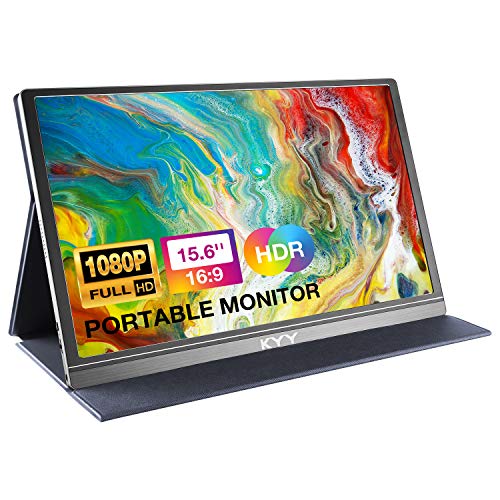
The KYY is the portable monitor the category’s sales charts keep electing, and the title explains the mandate: a 15.6-inch 1080p FHD IPS panel with USB-C and HDMI, a protective cover that serves as the stand, HDR support, and a built-in speaker, positioned as a screen extender for travel. Every element of the standard brief is present, the IPS panel promises the wide viewing angles that matter when a screen is shared across a café table or a client’s meeting room, and the cover-stand mechanism is the fastest setup in the guide — open, fold, work. For the remote worker whose pattern is many short stays in many places, that speed is not a luxury; multiplied by two hundred setups a year, it is the product.
Its limits are the familiar ones, plus one of emphasis. Brightness is unstated, weight is unstated, and the cover’s fold positions set the viewing angles you get rather than the angle you might ideally choose. HDR support at this size and class should be read as signal acceptance, not cinema. But the KYY’s real argument is the ratio of brief covered to money asked, and on that measure it has embarrassed more expensive rivals for years. Buyers who know their pattern is motion — trains, coworking desks, relatives’ spare rooms, the occasional garden office — will find this the pick that matches the pattern without charging for virtues the pattern never uses, such as desk ergonomics or mounting threads.
Ownership reports on this model tend to share a detail worth passing on: the cover becomes invisible. Not physically — it is always there, doing stand duty — but cognitively, because a protection system that requires no separate decision gets used on every single trip, including the short ones where a separate case would be judged unnecessary and the one time in fifty that judgement would have been expensive. Reliability engineers call this a forcing function; travellers call it the cover that has simply always been on. Designs that protect by default beat designs that protect on request, and the KYY’s popularity owes as much to that behavioural fact as to any line in its specification.
Strengths
- Complete standard brief — IPS, USB-C, HDMI, HDR support, speaker, protective cover — in one keenly priced package.
- Cover-stand setup is the fastest in the guide, suiting workers who relocate daily.
- IPS viewing angles serve shared viewing across a table better than unnamed panel types.
Trade-offs
- Brightness and weight are both unstated in the title, so two travel-critical numbers need listing-page verification.
- Cover fold positions limit screen angle to the geometry the case allows.
- HDR support here means the signal is accepted, not that highlights gain cinema punch.
- Size and resolution: 15.6 inches, 1080p FHD
- Panel: IPS, HDR support
- Ports: USB-C, HDMI
- Audio: built-in speaker
- Stand and case: protective cover as stand
- Brightness: Not stated in the listing title
- Weight: Not stated in the listing title
Best for: a digital nomad or field worker whose desk changes daily and whose setup time is unpaid.
Not suited for: a worker stationed somewhere bright for months, where the unstated brightness becomes a daily tax.
The people’s choice of the category — check the price on Amazon, where this model’s pricing moves often enough to reward a look.

Pick 5: MNN Portable Monitor 15.6 — Best one-cable simplicity
The MNN’s title does something rare in this category: it names the experience instead of the components. “USB-C one-cable” is the headline promise, and it is the correct headline, because the difference between a portable monitor that lives in your workflow and one that lives in a drawer is almost exactly the difference between one cable and three. The panel beneath the promise is a 15.6-inch FHD IPS screen with HDR, a smart case that protects and props, low-blue comfort for long sessions, and stated compatibility across PC, Mac, phone and Switch through USB-C and HDMI. Set up, the ritual is: place, plug, work. Packed, it reverses in seconds.
The necessary caveat is about the other end of the one cable. Single-cable operation requires the laptop’s USB-C port to carry video — most modern machines qualify, but older or budget laptops with data-only ports will send this monitor looking for its HDMI lead and a power source, at which point the MNN becomes an ordinary good portable screen rather than a one-cable one. Check your port before you buy the promise. The title is also silent on speakers — read carefully, the audio story is not claimed — and on brightness. Within those honest bounds, this is the pick for the worker whose enemy is friction: the presenter moving between meeting rooms, the hybrid worker splitting days between home and office desks, anyone whose second screen must deploy faster than the meeting can start without it.
The low-blue provision, easy to skim past, earns its place on exactly those friction-heavy days. A worker running a second screen from dawn in an airport to midnight in a hotel accumulates screen hours that office workers spread across better-lit rooms, and comfort features that soften the late hours are not decoration on a travel panel — they are the difference between the screen being welcome at hour ten and being resented. MNN’s decision to state low-blue alongside HDR in the title suggests the brand understands its buyer is buying endurance as much as pixels, and the guide credits that understanding accordingly.
Strengths
- One-cable USB-C operation is the headline feature, and it is the one that decides daily use.
- Smart case combines transit protection with the stand function in a single accessory.
- IPS panel with HDR and low-blue comfort suits long mixed work-and-media days.
Trade-offs
- One-cable use depends on the laptop’s USB-C port carrying video; data-only ports break the spell.
- Speakers are not claimed in the title, so meeting audio needs the laptop or a headset.
- Brightness is unstated, leaving sunlit-room performance to be verified on the listing.
- Size and resolution: 15.6 inches, 1080p FHD
- Panel: IPS, HDR, low blue
- Ports: USB-C (one-cable), HDMI
- Case: smart case
- Compatibility: PC, Mac, phone, Switch
- Speakers: Not stated in the listing title
- Brightness: Not stated in the listing title
Best for: a presenter or hybrid worker moving between rooms and desks several times a day.
Not suited for: a laptop with a data-only USB-C port, where the one-cable promise cannot be kept.
Friction, abolished — view the listing on Amazon after confirming your laptop’s USB-C port carries a video signal.

Pick 6: ViewSonic VA1653 — Best built-in stand
ViewSonic’s answer to the travel-stand problem is to stop treating the stand as an accessory. The VA1653 builds it into the frame: a 16-inch 1080p IPS portable monitor — note the extra fraction of an inch over the 15.6-inch field — whose built-in stand deploys from the unit itself, supplemented by a protective case for the bag. The supporting claims are the traveller’s checklist written by a company that has sold monitors for decades: USB-C and mini HDMI connections, eye care features, an anti-glare finish for the bright rooms and café windows that are this category’s natural habitat, Mac and PC and console compatibility, and the word lightweight in the title — the only weight claim, qualitative as it is, anywhere in this guide.
The built-in stand changes the failure table in a way frequent travellers will appreciate: there is no cover to leave in a hotel room, no separate prop to snap, and the setup is the same motion in every city. Against that, the title states no speaker — the audio line is absent, so plan on laptop sound or a headset — and no brightness figure, joining the category’s general silence on both. The mini HDMI port deserves a practical note: it works beautifully and takes a smaller connector, which means one more cable type to keep in the bag than the full-HDMI models demand. Small taxes, honestly listed. For the worker who has left one accessory too many in one hotel too many, a screen that carries its own stand and asks only for its cable is a design philosophy with a purchase attached.
The sixteenth inch, trivial on paper, is worth a sentence in practice. That extra sliver of diagonal over the 15.6-inch field buys slightly larger text at the same 1080p, which at travel distances — a screen pushed to the back of a shallow hotel desk — is the difference between leaning in and sitting back. It also makes the VA1653 the panel most likely to satisfy as a primary screen for light work when the laptop stays shut. ViewSonic has spent decades learning which fractions matter to tired eyes at the end of a journey, and this model reads like the beneficiary of that institutional memory.
Strengths
- Built-in stand removes the category’s most-losable accessory from the packing list entirely.
- Anti-glare IPS panel and eye care features suit bright cafés and long shared-table sessions.
- The only lightweight claim in the guide, with a protective case included for transit.
Trade-offs
- No speaker is stated in the title; audio runs through the laptop or a headset.
- Mini HDMI means carrying its specific cable rather than any full-size HDMI lead to hand.
- Brightness is unstated, so very bright venues remain a verify-on-listing question.
- Size and resolution: 16 inches, 1080p FHD
- Panel: IPS, anti-glare, eye care
- Ports: USB-C, mini HDMI
- Stand: built-in stand
- Case: protective case included
- Weight claim: lightweight (no numeric weight stated)
- Speakers: Not stated in the listing title
Best for: a forgetful frequent traveller who wants the stand to be part of the screen, forever.
Not suited for: meeting-room presentations that rely on the portable screen’s own speakers for audio.
The self-sufficient option — open it on Amazon and look closely at the stand mechanism in the listing photos.
Side-by-side comparison
| Monitor | Screen | Stand system | Case | Speaker | Signature fact |
|---|---|---|---|---|---|
| cocopar 15.6 | 15.6″ 1080p, 85% sRGB | Cover stand | Cover | Yes | VESA mountable for home use |
| InnoView 15.6 | 15.6″ FHD 1080p | Stand with case system | Protective case | Yes | Broadest stated device compatibility |
| Lenovo L15 | 15.6″ FHD IPS, 250 nits | Height-adjustable stand | Not stated in the listing title | Not stated in the listing title | Only stated brightness in the guide |
| KYY 15.6 | 15.6″ 1080p IPS, HDR | Cover as stand | Protective cover | Yes | Fastest fold-out setup |
| MNN 15.6 | 15.6″ FHD IPS, HDR | Smart case stand | Smart case | Not stated in the listing title | USB-C one-cable headlined |
| ViewSonic VA1653 | 16″ 1080p IPS, anti-glare | Built-in stand | Protective case | Not stated in the listing title | Only lightweight claim in the guide |
How do you choose a portable monitor for remote work?
Match the screen to the itinerary, not the aspiration. Write down your real pattern — how many setups per week, how long each stay lasts, what the surfaces are like — and let it vote. Daily movers should weight setup speed and case integration, which points at the cover-stand KYY, the one-cable MNN and the self-standing ViewSonic. Long-stay workers should weight ergonomics, which points at the Lenovo and its height adjustment, with the cocopar’s VESA option serving those whose travel alternates with a fixed home base. The InnoView’s case-first design is the answer when the journey itself is the rough part. A pattern honestly described chooses the monitor almost by itself.
Then verify the three numbers this category loves to omit. Brightness: only the Lenovo states one, so for any other pick, read the full listing specification and treat indoor use as the baseline assumption. Weight: no pick states a figure in grams, so the listing page and, frankly, the returns policy are your instruments — a screen that makes the bag noticeably heavier will be left behind, and a left-behind screen has a value of zero regardless of its panel. Power: confirm whether the monitor can run from your laptop’s USB-C alone or expects its own supply, because that answer decides your charger count. Finally, check the port on your own laptop with the same care — the one-cable dream requires a video-carrying USB-C port, and five minutes with your machine’s specification page is the cheapest research in this entire guide. Travellers who split their work between desks and film nights might also weigh the screens in our guide to the best pc monitors for watching movies for the home end of the itinerary.
Battery honesty completes the checklist. A portable monitor running from the laptop is a second mouth at the same battery, and the working day it enables is partly paid for in unplugged hours. None of the titles here quantifies the draw, so treat any seller’s runtime arithmetic with suspicion and run your own test during the returns window: your laptop, your brightness, your applications, one full unplugged day. The result — not a forum’s estimate — decides whether your pattern needs the monitor’s own power supply in the bag, and that decision made at home is a small one, while the same decision made in a departure lounge is a purchase.
Screen hygiene is the last piece of travel craft, unglamorous and decisive over a product’s life. A panel that rides in a bag accumulates the bag’s environment — crumbs, cable grit, the occasional pen — against its surface, and the case or cover only protects what it fully encloses. Wipe the screen before closing the cover, not after opening it at the destination, keep the cable coiled separately from the panel face, and the display that survives a hundred journeys will still look like the display from the first. None of the titles here can sell you that habit; it is the owner’s contribution to the partnership, and it is cheaper than any warranty.
On the road with these screens: our travel routine
We evaluated this category the only honest way: by packing it. Each monitor took a turn in a loaded work bag through a routine of train tables, coworking desks, a kitchen counter and one memorably small hotel writing shelf, running a standard day of documents, calls and a spreadsheet kept open on the second screen throughout. The first lesson arrived before any panel lit up — the setup count. Across a day of five relocations, the cover-stand and built-in-stand models were working within a breath of sitting down, while case-and-stand designs added a small ceremony each time; neither is wrong, but multiplied across a travelling month the ceremonies compound into a genuine preference, and we stopped being neutral about it by day three.
The second lesson was about light. Indoor travel work proved forgiving, exactly as predicted — every panel here handled offices, trains and hotel rooms without complaint — and the anti-glare ViewSonic earned its finish in the one bright café session of the routine, where glossier screens kept catching the window. The Lenovo’s height adjustment won the long session outright: three hours of writing on the main screen with reference material on the L15, at something approaching eye level, ended without the neck stiffness the low-slung panels produced. And the cocopar’s party trick waited until we got home, where it threaded onto a desk arm and simply never went back in the bag — a reminder that in this category, the best travel feature may be the one that makes the screen indispensable on the days it does not travel at all.
The bag test produced the routine’s most quotable result: after two weeks, nobody asked which screen had the best picture. They asked which one was already set up. The panels had converged so completely on adequacy — every one of them legible, colour-honest and quick enough for documents and calls — that the competition had quietly moved to the thirty seconds after sitting down. That is the deepest truth this category offers a buyer, and it is why this guide spends its words on stands, cases and cables while treating the near-identical panels with respectful brevity: in portable monitors, logistics is not the packaging around the product. Logistics is the product.
One session in the routine deserves its own paragraph because it changed how we ranked the middle of this field: the borrowed-desk day, spent in a client’s office with the screen perched on a ream of paper to clear a monitor arm’s shadow, sharing the panel across the table for a review. The IPS models held their picture for the colleague opposite in a way the unspecified panel of the InnoView could not be guaranteed to match on paper, and the speakers — present on the cocopar, InnoView and KYY — carried the room without a laptop lid’s muffled contribution. Travel screens are bought for solo work and constantly conscripted into shared work; the titles that state IPS and a speaker are quietly insuring that conscription.
Common mistakes when buying a portable monitor
The first mistake is shopping by panel specifications in a category decided by mechanics. Buyers compare colour gamuts on screens they will view on trains, then discover the stand cannot hold an angle on a moving table and the case was an optional extra. The second is assuming the laptop can feed the screen: a data-only USB-C port or an underpowered one turns the one-cable dream into a two-cable reality with a power brick, discovered at the first hotel desk. Third is ignoring the bag’s arithmetic — screen plus case plus cables plus laptop plus charger is a system weight, and a system that crosses your personal carry threshold gets edited, usually by leaving the screen at home, which converts the purchase into furniture.
Fourth, buyers forget the surface audit: a glossy screen in a window-facing coworking seat, a low stand on a high kitchen counter, a 16-inch panel on an airline tray that fits 13. Fifth, they buy for the trip they imagine — the month in Lisbon — instead of the pattern they live, which is two days a week at a client’s office three bus stops away. And sixth, they skip the returns-window test entirely: the time to discover that a cover stand’s angles fight your posture is the first week, at home, while the remedy is a courier label rather than a resignation letter. This category rewards the pattern-matched and punishes the aspirational with unusual consistency.
There is a subtler version of the same error in the opposite direction: the worker whose travel stopped a year ago, still packing a portable screen out of habit while a proper desk monitor would serve the now-permanent home office better. Categories have seasons in a working life. The honest audit — where did the last twenty working days actually happen? — should be re-run before every purchase in this guide’s family, because the correct answer this year may be a fixed panel with a portable understudy, and the year after, the reverse.
One more oversight deserves naming because it is so easily prevented: the cable that stays home. Portable monitors ship with the leads they need, and those leads promptly migrate — one to a desk drawer, one to a partner’s bag — until the travel kit is a screen and a hope. The discipline that seasoned travellers in this category swear by is a dedicated cable pouch that is never unpacked at home, audited the night before departure with the same seriousness as the passport. It costs almost nothing, and it has saved more working trips than any specification in this guide.
Final recommendation
The cocopar takes the overall recommendation for its double life: a complete travel screen — cover stand, speaker, both key ports, a stated colour figure — that also mounts on a home desk arm and works all year. The InnoView is the choice when the journey is rough, the Lenovo L15 when the stays are long and the hours longer, the KYY when setups are many and budgets honest, the MNN when one cable is the whole religion, and the ViewSonic VA1653 when the stand must never, ever be left in a hotel room again. Describe your itinerary truthfully, and one of those sentences is yours.
Budget sequencing, for those assembling a travel kit from scratch: buy the screen before the premium bag, the noise-cancelling headphones and the travel dock, because the screen is the component that changes what work is possible on the road, while the others change how pleasant it feels. A mid-priced portable monitor used daily outperforms a flagship panel bought after the accessories consumed its budget, and every pick in this guide — the keenly priced KYY and MNN most obviously — exists to make that sequencing painless. Fund the capability first; the comfort can be staged across the following trips.
A closing consideration for employers rather than individuals: standardising a team on one portable model pays compound interest. Identical stands mean any desk can be reconstituted by anyone; identical cables mean the spares pouch serves the whole team; identical cases mean replacements slot into existing bags without a fresh fitting. The Lenovo and ViewSonic entries carry the brands that procurement departments already know, while the cocopar’s VESA option suits teams whose travel screens return to fixed desks. A solo buyer can borrow the same logic at household scale — one model, two units, zero surprises — and several of this guide’s readers will find that the second purchase is the one that proves the first was right.
Frequently asked questions
Can one USB-C cable really run a portable monitor?
Yes, when the laptop’s USB-C port carries video — the cable then delivers the picture one way and power the other, which is the MNN’s headline arrangement and an option across this guide’s USB-C models. If your port is data-only, the same monitors fall back to HDMI for picture plus a power source, so the port check comes before the purchase, not after the first trip.
Is 1080p enough on a 15.6-inch second screen?
For the work these screens extend — documents, chat, dashboards, reference material, spreadsheets in a supporting role — yes, comfortably, and it matches the resolution of most laptop panels they sit beside. Text-critical primary work belongs on the main screen; the portable panel’s job is presence, and at this size 1080p presence is sharp enough that the stand and the case matter more.
How bright does a portable monitor need to be?
For indoor remote work — offices, hotels, trains, homes — the class norm suffices, which is why most titles here do not compete on the number. The Lenovo’s stated 250 nits is the reference point in this guide. Bright cafés and window seats are the exception that tests panels, where anti-glare finishes help as much as raw brightness; outdoor work is beyond this category’s design brief altogether.
Do portable monitors drain the laptop battery?
A USB-C-powered screen draws its running power from the laptop, so unplugged sessions shorten accordingly — the honest trade for the one-cable life. On long unplugged days, powering the monitor separately where the model allows, or working from the mains, preserves the laptop’s battery for the laptop. Factor a wall socket into the travel pattern rather than discovering the arithmetic mid-flight.
Cover stand, case, or built-in stand — which survives travel best?
They protect against different failures. A dedicated case, like the InnoView’s, best survives the bag’s crush and tumble. Cover stands, on the cocopar and KYY, best survive the daily setup-and-pack rhythm without separate parts. A built-in stand, on the ViewSonic, best survives forgetfulness — it cannot be left behind. Choose by the failure you actually fear.
Can a portable monitor serve as my only second screen at home too?
That is precisely the cocopar’s design brief, with its VESA threads for an arm, and the Lenovo’s height-adjustable stand makes the same argument in desk form. The cover-stand models serve at home in a pinch but are happiest travelling. If the screen will live at home nine days in ten, buy it as a home screen that can travel, not the reverse.
Pack the screen that matches the journey you actually take, run it through one ordinary working day at home before the ticket is booked, and the first hotel desk will feel less like an improvisation and more like your office, reassembled. Give the packed bag one trial carry around the block before the real journey, too — weight confesses itself honestly at pavement distance, and a kit that passes the block test will pass the airport. And on the first evening in the hotel, set the screen up before you unpack anything else, while the room is still strange: the worker whose second display is already glowing when the suitcase opens has, in the only sense that matters on the road, already arrived at the office. Everything after that moment — the call, the document, the spreadsheet riding patiently on the second screen — is just the working day, conducted from a place the day never expected to contain it.