What's inside
- Key Takeaways
- Quick Picks
- How Did We Choose These Portable Monitors?
- One Cable or Two: How Does a Portable Monitor Actually Connect?
- What Can You Honestly Expect From a 15.6-Inch 1080p Panel on the Road?
- The Six Best Laptop Portable Monitors, Pick by Pick
- How Do the Six Compare on What Their Titles Actually State?
- How Do You Set Up a Second Screen Away From Your Desk?
- What Should You Carry, and How Do You Keep the Screen Alive on the Road?
- What Mistakes Do Buyers Make With Portable Monitors?
- Which Traveller Are You? Matching the Six to Real Itineraries
- Can a Phone or Tablet Be the Computer Behind the Screen?
- How Long Does a Portable Monitor Last, and What Usually Fails First?
- What Should You Check in the First Ten Minutes After It Arrives?
- How Well Do These Screens Work on Trains, Planes and Café Tables?
- Final Recommendation
- Frequently Asked Questions
- Related Guides
As an Amazon Associate I earn from qualifying purchases. This post may contain affiliate links at no extra cost to you.
gizmoverdict.com is reader-supported. When you buy through links on our site, we may earn an affiliate commission.
Where to buy: Every screen below links to its Amazon listing, and in this category the listing check matters more than usual — confirm the size, the panel and the ports on the page itself, because portable-monitor listings have a history of describing one model and shipping the description of another.
The best laptop portable monitors solve a problem every laptop owner recognises within a week of working away from a desk: one screen is never quite enough. The spreadsheet wants to sit beside the email it is summarising. The video call wants its own space so the notes can stay visible. The document being edited wants the source document open next to it. A portable monitor — a slim 15.6 or 16-inch panel that slips into the laptop sleeve, connects over a single USB-C cable when the laptop allows it, and stands on a cover that folds into a prop — gives a laptop the second screen its owner keeps wishing for, in hotel rooms, client offices, kitchen tables and airport lounges alike.
This guide applies a verify-first discipline that this category has earned the hard way. Portable monitors are a white-label-heavy corner of the market where listings have historically been mislabelled — sizes, resolutions and features described loosely or borrowed from a sibling model. So every specification below comes from the pick’s own fetched listing title, and where a title does not state a figure, the article does not invent one. You will find no brightness numbers here except where a title supplies them, and the titles in this pool mostly do not. What the titles do establish is a consistent, checkable core: all six picks are genuine 15.6 or 16-inch portable monitors at 1080p with USB-C and, in most cases, HDMI alongside, differentiated by the honest details their listings actually state — cover and stand styles, speakers, HDR claims presented as claims, and one or two thoughtful extras.
The central technical question runs through the whole guide, so it is worth naming now: one cable or two? A laptop with a USB-C port that carries video can drive most of these screens over a single cable that also delivers power, which is the portable-monitor dream — one lead, no charger, screen on. A laptop without video-capable USB-C, or a phone or console used as the source, falls back to HDMI for the picture plus USB for power: two cables, still portable, slightly less elegant. Each pick below is read against that split, because it decides how the screen will actually live in your bag. Readers whose second screen will never leave the desk should also see our best monitors as second monitor for laptop roundup; this guide is for the screen that travels.
Key Takeaways
- Verify-first is the rule in this category: every specification in this guide is taken from the pick’s own listing title, and unstated figures are left unstated rather than estimated.
- The one-cable question decides daily convenience — USB-C with video from the laptop means a single lead; HDMI sources mean a second lead for power.
- All six picks are 1080p IPS-class panels at 15.6 or 16 inches, so the real differences are covers, stands, speakers and port arrangements, not the headline picture.
- A cover that becomes the stand is the standard design here, and its fold geometry quietly decides how usable the screen is on a shallow hotel desk.
- Built-in speakers on a portable monitor are for calls and video intelligibility, not music — judge them as a convenience, not a sound system.
Quick Picks
| Pick | Badge | Why it earns its place |
|---|---|---|
| MNN 15.6-Inch Portable Monitor | One-cable headline act | Its title leads with USB-C one-cable operation and HDR, with a smart case in the box. |
| KYY 15.6-Inch Portable Monitor | Travel extender favourite | Sold squarely as a laptop screen extender with cover, USB-C and HDMI, HDR and speakers. |
| cocopar 15.6-Inch Portable Monitor | Most complete stated spec | The rare title that states a colour figure — 85% sRGB — plus VESA mounting and a cover stand. |
| InnoView 15.6-Inch Portable Monitor | Console-friendly all-rounder | Names the widest device list, from MacBook to PS5 and Switch, with speaker and protective case. |
| AOC 16T20 16-Inch Portable Monitor | Brand-name polish | A slightly larger 16-inch panel from an established monitor maker, with smart cover and low blue light stated. |
| VILVA 15.6-Inch Portable Monitor | Straightforward value traveller | Cover and speakers with USB-C and HDMI, stated plainly without ornament. |
How Did We Choose These Portable Monitors?
The selection began with verification rather than enthusiasm. Each candidate’s fetched listing title had to establish, in its own words, that the product is a real portable monitor in the 15.6 to 16-inch class, at 1080p, with USB-C connectivity — the three facts a traveller is actually buying. Candidates whose titles could not establish that core were not carried into this guide on the strength of their photographs or their review counts, because this category’s history of mislabelled listings is precisely a history of buyers trusting the picture over the words.
With the verified core established, the ranking weighs what titles state about the ownership details: whether a cover or case is included and what it converts into, whether speakers are built in, which devices the maker names as compatible, and whether any colour or HDR claim is printed — treated always as the maker’s claim, not as a measurement. We also kept the six deliberately close in headline specification. When screens share a size, a resolution and a panel class, the honest guide compares the things that differ in daily use rather than pretending a spec-sheet gap exists. Readers comparing against larger travel options will find our best 4k portable monitors guide covers the sharper, pricier branch of this family; the six here are the mainstream 1080p branch that most laptop bags actually carry.
One Cable or Two: How Does a Portable Monitor Actually Connect?
The dream setup is a single USB-C cable. If your laptop’s USB-C port carries DisplayPort video — most modern thin laptops’ ports do, though not every port on every machine — then one cable from laptop to monitor delivers the picture and the power together. The monitor wakes when the laptop wakes, the desk holds exactly one lead, and packing up is a ten-second job. Several titles in this guide speak directly to that dream: the MNN leads with “USB-C one-cable,” and every pick here includes USB-C among its connections. The check to perform before buying is on your laptop, not on the monitor: confirm that at least one of its USB-C ports supports video output, a fact stated in the laptop’s own specifications and sometimes marked by a small display symbol beside the port.
The fallback is two cables, and it is not a failure — it is how these screens connect to HDMI sources. A games console, an older laptop, many phones in desktop mode: the picture travels over HDMI or mini HDMI, and power arrives over a USB cable from a port or a small charger. The AOC’s title, which names both USB-C and mini HDMI, describes exactly this dual personality. Two cables take slightly longer to set up and slightly more bag organisation, but they unlock the console and legacy-laptop uses that make a portable monitor earn its keep on trips where work and play share the luggage. A practical tip for either route: the cable in the box is the cable to carry. Third-party USB-C cables vary in whether they carry video at all, and the bundled one is the known-good lead.
What Can You Honestly Expect From a 15.6-Inch 1080p Panel on the Road?
Set expectations by the job. At 15.6 inches, 1080p is the same resolution most laptops of that size ship with, so the portable screen feels like a natural extension of the machine it accompanies — text at the same scale, windows at familiar sizes, no squinting and no scaling surprises. IPS panels, which every pick here uses, keep the picture consistent when the screen is viewed at the slight angles a café table imposes, and they make two-person viewing — a colleague pulling up a chair to check a figure — entirely civilised.
Weight and thickness deserve a sentence of expectation-setting too, even though the titles here do not quantify them. Screens in this class are built to disappear into a laptop sleeve: they are a few millimetres of panel and cover, light enough that the decision to carry one is made by the day’s work rather than by the bag’s burden. That thinness is why the handling advice later in this guide is not decoration — the same property that makes the screen effortless to carry makes it the most fragile object in the luggage, and the cover it ships with is part of the product, not packaging to be discarded at unboxing.
What a portable panel is not is a colourist’s reference or a brightness champion. None of the six titles states a brightness figure, and this guide treats that silence honestly: these are indoor screens for ordinary rooms, hotel lighting and office light, not for a sunlit terrace. Colour claims are similarly modest — the cocopar states 85% sRGB in its title, the MNN and KYY state HDR as a feature claim, and the rest make no colour promise at all, which the per-pick reviews respect. For documents, calls, code, dashboards, media and console play, the picture these screens state is entirely fit for purpose. For print-proofing or grading video, the honest advice is to do that work on a calibrated desk monitor and let the portable screen do the travelling it was built for — a division of labour our best senior monitors guide applies in its own way, matching the tool to the eyes and the task rather than to the brochure.
The Six Best Laptop Portable Monitors, Pick by Pick

MNN 15.6-Inch Portable Monitor — One-cable headline act
The MNN’s title is written by someone who understands what buyers of this category are dreaming about, because its central promise is “USB-C one-cable.” Around that promise it assembles the verified core — a 15.6-inch 1080p IPS panel — plus HDR stated as a feature, a smart case included, low blue light mentioned, and a device list that runs from PC and Mac to phone and Switch, aimed at work and game alike. As a statement of what a portable monitor should be in the single-lead era, it is the most complete in this guide.
Read with the verify-first discipline, the title supports a clear picture of ownership. The smart case is the stand-and-protection system, as is standard in this class. The HDR claim is a claim — portable panels interpret HDR signals rather than reproducing a true HDR picture, and the honest expectation is a lively image for video and games, not a grading display. The low blue mention aligns it with evening hotel-room work. What the title does not state — brightness, a colour percentage — we do not supply. What it does state is the thing that matters most at 7 a.m. in a departure lounge: plug one cable into a modern laptop and have a second screen. For the traveller whose laptop supports USB-C video, that is the whole argument, and the MNN makes it most explicitly.
- Size and panel: 15.6-inch IPS, as stated in the listing title
- Resolution: 1080p FHD, as stated in the listing title
- Connections per title: USB-C (one-cable operation stated) and HDMI
- Features per title: HDR stated as a claim, low blue light mentioned, smart case included
- Named devices per title: PC, Mac, phone, Switch — work and game
- Speakers: not stated in the listing title
Strengths
- The one-cable USB-C promise is printed in the title, which is the convenience this category exists for.
- Smart case included, so protection and stand arrive in the same box.
- Device list spans work machines and a console, matching how travellers actually use a second screen.
Trade-offs
- Speakers are not stated, so call audio may fall back to the laptop.
- HDR here is a signal claim, not the picture of a true HDR display — set expectations accordingly.
- No brightness or colour figure is stated, so sunlit-room performance is an unknown.
Best for: modern-laptop travellers who want the single-cable setup above all. Not suited for: buyers who need screen speakers confirmed, or colour-critical work.
KYY 15.6-Inch Portable Monitor — Travel extender favourite
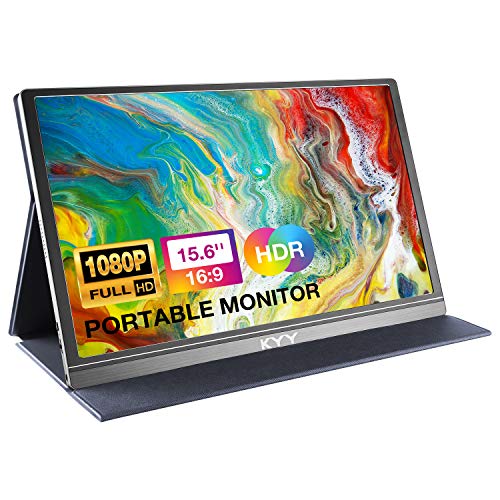
The KYY describes itself with the phrase this category has settled on — a laptop screen extender — and backs the phrase with the expected verified core: 15.6 inches, 1080p FHD, IPS, USB-C and HDMI, a cover included, HDR stated, and speakers named in the fuller title text. That combination makes it the most conventionally complete traveller in the six: nothing exotic, everything present, aimed at the laptop user who works in more places than they have desks.
Its longevity in this market is itself a kind of evidence. Portable monitors churn quickly, with models appearing and vanishing by the season, and a listing that has served the extender role for years has been bought, travelled with and re-bought by the travelling workforce in meaningful numbers — though this guide rests its recommendation on the stated specification, not on popularity. In daily terms the KYY’s pitch is the absence of surprises: the cover stands the screen, the speakers cover call audio, the two connection types cover new and older laptops. If the MNN is the pick that leads with a promise, the KYY is the pick that leads with a track record of the standard package, and for a buyer equipping a small team or replacing a retired unit, that steadiness is a feature.
- Size and panel: 15.6-inch IPS, as stated in the listing title
- Resolution: 1080p FHD, as stated in the listing title
- Connections per title: USB-C and HDMI
- Features per title: HDR stated as a claim, speakers included, cover included
- Role per title: laptop screen extender for travel
- Colour or brightness figures: not stated in the listing title
Strengths
- The complete standard package — cover, speakers, both cable routes — in one established listing.
- Extender positioning matches its real job: a laptop’s second screen, anywhere.
- Speakers are named, which the one-cable MNN’s title does not do.
Trade-offs
- No colour or brightness figure is stated, so critical picture judgements stay with a desk monitor.
- The cover-stand design is the class standard, with the class-standard limited angle choice.
- Nothing in the title distinguishes it for console play beyond the standard connections.
Best for: travelling professionals who want the proven, complete extender package. Not suited for: buyers chasing a stated colour specification or a distinctive stand design.

cocopar 15.6-Inch Portable Monitor — Most complete stated spec
In a category where titles routinely omit the numbers, the cocopar’s title is refreshingly willing to commit. It states the verified core — 15.6-inch, 1080p FHD, IPS-class travel monitor with HDMI and USB-C — and then adds three specifics its rivals mostly skip: a colour figure of 85% sRGB, a 60Hz refresh stated outright, and VESA mountability alongside its cover stand. It also names a speaker and an unusually wide device list: laptop, MacBook, Surface, PC, Xbox and PlayStation consoles. Each of those is a small act of listing honesty, and together they make this the easiest pick in the guide to buy with confidence about what will arrive.
The VESA point deserves expansion, because it gives the cocopar a second life none of the other five titles claims. A portable monitor that can also bolt to a standard VESA mount can graduate from the travel bag to a small desk arm, a workshop wall or a kitchen bracket when its travelling days pause — the screen stops being luggage and becomes furniture. The 85% sRGB figure, read honestly, describes a panel that covers most of the standard colour space: entirely adequate for documents, media and everyday photo viewing, short of the full-coverage panels used for colour-critical work. That is the correct expectation for this class, and the cocopar earns trust by stating the number instead of reaching for an adjective.
- Size and panel: 15.6-inch IPS-class travel panel, as stated in the listing title
- Resolution: 1080p FHD at 60Hz, both stated in the listing title
- Colour per title: 85% sRGB, stated as the maker’s figure
- Connections per title: HDMI and USB-C
- Features per title: speaker included, cover stand, VESA mountable
- Named devices per title: laptop, MacBook, Surface, PC, Xbox, PS4/PS5
Strengths
- The only title here stating a colour figure, which makes its picture expectations honestly settable.
- VESA mounting gives it a desk and wall life beyond the travel bag.
- Console compatibility is named outright, not implied.
Trade-offs
- 85% sRGB is honest mainstream coverage, not full colour-critical coverage.
- 60Hz is the class standard — fine for work and casual play, not a high-refresh gaming panel.
- Brightness is not stated, following the category’s usual silence.
Best for: buyers who want stated numbers and a screen that can also live on a mount at home. Not suited for: colour-proofing work or high-refresh gaming.

InnoView 15.6-Inch Portable Monitor — Console-friendly all-rounder
The InnoView’s title reads like a roll call of the devices in a modern household: laptop, desktop, MacBook, phones, tablet, PS5 and PS4, Xbox and Switch. That breadth is its identity. Where some picks optimise for the business traveller, the InnoView is specced as the household’s spare screen — the one that extends a laptop during the week, hosts a console in a bedroom or a dorm at the weekend, and gives a tablet a bigger canvas when someone is drawing or presenting. Its stated kit supports the role: a 15.6-inch FHD 1080p panel with HDMI and USB-C, a built-in speaker and a protective case.
Two details in that list are worth pausing on. The built-in speaker matters more in the console role than in the laptop role, because a console session in a room without a television is exactly where a screen with no sound becomes a problem; the InnoView closes that gap in its title. And the protective case, as distinct from a folding cover, signals a screen expected to be carried between rooms and houses rather than living in one laptop sleeve — a subtle but real difference in how the product imagines its life. The title makes no colour or HDR claim, and this review invents none; the InnoView’s case rests on versatility plainly stated, which in this verify-first category is a respectable foundation.
- Size and panel: 15.6-inch, as stated in the listing title
- Resolution: FHD 1080p, as stated in the listing title
- Connections per title: HDMI and USB-C
- Features per title: built-in speaker, protective case included
- Named devices per title: laptop, desktop, MacBook, phones, tablet, PS5/PS4, Xbox, Switch
- Colour or HDR claims: not stated in the listing title
Strengths
- The widest named device list in the guide, spanning work, tablet and console life.
- Built-in speaker suits the console and spare-room roles it is aimed at.
- Protective case matches a screen that moves between rooms and homes.
Trade-offs
- No colour or HDR claim is stated, so picture expectations rest on the class standard.
- The title does not describe the case’s stand behaviour in detail.
- Brightness is unstated, as with most of this category.
Best for: households and students wanting one spare screen for laptop, tablet and console alike. Not suited for: buyers who shop by stated colour figures.

AOC 16T20 16-Inch Portable Monitor — Brand-name polish
AOC is a name from the mainstream monitor world, and its 16T20 brings that world’s habits to the portable class. The title states a 16-inch FHD panel at 60Hz with USB-C and an IPS screen described as ultra slim, a smart cover, built-in speakers, VESA mounting and low blue light. Two of those details separate it from the pack. The 16-inch diagonal is a touch larger than the 15.6-inch standard — the difference is small on paper and mildly generous in use, a slightly bigger canvas that still fits the same bags. And the port list names mini HDMI alongside USB-C, which is the honest two-cable route for consoles and older machines, stated rather than implied.
The low blue light mention gives it an evening-work credential that only the MNN shares in this guide, and the VESA mount matches the cocopar’s second-life trick: travel screen by week, small mounted display when home. For buyers who feel more comfortable with an established monitor brand behind a portable panel — a preference this guide neither mocks nor overweights, since the verified titles are what count — the AOC is the natural landing spot. Its stated specification needs no charity: size, resolution, panel, ports, speakers, cover and mount are all in the title, which is more than much of this category manages.
- Size and panel: 16-inch IPS, ultra slim, as stated in the listing title
- Resolution: 1920×1080 FHD at 60Hz, as stated in the listing title
- Connections per title: USB-C and mini HDMI
- Features per title: built-in speakers, smart cover, VESA mount, low blue light
- Stand system per title: smart cover
- Named role per title: computer monitor for travel and desk
Strengths
- A slightly larger 16-inch canvas from an established monitor maker.
- Mini HDMI is named, making the two-cable console route explicit.
- Low blue light and VESA mounting broaden both its hours and its habitats.
Trade-offs
- Mini HDMI may need the bundled cable or an adapter for full-size HDMI sources — check the box contents on the listing.
- No colour percentage is stated in the title.
- The extra size is marginal; buyers expecting a visibly bigger screen should recalibrate.
Best for: brand-comfortable buyers wanting the complete stated package with a larger panel. Not suited for: anyone needing a stated colour figure, or a full-size HDMI port confirmed.

VILVA 15.6-Inch Portable Monitor — Straightforward value traveller
The VILVA’s title is the shortest story in this guide, and there is a kind of honesty in its brevity: a 15.6-inch FHD IPS portable monitor with USB-C and HDMI, a cover and speakers, for PC, Mac, phone, Xbox, Switch and PlayStation. That is the verified core plus the two conveniences travellers ask about most — something to protect and stand the screen, and sound without a separate gadget — stated without adjectives doing the work of specifications.
Position it plainly: this is the pick for the buyer who has read the category, concluded correctly that the mainstream specification is a commodity, and wants that specification with cover and speakers at the straightforward end of the range. It makes no colour claim, no HDR claim and no one-cable boast in its title, and this review returns the favour by claiming none of those for it. What can be said is that its stated contents match the job description of a laptop’s travelling second screen completely, and that in a category with a mislabelling history, a title that promises only what it lists is a safer foundation than one that promises everything. Buyers who want a stated extra — the cocopar’s colour figure, the AOC’s low blue light, the MNN’s one-cable headline — have their picks above; buyers who want the standard package plainly told have this one.
- Size and panel: 15.6-inch FHD IPS, as stated in the listing title
- Resolution: FHD (1080p class), as stated in the listing title
- Connections per title: USB-C and HDMI
- Features per title: cover included, speakers included
- Named devices per title: PC, Mac, phone, Xbox, Switch, PS4
- Colour, HDR or brightness claims: not stated in the listing title
Strengths
- Cover and speakers are both included in a plainly stated package.
- The title promises only what it lists — a virtue in this category.
- Device coverage spans the standard work-and-console set.
Trade-offs
- No stated colour, HDR or low-blue-light feature to differentiate it.
- Stand behaviour is the standard cover arrangement, undescribed in detail.
- Nothing in the title speaks to mounting; assume sleeve-and-desk life.
Best for: value-minded travellers who want the standard verified package without paying for claims. Not suited for: buyers who want a stated special feature or VESA mounting.
How Do the Six Compare on What Their Titles Actually State?
| Pick | Size | Connections per title | Cover or case | Speakers per title | Stated extra |
|---|---|---|---|---|---|
| MNN 15.6-Inch Portable Monitor | 15.6-inch IPS | USB-C one-cable, HDMI | Smart case | Not stated | HDR claim, low blue mention |
| KYY 15.6-Inch Portable Monitor | 15.6-inch IPS | USB-C, HDMI | Cover | Yes | HDR claim |
| cocopar 15.6-Inch Portable Monitor | 15.6-inch | HDMI, USB-C | Cover stand | Yes | 85% sRGB stated, VESA mount |
| InnoView 15.6-Inch Portable Monitor | 15.6-inch | HDMI, USB-C | Protective case | Built in | Widest device list |
| AOC 16T20 16-Inch Portable Monitor | 16-inch IPS | USB-C, mini HDMI | Smart cover | Built in | Low blue light, VESA mount |
| VILVA 15.6-Inch Portable Monitor | 15.6-inch IPS | USB-C, HDMI | Cover | Yes | Plain standard package |
The table is deliberately built only from stated facts, which is why some cells say “not stated” instead of guessing. Shop it by your own gap: if your laptop is modern and your bag is tight, the MNN’s one-cable row leads. If the screen must also live on a mount, two rows offer VESA. If a colour figure matters to your confidence, exactly one row states one. And if the screen will serve consoles as often as laptops, the InnoView’s device list and speaker make its row the household one. The sameness of the size and resolution columns is the category’s truth: at this level you are choosing ownership details, not picture revolutions.
How Do You Set Up a Second Screen Away From Your Desk?
Setup in the field rewards a small ritual. First, the surface: a portable monitor on a cover-stand wants a flat, stable base, and the shallow desks of hotel rooms sometimes argue for placing the laptop and screen in an L rather than side by side, with the screen angled toward the chair. Second, the cable: run the single USB-C lead if your laptop supports video over it, and confirm the picture before arranging anything else, because the two-cable fallback changes where the power lead must reach. Third, the software arrangement: tell the operating system the physical layout — screen to the left or right of the laptop, aligned at the top — so the pointer crosses between displays where your eyes expect it to. That thirty-second setting is the difference between a second screen that feels like one wide desk and one that feels like two machines arguing.
One more arrangement choice hides in the operating system’s display settings and repays attention: whether the portable screen mirrors the laptop or extends it. Mirroring is the presentation mode — the audience sees what you see — and it is the right choice for client walkthroughs and teaching. Extending is the working mode, doubling the canvas. Knowing which mode you are in, and how to switch, prevents the small public embarrassment of dragging a private window onto a mirrored screen in front of the room. Set the default to extend for work trips, and rehearse the mirror switch once at home if presentations are part of the itinerary.
Fourth, decide the division of labour and keep it consistent across the trip: reference material on the portable screen, active work on the laptop, or calls on one and notes on the other. Consistency builds the muscle memory that makes the second screen feel free rather than fiddly. Fifth, manage light: position the pair so windows fall to the side, and expect to raise brightness in bright rooms and lower it in evening ones, since a travelling screen meets more lighting variety in a week than a desk monitor meets in a year. None of this requires accessories beyond what the picks include — it is arrangement, not equipment — and it is the same discipline, at travel scale, that our best raspberry pi monitors guide applies to small screens in fixed projects: fit the screen to the place, then let it disappear into the work.
What Should You Carry, and How Do You Keep the Screen Alive on the Road?
The carrying kit is short: the screen in its cover or case, the bundled USB-C cable, the HDMI lead if your sources need it, and — the item experience adds — a small charger capable of powering the screen when a two-cable setup or a phone source is in play. Pack the screen against the laptop or against books, never loose against hard objects in a soft bag, because a portable panel’s thinness is its portability and its vulnerability in the same property. The covers and cases named in these titles are scratch and knock protection, not armour.
Power on the road deserves one clarification that saves confusion: a portable monitor powered over USB-C from the laptop spends the laptop’s battery. On a long flight or a café afternoon away from sockets, that shared budget shortens the laptop’s own runtime noticeably. The remedies are mundane — plug the laptop in when you can, or feed the monitor from its own small charger where the model allows pass-through arrangements — but knowing the trade exists prevents the mystery of a laptop dying early on the day its new second screen debuted. Treat the pair as one system with one fuel tank whenever a wall socket is out of reach, and the day’s work will plan itself around the truth rather than around a surprise shutdown.
What Mistakes Do Buyers Make With Portable Monitors?
The first mistake is buying on the photograph and the headline rather than the title and specification — the exact failure this category’s mislabelling history is built on. A listing image can show a thinner bezel, a different size or a stand the shipped model does not have; the words are the contract. The second mistake is assuming every USB-C port carries video. Buyers blame the monitor when the real gap is a laptop port that only handles data and charging, and the fix — an HDMI lead — was in the box all along. The third mistake is expecting desktop-monitor brightness and colour from a panel designed around a laptop’s power budget, then judging a competent travel screen by a standard it never claimed.
The fourth mistake is stand improvisation: propping a cover-stand screen at an angle its fold was not designed for, on a soft surface, and blaming the product for the physics. The fifth is forgetting the return-to-desk question — a screen that will spend half its life at home benefits from the VESA option two of these picks state. And the sixth is cable minimalism taken too far: leaving the bundled, known-good video cable at home to save grams, then discovering that the hotel-room spare lead in the bag carries charge only. In this category, the boring virtues — read the title, carry the cable, set the layout — are the whole game.
Which Traveller Are You? Matching the Six to Real Itineraries
The road tests these screens differently depending on the life carrying them, so it is worth walking the six through the common itineraries. The weekly business traveller — two nights, one bag, meetings in rooms with unknown furniture — lives and dies by setup speed and cable count. For that life the MNN’s one-cable statement and the KYY’s complete extender package are the front-runners, and the choice between them is speakers: if your calls happen through the laptop anyway, the MNN; if the screen should carry call audio in a quiet hotel room, the KYY. The consultant who works embedded at a client site for weeks at a time has a different centre of gravity: the screen will live on one borrowed desk for a month, so the cocopar’s or AOC’s VESA mount — onto a small arm or stand brought along or already there — converts a travel accessory into a proper workstation, and the stated colour figure on the cocopar helps if the work involves reviewing designed material.
The student splitting life between a dorm desk, a library table and a family home at weekends needs the screen to be three things in rotation: second display, console screen and film screen. That rotation is the InnoView’s stated biography — the widest device list, a speaker for the console hours, a case for the journeys between the three places. The hybrid worker whose travel is really a circuit of home, office and a relative’s spare room should weigh the AOC: the slightly larger panel flatters longer working days, the low blue light suits evenings, and the brand behind it suits a buyer who will keep the screen for years. And the occasional traveller — a few trips a year, a screen that mostly waits in a drawer — is the VILVA’s natural owner, because a plainly stated standard package bought without paying for unused claims is exactly right for equipment that works rarely but must work immediately. None of these itineraries requires a different resolution or size class; they require the ownership details to line up with the life, which is why this guide spent its length on covers, speakers, ports and claims rather than on a spec war the titles do not support.
Can a Phone or Tablet Be the Computer Behind the Screen?
Several titles here name phones among their devices, and the use is real: a modern phone connected over USB-C can drive a portable monitor, either mirroring its own small screen at a readable size or, on phones with a desktop mode, presenting a windowed workspace that turns a hotel room into a light office. For a traveller who writes, browses and joins calls, the phone-plus-portable-screen combination can genuinely replace a laptop on short trips, and it packs smaller than any computer. The honest limits are the phone’s, not the monitor’s: the desktop modes vary in polish, some apps resist the big canvas, and the phone’s battery is now feeding two devices, so a charger stops being optional.
Tablets make a steadier partner. The InnoView names tablets in its device list, and a tablet driving a 15.6-inch screen — or mirrored by it for drawing, presenting or watching with company — is a natural pairing for teachers, presenters and field workers. In presentation use, the portable monitor becomes the audience’s screen while the tablet stays in the presenter’s hand, a trick that once required a television and a prayer. For both phone and tablet routes, the two-cable discipline from the connection section applies whenever video does not travel the USB-C lead, and the bundled cables remain the known-good starting point.
How Long Does a Portable Monitor Last, and What Usually Fails First?
The panel technology in these screens is the same IPS LCD family as ordinary monitors, and left on a desk it would last as long. Travel writes a different story: the failures that end portable monitors are mechanical and electrical at the edges — a cable socket loosened by hundreds of insertions, a cover hinge or fold that softens until the stand slumps, a corner crack from a bag dropped once too often, a bundled cable that gives up at its strain relief. Knowing that list changes how you treat the screen: seat cables fully rather than hanging the screen’s weight from them, fold the cover as designed instead of improvising angles, and carry the panel flat against something rigid.
It also changes how you buy. A screen whose cover is integral, like most of these, should be judged partly on that cover’s apparent sturdiness in the listing photographs; a screen with standard ports can survive its bundled cable’s death because replacements are ordinary. None of the six titles makes durability claims this guide can verify, so none are repeated here — the honest guidance is the handling advice above, plus the observation that the established listings in this pool, the KYY and cocopar among them, have at least demonstrated that their models survive in the market’s hands over time. Treat the screen as the thinnest computer you own and it will repay the courtesy in years.
What Should You Check in the First Ten Minutes After It Arrives?
The verify-first discipline does not end at the buy button; it ends at your table, with the delivered screen checked against the title you bought from. Work through it in order. Measure the diagonal if anything looks off — screens in this class are sold by diagonal, and a genuinely wrong size announces a wrong model. Confirm the resolution in your computer’s display settings reads 1920×1080; a screen reporting a lower native figure is not the panel the title described. Walk the ports with your fingers and your eyes: USB-C where the title promised it, HDMI or mini HDMI as stated, and the bundled cables present and matching those ports. Fold the cover through its stand positions and confirm the screen sits at a usable angle without sliding, because that fold is the stand you will use every day.
Then run the picture checks. Display a plain mid-grey screen and a plain white one, and look for blotches, dead spots or a corner that glows differently — the standard panel faults, visible in seconds on flat colours and invisible in busy content. Play a minute of video with sound if your pick states speakers, and make a short test call, since call intelligibility is the speakers’ real job. Connect over the second route as well as the first: if you bought for USB-C, confirm HDMI works too, because the day you need the fallback is not the day to discover it. Finally, pack the screen into your actual bag with your actual laptop. A portable monitor that does not fit the sleeve it was bought for is a problem best discovered at home, where returns are easy, rather than in a hotel room, where it is merely a fact. Ten minutes of this turns a category known for surprises into a purchase with none.
How Well Do These Screens Work on Trains, Planes and Café Tables?
Transit is the stress test the category’s marketing photographs never show. An aircraft tray is narrower than most of these screens are wide once the laptop sits beside them, and the honest in-flight arrangement is often the portable screen in front and the laptop closed beneath it acting as a base — using the monitor as the display and a wireless keyboard as the input — or simply deferring the second screen to the hotel. Trains are kinder: a table seat gives the pair room to sit side by side, and the one-cable picks earn their keep when the seat neighbour arrives and everything must shift in seconds. Café tables fall between the two, with the added variable of other people’s sightlines; a second screen angled toward you is both a workspace and a small privacy decision, and IPS panels’ wide viewing angles cut both ways there.
Two practical habits make transit use succeed. Keep the cable short and routed behind the screens rather than across the workspace, because a snagged lead is how portable monitors meet floors. And set the operating system’s display arrangement before the journey, at home, so that connecting in a cramped seat is a plug rather than a configuration session. The screens themselves are all equal to the environments; what varies is the traveller’s ritual, and the ritual is learnable in one trip.
Final Recommendation
Match the pick to the gap in your travelling setup. If your laptop is modern and the single-cable life is the point, the MNN states that promise most directly. If you want the established all-round extender, the KYY is the steady choice, and if stated numbers calm you — a colour figure, a refresh rate, a mount — the cocopar is the most forthcoming listing here. Households splitting a screen between laptop and console should take the InnoView, brand-comfortable buyers the slightly larger AOC, and value-minded travellers the plainly stated VILVA. Whichever arrives, run the verification this guide began with — size, resolution, ports, contents — against the box in your hands before the first trip, because a second screen you have confirmed is a second screen you can trust at the far end of a journey, in the ten minutes before the meeting starts, when it simply has to work.
Frequently Asked Questions
Will a portable monitor work with my laptop if it only has USB-C ports?
Usually yes, and it is the cleanest setup in this guide — provided at least one of those ports carries video, which most modern laptops offer. Connect the bundled USB-C cable, and the picture and power travel together. If the screen stays dark, try the laptop’s other USB-C port before concluding anything, since video support sometimes lives on one port only. Every pick here includes USB-C, so the monitor is ready for the one-cable arrangement whenever the laptop is.
Can I use one of these screens with a games console?
Yes — that is the two-cable route. The console sends its picture over HDMI (mini HDMI on the AOC’s stated port list) and the screen takes power over USB from a port or charger. The InnoView and cocopar name consoles in their device lists outright, and the InnoView’s built-in speaker is particularly handy for a bedroom or dorm setup without a television. Expect the console’s standard output rather than any high-refresh mode; these are 60Hz-class panels as titled.
Why does this guide not list brightness for most picks?
Because their titles do not state it, and this guide’s verify-first rule forbids borrowing a figure from a review, a sibling model or a previous revision of the listing. In practice, portable monitors of this class are indoor screens of moderate brightness, comfortable in ordinary rooms and offices. If your work happens in bright, sunlit spaces, choose by a listing that states its brightness — and treat the absence of the figure elsewhere as information in itself.
Is 15.6 inches the right size, or should I look at the 16-inch AOC?
The difference is smaller in the hand than in the headline. A 16-inch panel gives a slightly larger canvas at the same 1080p resolution, which some users experience as slightly larger text, and it still fits the bags designed for this class. Choose the AOC for its whole stated package — low blue light, VESA, mini HDMI, speakers — rather than for the fraction of an inch alone, and choose any 15.6-inch pick without feeling you have settled.
Do portable monitors drain a laptop battery quickly?
They draw from it steadily whenever the laptop is the power source, so a working day on battery alone will be shorter with the second screen lit. The effect is manageable: plug the laptop in during long sessions, dim the portable screen to the level the room actually needs, or power the monitor from its own small charger in two-cable setups. Think of the laptop and screen as sharing one fuel tank away from sockets, and plan the day accordingly.
What is the difference between a cover, a smart cover and a protective case?
In these titles they describe variations of the same idea: protection that travels with the screen and, in the cover designs, folds to become its stand. A smart cover generally implies a designed folding stand arrangement; a protective case, as the InnoView names it, leans toward carrying protection. The practical differences are fold angles and stiffness, which titles rarely quantify — one more reason the guide ranks these picks on their stated connections, speakers and extras rather than on stand poetry.
Should I buy a touchscreen portable monitor instead?
Touch portable monitors exist and suit a few genuine niches — drawing workflows, kiosk-style presentations, some accessibility setups. For the mainstream second-screen job, though, touch adds cost, weight and a glossy surface while the laptop’s own trackpad and keyboard do the input work, which is why this guide’s pool is a non-touch pool: every title here describes a display, and the picks are judged as displays. If touch is your actual requirement, shop that category deliberately rather than accepting it as a bonus here.
Can two portable monitors give my laptop three screens?
On many laptops, yes — one over USB-C video and a second over the remaining ports, subject to the laptop’s own display limits, which are set by its graphics hardware rather than by the monitors. It is a legitimate road-warrior arrangement for analysts and traders, and the light weight of this class makes it physically plausible in a way it never was with desk monitors. Confirm your laptop’s external display count in its specifications before buying the second screen, and expect the shared-battery arithmetic from the power section to apply twice over.
Related Guides
Travellers building a fuller mobile desk may also want best 32 inch 4k computer monitors for the home base that the portable screen returns to, and best 40 inch computer monitors for the largest desk canvases in this batch’s family of guides.


