Our Top Picks


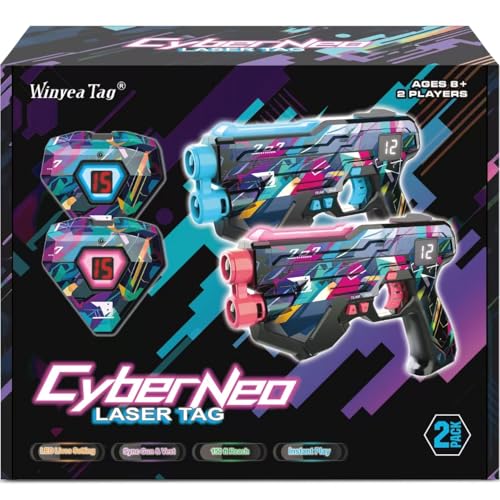
What's inside
- How home laser tag works
- What to look for in a quality set
- Start with the number of players
- Rechargeable power and preparation
- Range: what a number can and cannot tell you
- Score displays, LCDs, and knowing whether a hit counted
- Weapon modes and special effects
- Indoor play, outdoor play, and age guidance
- The eight sets at a glance
- 1. Laser Tag Guns Set for Kids, Teens and Adults — 2 guns with LED vests, 4 weapon modes and real-time data sync
- 2. Laser Tag Set of 2 — indoor and outdoor play for ages 8-12+
- 3. Rechargeable Laser Tag Set of 4 — outdoor family games for kids and adults, ages 8-13
- 4. Rechargeable Laser Tag Set with Vests — set of 4 with mist spray effect and LED digital, ages 8+
- 5. Squad Hero Rechargeable Laser Tag — 360-degree sensors and LCDs, set of 4, ages 8+
- 6. Laser Tag Guns with Vests — set of 2 for kids, teens and adults
- 7. OSALON Laser Tag Guns Set of 2 — digital LED score display vests, blue and red, indoor and outdoor
- 8. BAIAI Laser Tag Guns Set of 4 — digital LED vests with score display, outdoor, ages 8-12+
- Comparing the sets by how your family plays
- Setting up a safe and fair game
- Game formats that keep everyone involved
- Care, charging, and storage
- Buying checklist before you choose
- Frequently asked questions
- Check prices on Amazon
- Our verdict
As an Amazon Associate I earn from qualifying purchases. This post may contain affiliate links at no extra cost to you.
Finding the best quality laser tag sets for a family is less about chasing the loudest blaster and more about matching a set to the players, the space, and the way your group actually plays. A pair that is perfect for two siblings in a living room on a rainy afternoon will feel very different from a four-player set used for a birthday party in a garden or a weekend game mixing children, teenagers, and adults. Quality in this category shows up in practical details: vests that register hits fairly, sensors that work from more than one angle, a clear way to see a score or remaining lives, controls a younger player can learn quickly, and a charging routine that does not turn every game into a search for spare batteries.
This guide covers eight sets that all pair blasters with vests, rather than relying on a blaster alone to count hits. Some are two-player starter sets for indoor and outdoor play. Others include four blasters and four vests, so a small group can divide into teams straight from the box. Two sets put a digital LED score display on the vest, one adds a mist spray effect, one uses 360-degree sensors and LCDs, and one two-player set lists real-time data sync, four weapon modes, and a 130FT range in its published description. Those differences matter, and the sections below explain what each feature does, where it helps, and where a simpler set may be the smarter choice.
Our research is based on published specifications and product titles from the manufacturers, along with the general way home laser tag equipment works. We checked how each set is described for player count, age guidance, rechargeable power, vest displays, sensor coverage, and indoor or outdoor use. We did not invent range figures, battery times, or extra modes for sets that do not publish them. Where a specification is stated for one set only, it is discussed only for that set. Where a point applies to home laser tag in general, it is presented as general guidance rather than as a claim about a single product.
How home laser tag works
Home laser tag does not fire a visible beam that does the scoring. Despite the name, most family sets use infrared light, the same broad technology found in a television remote control, shaped into a game system. When a player pulls the trigger, the blaster sends a coded infrared signal. If that signal reaches a sensor on another player’s vest, the receiving equipment registers a hit. The vest or blaster then gives feedback through lights, sound, a life counter, or a score display, depending on the set.
That simple chain explains most of what feels good or frustrating in a game. A hit depends on aim, distance, angle, obstacles, and whether the receiving sensor can detect the signal. A player behind a thick cushion, a closed door, or another player may be much harder to tag than a player in the open, even at close range. Outdoors, bright conditions and long distances can make alignment more important. Indoors, walls and furniture create cover, but they also create narrow lanes where games become predictable if the group never changes the layout.
The vest is therefore more than a costume. It is the target, the scorekeeper, and often the fairest referee in the room. A well-placed sensor helps prevent arguments about whether a shot counted. A display on the vest can show a score or status that everyone can check, rather than relying on memory. Sensor coverage matters too. A sensor focused on the front rewards front-facing shots. Wider coverage, such as the 360-degree arrangement described for the Squad Hero set below, is designed to register hits from more directions, which changes tactics: players cannot treat their back as a safe zone, and movement matters more than standing in one protected corner.
What to look for in a quality set
Start with the number of players
The first decision is not range or effects. It is how many people will play at the same time. A set of two suits siblings, a parent and child, or a family that wants to learn the game before expanding. Two-player sets are easier to store, easier to charge, and easier to supervise with younger children. They also suit indoor play, where a large group can turn a hallway game into chaos. The limitation is obvious: a third player must wait, rotate in, or act as referee and timekeeper. Rotation works for short rounds, but it is less satisfying at a party.
A set of four changes the social shape of the game. It allows two-versus-two teams, a four-player free-for-all, or two pairs playing separate duels in a larger outdoor space. For families with three or four children, or households that regularly host cousins and friends, a four-player set removes the waiting problem. It also makes team strategy possible: one player guards a base while another moves, and older and younger players can be balanced across teams. The trade-offs are storage, charging, and setup. Four vests need straps adjusted and four blasters need to be ready. If your group is almost always two players, a good set of two may be used more often than a larger set that feels like an event to unpack. Buy for the usual group, not the largest group you can imagine.
Rechargeable power and preparation
Several sets in this guide are described as rechargeable. Rechargeable equipment can reduce the routine of buying disposable batteries and can make preparation simpler: charge the set, check the vests, and play. It also creates a responsibility. A rechargeable blaster left uncharged after the last game is no more useful than a battery-powered blaster with flat batteries. Families who choose rechargeable sets should charge after play, not minutes before guests arrive.
Range: what a number can and cannot tell you
Range is one of the most misunderstood specifications in home laser tag. One set in this guide, the two-player set with real-time data sync, publishes a 130FT range. That figure is useful context for outdoor play and larger indoor spaces, because it shows the set is designed for games that are not limited to one small room. It should not be read as a promise that every shot at that distance, at any angle, in any light, through any obstacle, will register. Infrared still needs the receiving sensor to detect the signal. A clean, well-aimed shot in open space is different from a hurried shot at a moving vest partly hidden behind a tree or sofa.
Score displays, LCDs, and knowing whether a hit counted
Clear feedback is one of the strongest markers of quality. The OSALON and BAIAI sets describe digital LED score display vests. The Squad Hero set describes LCDs alongside its 360-degree sensors. Another four-player set describes an LED digital element together with a mist spray effect. These are not identical systems, and this guide does not treat them as if they were. The shared idea is that information is shown on the equipment rather than kept in a player’s head. That reduces disputes, helps younger players understand the state of the game, and lets a referee check a round without restarting it.
Weapon modes and special effects
The two-player set with real-time data sync lists four weapon modes. Modes usually change how a blaster behaves in the game, but the exact names and effects vary by product, so players should learn them from the instructions supplied with that set rather than assuming they match another brand. Modes can add variety for teenagers and adults who have mastered the basic game. They can also complicate a first game for younger children. Start every new group on the simplest setting, play one short round, and only then introduce another mode.
Indoor play, outdoor play, and age guidance
Several sets here are described for indoor and outdoor play, while others emphasise outdoor family games. Indoor play rewards compact movement and layouts that protect furniture and younger players. Remove breakable objects, define stairs and kitchens as out of bounds unless an adult has approved them, and use furniture as cover without climbing on it. Outdoor play allows more running and longer sight lines, but needs firmer boundaries: no road, no neighbour’s garden without permission, no hiding in sheds or vehicles, and a clear signal for stopping the game.
Age guidance in the titles ranges from ages 8+ to bands such as 8-12, 8-12+, and 8-13. Treat those bands as the manufacturer’s starting point, not a guarantee that every child of that age will enjoy the same format. Some eight-year-olds are ready for team tactics and scorekeeping. Others have more fun with short, cooperative rounds and frequent respawns. Teenagers and adults can join many of these sets, especially those whose titles explicitly include teens or adults, but mixed-age games need balancing. Put experienced players on both teams, give younger players a role such as base defender or scout, and avoid formats where a child is eliminated in the first minute and then waits while everyone else plays.
The eight sets at a glance
- Two-player starter games: sets listed as a set of 2 suit pairs, smaller rooms, and learning the rules without a crowd.
- Four-player team games: sets listed as a set of 4 support two-versus-two play and reduce waiting at gatherings.
- Score-led play: the OSALON, BAIAI, and Squad Hero sets emphasise displays or LCDs in their published descriptions.
- Effect-led play: the set with mist spray and the set with four weapon modes offer different ways to vary a familiar game.
- Rechargeable choices: rechargeable power is explicitly stated for the first, third, fourth, and Squad Hero sets in their titles.
1. Laser Tag Guns Set for Kids, Teens and Adults — 2 guns with LED vests, 4 weapon modes and real-time data sync
ASIN B0HMC39NHL. This two-player set is the most specification-rich of the pairs in this guide. Its published title describes two toy guns with LED vests, four weapon modes, real-time data sync, rechargeable power, a 130FT range, and indoor and outdoor use, with an age band of 8-12 and an audience spanning kids, teens, and adults. That combination suits a household that wants a pair set but does not want the game to feel basic after the first week.
The LED vests are central to the appeal. In a duel, clear vest feedback keeps the contest honest: each player can see that a hit has registered without relying on the other player’s memory. Real-time data sync supports that clarity by keeping information aligned during play, as described for the product. Four weapon modes give the set a longer learning curve than a single-mode pair. Start simply, let both players learn the vest feedback and boundaries, then introduce one new mode at a time in short rounds. The published 130FT range makes the set relevant to larger gardens, although indoors the layout and line of sight will matter more than distance. Rechargeable power fits a pair that plays often, provided the household charges the set after use. With only two blasters and two vests, that routine is simpler than with a four-player kit.
2. Laser Tag Set of 2 — indoor and outdoor play for ages 8-12+
ASIN B0C3QX5ZSX. This set of two keeps the proposition simple: a laser tag game for kids for indoor and outdoor play, aimed at the 8-12+ age band and teenage players, for boys and girls. Simplicity is not a weakness here. For a first set, a clear two-player format lets children learn aiming, cover, vest feedback, and fair play without managing team settings or a long list of modes. An adult can introduce the game gradually: a short practice in a safe space, then a brief duel, then a rotation game when a third person joins as referee.
Because the title emphasises both indoor and outdoor play, this is a set a family can use across seasons. Indoors, keep rounds short and define the area tightly; a living room and hallway can be enough if furniture is arranged safely and fragile items are moved. Outdoors, the same pair can spread out, use garden features as cover, and play longer rounds. The equipment does not need to change for the game to feel different; the space does much of the work. A useful format is a series of short rounds with a rotating advantage, so each player takes a turn starting near stronger cover. Another is a cooperative challenge against the clock, which keeps practice fresh even with a competitive set.
3. Rechargeable Laser Tag Set of 4 — outdoor family games for kids and adults, ages 8-13
ASIN B0G1MBG843. This rechargeable set of four pairs laser tag guns with vests and is described for outdoor family games for kids and adults, with an age band of 8-13. Its strength is the combination of group size and family framing. Four players can split into balanced teams immediately, and the inclusion of adults matters: many family games fail because the equipment is aimed only at small children, leaving parents as referees rather than participants. A set that invites adults into the game can turn a children’s activity into a shared one.
Outdoor play is the natural home for a four-player set. Two-versus-two games need room for movement, cover, and retreat. A garden with a few safe obstacles gives each team choices. Set a boundary everyone can see, choose starting positions, and agree a stop signal. With four players, a short briefing prevents most confusion: which team starts where, how a player returns after being tagged out or respawning, and when the round ends. Rechargeable power is particularly useful here because the preparation routine multiplies with four blasters. Adopt one habit: collect all four blasters and vests after each game, check straps, charge according to the manufacturer’s instructions, and store the set together.
For mixed teams, balance experience rather than age alone. A confident thirteen-year-old and a cautious adult may be a fairer pairing than two highly competitive teenagers against two first-time players. Rotate teams between rounds so children play both with and against siblings. Choose this set if your default game is a family of three or four playing outdoors and you want rechargeable convenience without choosing primarily for a special effect or a named display system. Look elsewhere if most games will be one-on-one indoors, or if a vest score display is your top priority.
4. Rechargeable Laser Tag Set with Vests — set of 4 with mist spray effect and LED digital, ages 8+
ASIN B0BCDQ2XWB. This upgraded rechargeable set of four adds two ideas that stand out in the shortlist: a mist spray effect and an LED digital element. It is described as a multiplayer set for ages 8+. For families whose players are motivated by atmosphere, those features may be the reason to choose it. For families who prefer the plainest possible setup, they are also the features to think about most carefully.
The mist spray effect is presentation. It can make a game feel more dramatic, and drama has value for imaginative players who invent missions and give teams names. An adult should read the supplied instructions for how the effect is used and maintained, where it is appropriate, and what needs preparation before a game — before the first session, not while four excited players are waiting. The LED digital element points back to the practical side: players still need to know the state of play, and digital feedback helps connect the spectacle to a result. Rechargeable power suits a set that may be used heavily at gatherings, provided the household charges after use and checks the effect-related parts well before a party. If this set is bought for a birthday, play a small trial game with family members first. A trial reveals how long setup takes and which house rules are needed.
5. Squad Hero Rechargeable Laser Tag — 360-degree sensors and LCDs, set of 4, ages 8+
ASIN B082XJRTMG. The Squad Hero set is built around two published ideas experienced players will notice: 360-degree sensors and LCDs. It is a rechargeable set of four, described as a family group activity for ages 8+. Where many vest systems focus attention on the front of the vest, a 360-degree sensor arrangement is designed to make direction less of a loophole. A player cannot assume that turning away ends the contest. Movement, awareness, and positioning matter from every side.
That changes tactics in a healthy way. Cover has to be used honestly, a player advancing across open ground needs a plan, and a well-positioned shot from behind is part of the game rather than an exception to debate. The LCDs complement the sensors by giving players information during the round. In a fast four-player game, clear on-equipment information reduces the need to shout questions across the playing area. Players can check their status, understand that a hit has counted, and keep moving. For a family group activity, that clarity helps an adult run a tournament: several short rounds, rotating teams, and a simple points table kept between rounds.
6. Laser Tag Guns with Vests — set of 2 for kids, teens and adults
ASIN B0FC2HZH99. This set of two pairs laser tag guns with vests for kids, teens, and adults, and is described as an outdoor teenage game as well as a game for a broader family audience. Its appeal is breadth in a pair format. A parent and teenager can play a serious duel, two siblings can play a quick outdoor round, and an adult can join the activity rather than only supervising it.
Outdoor duels benefit from a defined course. Walk the area first and agree where play starts and ends. Choose cover that is safe to move around, not cover that invites climbing or running around blind corners at full speed. A garden course might use a start line at each end, two or three agreed cover points, and a rule that players stop immediately when the stop signal is given. Because the title includes kids, teens, and adults, mixed-age duels are a natural use. Balance them deliberately: an adult can defend a fixed base or take on a timed objective while a younger player plays freely, and a teenager playing a younger sibling can switch between attacking and defending roles each round. The aim is to keep both players making decisions.
The published title does not state rechargeable power, a score display, a specific range, weapon modes, or a special effect. Buyers should verify the exact power and feedback details in the full listing if those points are decisive. What the title establishes is the format: two guns with vests, a broad age audience, and outdoor play. A pair set can also suit grandparents who want an activity for visits without buying a large group set. The key question is frequency: if two people play often, a focused pair is efficient; if four regularly wait for a turn, choose a four-player set.
best instant print cameras for kids
7. OSALON Laser Tag Guns Set of 2 — digital LED score display vests, blue and red, indoor and outdoor
ASIN B0CF9JJKT8. The OSALON set of two is defined by its digital LED score display vests and its blue and red colours. It is described for indoor and outdoor play. For a pair of players, a vest score display solves the central problem of a duel: both competitors need a trusted record of the game. Instead of relying on memory or on one player announcing their own score, the vest itself carries the information. That makes this set especially relevant for competitive siblings, friends who like a series of short matches, and parents who want fewer disputes to referee.
The blue and red identity is practical as well as visual. Clear colours help players, referees, and spectators tell the sides apart at a glance. Build a simple ritual around them: choose a colour, check the vest display, adjust the straps, and start from opposite ends of the playing area. At the end of a round, swap colours and starting positions. Swapping removes any suspicion that one side of the room or garden is easier, and gives both players experience attacking and defending from different angles. Indoors, the display helps because players may be on opposite sides of furniture when a hit occurs; they do not need to stand together to agree on the state of play. Outdoors, the same clarity helps when distance separates them.
The published title does not describe this set as rechargeable, publish a range figure, or list weapon modes or a mist effect. Its case rests on the display vests and the pair format, and that focus can be a strength. Families sometimes buy the set with the longest feature list and then discover that the feature they use every time is the one that makes scoring clear. Before each game, check that both displays are visible and that straps are not covering sensors or displays, and agree what the display means for the chosen format: playing to a score, counting lives, or playing timed rounds and comparing the final display. Choose OSALON for a two-player indoor and outdoor set where the vest score display is the headline feature. Choose the BAIAI set below if you like the same display-led idea but regularly need four players.
8. BAIAI Laser Tag Guns Set of 4 — digital LED vests with score display, outdoor, ages 8-12+
ASIN B0CNTNKMT7. The BAIAI set takes the display-vest idea and expands it to four players. Its published title describes a set of four laser tag guns with digital LED vests and a score display, for outdoor play, aimed at ages 8-12+. For a family or friendship group in that age band, the combination is coherent: enough equipment for teams, a vest display to keep score visible, and an outdoor setting where four players have room to use the format properly.
Four-player score-led games work well as a small league. Divide the group into two teams, play a short round, record the result on paper between rounds, then swap starting positions. After several rounds, rotate the teams so players experience different partnerships. The vest displays handle the moment-to-moment state of each round, while the paper table handles the longer story of the afternoon. Children in the 8-12+ band often enjoy a tournament that builds over time, especially when the format rewards teamwork rather than only individual tagging. Outdoors, a referee — a parent, an older teenager, or a player rotating out for one round — can watch boundaries and unsafe running. With displays on the vests, the referee can ask players to check their vest status instead of deciding every disputed hit from memory.
The title does not describe this set as rechargeable and does not publish a range, weapon modes, or a special effect. Buyers should confirm the power arrangement and any other decisive detail in the full listing. The reason to shortlist BAIAI is clear without those additions: it is the four-player, outdoor, display-vest option for the 8-12+ group. Setup discipline matters with four display vests. Line them up before play, check each display, adjust straps player by player, and confirm teams before anyone disperses. At the end, collect the vests in the same order and check them again. Choose BAIAI for outdoor teams of four who will use vest score displays every round; choose Squad Hero if 360-degree sensors and LCDs matter more, or the rechargeable family set of four if rechargeable power comes first.
Comparing the sets by how your family plays
Comparisons are most useful when they start with a real routine. A household with two children who play after school, mostly indoors in winter and in a small garden in summer, will use a set of two with clear vest feedback constantly. The OSALON set’s score display vests and the first set’s LED vests, modes, and data sync both speak to that routine; the choice depends on whether modes and a published range matter more than a named score display.
Setting up a safe and fair game
A good session starts before anyone picks up a blaster. Walk the playing area with the players. Remove or declare out of bounds anything fragile, sharp, unstable, or private. Indoors, that usually means ornaments, drinks, laptops, and rooms that are not part of the game. Outdoors, it means tools, bikes in running lanes, ponds or pools, roads, and any area where a player could slip unseen. If the space cannot be made safe for running and quick changes of direction, slow the game down: walking only, a smaller area, shorter rounds.
Agree boundaries in language a child can repeat back, using landmarks rather than vague instructions. Instead of saying not to go too far, say the game stops at the blue gate, the end of the rug, or the line of chairs. Give one stop signal everyone recognises, and practise it once: when the signal is given, blasters go down and players stand still. Set movement rules that fit the space: no climbing on furniture during a round, no physical contact, no grabbing blasters or vests, no blocking doors, and no running on stairs. Comfortable shoes matter more than costumes, and if a game is played in low light, players must still be able to see obstacles and boundaries clearly.
Fairness rules deserve the same clarity. Decide whether a player who has used all lives in the chosen format leaves the round, returns to a base to respawn, or switches to a referee role. Decide what happens if two players tag each other at what feels like the same moment: check the vests or displays first, and if the equipment does not settle it, restart both players at their bases. Many families use a movement rule — a player must change position after a set time — to keep the game active. Include every player in the briefing, including adults, and model the behaviour the game needs: accept the display, respect the stop signal, and restart cleanly after a disputed moment.
best affordable drones with cameras
Game formats that keep everyone involved
The equipment provides the tools; the format provides the fun. A simple team match is the default for a set of four: two teams, equal starting positions, a fixed round length or a lives-based finish, and a swap of sides at half-time. Keep early rounds short so you can adjust teams if one side is much stronger. For a set of two, a duel series works better than one long match: play a sequence of short rounds, keep a running total between rounds, and vary the starting positions. A duel can also be cooperative, with both players working through an agreed course or a sequence of checkpoints against the clock, which helps when one player is much younger or less confident.
Care, charging, and storage
Laser tag sets live a physical life. Vests are pulled on and off, straps are adjusted by different hands, and equipment is sometimes dropped in excitement. Care is not complicated, but it needs to be routine. At the end of a session, collect every blaster and vest before players drift away and count the pieces against the set size. Inspect for cracked casings, loose sensor covers, frayed straps, and displays that are not behaving as they did at the start. Wipe equipment only in the way the manufacturer directs, and for the set with a mist spray effect, follow its specific preparation and care instructions rather than borrowing a routine from another product. If something is damaged, label it and set it aside so the next session does not begin with a faulty vest handed to a guest.
Buying checklist before you choose
- Count your regular players. Choose a set of 2 for pairs and learning the game; choose a set of 4 when three or four people regularly play together.
- Match the space. Indoor and outdoor sets suit changing seasons and smaller homes; outdoor-focused sets need a safe, bounded area with room for teams.
- Decide how scoring should be shown. If disputes are common, prioritise LED vests, digital LED score display vests, or LCDs so the equipment carries the record.
- Think about angles. If players are tactical and dislike loopholes, the 360-degree sensor design deserves close attention.
- Check power honestly. Rechargeable is stated for some sets and not for others in their titles. Confirm the exact arrangement for the set you choose and build a routine around it.
- Use published range only where it is published. The 130FT figure belongs to the first set in this guide. Do not transfer it to another set.
- Choose effects last. Weapon modes and mist spray can add fun, but only after player count, vests, feedback, and space are right.
- Respect the age guidance. Use the stated bands — 8+, 8-12, 8-12+, and 8-13 across these sets — as a starting point and adapt the format to the actual children playing.
Frequently asked questions
Is a set of two enough, or should a family start with four? A set of two is enough when two people are the regular players and others are happy to rotate as referee or join for short rounds. A set of four is better when siblings, cousins, or friends regularly make a group of three or four, because waiting quickly becomes the main memory of the game.
Why does the vest matter so much? The vest carries sensors and, on several sets here, the feedback or score information. It decides whether a hit counted and shows the result. A comfortable vest with straps adjusted properly and sensors unobstructed makes games fairer and calmer. Before blaming a blaster for a missed hit, check whether a strap, loose clothing, or a costume is covering the vest sensor.
What does a score display actually change? It changes who holds the truth. Without a display, players rely on memory and honesty, which works for relaxed games but can strain competitive ones. With a digital LED score display vest or an LCD, players can check status on the equipment, which helps children learning the game, tournaments, and mixed-age groups.
How should a mixed-age group stay fair? Balance teams by experience, rotate partnerships, use respawn formats for younger players, and give different roles to different players. A younger child can defend a base or play with a more experienced partner; a stronger player can take a harder objective. Fairness in family laser tag is mostly format design, and format design is in the adults’ hands.
Check prices on Amazon
Live listings for the shortlist in this guide are pulled from Amazon below, so prices and availability are always current at the moment you look.


Our verdict
There is no single best quality laser tag set for every family, because quality means something slightly different in a two-player flat, a four-child garden game, and a teenager-led tournament. The strongest choice is the one whose published strengths match your routine. For a specification-rich pair with LED vests, four weapon modes, real-time data sync, rechargeable power, and a published 130FT range, start with B0HMC39NHL. For a straightforward indoor and outdoor pair for the 8-12+ group, look at B0C3QX5ZSX. For rechargeable four-player outdoor family games across kids and adults, consider B0G1MBG843. For a rechargeable four-player set with a mist spray effect and LED digital feedback, consider B0BCDQ2XWB. For 360-degree sensors and LCDs in a rechargeable set of four, consider the Squad Hero set, B082XJRTMG. For a broad-audience outdoor pair for kids, teens, and adults, look at B0FC2HZH99. For blue and red two-player games led by digital LED score display vests, consider OSALON, B0CF9JJKT8. For a four-player outdoor display-vest set for ages 8-12+, consider BAIAI, B0CNTNKMT7.
Affiliate disclosure: This article contains affiliate links to Amazon. If you buy through one of those links, we may earn a commission at no additional cost to you. The product information in this guide is based on published specifications and product descriptions provided by the manufacturers and sellers, together with general information about how home laser tag equipment works. We have not directly used or handled the individual sets profiled here, and we do not present this guide as a record of personal use. Specifications, included parts, and availability can change, so please check the current product listing and the manufacturer’s instructions before buying and before the first game.


