What's inside
- Key Takeaways
- Quick Picks
- How Did We Choose the Best Graphics Cards for Upgrading Office PCs?
- How Do the Six Cards Compare Side by Side?
- What Should You Check Before Upgrading an Office PC?
- How Do You Fit and Configure the Upgrade?
- What Does the Working Day Actually Ask of the Card?
- When Is the Professional Card the Right Office Upgrade?
- What Mistakes Do Office PC Upgraders Most Often Make?
- Final Recommendation
- Frequently Asked Questions
- Related Guides
As an Amazon Associate I earn from qualifying purchases. This post may contain affiliate links at no extra cost to you.
gizmoverdict.com is reader-supported. When you buy through links on our site, we may earn an affiliate commission.
Where to buy: the six cards below link to their Amazon listings from the Quick Picks table and their detailed sections. Office machines vary under identical badges, so confirm your case’s height and your supply’s rating against the exact model before ordering.
The best graphics cards for upgrading office pcs exist because the office PC has a second life in it. The slim and small-form towers that businesses retire by the pallet — perfectly sound processors, adequate memory, cases built like filing cabinets — are held back at the desk by one component: integrated graphics that cannot drive a second modern monitor, cannot keep a video call and a spreadsheet composed at once, and cannot give a home worker, a student or a small business the display setup the work now assumes. A low-profile, low-power graphics card is the single upgrade that answers all three complaints, and it does so without touching the power supply, the case or the budget in any serious way. There is a quiet satisfaction specific to this upgrade, too: the machine was already yours, already configured, already full of your files and habits, and the card simply removes the ceiling it had been working under — no migration, no reinstall, no farewell to a familiar desk.
The shape of the right card is dictated by the machine, and this roundup follows that discipline strictly. It is worth pausing on how unusual that is: most graphics coverage begins with the fastest silicon and works downward, while the office brief begins with a case, a supply and a storeroom of monitors, and lets those facts elect the card. The result reads less like a contest and more like a matching service — which is what an upgrade, properly understood, has always been. Low profile comes first, because office towers ration height; modest power comes with it, because office supplies were sized for integrated graphics; and outputs come third, because the point of the exercise is usually a second display — or a first display of the modern kind, on machines whose only video port belongs to another decade. Gaming ability enters the conversation last and honestly: several of these cards will play light and older games after hours, and one of them is a genuine professional card, but the brief they were chosen against is the working day.
The six cards divide into three pairs. Two GT 1030s — one from MSI with 4GB of DDR4, one from maxsun with 2GB of GDDR5 — represent the minimal, proven route, and their memory difference is a real one worth understanding. Two RX 550s — from MAXSUN and 51RISC — bring 4GB of GDDR5 and low-profile small-form design to the middle, with a step more graphical substance. A low-profile GTX 1650 tops the list for the office machine that also plays, and PNY’s Quadro P1000 stands apart as the professional option for offices whose software cares about workstation drivers. Read the machine you own into the pairs, and the choice narrows quickly — usually to a single card whose title seems to have been written with your case, your supply and your storeroom monitor in mind.
Key Takeaways
- Low profile and modest power are the entry requirements: office towers ration both, and every card here was chosen inside that envelope.
- The two GT 1030s differ in the figure that matters — MSI’s states 4GB of DDR4, maxsun’s states 2GB of GDDR5 — a capacity-versus-memory-type trade explained in their sections.
- Both RX 550 cards state 4GB of GDDR5 in low-profile small-form designs, with the MAXSUN title adding a 128-bit bus, HDMI and DisplayPort.
- The GTX 1650 low-profile card states two native HDMI outputs and a 128-bit interface — the strongest light-gaming option in the list.
- PNY’s Quadro P1000 states 4GB of GDDR5 and brings workstation drivers to offices whose applications value them.
- Power figures are stated in none of these titles, so the manufacturer’s requirement for the exact model is the check that approves the fit.
- The second monitor is the mission: nearly every card here states two or more outputs, and the panel you already own decides which pairing is yours.
Quick Picks
| Pick | Badge | Why it made the list |
|---|---|---|
| GTX 1650 4GB Low Profile Graphics Card | Office by day, games by night | A low-profile 1650 with a stated 128-bit interface and two native HDMI ports — the most graphical substance here. |
| MAXSUN AMD Radeon RX 550 4GB Low Profile | Balanced SFF all-rounder | 4GB of GDDR5 on a stated 128-bit bus with HDMI and DisplayPort, in a small-form low-profile design. |
| 51RISC Radeon RX 550 LP 4GB GDDR5 | Second RX 550 route | Another 4GB GDDR5 low-profile RX 550 stating 4K display support for desktop and mini PC use. |
| maxsun GeForce GT 1030 2GB GDDR5 | Proven minimal upgrade | A GDDR5 GT 1030 in an SFF low-profile-ready design with DVI and HDMI for older monitor fleets. |
| MSI Gaming GeForce GT 1030 4GB DDR4 | Capacity-first GT 1030 | 4GB of DDR4 with DisplayPort and HDMI from a major board partner, in a low-profile OC model. |
| PNY Quadro P1000 Graphic Card 4GB GDDR5 | Professional driver option | A genuine Quadro for offices whose CAD and design software rewards workstation drivers. |
How Did We Choose the Best Graphics Cards for Upgrading Office PCs?
We also read each machine class the keyword implies — the slimline tower under a desk, the small-form box in a classroom, the mini PC in a reception — and asked whether the list serves all three. It does, deliberately: the ITX-described GT 1030 and the mini-PC-named 51RISC speak to the smallest hosts, the SFF RX 550s to the middle, and the low-profile 1650 to the towers with a slot and a little air to spare. An upgrade category is only as good as its fit to the installed base, and the installed base of office PCs is gloriously, stubbornly various.
We chose against the machine, not against a benchmark chart. The first test was fit: a card for an office PC must be low-profile or low-profile-ready, because the towers in question — slimline business machines above all — reject full-height cards at the case wall. The second test was appetite: office power supplies were specified for integrated graphics, so the card class had to be the modest, slot-fed kind, with the manufacturer’s stated requirement as the final verification since no title here prints a wattage. The third test was outputs, weighted toward the second-monitor mission: HDMI and DisplayPort for modern panels, DVI where the office’s existing monitors demand it.
Beyond the machine’s constraints, we weighed the working day’s actual demands — desktop compositing across two or three panels, video calls, browser-heavy work, document and spreadsheet life — and the after-hours honesty of each card, stating plainly which ones play and which ones merely display. We also kept one professional card in the list deliberately: a meaningful minority of office PCs run design software whose vendors maintain workstation hardware lists, and for those machines a Quadro is not an extravagance but the correct tool. The result is a ladder from the least a machine can accept to the most it can use, with each rung labelled by what it is for.

GTX 1650 4GB Low Profile Graphics Card — Office by day, games by night
This unbranded low-profile GTX 1650 is the ceiling of the office-upgrade brief: a stated 4GB, a 128-bit interface on PCIe 3.0 x16, DirectX 12 and OpenGL 4.6 support, HDCP 2.2, and — the detail that will sell it to half its buyers — two native HDMI outputs. Two HDMI ports on a low-profile card aimed at small machines is a considered specification: the second monitor is the reason most office PCs get upgraded at all, and here both panels connect natively, in the connector that home and small-office monitors overwhelmingly speak. By day, that means the spreadsheet and the call on separate screens; by night, the 1650 silicon is the one card in this list that plays contemporary games at mainstream resolutions as a matter of course rather than as a favour.
The unbranded presentation asks for the category’s usual discipline. The title states no memory type, no maker, no clock and no power figure, so the listing’s details and the delivered card must be checked against the claims — capacity in the operating system, outputs on the bracket, behaviour across a working week inside the return window. That verification is the price of the specification, which on paper is the strongest in this roundup for the mixed-use machine. Offices standardising a fleet should prefer the branded cards below for support reasons; the individual upgrader, buying one machine’s second life, can rationally accept the trade.
One fitment note belongs to this card above the others: low-profile 1650-class cards sometimes carry coolers that occupy the neighbouring slot’s space, and in a slim tower with a wireless card or a capture device next door, that neighbour matters. Measure the slot’s surroundings, not just its height, before this one is ordered.
The scenario that flatters it most is the shared family or small-office machine with split duties: accounts and homework by day, games in the evening, one box serving both economies. Cards are usually bought for one of those lives and tolerated by the other; this one is specified for both, which is why it leads the list despite its unbranded presentation. Its buyer is making a deliberate exchange — documentation homework for capability — and on a single-machine purchase that exchange is often the right one.
- Memory: 4GB (capacity as stated in the listing title; type not stated there)
- Memory bus: 128-bit (as stated in the listing title)
- Interface: PCIe 3.0 x16 (as stated in the listing title)
- Outputs: Native HDMI x2 (as stated in the listing title)
- API support stated in title: DirectX 12, OpenGL 4.6, HDCP 2.2
- Power requirement: Not stated in the listing title — verify with the seller’s listing details
Strengths
- The strongest graphical silicon in the list, in a low-profile format that respects the office brief.
- Two native HDMI outputs answer the second-monitor mission without adapters.
- A stated 128-bit bus doubles the memory path of the GT 1030 pair.
Trade-offs
- An unbranded listing places verification — capacity, outputs, behaviour — on the buyer.
- Memory type and power figures are unstated in the title.
- Its cooler may claim the neighbouring slot’s space in the tightest towers.
Best for: a buyer seeking one low-profile card that upgrades an office PC’s displays by day and plays respectably after hours. Not suited for: a buyer requiring a branded support channel for a fleet deployment.

MAXSUN AMD Radeon RX 550 4GB Low Profile — Balanced SFF all-rounder
MAXSUN’s RX 550 is the roundup’s centre of balance, and its title does the most complete specification work in the list: 4GB of GDDR5 on a 128-bit bus, DirectX 12, PCI Express x16 3.0, HDMI and DisplayPort outputs, in a low-profile small-form-factor design that names ITX and SFF in its own description. Every clause serves the brief. The 128-bit bus is twice the GT 1030s’ width; GDDR5 is the faster memory family in this company; the HDMI-plus-DisplayPort pairing covers modern panels of both dialects; and the form factor is stated rather than implied, which in this category is half the purchase.
The RX 550 silicon sits in the productive middle of office graphics: compositing across two or three panels, video, browser-heavy days and light creative work all sit comfortably inside its envelope, and light gaming — older titles, esports at modest settings — is a genuine capability rather than a slogan. For the home worker converting a retired tower into a proper desk, this is the card that makes the machine feel new without making the project feel risky. MAXSUN is a smaller board brand than the giants, and its support runs through its own channels; the specification’s completeness is its counter-argument, and it is a good one.
The title’s one silence is power, shared with the whole list. MAXSUN’s stated requirement for this model is the document to check against the office supply — a formality for this class, but a formality this article insists on for every card it names.
There is a fleet angle to this card as well. A small business refreshing a row of identical slim towers wants one card, bought several times, with a specification that can be read off the title and repeated without translation errors. The MAXSUN’s title — capacity, memory type, bus, outputs, format, all present — is the kind of listing a purchasing note can quote verbatim, and that clerical virtue, invisible in benchmarks, decides real fleet orders more often than any frame rate.
- Memory: 4GB GDDR5, 128-bit (as stated in the listing title)
- Interface: PCI Express x16 3.0 (as stated in the listing title)
- Outputs: HDMI, DisplayPort (as stated in the listing title)
- Form factor: Low profile, small form factor, ITX (as stated in the listing title)
- API support stated in title: DirectX 12
- Power requirement: Not stated in the listing title — verify with MAXSUN documentation
Strengths
- The most completely stated specification in the roundup — memory, bus, outputs and form factor all in the title.
- A 128-bit GDDR5 configuration gives the working day real composure across multiple panels.
- HDMI and DisplayPort together cover both dialects of the modern monitor fleet.
Trade-offs
- A smaller board brand than the industry giants, with support to match.
- Light gaming only — the newest titles at high settings are beyond its brief.
- Power figures require the documentation check, as with every card here.
Best for: a buyer seeking a fully stated low-profile specification — 4GB GDDR5, 128-bit, both modern outputs — for an SFF office machine. Not suited for: a buyer requiring a top-tier brand’s support organisation behind the card.

51RISC Radeon RX 550 LP 4GB GDDR5 — Second RX 550 route
51RISC’s RX 550 LP offers the same essential recipe as the MAXSUN card — an RX 550 with 4GB of GDDR5 in low-profile form — and adds one stated flourish of its own: 4K display support, named in the title alongside its desktop and mini PC intentions. Two cards built on the same silicon in the same format will perform as twins in the working day, so the choice between them is made on the margins: the MAXSUN states its bus width and both outputs, the 51RISC states its 4K display support, and each leaves the other’s facts to the listing details. A buyer with a 4K panel should weigh the stated ceiling; a buyer with a mixed pair of 1080p and 1440p panels should weigh the stated ports.
51RISC is a value-oriented board brand, and the card’s proposition follows that logic: the specification that matters — chip, capacity, memory type, format — at the gentlest price of entry the RX 550 class offers. The support path runs through the seller, and the verification habit applies on arrival: confirm the capacity, connect the panels, run the machine through its working week. For a single home-office upgrade, that is a fair exchange. For a small business equipping several desks, the calculation includes the value of a named brand’s support, and reasonable buyers land on different sides of it.
What neither RX 550 asks you to accept is ambiguity about the mission. These are desktop cards with light-gaming manners, sized for the machines that fill the world’s spare rooms and small offices, and both titles say so in the plain language of their specifications.
The mini PC mention in its title deserves a moment, because mini PCs are the hardest hosts in this category: their slots, where they exist at all, sit in enclosures with no spare air and strict length limits. A card that names mini PCs in its own title is at least claiming the homework has been considered — and the buyer’s half of that bargain is to measure the enclosure’s slot space against the maker’s dimension drawing before the order, since a mini PC forgives nothing.
- Memory: 4GB GDDR5 (as stated in the listing title)
- Form factor: Low profile, small form factor (as stated in the listing title)
- Stated capability: 4K display support (as stated in the listing title)
- Intended hosts stated in title: Desktop and mini PC
- Outputs: Not stated in the listing title — verify with the seller’s listing details
- Power requirement: Not stated in the listing title — verify with the seller’s listing details
Strengths
- The RX 550’s 4GB GDDR5 recipe in low-profile form, with 4K display support stated in the title.
- A value-brand route to the same silicon as the roundup’s centre pick.
- Mini PC intentions are stated outright, matching the smallest office hosts.
Trade-offs
- Outputs and bus width are not stated in the title, so panel planning waits on the listing details.
- Seller-channel support rather than a major brand’s organisation.
- As with its twin, gaming ambitions should stay light and older.
Best for: a buyer seeking a low-profile RX 550 with a stated 4K display capability for a desktop or mini PC. Not suited for: a buyer requiring stated output types in the title before ordering.

maxsun GeForce GT 1030 2GB GDDR5 — Proven minimal upgrade
The maxsun GT 1030 is the minimal upgrade in its correct form, and the crucial word in its title is GDDR5. The GT 1030 chip exists in two memory configurations in the wild — a GDDR5 version and a much slower DDR4 version — and listings do not always volunteer which one is in the box. This title states GDDR5 outright, alongside the 64-bit bus, PCIe 3.0, DirectX 12, HDCP support, DVI and HDMI outputs, and an SFF low-profile-ready design that calls itself ITX-sized. That is the honest version of the world’s commonest office upgrade: a card that gives an old tower a modern HDMI output, a second display, smooth desktop behaviour and video playback, for the smallest appetite in the NVIDIA line.
The DVI output deserves its sentence, because it reveals the card’s intended habitat. The monitors that retire alongside office PCs speak DVI in large numbers, and a card carrying both DVI and HDMI meets the old panel and the new one in the same bracket — the two-screen desk assembled from what the storeroom already holds. No adapter, no negotiation, no flicker. For the charity, the school, the small office and the spare room, that compatibility is the entire value proposition, and it is a strong one.
Set the gaming expectation at zero and the card exceeds it slightly — very light and older titles will run — but buy it as a display card and it will never disappoint. Its 2GB is sized for desktops, and desktops are where it will spend its life, compositing the working day for years after faster cards have been replaced twice.
Its afterlife pattern is the nicest in the list: these minimal cards migrate. Fitted first to give a tower a second monitor, they are later handed down to the machine that drives a workshop screen, a reception display, a child’s first PC — each time solving the same problem, an output the host did not have. Hardware that keeps being useful at smaller and smaller tasks has a claim on the word value that faster cards, retired outright, cannot match.
- Memory: 2GB GDDR5, 64-bit (as stated in the listing title)
- Interface: PCIe 3.0 (as stated in the listing title)
- Outputs: DVI, HDMI (as stated in the listing title)
- Form factor: SFF low-profile ready, ITX (as stated in the listing title)
- Features stated in title: DirectX 12, HDCP support
- Power requirement: Not stated in the listing title — verify with maxsun documentation
Strengths
- GDDR5 is stated in the title — the figure that separates the correct GT 1030 from its slower sibling.
- DVI plus HDMI bridges the old monitor fleet and the new panel in one bracket.
- An SFF-ready, ITX-described design aimed squarely at the machines this keyword serves.
Trade-offs
- Two gigabytes and GT-tier silicon confine it to desktop duty and the lightest play.
- No DisplayPort, so DP-only modern panels need the cards above.
- A smaller brand’s support channel stands behind it.
Best for: a buyer seeking the correct GDDR5 version of the minimal office upgrade, with DVI for an older second monitor. Not suited for: a buyer requiring DisplayPort outputs or any real gaming headroom.
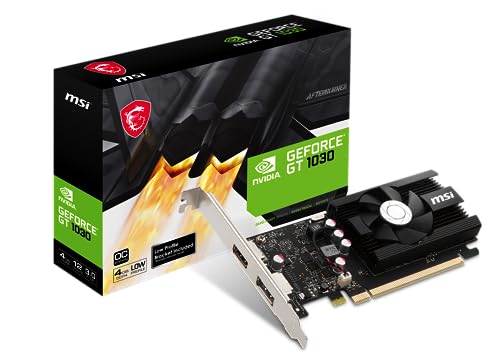
MSI Gaming GeForce GT 1030 4GB DDR4 — Capacity-first GT 1030
MSI’s GT 1030 is the other side of the GT 1030 coin, and this roundup places it beside the maxsun card so the trade can be read in one sitting. The title states 4GB of DDR4 on a 64-bit bus, with HDCP support, DirectX 12, DisplayPort and HDMI outputs, a single fan, an OC designation and the model code GT 1030 4GD4 LP OC — the LP marking its low-profile design. Against the maxsun card’s 2GB of GDDR5, this card doubles the capacity and halves the memory’s speed class. Which side of that trade serves an office machine? For pure desktop work — many windows, several panels, browser tabs by the dozen — capacity is the figure the desktop actually spends, and the DDR4 card’s 4GB is a rational choice. For anything that asks the memory to move quickly, GDDR5’s bandwidth wins, and the maxsun card is the better buy.
MSI’s name carries its own weight in the calculation: a major board partner’s support, documentation that states the power requirement plainly, and a model code that makes every fact about the card findable in seconds. In a category full of terse listings, that infrastructure is a genuine feature, particularly for a buyer upgrading a machine that belongs to an employer or a relative — someone else’s asset, where the paperwork matters.
Judge the card, finally, by its outputs: DisplayPort plus HDMI is the modern pairing, suiting the current monitor fleet better than the maxsun’s DVI-plus-HDMI. The two GT 1030s thus divide the office world neatly between them — old panels or new, capacity or bandwidth — and the desk in front of you already knows which one it is.
One more consideration belongs to the employer-owned machine: procurement records. A card with a full model code, a major brand and a stated specification files cleanly into an asset register and a warranty drawer, and when the machine is serviced by someone who has never seen it, that paperwork is the difference between a five-minute identification and a forensic exercise. The MSI card’s premium over its maxsun twin is, in part, exactly that filing quality.
- Memory: 4GB DDR4, 64-bit (as stated in the listing title)
- Outputs: DisplayPort, HDMI (as stated in the listing title)
- Cooling: Single fan (as stated in the listing title)
- Model code: GT 1030 4GD4 LP OC — LP denotes the low-profile design (as stated in the listing title)
- Features stated in title: HDCP support, DirectX 12, OC edition
- Power requirement: Not stated in the listing title — verify with MSI documentation
Strengths
- Four gigabytes gives multi-window, multi-panel desktop work the capacity it actually consumes.
- DisplayPort plus HDMI is the modern output pairing for current monitor fleets.
- MSI’s documentation and support infrastructure stand behind a fully coded model name.
Trade-offs
- DDR4 memory is markedly slower than GDDR5 — the capacity is bought with bandwidth.
- Any gaming ambition beyond the lightest titles will feel that memory choice immediately.
- The low-profile designation lives in the model code rather than in plain words in the title.
Best for: a buyer seeking a major-brand low-profile card with 4GB for a multi-panel desktop workload on modern outputs. Not suited for: a buyer requiring GDDR5 bandwidth for lighter gaming alongside the office work.

PNY Quadro P1000 Graphic Card — 4 GB GDDR5 — Professional driver option
The P1000 is the list’s professional, and its presence in an office-upgrade roundup is deliberate. A meaningful share of office PCs are not generic desktops at all — they are the machines running CAD seats, design software and technical applications whose vendors maintain workstation hardware lists and develop their support around workstation drivers. For those machines, a Quadro is the upgrade that keeps the software inside its supported world, and PNY’s card states its essential figure plainly: 4GB of GDDR5. The title offers nothing more, and the professional habit applies — PNY’s specification sheet carries the outputs, the form factor and the power requirement, and the application’s vendor list confirms the model.
Outside that professional niche, judge the card soberly. Its silicon is of an older generation, its 4GB matches the middle of this list rather than exceeding it, and a gaming or general-desktop buyer will find more for the purpose in the RX 550s or the 1650 above. The Quadro’s premium buys drivers and validation, and it buys them only for the workloads that use them. An office that runs such software already knows its name; an office that does not should let the other five cards divide its attention.
There is one more office scenario where this card earns its place: the mixed fleet standardising on a single qualified configuration. A P1000-class card in every design-adjacent seat means one driver package, one known viewport behaviour, one spare on the shelf — the fleet logic that professional graphics runs on, available at the modest end of the professional range.
It also serves as the list’s reminder that office is not one workload. The same building can hold a reception desk needing a second screen, a bookkeeper needing composure, a gamer-by-night needing the 1650, and a designer needing this Quadro — and a roundup that forced one card on all four desks would fail three of them. The P1000’s section is short on stated figures because its title is; its case rests on the ecosystem it belongs to, which for its intended desks is the only figure that matters.
- Memory: 4GB GDDR5 (as stated in the listing title)
- Line: NVIDIA Quadro professional family, from PNY
- Outputs: Not stated in the listing title — verify with PNY documentation
- Form factor: Not stated in the listing title — verify with PNY documentation
- Power requirement: Not stated in the listing title — verify with PNY documentation
- Software certification: Not stated in the listing title — verify with PNY documentation and your software vendor’s list
Strengths
- Genuine workstation drivers for offices whose applications are built and supported around them.
- A stated 4GB of GDDR5 gives design-adjacent seats a proper working capacity.
- PNY’s professional channel provides the documentation depth fleet buyers require.
Trade-offs
- An older generation’s silicon, bought for its drivers rather than its speed.
- Outputs and form factor are unstated in the title and must be confirmed before fitting.
- General-desktop buyers will find better value in the RX 550 pair.
Best for: a buyer seeking workstation drivers for a design-software office seat, verified against the vendor’s hardware list. Not suited for: a buyer requiring the best general-desktop or gaming value in this list.
How Do the Six Cards Compare Side by Side?
| Card | Memory stated in title | Outputs stated in title | Format stated in title |
|---|---|---|---|
| GTX 1650 Low Profile | 4GB, type not stated; 128-bit | Native HDMI x2 | Low profile |
| MAXSUN RX 550 | 4GB GDDR5, 128-bit | HDMI, DisplayPort | Low profile, SFF, ITX |
| 51RISC RX 550 LP | 4GB GDDR5 | Not stated; 4K display support stated | Low profile, SFF |
| maxsun GT 1030 | 2GB GDDR5, 64-bit | DVI, HDMI | SFF low-profile ready, ITX |
| MSI GT 1030 | 4GB DDR4, 64-bit | DisplayPort, HDMI | LP in model code |
| PNY Quadro P1000 | 4GB GDDR5 | Not stated | Not stated |
There is a story hiding in the table’s silences, too. The two cards with the least stated — the unbranded 1650 and the professional P1000 — sit at opposite ends of the trust spectrum: one asks the buyer to verify because its maker is anonymous, the other because its maker’s professional channel assumes verification as a way of life. Same silence, opposite meanings, and the reader who learns to tell them apart has learned the central skill of buying in this category: context decides what a quiet title is worth.
The table rewards a column-wise reading. The memory column contains the roundup’s central lesson — that the same chip name can hide different memory, and the same capacity can hide different speeds — which is why this article prints memory type wherever a title states it and flags it wherever one does not. The outputs column is the mission column: every desk’s panel inventory selects its row. And the format column shows the category’s manners improving as titles learn to state the fit that office buyers actually shop by.
What Should You Check Before Upgrading an Office PC?
Open the machine, or at least its service manual, before opening the listings — and while you are in the manual, note the machine’s own upgrade ceiling as its maker described it. Business PCs were sold with configuration guides that list supported card classes, slot power and bracket heights, and those guides, written by the people who designed the power budget, are the most trustworthy documents in the whole project. A card chosen inside the maker’s own stated envelope is a card whose success was engineered before it was purchased. Note the case’s card height — full or half — and the length available before the drive cage. Read the power supply’s label and its age with honest eyes, and check whether the long PCIe slot is free or already occupied by a forgotten card. Inventory the monitors: their inputs decide the output column of your purchase, and a storeroom DVI panel is an argument for one card while a new DisplayPort panel is an argument for another. Finally, note the machine’s other limits — an office PC short on system memory will feel that shortage after the graphics are fixed, and the same afternoon’s budget often covers both upgrades better than either alone.
One more inventory line is worth adding while the machine is open: the state of its dust and its fans. Office towers inhale carpet air for years, and a graphics card fitted into a clogged case inherits the thermal consequences. A soft brush and a can of air during the upgrade cost minutes and return measurable calm — the new card runs cooler, the old fans run slower, and the machine’s whole acoustic character improves in a way its owner will attribute, happily and wrongly, to the card alone.
Then buy the card whose title answers your inventory. Where the title is silent on a fact your inventory requires — an output type, a bracket, a power figure — the manufacturer’s page for the exact model is the authority, and five minutes there is cheaper than any return. Keep the machine’s original integrated graphics enabled in your plans as the fallback: if anything in the project surprises you, the old output still works while you think, which is the correct tempo for upgrading a machine that has work to do on Monday.
How Do You Fit and Configure the Upgrade?
One preparation saves the commonest scare: before the old configuration is disturbed, confirm the machine boots cleanly and note its current display behaviour. A machine with a pre-existing fault will present that fault immediately after the upgrade and be blamed on the card, and the baseline note — it did this before, too — is the difference between a calm diagnosis and a returned card that was never the problem.
Fit the card with the machine unplugged, swapping to the low-profile bracket first if the card arrives wearing the tall one and your case is slim. Seat it in the long slot until the latch closes, route nothing across its fan, and connect the displays to the new card’s outputs — not the motherboard’s, which is the classic reason a successful installation appears to have failed. Install the current driver from the chip maker’s site rather than any disc in the box, then arrange the displays in the operating system: order, orientation, scaling, and the primary panel chosen deliberately rather than by enumeration.
Configuration has one more step that separates a finished upgrade from a merely working one: set each panel’s scaling so text is the size your eyes prefer, and let the machine’s owner — who may not be you — sit at the desk and adjust the arrangement before the tools are put away. A second monitor placed where the installer liked it, rather than where its user reaches for it, gets quietly resented for years. The card provides the pixels; the desk’s owner should provide the geography.
Give the upgrade a working day before judging it, and spend that day at the machine’s real work. The gains of this category are ergonomic rather than numerical — the second panel that ends window-shuffling, the call that no longer stutters when a spreadsheet recalculates, the older machine that stops feeling older. If those gains arrive, the project is done; bank the win, label the spare bracket and keep it with the machine, and write the card’s model on the asset note so the next upgrade starts from knowledge instead of archaeology.
What Does the Working Day Actually Ask of the Card?
There is a perception lag to push through as well. A machine that has felt slow for two years keeps its reputation for a week after the upgrade, and its owner keeps working around limitations that no longer exist — minimising windows that could stay open, closing tabs that could stay loaded. Part of delivering this upgrade well is demonstrating the new headroom once, in person: both panels live, the call running, the spreadsheet recalculating. Machines are believed at the speed of their demonstrations, not their specifications. The modern working day is a compositing marathon: a browser with forty tabs, a video call compositing faces in real time, a spreadsheet recalculating behind a chart, documents rendering, a chat client animating, two or three panels of it all at once. None of that is gaming, and all of it is graphics work that integrated solutions — especially older ones sharing system memory — perform with visible reluctance. A discrete card with its own memory removes the contention at the root: the desktop stops borrowing from the same pool the applications are drinking from, and the whole machine feels less like it is negotiating with itself.
Noise belongs in the precision, too. An office machine sits within earshot for eight hours, and a card whose fan spins audibly at desktop loads taxes its owner in a currency no specification prints. The cards in this list are, by the standards of their modest silicon, quiet citizens — several are single-fan designs working far below their ceilings at desktop duty — and in a category bought for working comfort, that acoustic modesty is a feature to protect by keeping the case’s airflow paths clean and unblocked. Splitting work across two displays is the single most praised change in office computing, and it is entirely a graphics capability — the port, the framebuffer, the composure to drive both. Every card in this list delivers it; that is the floor of the category, not its ceiling. What the tiers above the floor buy is margin: the third panel, the 4K panel, the after-hours game, the design application’s viewport. Read your own day honestly — how many panels, at what sizes, doing what — and the ladder in this roundup assigns you a rung with very little argument.
When Is the Professional Card the Right Office Upgrade?
More often than the gaming-shaped market suggests, and the P1000’s presence in this list is the argument. Consider also the tender and the audit: practices that bid for institutional work are asked, in so many words, what their production machines run, and a fleet of vendor-listed professional configurations is an answer that closes the subject. The card’s value there is not performance at all — it is eligibility, purchased once and cited for years, and no benchmark table has a column for it. Offices are where professional software lives: the architect’s practice, the engineering consultancy, the design studio, the surveyor, the small manufacturer with a CAD seat between the lathe and the ledger. Those machines’ upgrades are governed by their applications’ hardware lists, and a consumer card — however fast — can step a seat outside its supported configuration. The professional card is the upgrade that respects the software’s terms, and its cost should be compared not against gaming cards but against the cost of an unsupported seat on a deadline.
The same logic scales down to the solo professional. A freelance designer whose office PC is also the business has no IT department to absorb a driver surprise; the known-behaviour card, from the professional channel, with its documentation in order, is a business-continuity purchase dressed as a graphics card. That is the honest frame for the P1000’s premium, and inside that frame it is not a premium at all.
What Mistakes Do Office PC Upgraders Most Often Make?
A sixth mistake is subtler: upgrading the card and leaving the display settings at whatever the machine negotiated. Panels run below their native resolution look soft, refresh settings sit at defaults, and the owner concludes the new card changed little. Five minutes in the display settings — native resolution on each panel, scaling set for the reader’s eyes — completes the upgrade the hardware began, and it is skipped with a consistency that would be impressive if it were not so costly.
Keep the removed slot covers and the spare bracket in a labelled bag inside the case or the asset drawer. Office machines outlive their upgraders’ memories, and the next person to open the box — often you, two years later, in a hurry — deserves to find the project’s evidence where the project left it.
The first is the full-height card in the slim case — the category’s founding error, repeated weekly, and avoidable with one measurement. The second is the GT 1030 memory trap: buying the chip name without reading the memory type, and receiving the slow DDR4 variant when the work wanted GDDR5 — or, in fairness, the reverse complaint from a desktop that wanted capacity. Read the title’s memory line as the specification it is. The third is ignoring the power supply’s age; office supplies live hard lives, and a card blamed for shutdowns is often innocent. The fourth is connecting the monitor to the motherboard after fitting the card, then concluding the upgrade failed. The fifth is upgrading the graphics of a machine whose real shortage was system memory or a failing drive — the card cannot fix what it did not cause, and a whole-machine reading before purchase prevents the disappointment.
Final Recommendation
For the typical retired office tower, the MAXSUN RX 550 is the balanced answer: a fully stated specification, 4GB of GDDR5 on a 128-bit bus, both modern outputs, and a low-profile small-form design that fits the machines this keyword is about. The 51RISC twin serves where its stated 4K display support matters more; the GTX 1650 serves the machine that must also play; the two GT 1030s divide the minimal end between GDDR5 bandwidth for older panels and DDR4 capacity on modern outputs; and the Quadro P1000 serves the offices whose software asks for workstation drivers by name. Measure the case, inventory the monitors, read the memory line twice — and an office PC that was halfway to the recycler becomes the most useful machine in the building, which is the quiet triumph this entire category exists to deliver.
Frequently Asked Questions
Will one of these cards let my office PC run two monitors?
That is the central mission of the list — and it is worth adding that the second monitor need not be new. The storeroom panel, the predecessor of your current main screen, the television in the meeting room: any of them becomes the second desktop the moment the card provides the port. The upgrade’s real cost is often just the card, because the panel half of the project has been sitting in storage, waiting for exactly this. The GTX 1650 states two native HDMI outputs; the MAXSUN RX 550 states HDMI and DisplayPort; the GT 1030s each state two outputs in their pairings. Connect each panel to the card, arrange them in the operating system’s display settings, and the extended desktop the office has been missing is simply there.
What is the difference between the GDDR5 and DDR4 GT 1030?
Memory type — and the difference is large enough to have generated years of forum warnings, because the two variants share a name and a box design language while performing noticeably differently. GDDR5 is the faster memory, suiting lighter graphical work; the DDR4 variant — represented here by MSI’s 4GB card — trades that speed for capacity, suiting window-heavy desktop work. The chip name is identical, which is why this article insists on the memory line of every title: it, not the name, describes the card you will receive.
Do I need to upgrade the power supply too?
Usually not for this class — these cards are chosen for modest, slot-fed appetites, the kind an office supply was indirectly designed around when the machine’s maker left a slot in the case and a margin in the budget — but no title here states a wattage, so check the manufacturer’s requirement for the exact model against your supply’s label and condition. An elderly supply that already misbehaves should be replaced on its own merits, card or no card.
Can an upgraded office PC play games?
Within honest limits — and the limits have a social shape worth noting. The office PC that games usually games in the evening, in a shared house, on a machine that must be back at work in the morning; the cards that serve it best are the ones that play without drama, heat or noise complaints. The low-profile GTX 1650 plays contemporary titles at mainstream resolutions; the RX 550 pair handles older and lighter games; the GT 1030s are display cards with the lightest of gaming manners; and the Quadro is bought for work. Match the card to the after-hours ambition when you buy, not after.
How do I know if a card is low-profile?
Trust the title’s plain words first — low profile, LP, SFF — and treat the bracket as part of the definition: a low-profile card needs its short bracket fitted to enter a slim case, and a listing that includes the bracket, or a maker whose box is known to, saves a second order. When the title and the code both stay silent, the dimension drawing on the maker’s page settles height, length and cooler overhang in one diagram, and that diagram outranks every photograph. and the model code second, as with MSI’s 4GD4 LP designation. Where neither speaks, as with the P1000 listing, the manufacturer’s specification gives the card’s height and bracket options, and that page should be read before the card meets a slim case.
Is it worth upgrading a very old office PC at all?
If the machine’s processor and memory still serve its work, yes — the graphics are very often the only component holding the desk back, and the test is simple: watch where the machine hesitates. If it hesitates at windows, panels, calls and scrolling, the card is the answer; if it hesitates at opening files and starting applications, storage and memory speak first, and the card should wait its turn in a sequence that ends with a machine renewed in the order of its actual complaints. and this list’s cards are priced as the small fix they are. If the machine struggles at its basic tasks, the honest advice is to read the whole machine as one specification and spend accordingly.
Related Guides
Complete the office machine’s second life with our companion reading: our guide to memory and storage upgrades for retired office PCs covers the other two fixes that matter, the dual-monitor desk setup guide arranges the panels your new card will drive, and our low-profile graphics card roundup widens the field for machines with more power to spare.
Related guides
- Best Enterprise SATA SSDs: Endurance Classes, Power-Loss Protection and Fleet Sense
- Best Color Product Label Printers: Six Desktop Machines for Short-Run Product Labels
- Best 1440p 165Hz Monitors: One Native 165Hz Pick, Three 180Hz Upgrades, an Overclock Headline and a 160Hz Ultrawide
- Best 13×19 Professional Printers


