What's inside
- Key Takeaways
- Quick Picks
- How Did We Choose These Compact Desks?
- How Small Can a Standing Desk Be Before It Stops Working?
- Fixed and Small, or Mobile and Smaller: Which Compact?
- Six Compact Desks for Six Kinds of Small Room
- How Do You Arrange a Compact Desk So It Feels Bigger?
- What Should Compact Buyers Check Before Ordering?
- How Do You Handle Storage When the Desk Has None?
- What Is It Like to Work at 40 Inches for a Year?
- Which Compact Desk for Which Small Room?
- How Does a Compact Desk Handle a Growing Setup?
- What Is the Compact Desk’s Relationship With the Chair?
- How Do You Keep a Compact Desk From Becoming a Storage Surface?
- How Compact Desks Handle Visitors, Guests and Borrowers
- Comparison Table
- What Mistakes Do Compact Desk Buyers Make?
- Final Recommendation
- Frequently Asked Questions
- Related Guides
As an Amazon Associate I earn from qualifying purchases. This post may contain affiliate links at no extra cost to you.
gizmoverdict.com is reader-supported. When you buy through links on our site, we may earn an affiliate commission.
Where to buy: Every desk below has a top of 48 inches or less, or wheels that let it behave like one, and each links to a listing verified in this site’s product pool.
The best compact standing desks start from an admission the big-desk market avoids: most rooms were not designed around a 60-inch slab of powered furniture. A box room that is also a guest room, a rented flat where the office is the corner the sofa did not want, a studio where the desk shares square footage with a bed — these are the natural habitats of the compact desk, and they are where most standing-desk buyers actually live. Compact, in this guide, has a definition: a desktop of 48 inches wide or less, or a mobile desk whose small top and wheels let it serve several spots in a room instead of owning one.
Small does not have to mean compromised, and the six picks below were chosen to prove it in different ways. Four are complete electric desks with real memory presets, spanning 40 to 48 inches. Two are mobile designs — one electric on lockable wheels, one pneumatic and cordless — for rooms where the desk must earn its place daily by moving out of the way. What none of them offers is acreage, and this review will not pretend otherwise: the art of compact buying is knowing exactly which things will live on the desk and which will live somewhere else.
A note on posture before products: a compact desk changes nothing about the ergonomics of standing. Your elbow height, screen distance and preset habits matter exactly as much at 40 inches as at 71. What changes is the choreography around the desk — where the printer goes, where notebooks sleep, whether the chair tucks fully under. Get the choreography right and a compact desk feels designed; get it wrong and it feels like camping.
Key Takeaways
- Compact here means a top of 48 inches or less, or a wheeled desk that can vacate its spot — the Sweetcrispy at 40 inches is the smallest complete desk in the guide.
- Small desks keep the full automatic experience: three memory presets on the Sweetcrispy, FEZIBO and Claiks, four on the ErGear 48.
- Depth is the hidden constraint — most compact tops are 24 inches deep, so a monitor arm or a rear riser is worth planning from day one.
- The two mobile picks solve a different problem: the Marsail rolls on lockable wheels between 28.3 and 46.5 inches, and the pneumatic H7 Plus needs no socket at all.
- The Claiks and ErGear 48s state 176-pound ratings — plenty for dual screens, not a licence for a tower plus everything you own.
- Decide what lives elsewhere before you buy: printer, scanner and paper storage are the usual exiles, and exiling them deliberately is what makes 48 inches feel generous.
Quick Picks
| Pick | Badge | Why it is here |
|---|---|---|
| Sweetcrispy 40×24 Electric Standing Desk | Smallest complete automatic desk | A 40-inch electric desk with three memory presets — the full automatic habit at the smallest footprint a keyboard and a screen can share. |
| FEZIBO 48×24 Electric Standing Desk, Maple | Best 48-inch all-rounder | Three presets, a 48-inch maple surface and complete-desk simplicity — the compact size most people actually mean. |
| ErGear 48×24 Electric Standing Desk | Best compact desk for two users | Four memory presets and a 176-pound steel frame at 48 inches — the compact desk a couple can share without reprogramming anything. |
| Marsail Mobile Stand Up Desk with Wheels | Best rolling electric desk | An electric desk on lockable wheels, travelling from 28.3 to 46.5 inches — park it, work standing by the window, then give the room back. |
| FLEXISPOT H7 Plus Mobile Standing Desk | Best cordless compact desk | A pneumatic 40-inch desk that plugs into nothing: float it up, roll it anywhere, and never think about sockets or cable runs again. |
| Claiks 48×24 Electric Standing Desk | Best compact desk with cable order | A rustic brown 48-inch electric desk with three presets, a stated 176-pound rating, and cable management — a hub and a hook — in its listing. |
How Did We Choose These Compact Desks?
The size gate came first and it was strict: 48 inches of width or less for fixed desks, because a 55-inch desk in a compact guide is just a desk. Within the gate we looked for variety of answer rather than six copies of one idea — a 40-inch minimum-footprint desk, two mainstream 48-inch electrics differentiated by preset count and finish, a third 48 with cable management built into its listing, and two mobile designs that treat the room itself as the constraint. If your space problem is unusual, one of these six shapes of solution should resemble it.
Mechanism honesty mattered as much as size. Compact desks are where manufacturers quietly downgrade — a small top on a feeble frame with a paddle control and no memory. Every fixed pick here has genuine presets, because the automatic habit is the point of owning one of these at all, and the mobile pair were chosen because their movement is their mechanism: wheels and a gas lift, respectively, each doing a job a fixed desk cannot.
Specifications are quoted only from the verified listing titles: the Marsail Mobile’s 28.3-to-46.5-inch travel, the H7 Plus’s 27.6-to-45-inch range and 40-inch one-piece top, the Claiks’ 176-pound rating and three presets, the Sweetcrispy’s splice-board construction — which we name as such, because a joined top is a real characteristic a buyer should know about, not a secret to keep from them.
How Small Can a Standing Desk Be Before It Stops Working?
The floor of the category is set by the keyboard, not by fashion. A keyboard and mouse at natural spacing take roughly 30 inches of width; add a laptop beside them and you are at 40; add a separate monitor instead and the monitor can overhang the rear edge on an arm while the input devices keep their 30. That arithmetic is why 40 inches, the Sweetcrispy’s size, is the smallest complete desk in this guide — below it, something you use hourly has to leave the surface, and a desk that exiles your keyboard is a shelf with ambitions.
Depth runs out before width does. At 24 inches deep, a monitor on its own stand sits close enough that many people find themselves leaning back to focus, which quietly wrecks the posture the desk was bought to fix. The cures are cheap and known: a monitor arm that parks the screen at the rear edge or beyond it, a low riser that lifts the screen while your keyboard slides beneath when not in use, or a laptop docked closed with an external display doing all the visual work. Any of the three converts 24 inches from a compromise into a non-issue, and compact buyers should budget one of them as part of the purchase rather than an accessory for later.
What genuinely does not fit is sprawl. Reference books open beside the keyboard, a graphics tablet in active use, a printer within arm’s reach — a compact desk asks you to run a one-project-at-a-time surface. Many owners discover they prefer it: the desk holds the current task and nothing else, and the room’s other furniture absorbs the archive. That is a working style, not a deficiency, but it should be chosen knowingly.
Fixed and Small, or Mobile and Smaller: Which Compact?
The fixed compact desk is a commitment to a spot: this corner is the office, the desk lives here, the chair tucks under it at night. It suits a room with one obvious workspace and a routine that happens in it. Its virtues are stability and simplicity — a fixed desk on a level floor is the steadiest platform in this guide, and the preset ritual anchors the working day to a place, which many people find helps them start and, just as importantly, stop.
The mobile compact desk treats the room as time-shared. The Marsail in this guide rolls on lockable wheels and rises electrically between 28.3 and 46.5 inches; the H7 Plus floats pneumatically and plugs into nothing. Either can work by the window in the morning, host a standing call in the middle of the room, and park against a wall when the room becomes a living room again. For a studio flat, that shape-shifting is not a novelty — it is the difference between having a standing desk and having a standing desk you had to get rid of.
Choose mobile only if you will actually move it, though. Wheels that never roll are just a slightly less stable fixed desk, and a pneumatic lift’s cordlessness is wasted on a desk permanently parked beside a socket. The honest question is about your evenings: if the room must transform, go mobile; if the corner is yours outright, take the fixed desk and its extra presets and stability, and let the room keep its one permanent citizen.
Six Compact Desks for Six Kinds of Small Room
From the 40-inch minimum to the 48-inch mainstream, and from fixed corners to rolling stations — each pick below names the room it belongs in.
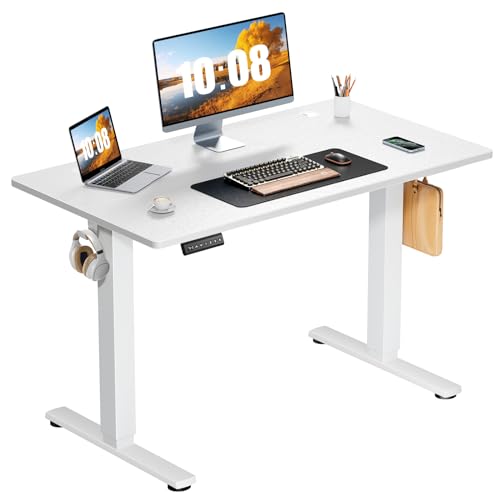
Sweetcrispy 40×24 Electric Standing Desk — Smallest complete automatic desk
The Sweetcrispy is the guide’s answer to the smallest honest question in the category: how little room can a real automatic desk take? Its top is 40 by 24 inches, its controller stores three memory presets, and nothing about its daily behaviour asks you to apologise for its size. Sit, stand, one spare height — the ritual is identical to the 55-inch desks elsewhere on this site, conducted on a surface that fits the wall of a box room or the short side of a studio. For a laptop plus one monitor on an arm, or a single generous screen, 40 inches is not a squeeze; it is a discipline that many tidy workers would choose freely.
The construction deserves its plain description: the top is a splice board, two joined pieces rather than one slab, and its listing says so. A joined top is how a desk at this size and tier is made, and in daily use the seam is a faint line you may notice in the first week and never again — but you should know it is there before the box opens, particularly if you plan to clamp a monitor arm at the centre rear, where the joint lives. White, small and unpretentious, the Sweetcrispy is the desk for the room that has exactly one desk-shaped space and no interest in negotiation.
A word about who thrives on 40 inches, because the Sweetcrispy’s owners sort themselves quickly. Writers, programmers and students — workers whose tools are a screen, a keyboard and a notebook — tend to forget the desk is small within a week, because their work was never wide to begin with. Workers whose day involves paper, peripherals and sprawl feel the boundary hourly. The desk is not better or worse for either group; it is a honest measure of how wide your work actually is, and it will tell you the truth about that within a fortnight.
And a closing calibration for the smallest pick: the Sweetcrispy’s white finish and modest scale make it the easiest desk in this guide to place second-hand or hand on — to a student leaving home, a partner’s first office, a spare room that finally gets its workstation. Compact desks circulate through households the way good chairs do, and a 40-inch automatic that still travels to three stored heights will be claimed at every circulation. Buy it for the corner you have; expect it to serve three more corners after that.
- Desktop: 40 x 24 inches, splice wood board, white
- Controls: 3 memory presets
- Mechanism: electric height adjustment
- Format: smallest complete desk in this guide
Strengths
- Full preset-driven automatic behaviour at 40 inches
- Fits walls and corners no 48-inch desk can use
- Simple, bright finish for small rooms
Trade-offs
- Spliced top — a visible joint line, and care with centre clamping
- One screen plus laptop is the comfortable ceiling
- 24-inch depth asks for a monitor arm or riser
Best for: Box rooms, studio corners and anyone whose wall space is measured in tens of centimetres of slack.
Not suited for: Dual-monitor sprawlers or clamp-heavy setups at the top’s centre seam.

FEZIBO 48×24 Electric Standing Desk, Maple — Best 48-inch all-rounder
If 40 inches is the minimum, 48 is the mainstream of compact, and the FEZIBO is its representative here for the second guide running — it earns the repeat appearance by being the size’s most straightforward expression. Three customisable memory presets, a complete electric desk, and a maple surface that makes a small room feel furnished rather than equipped. The extra eight inches over the Sweetcrispy buy real things: a second modest monitor, or one monitor plus an open notebook, or simply elbow room that stops the surface feeling rationed.
Maple is doing quiet work at this size. A compact desk usually lives in a room with another job — bedroom, living room, guest room — and a pale wood finish lets it pass as furniture when the workday ends, where a black slab keeps announcing itself as office equipment. The depth remains the family trait to plan around: 24 inches, a monitor arm’s natural habitat. Owners who make that one accommodation generally stop describing this desk as compact within a month; it is simply their desk, which is the outcome the category promises.
The FEZIBO’s maple top has one more virtue at this size that deserves naming: it photographs and video-calls like furniture. A compact desk often sits in the background of a bedroom or living room camera frame, and a pale wood surface reads as a table in a home, where a black slab reads as a workstation that escaped an office. For workers whose calls are client-facing, that background manners matter more than any spec in this guide. The desk is doing public relations for your room every time you unmute.
- Desktop: 48 x 24 inches, maple
- Controls: 3 customisable memory presets
- Mechanism: electric
- Format: complete desk
Strengths
- The compact mainstream — room for two modest screens
- Presets deliver the full automatic routine
- Maple finish blends with living spaces
Trade-offs
- 24-inch depth rewards a monitor arm
- No stated extras — storage and power are your own arrangements
- 48 inches still exiles the printer to another surface
Best for: A bedroom or living-room office that needs a real desk at a civilised size.
Not suited for: Anyone whose setup includes a tower and two large monitors plus paper sprawl.

ErGear 48×24 Electric Standing Desk — Best compact desk for two users
Preset count is a footnote on a solo desk and a headline on a shared one, which is why the ErGear 48 keeps winning this particular slot. Its four memory presets are exactly two people’s sitting and standing heights, and in a compact room — where a second desk is not an option and sharing is the whole arrangement — that arithmetic decides whether the desk serves both partners or quietly becomes one person’s desk with a guest’s compromise height. The steel frame and stated 176-pound capacity cover the shared reality too: two people’s different monitor habits, books and accumulated desk objects.
In black, at the same 48-by-24 footprint as the FEZIBO, the choice between them is a genuine fork rather than a ranking. Maple and three presets for the solo worker whose desk sits in a living space; black, steel and four presets for the household running shifts at one surface. Neither is the better desk in the abstract, and this review declines to fake a verdict the facts do not support. What can be said is that the ErGear’s specification was clearly written by someone who pictured two people using it, and compact rooms are where two people most often must.
Shared compact desks develop etiquette, and the ErGear supports the good kind. With both users’ heights stored, the handover ritual is ten seconds — clear your mug, press your number, the desk arrives — and the surface itself becomes neutral territory rather than one partner’s shrine the other must not disturb. Households that run shifts at one desk should also agree the exile list together: whose printer, whose files, whose lamp. The presets settle the vertical argument; the household must still settle the horizontal one, and doing it in week one is why shared desks survive.
- Desktop: 48 x 24 inches, black
- Controls: 4 memory presets
- Frame: steel
- Load rating: 176 lbs (per listing title)
Strengths
- Four presets map exactly onto two users’ sit and stand heights
- Steel frame with a stated 176-pound rating
- Compact footprint for shared corners
Trade-offs
- Black finish is the only option here
- Depth is the usual compact 24 inches
- 176-pound ceiling still excludes extreme tower setups
Best for: Couples and flatmates sharing one small desk in shifts.
Not suited for: A solo buyer who would rather have the FEZIBO’s warmer finish.

Marsail Mobile Stand Up Desk with Wheels — Best rolling electric desk
The Marsail Mobile starts from the studio flat’s central fact: any furniture that cannot move will eventually be resented. It is an electric height-adjustable desk on wheels — lockable ones, which is the detail that separates a rolling desk from a skating rink — travelling between 28.3 and 46.5 inches, a range that covers sitting on a low chair through standing for a tall user. Its listing even pictures it working over a walking pad or treadmill, which is a legitimate compact-desk use: a surface that can be rolled to the walking pad for the morning and rolled away from it by lunch.
Rolling furniture lives or dies by its behaviour when parked, so judge this desk by its locks and its manners at full height. Lock both wheels before a standing session, keep the load centred — this is a one-screen, laptop-class surface — and the desk does the job it promises. What it will not do is anchor a permanent battlestation, and it is not trying to: there are no memory presets in its listing’s story, because a desk that changes rooms does not live by stored heights the way a fixed desk does. Its buyers are buying freedom of placement, and on that measure it is the most capable compact pick in this guide.
The Marsail Mobile has a second career hiding in its listing: the walking-pad desk. Rolled over a treadmill belt, locked, and raised to the top of its range, it becomes the surface for the walking-meeting setup that compact rooms otherwise cannot host — the pad stores vertically or under a bed, the desk parks against the wall, and the room reclaims itself by evening. Even owners who never walk while working use the same mobility for daylight: the desk follows the sun around a studio the way plants wish they could, and a room with one window effectively gains three work spots.
Treat the wheels’ locks as part of the desk’s height ritual — rise, roll, lock, work — and the Marsail becomes the rare piece of office equipment that improves a room’s flexibility without taxing its owner’s attention, which is the entire promise of mobile furniture kept properly.
- Mechanism: electric height adjustment
- Height range: 28.3 to 46.5 inches (per listing title)
- Mobility: wheels, lockable
- Positioning per listing: also suits walking pad and treadmill use
- Finish: white
Strengths
- Moves between spots and roles in seconds
- Lockable wheels keep it planted while you work
- Tall maximum height suits standing calls anywhere in the room
Trade-offs
- A laptop-and-one-screen surface, not a battlestation
- No preset story — heights are set as you go
- Wheels need locking discipline on hard floors
Best for: Studio flats and multi-use rooms where the desk must vacate its spot daily.
Not suited for: A permanent multi-monitor installation that never moves.

FLEXISPOT H7 Plus Mobile Standing Desk — Best cordless compact desk
The H7 Plus is the compact desk for the room with no spare socket, no patience for cable runs, or no fixed idea of where work happens. Its lift is pneumatic — a gas-assisted mechanism in a dual-column frame — so the one-piece 40-inch top travels between 27.6 and 45 inches with no motor, no cord and no control box, and the whole desk is mobile. Forty inches is the same honest minimum as the Sweetcrispy: keyboard, mouse and one screen, arranged with intent. The difference is that this surface can be beside the sofa at ten and beside the window at eleven.
Pneumatic ownership has a feel to it that owners tend to love: the adjustment is quick and nearly silent, with none of the electric whir, and the desk asks the building for nothing at all, which makes it a natural second desk, guest-room desk or studiofloater. Its boundaries are equally clear. There are no presets, because there is no controller to hold them; you set the height by hand and eye. And a gas lift is built for moderate loads, so the tower PC and monitor array stay on the main desk. As the compact that goes anywhere, though, nothing else in this guide is playing its sport.
Because the H7 Plus asks nothing of a room, it is often bought for someone else — a teenager whose bedroom has no spare socket near the desk wall, a parent whose spare room hosts everything, a partner whose “office” is wherever the laptop lands. Gifts of furniture usually fail on logistics; this one succeeds because there are almost no logistics to fail. No cable route to plan, no outlet to reach, no preset to programme for a body you do not inhabit. It arrives, it floats, it is used — the rarest biography a gifted desk can have.
- Desktop: 40 inches, one-piece
- Mechanism: pneumatic, cordless
- Height range: 27.6 to 45 inches (per listing title)
- Design: dual-column, mobile, white
Strengths
- No power needed — works in any corner of any room
- Fast, quiet float adjustment
- One-piece 40-inch top, no seam
Trade-offs
- No presets — height set by feel each time
- Moderate loads only, by pneumatic nature
- 40 inches caps the setup at one screen plus laptop
Best for: Socket-poor rooms, second desks and anyone who works in several spots a day.
Not suited for: A primary heavy workstation, or preset devotees.

Claiks 48×24 Electric Standing Desk — Best compact desk with cable order
Compact desks suffer cable chaos out of proportion to their size, because the small surface has nowhere for the mess to hide and the short cable runs to a nearby socket tangle faster. Claiks’ 48-inch desk is in this guide because its listing confronts that directly: alongside three memory presets and a stated 176-pound capacity on a stable steel frame, it includes a cable management hub and a hook — modest hardware that keeps chargers and headphones in assigned places instead of in a heap behind the monitor. In a small room, that tidiness is not cosmetic; it is the difference between a desk that looks deliberate and one that looks like an incident.
The rustic brown finish is the other deliberate choice, warmer and more traditional than the blacks and whites around it, and it suits rooms with wooden furniture where a white Marsail or black ErGear would argue with the decor. Mechanically this is the mainstream compact recipe — 48 by 24, electric, presets — executed with the cable question answered in the box. Buyers whose desks live against a wall with the socket behind will feel the benefit every day; buyers with a cable spine already installed can treat the hub as a spare. Either way, the Claiks earns its place as the compact pick for people whose small desk must also be a neat one.
Claiks’ cable hub earns a longer defence than accessories usually get, because on a compact desk cable disorder is not visual — it is spatial. Every unmanaged charger brick and loop of lead occupies surface or floor that a 48-inch setup cannot spare, and the tangle grows toward the desk’s centre like ivy. A hub that assigns the cables a home at the desk’s edge reverses the ivy’s direction permanently. Owners of small desks learn to value any feature that returns square inches without removing a function, and by that accounting the hub is not an extra; it is a small annex of desktop, disguised as tidiness.
In short: the tidiest compact in the guide, for the buyer whose small desk must also be the room’s calmest object.
- Desktop: 48 x 24 inches, rustic brown
- Controls: 3 memory presets
- Load rating: 176 lbs (per listing title)
- Frame: steel
- Included per listing: cable management hub and hook
Strengths
- Cable hub and hook answer the small-desk tangle in the box
- Three presets and a stated 176-pound rating
- Warm rustic finish suits traditional rooms
Trade-offs
- 24-inch depth, like every fixed pick here
- 176-pound ceiling excludes the heaviest rigs
- Rustic brown will not match minimalist white or black setups
Best for: A tidy-minded worker whose compact desk sits in a furnished, traditional room.
Not suited for: Anyone planning a tower-plus-arms load near the rating’s ceiling.
How Do You Arrange a Compact Desk So It Feels Bigger?
Work in layers and exile without mercy. The surface layer holds only what the current hour needs: keyboard, mouse, screen, notebook, drink. Everything else gets an assigned home that is not the desk — the printer on a side table or a shelf, paper in a drawer unit that doubles as the desk’s missing storage, chargers in one dock rather than three bricks. Compact desks fail by accumulation, not by dimensions, and the owners who love theirs run a strict border policy at the surface’s edge.
Height is your spare square footage. A monitor arm lifts the screen off the surface and returns the footprint beneath it; a small shelf riser creates a parking level for the keyboard when the desk moonlights as a dining or craft table; wall shelves above the desk absorb the books that would otherwise colonise the corners. On the mobile picks, the room itself is the extra space — the desk works in the light and parks in the dead corner, which is a kind of square footage no fixed desk can rent.
Finally, mind the chair. In a compact room the chair’s footprint rivals the desk’s, and a chair that tucks fully beneath the surface at sitting height returns the floor to the room every evening. Measure the tuck before you buy either piece: armrests are the usual traitors. A room where the chair disappears under the desk at night feels a size larger than the same room with the chair stranded in the middle, and that feeling is most of what compact living is actually about.
What Should Compact Buyers Check Before Ordering?
Measure the wall, then measure the life around the wall. The desk’s width is the easy number; the ones that bite are the door swing, the radiator that eats four inches of the alcove, the skirting board that pushes the desk off the wall, and the socket’s position relative to where the cables must fall. Compact rooms forgive nothing, because there is no spare space to absorb a surprise. A cardboard outline on the floor, lived with for a day, catches more problems than any tape measure.
Check the travel, not just the footprint. A standing desk at full height puts your monitor near the underside of shelves and sloped ceilings that a sitting desk never approaches — attic rooms and under-stair corners are the classic traps. Run the numbers for the tallest pick’s maximum height plus your monitor’s height, and if the ceiling disagrees, the mobile desks’ freedom to work away from the slope may be the actual solution.
And check the floor’s opinion. Fixed desks want level; a wobble at sitting height becomes a sway at standing height, and compact frames have less mass to argue with. The wheeled picks want hard floors or short carpet — deep pile turns rolling into ploughing. None of these checks takes ten minutes, and every one of them is cheaper before the delivery than after it.
How Do You Handle Storage When the Desk Has None?
The compact desk’s storage answer is almost never inside the desk — only the Marsail in this batch’s wider family of guides arrives with a drawer — so the storage must be designed as part of the workstation rather than wished into the furniture. The classic arrangement is a slim drawer unit standing beside the desk at the same height as the lowered surface: it becomes a side wing for paper, chargers and the archive, close enough to reach, separate enough not to travel. Pedestals on castors add the mobile room’s favourite trick — storage that parks under the desk at night and rolls out as a side table by day.
Vertical storage is the compact room’s other ally. A shelf above the desk absorbs books and boxes that would otherwise colonise the surface, provided the shelf’s underside clears the monitors at full standing height — the measurement compact buyers most often forget, because the desk explores vertical territory a fixed desk never visits. Wall-mounted everything is the principle: lamps on arms or walls rather than bases, speakers on brackets, the router evicted to a high shelf. Every object that leaves the surface makes 48 inches behave like 55.
What remains on the desk should earn its place daily. The compact owners who thrive run a closing ritual — surface cleared to its essentials each evening — not from tidiness as a virtue, but because a small desk has no buffer for yesterday’s accumulation. The ritual takes ninety seconds and returns a desk that greets its owner like a place of work rather than a site of archaeology. Storage, for the compact buyer, is a habit wearing furniture’s clothes.
What Is It Like to Work at 40 Inches for a Year?
The honest answer is that the year divides into a fortnight of noticing and fifty weeks of not. In the fortnight, every boundary is news: the notebook that must close for the laptop to open, the mug’s single assigned parish, the second monitor that was not bought. Workers either renegotiate their sprawl in that fortnight — docking the laptop closed, moving the reference shelf, exiling the printer — or they conclude the desk is too small, and both conclusions are really measurements of the work rather than the furniture.
After the renegotiation, the small desk’s character asserts itself in an unexpected direction: focus. A 40-inch surface holds one task in its entirety and no more, so the desk becomes a single-threading device in a multitasking world. Writers and coders in particular report the effect as a feature they would now defend — the next task literally does not fit until the current one is put away. Whether that reads as discipline or as deprivation depends on the work, which is why this guide keeps asking what your work’s true width is.
The year’s other lesson is about guests. A compact desk in a shared room is borrowed constantly — for wrapping, for sewing, for a laptop that is not yours — and the preset desks handle the borrowing gracefully, since a borrowed height is one press away from being restored. Small furniture in shared rooms must be forgiving, and a desk that returns to exactly your heights after every incursion is forgiving in the way that matters most.
Which Compact Desk for Which Small Room?
Match the desk to the room’s specific poverty. The box room that is also a guest room is poor in permanence: the desk must look like furniture when guests arrive, which argues for the FEZIBO’s maple or the Sweetcrispy’s white smallness, and against anything that reads as equipment. The studio flat is poor in zoning: the desk must move or disappear, which is the mobile pair’s whole brief. The rented room is poor in permission: nothing may be fixed, drilled or replaced, and a compact electric that simply stands there, plugged into the one reachable socket, respects every clause of the lease.
The shared bedroom office is poor in exclusivity: the desk is borrowed, slept beside and walked around, arguing for the ErGear’s four presets and a finish that survives domestic life. The student room is poor in money and space simultaneously, and poor in the expectation of staying — a compact desk that will move house twice more should be light, simple and unresentful of new corners, which describes the Sweetcrispy’s brief precisely.
Notice that none of these matches began with a product. Each began with the room’s constraint stated plainly, and the product followed as a consequence. That order — constraint first, catalogue second — is the whole method of compact buying, and it is why this guide’s reviews keep naming rooms instead of merely ranking desks.
How Does a Compact Desk Handle a Growing Setup?
Setups grow the way gardens do — gradually, then all at once in the spring of a new job or a new hobby. The compact desk’s defence is not size but strategy. The first growth, a second screen, is absorbed by an arm that stacks the new monitor’s footprint onto air rather than surface. The second growth, better audio, is absorbed by small speakers at the rear corners or a soundbar under the screen’s chin, neither of which eats working depth. The third growth, a more serious machine, is absorbed by evicting the tower to a floor stand beside the desk, where its weight and heat were always better placed.
What cannot be absorbed is sprawl of kind rather than degree — the day the work itself becomes wide, with paper, tablets and instruments in simultaneous use. That day is not a failure of planning; it is information that the work has changed category, and the honest response is a full-size desk, with the compact one honourably retired to a bedroom, a teenager or a second life as the household’s floating desk. Compact desks hold their value in households precisely because they demote gracefully.
Buyers can future-proof the demotion at purchase: choose finishes that suit more than one room, keep the packaging until the setup settles, and prefer desks whose virtues — presets, mobility, tidiness — are portable virtues rather than fitted ones. The compact desk is rarely a household’s last desk. Bought well, it is the desk that keeps being useful after it stops being yours.
What Is the Compact Desk’s Relationship With the Chair?
On a full-size desk the chair is a guest; on a compact desk it is a co-tenant, sharing a floor plan neither can escape. The pairing rules are therefore stricter. The chair’s base must not fight the desk’s feet for the same floor; its armrests must clear the surface at sitting height, or adjust, or be absent; and its back must let its owner sit close enough that the 24-inch depth stops mattering. A chair that fails any of these makes the desk feel smaller than it is, and the desk is usually blamed for the chair’s offences.
Standing changes the tenancy rather than ending it. The chair must park somewhere during standing hours — tucked fully beneath the desk is the compact ideal, which is another argument for armless or low-armed chairs in small rooms — or it becomes an obstacle in exactly the floor space the standing body needs. Owners of the mobile desks have the elegant out: the desk rolls to the chair’s neighbourhood for sitting and away again for standing, and the room’s geography stays negotiable.
Budget the two as one purchase even if they are bought a year apart. A compact desk with a well-matched chair feels like a designed workstation; the same desk with a stranded, clashing chair feels like a compromise with legs. The room notices the difference every day, and so, eventually, does the back.
How Do You Keep a Compact Desk From Becoming a Storage Surface?
Every horizontal surface in a home is a candidate for storage, and a compact desk — often the only free surface in a small room — is the most tempted object in the house. The defence is constitutional rather than hygienic. Declare, in the household’s hearing, what the desk is: a workstation that parks a chair at night, not a shelf that sometimes hosts a laptop. Objects that land on it acquire a sunset rule — anything not part of the work is gone by the evening’s end — and the rule is enforced kindly but without exception, because exceptions are how surfaces are annexed.
Give the annexation somewhere else to go. A single tray or basket near the door, designated as the household’s landing strip, absorbs the post, the keys and the parcels that would otherwise colonise the desk’s corners. Compact rooms fail at their edges, not their centres, and one sanctioned dumping ground protects every other surface in the home, the desk most of all.
The mobile desks have a sterner defence available: motion. A desk that parks against a different wall each night cannot accumulate a permanent geology of objects, because everything aboard must justify travelling. Owners of the Marsail and the H7 Plus report that the nightly park-and-tidy takes under a minute and functions as the room’s closing ceremony — the working day is put away, physically, and the room becomes a living room again. In a compact home, that ceremony may be the most valuable feature in this entire guide, and it is not listed on any spec sheet.
How Compact Desks Handle Visitors, Guests and Borrowers
A compact desk in a shared home leads a double life, and the wise buyer plans for the second one. It will be borrowed for gift-wrapping in December, for a visiting cousin’s laptop week, for the household’s sewing, sorting and repairing — because it is the right height, in the right light, with a chair already there. The preset desks handle the borrowing with unusual grace: a borrower’s session at a hand-set height is one press away from being forgotten, and your own heights return exactly, which removes the small resentment that borrowed furniture usually accrues.
Set one house rule and the double life stays benign: the desk is returned empty. Not tidy by your standards — empty by agreement, surface clear, chair tucked. Borrowers respect a rule stated once, kindly, at the first loan far more reliably than a grievance nursed silently for a year. And keep a household spare in mind: a folding tray table that absorbs the overflow tasks in busy weeks protects the desk’s availability for its actual job.
There is a compliment hidden in the borrowing, worth hearing. Furniture that the whole household gravitates to is furniture placed and sized correctly — the room’s life is voting for the corner you chose. A compact desk that is fought over gently is a success by the only metric small homes really keep, which is usefulness per square foot.
Comparison Table
All six fit the compact definition, so the table separates them by the question that actually divides them: fixed or mobile, and if fixed, whose presets and finish.
| Pick | Desktop | Mechanism | Defining trait |
|---|---|---|---|
| Sweetcrispy 40×24 Electric Standing Desk | 40 x 24 in | Electric, 3 presets | Splice-board top, white |
| FEZIBO 48×24 Electric Standing Desk, Maple | 48 x 24 in | Electric, 3 presets | Maple complete desk |
| ErGear 48×24 Electric Standing Desk | 48 x 24 in | Electric, 4 presets | Steel frame, 176 lbs |
| Marsail Mobile Stand Up Desk with Wheels | Mobile top | Electric, wheeled | 28.3–46.5 in, lockable wheels |
| FLEXISPOT H7 Plus Mobile Standing Desk | 40 in top | Pneumatic, cordless | Mobile, 27.6–45 in travel |
| Claiks 48×24 Electric Standing Desk | 48 x 24 in | Electric, 3 presets | Cable hub and hook, 176 lbs |
What Mistakes Do Compact Desk Buyers Make?
The first mistake is buying the room’s dimensions instead of the setup’s. A buyer measures a 50-inch alcove, orders a 48-inch desk, and only then remembers the second monitor, the speakers and the desk lamp all expected to live on it. List everything that must be on the surface, measure that convoy, and let the convoy choose the size — within this guide, that is the difference between the Sweetcrispy’s 40 inches being perfect and being a daily irritation.
The second mistake is ignoring depth. Compact marketing leads with width, but the 24-inch depth of the fixed picks is what your eyes will negotiate with, and buyers who skip the monitor-arm plan often conclude, wrongly, that standing desks are uncomfortable. Third, people buy mobile desks for rooms that never change, paying in stability for wheels that never roll — or buy fixed desks for studio flats that must transform nightly, and end up working around a monument.
Fourth, compact buyers forget the exiles. The printer, the scanner, the paper archive have to live somewhere, and if the answer is “on the desk anyway”, the desk was the wrong size. Decide their homes first. And fifth, nobody checks the chair tuck, so the room’s second-largest object spends its life stranded mid-floor, making a small room feel smaller than the desk ever could.
Final Recommendation
Choose by room, not by ranking. The Sweetcrispy if 40 inches is what the wall allows, the FEZIBO if you want the mainstream 48 in a finish that behaves like furniture, the ErGear if two people will share the presets, the Claiks if cables and warmth matter, and one of the mobile pair — Marsail for powered rolling, H7 Plus for cordless floating — if your room changes its mind every evening.
A compact desk is a promise a room makes to itself about how it will be used, and the right one disappears into that use so completely that within a month you will have stopped calling it small at all — it will just be the place where the work fits, exactly.
Frequently Asked Questions
What size counts as a compact standing desk?
In this guide, a desktop of 48 inches wide or less, or a mobile desk whose small top lets it serve several spots. The smallest complete pick is the Sweetcrispy at 40 by 24 inches; the fixed mainstream is 48 by 24. Anything at 55 inches is a full-size desk wearing a compact costume.
Can a compact desk hold two monitors?
Two modest monitors, yes — the 48-inch picks handle them, especially on a shared stand or arms. Two large monitors plus a tower is where compact stops being honest; the 40-inch picks are one-screen desks, and pretending otherwise leads to a crowded, wobbly surface.
Is 24 inches of depth enough?
With a plan, yes. A monitor arm or a rear riser restores comfortable viewing distance, and most compact owners adopt one within the first month. Without a plan, 24 inches puts the screen close enough to strain focus over a long day — budget the arm as part of the desk.
Are mobile standing desks stable enough to type on?
Parked and locked, yes, for laptop-class loads. The Marsail’s wheels lock, and the H7 Plus’s dual-column frame is built for its 40-inch top. Neither is the platform for a heavy multi-monitor rig — that is what the fixed picks are for.
Do compact desks have memory presets?
The fixed ones here do: three on the Sweetcrispy, FEZIBO and Claiks, four on the ErGear 48. The mobile pair are the exceptions — the H7 Plus is pneumatic and has no controller, and the Marsail’s listing centres on its wheels and range rather than stored heights.
Where does the printer go with a compact desk?
Somewhere else, by design: a side table, a shelf, a drawer unit beside the desk. Deciding the exiles’ homes before ordering is the single habit that separates compact desks that feel generous from compact desks that feel like camping.
Related Guides
Keep reading with Best Audio USB Headsets: Clean Signal, Honest Surround, Six Real USB Picks Best 4K Webcams for Mac: Six Cameras That Feel Native on macOS Best Chairs for Gaming Sessions: Six Chairs Judged at Hour Four.



[…] reading with Best Backup Portable Hard Drives: Software, Recovery Cover and Routines That Work Best AM4 CPU Coolers: Keeping a Great Platform Cool, Quiet and Alive Best Affordable HD Webcams: […]