What's inside
- Where to Buy the Best Big PC Cases
- Key Takeaways
- Quick Picks
- How Did We Choose These Big Cases?
- Which Big Case Fits Your Build?
- How Do the Big Cases Compare at a Glance?
- What Should You Check Before Buying a Big Case?
- How Do You Plan a Custom Loop in a Full-Tower?
- What Mistakes Do Big-Case Buyers Keep Making?
- Why Does a Workstation Belong in a Full-Tower?
- How Do You Move and Maintain a Case This Large?
- What Is E-ATX, and Do You Actually Have One?
- Why Do Big Cases Still Matter in the Age of Small PCs?
- How Much Storage Can a Big Case Really Hold?
- How Do You Keep a Big Case Quiet at Full Load?
- What Does a Big Case Cost to Own Over Ten Years?
- How Do You Build Inside a Full-Tower Without Losing the Day?
- Can One Big Case Hold a Gaming PC and a Streaming PC?
- Final Recommendation
- Frequently Asked Questions
- Related Guides
As an Amazon Associate I earn from qualifying purchases. This post may contain affiliate links at no extra cost to you.
gizmoverdict.com is reader-supported. When you buy through links on our site, we may earn an affiliate commission.
Where to Buy the Best Big PC Cases
There comes a point in many builds where the mid-tower stops being a home and becomes a negotiation. The radiator wants the space the reservoir has claimed. The second graphics card, the capture hardware, the forest of drives — each arrives with a tape measure. The best big pc cases end the negotiation by simply having the room: full-tower and super-tower chassis built for E-ATX motherboards, multiple large radiators, and cooling arrays that read like weather systems. This guide takes the word big seriously. Four of the six picks are genuine full-tower or larger designs, one is an E-ATX mid-tower with full-tower appetites, one is the roomiest mainstream tower in its line presented honestly as the gateway to big, and one further true full-tower appears as a clearly labelled prose-only alternative for readers whose priorities run to silence.
The headliners are Corsair’s two flagships. The 7000D Airflow is the full-tower as a finished product: high-airflow front, spacious interior, three 140mm AirGuide fans and a PWM repeater included. The 9000D RGB Airflow is the super-tower as a platform: room for up to eighteen 120mm fans, InfiniRail mounting, an iCUE LINK hub in the box, and — read the listing carefully — no fans included, because at this level Corsair assumes you are specifying your own cooling the way a studio specifies its own monitors. Fractal’s North XL scales the walnut-fronted furniture case up to E-ATX proportions. MONTECH’s AIR 903 MAX brings E-ATX support, a 400mm graphics card ceiling and dual 360mm radiator positions down to a mid-tower footprint and a value brief. The LANCOOL 217 closes the linked picks as the big-hearted mainstream option, and the Fractal Define 7 XL stands as the prose-only full-tower for the silence-first builder.
A word on who should keep scrolling past this entire category, offered in the guide’s own interest: if your build is a single mainstream graphics card, an air cooler, two drives and no plans that scare you, a big case will give you nothing but a heavier desk and a longer wait for the room to feel finished. The mid-tower guides in this series exist for you, and the LANCOOL 217 below marks the exact border where sensible growth ends and the full-tower country begins. Read the six picks that follow as a map of that country — its finished capital in the 7000D, its open frontier in the 9000D, its diplomatic quarter in the North XL — and enter it when your parts list, not your envy, issues the passport.
Buy big for a reason you can name. A named reason sounds like: two 360mm radiators, an E-ATX board, a workstation that renders overnight, a loop with a reservoir, a decade of upgrades that will not fit anywhere else. An unnamed reason — it looked impressive — buys you a heavier desk ornament that is harder to move, harder to clean and no faster than the mid-tower you passed over. The cases below reward named reasons magnificently. That is the whole of their job, and they do it at a scale no smaller chassis can imitate.
Key Takeaways
- Big, defined honestly: full-tower or E-ATX-capable cases with multi-radiator room — the 7000D, 9000D, North XL and prose-only Define 7 XL are true full-towers.
- The Corsair 9000D ships with no fans included per its listing; budget for up to eighteen 120mm fan positions if you intend to fill its InfiniRail system.
- The 7000D is the complete opposite philosophy: three 140mm AirGuide fans and a PWM repeater in the box, ready to cool on day one.
- MONTECH’s AIR 903 MAX is an E-ATX mid-tower, not a full-tower — but its 400mm GPU support and front/top 360mm radiator positions per its listing outgun many larger cases.
- The North XL proves big no longer means garish: the walnut furniture design scales to E-ATX builds for shared rooms.
- Measure the room, the desk and the doorway before ordering; a super-tower is furniture you will move house with.
Quick Picks
| Pick | Badge | Why it belongs here |
|---|---|---|
| Corsair 7000D Airflow | Best Full-Tower Overall | A complete, fan-included flagship with space for serious loops and E-ATX boards. |
| Corsair 9000D RGB Airflow | Best Super-Tower Platform | Eighteen 120mm fan positions and InfiniRail — a chassis you specify like equipment. |
| Fractal Design North XL | Best Big Case for Shared Rooms | The walnut North, enlarged for E-ATX builds that must still look like furniture. |
| MONTECH AIR 903 MAX | Best Big-Capacity Value | E-ATX support, 400mm GPU room and four fans in a mid-tower footprint. |
| Lian Li LANCOOL 217 | Best Gateway to Big | Five PWM fans and generous mainstream room — the step before full-tower commitment. |
| Fractal Design Define 7 XL (prose-only) | Best Silence-First Full-Tower | A true full-tower known for damped panels and storage depth; no verified link in this pool. |
How Did We Choose These Big Cases?
Size claims in case marketing inflate like fishermen’s stories, so we graded from listings and form factors rather than adjectives. A case qualified as big by supporting at least one of the things smaller cases cannot: an E-ATX motherboard, multiple 360mm-class radiators, a fan array in double figures, or a graphics card ceiling around 400mm. We then asked what the size is for. The full-towers here serve custom liquid cooling, workstation duty and multi-device builds; the AIR 903 MAX serves the builder who needs E-ATX and card room without the full-tower footprint; the 217 serves as the honest border — a large, well-fanned mainstream tower for readers discovering that their ambitions are big-adjacent rather than big.
We also counted what the box contains, because at this scale the omissions are expensive. The 9000D’s fan-free listing is a feature for its intended buyer and a budget trap for anyone else, so it is stated in its quick pick, its spec list and its trade-offs. The Define 7 XL appears without a link because our verified pool holds no listing for it; it is discussed as a design alternative, clearly labelled prose-only, rather than dressed in a borrowed link.
Which Big Case Fits Your Build?

Corsair 7000D Airflow — Best Full-Tower Overall
The 7000D is what happens when a full-tower is designed as a product instead of a platform. Its listing promises a high-airflow front panel, a spacious interior, easy cable management and three 140mm AirGuide fans with a PWM repeater included — and that last detail reveals the philosophy. Corsair expects this case to cool a serious build the day it is unboxed, by an owner who would rather spend the weekend building the loop than shopping for fans. The AirGuide fans use anti-vortex vanes to push air where it is aimed, and the repeater lets the whole array behave as one controllable unit, which suits a case whose cooling should be set with intent and then forgotten.
Inside, the scale is the luxury. An E-ATX board sits with room around it instead of apology; long graphics cards stop being a measurement exercise; radiators find positions that do not require evicting the storage or the reservoir. Cable management at this size stops being a puzzle and becomes a route map, with the depth behind the tray that big cases owe their owners. For the workstation that renders overnight, the gaming rig with a custom loop, or the build that simply accumulated ambitions across three upgrade cycles, the 7000D is the complete answer in this guide — the big case for people who want the size and the finish in the same box.
Its demands are the honest demands of the class. It is a full-tower: heavy, tall, and happiest in a permanent position rather than a nomadic one. Its airflow-first front chooses cooling over the damped silence of a sealed design, so a noise-obsessed bedroom build should read the Define 7 XL’s prose entry with care. And its completeness costs more than a bare platform — though, as the 9000D’s fan arithmetic shows, completeness and cost are not the simple opposites they appear. For most builders who have genuinely outgrown the mid-tower, this is the case the guide exists to point at.
- Form factor: full-tower ATX, E-ATX class interior
- Included fans: 3 x 140mm AirGuide with PWM repeater per listing
- Front panel: high-airflow design
- Interior: spacious, cable management a stated design priority
- Standout trait: a flagship full-tower that arrives cooling-complete
Strengths
- Complete out of the box — fans, repeater and airflow front included.
- Room for E-ATX boards, long cards and serious radiator layouts.
- Cable depth and interior space make big builds calm to assemble.
Trade-offs
- Full-tower weight and height demand a permanent, measured home.
- Airflow front prioritises cooling over absolute silence.
- You pay for included fans a platform buyer might not want.
Best for: custom-loop and workstation builds that want a finished flagship. Not suited for: small desks, frequent movers, or silence-at-all-costs bedrooms.
Corsair 9000D RGB Airflow — Best Super-Tower Platform
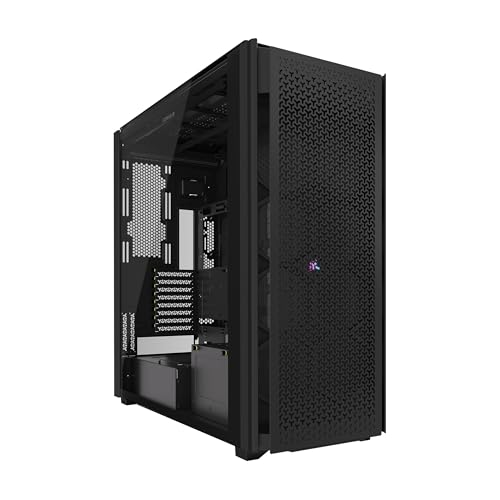
Read the 9000D’s listing as a specification for a building, not a box: a super full-tower that fits up to eighteen 120mm fans, seven 140mm, or four 200mm; an InfiniRail fan mounting system; an iCUE LINK system hub included; and no fans included. That final clause is the key to the whole design. The 9000D is sold to builders who regard fan selection the way photographers regard lenses — as a personal system, accumulated deliberately — and who would resent paying for bundled fans destined for a drawer. What Corsair sells instead is capacity and infrastructure: rails that let enormous fan arrays be positioned and repositioned, and the hub that lets an iCUE LINK ecosystem run the array as one instrument.
The scale unlocks builds that are simply not available below it. Dual systems, extreme radiator counts, a workstation and a streaming PC in one enclosure’s philosophy if not always in one build — the super-tower’s natural inhabitants are projects, plural, the kind documented in build logs and revisited for years. Cooling at this scale becomes architecture: intake and exhaust zones, radiator stacks with their own airflow territories, a machine whose thermal design is a drawing before it is a purchase. If that sentence excites you, you are the 9000D’s reader. If it exhausts you, the 7000D was designed by the same company for you instead, and there is no shame in the finished product.
The cautions are arithmetic and logistics. Eighteen fan positions are a possibility, not an obligation — but even a half-populated array is a significant additional purchase on top of a flagship chassis, and the honest total cost of a 9000D build should be calculated before the case is ordered, not discovered after. The enclosure is also a piece of furniture by any measure: doorways, stairwells, desk load and the simple question of where it stands while you build inside it all deserve forethought. Buy it as the foundation of a multi-year project and it is magnificent. Buy it as a big box for a normal PC and it is the most expensive empty room in your house.
- Form factor: super full-tower
- Fan capacity per listing: up to 18 x 120mm, 7 x 140mm, or 4 x 200mm
- Included fans: none — hub included, fans are your specification
- Mounting: InfiniRail fan system
- Ecosystem: iCUE LINK system hub included per listing
Strengths
- Cooling capacity beyond any other case in this guide, full stop.
- InfiniRail turns fan placement into an adjustable system, not a fixed grid.
- Platform honesty: no bundled fans to pay for and discard.
Trade-offs
- Fans are a major additional cost — calculate the full build before ordering.
- Super-tower size and weight dominate a room and a moving day.
- Its capacities are wasted on a conventional single-system build.
Best for: extreme custom loops, dual-purpose project builds, cooling architects. Not suited for: a normal gaming PC, a tight budget, or a small room.

Fractal Design North XL — Best Big Case for Shared Rooms
The original North proved a gaming PC could wear walnut; the North XL asks the more interesting question of whether a big one can. This is the XL edition — Charcoal Black with dark tempered glass per its listing title — scaling Fractal’s furniture-grade design up to the proportions E-ATX builds and larger cooling layouts require. The slatted wood front that made the standard North a living-room citizen survives the enlargement, and it matters more at this size, not less: a full-tower is the most visible object in any room it enters, and the difference between a walnut-fronted XL and a glowing super-tower is the difference between a sideboard and a server rack in your home’s most social space.
Function follows the furniture honestly. The XL’s enlarged interior takes the big boards and longer cards that define this guide’s category, and the front remains a working intake behind its timber. It will not chase the 9000D’s fan census or the 7000D’s loop-first layout — Fractal’s design energy goes into proportion, materials and the calm of the finished object. For the home where a workstation must earn its place in a shared study, or a gaming rig drives the living-room television, that trade is not a compromise. It is the entire requirement, met at a scale the standard North could not reach.
Choose the North XL when the build is big and the room is shared — the two conditions that eliminate nearly every other case in this guide. Its cautions are the North family’s own: wood asks for ordinary furniture care, the aesthetic is a commitment that will organise the room around it, and extreme radiator architects should count mounting positions against their drawings before assuming an XL interior is an unlimited one. Within its brief, though, it stands alone here: the only big case you could place beside a record collection without starting an argument about either.
- Form factor: XL full-tower class, E-ATX builds
- Front: walnut slatted intake, charcoal finish
- Side panel: dark tempered glass per listing title
- Character: furniture-grade design at full-tower scale
- Standout trait: the only pick that makes a big PC welcome in a living room
Strengths
- Genuine big-case capacity in a design households accept.
- Walnut front remains a functional intake, not decoration over a seal.
- Dark glass and charcoal finish suit grown-up rooms and studies.
Trade-offs
- Cooling ceiling sits below the airflow-flagship Corsairs for extreme loops.
- Wood finish wants the care any furniture wants.
- The look is a strong commitment — it will set the room’s tone.
Best for: E-ATX and large builds in living rooms and shared studies. Not suited for: maximum-radiator project builds or all-RGB showcase themes.

MONTECH AIR 903 MAX — Best Big-Capacity Value
Accuracy first: the AIR 903 MAX is an E-ATX mid-tower, and this guide will not promote it to full-tower to flatter the keyword. What its listing claims is more interesting than a promotion — support for E-ATX motherboards, graphics cards up to 400mm, 360mm radiators at both top and front, four fans included, tempered glass, USB-C, vertical GPU readiness, dedicated cable space and dust filters, all inside a mid-tower’s footprint. Read that again slowly. The two specifications that push most builders toward a full-tower — the big board and the long card — are both answered here, with radiator positions that match the 7000D’s ambitions more closely than its size suggests.
That makes the 903 MAX the pragmatist’s big case. A builder whose E-ATX workstation board and flagship-length card have outgrown a standard mid-tower, but whose room, desk and budget have not outgrown anything, gets the capacity without the furniture. Four included fans complete the cooling start, the cable space acknowledges that big boards bring big cable counts, and the vertical GPU readiness serves the showcase instinct without a bracket hunt. MONTECH’s value engineering shows in the aggregate: no single specification is exotic, but the combination, at a mid-tower’s scale and price class, is rare enough to headline a guide about bigness.
The limits are the limits of compression. A mid-tower that swallows E-ATX and 400mm cards has spent its interior generously on those two tricks; elaborate multi-radiator loops with reservoirs will find the 7000D’s true full-tower volume more forgiving, and builders planning a second system or a fan array in double figures belong in the 9000D’s territory entirely. Judge the 903 MAX as what it declares itself to be — the most capacity a mid-tower can honestly hold — and it is the value pick of this guide by a wide margin.
- Form factor: E-ATX mid-tower (not a full-tower — labelled honestly)
- GPU support: up to 400mm per listing
- Radiator support: 360mm top and front per listing
- Included fans: 4 per listing; USB-C front connection
- Extras per listing: vertical GPU ready, cable space, dust filters
Strengths
- E-ATX board and 400mm card support without full-tower bulk.
- Dual 360mm radiator positions match larger cases’ ambitions.
- Four fans included keep the value complete, not theoretical.
Trade-offs
- Interior volume still trails a true full-tower for complex loops.
- Not the choice for fan arrays in double figures or dual systems.
- Value finish is functional rather than furniture-grade.
Best for: E-ATX and long-card builds in rooms that cannot host a full-tower. Not suited for: extreme multi-radiator projects — step up to the 7000D or 9000D.
Lian Li LANCOOL 217 — Best Gateway to Big
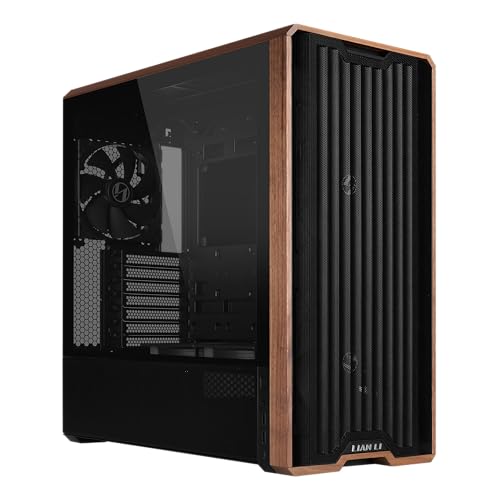
Every category needs its honest border case, and in this guide it is the LANCOOL 217: a generously proportioned ATX mid-tower with walnut trim and five PWM fans fitted as standard. It is not a full-tower, and we will not call it one. It earns its place because a large share of readers searching for big cases do not actually need a full-tower — they need more than the compact mid-tower they have, in airflow, in fan count and in working room, without committing to furniture-scale hardware. For that reader, the 217 is not a compromise pick. It is the correct destination, and the full-towers above are the over-purchase.
The substance behind the gateway label is the fan array and the control that comes with it. Five PWM fans is a complete cooling system with headroom, trimmable from near-silent desktop manners to full gaming draw, and the LANCOOL interior gives a growing build room to breathe and to be worked on. The walnut trim, shared in spirit with the North XL, warms a room at mainstream scale. A builder stepping up from a cramped or sealed case will feel the difference in every dimension that made them search this keyword — space, air, calm — while keeping the machine on the same desk, under the same shelf, in the same life.
Its boundary is equally clear, and stating it protects the reader in both directions. E-ATX boards, dual-radiator loops and 400mm-class ambitions exceed the 217’s brief; if your parts list already names them, the cases above this one are your guide. But if your search for big began with a hot, cramped PC and a suspicion that size was the answer, test the suspicion here first. The gateway pick exists so that bigness is a decision, not a drift — and many builders who pass through it discover, happily, that they have arrived.
- Form factor: ATX mid-tower — the roomy end of mainstream, not a full-tower
- Included fans: 5 x PWM per listing
- Accent: walnut wood trim
- Control: full PWM fan management via motherboard
- Standout trait: the step up from compact cases without the full-tower commitment
Strengths
- Five controllable fans give genuine big-case airflow behaviour.
- Roomy mainstream interior ends the cramped-case frustrations.
- Walnut trim suits shared rooms at a smaller scale than the North XL.
Trade-offs
- Not E-ATX, not full-tower — true big-build parts exceed it.
- Radiator ambitions beyond the mainstream belong to the Corsairs.
- Buyers who truly need big will buy twice if they stop here.
Best for: builders outgrowing a compact case who need air and room, not a tower. Not suited for: E-ATX boards or multi-radiator loops — those start two picks up.
Fractal Design Define 7 XL (Prose-Only) — Best Silence-First Full-Tower
This final pick carries no link, deliberately: our verified pool for this batch holds no listing for it, and a guide’s honesty is worth more than a sixth hyperlink. The Define 7 XL is Fractal Design’s true full-tower in the Define tradition — a large, steel, sound-damped enclosure built around modular storage and quiet operation, the long-standing reference for builders whose big build must also be an unobtrusive one. Where the 7000D chooses airflow and the 9000D chooses capacity, the Define line chooses calm: dense panels, damping material, and an interior that can be arranged toward drives and work rather than display.
It belongs in this guide because a real class of big builds is invisible in most round-ups — the home server that becomes a workstation, the studio machine beside a microphone, the overnight renderer in a bedroom. For those, the XL’s scale serves storage and sustained loads while its damping serves the room. We describe it qualitatively because we will not invent specifications we have not verified in this pool; readers who shortlist it should confirm its current listing details directly. Its presence here is a signpost, and signposts do not need affiliate links to be useful.
Consider it the counterweight that keeps this guide honest. Big cases are usually sold on spectacle — fan counts, glass, radiators — and the Define 7 XL represents the builders who want the volume without the theatre. If your big build’s defining requirement is that nobody notices it working, this prose-only pick may be your first choice rather than your sixth, and the linked cases above will forgive you. They were built for different rooms.
- Form factor: full-tower (prose-only — no verified ASIN in this pool)
- Character: sound-damped, storage-led, modular interior
- Glass/display focus: minimal by design
- Standout trait: big-case volume with silence as the headline specification
- Availability note: check the current listing directly; no dp link is provided here
Strengths
- Damped, quiet-first design no airflow flagship can imitate.
- Full-tower storage depth for server and workstation hybrids.
- Understated appearance suits studios and bedrooms alike.
Trade-offs
- No verified link in this pool — you must source and confirm it yourself.
- Damped panels trade raw airflow ceiling for quiet.
- Utilitarian looks will not satisfy a showcase builder.
Best for: silence-first full-tower builds, studios and storage-heavy workstations. Not suited for: readers who want a verified one-click pick from this guide.
How Do the Big Cases Compare at a Glance?
| Case | Class | Fans included | Defining trait |
|---|---|---|---|
| Corsair 7000D Airflow | Full-tower | 3 x 140mm AirGuide | Complete flagship, loop-ready |
| Corsair 9000D RGB Airflow | Super full-tower | None — up to 18 x 120mm capacity | Platform for cooling architects |
| Fractal North XL | XL / E-ATX | Standard Fractal complement | Walnut furniture at full scale |
| MONTECH AIR 903 MAX | E-ATX mid-tower | 4 | 400mm GPU, dual 360mm positions |
| Lian Li LANCOOL 217 | ATX mid-tower | 5 x PWM | The gateway step up |
| Fractal Define 7 XL | Full-tower (prose-only) | — | Damped silence and storage |
What Should You Check Before Buying a Big Case?
Begin outside the PC entirely: the room. Measure the floor or desk space the case will occupy, the height beneath any shelf, and the path it will travel through doorways and around corners to get there — a super-tower that cannot round a stairwell is a very expensive problem to discover on delivery day. Check the desk’s load rating if the case will stand on it; a filled full-tower with a custom loop carries serious weight, and floor placement beside the desk is the traditional, safer answer for the largest builds. Then confirm the build’s actual requirements against the listing: E-ATX support if your board needs it, radiator positions drawn against your loop plan, and card length, where the AIR 903 MAX’s stated 400mm shows the standard a big case should meet.
Finally, cost the whole enclosure, not the chassis. The 9000D’s empty fan mounts are the extreme example of a general rule: big cases invite big cooling, big cooling has a bill, and the bill belongs in the decision. Add the fans, the radiators, the extra fittings and the longer cable runs a full-tower sometimes needs, and compare complete builds rather than bare frames. The 7000D’s included fans and the 903 MAX’s four fitted units look different — better — under that arithmetic than they do on a sticker.
How Do You Plan a Custom Loop in a Full-Tower?
Draw it before you buy it, on paper, to scale if you can manage it. Radiators claim the case’s edges — front, top, sometimes side — and each placement spends something: a front radiator spends card length and warms the intake air for everything downstream; a top radiator spends headroom and asks about memory clearance; both spend fan positions that the plan must populate with intent. The full-towers in this guide exist to make those trades gentle rather than impossible. Reserve the pump and reservoir a home with service access, route the loop so the drain point is the lowest point, and leave one fan position’s worth of slack in the plan for the fitting you forgot, because there is always a fitting you forgot.
Build the loop outside the case’s schedule, not inside it. Assemble and test the core system on air first if the parts allow, so a dead component is diagnosed before it is plumbed into a litre of coolant. Fill slowly, leak-test with the system powered only at the pump, and keep the first week of operation supervised the way you would watch a new aquarium. A big case rewards this patience with the thing it was bought for: a machine whose cooling is a designed system with headroom in every direction, quiet at loads that would have a mid-tower shouting. The size was never the point. The headroom was.
What Mistakes Do Big-Case Buyers Keep Making?
The expensive mistake is buying capacity without a named use, then filling the void with purchases to justify the room. The logistical mistake is skipping the doorway measurement — it sounds like a joke until a super-tower meets a narrow hallway. The budgetary mistake is pricing the 9000D as a chassis rather than as a chassis plus the fan array its design invites. The thermal mistake is assuming big means automatically cool: an empty full-tower with two fans can move air worse than a focused mid-tower, because volume without airflow design is just a larger room for heat to loiter in. And the aesthetic mistake is placing a showcase super-tower in a shared room without household consultation — for which the North XL exists as this guide’s standing act of diplomacy.
Why Does a Workstation Belong in a Full-Tower?
Because workstation loads are measured in hours, and hours change what a case must be. A gaming PC sprints; a rendering, compiling or training workstation holds its pace through the night, and sustained load is where full-tower virtues compound — radiator area that keeps coolant temperatures and fan speeds low indefinitely, room for the storage arrays and capture or accelerator cards that professional work accumulates, and cable and airflow organisation that survives the third year of hardware swaps. Noise behaves differently across an eight-hour render too: a case that is merely acceptable for a two-hour game becomes the room’s defining sound by hour five, which is why the damped Define 7 XL and the headroom-rich 7000D both belong in a workstation conversation.
There is also the matter of service. Professional machines are opened on schedules, not whims — drives rotated, cards added, dust cleared between projects — and a full-tower’s working room turns maintenance from a dismantling into a visit. If the PC earns money, the case is part of its tooling, and tooling is bought for the decade. That is the sober centre of this whole guide: big cases are not toys scaled up. At their best they are the workshop itself, sized to the work.
How Do You Move and Maintain a Case This Large?
Empty it of what can be emptied, carry it with two people or a trolley, and never lift a loop-filled full-tower by its panels. For routine care, the scale helps you: filters are larger and fewer per litre of case, interiors admit a whole hand with a cloth, and fan arrays on rails — the 9000D’s InfiniRail above all — can be slid, cleaned and reseated without unbuilding the machine. Set a twice-yearly rhythm for deep cleans and a monthly glance at intakes, and a big case will hold its temperatures the way a well-kept workshop holds its order. The owners who struggle are the ones who treated delivery day as the finish line; a full-tower is a premises, and premises are kept.
What Is E-ATX, and Do You Actually Have One?
E-ATX — extended ATX — is a motherboard format wider than standard ATX, and the width is where beginners in the big-case market get caught, because the term is used loosely. True E-ATX boards stretch toward server dimensions; many boards marketed with the label are only modestly wider than ATX, and cases vary in which flavour they genuinely swallow, including whether the wider board covers the cable grommets it passes over. The discipline this guide recommends is unfashionable and absolute: take your board’s exact dimensions from its maker, take the case’s stated motherboard support from its listing, and confirm the two agree — then confirm the cable cut-outs remain usable at that width, because a board that fits but seals its own cable doors has solved the wrong problem.
Most readers, honestly, do not own an E-ATX board and never will. The format serves multi-GPU and HEDT workstations, heavy storage controllers and memory counts beyond mainstream chipsets. If your board is standard ATX, every case in this guide still welcomes it — you are buying radiator room, fan capacity and working space, which are reasons enough. But let the board you own, not the board in a forum signature, set the requirement. Big-case shopping goes wrong when it is driven by an imaginary future parts list; it goes right when the parts on your desk, plus one plausible upgrade, draw the specification.
Why Do Big Cases Still Matter in the Age of Small PCs?
The mini-PC movement is real and delightful, and it makes the full-tower look, at first glance, like a survivor from another era. Look closer and the two trends serve different physics. Small cases win on volume and charm; they lose, unavoidably, on radiator area, expansion and the simple ability to hold a hand inside while working. The workloads that fill big cases — sustained rendering, simulation, local AI work, multi-card capture and storage duty — have not shrunk with the fashion. If anything they have grown hungrier, and heat remains the one specification no industrial design can charm away. A litre of case can hold only so much radiator, and a radiator can shed only so much heat, and the full-tower is what that arithmetic looks like when it is allowed to be generous.
There is also a longevity argument that small cases cannot answer. A full-tower bought today will accept the next decade’s boards, cards and cooling fashions without a dimensional argument, because it has room in every direction the industry might grow. The 7000D under a desk in 2032 will be on its fourth platform, and its owner will have bought one case while the fashion cycle sold others four. Bigness, in that light, is not the opposite of the small-PC ethos. It is the same ethos — buy once, buy well — expressed at the other end of the tape measure.
How Much Storage Can a Big Case Really Hold?
Storage is the quiet reason many full-towers are bought and the first thing their marketing forgets to photograph. A large chassis offers what no mid-tower can match: bays and mounting points for stacks of drives, room to cable them without strangling airflow, and the physical separation that lets a home server, a media library and a workstation share one enclosure without sharing one cramped drive cage. The Define 7 XL’s reputation rests substantially here — its modular interior can be arranged toward drive capacity in a way that makes it a genuine server alternative — while the Corsair flagships serve the modern pattern of fast NVMe storage on the board plus a modest, well-cooled set of bulk drives in the case.
Plan storage the way you plan radiators: count today’s drives, add the two you can already foresee, and check the case’s arrangement serves that number with the cooling layout you also intend — because drive cages and radiator positions sometimes claim the same front territory, and the compromise should be chosen on paper, not discovered with a screwdriver. For most gaming builds this is a footnote; for the workstation and home-server readers who quietly dominate full-tower sales, it is the chapter that decides the purchase, and it is why this guide keeps a storage-led, silence-damped full-tower in its six despite that pick arriving without a link.
How Do You Keep a Big Case Quiet at Full Load?
The paradox of the full-tower is that it contains the most fans and can be the quietest machine in the house — if the array is run as a system rather than a crowd. The governing principle is the same one that rewards the large-fan designs elsewhere in our guides: many fans turning slowly move more air, more quietly, than few fans turning fast. A 9000D populated thoughtfully, its InfiniRail array loafing at low speed, presents a broad, low sound that rooms absorb easily. The same case with its array at full tilt is a wind tunnel with a mortgage. The hardware permits both; the fan curve decides, and a big case deserves a curve set in stages — intake and exhaust zones responding to the temperatures they actually serve, with a floor low enough that idle means silence.
Radiators help the cause when they are sized generously, which is the full-tower’s home advantage: more radiator area means each fan on it works less for the same heat rejection, and pump speeds can stay in their calm register. Damping is the other road, the Define line’s road, and the two approaches suit different rooms — airflow-and-headroom for the study that can tolerate a low rush of air, damping for the studio where a microphone has opinions. What does not work is the accidental big case: flagship volume, default fan settings, no plan. Spend the hour the curve deserves, and the largest object in the room becomes one of its quietest, which is the full-tower’s most satisfying trick.
What Does a Big Case Cost to Own Over Ten Years?
The purchase price is the smallest honest number in a full-tower’s ledger, and thinking in decades clarifies every pick in this guide. Add the completion cost first — fans for the 9000D’s empty mounts, fittings and radiators for a loop, the longer cables a tall case occasionally demands. Add the running reality: a big case that cools at low fan speeds ages its fans slowly, holds its filters longer between cleans by sheer area, and accepts a decade of boards without replacement, where a marginal mid-tower might be retired at the second platform change. Subtract, finally, the resale and hand-me-down value of a flagship chassis, which survives in a way budget cases do not; a 7000D in good order is a gift worth giving in year six.
Set against that ledger, the value pick’s argument sharpens rather than dulls. The AIR 903 MAX delivers the two specifications that force most upgrades — E-ATX support and 400mm card room — at a mid-tower’s cost of entry and footprint, and for the builder whose decade holds boards and cards but not loops and dual systems, it may be the most rational line in the table. Ownership cost is a match between a case’s capacities and a life actually lived with it. The most expensive case in this guide is the one bought for a build that never happens; the cheapest is whichever of the six is still in service, uncomplained about, in ten years’ time.
How Do You Build Inside a Full-Tower Without Losing the Day?
Scale changes the build’s choreography in ways first-time full-tower owners underestimate. The case is too large for the kitchen table and too heavy to rotate casually, so the build happens where the machine will live, on the floor or a low, sturdy surface, with parts staged within reach like a theatre’s props. Fit the motherboard outside the case as far as your cooler allows, because leaning into a tower’s depth with a screwdriver is nobody’s idea of precision. Route the long cable runs first — in a full-tower, the power supply may sit a surprising distance from the board’s far connectors, and discovering a cable’s shortfall after the radiators are mounted is the class’s signature frustration. Work from the inside out: board, storage, cooling hardware, then the graphics card, and keep the panels off until the loop is filled, the system has posted, and the fan array has been heard at full speed once, deliberately, so its voice holds no surprises later.
The reward for the slower ceremony is the build’s quality of life ever after. Everything in a full-tower is reachable; every upgrade is a visit rather than a dismantling; every cable can be re-routed without unpicking three others. Builders who come from compact cases describe the first full-tower build the way cooks describe a first large kitchen — the same tasks, suddenly unhurried. That unhurried quality is, in the end, a performance feature: machines that are pleasant to maintain get maintained, and maintained machines hold their temperatures, their quiet and their value. The big case earns its room every time you open it and find room to work.
Can One Big Case Hold a Gaming PC and a Streaming PC?
It is the use case super-towers are whispered about, and it deserves a plain answer: the largest enclosures exist partly to consolidate what used to be two machines — the gaming rig and the streaming or server system — into one footprint, one cooling plan and one set of fans to clean. Even where a specific chassis is not configured as a literal dual-system case, the full-tower’s volume serves the same consolidation in spirit: capture hardware, extra storage, a second set of drives for recording, and the radiator area to cool a machine that is gaming and encoding at once. The practical gains are domestic as much as technical. One tower under the desk instead of two means one noise source to tame, one dust contract to keep, and one cable thicket where a pair used to breed.
The honest cautions are heat and complexity. Two workloads in one enclosure share one thermal environment, so the fan and radiator plan must be drawn for the combined worst case, not for either machine alone — this is precisely the scenario the 9000D’s fan capacity and the 7000D’s complete airflow were designed around. Power delivery and cable discipline also stop being hobbies and become infrastructure. Consolidate because the combined build genuinely simplifies your room and your maintenance, not because the empty half of a super-tower made you restless. Space in a case, like space in a house, has a way of filling with whatever the owner allows; the builders who benefit from bigness are the ones who decided in advance what the room was for.
Final Recommendation
Name your reason, then buy the case that answers it. A finished flagship loop or workstation belongs in the 7000D; a multi-year cooling project belongs in the 9000D, with its fan bill counted in advance; a big build in a shared room belongs in the North XL; E-ATX capacity without the furniture belongs in the AIR 903 MAX; a builder who needs room rather than a tower belongs in the LANCOOL 217; and the silence-first should follow the Define 7 XL signpost and verify its listing directly. Bigness, chosen honestly, is not excess — it is the moment a PC stops negotiating for space and starts simply working, in a case that will still have room for the idea you have not had yet.
Frequently Asked Questions
What actually makes a PC case “big”?
Capability, not adjectives: E-ATX motherboard support, multiple large radiator positions, fan capacity in double figures, or card support around 400mm. The 7000D, 9000D, North XL and Define 7 XL are true full-tower class; the AIR 903 MAX is an E-ATX mid-tower with big-case capacity, labelled as such throughout this guide.
Does the Corsair 9000D really come without fans?
Yes — its listing states no fans included, while providing an iCUE LINK hub and InfiniRail mounting for up to eighteen 120mm fans. It is a platform for builders who specify their own cooling. Budget the fans before ordering the case.
Is a full-tower quieter than a mid-tower?
It can be, for two different reasons: airflow flagships like the 7000D cool at lower fan speeds thanks to headroom, while damped designs like the Define 7 XL absorb sound directly. A big case with a weak fan plan, though, is just a larger space to be loud in — the design, not the volume, decides.
Can a big case fit a normal ATX gaming build?
Yes, easily — ATX boards mount in all of these. The question is whether the build benefits. Without E-ATX parts, large radiators or expansion plans, a roomy mid-tower like the LANCOOL 217 may serve the same PC with less cost, weight and room taken.
What desk or floor space does a super-tower need?
More than its footprint: clearance above for exhaust, behind for cables, and a delivery path through your home that the case can physically travel. Measure all three before ordering any full-tower, and treat floor placement as the default for the heaviest loop-filled builds.
Are big cases harder to keep clean?
The opposite, mostly. Larger filters cover more area before they load up, interiors admit a cloth and a whole hand, and rail-mounted fans can be reached without dismantling the build. The discipline is the same monthly glance as any case; only the geography is grander, and the walk from one end of a super-tower to the other slightly more scenic.
Does a big case need to sit on the floor?
Not by rule, but by physics it often ends up there: a filled full-tower is heavy, and floor placement removes the desk’s load limit from the conversation while giving top exhaust an unobstructed ceiling to rise into. If the floor is carpeted, stand the case on a board or low riser so bottom intakes breathe and filters stay out of the pile. Desk placement suits the lighter end of this guide — the AIR 903 MAX and LANCOOL 217 — provided the desk is rated for the weight and the tower cannot be knocked by a passing elbow.
Will a big case make my PC faster?
Not directly — and any guide implying otherwise is selling you volume as performance. What a big case changes is the ceiling: sustained loads hold their boost longer when radiators and fans are not the bottleneck, and future parts fit without a dimensional negotiation. For a mainstream build that never approaches those ceilings, the speed difference against a good mid-tower is zero, which is why this guide keeps asking for your named reason before recommending the room.
How many radiators does a custom loop actually need?
Fewer than super-tower marketing suggests. A single large radiator handles a CPU-only loop comfortably; a CPU-plus-GPU loop is where the second radiator earns its place, and full-towers make that second unit a placement choice instead of an impossibility. Beyond two, returns diminish unless the build’s heat load is genuinely extreme — the 9000D’s capacity exists for the projects that are, and it is no criticism of a normal loop that it is not one of them.
Why is one pick in this guide prose-only?
The Fractal Define 7 XL has no verified listing in this batch’s pool, so it is discussed without a purchase link rather than attached to an unverified one. Its silence-first full-tower design is a genuine alternative worth a signpost — and your own check of its current listing.
Related Guides
Compare the mainstream class in Best Affordable Gaming PC Cases, weigh the look-first options in Best Aesthetic PC Cases, and revisit the airflow flagships in Best Airflow Full Tower PC Cases: Verified High-Airflow Mid-Towers and Two True Full Towers.
Related guides
- Best Enterprise SATA SSDs: Endurance Classes, Power-Loss Protection and Fleet Sense
- Best Color Product Label Printers: Six Desktop Machines for Short-Run Product Labels
- Best Printers for Dental Practices
- Best 1440p 165Hz Monitors: One Native 165Hz Pick, Three 180Hz Upgrades, an Overclock Headline and a 160Hz Ultrawide



[…] with Best Affordable Gaming PC Cases for the value end of the market, browse Best Aesthetic PC Cases when looks move up the list, and […]