What's inside
- Where to buy
- Key Takeaways
- Quick Picks
- How did we choose cases for an airflow full tower shortlist?
- Which airflow cases deserve your shortlist, mid-tower and full?
- How do the six positions compare on size and breathing?
- What actually decides airflow: the physics a buyer can check?
- How do you decide between a high-airflow mid-tower and a true full tower?
- How do you set up an airflow case so it performs as designed?
- What mistakes do airflow shoppers make most?
- How does an airflow case age, and what maintenance does it demand?
- Final Recommendation
- Frequently Asked Questions
- How does liquid cooling change the airflow calculation?
- What role does noise play in judging airflow honestly?
- How should a buyer verify a case’s airflow claims before ordering?
- What does a full tower feel like to live with for five years?
- Why did mid-towers steal the full tower’s cooling crown?
- How do dust, pets and seasons rewrite an airflow plan?
- What should be measured on the first evening after the build?
- How do you move a full tower without regretting the purchase?
- Related Guides
As an Amazon Associate I earn from qualifying purchases. This post may contain affiliate links at no extra cost to you.
gizmoverdict.com is reader-supported. When you buy through links on our site, we may earn an affiliate commission.
Where to buy
Linked names below open listings verified through this site’s own product feed, and the best airflow full tower cases PC builders hunt for begin with a distinction this guide refuses to blur. The best airflow full tower cases PC shoppers imagine are enormous, fan-covered chassis, yet the verified pool for this batch is dominated by mid-towers whose airflow engineering has become so effective that they have absorbed most of the full tower’s historical purpose. Four linked picks below are those mid-towers, labelled as mid-towers every time they are named. Two prose positions cover genuine full towers, the Corsair 7000D Airflow class and the Fractal Meshify 2 XL class, for builders whose hardware truly needs the volume. Nobody should finish this page believing they bought a full tower when they bought a mid-tower, or the reverse.
Airflow itself needs defining before any case earns the word. A high-airflow case moves a large volume of air through the chassis with minimal obstruction: an open or mesh front, fans sized and placed to feed the graphics card directly, exhaust paths that do not fight the intake, and interior geometry that avoids trapping hot air in pockets. Glass-front cases with side vents can approach that performance and sealed cases cannot, whatever their fan count. The cases gathered here were chosen because their designs start from that physics rather than from a silhouette, and their sections describe the specific mechanism each one uses, because airflow is a mechanism, not a mood.
The full tower question then becomes a question about contents. A full tower earns its footprint when a system carries multiple radiators, several graphics or capture cards, a forest of drives, or an E-ATX board, or when its owner simply wants assembly room that turns maintenance into a pleasure. A single-card gaming system with two drives gains almost nothing from the volume and loses desk space, money and the focused airflow path that a good mid-tower provides. This guide therefore treats the mid-tower picks not as consolation prizes but as the correct answer for most readers, and the full tower prose positions as the correct answer for a specific, identifiable minority.
Key Takeaways
- Four linked picks are high-airflow mid-towers, labelled honestly, led by Lian Li’s LANCOOL 216 with its twin 160mm front fans.
- True full towers appear as prose positions, the Corsair 7000D Airflow and Fractal Meshify 2 XL classes, for radiator and drive-heavy systems.
- Airflow quality is decided by front openness, fan size and placement, and exhaust freedom, not by fan count alone.
- Most single-card gaming systems cool better in a focused mid-tower than in an empty full tower with unfocused air paths.
- Full tower volume earns its cost when E-ATX boards, multiple radiators or many drives genuinely enter the parts list.
Quick Picks
| Pick | Badge | Why it earns its place |
|---|---|---|
| Lian Li LANCOOL 216 RGB | The airflow benchmark, mid-tower | Two 160mm front fans behind mesh move air the way this keyword dreams about, in an ATX mid-tower body. |
| Lian Li LANCOOL 217 | The refined successor, mid-tower | Five PWM fans and a walnut-accented design that treats airflow and furniture manners as one problem. |
| Corsair 4000D RS Frame | The modular airflow frame, mid-tower | Corsair’s modular Frame design with three RS fans and high-airflow intent for builders who reconfigure often. |
| Fractal Design North, mesh side | The breathable furniture case, mid-tower | Walnut slats over a ventilated front and a mesh side panel, for rooms where the PC must behave like furniture. |
| Corsair 7000D Airflow class | The true full tower, prose | Prose-only: a genuine full tower with a perforated front and room for serious radiator arrays. |
| Fractal Meshify 2 XL class | The storage full tower, prose | Prose-only: full tower volume arranged for many drives and large boards behind a mesh front. |
How did we choose cases for an airflow full tower shortlist?
The selection began by separating the keyword’s two demands and grading them independently. Airflow was graded on design evidence available in verified titles and the known engineering of each model line: front panel openness, stock fan size and count, and whether the case’s interior directs air at the graphics card or merely stirs the whole volume. Size was graded by the manufacturer’s own classification, and any case the maker calls a mid-tower is called a mid-tower here, without exception. That second rule is what gives this guide its unusual shape, and it is non-negotiable, because a buyer planning around full tower dimensions deserves dimensions they can trust.
Within the pool, Lian Li’s LANCOOL line demanded two positions because it represents the modern airflow consensus at its most developed: very large front fans turning slowly, mesh everywhere air wants to travel, and interiors arranged around the graphics card’s appetite. Corsair’s Frame entry earned its place by adding modularity to the same physics, and Fractal’s North earned its place by proving that a case can breathe properly while looking like it belongs beside a bookshelf. Each linked pick therefore teaches a different lesson about how airflow is achieved, which is what a shortlist in a design-led category should do.
The prose full towers were chosen to be genuinely full and genuinely airflow-minded, since token giants with sealed fronts would betray both halves of the keyword. The Corsair 7000D Airflow class carries the airflow variant of Corsair’s largest mainstream chassis, and the Fractal Meshify 2 XL class pairs full tower volume with the mesh philosophy its line is named for. Both are discussed with their real trade-offs, size, weight and price character included, and both are left unlinked because this batch’s pool verified no full tower listing. A reader who needs one can shop the class with the checks in the buying sections below.
One further criterion quietly shaped the list: fan control. High airflow achieved by fans that cannot be slowed is a noise problem wearing a cooling badge, so cases whose stock fans are PWM and motherboard-controllable were favoured, and fixed-speed arrangements were noted as caveats where they appear. The best airflow case is the one that moves the most air at the noise level its owner can live beside, a definition that rewards engineering over bravado and that every section below applies.
Which airflow cases deserve your shortlist, mid-tower and full?

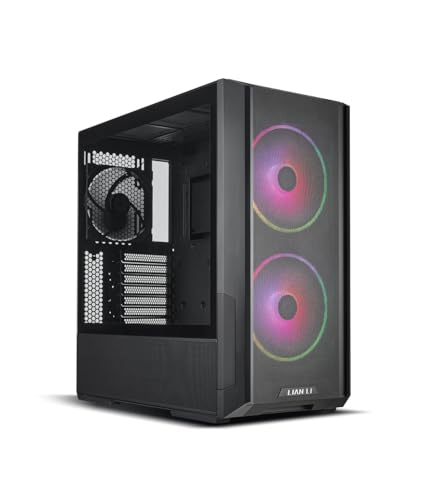
Lian Li LANCOOL 216 RGB — The airflow benchmark, mid-tower
Start with the mechanism, because this case is a mechanism before it is an object. Its verified title names two 160mm ARGB fans at the front, and that single specification explains its reputation: fans of that diameter move a great deal of air while turning slowly, and slow fans are quiet fans. Behind a mesh front, the pair feeds the interior with an unobstructed column of air aimed where a graphics card’s intake fans are waiting, while the case’s interior layout keeps the path from front to rear unusually honest. This is the design that reviewers reach for when they need a mid-tower reference point for cooling, and its presence here as a linked pick is the least surprising sentence in the guide.
The mid-tower label deserves its own paragraph rather than a footnote. The LANCOOL 216 houses ATX builds with room and grace, supports large modern graphics cards and respectable radiator arrangements, and will satisfy the overwhelming majority of readers who arrived via a full tower keyword. What it will not do is swallow an E-ATX board with cabling room to spare, host a smallholding of hard drives, or give a dual-radiator custom loop the canvas it wants. Buyers whose parts lists contain none of those things should hear the mid-tower label as good news: less money, less desk, and airflow so competent that the full tower’s cooling argument evaporates.
- Size: ATX mid-tower, stated plainly
- Front fans: two 160mm ARGB fans, per the verified title
- Front design: mesh, arranged for direct graphics card feeding
- Character: reference-grade airflow in a mainstream footprint
Strengths
- Twin 160mm front fans deliver high airflow at low rotational speed and civilised noise.
- Mesh front and focused interior path cool graphics cards as directly as any mid-tower made.
- Assembly room and cable design are generous for the class, easing first builds and upgrades alike.
Trade-offs
- It is a mid-tower, so E-ATX boards, drive farms and elaborate loops exceed its brief.
- ARGB lighting may need subduing for bedrooms and offices that prefer darkness.
- Its popularity means stock and pricing vary, so timing a purchase rewards patience.
Best for: high-performance single-card gaming builds that want flagship cooling without flagship size. Not suited for: genuine full tower contents, however fondly the keyword was typed.
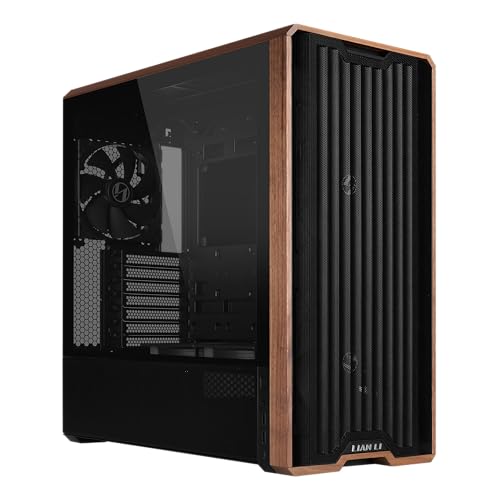
Lian Li LANCOOL 217 — The refined successor, mid-tower
The LANCOOL 217 reads like Lian Li’s answer to a question the 216 raised: how much refinement can an airflow case absorb before it stops being an airflow case? Its verified title lists five PWM fans included, a count that removes fan shopping from the build entirely, and names walnut wood among its materials, placing a piece of furniture’s warmth on a performance chassis. The combination is characteristic of where case design has travelled: the machine is expected to cool like equipment and sit in a room like furniture, and this generation attempts both without apologising for either ambition.
Five PWM fans change the ownership experience in a specific way worth describing. Coverage stops being a project: front intake, rear exhaust and supplementary positions arrive populated and controllable, so the builder’s job becomes tuning curves rather than purchasing coverage. Walnut accents, meanwhile, impose a small discipline of their own, since wood belongs in rooms with a point of view and can clash with a desk built from chrome and black glass. Neither consideration diminishes the case’s airflow credentials, which descend directly from the line’s mesh-first philosophy. It is the pick for the reader who wants the LANCOOL mechanism with the edges sanded, literally and otherwise.
- Size: ATX mid-tower
- Fans: five PWM fans included, per the verified title
- Materials: walnut wood accents, per the title
- Character: airflow performance with furniture-grade finish
Strengths
- Five included PWM fans complete the airflow system with no further purchases.
- Wood accents let a high-performance machine live gracefully in considered rooms.
- LANCOOL airflow lineage keeps cooling honest beneath the refinement.
Trade-offs
- Still a mid-tower, with the same full tower exclusions as its sibling above.
- Walnut styling commits the desk to a warmer aesthetic direction.
- Refinement prices it above the raw-performance value its predecessor sometimes offers.
Best for: builders who want complete fan coverage and a room-friendly finish in one purchase. Not suited for: full tower contents, or desks whose style runs cold and industrial.

Corsair 4000D RS Frame — The modular airflow frame, mid-tower
Corsair’s contribution to this list is an idea about change. The verified title describes a Frame Modular design with high airflow intent and three RS fans included, and the modularity is the story: panels and mounts arranged to be reconfigured as a build evolves, inside the 4000D lineage that taught a generation of builders what a tidy mid-tower interior feels like. A case that expects to be rearranged suits the owner whose machine is a continuing project, adding a radiator here, a drive there, a new card when the old one’s fans begin to sing. Static cases serve static builds; this one is aimed at the restless.
Three included RS fans give the modularity something to work with from the first evening, establishing the front-to-back current that the whole airflow idea depends on. As with the Lian Li picks, the size honesty applies in full: this is a mid-tower, superb for ATX gaming systems, wrong for E-ATX or drive-farm ambitions. Corsair’s ecosystem gravity deserves a mention as the pick’s soft caveat, since a modular case invites its owner into a family of matching parts and controllers. That gravity is pleasant when embraced deliberately and mildly annoying when discovered accidentally, so embrace it deliberately or choose a more neutral chassis.
- Size: ATX mid-tower
- Design: Frame Modular system, per the verified title
- Fans: three RS fans included, per the title
- Character: reconfigurable high-airflow interior
Strengths
- Modular construction adapts as the build’s cooling and storage needs evolve.
- Three included fans establish proper airflow from the first assembly.
- 4000D lineage brings proven interior manners and wide parts familiarity.
Trade-offs
- Mid-tower volume excludes the full tower workloads this keyword also names.
- Corsair’s ecosystem can pull a build toward matching proprietary companions.
- Modularity rewards planners; a build that never changes pays for flexibility unused.
Best for: evolving ATX gaming builds whose owners reconfigure cooling as parts change. Not suited for: E-ATX systems, many-drive storage builds or deliberately static machines.

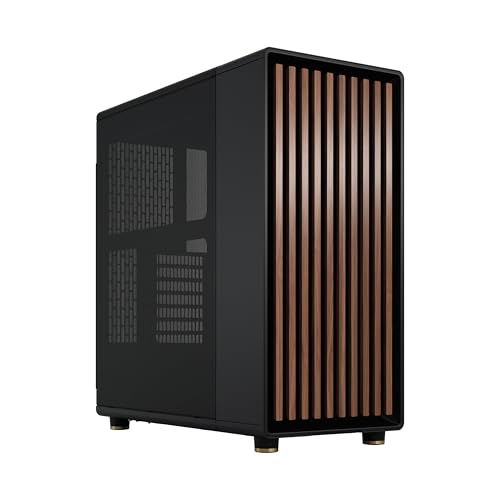
Fractal Design North, mesh side — The breathable furniture case, mid-tower
The North is the case that walks into a room and changes what the room thinks a computer is. Its verified listings describe walnut front slats, and this mesh-side variant pairs that wooden front with a ventilated side panel, a combination that treats breathing as a whole-surface problem rather than a front-only one. Air enters through the slatted front’s gaps and the mesh side gives the interior an additional, unusually large exchange surface, so a system inside stays supplied without the visual language of a gaming appliance. For living rooms, studios and offices where a black tower would be an intrusion, this is airflow with manners.
Manners come with physics attached, and the North’s should be stated plainly. Its front is ventilated rather than fully open mesh, so its absolute airflow ceiling sits below the LANCOOL designs, and a flagship graphics card under sustained load will run somewhat warmer here than in a mesh maximalist case. The mesh side variant narrows that gap and is the version an airflow shopper should choose, which is why it, rather than its glass sibling, holds this position. Within those honest bounds, the North serves mainstream and even strong gaming builds beautifully, and it does so while being the only case in many homes that guests compliment without knowing what it is.
- Size: ATX mid-tower
- Front: walnut slats with ventilation, per the verified listings
- Side: mesh panel on this variant, adding a large breathing surface
- Character: furniture-first design with credible airflow
Strengths
- Mesh side panel lifts its airflow well beyond the glass variant’s comfort zone.
- Walnut and brass-toned design integrates with real rooms instead of dominating them.
- Fractal’s interior discipline keeps assembly calm and cable work tidy.
Trade-offs
- Absolute airflow trails the mesh-front LANCOOL picks under sustained flagship loads.
- Mid-tower size excludes full tower contents as firmly as every linked pick here.
- Its aesthetic is a commitment; rooms that want an appliance look should look elsewhere.
Best for: strong mainstream builds in living spaces where the PC must earn its place visually. Not suited for: maximum-possible cooling, full tower contents or showpiece glass ambitions.
Corsair 7000D Airflow class — The true full tower, prose
Here, finally, is an actual full tower. The 7000D Airflow class takes Corsair’s largest mainstream chassis and gives it the perforated steel front its name advertises, creating the volume and the breathing that the keyword’s two halves demand together. Inside that volume live the workloads mid-towers refuse: extended-ATX boards with room to cable them, radiator arrangements stacked at front and roof simultaneously, drive counts that turn a machine into household infrastructure. We hold no verified listing for it in this batch’s pool, so the treatment is prose, and a buyer should confirm the Airflow variant specifically, since a glass-front sibling shares most of the name and little of the breathing.
Owning a full tower is a lifestyle decision disguised as a specification. The case will dominate its corner, weigh enough to make moving day a planned operation, and cost accordingly, while rewarding its owner with assembly room that feels luxurious every single time a part changes. Fan and radiator support at this scale also invites spending at this scale, a gravity worth resisting deliberately: a full tower half-filled with a modest system is not wrong, but it is money parked in empty air. The class earns its recommendation when the parts list fills it with intent, and the buying sections below give that intent a checklist to prove itself against.
- Size: full tower, the genuine article
- Front: perforated airflow variant, confirm it against the glass sibling
- Capacity: E-ATX boards, multiple radiators, many drives
- Pool status: no verified listing held for this full tower class
Strengths
- True full tower volume with an airflow front, satisfying both halves of the keyword.
- Radiator and drive capacity absorb workstation and enthusiast builds without compromise.
- Assembly and maintenance room make every future upgrade physically pleasant.
Trade-offs
- Footprint, weight and price are all full-sized commitments.
- A modest system inside it wastes the volume the premium purchased.
- Variant confusion with the glass-front sibling demands careful ordering.
Best for: E-ATX, multi-radiator and drive-heavy systems that have outgrown every mid-tower. Not suited for: ordinary gaming builds, small rooms or anyone who moves house often.
Fractal Meshify 2 XL class — The storage full tower, prose
Fractal’s answer to the full tower question wears its philosophy in its name. The Meshify 2 XL class stretches the Meshify line’s mesh-front discipline over a full tower frame whose party trick is storage: a layout that can be arranged for a remarkable number of drives while keeping the front breathing freely. It is the full tower for the household server that games, the video archive that edits, the machine whose drive census reads like a small business’s. Like the Corsair above, it is prose-only in this guide for want of a verified pool listing, and its buyer should verify the XL specifically, since the Meshify family contains smaller siblings with similar names.
What distinguishes this class from the 7000D is emphasis rather than worth. Corsair’s giant leans toward radiator theatre and showcase builds; Fractal’s leans toward configurable storage and Scandinavian restraint, with panels that would rather be quiet than noticed. Both breathe properly in their airflow forms, both swallow E-ATX ambitions, and both punish indecision about whether the volume is truly needed. A buyer whose spreadsheet of parts includes a drive count in double figures will feel the Meshify’s layout was drawn for them personally. A buyer whose parts list is a card, a cooler and two drives should close this section and return to the LANCOOL picks with a clear conscience.
- Size: full tower, XL class
- Front: mesh, per the Meshify line’s defining design
- Capacity: extensive configurable drive storage, large boards
- Listing status here: prose-only coverage of an unlinked class
Strengths
- Storage-configurable interior serves archives, servers and media libraries superbly.
- Mesh front keeps full tower volume breathing as the keyword requires.
- Fractal restraint suits rooms that reject gaming theatre at any size.
Trade-offs
- Full tower scale and cost for capacity most builds never touch.
- Family naming makes exact-model verification essential before ordering.
- Its storage genius is wasted on the two-drive systems most gamers own.
Best for: drive-rich workstations, home servers and archives that also need real airflow. Not suited for: ordinary gaming desks, where its virtues would stand empty for years.
How do the six positions compare on size and breathing?
| Case or class | True size | Airflow mechanism | Status |
|---|---|---|---|
| Lian Li LANCOOL 216 RGB | Mid-tower | Mesh front, twin 160mm fans | Linked |
| Lian Li LANCOOL 217 | Mid-tower | Five PWM fans, mesh lineage | Linked |
| Corsair 4000D RS Frame | Mid-tower | High-airflow modular frame, three fans | Linked |
| Fractal North, mesh side | Mid-tower | Ventilated slats plus mesh side | Linked |
| Corsair 7000D Airflow class | Full tower | Perforated front, vast fan room | Prose-only |
| Fractal Meshify 2 XL class | Full tower | Mesh front, storage layout | Prose-only |
The size column is the table’s conscience, and readers should let it govern their reading of every other column. Airflow numbers divorced from volume mislead, because a full tower’s job is to cool more hardware, not the same hardware more smugly. Judge each row against the parts list it was designed to house, and the table becomes a matching exercise rather than a league ladder, which is the only honest way to rank cases across size classes.
What actually decides airflow: the physics a buyer can check?
Begin at the front panel, where cases either breathe or pose. Open mesh with a fine dust layer behind it is the gold standard; perforated steel follows closely; slatted or vented designs trade some openness for appearance; and solid glass or plastic fronts with side slots trail the field regardless of the fan army behind them. This hierarchy can be read from photographs of real units and from the maker’s own panel descriptions, and it predicts cooling behaviour better than any other single observation. A buyer who learns to grade fronts has learned most of airflow shopping.
Fan size and placement form the second lesson. Large fans move more air per revolution and therefore per decibel, which is why the LANCOOL 216’s 160mm pair is a specification and not a garnish. Placement matters as much as size: intake fans should face the graphics card’s intake with as little obstruction as the interior allows, and exhaust fans should sit where heat naturally collects, high and rearward. A case can hold many fans and still arrange them into a decorative cyclone that cools the empty middle of the chassis while the card recirculates its own exhaust. Diagrams in reviews, showing the intended air path, reveal which sin a design commits.
Pressure and filtration close the physics. Slightly more intake than exhaust keeps dust entering through the filtered paths rather than through every seam, while wild imbalance in either direction wastes fan effort. Filters themselves are a maintenance contract: fine filters protect components and demand regular cleaning, coarse ones breathe freely and protect less. The right choice depends on the home’s dust reality, and the wrong choice announces itself over months rather than minutes, which is why the maintenance sections of this guide treat filter access as a first-class buying criterion.
How do you decide between a high-airflow mid-tower and a true full tower?
Write the parts list down, including the parts you genuinely expect within two years, and interrogate it for full tower triggers. An E-ATX motherboard is one. Two radiators are another. More than a handful of 3.5-inch drives is a third, as is a second graphics card or a capture and networking card stack that crowds a mid-tower’s slots. If the list contains none of those, the full tower is a want rather than a need, and wants are legitimate only when named as such. Many builders discover, list in hand, that the LANCOOL-class mid-tower covers their next two years completely, and the money difference migrates to a better monitor with their blessing.
If the list does contain a trigger, the decision inverts and the mid-towers become the false economy, because a case that must be replaced at the first radiator or drive expansion costs twice. Full tower buyers should then choose by their dominant workload: radiator theatre and showcase assembly point toward the Corsair class, storage architecture and restraint toward the Fractal class. Either way, measure the destination before ordering, since a full tower’s depth surprises buyers who measured only its height in their imagination, and confirm the floor or desk can carry its populated weight without complaint.
How do you set up an airflow case so it performs as designed?
Respect the intended path. Fit intake fans at the front, exhaust at the rear and roof, and resist the decorative urge to reverse any of them for lighting reasons. Keep the corridor between front fans and graphics card empty of cable bundles and drive cages the layout lets you remove, because that corridor is the case’s main highway. Set fan curves in the firmware so intake responds to graphics card temperature where the board allows it, since the card is the furnace the whole design exists to feed, and a curve keyed only to processor temperature will leave the card waiting for air during exactly the loads that matter.
Balance the pressure with arithmetic rather than vibes: count effective intake against effective exhaust, remembering that a filtered intake fan moves less than its free-air figure suggests. Aim for a gentle intake surplus, then verify with the oldest instrument in the field, a hand and a strip of tissue at the case’s seams during load, which will confess leaks and dead zones honestly. Finally, give the machine its room: an airflow case pushed against a wall or sealed inside a cabinet has been un-designed by its furniture, and no fan curve can appeal the verdict.
What mistakes do airflow shoppers make most?
Counting fans instead of reading fronts leads the list, followed closely by buying a full tower for a mid-tower parts list and calling the empty volume future-proofing. A third mistake is subtler: choosing the glass variant of a case whose airflow variant holds the reputation, a confusion manufacturers’ naming does little to prevent and this guide has flagged at every opportunity. Each mistake shares a remedy, which is to shop from the mechanism outward, front, fans, path, size, and let appearance argue only after the physics is satisfied.
The operational mistakes matter as much as the purchasing ones. Owners suffocate good cases with cabinet doors, starve them with clogged filters, and defeat their pressure design by removing panels in the belief that open must mean cooler, when a directed path usually beats an open box. An airflow case is a system that includes its room and its maintenance, and the shoppers who understand that sentence get the temperatures the reviewers promised. The ones who treat the case as a magic object get a warm, loud education instead.
How does an airflow case age, and what maintenance does it demand?
Filters set the calendar. In a typical home they want attention every month or two, more often with pets or carpets, and cases whose filters slide out from the front without tools turn that chore into a habit rather than a project. Fans age next, announcing themselves through bearing noise long before failure, and standard fan sizes make replacements painless in every case on this list. Dust that escapes the filters settles on heatsinks and gradually insulates them, so an annual interior clean with air and patience restores the machine’s first-year temperatures almost completely.
The design itself ages slowest. A genuinely open front and a sane interior do not become obsolete, because the physics they serve does not change, and a high-airflow case bought today will cool a future graphics card with the same competence it cools the current one, provided the card’s size still fits. That longevity is the quiet argument for buying airflow quality even in a mid-tower: the case may outlive two graphics cards and a platform change, repaying its engineering long after its lighting has ceased to be fashionable. Choose the mechanism well and the case becomes the build’s elder statesman rather than its first regret.
Final Recommendation
For most readers who typed this keyword, the LANCOOL 216 is the answer wearing the wrong size label: its twin 160mm fans and mesh front deliver the airflow the search promised, in a mid-tower that costs and occupies less than the imagined giant. Step to the LANCOOL 217 for complete fan coverage with a warmer finish, to the Corsair Frame for a build that reconfigures often, or to the mesh-side North when the room itself is part of the specification. Reserve the two full tower classes for parts lists that can prove they need the volume, radiators, boards or drives in writing, and buy them by variant name with care. Let the front panel and the fan sizes decide, let the size label be read as literally as a contract, and the case that arrives will cool the machine it was actually bought for.
Frequently Asked Questions
Do I need a full tower for a high-end graphics card?
Almost never for the card alone. Modern high-airflow mid-towers such as the LANCOOL 216 are designed around flagship cards, with the length clearance and direct front airflow they need. A full tower becomes necessary when the card is joined by multiple radiators, an E-ATX board or many drives, not by its own presence.
What makes a case genuinely high airflow?
An open or mesh front, large intake fans aimed at the graphics card, unobstructed exhaust at the rear and roof, and an interior that keeps the main air path clear. Fan count alone proves nothing, since fans behind a sealed front move little air and fans arranged without a path merely stir it.
Is the Fractal North an airflow case or a style case?
Both, with a ranking. Its design leads with furniture manners, and the mesh-side variant discussed here breathes well enough for strong mainstream builds. Its absolute ceiling sits below dedicated mesh designs like the LANCOOL line, so maximum-load flagship systems should choose those instead.
How many radiators justify a full tower?
Two radiators of meaningful size, especially alongside a large reservoir or an E-ATX board, is the usual threshold where mid-towers begin refusing and full towers begin relaxing. A single radiator, even a thick one, lives comfortably in the better mid-towers on this list.
Should intake exceed exhaust in an airflow build?
Slightly, yes. A gentle intake surplus keeps air entering through filtered paths and reduces dust drawn through seams. Large imbalances in either direction waste effort, so count filtered intake fans at a discount when balancing the arithmetic.
How often do airflow case filters need cleaning?
Every month or two in a typical home, sooner with pets, carpets or a floor-level intake. Cases with tool-free front filters make the interval realistic; neglected filters quietly convert a high-airflow case into a sealed one over a single season.
How does liquid cooling change the airflow calculation?
A radiator is a fan wearing a restriction, and treating it as a simple fan position is the commonest error in liquid-cooled airflow planning. Air pushed through dense fins emerges slower and warmer, so a front radiator feeds the graphics card with pre-heated air while a roof radiator exhausts case air through a warm bath of its own. Neither arrangement is wrong, yet each moves the thermal burden rather than deleting it, and the case’s remaining open paths must be planned around the choice. Full towers earn admiration here because they offer both positions at full size simultaneously, letting a builder separate the processor’s radiator from the card’s air supply instead of forcing them to share one compromised route.
All-in-one coolers soften the dilemma for mid-tower owners. A single roof-mounted radiator exhausting upward keeps the front mesh free for the graphics card, which is the arrangement the LANCOOL-class cases quietly assume. The processor accepts slightly warmer case air at its radiator, a tax most chips pay without visible complaint, while the card, the hotter and more temperature-sensitive component, drinks fresh air. Custom loops invert the priorities because their owners chase processor temperatures as a hobby, and for them the full tower prose positions exist. Knowing which game you are playing, card-first convenience or loop-first craft, decides the case size more honestly than any dimension table.
Pump and reservoir placement add a physical footnote. A mid-tower custom loop is an exercise in jewellery-box packing, possible and even beautiful, but hostile to maintenance, while a full tower lets a drain valve exist, which anyone who has emptied a loop over a motherboard will describe as the difference between a hobby and a hazard. Airflow shoppers who suspect a custom loop in their future should count that suspicion as a legitimate full tower trigger, written into the parts list in plain words.
What role does noise play in judging airflow honestly?
Airflow and noise are one subject photographed from two sides, because every decibel of cooling is purchased with moving air. A case that achieves its temperatures with large fans turning slowly has solved the equation elegantly; a case that matches them with small fans screaming has merely relocated the cost to its owner’s ears. This is why the guide favours diameter and openness over raw fan count, and why fan curves, set with patience on the first evening, belong in any honest airflow review. Two cases with identical temperatures can be a room apart in lived experience, and the difference is almost always fan size, fan control and the freedom of the front panel.
Room placement writes the noise story’s second half. A case under a desk fires its exhaust into a wooden canyon that reflects sound toward the owner’s knees, while the same case beside the desk breathes into open room and sounds gentler for identical work. Hard floors amplify, carpets forgive, and a top exhaust near a low ceiling returns warmth to the room’s occupants in winter like a small, expensive radiator. Owners troubleshooting noise should therefore interrogate placement before parts, because moving a case thirty centimetres has outperformed many a fan purchase.
There is a psychological component worth admitting. A machine whose fans hold a steady note is forgotten within minutes, while a machine whose fans hunt up and down with every small load change is noticed forever, even at lower average volume. Steady curves with deliberate hysteresis, a setting every modern board offers, are the unglamorous fix. The airflow cases in this guide provide the hardware headroom that makes steady curves possible, since fans with capacity in reserve can afford to change speed slowly. Headroom, in cooling as in engines, is what calm feels like from the inside.
How should a buyer verify a case’s airflow claims before ordering?
Look for measurements taken with the same hardware across cases, because temperatures only mean anything comparatively. A review that moves one system between chassis and reports the graphics card’s temperature under a fixed load is worth a shelf of impressions, and a pattern across several such reviews is worth more than any single verdict, including this guide’s. Read for the front panel’s behaviour specifically: reviews that test with the front on and off reveal how much of a case’s cooling is design and how much is obstruction, and a case whose numbers collapse with its front fitted has told you its secret.
Owner reports supply the second evidence stream, particularly about the things reviewers’ schedules miss: whether filters clog quickly in real homes, whether fans develop bearing chatter in month four, whether the front panel’s clips survive their tenth removal. Search those reports for your exact variant, since this category’s naming traps, glass against airflow, XL against standard, apply to complaints as much as to praise. A case class with years of owner history, like the prose full towers here, can be judged with unusual confidence precisely because its surprises have all been published already.
Finally, verify the unglamorous dimensions against your own hardware with a tape measure’s mindset. Graphics card length including its power cables’ bend, cooler height, radiator thickness at the roof against the board’s top edge: these are the collisions that end builds, and every figure needed is published by both makers. Airflow may be this keyword’s poetry, but fit is its prose, and prose is what gets a machine assembled on the first attempt.
What does a full tower feel like to live with for five years?
The first feeling is space, and it never entirely fades. Every upgrade begins with room to work, every cable run can be redone properly instead of adequately, and a dropped screw lands on a floor you can see rather than in a crevice behind a shroud. Owners of full towers describe maintenance the way drivers of large cars describe parking in empty lots: the manoeuvre stops being a skill. For builders who change parts often, that feeling alone can justify the footprint, because a case that invites opening gets maintained, and a maintained machine runs cooler every year of its life.
The second feeling is permanence, which cuts both ways. A full tower anchors a room; it is chosen once and accommodated thereafter, through redecoration, moves and changes of desk. Its weight makes it the last object packed and the first complained about, and its size can turn a change of home office into a furniture problem. Buyers should therefore choose a full tower the way they would choose a wardrobe, expecting it to outlast several generations of the room’s other contents. The prose classes in this guide have the production longevity to support that expectation, which is part of why they, rather than fashionable giants, hold those positions.
By year five, the full tower’s deepest virtue reveals itself quietly: nothing has been refused. No card was too long, no radiator too thick, no drive count too ambitious, no board too wide. A mid-tower owner meets those refusals occasionally and works around them with ingenuity; a full tower owner simply never receives the letter. Whether that freedom was worth its rent in space and money depends entirely on how many of those letters would actually have arrived, which is why this guide keeps returning the decision to the written parts list, the only fortune-teller that works.
Why did mid-towers steal the full tower’s cooling crown?
Because graphics cards became the furnace and the furnace moved to a standard address. Once the hottest component in most systems sat in a predictable slot with its intake facing a predictable direction, case designers could optimise a focused wind tunnel around it instead of ventilating a general volume. Large slow fans, mesh fronts and unobstructed front-to-card paths followed, and the mid-tower’s smaller volume became an advantage: less air to move, shorter paths, fewer dead zones. The full tower’s generalist ventilation, designed for an era of hot processors and many warm drives, suddenly looked like a solution to a problem that had moved house.
Full towers remain the answer where the problem moves back: multiple hot components, distributed heat, storage arrays and loops. Their modern airflow variants, the classes described in this guide, have absorbed the mid-tower lessons, mesh fronts and focused paths at giant scale, which is why a contemporary full tower cools a big system better than its sealed ancestors cooled a small one. The categories are converging in method while remaining distinct in purpose, and a buyer who understands that sentence can shop both shelves without confusion.
How do dust, pets and seasons rewrite an airflow plan?
A case breathes its room, and rooms differ more than cases do. A home with two cats delivers fur to an intake filter at a rate no laboratory test simulates, and a floor-level case in that home needs its filters on a fortnightly rhythm and its intake raised or filtered accordingly. A workshop-adjacent room adds fine dust that penetrates coarse mesh, arguing for finer filtration and a positive-pressure fan balance even at some cost in peak airflow. The correct airflow case in those rooms is partly the one whose filters can be reached without moving the machine, a criterion that sounds domestic and is, in practice, thermal.
Seasons rotate the problem. Summer raises every temperature in the system by roughly the amount the room rises, and an airflow case’s headroom, its ability to move more air when asked, becomes the difference between a card that holds its boost and one that quietly retreats. Winter tempts owners to place a tower beside a radiator or a heating vent, a small domestic decision that can cost more degrees than any fan upgrade buys. The annual rhythm of an airflow machine therefore includes two habits: a filter clean at each season’s turn, and a glance at whether furniture migration has fenced the case into a warm corner.
None of this appears on a specification sheet, and all of it decides whether the temperatures promised in reviews appear in a particular home. That gap between the laboratory and the living room is where case guides earn or lose their worth, and it is why this one keeps translating specifications into household language. A mesh front is not a feature; it is a fortnightly filter and a summer margin. A full tower is not a size; it is a piece of furniture with opinions. Buy the household reality, and the specification will follow.
What should be measured on the first evening after the build?
Three numbers and one sound. Record the graphics card’s temperature under a repeatable load, the processor’s temperature under the same session, and the room’s temperature beside the case, because the first two are meaningless across seasons without the third. Save those figures with the build’s date, and the machine gains a baseline against which every future change, a new card, a moved room, a clogged filter, can be diagnosed in minutes. Owners who keep baselines stop guessing about whether a system runs hotter than it used to; they know, and knowing turns maintenance from anxiety into arithmetic.
The sound to record is simpler: stand where you sit, during the same load, and decide whether the machine’s voice is one you can forget. If it is not, the first evening is when curves are adjusted, a fan is reseated or a panel rattle is found and silenced with a fingertip’s pressure. Small noises harden into permanent irritations when tolerated past the return window. The builders who treat the first evening as an inspection, rather than a celebration that forbids criticism, own the quietest machines in every forum, and the habit costs them one honest listen.
How do you move a full tower without regretting the purchase?
Remove the graphics card for any journey longer than a room, because its weight works against its slot with every bump, and carry the case with two hands at its base rather than by any panel. Lay it on its side in a vehicle, on the motherboard’s side, so the cooler’s weight presses toward the board rather than hanging from it. These precautions sound elaborate until a single pothole teaches them, after which they sound like the voice of experience, which is what they are. A mid-tower, by contrast, forgives casual handling, one more entry in the honest ledger between the sizes.
At home, give the tower a permanent, ventilated station rather than a sequence of temporary corners. A board beneath it on carpet, clearance behind for exhaust, and a cable route that does not cross a walkway complete the installation more truly than any internal accessory. Machines that live in considered places get cleaned, noticed and enjoyed; machines in improvised places get hot and forgotten. The case decision, this guide has argued throughout, is finally a decision about where and how a computer will live, and the airflow figures are simply that decision expressed in degrees.
Choose the size your parts list proves, the front your climate demands and the fans your ears can live beside, and the degrees will take care of themselves.
Keep the case’s spare fan screws and brackets in a labelled bag inside the chassis if space allows, so the next reconfiguration begins with its hardware already home.
Small foresight of that kind is what separates a case that serves for a decade from one that merely survives it.
Now measure the desk, and order with confidence.
The tape measure settles what opinions cannot.
Related Guides
Builders speccing the machine these cases will house should pair this guide with our guide to B550 motherboards on the AMD side or our guide to motherboards for 12th Gen Intel on the other, and strict budgets are served by our guide to fifty-dollar full ATX cases.