What's inside
- Where to buy
- Key Takeaways
- Quick Picks
- How did we approach a keyword whose literal answer no longer exists?
- Which are the best android 4.7 phones you can still buy today?
- The real 4.7-inch phones: an honest hall of fame
- Why did phones grow — and will small ones return?
- How do you judge a small phone properly before buying?
- How does a small phone change your everyday habits?
- What about cases, grips and one-handed tricks for small phones?
- How do small phones handle reading, video and games?
- What should older users and parents know about small phones?
- How do you move down to a smaller phone without friction?
- How do compact phones handle photography?
- What about the ultra-small niche — mini phones from tiny brands?
- How long will the modern compacts stay worth owning?
- Comparison table
- What mistakes do small-phone buyers keep making?
- Final Recommendation
- Frequently Asked Questions
- Related Guides
As an Amazon Associate I earn from qualifying purchases. This post may contain affiliate links at no extra cost to you.
gizmoverdict.com is reader-supported. When you buy through links on our site, we may earn an affiliate commission.
Where to buy
The phones we can honestly recommend are sold on Amazon as listed, unlocked, and several are renewed units — inspected and resold rather than sealed — which we flag in each section. The genuine 4.7-inch phones discussed later are not linked at all, for reasons that will become cheerfully clear: you can still find them for sale, and you should almost certainly not buy one to use.
Let us begin with the truth, because the best android 4.7 phones is a search with a sad answer hiding inside it. A 4.7-inch screen was once the centre of the Android world — the size of era-defining phones — but the last Android handsets built around a true 4.7-inch display are now more than a decade old. Their networks have been switched off beneath them, their batteries have aged past reliability, their software stopped receiving protection years ago, and modern apps increasingly refuse to run on them at all. Recommending one as a phone, in good conscience, is not something this guide will do. What we will do is two more useful things: honour the classics honestly, in prose, for the collectors and the curious — and then find you the smallest Android phones that can still be bought, supported and used today, which is what nearly everyone typing that search actually needs.
The good news buried in the bad news is that the modern “small” phone is better than the 4.7-inch classics in a way that matters more than the diagonal: because bezels have nearly vanished, a current phone with a 5.8-inch screen can be physically smaller in the hand than a 4.7-inch phone from 2013. The number on the spec sheet grew; the object in your palm did not. Keep that inversion in mind through everything below, because it turns this guide from an obituary into a shopping list.
Key Takeaways
- No Android phone with a true 4.7-inch screen can be honestly recommended for daily use today — the newest are a decade old, unsupported and cut off by network shutdowns.
- The classics that defined the size — the Nexus 4, the HTC One and the original Moto X — are covered in prose as collector pieces, not purchases.
- The Samsung Galaxy S10e is the smallest recommendable Android in our verified listings: a 5.8-inch screen in a body narrower than the beloved 4.7-inch classics themselves.
- Google’s Pixel 4a is the one-hand purist’s pick — light, narrow and still a genuinely pleasant small phone today overall.
- The Galaxy S23 and Pixel 8 are the modern answer: compact flagships with long support runways for buyers who want small and current together.
- Judge small phones by body width in millimetres, not screen inches — the modern small phone wins the comparison that matters most to your thumb and your pocket every time.
Quick Picks
| Pick | Badge | Why it is here |
|---|---|---|
| Samsung Galaxy S10e | Smallest We Can Recommend | A 5.8-inch screen in the narrowest body here — the closest living relative of the 4.7-inch era. |
| Google Pixel 4a | Best One-Handed Feel | Feather-light, narrow and simple — the phone small-phone loyalists still describe with unusual fondness. |
| Samsung Galaxy S23 | Best Small Flagship | A complete flagship camera and processor package in a 6.1-inch body that respects pockets. |
| Google Pixel 7a | Best Small Camera Value | Google’s forgiving photography in a compact mid-range body at a friendly price. |
| Google Pixel 8 | Best Small Modern Pixel | The compact flagship Pixel with a long update runway and a bright, fluid screen. |
| Samsung Galaxy S24 | Best Small Long-Term Buy | Samsung’s compact flagship with the longest support commitment in this guide. |
How did we approach a keyword whose literal answer no longer exists?
By splitting it into the two questions it contains. The first — what were the great 4.7-inch Android phones, and can I still buy one? — gets an honest historical answer in the prose section below, including why “can buy” and “should buy” have different answers for decade-old electronics. The second — what is the smallest Android phone worth owning now? — gets this guide’s six picks, drawn from our verified pool, each checked for the things that make a small phone recommendable in the present tense: it must still receive security protection, run current apps without argument, hold a charge through a day, and be repairable or replaceable if it breaks. Those four tests eliminated every true 4.7-inch phone ever made and admitted the six below.
We also measured the thing that actually matters. A phone’s size lives in its body, not its spec sheet: width decides whether your thumb reaches the far corner, weight decides whether your wrist notices an hour of reading, and thickness decides how it sits in a pocket. On those measures, as the picks will show, the modern small phone is not a compromise substitute for the classics — in several cases it is smaller than them, while carrying a screen that dwarfs theirs. The 4.7-inch era is honoured in this guide. It is simply not for sale, and pretending otherwise would be the one genuinely unhelpful thing we could write.
Which are the best android 4.7 phones you can still buy today?

Samsung Galaxy S10e — Smallest We Can Recommend
The S10e is the answer this guide exists to give: the smallest Android phone in our verified listings that a person can still buy and use as a phone. Its 5.8-inch screen sounds larger than the 4.7-inch classics until you hold the two eras side by side — the S10e’s body is barely wider than the Nexus 4’s, and shorter than the HTC One’s, because a decade of bezel-shrinking put the extra screen where the old phones kept plastic and logos. What you get for that footprint is a real flagship of its generation: a sharp AMOLED display, a capable dual camera, water resistance, a fingerprint reader in the power button where your thumb already lives, and — a detail that makes small-phone loyalists emotional — a headphone jack and expandable storage, features the industry has since deleted from flagships entirely.
Honesty requires the caveats to be as visible as the praise. The S10e is an older phone: its software support has ended, which is why it is recommended here as the smallest option rather than the best one, and why we would steer security-sensitive buyers toward the S23 or S24 below. Its battery, in any unit you buy now, has years of wear in it, so the renewed listing’s return window matters — test the stamina against your real day in the first week. Judged as what it is — the last of the truly small Samsungs, still quick, still lovely in the hand — it remains the closest a modern buyer can come to the 4.7-inch experience without buying a museum piece.
- Display: 5.8-inch AMOLED — the smallest screen in this guide
- Body: narrower than the 4.7-inch classics it replaces
- Cameras: dual rear system, wide and ultrawide
- Memory and storage on this listing: 128GB, expandable by card
- Extras: headphone jack, side fingerprint reader, water resistance
Strengths
- The most genuinely compact recommendable Android in our listings.
- Features modern flagships deleted — headphone jack and card expansion — still present.
- One-handed use that needs no grip gymnastics or reachability modes.
Trade-offs
- Software support has ended; security-conscious buyers should choose the S23 or S24.
- Battery wear varies by unit — the return window is part of the purchase.
- Camera and processor are a generation’s distance behind the modern picks here.
Best for: small-phone loyalists who want the tiniest usable Android and accept its age. Not suited for: buyers who need current security support or all-day heavy use from a worn battery.

Google Pixel 4a — Best One-Handed Feel
Ask small-phone people about the Pixel 4a and watch their posture change. This was the last of Google’s featherweight compacts: a 5.81-inch screen in a body so light and narrow that it disappears into a pocket and a hand in a way no current phone attempts. Its design philosophy was subtraction — one excellent camera instead of three mediocre ones, a plastic body that shrugs off drops and weighs almost nothing, software that did everything with a fraction of the fuss. The camera, a single lens carried entirely by Google’s processing, still produces photographs that shame newer multi-lens budget phones, which tells you most of what matters about how phone photography actually works.
The same honesty as the S10e applies, doubled: the 4a’s update runway has ended, its battery in any surviving unit is elderly, and it is a 4G-era device in a 5G world. We include it — renewed, as listed — for the buyer whose priority is the physical experience of a truly small, light phone for calls, messages, music and photography, and who understands the support situation with open eyes. For everyone else it serves as this guide’s reference point: the size and weight that the industry abandoned, and that the modern picks below approach without quite matching. If Google ever revives this formula, the queue will form instantly; until then, the 4a is its last exhibit.
- Display: 5.81-inch OLED
- Body: among the lightest Android phones ever sold by a major maker
- Camera: single rear lens with flagship-grade processing of its era
- Storage on this listing: 128GB
- Listing status: renewed — inspect on arrival
Strengths
- Weight and width no modern phone matches — true one-handed, all-day comfort.
- A single camera that still out-photographs many newer budget multi-lens systems.
- Simple, clean software with none of the bloat of its budget contemporaries.
Trade-offs
- Software support has ended; not a phone for banking-led lives.
- No 5G, and an ageing battery in every surviving unit.
- A single camera means no ultrawide and no optical zoom, at any price of nostalgia.
Best for: minimalists and light users who prize the smallest, lightest hand-feel above all. Not suited for: anyone needing current support, 5G, or a full modern camera system.

Samsung Galaxy S23 — Best Small Flagship
The S23 is where this guide stops apologising. At 6.1 inches it is not a tribute act to the 4.7 era — it is a complete modern flagship that happens to respect your hand: the full triple camera system with a real telephoto, the flagship processor of its generation, a bright 120Hz display, water resistance, and Samsung’s long update commitment with years still to run. In the hand it reads as compact because its width stays in the one-hand zone, and its flat edges and modest weight make it the phone in this guide most likely to be used without a case by people who hate cases. This is the smallest phone here that asks for no compromises at all.
The renewed US-version listing in our pool makes it a value as well as a size story: a generation behind the newest, which in Samsung’s flagship line means a camera and screen that still sit near the top of the market, at a price that has slid into mid-range territory. Battery life is the honest constraint of all small phones — less volume means less battery — but the S23’s efficiency makes it a genuine full-day phone for ordinary use, and its fast-enough charging covers the heavy days. If your search for a 4.7-inch phone was really a search for a phone that fits your hand and your life, the S23 is the modern object those feelings were pointing at.
- Display: 6.1-inch AMOLED, 120Hz
- Cameras: triple rear system — main, ultrawide, telephoto
- Memory and storage on this listing: 128GB
- Connectivity: 5G, unlocked US version
- Listing status: renewed — inspect on arrival
Strengths
- A complete flagship with no feature deleted for size — telephoto included.
- Years of Samsung updates still ahead of it.
- The hand-feel small-phone buyers actually want, at renewed-flagship value.
Trade-offs
- Small-phone battery physics apply: heavy days will want a top-up.
- Renewed condition varies; run the arrival checks.
- Charging trails the fastest rivals in the wider market.
Best for: buyers who want small and flagship in the same phone, without asterisks. Not suited for: two-day battery seekers or the absolute smallest-body purists served by the S10e.
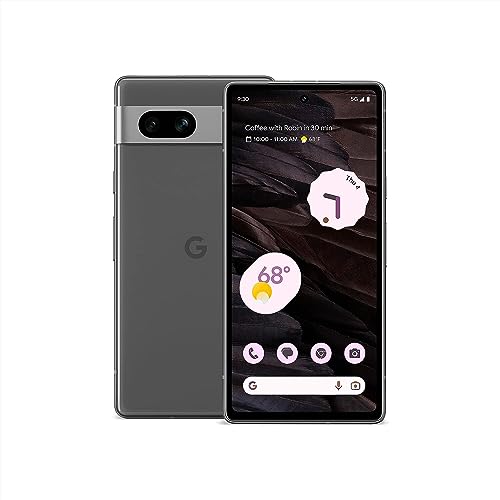
Google Pixel 7a — Best Small Camera Value
The Pixel 7a is the compact for people whose small-phone loyalty is really camera loyalty in disguise. Google’s mid-range formula — take the flagship’s processing brain, give it a very good main camera, house it in a body a size down and a price tier down — produced a 6.1-inch phone that photographs like something far grander. Faces, food, dim restaurants, the dog at dusk: the 7a’s processing handles the catalogue of ordinary photographic emergencies with a calm that phones with twice its lens count fail to match, because the intelligence is in the software and the software does not care what the phone cost.
As a phone rather than a camera it stays likeable: a 90Hz screen that feels fluid, wireless charging that budget rivals omit, water resistance, and Google’s clean Android with years of support still running from its long commitment. The pool listing is the unlocked US version in Charcoal. Its compromises are the honest mid-range ones — the ultrawide is a step down from the main camera, charging is unhurried, the bezels announce its price — but as the smallest route into Google’s photography at a sensible price, nothing in this guide argues with it. Small-phone buyers who shoot constantly should start their shortlist here.
- Display: 6.1-inch OLED, 90Hz
- Cameras: dual rear system with Google processing and night mode
- Storage on this listing: 128GB
- Connectivity: 5G, unlocked US version
- Extras: wireless charging, water resistance
Strengths
- Photography that punches a full class above its price and size.
- Wireless charging and water resistance — flagship manners in a mid-range body.
- Clean software with a long support runway still running.
Trade-offs
- No telephoto; distance is handled by cropping.
- Charging speeds are leisurely.
- Design is tidy rather than premium in the hand.
Best for: compact-phone buyers whose camera matters more than their spec sheet. Not suited for: zoom shooters or buyers wanting a flagship build.

Google Pixel 8 — Best Small Modern Pixel
The Pixel 8 is Google’s compact flagship statement: the full Pixel experience — the brightest, smoothest screen Google had put in a phone of this size, the refined dual camera with its superb processing, the long seven-year-class support commitment — in a 6.2-inch body that stays honest to one-handed use. Its rounded, polished design makes it the most pleasant object in this guide to simply hold, a quality that sounds trivial until you multiply it by the hundreds of times a day a phone is picked up. For buyers who want small, current and Google-flavoured without compromise-shopping, this is the pick.
The renewed unlocked US-version listing in our pool brings it within reach of budgets that balked at launch. What you get for the money over the 7a is meaningful: a markedly better display, a faster and longer-supported platform, a more capable main camera, and a build that feels like the flagship it is. What you do not get is a telephoto — Google reserves optical zoom for its Pro line — so distance photography remains a crop, albeit a well-processed one. Small-phone buyers who live in Google’s ecosystem, or who want the longest support runway in a compact body, will find the Pixel 8 the most future-proof hand-feel in this guide.
- Display: 6.2-inch OLED, bright, 120Hz class
- Cameras: dual rear system with advanced Google processing
- Storage on this listing: 128GB
- Connectivity: 5G, unlocked US version
- Listing status: renewed — inspect on arrival
Strengths
- The longest support commitment available in a compact Android.
- A display and in-hand feel that shame larger, pricier phones.
- Google’s camera processing at its most refined in this size.
Trade-offs
- No optical telephoto — the Pro line keeps that privilege.
- Renewed stock requires the usual battery and screen checks.
- Charging is adequate rather than fast.
Best for: buyers wanting a compact flagship that will be supported for years. Not suited for: optical zoom photographers or the strictest budgets.

Samsung Galaxy S24 — Best Small Long-Term Buy
The S24 takes the S23’s formula — the complete compact flagship — and extends its horizon. Samsung’s support commitment on this generation is the longest in the guide, which transforms the purchase mathematics for a small phone: this is a device you can buy intending to keep, in a size class where rivals often treat compact models as afterthoughts with afterthought support. The triple camera carries a genuine telephoto, the processor is a generation fresher than the S23’s, and the display is brighter for outdoor use — the incremental, unglamorous improvements that compound across years of ownership into a phone that never feels like the small compromise.
The renewed US-version listing in Onyx Black makes the long-term flagship the value play as well: pay renewed money, receive a phone whose support clock has barely started ticking. Battery life benefits from the newer platform’s efficiency, stretching the small-phone battery further than its size suggests, though the physics of compactness still apply on the heaviest days. Set beside the S23, the choice is a horizon question: the S23 is cheaper today, the S24 is supported longer tomorrow, and both are honest answers. Buyers planning a five-year phone should take the S24 and never think about this category again — which, for the small-phone loyalist tired of searching, may be the greatest luxury in this entire guide.
- Display: 6.2-inch AMOLED, bright, adaptive refresh
- Cameras: triple rear system — main, ultrawide, telephoto
- Storage on this listing: 128GB
- Connectivity: 5G, unlocked US version
- Listing status: renewed — inspect on arrival
Strengths
- The longest update runway in this guide, in a genuinely compact flagship.
- Full triple camera with optical telephoto — no small-phone asterisks.
- Efficiency gains stretch small-phone battery life respectably far.
Trade-offs
- Costs more than the S23 for a similar daily experience today.
- Storage on this listing is the entry configuration.
- Still a compact battery on the heaviest travel or gaming days.
Best for: buyers who keep phones for years and want the smallest flagship that keeps its promises longest. Not suited for: bargain hunters content with the S23, or two-day battery seekers.
The real 4.7-inch phones: an honest hall of fame
They deserve their paragraph of glory, because for about three years the 4.7-inch screen was where Android grew up. The LG-made Nexus 4 of 2012 put a 4.7-inch display in a glass-backed phone that felt like the future arriving early, and sold Google’s clean Android vision at a price that embarrassed flagships. The HTC One of 2013 — the M7 — wrapped the same size in a milled aluminium unibody that remains, a decade later, one of the most beautiful phones ever manufactured, with front-facing speakers that modern phones still fail to match. Motorola’s original Moto X, also 2013, was the philosopher of the group: deliberately mid-sized at 4.7 inches, curved to the palm, arguing in wood and leather finishes that a phone should fit a hand rather than a spec war. Samsung’s Galaxy Alpha carried the size into 2014 with a metal frame that previewed the company’s premium turn. If you owned one, you owned a piece of the platform’s golden age.
And here is why every one of them is prose-only in this guide. The networks they were built for have been dismantled — the 3G services several of them depend on for calls have been switched off in major markets, and their LTE bands predate the networks now in use. Their software froze years ago, leaving known security holes permanently open, and the app ecosystem has walked away: current versions of banking, messaging and even many basic services will not install or will not run. Their batteries have aged through a decade of chemistry — swollen cells in old phones are a genuine safety consideration, not a cosmetic one — and replacement parts exist only as ageing stock of the same vintage. As objects to collect, restore and admire, they are wonderful. As phones, their time has honestly passed, and any guide that links you to one as a daily device is selling you a story at the price of a tool.
If the collector’s itch is the real one, scratch it knowingly: buy the HTC One for the shelf and the speakers, keep it off your accounts, treat its battery with respect, and enjoy owning the high-water mark of the 4.7-inch era. Then buy one of the six phones above to actually carry. Nostalgia and utility are both legitimate desires; the only mistake is confusing which purchase serves which.
Why did phones grow — and will small ones return?
The growth was not a conspiracy; it was an accumulation of honest pressures. Bigger screens sold better in shops, where side-by-side comparisons reward the larger canvas. Video became the phone’s main medium, and video wants inches. Batteries needed volume to feed brighter displays and faster radios, and volume is easiest to find in a larger body. Camera systems multiplied and demanded depth and width. Each step was rational, and the sum of the steps was the disappearance of the small flagship — a category that did not die because nobody loved it, but because every individual decision paid better in the other direction.
The return, when it comes, will probably arrive disguised. Folding phones already sell a large screen in a small pocket footprint, at prices and fragilities that keep them niche. The mainstream answer, meanwhile, is the one this guide documents: the compact flagship at 6.1 or 6.2 inches, whose body is scarcely larger than the classics because the bezels died in the small phone’s place. The 4.7-inch loyalist’s real inheritance is not a diagonal — it is the demand that a phone fit a hand, a pocket and a life. That demand is alive in every pick above; it simply wears a larger number now, the way a childhood street wears new buildings.
How do you judge a small phone properly before buying?
Ignore the screen diagonal for the first minute and read the body’s width and weight instead — those two numbers predict your daily experience, while the diagonal mostly predicts the marketing. Then perform the three physical tests in a shop or during the return window at home. The thumb test: holding the phone naturally in your dominant hand, can your thumb reach the far top corner without a grip shift? The pocket test: does it disappear into the pockets you actually wear, sitting down included? The hour test: read or browse for a sustained stretch and notice your wrist, because small phones are bought for comfort and comfort is a duration, not a first impression.
Then check the small-phone tax honestly, because there is one and it is battery. A compact body holds a compact battery, and no efficiency fully repeals that arithmetic — the picks above manage a day, not two, and heavy users should plan around a charger or choose stamina over size with open eyes. Finally, verify the support runway in writing, since a small phone bought for years of comfortable service deserves years of software to match. The S23, S24 and Pixel 8 in this guide were chosen substantially on that criterion; it is what separates a small phone from a small disappointment.
How does a small phone change your everyday habits?
Owners of compact phones describe the difference in verbs rather than specifications. You check things one-handed on a train strap, reply while carrying shopping, photograph a moment with the hand that is already free. The phone stops being a two-handed commitment — a small ceremony of setting down, gripping, steadying — and becomes an extension of whichever hand is unoccupied. That fluidity is the real product the 4.7-inch generation sold, and it is why its loyalists describe modern large phones not as powerful but as laborious: every interaction costs a posture.
The habits compound quietly. A phone that fits the hand gets used in shorter, more frequent touches and put away sooner, which many owners experience as a healthier relationship with the device — it serves in moments rather than sessions. It also gets dropped less, not because its owners are careful but because grip is physics: a phone your fingers wrap is a phone your fingers keep. And it travels through the world differently — in the front pocket of actual trousers, in a small bag’s small pocket, in a running belt — the geography of a life measured in where objects fit.
None of this requires a decade-old handset, which is the point of this guide’s picks. The S23 and Pixel 8 deliver the same verbs with modern cameras and live support; the S10e and 4a deliver them in their purest surviving form for buyers who accept their ages. The habit is the inheritance. The diagonal was only ever its rough measurement, and the measurement, as this guide keeps demonstrating, has been lying to everyone for years — in both directions.
What about cases, grips and one-handed tricks for small phones?
A compact phone needs less help than a large one, which is precisely why the help it does get should be chosen carefully. The case question inverts at this size: on a big phone a case is armour; on a small one it is also a size decision, since a bulky case can hand back the very bulk you bought the phone to escape. Slim cases and skins preserve the point of the purchase while covering the drop risk, and the modern compacts’ water resistance quietly handles the other classic accident. If you use a case at all, let it be the thinnest one that covers the corners.
Software offers the second layer of smallness, and it is free. Every Android in this guide can pull its interface toward your thumb — one-handed modes that shrink the screen’s active area, gesture navigation that replaces far-corner buttons, keyboards that shift to one side for single-thumb typing. On a compact these features are seasoning rather than survival, but they finish the job the hardware started: a phone arranged so that nothing you do daily requires the second hand. Set them up in the first week, while you are configuring everything else, and the phone’s smallness becomes a system rather than a dimension.
Grips and rings deserve a sceptical sentence. On large phones they solve a real problem; on compacts they mostly add a protrusion to a phone whose virtue is having none, and they interfere with the pocket-fit that defines the class. If you love one, use one — comfort is personal — but try the phone bare or in a slim case first. Most small-phone owners discover the accessory they needed was the absence of accessories, which is the cheapest discovery in this entire guide.
How do small phones handle reading, video and games?
Reading is where compact phones quietly excel, because reading is a one-handed, long-duration activity and those are the small phone’s home conditions. An hour of articles or an e-book on a 6.1-inch screen held in one hand, wrist unstrained, is a genuinely different experience from the same hour on a device that demands two hands and a surface. Text size is adjustable on every pick here, and the modern displays are sharp enough that smaller physical text stays legible — the old fear that a small screen means squinting belongs to the low-resolution era of the classics themselves.
Video is the honest trade: a film is more cinematic on a larger canvas, and nobody in this guide will pretend otherwise. But most phone video is not cinema — it is clips, calls, highlights and episodes in transit — and for those, the compact screen is entirely sufficient and considerably more holdable on a train or in bed. Games split by genre: strategy, puzzles, cards and most casual titles lose nothing at this size, while competitive shooters and sprawling role-players genuinely benefit from inches and from the larger batteries that accompany them. Know your library and the answer chooses itself.
The synthesis small-phone owners reach, usually within a month, is that the phone is not their only screen. The tablet, the laptop and the television exist in their lives for the big-canvas hours, and the phone’s job is the other twenty hours — the carried, glanced, one-handed day. Judged as the screen of those hours, the compact is not the compromise in the house. It is the specialist, and the big phone in the drawer is the one that was over-bought.
What should older users and parents know about small phones?
For older hands, the compact case is stronger than fashion admits. Arthritis and reduced grip strength turn a large, heavy phone into a dropped phone, and a dropped phone into an expense or an injury’s accomplice; a light, narrow device that the fingers genuinely wrap is a safety feature disguised as a preference. The Pixel 4a’s featherweight build made it a quiet favourite with older users in its day, and the modern compacts inherit the logic with better screens for ageing eyes — brightness and text scaling on the Pixel 8 and S24 are excellent, and both offer simplified home-screen modes that enlarge the essentials and hide the machinery.
For children, the calculus runs through size to durability and cost. A first phone that fits a child’s hand gets dropped less, and the mid-range compacts here — the 7a above all — pair that fit with cameras good enough to matter to a young photographer and prices that keep a loss in the category of lesson rather than disaster. What the classics cannot do, for either generation, is protect them: an unsupported phone in a child’s or a parent’s hands carries the security patterns our companion guides warn about, in the hands of the users least equipped to notice. Small is a virtue. Current is a duty. The picks above the classics section are where the two meet.
One practical tip serves both audiences: set the phone up for its owner before handing it over. Text size, home-screen layout, the emergency contacts, the one-tap calling for the people who matter — an hour of configuration by the family’s designated technician converts a small phone from a gadget into an appliance, and appliances are what most people, at most ages, actually want from the object in their pocket.
How do you move down to a smaller phone without friction?
The transfer itself is the easy part — modern Android moves accounts, photos and apps between phones with a cable and a coffee’s worth of patience, and the compact picks here all receive a transfer as gracefully as any flagship. The friction new small-phone owners report is psychological, and it lasts about a week: the keyboard feels narrower for two days, videos feel modest for three, and then the hand relearns the world and the old phone, picked up for comparison, feels absurd — a serving tray where a tool used to be. Knowing the adjustment curve exists is most of surviving it; nearly everyone who persists past the week does not go back.
Two settings shorten the curve. Raise the display’s text and interface scaling a notch for the first fortnight rather than heroically accepting the default — you can lower it later from a position of comfort, and most people find their eyes needed less help than feared. And arrange the home screen for one thumb from day one: the daily apps in the lower half, within the arc the thumb draws without stretching, so the phone’s layout confirms its size instead of fighting it. A small phone arranged like a big one is a daily argument; arranged for its own shape, it is a daily pleasure.
Keep the old phone, if it is a supported model, as the house’s second device — the role our other guides describe for retired handsets — rather than trading it for a token sum. A household with a spare current phone owns an insurance policy against the drop, the loss and the repair week, and the compact convert who keeps the big phone as a media slab at home often discovers the final truth of this category: the best arrangement was never one phone of the perfect size, but the small one in the pocket and the large screen staying, contentedly, at home.
How do compact phones handle photography?
Better than their size suggests, because phone photography is mostly software now and software weighs nothing. The Pixel entries in this guide prove the point from two directions: the 7a and 8 carry Google’s processing into bodies a size down from the flagships, and their photographs — faces, food, night streets — stand comparison with phones twice their price and half again their size. The Samsung compacts answer with hardware, fitting genuine triple systems with telephoto lenses into the S23 and S24, so the compact buyer who shoots distance is not asked to crop and pray. Between the two philosophies, the small-phone photographer is served better today than the large-phone photographer was five years ago.
The physical experience of compact photography deserves its own sentence, because it is a genuine advantage disguised as a limitation. A small phone is faster out of the pocket, steadier in one hand, and less obtrusive in the moment — street photography, candid family moments and anything involving not frightening the subject all benefit. The photograph you take because the phone was already in your hand beats the photograph a larger, better phone stayed in a bag for. Photographers call this the availability principle, and compact owners live it daily.
Where size does tax photography is endurance and heat: a compact body shooting 4K video on a summer day will warm and throttle sooner than a large one, and a photography-heavy travel day drains a small battery with the same enthusiasm as a large one while holding less charge to drain. The mitigations are habits, not hardware — a pocket power bank on the heavy days, short clips instead of long ones, the screen brightness tamed outdoors. Accept those, and the compact is not the camera compromise of the house. For most of the photographs most people take, it is the camera that was there.
What about the ultra-small niche — mini phones from tiny brands?
Search long enough for a small Android and you will find the niche within the niche: miniature phones from small specialist brands, some with screens near or even below the classic sizes, sold on the promise of digital minimalism. They are real products with real devotees, and this guide treats them with more respect than the mystery-brand pattern in our best-and-worst roundup — the honest ones state their limitations plainly and serve a deliberate philosophy of less. But they are not linked here, for the ownability reasons that run through all our guides: support organisations are thin, parts and cases are scarce, network certification varies by market, and a phone bought as a lifestyle statement still has to survive being a phone.
The buyer’s rule for the niche mirrors the rule for the classics, from the opposite direction. A mini phone bought knowingly — as a second device, a weekend detox tool, a deliberate experiment with attention — can be a genuinely good purchase, because its compromises were the buyer’s choice. The same phone bought as a main device by someone who simply wanted “a small Android” tends to disappoint in the unglamorous places: the app that assumes a bigger screen, the battery that assumes a lighter life, the update that never arrives. Intent is the difference between a niche tool and a bad buy.
For the mainstream small-phone seeker, the six picks in this guide remain the answer we can stand behind — made by organisations that will answer for them, sold through listings we verified, sized for hands rather than manifestos. The niche will still be there, honourably weird, if the mainstream compacts ever feel too large. That is the correct order of exploration, and it is the order this guide recommends in everything: the supported centre first, the fascinating edges with eyes open.
How long will the modern compacts stay worth owning?
Longer than small phones used to, because the industry’s support promises finally grew as its screens did. The Pixel 8 and Galaxy S24 in this guide carry commitments measured in many years — the longest their makers offer — and the S23 and 7a run on multi-year runways with substantial time remaining. That matters disproportionately in this category, because the compact buyer is often a keeper by temperament: the person who finds the right size tends to hold it until it dies. A support window matched to that temperament converts the purchase from a two-year rental of novelty into a five-year relationship with a tool, which is both the economical and the satisfying way to own anything.
The battery will be the relationship’s middle chapter, as it is in every phone: expect a replacement around the third or fourth year in daily service, budgeted as maintenance rather than mourned as failure, with parts for Samsung and Google compacts readily available because both lines sell in volume. Plan that single service and the modern compact’s lifespan stops being a hope and becomes a schedule. The classics in this guide’s hall of fame never got that chance — their makers’ ecosystems moved on while the hardware still worked — and the kindest thing the modern market does for small-phone lovers is refuse, so far, to repeat the abandonment.
Comparison table
| Pick | Screen | Support status | Character | Choose it if… |
|---|---|---|---|---|
| Samsung Galaxy S10e | 5.8″ | Ended — buy with open eyes | Smallest body here | Absolute compactness outranks everything else. |
| Google Pixel 4a | 5.81″ | Ended — buy with open eyes | Lightest hand-feel | You prize featherweight simplicity for light duties. |
| Samsung Galaxy S23 | 6.1″ | Years remaining | Complete compact flagship | You want small with no compromises. |
| Google Pixel 7a | 6.1″ | Years remaining | Camera value | Photography matters most at a fair price. |
| Google Pixel 8 | 6.2″ | Longest class | Refined compact flagship | You want Google’s best in a hand-friendly size. |
| Samsung Galaxy S24 | 6.2″ | Longest class | Long-term flagship | You keep phones for years and want the runway. |
What mistakes do small-phone buyers keep making?
Buying the diagonal instead of the device is the founding error — purchasing a genuinely old 4.7-inch phone because the number matches the memory, and discovering that networks, apps and batteries have all moved on without it. The classics section of this guide exists to give that nostalgia a safe home: admire them, collect them, but do not depend on them. A phone is infrastructure now, and infrastructure must be maintained by someone; if the maker has stopped, the maintenance burden — and the risk — is yours.
The second mistake is the mirror image: assuming a modern 6.1-inch phone must be huge, and never testing one in the hand. Buyers loyal to small phones routinely dismiss the current compacts on a number, then hold one and discover it is narrower than the phone in their pocket. Bodies shrank around the screens; judge the object, not the arithmetic.
Third, small-phone buyers underweight support because the community’s conversation is all about size. A compact phone with ended updates — and two picks in this guide carry that warning openly — is a choice to make knowingly, for light duties, at a light price. The same purchase made unknowingly, as a main phone for a banking-led life, is the mistake. Size is a preference; support is a safety property, and the two should never be traded in the dark.
Final Recommendation
If your heart is set on 4.7 inches, let it be set on the HTC One as an object to own and admire — and then buy a phone from this century to carry. For the carrying, the Galaxy S23 is the sweet spot of the modern compacts: complete, supported, hand-friendly, and renewed-priced. The S24 extends the same idea for the longest horizon, the Pixel 8 is the connoisseur’s compact flagship, and the 7a brings Google’s camera down to a friendly price. The S10e and Pixel 4a remain for the purists — the smallest, lightest Androids we can point to with a straight face, offered with their ages stated plainly. The 4.7-inch era deserved its fame; what it deserves from us now is honesty, a worthy succession, and the respect of being remembered accurately rather than bought blindly.
Frequently Asked Questions
Can I still use a 4.7-inch Android phone in 2026?
As a collector’s piece, a media player or a Wi-Fi-only curiosity, yes. As a phone — for calls, banking, messaging and modern apps — no: the newest true 4.7-inch Androids are over a decade old, their networks have been shut down or superseded, their software is unpatched, and many current apps will not run on them. The smallest phones in this guide exist to serve the need honestly.
Which Android phone is closest in size to the old 4.7-inch models?
By body size — the measure your hand cares about — the Galaxy S10e in this guide is the closest recommendable relative, with the Pixel 4a beside it. Their screens measure larger than 4.7 inches, but their bodies are as narrow as the classics or narrower, because modern screens fill the front of the phone almost completely.
Why did manufacturers stop making 4.7-inch phones?
A decade of compounding pressures: larger screens sold better in shops, video became the dominant medium, batteries and camera systems needed physical volume, and the market followed. The compact flagship survived at larger screen sizes because bezels shrank — the small phone did not die, it changed its number.
Is a small phone’s battery always a problem?
It is always a constraint, rarely a problem. The modern compacts in this guide are engineered for a full ordinary day; heavy gaming, navigation and video days will want a top-up. Buyers who need two-day stamina should choose a larger phone with open eyes — that trade is physics, not a flaw in any particular model.
Does a smaller phone mean a worse phone?
No — it means a phone whose budget of space was spent differently. The modern compacts in this guide carry flagship processors, flagship cameras or both, long support commitments and premium displays; what they spend less on is battery volume and screen canvas, because physics insists on paying for those in size. Buyers who value the canvas should buy it. Buyers who value the hand should know the sacrifice demanded of them is far smaller than the industry once made it.
Should I buy a classic 4.7-inch phone as a backup?
Not as a backup phone in any meaningful sense — a backup must make calls on current networks and run your essential apps, and the classics increasingly can do neither. As a backup camera, music player or smart-home remote on Wi-Fi, an old favourite can serve happily, provided its battery is healthy and it stays signed out of your important accounts.
Related Guides
Size is one axis of phone choice; explore the others with our best 4 inch screen android phones guide to the even smaller classes, the best 5 inch android phones roundup of the next size up, and the best 5.5 inch android phones survey of where the mainstream used to live.



[…] shopping with the patterns in mind: our best affordable android phones guide applies the same tests at budget prices, the best and cheapest android phones roundup hunts […]