Our Top Picks
 Mackie CR8BT 8" Creative Reference Powered Studio Monitors8" Monitor13.58 x 9.9 x 14.8 inches35.3 poundsCheck on Amazon


What's inside
- Powered, active, and what the words mean
- Why woofer size interacts with room and distance
- The specifications that actually matter
- Studio nearfield models in published material
- Compact 8 inch powered PA options
- Placement: stands, pads, walls, and the desk
- Boundary effects and room behavior in plain terms
- Setting levels and using room controls well
- Mistakes to avoid
- Questions buyers ask most often
- Comparing the shortlist on paper
- How the tweeter and waveguide shape the working day
- Power, heat, and living with the cabinets daily
- Using published measurements responsibly
- Stereo imaging, phantom center, and what to listen for in documents
- Treatment basics that help an 8 inch pair
- Choosing between one great pair and a wider system
- A note on desktop and multimedia variants
- Check prices on Amazon
- Verdict: matching the box to the room and the job
As an Amazon Associate I earn from qualifying purchases. This post may contain affiliate links at no extra cost to you.
An 8 inch powered speaker sits at an interesting crossroads. In one world it is a studio nearfield monitor, built to tell the truth about a mix at arm’s length, with a flat response, a controlled waveguide, and room controls on the back panel. In another world it is a compact powered PA box or desktop speaker, built to fill a small room with music, speech, or a keyboard rig, with handles, pole mounts, Bluetooth in some cases, and voicing that favors presence over neutrality. Both worlds share a woofer diameter, an internal amplifier, and a cabinet of broadly similar size. Almost everything that matters about choosing between them lies in the details that published specifications reveal.
This guide uses manufacturer specification sheets, owner manuals, and published product documents as its evidence base. Those sources state frequency response, maximum sound pressure level, amplifier power and how that power splits between woofer and tweeter, crossover frequency, input types, dimensions, weight, and the behavior of any DSP room controls. They do not capture personal taste, and a spec sheet cannot hear a room. What the documents can do is prevent the most common errors: buying a monitor for a party, buying a PA box for critical mixing, or putting an 8 inch woofer in a room too small to let it behave.
Powered, active, and what the words mean
Retail language blurs two terms that are worth separating. A powered speaker contains an amplifier in the cabinet, so it needs a line level signal and mains power rather than a separate amplifier. An active speaker goes further: the crossover splits the signal before amplification, with a dedicated amplifier channel for the woofer and another for the tweeter. Most modern studio monitors, including the Yamaha HS8, KRK Rokit 8 G5, JBL 308P MkII, Kali Audio LP-8, and ADAM Audio T8V, follow the active pattern with two amplifier sections. Many compact PA boxes are also bi-amplified in this sense, although their DSP often adds limiting, voicing presets, and protection that studio monitors do not emphasize.
The practical benefit of the active layout is control. Each driver gets an amplifier matched to its range, and the crossover can be steeper and more precise than a passive network built from coils and capacitors. The cost is complexity and heat inside the cabinet, plus a power cable and a signal cable for every box. A stereo pair of monitors therefore needs two mains outlets within reach, a detail that shapes desk layouts more often than buyers expect. Surge protection and tidy cable runs belong in the budget conversation from the start.
Passive speakers with an external amplifier still exist in studios and homes, but they fall outside this guide. Everything here assumes self contained cabinets that take line level input. That assumption simplifies setup and removes amplifier matching from the decision, letting attention stay on response, output, placement, and room behavior.
Why woofer size interacts with room and distance
Woofer diameter governs how much air a speaker can move and, broadly, how low it can play with authority. An 8 inch woofer offers a real step over 5 inch models in low frequency extension and in output at distance. That step is a gift in a medium room and a liability in a tiny one. Low frequencies excite room modes, the standing wave patterns set by wall spacing, and a speaker that produces strong energy at 40 to 60 Hz will light those modes up in a small bedroom studio. The result is boomy, uneven bass that no amount of careful mixing can fully outwit, because the room itself is storing and returning energy unevenly.
Listening distance is the other half of the equation. Nearfield monitors are designed for roughly one to one and a half meters, where direct sound dominates reflected sound. At that distance an 8 inch model can sound full and calm. Pull the chair back to three meters in a living room and the same speaker must work harder, room reflections grow in proportion, and a compact PA design with higher maximum output may serve better. Push an 8 inch monitor close to a wall in a small room and boundary gain lifts the low end further, compounding the mode problem. Size, distance, and placement form one decision, not three.
Room volume deserves a number before a purchase. Multiply length, width, and height, then be honest about treatment. A small untreated room of around ten square meters will usually flatter a 5 or 6 inch monitor and fight an 8 inch one. A treated room of fifteen to twenty square meters gives an 8 inch woofer space to work. These are guides drawn from manufacturer placement literature and general acoustics references, not hard borders, but they point the right way: match the air moving capacity to the air volume it must serve.
Desktop listeners who also need sound for video calls, rehearsal playback, or a small gathering sometimes look sideways at PA formats, and the comparison in best 10 inch powered speakers helps frame what a step up in cabinet size changes for that job.
The specifications that actually matter
Frequency response and its tolerances
A frequency response figure means little without its tolerance. A claim of 38 Hz to 25 kHz sounds impressive until the reader learns whether that range is measured at minus 3 dB, minus 10 dB, or with no stated window at all. Serious monitor makers publish the tolerance and often a response graph in the manual. Yamaha lists the HS8 with a response extending into the high 30 Hz region at the minus 10 dB point, a common and honest way to state the useful edge of a ported cabinet. Compare models at the same tolerance whenever the documents allow it, and treat a bare range with no tolerance as marketing rather than measurement.
Flatness within the passband matters more for mixing than the last few hertz of extension. A monitor that stays within a tight window from 60 Hz upward will translate decisions better than one that reaches lower but wanders. Published graphs, where supplied, reveal dips and peaks that a single pair of numbers hides. Readers should also note the crossover frequency, often near 2 kHz in this class, because the handover between woofer and tweeter shapes vocal clarity and stereo imaging.
Maximum SPL and amplifier power split
Maximum sound pressure level, stated in decibels, describes how loud a speaker can play under specified conditions, usually at one meter. Studio 8 inch monitors commonly publish figures in the 108 to 112 dB region per pair or per speaker depending on the maker, while compact PA boxes aim higher for audience coverage. The fine print matters: peak versus continuous ratings differ greatly, and a peak number flatters. Manuals that state the measurement basis deserve more trust than listings that print a lone large number.
Amplifier power should be read as a split, not a sum. A monitor might assign the larger share, often 70 to 100 watts in this class, to the woofer and a smaller share to the tweeter, reflecting where musical energy lives. JBL publishes the 308P MkII as a bi-amplified design with its power divided between the low and high frequency sections, and Kali, Yamaha, and ADAM follow the same reporting habit in their documents. Total wattage headlines that merge both channels into one figure tell the reader less than the split does. Power also interacts with sensitivity and limiting, so a lower powered design with honest limiting can sound cleaner at high level than a higher powered design that distorts before its protection engages.
DSP, room controls, and voicing switches
Modern monitors now often carry DSP. KRK’s Rokit G5 line offers DSP driven room tuning with an LCD interface and preset modes that alter voicing, while Kali’s LP-8 provides boundary EQ switches set by DIP switches on the rear panel, with a chart in the manual that maps switch positions to placement. Yamaha’s HS series keeps the analog approach with room control and high trim switches that cut or boost defined bands. ADAM’s T8V offers high and low shelving switches on the back. Each system pursues the same goal: compensating, within limits, for walls, desks, and corners. None of them can cancel a room mode or fix a speaker placed in a genuinely bad position, and the manuals generally say so in careful language.
PA boxes add a different DSP vocabulary: music, speech, and live presets, feedback suppression in some models, and delay for fill applications in larger systems. For a compact 8 inch PA speaker, the useful features are usually simpler: a mic and line input with gain, a two or three band EQ, and a voicing that stays intelligible for speech at moderate level. Bluetooth pairing appears on many consumer and prosumer boxes and is convenient for breaks and background music, though a wired feed remains the reliable choice for any performance that matters.
Inputs and connectivity
Balanced XLR and TRS inputs are the studio standard because balanced wiring rejects hum and noise over longer cable runs. Most monitors in this class provide both, sometimes as a combination socket, and many add an unbalanced RCA input aimed at consumer sources. Level controls on the rear panel set the monitor gain against the interface output. PA boxes widen the menu: combination XLR and TRS sockets that accept microphones directly, auxiliary inputs on 3.5 mm or RCA connectors, and in some designs a mix output that feeds a second cabinet. Check the manual for input sensitivity figures when a microphone will connect directly, because a line only input will leave a mic far too quiet.
Digital inputs remain uncommon in this class. A few desktop oriented models accept USB audio, which suits a computer only setup and removes the interface from the chain. For most buyers, the audio interface or mixer remains the hub, and the speaker decision should confirm cable types and lengths rather than chase exotic inputs. Keep signal cables away from mains runs where possible, and use balanced lines when the source offers them, especially in rooms with dimmers or older wiring that hums.
Studio nearfield models in published material
Yamaha HS8
The HS8 is the largest member of Yamaha’s HS nearfield family, pairing an 8 inch cone woofer with a 1 inch dome tweeter in a bass reflex cabinet with a rear port. Yamaha publishes a bi-amplified power split with the larger share to the woofer, room control and high trim switches, and XLR plus TRS balanced inputs. The white woofer cone makes the line easy to recognize, and the voicing philosophy follows Yamaha’s long standing nearfield tradition of a forward, honest midrange. The rear port demands clearance from walls, a point the manual supports through its placement guidance and the room control switch range. For rooms that can give it space, the HS8 offers the classic Yamaha bargain: plain appearance, serious documentation, and a midrange that exposes arrangement clutter.
KRK Rokit 8 G5
KRK’s Rokit line, with its yellow woofer cones, has been a fixture in project studios for years, and the fifth generation 8 inch model adds DSP room tuning, multiple voicing modes, and a front facing port. That front port is a genuine placement advantage in small rooms, because the cabinet can sit closer to a wall than a rear ported rival without choking the port output. KRK publishes the DSP preset structure and an app and LCD workflow in its materials. The Rokit voicing has historically favored low end energy that many electronic and hip hop producers enjoy while working, and the G5 modes let the owner steer that character. Readers who mix for translation should study the published mode descriptions and choose the flattest setting as a home base.
JBL 308P MkII
JBL’s 3 Series MkII flagship pairs an 8 inch woofer with JBL’s Image Control Waveguide, a horn geometry derived from the company’s larger mastering monitors, intended to give a wide and stable listening area. The 308P MkII publishes boundary EQ and high frequency trim switches, balanced XLR and TRS inputs, and a bi-amplified power split. The waveguide is the story here: off axis response stays smoother, so small head movements at the desk change the sound less, and two listeners side by side hear a more similar balance. For collaborative rooms and producers who move while they work, that published design intent maps directly onto daily use.
Kali Audio LP-8
Kali’s Lone Pine 8 inch model built its reputation on value and on a thoughtful boundary EQ system. The LP-8, now in its second generation form in Kali’s catalog, uses a front port, a waveguide with a smooth profile, and DIP switch boundary settings that the manual charts against concrete placements: free standing, against a wall, on a desk, on a console meter bridge, and so on. That chart is a model of useful documentation, because it turns an abstract EQ into a decision the owner can make by looking at the room. Kali also publishes detailed response and distortion material for its monitors, a transparency that invites comparison and rewards readers who do it.
ADAM Audio T8V
ADAM’s T series entry with an 8 inch woofer carries the company’s U-ART ribbon style tweeter, a folded diaphragm design that extends high frequency response and disperses it through a precision waveguide. The T8V publishes high and low shelf switches, balanced XLR and unbalanced RCA inputs, and a rear port. The tweeter technology is the differentiator: ribbon style drivers move air with a large surface and low mass, and ADAM’s documents describe the resulting extension and dispersion in detail. Rooms that can respect the rear port spacing gain a monitor with notably airy top end presentation, which string and acoustic producers often value.
Anyone weighing these monitors against larger live formats for a dual purpose room will find the contrast drawn out in best 15 powered speakers, where output and coverage take priority over nearfield accuracy.
Compact 8 inch powered PA options
The compact PA world uses the same woofer size for a different job. Cabinets gain handles, pole mount sockets, angled sides for floor monitor duty, and grilles that tolerate transport. Models from makers such as Yamaha, QSC, Electro-Voice, JBL, and Mackie populate this tier, with published documents that emphasize coverage angles, maximum output, and input flexibility rather than response flatness. An 8 inch PA box will not fill a hall with bass, and its makers generally position it for speech, small acoustic acts, keyboard monitoring, delay fill, and personal monitoring near the performer.
Speech clarity is the strongest card in this hand. A well designed 8 inch PA cabinet keeps voices intelligible at modest level in a reverberant room, where a larger box exciting more low energy can blur words. Presenters, houses of worship with small rooms, fitness instructors, and teachers often need exactly that: a portable cabinet, a microphone input, and enough clean output for fifty people at conversational distance. Battery powered variants exist in this size class and add outdoor and busking uses, with published run time figures that should be read as best case estimates at moderate volume.
For music playback in a cafe or small shop, a pair of compact PA boxes on stands at ear height will usually outperform a single larger cabinet in the corner, because stereo placement spreads coverage and lowers the level each box must produce. Built in mixers on some models accept a microphone and a music source together, which simplifies small events. The specification to study is the coverage pattern, stated in degrees horizontally and vertically, since it predicts whether the audience area is served evenly or only in a narrow beam.
Placement: stands, pads, walls, and the desk
Placement decides more of the final sound than the gap between rival models in this class. Begin with the equilateral triangle: two speakers and the listening position forming roughly equal sides, tweeters at ear height, cabinets angled inward so their axes cross near or just behind the head. Symmetry between the speakers matters as much as the triangle itself. If one monitor sits near a side wall and the other opens into the room, their bass and imaging will differ, and mixes will lean. Center the desk along the wall where possible, and keep both cabinets the same distance from the surfaces behind and beside them.
Stands beat desks for monitors of this size. An 8 inch cabinet is heavy, deep, and prone to exciting a desk surface that acts like a sounding board. Dedicated stands place the tweeter correctly, decouple the cabinet from furniture, and free desk space. Where desks are unavoidable, isolation pads or stands that tilt the cabinet up toward the ears help twice: they reduce vibration transfer and they aim the tweeter correctly. Foam pads are not magic, but the manuals of several makers recommend decoupling, and the mechanical logic is sound. Avoid stacking monitors on books or boxes that can shift and buzz.
Wall distance is the placement variable buyers most often get wrong. Rear ported models such as the HS8 and T8V need breathing room, commonly a hand span at minimum and more where the room allows, so the port can work without turbulence and boundary lift stays manageable. Front ported designs such as the Rokit 8 G5 and LP-8 tolerate closer placement, which is a real advantage in shallow rooms, though no port location repeals the physics of boundary gain. Moving a speaker even ten centimeters changes low frequency balance audibly. Set placement before reaching for EQ switches, because EQ applied to a bad position bakes the problem in.
Boundary effects and room behavior in plain terms
Every nearby surface reinforces low frequencies. A speaker in free space radiates bass in all directions. Place it near a wall and the wall reflects energy forward, lifting the low end. A corner, where two walls and often the floor meet, lifts it further still. Manufacturers know this, which is why boundary EQ exists: the switch cuts low shelf energy to compensate for a known placement. The Kali placement chart and the JBL boundary settings both encode this relationship. Use the setting that matches the real placement, then fine tune by ear with familiar recordings at moderate level.
Desks add their own reflection. Sound bouncing off the desk surface reaches the ears slightly after the direct sound and combs the midrange, blurring clarity in the region where voices live. Raising monitors on stands, pulling them toward the desk edge, or angling them so the desk bounce misses the ears all reduce the effect. Speaker height interacts here as well: a tweeter far below ear level throws the desk reflection straight at the listener. These are geometry problems with geometry solutions, and they cost nothing but care.
Room modes need a different toolkit. Modes are set by room dimensions and cannot be EQ’d away for more than one seat, because cutting a peak at the listening position can deepen a null elsewhere. Bass trapping in corners, sensible speaker and seat positions away from the worst pressure zones, and moderate listening levels do more than any switch. This is also where the oversizing mistake returns: an 8 inch woofer in a modal small room creates problems that its own controls cannot solve, while a smaller monitor in the same room may sound plain and workable. Honesty about the room is a buying skill.
Readers setting up a broader desktop system may also consult best 2 0 powered speakers for the simpler stereo category that many desks actually need.
Setting levels and using room controls well
Gain staging protects both sound quality and hearing. Set the interface or mixer output to a healthy level, then bring the monitor rear panel level up to a comfortable working volume, so neither stage is straining or whispering. Many engineers work near a consistent reference level for mixing, checking quieter and louder briefly, because balances judged at one level translate better than balances chased across a wandering volume knob. Mark the settled control position with tape or a note so a cleaned desk does not erase the calibration.
Apply room controls one at a time, with a purpose for each. Start flat. Set boundary compensation for the actual placement. Then judge the high trim against familiar voices and acoustic recordings, not against a favorite bass heavy track. Change one switch, listen for a day if the room is a work room, and resist stacking every correction at once. DSP systems with presets deserve the same discipline: begin with the flattest published mode, treat creative voicings as listening modes rather than mixing modes, and store the chosen configuration so a borrowed room or a curious visitor does not silently change it.
Subwoofers enter many 8 inch discussions, usually as a remedy for missing low end. In truth, an 8 inch monitor already covers the range most small rooms can support, and a subwoofer adds a crossover alignment task, another placement problem, and more modal energy. Subs earn their place for film work, electronic producers checking sub content at low level, and larger treated rooms. Buyers tempted by a sub should first confirm that placement and boundary settings are right, because a well placed pair of 8 inch monitors surprises many owners who thought the speakers were the weak link.
Mistakes to avoid
Oversizing for a small room leads the list, for reasons already covered: modes, boundary gain, and a listening distance too short for the cabinet’s drivers to blend. The crossover region needs some distance to integrate, and a large monitor heard from half a meter can sound disjointed even when its measurements are excellent. The second mistake is ignoring rear port clearance, then blaming the speaker for boomy bass that the wall created. The third is placing monitors on their sides to fit a shelf. Most of these designs assume vertical orientation for correct waveguide dispersion, and the manuals state the intended orientation. Laying a monitor sideways rotates its dispersion pattern and usually harms imaging.
A fourth mistake is mixing categories. A PA box used as a studio monitor will sound present and tiring, with voicing that flatters a demo and misleads a mix. A studio monitor used as a party PA speaker risks its drivers and its amplifiers, because nearfield designs are not built for sustained high output across a room, and their limiters, where fitted, protect rather than perform. A fifth mistake is feeding monitors from a headphone output with a tangle of adapters when a proper line output exists, inviting hum, level mismatch, and channel imbalance. Balanced cables from the interface, at the lengths the room actually needs, solve most of it.
Finally, avoid judging any speaker in the first hour at high volume in an unfamiliar room. Ears adapt, rooms mislead, and loud playback hides imbalance behind excitement. Work at moderate level with recordings whose balances are well known, across several days if the purchase allows evaluation time. Published measurements predict much, but the room finishes the sentence, and the room needs time to be understood.
Questions buyers ask most often
Is an 8 inch monitor too much for a bedroom studio?
Often, yes, though the room decides rather than the label. A small, untreated bedroom with the desk against a wall is the hardest case: short distance, strong boundary lift, and lively modes. A front ported model with boundary EQ, placed carefully and played at moderate level, can work. A rear ported model that needs wall clearance may not. Measure the space, note where the speakers must sit, and let those facts rank the shortlist before brand preference enters.
How much amplifier power does this class need?
Less than headline numbers suggest, because nearfield distance is short and speaker sensitivity does much of the work. The published splits in this class, with the woofer receiving the clear majority, reflect musical reality. What matters more is clean limiting behavior and low noise at idle, since a faint hiss from tweeters at close range annoys during quiet work. Manuals that state idle noise or signal to noise figures give the careful reader an edge here.
Can one cabinet serve for mixing and small events?
A compact PA box can play back finished mixes at an event very well. The reverse, mixing on the PA box, is the weak direction. If one purchase must cover both duties, a PA oriented pair with a relatively neutral music preset is the pragmatic compromise, with the understanding that critical mixing decisions deserve cross checks on headphones and other systems. Dual purpose rooms benefit from honesty about which job matters more often.
Do these speakers need a break in period?
Driver suspensions can loosen slightly with early use, and makers occasionally mention a settling period in their literature. The larger adjustment is the listener’s own: ears and brain learn a new monitor over days of familiar material. Schedule judgment accordingly. Set placement and controls, live with the result through several working sessions, and only then decide whether the voicing suits the work.
What cables and accessories belong in the first order?
Two balanced signal cables of correct length, two mains cables if the maker supplies short ones, stands or isolation supports, and basic acoustic treatment for the first reflection points if the room is bare. A sound level meter app helps set consistent working levels. That list is less exciting than the speakers, and it protects more of the purchase than any extended warranty conversation.
For readers whose events outgrow the compact format, the step up path continues in best 12 active pa speakers, where larger cabinets trade portability for coverage.
Comparing the shortlist on paper
Build a comparison table from the manuals before listening to anyone’s opinion, including this guide’s emphasis. Columns should cover response range with its tolerance, maximum SPL with its basis, amplifier split, crossover frequency, port location, room control type, inputs, dimensions, and weight. Port location and dimensions belong beside the acoustic figures, because a monitor that cannot fit the room with proper clearance is not a candidate at all, however fine its graph looks. Weight matters for stand selection and for anyone who moves between rooms.
Then rank by room fit first, documentation quality second, and feature list third. Kali’s placement chart, JBL’s waveguide explanation, Yamaha’s long record of published data, KRK’s DSP flexibility, and ADAM’s tweeter design each represent a different bet about what the buyer values. None of those bets is universally right. A treated midsize room rewards the HS8 or T8V pattern. A tight desk against a wall rewards front ports and boundary control. A collaborative desk rewards waveguide behavior. The paper exercise makes those matches visible before money and habit lock them in.
Warranty terms and service networks complete the picture. Powered speakers contain amplifiers and DSP boards, so service is a board level matter rather than a driver swap in many cases. A maker with clear warranty documents and regional service gives a working studio less downtime risk. Keep manuals and purchase records together, because rear panel switch layouts and DSP menus are easy to forget and hard to reconstruct from memory a year later.
How the tweeter and waveguide shape the working day
Discussion of this class tends to orbit the woofer, because the woofer gives the category its name, yet the tweeter and its waveguide decide how a speaker feels across a long working session. Dome tweeters in the HS8 and LP-8 present a familiar, direct top end. The U-ART folded driver in the T8V spreads high frequencies through its waveguide with a character many listeners describe as open and unforced. JBL’s waveguide work on the 308P MkII aims at consistency as the head moves. These are not small differences. Vocal editing, de-essing decisions, and reverb tail judgments all live in the tweeter’s territory, and a monitor whose top end stays stable off axis makes those judgments calmer.
Dispersion also governs how wide the useful listening area is. A narrow pattern rewards a single fixed chair and punishes movement. A wide, well controlled pattern suits producers who stand, reach for keyboards, or share the desk with a collaborator. Published polar and off axis information, where a maker supplies it, is worth more than a slogan about sweetness. Readers should look for language about off axis response in the manual and weigh it against how they actually sit and move during a session.
Fatigue is the long form test that specifications only hint at. A peaked presence region can sound exciting in a short comparison and wearing across six hours. Smooth published curves, moderate working levels, and regular short breaks protect both judgment and hearing. No monitor, however accurate, should be played loudly all day, and a speaker that encourages moderate levels by sounding complete at those levels is doing its owner a quiet favor.
Power, heat, and living with the cabinets daily
Self powered cabinets turn electricity into heat inside a closed box, and their rear panels double as heat sinks. Leave ventilation space behind and above each speaker, keep them out of direct sun where possible, and do not stack papers or cloth over the amplifier plate. Auto standby features, fitted to many current models, cut idle draw and heat, though some owners disable them when a wake up delay interrupts the first notes of a session. Manuals describe the standby timing and the signal level that wakes the cabinet, details worth reading before the feature is blamed for a fault that is really a setting.
Idle noise deserves a check in any quiet room. Amplifier hiss at the tweeter, audible at the listening position in a silent space, points to gain staging that can often be improved by running the source hotter and the monitor level lower, within sensible limits. Ground loops announce themselves as hum through both speakers and usually trace to power and signal grounds meeting across devices. Balanced connections, a single power distribution point for the audio chain, and methodical cable changes solve most cases. These ownership realities rarely appear in marketing, yet they decide whether a good speaker feels good to live with.
Weight and handles sound mundane until a speaker must move weekly. Studio monitors in this class are not built for transport: corners dent, finishes mark, and rear controls take knocks. Owners who must move monitors should keep the original cartons or buy padded covers, and should never carry a cabinet by its port or waveguide. PA boxes, by contrast, are designed around exactly this life, with recessed handles and tougher finishes, which is one more reason the two categories should not be casually swapped.
Using published measurements responsibly
Independent measurement articles and maker graphs can deepen a shortlist, provided the reader checks how each measurement was made. Anechoic data, ground plane bass measurement, and in room curves answer different questions and should not be compared as if they were one. Spin style measurement sets that sample many angles predict listening window behavior well and have become a common reference in serious reviews of monitors in this class. A single on axis curve, by contrast, can hide off axis problems that real rooms will expose.
Distortion figures need similar care. A monitor that stays clean at the owner’s real working level matters more than one that survives an extreme level with grace the owner will never use. Relate published distortion and maximum output data to the actual distance and level of the room in question. At one meter in a small studio, most of this class operates far inside its comfort zone. At three meters in a rehearsal space, the same cabinet may live at its limits, which is precisely the scenario where PA designs take over.
Sample variation is the quiet caveat behind every graph. Reputable makers hold tolerances tightly, and pair matching in this class is generally good, but a graph describes a model line rather than the two individual boxes in a given room. That is another reason placement, symmetry, and control settings deserve the owner’s first hours of attention: they act on the actual pair, in the actual room, where the work will happen.
Stereo imaging, phantom center, and what to listen for in documents
A good pair of monitors builds a phantom center image that stays put: a vocal mixed to the middle should hang between the cabinets, stable as the listener shifts slightly. That stability comes from matched drivers, matched amplifiers, and waveguides that behave the same way to the left and to the right. Makers rarely publish pair matching tolerances in this price class, yet their crossover and dispersion documentation hints at the care taken. When a manual describes the waveguide geometry in detail, as JBL does for the 308P MkII, it is signaling that off axis sameness was a design goal rather than an accident.
Depth presentation follows from the same discipline. Reverb and room ambience in a recording live at low levels and in fine phase detail. A monitor with low cabinet vibration, controlled diffraction at the baffle edges, and a quiet amplifier preserves those cues. Cabinet construction notes in published material, such as bracing descriptions or baffle design, therefore deserve a reader’s attention even though they sound like carpentry. The enclosure is part of the instrument. A resonant box adds its own voice at exactly the low midrange frequencies where recorded rooms are hardest to judge.
Toe in angle tunes the image at the seat. Strong toe in sharpens the center and narrows the listening area. Gentle toe in widens the area and softens the top end slightly, because most tweeters are brighter on axis. There is no universal correct angle, only the angle that suits the waveguide, the room width, and the number of listeners. Manuals often suggest a starting geometry. Treat it as a starting point, set both sides with a tape measure rather than by eye, and change it in mirrored steps so symmetry is never lost while experimenting.
Treatment basics that help an 8 inch pair
Full studio treatment is beyond this guide, but three modest steps help any room serve an 8 inch pair better. First, tame the first reflection points on the side walls and ceiling, where a mirror placed flat against the wall shows the speaker from the listening seat. Absorptive panels at those points clean up imaging more cheaply than any speaker upgrade. Second, give the corners behind the speakers some attention if bass feels uneven, because corners collect low frequency energy from every mode. Third, soften the wall behind the listener when it sits close, since a hard rear wall returns a sharp slap of sound that clouds detail.
Treatment should follow measurement and listening, not precede them blindly. Set the speakers up well, live with them, note the specific problem in plain words, and treat that problem. A room that sounds boomy at the desk but fine standing may need seat or speaker movement more than panels. A room that rings when a handclap pops needs absorption. Matching the remedy to the symptom keeps spending honest and keeps the room comfortable as a place to spend a working day.
Furniture already in the room plays a part. Bookshelves filled unevenly scatter sound in a useful, irregular way. Heavy curtains calm a glass wall. A rug between desk and listener softens a hard floor bounce. None of this replaces purpose built treatment in a serious room, but a lived in room often behaves better than a bare one of the same dimensions, which is worth remembering before a small room is declared hopeless for an 8 inch pair.
Choosing between one great pair and a wider system
Budget pressure often poses a false choice: one respected 8 inch pair, or a lesser pair plus a subwoofer, headphones, and treatment all at once. For mixing work, the single strong pair, placed well in a calm room, usually serves better than a scattered system of weaker parts. Headphones remain a useful second opinion for bass and editing detail, and most engineers keep a familiar pair nearby regardless of monitor budget. But the monitor pair is the reference the room is built around, and spreading funds too thin at that central point weakens every later decision.
Longevity argues the same way. A well documented monitor from a maker with stable model lines can serve through several computer and interface generations. Drivers and amplifiers in this class, kept cool and not abused at PA levels, age slowly. Buying the pair that fits the room properly the first time avoids the common cycle of a small monitor outgrown in a year, then an 8 inch pair bought in frustration with placement lessons still unlearned. The room lessons, in the end, are the durable purchase. Cabinets change. Knowing why a speaker belongs where it stands transfers to every system that follows.
Second hand buying can stretch a budget toward a better tier, with cautions that mirror the pedal market in the companion world of instruments. Check both tweeters for damage, listen in the seller’s space for rattles at moderate level if a visit is possible, and confirm that rear panel controls move cleanly and that any DSP screen and menu work fully. Ask about smoke exposure and studio history where relevant, and confirm that power supplies match local voltage on imported units. A maker whose manuals and firmware remain available online years later is a safer used bet than one whose support pages have vanished.
New buyers should also plan the unglamorous second order: the right stand height for the tweeter at the actual chair, cable lengths that reach without tension, and a power strip position that does not hum against signal leads. Writing those measurements down before ordering turns delivery day into setup day instead of a second shopping trip. It also reveals, early, the rooms where an 8 inch cabinet simply will not fit with honest clearance, which is the cheapest possible moment to learn that fact and choose a smaller, happier system.
A note on desktop and multimedia variants
Between the studio monitor and the PA cabinet sits a third family worth naming: desktop and multimedia powered speakers with 8 inch class woofers, sold for entertainment, gaming, and casual production. These designs often add remote controls, optical or USB inputs, and voicing that flatters film and game sound. They can be deeply enjoyable for listening, and enjoyment is a legitimate goal. The line to hold is about purpose. A desktop entertainment speaker should not be asked to certify a mix, just as a studio monitor should not be judged by how it renders an action film at party level. Published documents usually make the intended role clear through their input sets and control layouts, so a reader who checks those pages can sort the families without relying on store category labels, which are often generous.
That sorting habit generalizes well. Whenever a product page seems to promise every role at once, return to the primary documents: the manual’s application section, the stated measurement conditions, and the accessory list. Makers write those pages for owners, and they tend to be franker than campaign copy. A speaker honest about its role, with the specifications to support the claim, is almost always the safer buy than a speaker that promises the studio, the stage, and the cinema in one modest cabinet.
One final habit separates satisfied owners from restless ones: keep a short setup diary. Note stand height, wall distance, toe in angle, switch positions, and the reference level mark, with the date of any change and the reason for it. Rooms evolve as furniture moves and seasons change curtains and soft furnishings, and a diary turns a mysterious shift in sound into a solvable comparison. It also makes advice from other owners usable, because their settings can be tried exactly and reversed exactly. Good sound in a small room is rarely an accident. It is a record of small, deliberate choices, kept.
Neighbors and household members form part of the room equation too, especially with a woofer that reaches low at night. Moderate evening levels, doors closed, and speakers decoupled from shared walls keep the peace without giving up the working setup. Low frequency energy travels through structure, so a stand that isolates the cabinet can matter to the apartment below as much as to the mix position. Considerate level habits, like considerate pedal practice in the drum world, protect the long term freedom to work at home, which is the entire point of a personal studio.
Shipping and unboxing deserve a sentence of their own. Inspect cabinets on arrival for corner damage, photograph any marks before setup, and keep packaging until the pair has worked through several full sessions without a rattle, hum, or intermittent channel. Faults in powered speakers often appear under sustained use rather than in the first minute, so a calm evaluation window protects the buyer better than a hurried verdict formed while the room is still in disarray.
Check prices on Amazon
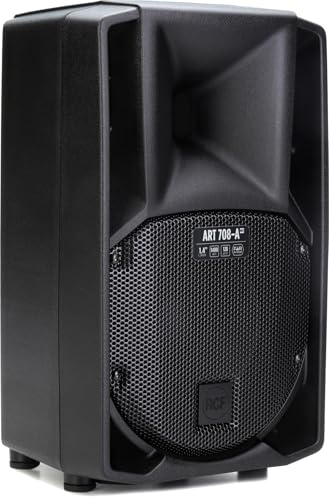
Live listings for the shortlist in this guide are pulled from Amazon below, so prices and availability are always current at the moment you look.


Verdict: matching the box to the room and the job
For a treated or naturally calm midsize room, the classic nearfield choices divide by temperament. The HS8 offers Yamaha’s direct midrange honesty and simple analog controls. The 308P MkII counters with waveguide consistency for listeners who move. The LP-8 brings the clearest placement guidance and front port freedom. The T8V adds its folded tweeter character for those who value top end air. The Rokit 8 G5 suits the small room and the producer who wants DSP modes and a front port in one cabinet. None of these rankings survives a bad room unchanged, which is why this guide has returned to placement so often.
For speech, teaching, and small event work, a compact PA pair remains the right tool, and studio monitors should stay in the studio where their accuracy is the point. The shared woofer diameter is a coincidence of sizing, not a promise of shared purpose. Buyers who respect that boundary, who measure their room before their shortlist, and who read the manuals their makers took care to publish will end up with speakers that feel inevitable rather than merely impressive.
This guide’s recommendations rest on published specifications and manufacturer documents, rather than on hands-on use of the speakers covered. Model descriptions follow the makers’ own published material, and figures quoted are the figures those documents state. When readers buy through retailer links on this site, the retailer may pay this site a commission, at no extra cost to the reader. Readers should confirm current specifications and included accessories with the retailer and the manufacturer before ordering, since model revisions can change details over time.
Give an honest room an honest speaker, placed with care, and the mixes will start traveling well beyond those four walls.

