Our Top Picks




What's inside
As an Amazon Associate I earn from qualifying purchases. This post may contain affiliate links at no extra cost to you.
A manual inflation aneroid arm monitor is the classic blood pressure kit found in clinics, nursing classrooms, and many home medicine cabinets. There is no battery, no motor, and no automatic inflation cycle. You wrap a fabric cuff around the upper arm, squeeze a rubber bulb to inflate it by hand, place a stethoscope over the brachial artery inside the elbow, and slowly release air while you listen and watch a round mechanical dial. The two numbers you record, systolic and diastolic pressure, come from what you hear and what the needle shows at the same moment. That hands-on method is exactly why these kits remain in use. They teach the underlying skill, they work during a power outage, they do not depend on an algorithm, and a well-kept gauge can stay in service for years with periodic calibration checks.
This guide covers eight manual aneroid kits sold for adult upper-arm use, plus one multi-cuff set that extends well beyond a single adult size. Every model in the list uses manual inflation and an aneroid dial rather than a digital sensor and display. The differences that matter are more practical than electronic: the arm range printed for the cuff, whether the cuff uses a D-ring to make one-handed tightening easier, whether a carrying case is included, whether a calibration tool is included, whether a stethoscope is included or clearly not included, and, in one case, how many cuffs come in the bag. Reading those details carefully prevents the most common disappointment with this category, which is opening the box and discovering that a part you assumed was inside was never part of the kit.
Two of the eight kits state plainly in their product names that a stethoscope is not included: the PARAMED kit and the Santamedical kit. One kit states plainly that a stethoscope is included: the PrimaCare Medical DS-9197-BK Professional Classic Series kit. For the remaining kits, the product names in our research focus on the cuff, the case, and in two cases a calibration tool, and they do not present a stethoscope as part of the named contents. Treat a stethoscope as a separate purchase unless the listing for the exact kit you choose confirms one in writing. A manual aneroid monitor without a stethoscope cannot be used for the standard listening method described in this guide, so that single detail should be settled before anything else.
If you also track activity and everyday health with wearable devices, our research notes link this topic to broader home health setups, and readers comparing connected gear may also want to look at best activity smartwatches alongside a traditional cuff kept at home. The two kinds of tools do different jobs. A watch can show trends in movement, sleep, and pulse through the day, while a cuff measurement taken seated at a table remains the familiar reference method taught in clinical training. Keeping both perspectives helps you avoid expecting one device to do the work of the other.
How a manual aneroid monitor works
An aneroid gauge measures pressure without liquid. Inside the round dial housing, a small mechanical linkage moves as air pressure in the cuff rises and falls, and that movement drives the needle across a printed scale marked in millimeters of mercury, usually shortened to mmHg. When you squeeze the inflation bulb, air travels through tubing into an inflatable bladder sewn inside the arm cuff. As the bladder fills, the cuff tightens around the upper arm and temporarily stops blood flow in the brachial artery below it. A small screw valve beside the bulb lets you control how quickly that air escapes again.
The listening part of the method has a name: auscultation. You place the chest piece of a stethoscope over the brachial artery at the inner elbow, inflate the cuff until the needle rises above the expected systolic level, and then open the valve slightly so the needle falls slowly and steadily. The first clear tapping sound you hear through the stethoscope marks systolic pressure, the pressure when the heart contracts and blood first pushes past the cuff. As air continues to leave and the needle continues to fall, those sounds eventually disappear. The point where the last sound is heard marks diastolic pressure, the pressure when the heart relaxes between beats. You read both numbers directly from the dial at those two moments, which is why dial legibility, a steady deflation rate, and a quiet room all matter.
Because the reading depends on hearing and observation, technique influences the result as much as the hardware does. Talking during a measurement, letting the arm hang unsupported, crossing the legs, using a cuff that is too small for the arm, or releasing air too quickly can all shift the numbers. None of that is a flaw in any particular kit in this guide. It is the nature of a manual method, and it is also why nursing and medical training programs still teach the method step by step, with a supervisor listening alongside the learner through a teaching stethoscope in some settings. If you are learning at home, expect the first several attempts to feel clumsy. Coordinating the bulb, the valve, the dial, and the sounds at once takes practice, and practicing on a willing partner is far easier than measuring your own arm, because measuring yourself means working the bulb with the same side of the body that is wearing the cuff.
Cuff size comes before brand
The single most important buying decision in this category is cuff fit. A cuff works correctly only when its bladder wraps the arm within the range the maker intended. A cuff that is too small for the arm can produce readings that run high, and a cuff that is too large can produce readings that run low. The practical step is simple and often skipped: measure the circumference of the bare upper arm at its midpoint, halfway between shoulder and elbow, with a flexible tape, and compare that number with the cuff range stated for the kit you are considering. Do not estimate from clothing size, weight, or the fit of a different brand of cuff, because ranges differ between makers.
Three of the kits in this guide state a numeric arm range in their product names, and those ranges are not identical. The PARAMED kit states a universal cuff range of 8.7 to 16.5 inches. The McKesson Premium kit states 23 to 40 centimeters, which is the metric expression of an adult arm range for its cuff. The CUG kit states a standard adult cuff range of 9 to 17 inches. Those stated ranges overlap for many adults, but the edges matter. An arm near the top or bottom of one range may sit more comfortably in the middle of another, and a cuff worn near its limit is harder to position smoothly and keep closed under pressure. If your measurement falls close to an edge, favor the kit whose stated range puts your arm nearer the middle, and re-check the fit once the cuff arrives by confirming that the index line on the cuff falls inside the printed range markings when wrapped.
Most of the other kits describe their cuff simply as an adult cuff without a numeric range in the product name. That wording is normal for this category, but it means you should confirm the usable range on the product page or packaging before relying on the kit for a specific person. Households where several adults with different arm sizes will share one kit, and anyone who measures children as well as adults, should look closely at the Primacare DS-9185-BK set in this guide. Its product name states that it includes five nylon cuffs covering infant, child, adult, large adult, and thigh sizes, which addresses the fit problem by giving the user a cuff matched to each arm rather than forcing one cuff to serve everyone.
What is in the box, and what is not
Manual kits look similar in photographs, so it helps to sort the eight models in this guide by their stated contents before comparing anything else. Carrying cases are common across the list. The PARAMED, Dixie EMS, McKesson Premium, Santamedical, PrimaCare DS-9197-BK, CUG, Primacare DS-9185-BK, and MDF kits all mention a carrying case in their product names, although the PrimaCare DS-9197-BK describes its case as a portable leatherette case while others use the plainer carrying case wording. A case matters more than it sounds. The gauge is a mechanical instrument that can drift if it is knocked or dropped, the tubing can kink, and the bulb and valve are small parts that are easy to misplace in a drawer. Storing the whole kit together in its case protects the dial and keeps the stethoscope, where one is owned, with the cuff.
Calibration tools are stated for two kits: the Dixie EMS Deluxe set and the CUG kit. A calibration tool for an aneroid gauge is typically a small key used to adjust the needle rest position when the needle does not sit at zero with the cuff fully deflated. Its presence in the box does not remove the need for periodic accuracy checks against a known reference, but it does mean the basic zero adjustment described in many gauge manuals can be done with the tool the maker supplied rather than a substitute. The MDF kit takes a different approach to the same concern and states lifetime calibration in its product name, which is a service commitment from that maker rather than a tool in the box. The Primacare multi-cuff set and the other kits do not name a calibration tool, so owners who want one should plan accordingly.
The stethoscope question deserves a short list of its own because it changes the total purchase. Not included, stated in the product name: PARAMED and Santamedical. Included, stated in the product name: PrimaCare Medical DS-9197-BK, which describes itself as a blood pressure kit with stethoscope. Not stated in the product name: Dixie EMS, McKesson Premium, CUG, Primacare DS-9185-BK, and MDF. For that last group, our research treats the stethoscope as unconfirmed rather than assumed, and you should read the exact contents list for the kit before ordering if you do not already own a stethoscope. Many clinicians, students, and experienced home users already own a stethoscope they prefer, and for them a cuff-and-gauge kit without one is not a drawback at all. For a first-time buyer building a kit from nothing, it is the difference between measuring on day one and waiting for a second delivery.
The eight manual aneroid arm monitors in this guide
The eight sections below follow the order of the verified product list for this guide. Each section sticks to what the product name itself states, plus general guidance about how that kind of feature is used in practice. Where a product name is silent on a point, the section says so instead of filling the gap with a guess. That discipline matters in a medical-adjacent category, where a wrong assumption about cuff range or contents can lead to a kit that does not fit the person or cannot be used on arrival.
1. PARAMED Aneroid Sphygmomanometer with universal cuff
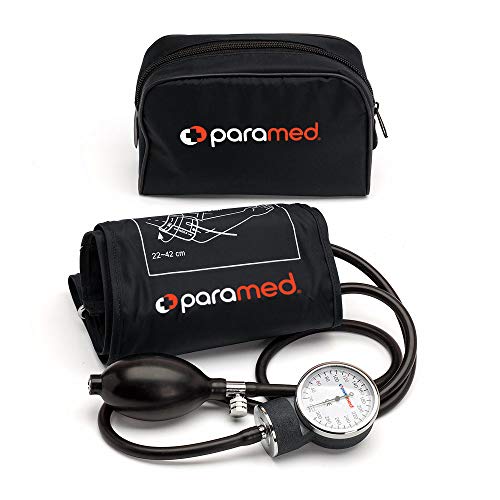
The PARAMED Aneroid Sphygmomanometer is a manual blood pressure cuff kit built around a universal cuff with a stated range of 8.7 to 16.5 inches and a D-ring design. That stated range is one of the widest single-cuff ranges named in this guide, and it is the main reason this kit suits households where one cuff may be used on more than one adult. The word universal in the product name refers to that broad fit range, not to a promise that one cuff fits every possible arm, so the tape-measure check still applies. An arm below or above the stated range needs a different cuff size, no matter how convenient a single shared kit would be.
The D-ring is the second practical point in its favor. Pulling the strap through the ring gives you leverage with one hand, which makes self-application and quick refitting noticeably simpler than wrestling a plain strap into place. In daily use, that ease shows up as better habits: the cuff gets placed at the same height on the arm, the artery marker can be lined up over the brachial artery without the cuff slipping, and the closure can be snugged firmly without leaving the loose gap that lets a bladder shift during inflation. Small handling advantages like this are worth weighting heavily in a manual kit, because you repeat the same motions at every single measurement.
The kit is described in black and includes a carrying case in the kit. The case keeps the gauge, bulb, and cuff together for storage at home or for transport to training sessions. The most important honesty note for this model is stated in capital terms in its own product name: stethoscope not included. Budget and plan for a separate stethoscope if you do not already own one. That is not a hidden catch; the maker states it up front, and buyers who already have a preferred stethoscope may actively prefer a kit that does not bundle a second one. One further note from our research is worth repeating: PARAMED appears in multiple similar listings online, so confirm the exact identifier for this kit before ordering and judge this section only against the configuration described here, with the 8.7 to 16.5 inch D-ring cuff and case.
Choose this kit if your arm, or the arms in your household, fall inside that wide stated range, if one-handed cuff application matters to you, and if you already own a stethoscope or are happy to choose one separately. Look elsewhere in this guide if you need a stethoscope in the same box, if you need child or thigh cuffs, or if your arm measurement falls outside the stated range and a different size would put you nearer the middle of a cuff range.
2. Dixie EMS Deluxe Aneroid Sphygmomanometer Blood Pressure Set
The Dixie EMS Deluxe Aneroid Sphygmomanometer Blood Pressure Set is presented as a set with an adult cuff, a carrying case, and a calibration tool, finished in black. The inclusion of the calibration tool in the stated contents is its distinguishing point in this guide. Only two of the eight kits name one, and for owners who expect to keep a gauge in service for a long time, having the maker-supplied tool for zero adjustment removes a small but real friction from routine care. When a fully deflated cuff leaves the needle sitting off the zero mark, the gauge manual for this kind of instrument typically describes a careful adjustment, and the supplied tool is the intended way to make it.
The adult cuff wording tells you the intended user clearly, while the absence of a numeric range in the product name means the tape-measure step needs a follow-up check of the stated range on the product details before you rely on the fit for a particular arm. That is especially relevant for smaller adults and for larger arms near the boundary of a standard adult cuff, where a number matters more than a label. The carrying case completes a set that reads as aimed at practical, mobile use, consistent with the EMS reference in the brand name: gauge, cuff, and adjustment tool stored together and ready to move between rooms, vehicles, or training sites without loose parts.
The product name for this set does not list a stethoscope among its contents. Our research therefore treats a stethoscope as a separate item for this kit unless the exact contents list you review confirms otherwise. That pattern is common for professional-leaning sets, since many trained users already carry a stethoscope they know well, but a first-time buyer should not discover it after delivery. Pairing this set with a stethoscope you already own is a sensible route; buying both at once is equally sensible, as long as it is a deliberate decision.
Choose this set if the included calibration tool appeals to you, if a standard adult cuff matches the arm or arms you measure, and if a cased, portable set fits how you work. Consider another kit in this guide if you need a stated numeric cuff range before you buy, if you need multiple cuff sizes in one purchase, or if you want a stethoscope confirmed inside the same kit.
3. McKesson Premium Manual Blood Pressure Monitor
The McKesson Premium Manual Blood Pressure Monitor is described as a premium pocket aneroid sphygmomanometer with an inflation pump and cuff for an adult arm, in blue and navy, with a stated cuff range of 23 to 40 centimeters and a count of one per package. Pocket aneroid in this context describes the gauge style: a compact dial gauge of the kind commonly carried in a pocket or clipped into a kit, paired here with the hand inflation pump and cuff you use in the standard method. The stated metric range is helpful because it lets you compare your tape measurement directly if your tape is marked in centimeters, as many flexible tapes are on one edge.
McKesson is a name associated with medical supply distribution, and the product presentation here is plain and specification-led: color, range, count, pump, cuff, gauge type, and carrying case. That plainness is useful. There is no suggestion in the product name that this is anything other than a single adult kit, which sets expectations correctly for a clinic drawer, a home health bag, or a student kit built around one adult size. The carrying case is included, so the pump, cuff, and gauge can be stored as one unit rather than scattered among other supplies, which also reduces the chance of the gauge taking a knock from heavier items.
The product name does not mention a stethoscope or a calibration tool. As with several kits in this guide, that silence should be read literally: plan on your own stethoscope for the listening method, and treat calibration as a periodic check against a reference device or a service, with any adjustment carried out according to the instructions supplied with the gauge. Buyers who keep a small home health station may find that arrangement entirely normal, since a single good stethoscope often serves alongside more than one cuff in the same household or practice.
Choose this kit if you want a compact pocket-style gauge, an adult cuff with a clearly stated 23 to 40 centimeter range, and a case included for tidy storage. Students and professionals who spend long days moving between study, labs, and placements sometimes pair this kind of compact clinical kit with the wider gear covered in best laptops for medical school, since notes, readings, and coursework tend to travel together. Look at other kits here if you need a D-ring cuff, a named calibration tool in the box, a confirmed stethoscope in the kit, or cuff sizes beyond the adult range.
4. Santamedical Manual Blood Pressure Cuff
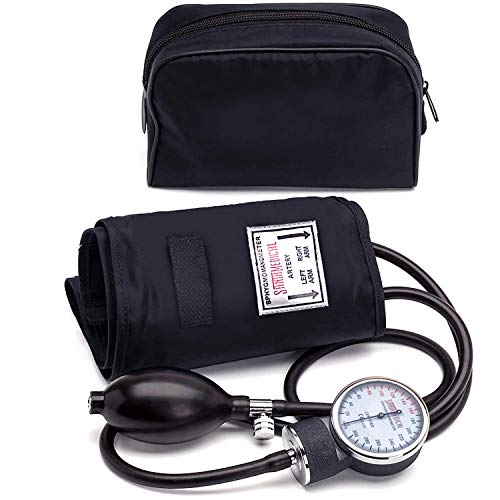
The Santamedical Manual Blood Pressure Cuff is described as an adult aneroid sphygmomanometer, a deluxe blood pressure cuff monitor with a carrying case and an adult black cuff. Its product name, like the PARAMED name, ends with an explicit and helpful warning: stethoscope not included. That clarity should be taken at face value and, frankly, appreciated. A buyer who reads the name carefully knows exactly what else is needed to take a measurement on the day the kit arrives, and a buyer who already owns a stethoscope knows the kit is aimed at them.
The adult black cuff is the working part of the kit, and the same fit guidance applies here as everywhere in this guide. Adult describes the intended size class, not a guarantee for every arm, so measure the arm, then confirm the usable range for this cuff from the product details before depending on it for a specific person. A cuff that wraps with its index marker inside the printed range and sits smoothly without bunching will be easier to use consistently than one forced to its limit. The deluxe wording in the name is a product tier description rather than a measurable specification, so let the concrete points, cuff class, case inclusion, and the stethoscope note, carry your decision.
The carrying case is included, which keeps this simple kit self-contained for storage. Simple is a genuine virtue in this category. A gauge, a cuff, a bulb, and a valve, stored together and used with a stethoscope you already trust, is the setup many experienced users prefer, because there are no batteries to replace, no charging routine, and nothing to update. Maintenance reduces to keeping the kit dry and protected, checking that the needle rests at zero when deflated, listening for leaks if inflation will not hold, and arranging an accuracy comparison from time to time.
Choose this kit if you want a straightforward adult cuff and gauge with a case, you already own a stethoscope, and you prefer a short contents list with no bundled extras. Choose a different kit if you are buying your first complete setup and want a stethoscope confirmed in the box, if you need a numeric cuff range stated in the name itself, or if the people you measure need child, large adult, or thigh sizes as well.
5. PrimaCare Medical DS-9197-BK Professional Classic Series Manual Adult Size Blood Pressure Kit
The PrimaCare Medical DS-9197-BK Professional Classic Series kit holds a unique place in this guide: it is the one kit whose product name states that a stethoscope is included. It is described as a manual adult size blood pressure kit, an emergency blood pressure kit with stethoscope and a portable leatherette case, with a nylon cuff, in black. For a buyer who wants to open one case and have the complete listening setup in hand, that stated inclusion answers the most important contents question in this entire category without any further checking. It also makes this kit a natural gift or starter kit for a student or a household equipping itself for the first time.
The nylon cuff is worth a brief note. Nylon is a common cuff fabric in clinical kits because it is light, flexible, and easy to wipe clean between users, which suits a kit that may be used for training, first aid readiness, or shared household use. The adult size wording again calls for the standard caution: confirm that the cuff range suits the arm you intend to measure, particularly if the kit will serve several people. The leatherette case description distinguishes its storage from the plain carrying cases elsewhere in the list, and a structured portable case suits an emergency kit that is expected to travel and to be opened quickly, with gauge, cuff, and stethoscope kept together rather than gathered from separate places.
Choose this kit if you want the stethoscope confirmed in the same purchase, a nylon adult cuff, and a portable leatherette case for storage and travel. It is the most self-contained option in this guide for a new buyer. Consider the multi-cuff Primacare set below instead if your measuring needs extend beyond one adult size, and consider the MDF kit if dial presentation and a stated lifetime calibration commitment matter more to you than a bundled stethoscope.
6. CUG Manual Blood Pressure Cuff with standard adult cuff
The CUG Manual Blood Pressure Cuff is described with a standard adult cuff covering 9 to 17 inches, a carrying case, and a calibration tool. That combination gives it two of the clearest stated specifications in this guide. The 9 to 17 inch range is the widest upper limit named for a single adult cuff here, reaching slightly beyond the PARAMED range at the top end, which may matter for larger arms that sit at the edge of other adult cuffs. As always, wider is only better if your arm actually falls in the part of the range you need; a smaller arm near the bottom of any range still deserves a check that the cuff closes smoothly and its index marker lands where the maker intends.
The calibration tool is the second stated inclusion, shared in this guide only with the Dixie EMS set. For an owner who plans to check the zero position regularly, and that is a habit worth building, since a needle that no longer rests at zero with no pressure in the system is an early visible sign that a gauge needs attention, having the tool in the case keeps that check self-contained. Keep the tool with the kit rather than in a general toolbox, label the case if the kit is shared, and follow the gauge instructions carefully for any adjustment rather than turning the mechanism by feel. Small, careful corrections preserve an instrument; force does the opposite.
The product name does not mention a stethoscope, so the same planning rule applies: assume you will use a stethoscope you already own or buy one separately, unless the exact contents list for this kit confirms one. The carrying case is stated, which suits the tool as well as the gauge and cuff, since a small calibration key is exactly the kind of item that disappears when stored loose. Taken together, the CUG reads as a value-conscious, specification-clear adult kit for a home user, student, or small practice that already has the listening side of the setup covered.
Choose this kit if your arm falls within the stated 9 to 17 inch range, especially toward its upper half, and if you want a calibration tool included alongside the case. Choose another kit if you need a stethoscope in the box, multiple cuff sizes, or a D-ring cuff design for easier one-handed application.
7. Primacare DS-9185-BK Aneroid Sphygmomanometer BP Kit with 5 BP cuffs
The Primacare DS-9185-BK Aneroid Sphygmomanometer BP Kit is the outlier in this guide in the best sense: its product name states that it includes five blood pressure cuffs, in infant, child, adult, large adult, and thigh nylon sizes, plus a portable carrying case, in black. Every other kit here centers on a single adult cuff. This set solves the fit problem at the root by matching cuff size to the person being measured, which is how measurement is handled in settings that see a wide range of patients. For a family with children and adults, a community health volunteer, a training program, or a small clinic, that range of sizes in one case is a substantial practical advantage.
Using the right cuff from the set requires the same measurement discipline, applied each time. Measure the arm, select the cuff whose range contains that measurement comfortably, and do not default to the adult cuff out of habit when a child or large adult cuff is sitting in the same case. The thigh cuff has its own intended use for very large arms and for leg measurement in specific clinical situations directed by a professional; it is not simply a bigger arm cuff to reach for casually, and anyone unsure about its use should follow professional guidance. The infant cuff likewise belongs to trained measurement of very small arms, where technique and cuff fit are especially critical and where home users should follow the direction of their clinician rather than improvising.
The product name for this set does not list a stethoscope or a calibration tool among its contents, focusing instead on the cuffs and the case. Plan the listening equipment separately, and give some thought to organization: five cuffs, tubing, gauge, and bulb in one portable case benefit from being stored in a consistent arrangement, with each cuff rolled or folded the same way each time so the set can be checked at a glance. Labeling cuffs by size, if they are not already clearly marked, prevents the slow confusion that creeps into shared kits.
Choose this set if you genuinely measure people across size categories and want one gauge with matched cuffs, stored together. It is more kit than a single adult at home will ever need, and that is fine; its audience is broader by design. If you only ever measure one or two adults, one of the single-cuff kits above will be simpler to store, simpler to learn, and easier to keep organized.
8. MDF Manual Blood Pressure Cuff, Calibra Aneroid Premium Professional Sphygmomanometer
The MDF Manual Blood Pressure Cuff, model MDF808M04 in its product name, is described as a Calibra Aneroid Premium Professional Sphygmomanometer with an adult cuff and carrying case, lifetime calibration, a white dial, and a navy blue cuff. Two stated points set it apart. The first is the white dial. Dial legibility is not a cosmetic detail in a manual kit, because you must read a moving needle at the exact moments sounds appear and disappear, often while your other hand controls the valve. A light dial face with clear markings is the classic presentation for this kind of gauge precisely because it keeps the needle and scale easy to follow at a glance, including in ordinary room light at home.
The second stated point is lifetime calibration. Where the Dixie EMS and CUG kits include a tool for adjustment, the MDF name instead states a lifetime calibration commitment from the maker. Those are different forms of reassurance and should not be confused with each other. A tool lets the owner make a described adjustment; a maker commitment describes support available for the instrument over its life, on the terms the maker sets. Either way, the owner habit that matters stays the same: notice if the needle stops resting at zero, compare the gauge against a reference from time to time, and act when readings or the rest position suggest drift, rather than assuming a mechanical dial stays accurate forever without attention.
The adult cuff and carrying case complete a professional-leaning presentation, with the navy blue cuff distinguishing it visually from the black cuffs that dominate this list. That color difference has one modest practical benefit in shared settings: a kit that looks distinct is less likely to be mixed up with another kit on the same shelf. The product name does not mention a stethoscope, so plan on your own for the listening method, as with most kits in this guide. Many professional users will regard that as normal, since a stethoscope is a personal instrument that clinicians tend to choose and keep separately from cuffs.
Choose this kit if dial readability is a priority, if the stated lifetime calibration appeals to you, and if a single adult cuff in navy blue suits the person or people you measure. Readers building a broader outdoor and training kit sometimes browse this kind of durable, no-battery equipment alongside best adventure fit smartwatches for activity tracking away from home, but for blood pressure itself the cuff, gauge, and stethoscope remain the tools that count. Look elsewhere in this guide if you need a stethoscope included, a calibration tool in the box, or more than one cuff size.
Taking a measurement, step by step
Sit quietly for several minutes with your back supported, feet flat, and legs uncrossed. Place the cuff on a bare upper arm at heart level, with the artery marker over the brachial artery and the lower edge above the elbow crease. Rest the arm on a table, place the stethoscope chest piece inside the elbow, inflate until the needle rises above the expected systolic level, then release air slowly while listening. Note the dial reading at the first clear sound and again at the last sound, deflate fully, wait before repeating, and record both numbers with the time and arm used. Avoid talking, caffeine, exercise, and a full bladder beforehand, since each can shift a reading.
Check prices on Amazon
Live listings for the shortlist in this guide are pulled from Amazon below, so prices and availability are always current at the moment you look.


Calibration, care, and when to choose a different kit
Check regularly that the needle rests at zero with the cuff deflated, store the kit dry in its case, avoid dropping the gauge or kinking the tubing, and compare readings periodically against a reference at a clinic or pharmacy. If the needle sticks, inflation leaks, or comparisons drift, arrange professional checking rather than guessing. Choose a manual kit if you value a battery-free method and are willing to learn the listening skill; choose a validated automatic monitor instead if hearing, dexterity, or measuring alone makes the manual method impractical, and discuss persistent high or low readings with a clinician. Readers comparing budget connected trackers for everyday activity alongside home cuff readings may also review best android smartwatches fitness trackers under 100, while keeping cuff measurements as the reference for blood pressure itself.
Disclosure: This article is based on our research of the product names and stated contents listed above. As an Amazon Associate we earn from qualifying purchases. Product contents and specifications can change, so please confirm cuff range and included items before ordering.


