Our Top Picks
 4M Kidzlabs Anti Gravity Magnetic Levitation Science Kitoriginal2.5 x 9.5 x 8.5 inches0.45 poundsCheck on Amazon
 Thames & Kosmos Physics Workshop STEM Science KitStandard11.5 x 3.1 x 14.6 inches2.4 poundsCheck on Amazon
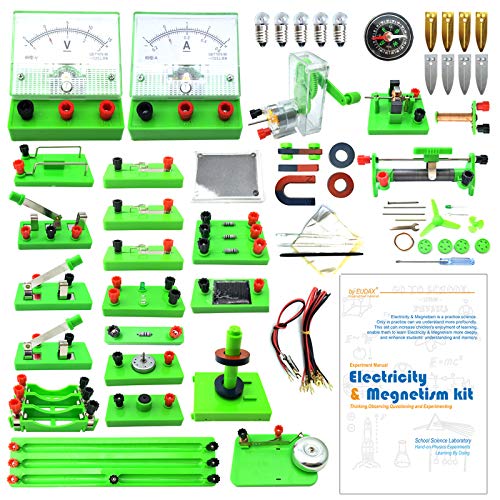


What's inside
- What a 14-Year-Old Is Actually Studying in Physics
- How to Choose: Core Kits, Bridge Kits, and Focused Builds
- The Kits, One by One
- EUDAX School Physics Labs Basic Electricity Discovery Circuit and Magnetism Experiment Kit
- MiOYOOW DIY Electromagnetic Coil Shooting Kit
- Engino STEM Newton’s Laws, Inertia, Kinetic and Potential Energy Building Set
- 4M KidzLabs Anti Gravity Magnetic Levitation Science Kit
- Thames & Kosmos Physics Workshop STEM Science Kit
- EUDAX Physics Science Lab Learning Circuit Kit (Basic Kit)
- Physics Electricity and Magnetism Experiment Kit
- 12 Electric Circuit Kit for Kids and Teens
- Electricity and Magnetism: The Heart of the School Course
- Mechanics: Forces, Machines, and Energy
- Safety, Supervision, and Good Habits
- Making Any Kit Go Further
- Which Kit Fits Which Learner
- Check prices on Amazon
- Disclosure
As an Amazon Associate I earn from qualifying purchases. This post may contain affiliate links at no extra cost to you.
Choosing a physics set for a 14-year-old is a different job from choosing one for a younger child. At fourteen, most students are meeting formal physics at school: electric circuits, electromagnetism, forces, motion, and energy. A set that matches those topics can reinforce a whole term of lessons, while a set aimed at younger learners can still help as a gentler starting point if it is chosen with open eyes. This guide works through eight kits, explains which ones form the core for this age, which ones work as a bridge, and how to think about the subject areas each one covers, based on our research into the published product information for each set.
A note on honesty before the details. The specifications and age guidance in this guide come from the product titles and from general knowledge of how physics is taught at this level. Where a title states an age range, a piece count, or a topic list, that is what is reported here. Where a title is silent, nothing is invented to fill the gap. That approach keeps expectations realistic, which matters when a gift or a school support purchase needs to do a specific job.
What a 14-Year-Old Is Actually Studying in Physics
At fourteen, physics stops being a collection of fun tricks and starts becoming a language for describing how the world behaves. A good kit respects that change by giving a learner something real to build, measure, and explain rather than something that only lights up and stops there. Parents and teachers often ask whether a kit is too young or too advanced, and the honest answer usually depends on how the learner will use it.
A bridge kit used for a weekend is different from a lab kit used alongside a term of schoolwork, and both can have a place in the same home. The strongest learning happens when a student predicts an outcome before switching a circuit on or releasing a pendulum, then compares the prediction with what actually happened. Writing that prediction down, even in one sentence, turns play into an experiment and gives the learner something to argue with later.
Three topic clusters dominate at this age. The first is electricity: current, circuits, components, and the difference between series and parallel arrangements. The second is electromagnetism: magnets, fields, coils, and the link between electric current and magnetism that makes motors possible. The third is mechanics: forces, gravity, simple machines, gears, pendulums, and energy transfers between kinetic and potential forms. The eight kits in this guide map onto those clusters, with the EUDAX school lab sets and the electricity and magnetism starter set covering the first two clusters, and the Thames & Kosmos Physics Workshop covering the third in depth.
Students who enjoy project work at home often enjoy documenting it too, and the same household might be comparing other study and hobby gear in parallel, such as the options in best affordable laptops for coding and programming for schoolwork computing. Keeping research notes in one place, with a dated record of what was built and what was observed, is a habit that pays off across subjects.
How to Choose: Core Kits, Bridge Kits, and Focused Builds
Writing that prediction down, even in one sentence, turns play into an experiment and gives the learner something to argue with later. Vocabulary grows naturally in that setting, because words like conductor, insulator, friction, and torque are needed to explain a result the student has just seen. A kit also helps when school equipment is shared among a whole class and time at the bench is short, since home practice can be slower and more reflective.
None of that requires expensive equipment; it requires clear instructions, repeatable builds, and enough pieces that one missing part does not end the project. Safety belongs in the same conversation, especially with soldering, coils, and small components, where adult supervision and tidy habits matter more than speed. Storage matters too, because a kit that stays organised is a kit that gets used again when the next school topic arrives.
It helps to sort the eight kits into three roles. Core kits are the ones whose titles point at high school or junior and senior high school learners, or whose topic breadth covers a school unit in depth. Bridge kits are the ones listed for younger starting ages, such as 9 and up, which a 14-year-old can use as an introduction or share with a younger sibling. Focused builds are single-project kits, such as the electromagnetic coil shooting kit, which teach depth, patience, and a specific skill like soldering practice rather than broad coverage. None of these roles is a failure; a mismatch only happens when a bridge kit is bought expecting a full high school lab, or a focused build is bought expecting a term of varied experiments.
The Kits, One by One
EUDAX School Physics Labs Basic Electricity Discovery Circuit and Magnetism Experiment Kit
This EUDAX set is presented in its title as a school physics lab kit covering basic electricity discovery circuits and magnetism, aimed at high school students and covering electromagnetism and elementary electronics. That positioning matters for a 14-year-old, because it lines up directly with the electricity and magnetism units most students meet in middle and high school physics. Rather than treating circuits as a toy novelty, a school lab format encourages a learner to build a circuit, change one variable, observe what changes, and explain the result using vocabulary from class such as current, voltage, resistance, and magnetic field.
On the subject of electricity discovery, the learning value for a student around fourteen comes from repetition with variation. A first build shows that something works. A second build, changed in one deliberate way, shows why it works. A third attempt, where the learner predicts the outcome in writing before starting, builds the habit of thinking in causes and effects that school physics rewards. Families should also think about where electricity discovery sits in the school year: a kit bought just before the matching unit begins lets a learner arrive with questions already formed, while a kit bought during the unit can rescue a topic that felt rushed in class, because home builds can be repeated slowly and photographed for a notebook.
On the subject of circuit building, the learning value for a student around fourteen comes from repetition with variation. A first build shows that something works. A second build, changed in one deliberate way, shows why it works. A third attempt, where the learner predicts the outcome in writing before starting, builds the habit of thinking in causes and effects that school physics rewards. Families should also think about where circuit building sits in the school year: a kit bought just before the matching unit begins lets a learner arrive with questions already formed, while a kit bought during the unit can rescue a topic that felt rushed in class, because home builds can be repeated slowly and photographed for a notebook.
MiOYOOW DIY Electromagnetic Coil Shooting Kit
The MiOYOOW kit is a do-it-yourself electromagnetic coil shooting project, described as a STEM physics experiment and a soldering practice kit for school learning, and as a gift option for teens and adults. Its value for a 14-year-old is different from a broad lab set: it is a single focused build. A focused build teaches patience, sequencing, and troubleshooting, because a coil-based launcher only works when the circuit, the coil, and the timing of the energy release all come together. The soldering practice element also makes it a step up in responsibility, so adult supervision and proper safety habits belong in any discussion of this kit.
On the subject of electromagnetic coil, the learning value for a student around fourteen comes from repetition with variation. A first build shows that something works. A second build, changed in one deliberate way, shows why it works. A third attempt, where the learner predicts the outcome in writing before starting, builds the habit of thinking in causes and effects that school physics rewards. Families should also think about where electromagnetic coil sits in the school year: a kit bought just before the matching unit begins lets a learner arrive with questions already formed, while a kit bought during the unit can rescue a topic that felt rushed in class, because home builds can be repeated slowly and photographed for a notebook.
On the subject of soldering practice, the learning value for a student around fourteen comes from repetition with variation. A first build shows that something works. A second build, changed in one deliberate way, shows why it works. A third attempt, where the learner predicts the outcome in writing before starting, builds the habit of thinking in causes and effects that school physics rewards. Families should also think about where soldering practice sits in the school year: a kit bought just before the matching unit begins lets a learner arrive with questions already formed, while a kit bought during the unit can rescue a topic that felt rushed in class, because home builds can be repeated slowly and photographed for a notebook.
Engino STEM Newton’s Laws, Inertia, Kinetic and Potential Energy Building Set
The Engino set covers Newton’s laws, inertia, and kinetic and potential energy, and its title lists it for kids aged 9 and up, with eight model options. For a 14-year-old, honesty matters here: this is best presented as an entry or bridge choice rather than the core high school lab. A younger sibling, a student who learns best by building models first, or a learner who wants a gentler route into mechanics concepts can still get real value from it. Building a model that rolls, falls, or transfers energy makes abstract words like inertia and potential energy concrete before a student meets them in equations.
On the subject of Newton’s laws, the learning value for a student around fourteen comes from repetition with variation. A first build shows that something works. A second build, changed in one deliberate way, shows why it works. A third attempt, where the learner predicts the outcome in writing before starting, builds the habit of thinking in causes and effects that school physics rewards. Families should also think about where Newton’s laws sits in the school year: a kit bought just before the matching unit begins lets a learner arrive with questions already formed, while a kit bought during the unit can rescue a topic that felt rushed in class, because home builds can be repeated slowly and photographed for a notebook.
On the subject of inertia, the learning value for a student around fourteen comes from repetition with variation. A first build shows that something works. A second build, changed in one deliberate way, shows why it works. A third attempt, where the learner predicts the outcome in writing before starting, builds the habit of thinking in causes and effects that school physics rewards. Families should also think about where inertia sits in the school year: a kit bought just before the matching unit begins lets a learner arrive with questions already formed, while a kit bought during the unit can rescue a topic that felt rushed in class, because home builds can be repeated slowly and photographed for a notebook.
Mechanics builds pair naturally with outdoor and aerial hobbies for many teenagers, and readers comparing project gear across categories may also be looking at best affordable drones with cameras as a separate interest. The physics overlaps more than people expect: flight, energy, and control all reward the same careful, testable thinking, described here in neutral terms as prediction and observation rather than guesswork.
4M KidzLabs Anti Gravity Magnetic Levitation Science Kit
The 4M KidzLabs kit focuses on anti-gravity magnetic levitation, described as a maglev physics STEM set and an educational gift for kids and teens. Like the Engino set, it works best for a 14-year-old as an opening or bridge choice rather than a full course companion. Levitation is a memorable demonstration because it makes an invisible force visible: magnets repel, a gap appears, and an object floats where a learner expects it to fall. That single striking effect can start better questions about poles, field strength, distance, and stability than a page of definitions on its own.
On the subject of magnetic levitation, the learning value for a student around fourteen comes from repetition with variation. A first build shows that something works. A second build, changed in one deliberate way, shows why it works. A third attempt, where the learner predicts the outcome in writing before starting, builds the habit of thinking in causes and effects that school physics rewards. Families should also think about where magnetic levitation sits in the school year: a kit bought just before the matching unit begins lets a learner arrive with questions already formed, while a kit bought during the unit can rescue a topic that felt rushed in class, because home builds can be repeated slowly and photographed for a notebook.
On the subject of maglev principles, the learning value for a student around fourteen comes from repetition with variation. A first build shows that something works. A second build, changed in one deliberate way, shows why it works. A third attempt, where the learner predicts the outcome in writing before starting, builds the habit of thinking in causes and effects that school physics rewards. Families should also think about where maglev principles sits in the school year: a kit bought just before the matching unit begins lets a learner arrive with questions already formed, while a kit bought during the unit can rescue a topic that felt rushed in class, because home builds can be repeated slowly and photographed for a notebook.
Thames & Kosmos Physics Workshop STEM Science Kit
The Thames & Kosmos Physics Workshop is listed with 38 builds, 37 experiments, and 305 pieces, for ages 8 and up, covering gravity, simple machines, gears, a pendulum, and centrifugal force. Despite the younger age floor in the title, the breadth of the mechanics coverage makes it a genuine core option for a 14-year-old who is studying forces and machines. Mechanics is where many students first learn to think like physicists: predict, build, measure, compare, and revise. A workshop format with many builds supports that cycle repeatedly, across levers, gears, pendulums, and rotating systems, instead of ending after one afternoon.
On the subject of gravity and simple machines, the learning value for a student around fourteen comes from repetition with variation. A first build shows that something works. A second build, changed in one deliberate way, shows why it works. A third attempt, where the learner predicts the outcome in writing before starting, builds the habit of thinking in causes and effects that school physics rewards. Families should also think about where gravity and simple machines sits in the school year: a kit bought just before the matching unit begins lets a learner arrive with questions already formed, while a kit bought during the unit can rescue a topic that felt rushed in class, because home builds can be repeated slowly and photographed for a notebook.
On the subject of gears and pendulums, the learning value for a student around fourteen comes from repetition with variation. A first build shows that something works. A second build, changed in one deliberate way, shows why it works. A third attempt, where the learner predicts the outcome in writing before starting, builds the habit of thinking in causes and effects that school physics rewards. Families should also think about where gears and pendulums sits in the school year: a kit bought just before the matching unit begins lets a learner arrive with questions already formed, while a kit bought during the unit can rescue a topic that felt rushed in class, because home builds can be repeated slowly and photographed for a notebook.
EUDAX Physics Science Lab Learning Circuit Kit (Basic Kit)
This second EUDAX entry is a physics science lab learning circuit kit for building circuits, described for junior and senior high school students in its basic kit form. That junior and senior high school framing places it squarely in the age band around 14. A basic circuit kit earns its place by making the fundamentals repeatable: connecting a source, a load, and a path, then rearranging components to see series and parallel behaviour for yourself. Those fundamentals underpin almost everything else in school electricity, from reading a circuit diagram to understanding why a bulb brightens or dims when a circuit changes.
On the subject of learning circuits, the learning value for a student around fourteen comes from repetition with variation. A first build shows that something works. A second build, changed in one deliberate way, shows why it works. A third attempt, where the learner predicts the outcome in writing before starting, builds the habit of thinking in causes and effects that school physics rewards. Families should also think about where learning circuits sits in the school year: a kit bought just before the matching unit begins lets a learner arrive with questions already formed, while a kit bought during the unit can rescue a topic that felt rushed in class, because home builds can be repeated slowly and photographed for a notebook.
On the subject of series and parallel ideas, the learning value for a student around fourteen comes from repetition with variation. A first build shows that something works. A second build, changed in one deliberate way, shows why it works. A third attempt, where the learner predicts the outcome in writing before starting, builds the habit of thinking in causes and effects that school physics rewards. Families should also think about where series and parallel ideas sits in the school year: a kit bought just before the matching unit begins lets a learner arrive with questions already formed, while a kit bought during the unit can rescue a topic that felt rushed in class, because home builds can be repeated slowly and photographed for a notebook.
Circuit work also creates a lot of small digital records, from photos of builds to tables of results, and households organising project media sometimes look at storage topics such as best dji drone sd cards for their other devices. Whatever the storage method, labelling photos with the date and the circuit arrangement turns a camera roll into a usable lab notebook.
Physics Electricity and Magnetism Experiment Kit
This electricity and magnetism experiment kit is described as a STEM physics lab supply set covering electromagnetism and elementary electronics, and as a learning starter set for high school students. Starter is the key word to read honestly: a starter set is a foundation, not a ceiling. For a 14-year-old beginning a high school unit, a foundation set that covers both electricity and magnetism in one box helps connect two topics that textbooks sometimes treat separately, even though an electromagnet shows they are deeply linked. Current flowing through a coil produces magnetism, and that single insight unlocks motors, generators, and relays as ideas.
On the subject of electricity and magnetism combined, the learning value for a student around fourteen comes from repetition with variation. A first build shows that something works. A second build, changed in one deliberate way, shows why it works. A third attempt, where the learner predicts the outcome in writing before starting, builds the habit of thinking in causes and effects that school physics rewards. Families should also think about where electricity and magnetism combined sits in the school year: a kit bought just before the matching unit begins lets a learner arrive with questions already formed, while a kit bought during the unit can rescue a topic that felt rushed in class, because home builds can be repeated slowly and photographed for a notebook.
On the subject of electromagnetism, the learning value for a student around fourteen comes from repetition with variation. A first build shows that something works. A second build, changed in one deliberate way, shows why it works. A third attempt, where the learner predicts the outcome in writing before starting, builds the habit of thinking in causes and effects that school physics rewards. Families should also think about where electromagnetism sits in the school year: a kit bought just before the matching unit begins lets a learner arrive with questions already formed, while a kit bought during the unit can rescue a topic that felt rushed in class, because home builds can be repeated slowly and photographed for a notebook.
12 Electric Circuit Kit for Kids and Teens
This electric circuit kit is listed for boys and girls across the 8 to 12 and 12 to 14 age bands, and is positioned for science electrical circuits, engineering electronics experiments, and science fair projects. The science fair angle is worth taking seriously for a 14-year-old. A fair project needs a question, a method, and results that can be shown clearly, and circuit experiments lend themselves to all three. A learner can vary one part of a circuit, record the outcome in a table, and present a poster that a judge can follow. The upper end of its listed age range reaches exactly to 14, so it sits at the boundary between a bridge kit and a school project tool.
On the subject of science fair projects, the learning value for a student around fourteen comes from repetition with variation. A first build shows that something works. A second build, changed in one deliberate way, shows why it works. A third attempt, where the learner predicts the outcome in writing before starting, builds the habit of thinking in causes and effects that school physics rewards. Families should also think about where science fair projects sits in the school year: a kit bought just before the matching unit begins lets a learner arrive with questions already formed, while a kit bought during the unit can rescue a topic that felt rushed in class, because home builds can be repeated slowly and photographed for a notebook.
On the subject of electrical circuits, the learning value for a student around fourteen comes from repetition with variation. A first build shows that something works. A second build, changed in one deliberate way, shows why it works. A third attempt, where the learner predicts the outcome in writing before starting, builds the habit of thinking in causes and effects that school physics rewards. Families should also think about where electrical circuits sits in the school year: a kit bought just before the matching unit begins lets a learner arrive with questions already formed, while a kit bought during the unit can rescue a topic that felt rushed in class, because home builds can be repeated slowly and photographed for a notebook.
Electricity and Magnetism: The Heart of the School Course
Parents and teachers often ask whether a kit is too young or too advanced, and the honest answer usually depends on how the learner will use it. A bridge kit used for a weekend is different from a lab kit used alongside a term of schoolwork, and both can have a place in the same home. The strongest learning happens when a student predicts an outcome before switching a circuit on or releasing a pendulum, then compares the prediction with what actually happened.
Writing that prediction down, even in one sentence, turns play into an experiment and gives the learner something to argue with later. Vocabulary grows naturally in that setting, because words like conductor, insulator, friction, and torque are needed to explain a result the student has just seen. A kit also helps when school equipment is shared among a whole class and time at the bench is short, since home practice can be slower and more reflective.
Electricity is often the first physics topic where a diagram and a real object have to match. A circuit diagram on paper uses symbols; a kit uses real components and connecting paths. Moving between the two is a skill in itself, and it is exactly the skill the EUDAX circuit kits and the electricity and magnetism starter set are built around, according to their titles. Magnetism adds the invisible element: a field cannot be seen directly, but its effects can, in the pull of a magnet, the behaviour of a compass, or an electromagnet lifting small metal objects when a circuit is closed. Levitation, as in the 4M kit, is the dramatic end of the same idea.
Mechanics: Forces, Machines, and Energy
A kit also helps when school equipment is shared among a whole class and time at the bench is short, since home practice can be slower and more reflective. None of that requires expensive equipment; it requires clear instructions, repeatable builds, and enough pieces that one missing part does not end the project. Safety belongs in the same conversation, especially with soldering, coils, and small components, where adult supervision and tidy habits matter more than speed.
Storage matters too, because a kit that stays organised is a kit that gets used again when the next school topic arrives. A learner who returns to the same kit for a second topic often understands the first topic better, because the ideas in physics connect to each other. Electricity connects to magnetism, magnetism connects to motion, and motion connects back to energy, so a broad kit can quietly teach the shape of the subject itself.
Mechanics rewards builders. A pendulum can be timed, a gear train can be counted, a lever can be loaded, and each result can be compared with a simple prediction. The Thames & Kosmos Physics Workshop, with its listed builds and experiments across gravity, simple machines, gears, pendulum work, and centrifugal force, gives a learner many chances to run that cycle. The Engino set approaches the same territory through models of Newton’s laws and energy, at a level its title places from age nine upward, which is why this guide treats it as the bridge into mechanics rather than the destination for a 14-year-old.
Older students who take physics further often pair it with computing, from simulations to data handling, and some readers will also be weighing up best laptops for machine learning and coding for that next stage. The pairing is natural: a careful experiment produces numbers, and a computer helps turn those numbers into graphs that reveal patterns a table can hide.
Safety, Supervision, and Good Habits
A learner who returns to the same kit for a second topic often understands the first topic better, because the ideas in physics connect to each other. Electricity connects to magnetism, magnetism connects to motion, and motion connects back to energy, so a broad kit can quietly teach the shape of the subject itself. That is why this guide separates core high school choices from bridge choices instead of pretending every box serves a 14-year-old in the same way.
Two kits in this list deserve a specific safety conversation. The MiOYOOW coil kit includes soldering practice, which involves a hot tool and should be supervised, with a clear workspace and heat-safe habits from the first session. Circuit kits involve small components and power sources that should be used as directed, disconnected when a build is changed, and kept tidy so parts are not lost or mixed. These are not reasons to avoid the kits; they are part of the education. Real lab discipline, learned at home at fourteen, carries directly into school practical work and into any later technical study.
Making Any Kit Go Further
Reading a title carefully is part of that honesty: age guidance, topic lists, and piece counts in a title tell you what a maker is actually claiming. Where a title does not state a detail, this guide does not invent one, and families should treat unstated details as questions to check on the product page. A thoughtful gift at this age also leaves room to grow, so a kit that supports a science fair project or a second term of study is worth more than a novelty that is finished in an hour.
Confidence is a real outcome as well, because a student who has already built a working circuit at home walks into a school lab feeling prepared rather than lost. At fourteen, physics stops being a collection of fun tricks and starts becoming a language for describing how the world behaves. A good kit respects that change by giving a learner something real to build, measure, and explain rather than something that only lights up and stops there.
A notebook is the cheapest upgrade for any kit in this guide. Date each build, sketch the arrangement, write the prediction, record the result, and add one sentence about what would be changed next time. Over a term, that notebook becomes revision material written in the student’s own words. Photographs help too, especially for circuits, where a picture taken before a build is taken apart saves rebuilding from memory. For a science fair, the same records become the backbone of a poster: a clear question, a fair method, a table of results, and a conclusion that admits what did not work as expected.
Which Kit Fits Which Learner
For a 14-year-old in the middle of a high school electricity unit, the EUDAX School Physics Labs kit and the EUDAX basic circuit kit are the most direct matches in this list, joined by the electricity and magnetism starter set for high school students. For mechanics depth, the Thames & Kosmos Physics Workshop is the broad choice. For a single absorbing project with soldering practice, the MiOYOOW coil kit stands apart. For a gentler entry, a younger sibling sharing the hobby, or a first step before the core kits, the Engino Newton’s laws set and the 4M magnetic levitation kit are the honest bridge choices. For a science fair project built around circuits, the 12 electric circuit kit whose title reaches up to age 14 is worth a close look.
Safety belongs in the same conversation, especially with soldering, coils, and small components, where adult supervision and tidy habits matter more than speed. Storage matters too, because a kit that stays organised is a kit that gets used again when the next school topic arrives. A learner who returns to the same kit for a second topic often understands the first topic better, because the ideas in physics connect to each other.
Electricity connects to magnetism, magnetism connects to motion, and motion connects back to energy, so a broad kit can quietly teach the shape of the subject itself. That is why this guide separates core high school choices from bridge choices instead of pretending every box serves a 14-year-old in the same way. Reading a title carefully is part of that honesty: age guidance, topic lists, and piece counts in a title tell you what a maker is actually claiming.
Check prices on Amazon
Live listings for the shortlist in this guide are pulled from Amazon below, so prices and availability are always current at the moment you look.


Disclosure
This page contains affiliate links to the physics kits discussed above. If you buy through one of those links, this site may earn a commission, at no extra cost to you. The information in this guide is based on our research into the published product titles and manufacturer descriptions for each kit, together with general knowledge of school physics topics. We do not carry out direct, in-person trials of these kits, and no statement here should be read as a claim that a product was used or evaluated in person. Age guidance, piece counts, and topic lists are reported as stated by the makers, so please check the current product page before buying, as details can change.


