Our Top Picks


What's inside
- What a barometric sensor in a watch actually measures
- Barometric altimetry, drift, and why calibration matters
- Reading pressure tendency for weather, and how storm alerts work
- The main product families and how their approaches differ
- Accuracy, resolution, and reading specifications honestly
- Compass and thermometer interplay on the wrist
- Power systems: solar, rechargeable, and coin-cell designs
- Water resistance and using buttons in wet conditions
- Display readability, altitude logs, and pressure graphs
- Use cases, honest limits, and the comparison with a phone
- Interpreting trends in different climates and seasons
- Ascent totals, climb profiles, and training data
- Care, servicing, and buying with a long horizon
- Learning the instrument during ordinary weeks
- Check prices on Amazon
- A pre-purchase checklist for barometer watches
As an Amazon Associate I earn from qualifying purchases. This post may contain affiliate links at no extra cost to you.
As an Amazon Associate we earn from qualifying purchases. This guide treats barometer watches as instruments first and accessories second, drawing its explanations from manufacturer specifications, instruction manuals, and documented feature sets rather than from personal use. A watch that reports altitude, pressure tendency, and compass bearing can help a hiker notice a weather change, confirm a summit elevation, or keep orientation when a trail junction is poorly marked, but only when the reader understands what the sensor actually measures and where its limits lie. The pages that follow explain the physics in plain language, translate common specification lines into practical meaning, and separate the major product families by how they handle calibration, logging, power, and display. No single model suits every wrist or every route, so the emphasis stays on decision criteria: how often you will calibrate, whether you need a pressure graph at a glance, how you prefer to charge or replace a battery, and whether buttons must work in rain or under gloves. Read with a specific trip in mind and the trade-offs become much clearer.
What a barometric sensor in a watch actually measures
A barometer watch contains a small pressure sensor, usually a micro-electromechanical device sealed inside the case with a vent that lets outside air reach it. The sensor flexes in response to air pressure and converts that flex into an electrical signal, which the watch firmware turns into a number expressed in hectopascals, millibars, or inches of mercury depending on regional settings. Air pressure at a given place reflects the weight of the air column above that place, so the reading falls as you climb and rises as you descend, even when the weather itself has not changed at all. That single fact explains both the usefulness and the confusion of the category: the same sensor supports an altimeter, a weather trend indicator, and a storm alert, yet it cannot by itself tell whether a pressure change came from movement or from the atmosphere. Firmware separates those causes by context, by time, and by assumptions the user supplies during calibration, which is why two watches worn side by side can show different altitudes after a front moves through overnight.
Manufacturers describe two different pressure values, and conflating them leads to misread forecasts. Station pressure is the raw pressure at the watch itself, unadjusted for elevation, and it is the honest measurement the sensor produces. Sea-level pressure is a calculated figure that answers a hypothetical question: what would the pressure be if this location were brought down to sea level under a standard atmosphere? Weather services report sea-level pressure because it lets stations at different elevations be compared on one map, removing altitude as a variable. Many outdoor watches display sea-level pressure for weather reading while using station pressure internally for altitude change. When a manual mentions a reference pressure, a QNH setting, or an offset, it is describing the bridge between those two values. Entering a known sea-level pressure from a nearby weather report gives the altimeter a starting point, while entering a known elevation gives the weather display a starting point. You cannot independently fix both from one sensor reading, and any guide that suggests otherwise is hiding the underlying trade-off.
Resolution and sampling shape how alive the instrument feels. A sensor may resolve changes as small as a tenth of a hectopascal, yet the watch may only sample every few seconds in an active mode and every few minutes at rest to save power. Rapid sampling matters on a chairlift or in a vehicle climbing a pass, where altitude changes quickly; slow sampling is enough for overnight pressure trend recording at camp. Some models record a measurement at fixed intervals into a log regardless of activity, while others only record when an outdoor or training mode is running. Documentation usually states the measurement range, often spanning from well below the pressure found on high summits to above the highest sea-level readings, and the display range for altitude, which can extend below sea level for places such as Death Valley or the Dead Sea shore. Those ranges rarely limit ordinary hiking, but they matter for mountaineering at extreme elevation, where a watch whose altimeter ceiling is modest may stop giving useful figures near the top of very high peaks.
Barometric altimetry, drift, and why calibration matters
A barometric altimeter does not measure height directly. It measures pressure and converts that pressure into altitude using a model atmosphere in which pressure falls in a predictable curve as height increases. Near sea level, a change of roughly one hectopascal corresponds to about eight metres of elevation, though the exact relationship shifts with temperature and with altitude itself. When the weather is stable, the conversion is remarkably consistent over a day on foot, and relative changes such as the height gained between a trailhead and a ridge are often more trustworthy than the absolute figure at either point. When a front approaches and the ambient pressure falls by several hectopascals, the watch interprets part of that fall as a climb, so the displayed altitude creeps upward while you sit still in a tent. Conversely, building high pressure can make a summit appear lower than it is. This weather drift is not a defect in a particular brand; it is the physics of using one measurement to infer another variable.
Calibration is the act of telling the watch one true value so it can solve for the other. The most reliable field method is to stand at a point of known elevation, such as a surveyed summit marker, a trailhead sign, a contour line at a distinct lake shore, or a hut whose altitude is printed in a guidebook, and enter that elevation. From that moment, subsequent pressure changes are read as movement until weather drift accumulates again. A second method uses a reference sea-level pressure obtained from a local forecast, an airport report, or a mountain weather station, which suits users starting from an unknown elevation near the coast. A third method, available on GPS-equipped models, uses satellite-derived elevation or a digital elevation model stored in the watch to adjust the barometric reading automatically at intervals. Each method has failure modes worth knowing: guidebook elevations can be outdated, coastal reference pressure may not match conditions inland, and GPS elevation is typically less smooth than barometric elevation, so automatic blending can introduce small jumps when the satellite fix is poor under trees or in a gorge.
Good practice is to calibrate at the start of an outing, again at any known point during the day, and once more before relying on an evening pressure trend. Hikers who keep a simple habit of noting the displayed altitude at familiar trailheads build an intuition for how much drift is normal in their region and season. Manuals for triple-sensor watches often recommend calibrating the altimeter before an ascent and warn that temperature changes, sensor contamination, and sudden pressure swings from wind gusts against the sensor port can all disturb a reading. Keeping the sensor vent clean and free of sunscreen, dust, and dried sweat is a mundane but real maintenance point. If altitude figures suddenly become implausible, checking for a blocked vent and recalibrating at a known point resolves the problem far more often than any reset procedure. Treat the altimeter as a skilled assistant that needs occasional correction, not as a survey instrument, and its figures become genuinely useful for navigation decisions such as confirming that you have reached the correct col before descending.
Reading pressure tendency for weather, and how storm alerts work
Weather forecasting with a wrist barometer rests on tendency, meaning the direction and speed of pressure change over several hours, rather than on any single value. In mid-latitude conditions, a steady rise generally accompanies settling weather, a steady fall precedes cloud build-up and possible precipitation, and a rapid fall deserves real attention. Manuals and meteorological references commonly discuss thresholds in the region of a fall of two hectopascals or more within three hours as a sign of deteriorating conditions, with faster falls associated with stronger wind and more unsettled weather approaching. A rise of similar size over three hours often follows the passage of a front and can coincide with clearing skies and dropping temperature. These are tendencies, not guarantees: local terrain, diurnal pressure cycles, and the track of a low-pressure system all modify what a single station trend can promise. Pressure also follows a natural twice-daily rhythm, rising and falling by a small amount even on calm days, which is why a trend judged over twenty minutes can mislead while a trend judged over six to twelve hours carries more weight.
The pressure graph is therefore the most valuable weather screen on these watches. A well-designed graph shows at least the past day, marks the scale clearly, and lets the reader distinguish a gentle slope from a sharp drop without entering menus. Some models store several days of readings and overlay altitude history, which helps separate a fall caused by an evening ascent to a high camp from a fall caused by the atmosphere itself. When you reach a campsite, note the pressure; if you wake to a reading several hectopascals lower at the same elevation, the change is atmospheric and worth factoring into route choices. Storm-alert features automate that watchfulness: the firmware monitors for a fall exceeding a configured threshold within a set window, often around three hours, and then triggers a visual or audible alert, sometimes even while the watch is in a low-power or sleep state. Documentation typically allows the alert threshold to be adjusted or disabled, an important detail for users camped at altitude who would otherwise receive alerts driven by their own movement if the feature were poorly implemented.
Forecast icons deserve a sceptical reading. Many outdoor watches translate tendency into a small set of symbols for sun, cloud, or rain, sometimes combined with temperature and time of day. Those icons summarise a trend; they do not incorporate humidity, wind direction, cloud observation, or regional forecast models, and they should never override a proper mountain forecast obtained before a trip. Their best use is as a prompt to pay attention: an icon change plus a falling graph plus a freshening wind is a coherent signal, while an icon alone on a still morning is not. Sailors have used exactly this layered judgement for generations, pairing the barometer with sky observation, and wrist instruments fit that tradition rather than replacing it. A reader who learns to glance at the graph morning and evening, calibrate at known heights, and interpret change in context will extract more value from a modest watch than a reader who owns a sophisticated model but only ever looks at the single large altitude number on the main screen.
The main product families and how their approaches differ
Japanese triple-sensor ABC watches form the oldest continuous family in this category. Their design centres on three sensors — pressure, magnetic direction, and temperature — housed in resin cases built for impact resistance, with large digits, prominent front or side buttons, and displays that remain readable without backlight in daylight. Successive sensor generations shrank the module, improved power consumption, and added features such as sunrise and sunset data, tide graphs on marine-leaning variants, and barometric trend alarms. These watches typically rely on manual calibration, reward owners who learn the button logic, and run for long periods on a coin cell or on solar charging through the dial. They are not mapping devices and they do not pretend to be; their strength is a focused instrument that keeps working for years with minimal attention. For readers comparing broader training features alongside pure ABC functions, a useful next read is the overview behind best adventure fit smartwatches which places outdoor tools in a wider wearable context.
Finnish outdoor computers take a different route, growing from dive and mountaineering instruments into wrist-top computers that pair barometric altitude with detailed logs, PC connectivity in earlier generations, and later GPS, heart-rate, and route functions. Their manuals emphasise profiles: an altimeter profile that treats pressure change as movement, a barometer profile that treats pressure change as weather when you stay at one elevation, and automatic switching between the two based on movement patterns. That profile concept is one of the most thoughtful answers to the single-sensor problem described earlier, because it makes the assumption explicit instead of hiding it. These models often use rechargeable batteries, metal or reinforced polymer cases, and menu systems that favour depth over immediacy. They suit users who review data after a trip, annotate logs, and care about cumulative vertical totals across a season. Their learning curve is steeper, and their displays reward familiarity, so documentation quality and the availability of a clear printed or PDF manual should count as part of the purchase decision.
GPS multisport watches with barometric altimeters now dominate sales, and their approach is fusion. Satellite positioning, elevation models, accelerometers, and pressure data are combined to produce altitude, ascent totals, and climb profiles during recorded activities, while the same pressure sensor feeds weather widgets and storm alerts outside training. The advantage is context: during a run or ride the watch knows you are moving, so it can attribute pressure change sensibly, and after the activity it can show a clean elevation chart. The compromise is complexity and power. Colour maps, music, contactless features, and bright displays shorten the interval between charges to days or a few weeks depending on settings, and firmware updates periodically change menus and metrics. Shoppers who mainly want an altimeter for hiking may find much of the multisport apparatus surplus, while athletes who already record every session gain the barometer almost incidentally. Anyone weighing that training-centred route can also consult the comparison framed by best running smartwatches to see how running features interact with sensor choices.
Between these families sit simpler trekking watches and connected hybrids that include a pressure sensor but expose only part of its data. Some show altitude during an activity yet offer no multi-hour pressure graph; others provide a weather widget whose figures come partly from a paired phone rather than from the onboard sensor, which fails when the phone is absent or out of coverage. The specification sheet and manual settle the question: look for explicit mention of a barometric altimeter, a barometer graph range, and a calibration method. If the documentation only promises weather from a connected service, the watch is not a standalone barometer instrument regardless of marketing language. Likewise, a model that derives altitude solely from GPS will show noisier figures in steep terrain and will drain its battery faster on long days, because satellite positioning must run continuously to track elevation. Naming the family you are buying from clarifies expectations before money changes hands and prevents the common disappointment of expecting triple-sensor behaviour from a fashion-led connected watch.
Accuracy, resolution, and reading specifications honestly
Specification tables for pressure sensors list several distinct numbers that are easy to blur together. Measurement resolution describes the smallest change the display can show, often a tenth of a hectopascal for pressure and one metre or five feet for altitude. Accuracy describes how close a reading may be to the true value under stated conditions, and it is usually looser than resolution, sometimes expressed as a tolerance over a temperature range. A watch can therefore display altitude to the nearest metre while being twenty metres from the true elevation after weather drift, and both statements can be honest at once. Repeatability, the consistency of successive readings at the same place, is what makes relative altitude gain trustworthy during a climb. When comparing models, favour clear statements of sensor tolerance and calibration options over impressive-looking decimal places. A manual that explains error sources plainly is usually a better sign than a product page that quotes resolution as though it were accuracy.
Temperature compensation is the hidden work behind stable readings. Pressure sensors drift with temperature, so quality modules measure their own temperature and correct the pressure signal accordingly. Even so, moving a watch from a warm wrist into cold wind changes its internal temperature gradually, and readings can wander during the transition. Manuals for several long-running ABC lines advise allowing the watch to acclimatise and keeping conditions as stable as possible during calibration. Altitude error also grows with any error in the assumed sea-level pressure, which is another reason a same-day calibration at a known height outperforms a reference value copied from a distant station. For most recreational navigation, an error band of ten to thirty metres after hours of walking in changing weather is realistic and acceptable, because the decisions involved — have we reached the pass, are we above the treeline, how much climbing remains — tolerate that margin. Decisions that do not tolerate it, such as aviation altitude separation, belong to certified instruments, a boundary the next sections return to.
Compass specifications deserve the same scrutiny. A digital compass reports magnetic bearing, and its accuracy depends on calibration, on level holding, and on distance from metal objects, vehicle bodies, power lines, and even the magnets in phone cases and backpack clasps. Most outdoor watches offer a declination setting so that magnetic north can be adjusted toward true north for the region of use; without that adjustment, bearings can be off by an amount that matters over long legs in featureless terrain. Calibration routines usually involve rotating the watch in a figure pattern or turning in a full circle, and they should be repeated after battery changes, after travel to a different magnetic environment, and whenever bearings look inconsistent with a map. A compass that locks a bearing, shows cardinal points in large type, and records a reciprocal bearing earns its place in whiteout or forest navigation as a backup to map and compass skills, not as a substitute for them. Readers interested in how activity tracking interacts with navigation sensors may find helpful context in the guide linked as best activity smartwatches which covers activity-first designs.
Compass and thermometer interplay on the wrist
The thermometer in a triple-sensor watch measures the temperature at the watch case, which for most of the day means the temperature of your wrist and the air trapped under a sleeve. Body heat can raise the reading well above the true air temperature, sometimes by a margin large enough to make the figure useless for judging frost risk or layering. Manufacturers state this plainly in their manuals and recommend removing the watch from the wrist and leaving it in shade, away from direct sunlight, for roughly twenty to thirty minutes before treating the reading as air temperature. That procedure suits a lunch stop or a camp routine, where the watch can rest on a pack while you eat, and it explains why experienced users quote watch temperature with caution. In winter the opposite bias can appear when a watch worn over clothing tracks cold air more closely but responds slowly after coming indoors. The sensor is not faulty; it is faithfully reporting its own microclimate.
Temperature still matters even when the number is not air temperature. It feeds the compensation of the pressure sensor, it can be logged alongside altitude to help interpret a route profile later, and a falling overnight temperature combined with a falling pressure trend tells a more complete story about an approaching front than either reading alone. Some models display temperature and pressure together on one screen for exactly this reason. When comparing models, check whether temperature is available as a standalone display or buried inside a sensor menu, whether the unit can be switched between Celsius and Fahrenheit independently of other settings, and whether the stated measurement range covers genuine winter conditions in your region. A range that stops above the coldest nights you expect will simply show an out-of-range indication when you most want confirmation. Small ergonomic details, such as being able to reach the temperature screen with gloved hands through a shortcut or a dedicated button, separate instruments designed for mountains from instruments merely styled after them.
Interference between sensors is rarely discussed yet easy to demonstrate. The compass should be calibrated away from the pressure sensor concerns entirely, but metal watch cases, magnetic clasps, and nearby electronics affect bearing far more than anything inside the module. The barometer vent, meanwhile, must stay open to the air; a tight sleeve, a wrist turned against a waterproof jacket cuff, or carrying the watch inside a sealed pocket will distort pressure response and slow its reaction to genuine change. Wearing the watch over a cuff in cold weather changes both temperature and pressure behaviour, and some users accept that trade for visibility. Understanding these physical interactions lets a reader diagnose odd readings in the field with simple experiments: move away from the vehicle, take the watch off the wrist, open the cuff, wait, and observe. A model whose manual anticipates these situations with clear troubleshooting notes will serve its owner better over years than a model with a longer feature list and thinner documentation.
Power systems: solar, rechargeable, and coin-cell designs
Power choice determines how freely you can use the sensor. Coin-cell ABC watches sip energy, sampling pressure at intervals for months or a few years on one battery, and their owners rarely think about charging before a trip. The cost arrives later as a battery change that may require a gasket check to preserve water resistance, and as a feature ceiling, since backlight use, frequent compass readings, and alarms all draw from the same small reserve. Solar designs place a photovoltaic layer around or beneath the dial and top up a rechargeable cell from daylight and strong indoor light. They reward regular exposure and punish drawer storage, where a depleted cell can take many hours of bright light to recover. Their manuals publish charging time tables by light level, and those tables are worth reading before purchase if your routine keeps a watch under sleeves through winter. A solar watch that spends a dark season in a kit bag may greet spring with a blank display and a need for patient recovery in a window.
Rechargeable GPS multisport models sit at the other end of the scale. Their batteries support bright colour screens, satellite receivers, optical heart-rate sensors, and wireless radios, and in exchange they ask for a cable every few days to few weeks depending on activity load and settings. Barometric logging itself is cheap; the expensive habits are continuous satellite tracking, always-on displays, and backlight at high brightness. For a long trek, the practical questions are whether the watch can record pressure trend while in a low-power watch mode, whether a battery-saver profile keeps the altimeter alive while disabling other systems, and whether charging from a small power bank during a rest stop restores enough capacity for the next day. Some models allow sensor and display settings to be tuned per activity, which lets a hiker trade map detail for longevity. Published battery figures are given under manufacturer test conditions, so treat them as comparative rather than predictive, and pay closest attention to the figure quoted for the mode you will actually use, not the headline figure for the lightest mode.
Each system also fails differently, and failure behaviour matters outdoors. A coin-cell watch often warns of low battery and may disable power-hungry functions in stages, giving days of notice. A solar watch shows its charge level and recovers gradually, which is forgiving if noticed early. A rechargeable watch that reaches empty becomes a blank wristband until a cable and power source are available, losing altimeter, compass, and time at once. Travellers who rely on a single instrument should match the power system to the trip: a long expedition without resupply favours solar or coin-cell simplicity, a training block near home makes recharging trivial, and a mixed life may justify owning the barometer inside a multisport watch while carrying a simple backup timepiece. Whichever route you choose, learn the low-power behaviour from the manual before departure, including which alerts still function and whether logged data survives a full discharge. Those details rarely appear in marketing summaries, yet they decide whether the instrument is present on the one evening its storm alert matters.
Water resistance and using buttons in wet conditions
Water-resistance markings on outdoor watches follow conventions that reward careful reading. A rating expressed in bar or metres describes a static laboratory test, not a guaranteed safe depth during movement, and brand guidance translates those ratings into activities such as hand washing, showering, swimming, or diving. Many ABC watches carry ratings that comfortably cover rain, river crossings, and swimming, while a smaller number are built to dive standards with screw-down controls. The barometer introduces a specific tension: its sensor needs air, so the case includes a vent, and that vent is protected by membranes and labyrinth paths that resist water entry while allowing pressure equalisation. Forceful water jets, hot showers that generate steam, and pressing buttons underwater can defeat those protections on models whose manuals prohibit underwater button use. Other models explicitly permit button operation in water, a meaningful distinction for sailors and swimmers who adjust modes with wet hands.
Before purchase, read the exact water guidance for the specific model rather than assuming from the headline rating. Check whether the manufacturer permits operating buttons while submerged, whether the rating is maintained after a battery change only when performed by an authorised service, and whether salt water use requires rinsing, which is standard advice across brands. Gaskets age, and a watch that was swim-proof when new may not remain so after years of heat, sunscreen, and case openings. For a barometer watch there is an additional diagnostic: after immersion, pressure readings may lag briefly while the vent clears and dries, which is normal, but persistent sluggish response after the case is dry suggests contamination or damage worth servicing. Users who spend serious time on the water should also consider how the watch behaves with wet gloves, whether the strap secures with a keeper that cannot slip when soaked, and whether the display remains legible through spray, because those practicalities decide whether the instrument gets consulted at all during a rough passage.
Display readability, altitude logs, and pressure graphs
An outdoor instrument earns its keep in the seconds when conditions are poor and attention is scarce. Segment LCD displays on traditional ABC watches offer superb contrast in bright sun, large altitude digits, and a dot-matrix area for graphs, but limited flexibility. Memory-in-pixel and transflective screens on multisport models balance sunlight readability with lower power draw and can present colour-coded elevation profiles. Fully emissive displays look striking indoors and can be dimmed for night use, yet they wash out more readily in harsh light and cost battery life. None of these technologies is universally superior; the right choice depends on whether your typical glance happens on a sunlit ridge, a shaded forest trail, or a night watch on deck. Look for a graph scale that is labelled, a backlight or illumination that can be triggered with one press and lasts long enough to read a trend, and a way to lock buttons against accidental presses from cuffs or pack straps.
Logging turns a momentary reading into a record you can learn from. Altitude logs that store readings at set intervals, with date and time, let you reconstruct a day and compare it against a map after returning home. Some triple-sensor models store a limited set of records manually or automatically and overwrite the oldest when full, while connected multisport platforms archive everything and present cumulative ascent across weeks. Pressure logs serve the weather watcher: a continuous record through the night, viewable as a graph at breakfast, is the core ritual of barometric forecasting. Check the logging interval, the total span retained on the watch itself without a phone, and whether data can be exported or is trapped in a proprietary format. A reader who values long-term records should also check what happens to logs during a factory reset or battery change. Features such as a one-touch recall of the highest and lowest altitude of a trek, or a cumulative ascent counter that can be reset at a trailhead, sound minor in a brochure and prove satisfying in practice because they answer the questions hikers actually ask at a summit.
Customisation decides whether the data you care about is one glance away. Watches that allow the main outdoor screen to be arranged — altitude large, pressure trend beneath, compass on the next screen, for example — reduce menu diving in bad weather. Others fix their layouts, which can be perfectly acceptable if the fixed order matches your habits. Documentation and menu maps published by manufacturers reveal this before purchase, and a few minutes studying them prevents the frustration of discovering that two favourite metrics can never share a screen. Readers whose interests lean toward everyday training displays as much as mountain data can compare philosophies through the material at best fitness and music smartwatches where screen and media priorities are weighed differently. For a dedicated barometer watch, prioritise the trend graph, the altitude log, and a compass screen that shows bearing in degrees and cardinal letters simultaneously, since those three views will account for nearly all of your interaction with the instrument outdoors.
Use cases, honest limits, and the comparison with a phone
For hiking, the barometer watch supports three recurring jobs: confirming position by altitude at a known feature, estimating remaining ascent against a route profile, and watching overnight pressure for a change in the weather pattern. Mountaineers add a fourth, monitoring acclimatisation days and cumulative gain, and a fifth in some regions, using storm alerts during exposed bivouacs. Sailors value the pressure trend above altitude, keeping a barometric log as part of a passage routine and treating a fast fall as a cue to reef early, seek shelter, or postpone a departure. Aviators sometimes carry a barometric watch as a casual backup reference, but its altitude is not certified, its calibration state is unknown to anyone but the wearer, and it must never be treated as a substitute for aircraft instruments or approved procedures; its legitimate aviation role is limited to general situational awareness on the ground and personal interest. Trail runners use barometric ascent totals because satellite-only elevation in switchback terrain can swing wildly, and a fused or barometric figure usually yields a smoother, more believable climb total for training records.
A modern phone also contains a barometric sensor in many models, and apps can display pressure, altitude, and trends, so the honest question is why carry the function on the wrist. The answers are practical rather than sentimental. A watch is already on the body, works with gloves, survives rain without a protective case, samples pressure continuously for days without threatening the battery you need for communication, and presents its graph without unlocking a screen or opening an application. A phone kept in a pack for battery conservation cannot build the continuous trend record that makes forecasting possible, and a phone dropped on rock is a larger loss. Conversely, the phone wins on screen size, map integration, and access to genuine forecast models and radar, which no wrist barometer replaces. The sensible system uses both in their strengths: the watch as the always-on instrument and trend recorder, the phone or a printed forecast as the source of regional prediction, and map and compass skills as the foundation that neither device can supply.
Limits should be stated without apology. A barometer watch cannot predict localised convective storms with the reliability of radar, cannot measure wind, humidity, or visibility, and cannot fix position by itself unless paired with satellite positioning. Its altitude will drift with weather, its compass will suffer near metal and magnetic interference, and its temperature reading reflects the wrist unless the watch is removed and rested. None of this diminishes the category; it defines the competence of a single well-understood instrument. Buyers who accept those boundaries tend to remain satisfied for years, calibrating cheerfully and reading trends with judgement. Buyers who expect a wristwatch to behave like a weather station and a survey altimeter combined tend to blame the device for physics. The checklist that follows is designed to match expectations to specifications before purchase, so that the watch you choose is judged on the work it can genuinely perform on your routes, in your climate, with your habits of charging and care.
Interpreting trends in different climates and seasons
The same pressure fall means different things in different places, and a thoughtful owner adjusts interpretation to region and season rather than applying one rule everywhere. In maritime mid-latitudes, where travelling low-pressure systems dominate the weather, tendency is a strong signal and a sustained fall through an evening often precedes a genuinely unsettled day. In continental interiors during summer, much of the risk comes from convective storms that build locally in the afternoon; pressure may fall only modestly before thunderheads form, and cloud observation, humidity, and the feel of the wind carry information the barometer cannot supply. In the tropics, the twice-daily pressure oscillation is larger and more regular, so a naive storm alert tuned for temperate latitudes can trigger on the normal daily cycle unless the firmware accounts for it or the threshold is set with that rhythm in mind. Mountain regions add their own pattern, with pressure at a fixed camp responding to both synoptic change and the daily heating and cooling of slopes and valleys.
Season changes the baseline as well. Winter storms in many ranges arrive with deep low-pressure centres and strong winds, so a rapid fall deserves an earlier and more conservative response, including reconsidering exposed ridges and cornices. Spring brings changeable conditions in which a rising trend after a front can still leave unstable air and afternoon showers. During settled summer high pressure, small falls may only signal a weak trough that produces cloud without rain, yet a fall that persists through the usual morning rise is more telling because it overcomes the daily cycle. Keeping a simple written log for a season — date, camp altitude, morning pressure, evening pressure, and what weather actually followed — teaches local interpretation faster than any general rule. Several watches can export or display enough history to support that habit, and even a notebook record kept alongside the watch graph will, over months, turn abstract thresholds in hectopascals into a personal sense of what a given fall means above your home valley or along your usual coastline.
Ascent totals, climb profiles, and training data
Beyond navigation and weather, many owners use barometric altitude to quantify effort. Total ascent and descent over a route, the shape of a climb profile, and the rate of vertical gain per hour all help compare days and judge pacing. Barometric data usually produces smoother profiles than satellite-only elevation, especially on switchbacks, in forests, and beside rock walls where satellite geometry is poor. Fusion systems attempt to keep that smoothness while anchoring the absolute altitude with satellite and map data, and their manuals describe, at least in outline, when each source dominates. When reviewing a recorded activity, look for implausible spikes at tunnels, bridges, and cliff edges, and learn whether the platform offers an elevation correction that replaces watch data with map data. Some athletes prefer the watch record untouched, accepting small errors in exchange for consistency across a season, while others correct every file and accept that totals will shift slightly between sources.
Vertical metrics also feed safety judgement in a quieter way. A party that knows it has already climbed a large total and still faces a long descent reads its fatigue more honestly than a party guessing from elapsed time. A climber moving noticeably slower in vertical metres per hour than earlier in the day may decide to shorten the objective before weather or darkness forces the choice. None of this requires laboratory accuracy; it requires consistency, which is why keeping the same calibration habit and the same device settings across a trip matters more than pursuing the most precise figure on any single summit. If you share data with partners, agree whose record will be the reference for the group, because two watches with different calibration states will report different ascent totals for the identical walk, and neither is necessarily wrong. Understanding that spread in advance prevents pointless argument at a hut table and keeps attention on the decisions the numbers were meant to support.
Care, servicing, and buying with a long horizon
A barometer watch is a sensor exposed to the world, and its care routine reflects that exposure. Rinse salt and grit from the case after sea or desert use according to the manual, keep the sensor port free of debris without probing it with sharp tools, and avoid exposing the watch to solvents, insect repellent overspray, and very hot water, all of which can attack seals and resin. Store solar models where they receive light rather than in a closed drawer, and store any model away from strong magnetic sources that could disturb compass behaviour. When a battery change is due, weigh the saving of a quick high-street replacement against the value of a pressure test and gasket renewal, especially if you swim with the watch. A service record, like a calibration habit, is part of owning an instrument rather than a disposable gadget, and it preserves the water resistance that the specification sheet promised when the watch was new.
Regional variants and older stock require the same careful reading as current models. A watch sold for one market may default to different units, may carry a different strap or case finish, and may be covered by a different warranty arrangement, while the sensor module itself remains the same. Manuals are usually published per model code rather than per marketing name, so matching the code on the case back to the correct document avoids confusion about features that differ between generations with similar names. When considering a discontinued model, check strap and gasket availability, confirm that any companion software it once used is not essential to the barometer functions you care about, and verify that the core ABC displays work entirely on the watch itself. The strongest designs in this category were built to function without a phone, an account, or a subscription, and that independence is a genuine part of their value for remote travel. A newer model that ties basic altitude history to a service you may not keep is not automatically the better instrument for a decade of mountain use.
Learning the instrument during ordinary weeks
The most effective preparation for relying on a barometer watch in the mountains is to wear it during ordinary weeks at home and watch its behaviour in familiar conditions. Note how the pressure graph moves ahead of rain you can see arriving, how the altitude reading at your front door drifts across a week of changing weather, and how the compass responds near a car, a railway line, or a steel bridge. Recalibrate at home using a known local elevation, then observe how long the reading stays close before weather drift becomes visible. This low-stakes familiarity builds exactly the judgement that a single dramatic trip cannot, because it pairs the instrument with outcomes you already understand. By the time the watch travels to a remote trailhead, its graph will feel like a language you have been reading for months rather than a puzzle to solve under pressure, and you will know from direct observation which alerts deserve action and which small fluctuations belong to the normal breathing of the atmosphere over your own town through calm and unsettled spells alike in every season of the year.
That home practice also reveals personal preferences no specification can settle: whether you like checking the graph with a long button press, whether the alarm tone wakes you without startling a tent partner, and whether the strap stays comfortable when your wrist swells slightly on a warm afternoon walk. Note those impressions honestly, because a watch that irritates in daily wear will be left behind on the very trip where its sensor could have helped most, while a comfortable, familiar instrument becomes part of your routine without any conscious effort at all each morning, in rain, in cold, and in the tired final hour of a long descent toward home.
Check prices on Amazon
Live listings for the shortlist in this guide are pulled from Amazon below, so prices and availability are always current at the moment you look.
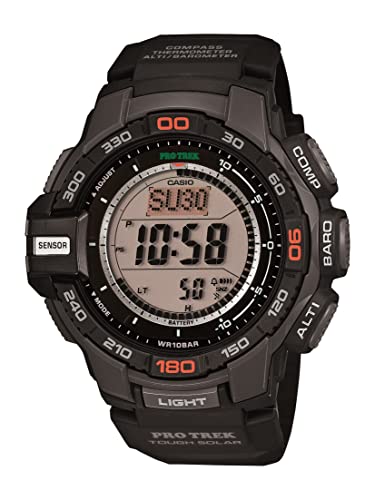
Casio Men's Pro Trek PRG-270-1 Tough Solar Triple Sensor Multifunction Digital Sport Watch


A pre-purchase checklist for barometer watches
Start with the sensor itself. Confirm from the manual, not the marketing page, that the watch contains a barometric sensor, state which values it displays, and note the pressure and altitude ranges, the resolution, and the sampling and logging intervals. Confirm the calibration methods offered — known elevation, reference pressure, satellite assistance, or a combination — and decide whether those methods match the information you will actually have at your trailheads. Check whether the watch distinguishes a barometer mode from an altimeter mode or switches automatically, because that behaviour shapes how trustworthy an overnight trend will be at a fixed camp. Verify the storm-alert threshold and whether it can be adjusted or silenced, and look at a picture of the pressure graph screen to judge whether its span and scale would be readable at arm’s length in poor light.
Next, examine the supporting systems. Read the battery or charging claims for the mode you will use most, learn the low-power warnings, and decide whether the power system fits your longest trip without resupply. Read the water-resistance guidance in full, including button use in water and service requirements after battery changes. Check the compass declination setting, the temperature measurement range, and the procedure the manual recommends for air-temperature readings. Consider case size and strap security on your own wrist, button size with the gloves you wear, and whether the display technology suits the light conditions where you travel. If after-sales support matters to you, confirm that gaskets, straps, and service are obtainable in your region, since an instrument intended to last a decade depends on that supply chain more than on any single feature in its launch announcement.
Finally, test your expectations against the trip that prompted the search. Write down the three questions you most want the watch to answer — remaining ascent, overnight trend, bearing confirmation, or another specific need — and check each against the documented features rather than against a general impression of capability. If a question cannot be answered from the manual, treat it as unanswered by the product. Prefer the model whose documentation is clearest about error, calibration, and care, because that clarity predicts a better ownership experience when readings puzzle you in the field. A barometer watch chosen this way becomes a quiet companion: calibrated at the trailhead, glanced at during the climb, consulted over the evening graph, and trusted within its limits. For the walker who wanted a clearer sky judgement from the wrist, that steady, well-understood instrument is the entire point of the category.