Our Top Picks
 QIXIAMO Tweeter Loudspeaker Piezoelectric Buzzer Ceramic reble Rectangle18.8×7.85cm0.6 poundsCheck on Amazon


What's inside
- How horn loading works: impedance matching, throat, flare and mouth
- Compression drivers versus horn-loaded dome tweeters
- Sensitivity: what the decibel figures really promise
- Dispersion and coverage: where the treble actually goes
- Diaphragm materials and how they break up
- Crossovers: frequency, slope and driver protection
- Mounting standards: threads, bolts and exit sizes
- Ferrofluid, cooling and living with high power
- Why horns can sound harsh, and how good designs avoid it
- Matching a horn tweeter to a woofer in DIY and PA builds
- Reading a specification sheet and building a shortlist
- Check prices on Amazon
- Horn tweeters in hi-fi, PA and instrument service
As an Amazon Associate I earn from qualifying purchases. This post may contain affiliate links at no extra cost to you.
Keeping guides like this free for every reader takes support, and ours comes from the people who use the advice when they build, repair or upgrade a system. As an Amazon Associate we earn from qualifying purchases. That arrangement sits behind the scenes; what follows is a research-based explanation of how horn tweeters work, where they shine, and how to choose and integrate one without ending up with the harsh, shouting treble that gives the category an unfair reputation.
A horn tweeter is not simply a tweeter with a decorative flare in front of it. The horn is an acoustic transformer, a carefully shaped passage that lets a small, hard-working diaphragm move air in a large room far more efficiently than it could on its own. That efficiency is why horn tweeters dominate public address, appear in high-sensitivity hi-fi designs, and turn up in instrument cabinets where projection matters. It is also why they punish careless matching: a device that can reproduce a whisper of amplifier power at startling volume will reproduce crossover mistakes, diaphragm break-up and reflections just as faithfully.
This guide works from the physics outward, through throat and flare, driver types, sensitivity, dispersion, diaphragm materials, crossovers, mounting standards and cooling, and ends with practical matching for DIY, PA and hi-fi builds. Readers planning a wider loudspeaker project may want to keep our woofer coverage open as well, starting with best 12 inch speakers for the mid-bass partner that most horn tweeters will spend their working life alongside. Treble never exists alone in a real system, and the best horn choice is always a choice about the whole speaker.
How horn loading works: impedance matching, throat, flare and mouth
Sound is pressure variation in air, and air is light, compliant and easily pushed aside. A small diaphragm, by contrast, is comparatively stiff and heavy for its area. When that diaphragm tries to radiate directly into a room, most of its motion produces very little sound, because the air simply slips around it instead of being compressed and launched as a wave. Engineers describe this as a poor impedance match between the driver and the air. A horn improves the match in the same spirit as a megaphone or the bell of a trumpet: it presents the diaphragm with a confined, high-pressure environment at its narrow end and then gradually expands that environment until the wave is large enough and matched well enough to leave into open space efficiently.
The throat is the narrow opening where the driver couples to the horn. Its area relative to the diaphragm area sets the compression ratio. A smaller throat raises the pressure the diaphragm works against, increasing efficiency and the load the diaphragm feels, which helps control its motion. Push the ratio too far, however, and pressures in the throat become so high that the air itself behaves non-linearly at large excursions, generating distortion, while the diaphragm and its surround are stressed by forces they were not built to survive. Well-judged compression ratios are therefore a compromise between efficiency, bandwidth and clean output at the levels the driver will actually face.
From the throat, the flare is the expanding profile of the passage, and its rate of expansion decides the lowest frequency the horn can load properly, often described through the horn’s cut-off frequency. A slow, gradual expansion supports lower frequencies but demands a long horn with a large mouth. A rapid expansion makes a compact horn but abandons loading at lower frequencies, leaving the driver to work unprotected and inefficient near the bottom of its range. Classic profiles each strike the balance differently: exponential flares expand by a constant proportion per unit length and remain the reference for predictable loading, hyperbolic variants trade some low-frequency behaviour for size, and tractrix profiles, popular in hi-fi, aim for a wavefront that leaves the mouth as if from a sphere, which many listeners experience as natural imaging.
Conical flares, a straight-sided expansion, are the simplest to make and appear on many PA horns because they hold a relatively constant directivity, but they provide weaker loading near cut-off and can need more equalisation. Modern constant-directivity horns are more sophisticated still, often using a diffraction slot at the throat followed by a rapid then slower expansion in separate planes, so that horizontal and vertical coverage stay controlled across the working band instead of narrowing as frequency rises. When a specification lists two coverage angles, it is this engineered geometry you are reading about, not a vague promise about spaciousness.
The mouth, the large open end, completes the transformer. As a working rule, the mouth must be comparable in size to the wavelength of the lowest frequency it is meant to control; a mouth that is too small for the wavelength behaves as if the horn ended abruptly, the wave reflects back down the flare, and both response smoothness and pattern control suffer near the bottom of the band. This is why genuinely low-reaching horns are physically large and why compact horn tweeters are honestly high-frequency devices, whatever optimistic crossover points a parts list might suggest. The mouth also sets the transition to the room: a well-finished mouth with a rolled or smoothly blended edge disturbs the departing wave less than a sharp, thin rim.
Loading brings a further benefit that is easy to overlook. Because the horn raises efficiency, the diaphragm needs far less excursion to produce a given sound level, and small excursions mean the diaphragm stays in the region where its motor and suspension behave most linearly. Distortion falls, power handling effectively rises, and the driver gains headroom. That virtuous circle, more output for less movement, is the core reason horn systems can sound effortless at levels where direct radiators are audibly straining.
Compression drivers versus horn-loaded dome tweeters
The classic horn tweeter pairs the horn with a compression driver, a purpose-built motor unit in which a relatively large diaphragm, driven around its edge by a voice coil, fires into a phase plug. The phase plug is a precisely machined piece with slits or channels that gather sound from across the diaphragm surface and deliver it to the throat with path lengths arranged so the contributions arrive in step. Without it, sound from the centre and the edge of a large diaphragm would arrive at the throat at different times and cancel at high frequencies. With it, a diaphragm of generous area, which moves a useful amount of air and handles power well, can still reproduce the top octave cleanly.
Compression drivers are usually sold without a horn, or with a choice of horns, because the pairing is an application decision. The driver’s exit diameter, its internal geometry and its diaphragm size suit it to a band of frequencies and a style of flare. Bolt the same driver to a large, slow-flaring horn and it can work lower and project differently than it does on a compact constant-directivity horn. This modularity is a gift to system builders and a trap for the careless, because compatibility is more than whether the bolts line up; the throat transition must be smooth, with no step or cavity where the driver meets the horn, or reflections and cancellations will appear in the response.
A horn-loaded dome tweeter is a different construction. Here a conventional dome tweeter, typically with its voice coil and dome as one familiar assembly, sits behind a short horn or waveguide moulded into the speaker’s front panel or the tweeter’s own faceplate. The flare is shallower and the efficiency gain more modest, often just enough to match a sensitive woofer, to control dispersion so the tweeter’s spread resembles the woofer’s at crossover, and to gain a little headroom by recessing the dome. Many respected hi-fi speakers use this approach without ever calling themselves horn speakers, and it suits domestic levels and distances very well.
Choosing between the two is a question of scale and intent. For PA work, large rooms, outdoor use or any system that must reach high levels cleanly from modest amplifier power, a true compression driver on a properly sized horn is the correct tool, with replaceable diaphragms as a practical bonus when a driver is damaged. For a compact home speaker or a nearfield monitor, a horn-loaded dome is simpler, cheaper to integrate, needs no separate horn purchase or baffle surgery, and avoids the very high sensitivity that can make level matching and hiss audibly awkward in quiet rooms. Guitar and instrument cabinets sit between these worlds and are discussed later in this guide.
There are also ribbon and planar drivers used with horn-like waveguides, and piezo elements behind horns in budget PA boxes. Piezo horn tweeters deserve a specific caution: they are capacitive devices that need no crossover in the conventional sense, which made them popular in inexpensive cabinets, but their response is often peaky and their integration crude, and they are rarely the route to the smooth, controlled treble this guide is concerned with.
Sensitivity: what the decibel figures really promise
Sensitivity is the headline number for any horn tweeter, conventionally expressed as the sound pressure level produced at one metre with one watt of input, written as dB at 1W/1m. Direct-radiating dome tweeters commonly sit in the mid-to-high eighties or low nineties. Horn-loaded tweeters routinely reach the high nineties, and compression drivers on suitable horns frequently exceed one hundred, with figures in the region of one hundred to one hundred and ten decibels being realistic for capable PA-oriented units. Those are not small differences dressed up by marketing. Because the decibel scale is logarithmic, every three decibels of extra sensitivity represents the same sound level from half the amplifier power, and ten decibels represents the same level from a tenth of the power.
Follow that arithmetic into a real system. A tweeter that is ten decibels more sensitive than another needs one watt where the other needs ten to reach the same level, and one hundred watts of amplifier capacity in the less sensitive design is matched by ten in the more sensitive one. In practice this means a horn system can be driven by a modest amplifier, including the low-powered valve amplifiers prized by some hi-fi listeners, and still have generous headroom for peaks. Headroom is not about playing loudly for its own sake; unclipped peaks are what make music sound open rather than pinched, and an amplifier working well inside its limits also produces less distortion and less hiss relative to the music.
Read sensitivity figures with the same scepticism you would bring to any specification. Some makers quote sensitivity at a favourable peak in the response rather than as an average across the working band, some measure with the driver on a particular horn and others on a plane-wave tube, and some quote at a voltage that corresponds to one watt only for a nominal impedance the driver does not actually present at the frequency measured. Compare like with like where you can, favour makers who publish full response curves and state their measurement conditions, and remember that the figure that matters is sensitivity across the band your crossover will actually use, not the tallest spike anywhere in the top octave.
Very high sensitivity brings obligations. In a passive speaker, a tweeter that is far more sensitive than its woofer must be padded down with resistors in an L-pad network so the two meet at the same level, and that network must be rated for the power it will absorb and placed so it does not cook in an enclosed cabinet. In an active system, the amplifier channel feeding the horn needs its gain set correspondingly lower, and its noise floor matters more, because a sensitive horn will faithfully reproduce the hiss of a noisy amplifier or processor at listening distance. A faint hiss that is inaudible through a conventional dome can become a constant companion through an efficient compression driver, so quiet electronics are part of the horn budget.
Sensitivity also interacts with the room and the audience. A PA horn that reaches its level with little power can be run with enormous reserve for announcements and peaks, which is exactly what speech intelligibility in a hall requires. In a small living room, the same sensitivity means the volume control operates in the bottom of its range, where channel balance on some controls is least accurate. None of this argues against horns at home; it argues for matching gain structure thoughtfully, using padding or channel trims so the system operates in its well-behaved region.
Dispersion and coverage: where the treble actually goes
A loudspeaker does not only fire sound at the listener; it fills a room, and the pattern in which it spreads high frequencies shapes clarity, imaging and how much the room itself contributes. Horns are prized because they control that pattern. A horn’s coverage is usually quoted as horizontal by vertical angles, defined by the points where output has fallen by six decibels relative to the axis. Common PA patterns include wide horizontal coverage with a narrower vertical wedge, which suits covering an audience that spreads sideways while wasting less energy on ceilings and floors, and squarer patterns for fills and monitors.
Direct radiators narrow their dispersion as frequency rises, beaming the top octave into an ever tighter cone while the midrange spreads widely, so the reflected sound in the room has a very different tonal balance from the direct sound. A well-designed horn holds its pattern far more consistently across its band, which means the sound bouncing off walls resembles the sound arriving directly, and the listener hears a more coherent whole. In hi-fi terms this often presents as stable imaging and a treble quality that stays put when you move your head. In PA terms it presents as even coverage, fewer hot seats near the axis and fewer dead seats at the edges, plus less energy spilled onto reflective surfaces that would blur speech.
Coverage must be chosen for the geometry of the job. A horn that is too narrow for a wide room leaves the side seats starved of treble, and no equalisation can restore to them what never reached them. A horn that is too wide for a narrow, reflective hall excites the walls and ceiling, trading clarity for splash. In home listening, a moderately wide, even pattern usually suits a sofa’s worth of listeners, while a deliberately narrower pattern can help in a long room or a reflective space by keeping energy off the side walls, at the cost of a smaller sweet spot. There is no universally best angle; there is only the angle that matches the seats and surfaces in front of the speaker.
Vertical behaviour deserves as much care as horizontal. Stand-mounted speakers and stage monitors are heard at very different heights depending on whether the audience sits or stands, and a horn mounted with its narrow plane in the wrong orientation is a common and entirely avoidable error. Many horns can be rotated in their mounting so the wide pattern can be placed horizontally or vertically as the cabinet demands; check whether your chosen horn allows this before building a cabinet around an assumption. At home, aim the vertical centre of the pattern at ear height at the main seat, using stand height or a slight tilt, rather than compensating later with treble controls.
Off-axis response smoothness matters as much as the headline angles. A horn whose response develops deep notches just off axis, often from reflections at the mouth or from a poor driver-to-throat transition, will sound coloured from most real seats even if its on-axis curve is ruler flat. Published polar responses or at least a family of off-axis curves are the evidence to look for. Makers who publish them are telling you they expect the question, and that confidence is worth something when two horns share similar headline figures.
Diaphragm materials and how they break up
Every diaphragm is rigid only up to a point. Above some frequency it stops moving as a single piston and begins to flex in patterns, with different regions moving in different directions. This is break-up, and it produces peaks, dips and stored energy that the ear hears as ringing, edge or harshness. Material choice is largely a decision about where break-up occurs, how violently it behaves when it arrives, and how the material survives heat, humidity and years of movement. The suspension and the phase plug share the work, but the diaphragm material sets the character.
Titanium is the workhorse of professional compression drivers. It is light, very stiff for its weight and tolerant of heat, so its first break-up modes sit high, and it survives the sustained high power of PA work that would fatigue softer materials. Its break-up, when it comes, can be pronounced, which is one reason titanium drivers reward a well-designed phase plug and a crossover that does not ask them to perform where they are unhappy. In skilled designs titanium sounds detailed and incisive; in careless ones it earns its reputation for hardness. It is also robust in transport and in venues where humidity and temperature swing widely.
Aluminium is slightly less stiff than titanium for comparable weight and has a long history in both compression drivers and dome tweeters. Its break-up tends to arrive a little lower but is often well behaved, and many listeners describe good aluminium diaphragms as open and quick without the last degree of titanium’s edge. Aluminium fatigues differently and can be more vulnerable to damage from extreme excursion at low frequencies, which reinforces the need for a protective crossover slope. In horn-loaded domes for hi-fi, aluminium is a frequent and successful choice, especially where the horn’s loading lets it work with small excursions in its comfortable band.
Phenolic diaphragms, made from resin-impregnated fabric, occupy the warmer, more forgiving end of the spectrum. They are heavier and less stiff, their break-up begins lower and is heavily damped by the material itself, so instead of ringing they tend to roll off and soften. That character made phenolic drivers favourites in older PA systems, paging horns and instrument applications where durability, low cost and a forgiving top end matter more than extended response to the limits of hearing. A phenolic driver will not deliver the sparkling top octave of a good metal diaphragm, and for speech, announcement and many guitar duties it does not need to. Choosing phenolic knowingly, for its smoothness and toughness, is sound engineering rather than compromise.
Silk and other treated-fabric domes are the familiar soft option in horn-loaded hi-fi tweeters. Their break-up is gradual and self-damped, producing a treble many listeners find relaxed and free of glare, at the cost of the last measure of extension and of sensitivity compared with metal. In a waveguide that adds a few decibels of loading and controls dispersion, a silk dome can be an elegant answer for domestic listening, particularly in systems voiced for long sessions. Polymer films and composite diaphragms, including coated and sandwich constructions, fill the space between these poles, each attempting to move break-up upward while keeping its consequences damped, and the better makers publish the curves that let you judge whether they succeeded.
Whatever the material, remember that the diaphragm does not work alone. The surround that joins it to the driver’s frame, the shape of the dome or annulus, and in compression drivers the geometry of the phase plug all move or tame break-up. Two drivers sharing a diaphragm material can sound quite different, and a material preference should guide shortlisting rather than decide a purchase sight unseen. If a driver’s published response shows a large, sharp peak near the top of its intended band, expect to hear it unless the crossover and any equalisation have been designed with that peak in mind.
Crossovers: frequency, slope and driver protection
If the horn is the horn tweeter’s voice, the crossover is its bodyguard. A compression driver or horn tweeter must never be asked to reproduce frequencies near or below the horn’s cut-off, because there the loading disappears, excursion rises sharply for little output, and a diaphragm built for microscopic high-frequency movements can be damaged by a single loud low-frequency transient. The recommended minimum crossover frequency in a driver’s documentation is not a suggestion to be negotiated downward for the sake of a smoother blend on paper; it is a boundary set by physics and by the maker’s knowledge of the diaphragm’s limits.
Typical crossover points for horn tweeters fall between roughly one point two and three point five kilohertz, with the position in that range set by driver size, horn size and the woofer’s behaviour. Larger compression drivers with bigger diaphragms and larger horns can work toward the lower end, which helps them meet a large woofer that cannot reach high. Smaller drivers and compact horns belong toward the upper end, paired with woofers or midrange drivers that remain well behaved up to meet them. The woofer’s side of the bargain matters equally: a cone that is breaking up badly or beaming narrowly at the crossover frequency will not blend with any tweeter, however capable, so the crossover point is chosen where both drivers are still behaving, not merely where one of them survives.
Slope is the second half of protection. A shallow slope, such as a first-order network, lets substantial energy through well below the crossover point, which is exactly what a horn driver cannot tolerate. Steep slopes, commonly third or fourth order in passive PA crossovers and often steeper still in active digital processing, cut that low-frequency energy decisively and are the norm for compression drivers. Active systems add the ability to include a dedicated protective high-pass filter below the working crossover, plus delay to align the horn driver’s acoustic centre with the woofer’s, since the diaphragm of a horn driver sits at the back of a flare while the woofer’s radiating surface is at the front of the cabinet, and that physical offset becomes a time offset that smears the blend if it is ignored.
Passive crossover design for a horn tweeter must also handle the driver’s impedance and sensitivity honestly. Compression drivers rarely present a flat impedance, and a network calculated for an assumed constant resistance will miss its intended frequencies and slopes when connected to the real load. Established designs use impedance compensation where needed and an L-pad or a series-parallel arrangement to set level without wrecking the crossover’s behaviour. This is why proven published designs and manufacturer-recommended networks are such a good starting point for a first build, and why changing a driver in an existing speaker for a different horn unit, on the assumption that any tweeter will do, so often disappoints.
Equalisation is frequently part of a horn system’s crossover story. A constant-directivity horn characteristically needs a rising high-frequency boost in the network or processor to offset the way its controlled dispersion interacts with the driver’s natural power response, which is why many active presets and passive networks for such horns include a treble shelf that looks surprising if you expect a crossover to be only a dividing filter. Applied correctly this is not a fudge but the completion of the design. Applied blindly, copying a boost from another horn’s preset, it is a reliable route to a bright, tiring result, so treat equalisation as specific to the exact driver and horn pairing.
Mounting standards: threads, bolts and exit sizes
Horn tweeters and compression drivers meet their horns and cabinets through a handful of mechanical standards, and fluency in them prevents expensive mismatches. The most common small-driver connection is the screw-on mount described as one and three-eighths of an inch with eighteen threads per inch, universally shortened to 1-3/8 inch 18 TPI. A driver with this thread screws directly into a horn with the matching internal thread, a simple and compact arrangement widespread in PA and replacement parts. Check thread engagement and the seat at the base of the thread, because a driver that screws in but seats on a gap or a burr leaves exactly the kind of cavity that disturbs the throat transition.
Flange mounting is the alternative, in two-bolt and four-bolt patterns. The driver ends in a flat flange with bolt holes, and the horn begins with a matching flange; a gasket or a smooth, airtight joint between them is essential. Bolt patterns are not fully universal, so measure the hole spacing and diameter on both parts rather than trusting a photograph, and confirm that the flange’s central opening matches the driver’s exit so there is no step inward or outward at the junction. Adapters exist between thread and flange standards and between exit sizes, and good ones preserve a smooth internal path; a crude adapter with an abrupt expansion can undo the care taken elsewhere in the system.
Exit size divides the driver world into broad classes. One-inch exit drivers are the standard for high-frequency work in two-way systems: their smaller phase plugs and diaphragms suit the top octaves, and the enormous choice of horns for them reflects decades of PA and studio use. Two-inch exit drivers, with larger diaphragms, work lower and louder and historically covered more of the midrange, though their top-octave performance depends heavily on diaphragm and phase-plug design, and many large-format systems pair them with a separate smaller device for the highest frequencies. Between them sit intermediate exits that aim to bridge the gap. Choose the class by the crossover frequency and output the system truly needs, because a larger exit is not automatically an upgrade; it is a different set of strengths.
Cabinet mounting deserves equal attention. A horn’s own flange or rim bolts to the baffle, and the combined weight of a metal horn and a compression driver can be considerable, hanging off the back of that joint inside the cabinet. Support heavy combinations so the baffle is not carrying a bending load it was never given, seal the horn-to-baffle joint so air and sound do not leak around it, and leave access for diaphragm replacement, since the serviceability of compression drivers is one of their practical virtues. In a home build, a removable rear panel or a horn mounted so its driver can be reached without dismantling the cabinet will be appreciated the first time any service is needed.
Replacement diaphragms follow their own compatibility rules. A diaphragm assembly is specific to its driver model, including its voice-coil diameter, its material and its terminal arrangement, and fitting involves aligning the coil in its gap without rubbing.
Ferrofluid, cooling and living with high power
Heat is the quiet enemy of every tweeter. The voice coil converts most of the electrical power it receives into heat rather than sound, and in a small high-frequency coil that heat has nowhere obvious to go. Ferrofluid is an elegant partial answer used in many dome tweeters and some compression drivers: a magnetic liquid, carrying fine magnetic particles in an oil, is held by the driver’s own magnet in the gap around the voice coil, where it conducts heat away from the coil toward the magnet structure far better than air would. As a side benefit it also provides a degree of mechanical damping and helps centre the coil in the gap.
The benefits show up as higher power handling, more consistent behaviour as the driver warms, and in some designs a smoother response around resonance because the fluid damps the coil’s movement there. The limits matter too. Ferrofluid is chosen for a specific gap and temperature range, it can gradually thicken or migrate over many years, especially in drivers stored or used in heat, and a vintage horn-loaded tweeter that sounds dull or measures oddly may simply need its old fluid cleaned out and replaced with the correct grade and quantity. Too much fluid is as much a fault as too little, and substituting a random oil is not a repair. If a driver was designed dry, do not add fluid to it; its gap and damping were engineered around air.
Compression drivers in serious PA service rely more on sheer thermal mass, on heat conducted into a substantial magnet and rear structure, and on the fact that their high efficiency means less power is needed in the first place. Even so, sustained high-frequency energy, feedback incidents and clipped amplifiers, which generate abnormal amounts of high-frequency content, can overheat any driver. Sensible system practice protects the investment: limiters set with the horn channel in mind in active rigs, amplifiers kept out of sustained clipping, and a protective capacitor in series in some passive and active arrangements to block any low-frequency or direct-current fault from ever reaching the coil. Builders adapting ideas across categories will find useful context in our coverage of larger powered and passive systems at best 15 inch passive speakers, where thermal headroom is planned at cabinet scale rather than driver scale.
Environment completes the cooling picture. A horn tweeter in a sun-baked outdoor cabinet, a sealed enclosure in a hot venue, or a car interior lives a harder thermal life than the same driver in a ventilated studio. Phenolic and titanium diaphragms tolerate such abuse better than most, which is part of their professional following. For outdoor and portable systems, also consider moisture: horns funnel whatever arrives at the mouth toward the driver, so grilles, downward-angled mounting where the design allows, and covers during transport are cheap insurance for the most delicate part of the speaker.
Why horns can sound harsh, and how good designs avoid it
Harshness is the charge most often laid against horn tweeters, and it is worth diagnosing rather than dismissing, because its causes are specific and mostly avoidable. The first cause is higher-order modes. Inside a horn, the orderly wave that travels down the flare at lower frequencies gives way, as frequency rises and dimensions become comparable to the wavelength, to additional wave patterns that bounce across the passage rather than travelling cleanly along it. These modes emerge from the mouth out of step with the main wave and carve peaks and notches into the response, especially off axis. Horn profiles and throat geometries that manage the wavefront carefully, and drivers whose phase plugs deliver an even wave into the throat, postpone and reduce this behaviour; abrupt throats and poorly matched driver-horn pairings invite it.
The second cause is reflection at the mouth. Where the flare ends, the wave meets open air, and any abrupt change sends part of the energy back down the horn to reflect again, setting up a pattern of ripples in the response and a faint repetition in time that listeners perceive as a horn-like colouration, a slightly nasal or cupped-hands quality on voices. Rolled mouth edges, flares that blend into the baffle, and mouths large enough for their lowest working frequency all reduce the abruptness and with it the reflection. This is one reason flush-mounting a horn into a wide, smooth baffle can sound better than the same horn perched in a small cut-out with sharp cabinet edges beside it, which add their own diffraction reflections a moment later.
The third cause is being asked to work too low or too loud. Near cut-off, a horn driver’s distortion rises quickly, and distortion in the two-to-five kilohertz region, where hearing is acutely sensitive, reads immediately as harshness and fatigue. A crossover set optimistically low, a slope too shallow to protect, or a small horn driven to fill a space beyond its ability will sound hard no matter how fine the diaphragm material is. The remedy is unglamorous: cross higher, use a larger horn, add a second cabinet, or accept a lower maximum level. Systems that respect their horns’ limits are routinely described as smooth, which tells you the harshness was never intrinsic to the principle.
The fourth cause lives upstream. A highly sensitive horn reveals the character of everything feeding it, including an amplifier clipping on peaks, a processor preset with an aggressive treble shelf, a recording that is itself bright, and the hiss and hash of mediocre electronics discussed earlier. Before blaming a horn for hardness, it is worth hearing it at a modest level with a clean, familiar recording and the equalisation flattened. Many supposedly harsh horns become articulate and calm under those conditions, and the exercise separates a genuine driver problem from a gain or voicing problem elsewhere in the chain.
Finally, level itself deceives. Listeners reliably judge a louder treble as brighter and harsher, and a horn tweeter padded a decibel or two too hot in its crossover will be condemned as aggressive when it is merely misbalanced. Careful level setting, ideally by measurement at the listening position and confirmed with familiar voices, is the cheapest sound-quality upgrade in any horn system. Small level changes in the top octaves have an outsized effect on perceived character, so adjust in fine steps and live with each for more than a single track.
Matching a horn tweeter to a woofer in DIY and PA builds
A successful build begins with the meeting point. Choose the woofer first for the bass and midrange the cabinet must deliver, then find how high that woofer remains smooth in response and reasonably wide in dispersion, and let that ceiling set the neighbourhood of the crossover. From there, select a horn and driver whose recommended minimum crossover sits comfortably below that neighbourhood with a protective slope, whose sensitivity can be padded gracefully to the woofer’s, and whose coverage at crossover roughly matches the woofer’s dispersion at the same frequency, so the combined speaker does not lurch from wide to narrow as a note crosses from cone to horn. Readers sizing the low-frequency half of a two-way build can compare cabinet-scale options in best 2 0 passive speakers for complete designs and in the woofer coverage already mentioned for individual drivers.
Physical alignment follows. The horn driver’s diaphragm sits well behind the baffle, at the end of its flare, while the woofer’s effective radiating point sits near the front, so at the crossover frequency the two sources are displaced in depth by a distance that is a significant fraction of a wavelength. In a passive build this is handled by crossover design choices and sometimes by mounting geometry; in an active build a small delay on the appropriate channel aligns them cleanly, and the improvement in the blend through the crossover region is audible as coherence rather than as any obvious effect. Either way, a builder who ignores the offset and judges the pairing by a single on-axis curve risks building a speaker that measures acceptably in one spot and sounds disconnected everywhere else.
Level and voicing come next, and they should be settled with the speaker in a realistic position, not only on a workshop bench. Horn tweeters project, so a balance that seems polite at one metre in a cluttered workshop can be assertive at four metres in a reflective hall or living room. Set the padding so voices sit naturally and sibilance stays proportionate, then check from several seats, because the horn’s controlled pattern should make the balance unusually consistent from seat to seat; if it does not, revisit coverage orientation and toe-in before reaching for more equalisation. In PA builds, voice the system at something approaching working level, since both ears and drivers behave differently at low volume, and confirm that speech remains intelligible at the back of the space, which is the entire point of the exercise.
Cabinet and porting decisions interact with the horn more than first-time builders expect. A large horn and driver add weight high in the cabinet and can make a tall box top-heavy on a stand, so check stability with the stand you will actually use. The horn’s cut-out weakens the baffle, and bracing around it pays off in a cabinet that stays quiet. Keep crossover components, especially inductors and the padding resistors that will warm in use, away from the driver’s magnet and from enclosed pockets of still air, and keep the internal wiring to the horn short, secured and unable to rattle against the flare, because a sensitive horn system will make a buzzing cable audible to the whole room.
For PA specifically, think in systems rather than boxes. Identical horns across the main cabinets give predictable coverage and a shared stock of spare diaphragms. Arraying or splaying cabinets must respect the horns’ patterns: overlap two wide horns carelessly and their interference combs the treble for much of the audience, while tight-packed or properly splayed narrow patterns can tile a space evenly. Monitor wedges want a pattern that covers the performer generously and the microphone minimally, and a horn that can be rotated to keep its narrow plane vertical in wedge orientation is worth favouring. These are planning decisions made on paper, with the coverage angles in hand, long before a cabinet is cut.
Reading a specification sheet and building a shortlist
A good specification sheet tells a coherent story, and learning to read one quickly will save more money than any single buying tip. Start with the recommended minimum crossover frequency and the recommended slope, because together they define the lowest work the maker is willing to stand behind. Then look at the frequency response graph rather than the single range figure in the headline text. A stated range means little on its own; the graph shows whether the response is smooth through the band you intend to use, where the break-up peak sits, how quickly the top octave falls away, and whether there is a notch in the middle of the working band that no crossover can fill. Prefer the driver whose graph is boring in the band you need over the driver whose headline numbers are larger and whose graph is dramatic.
Next, read sensitivity together with nominal impedance and power handling, and treat the three as one statement about how the driver will behave in a system. Power handling figures for high-frequency drivers assume a specified crossover; the same driver fed through a lower or shallower network handles far less, which is why honest makers state the crossover conditions beside the wattage. Check whether the rating is continuous, programme or peak, since those describe very different duties, and be wary of any listing that offers a large wattage with no crossover condition attached. Impedance curves, where published, reveal the resonances your crossover network will meet and help explain why a proven network design is worth copying exactly for a first build.
Then confirm the mechanical facts in writing: exit diameter, thread or flange pattern with its bolt spacing, overall dimensions, weight, and the depth the combination of driver and horn will occupy inside the cabinet. Measure your baffle and cabinet against those figures, remembering that the horn’s mouth dimensions set the cut-out and that two large horns in a stereo pair or a multi-box rig multiply every clearance question. Check diaphragm replacement availability for the exact model while you are at it, because a driver whose consumable parts are stocked by its maker is a driver you can keep in service for decades, and note the part number in your build records alongside the crossover values you finally settle on.
Finally, shortlist by application rather than by reputation. Write down, in plain terms, the room or venue, the listening distance, the woofer the horn must meet, the crossover neighbourhood that meeting requires, and the maximum level the system honestly needs. Score each candidate against that list and let drivers fall away when they miss a hard requirement, however admired they are elsewhere. The horn tweeter that survives this process is rarely the most famous name in the category; it is the one whose throat, flare, sensitivity, coverage and mounting all agree with the speaker you are actually building, and that agreement is what listeners eventually hear as effortlessness.
Check prices on Amazon
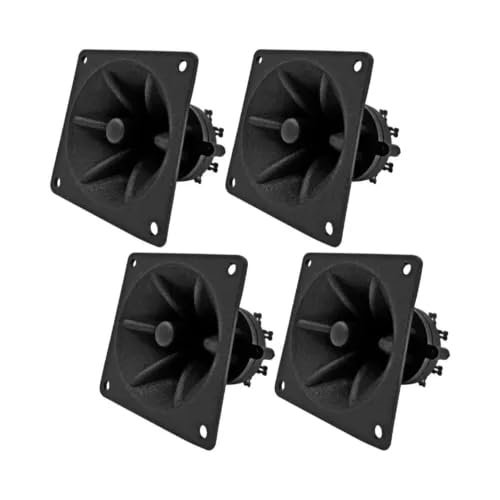
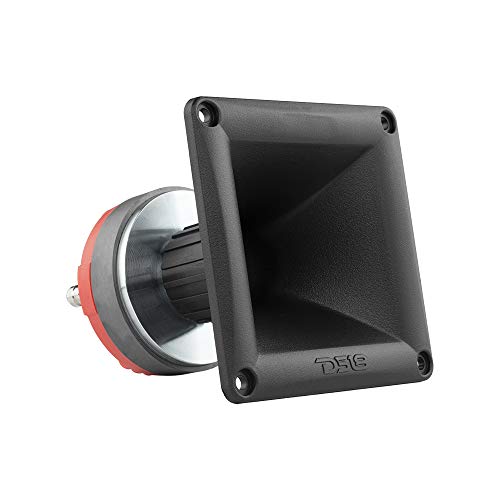
Live listings for the shortlist in this guide are pulled from Amazon below, so prices and availability are always current at the moment you look.
Horn tweeters in hi-fi, PA and instrument service
In hi-fi, the horn’s case rests on efficiency and control. High-sensitivity horn systems partner naturally with low-powered amplifiers, reproduce dynamic swings without compression from the driver, and keep their dispersion consistent enough that the room hears a tonal balance close to the direct sound. The great historical horn systems were large because their horns were honestly sized for the frequencies they covered, and modern domestic horns either accept meaningful size, restrict true horn loading to the treble with a waveguide-assisted woofer below, or use the horn-loaded dome approach for a gentler version of the same virtues. Set up with the pattern aimed thoughtfully and the level set with restraint, a hi-fi horn system does not shout; it sounds unforced, with voices placed in a stable, specific space.
In PA, the case is output, reach and intelligibility. A compression driver on a well-chosen horn converts modest amplifier power into speech that remains clear at distance, throws that clarity in a planned pattern rather than spraying it at ceilings, and survives years of transport and service with diaphragm-level repairs. The priorities differ from hi-fi in emphasis: maximum clean level, pattern discipline, weather and handling tolerance, and predictable behaviour across many identical boxes outrank the last degree of top-octave refinement. A driver that is perfect for a concert hall’s delay fill may be the wrong choice for a small hall’s main system, and the discipline of matching horn, driver and coverage to the venue is the professional skill the equipment lists cannot supply.
Instrument cabinets, above all guitar cabinets, use horns and tweeters by different rules again, and often deliberately break hi-fi rules. Many classic guitar cabinets have no tweeter at all, because the instrument’s speaker is part of its voice and rolls off where a hi-fi designer would be reaching for a horn. Where horn tweeters do appear, in bass cabinets, acoustic-guitar amplification, keyboard cabinets and full-range stage systems, their job is to add string detail, pick attack and air that a large cone cannot reproduce, and they are commonly crossed high, padded generously and sometimes switched so the player can defeat the tweeter entirely for a more traditional voice. Comparing instrument drivers is its own discipline, and our coverage at best 10 guitar speakers is the right starting point for the cone side of those cabinets. In this context a horn that would measure as modest in a PA catalogue can be exactly right, because the musical task is seasoning rather than full-range accuracy, and a phenolic or modest dome device that survives life on the road earns its place.
Across all three worlds the same closing discipline applies. Respect the driver’s minimum crossover and use a slope that protects it. Match sensitivity with proper padding or gain, and keep the electronics quiet enough for the sensitivity you have chosen. Choose coverage for the seats and surfaces in front of the speaker, align the horn in depth with its woofer, and set the final level by ear on familiar voices after measurement has done its work. A horn tweeter chosen and integrated with that care gives a system treble that is clear at the back row, calm at the front, and still composed when the music asks for everything at once, which is precisely what a century of horn design has been promising.