What's inside
- Key Takeaways
- Quick Picks
- How We Chose These Picks
- What Can an Xbox One Actually Do With an External SSD?
- What About the Expansion Cards and the Series X|S Question?
- How Do You Set Up an External SSD on an Xbox One?
- How Many Games Does a Terabyte Actually Hold?
- Why Is External the Right Route for This Console?
- The Six Drives, Reviewed One by One
- How the Six Line Up on Capacity, Pace and Temperament
- What Happens When the External Drive Fills Up?
- Which Buying Mistakes Catch Xbox One Owners?
- Final Recommendation
- Frequently Asked Questions
- Related Guides
As an Amazon Associate I earn from qualifying purchases. This post may contain affiliate links at no extra cost to you.
gizmoverdict.com is reader-supported. When you buy through links on our site, we may earn an affiliate commission.
Where to buy: the Quick Picks table and every detailed review below carry a link to the drive’s own Amazon listing. Portable SSD listings frequently gather several capacities under one page, so check that the capacity in the listing title is the capacity you are actually ordering — the difference between a 1TB and a 2TB version of the same drive is easy to miss at checkout and impossible to fix afterwards.
The best SSDs for Xbox One solve a problem every owner of that console eventually meets: the internal hard drive fills up, and the games that remain installed load with the patience of another era. The Xbox One’s internal storage was mechanical, and its USB ports accept external drives, which makes an external SSD the single most effective quality-of-life upgrade the console can receive. Games stored on flash load faster, stream their textures with less pop-in, and install from disc or download without the long tail of mechanical seeking that defines the stock experience.
One boundary must be drawn before any money moves, because confusion here is expensive. The Xbox One plays its games from USB storage, and every pick in this roundup is a genuine portable SSD that connects by USB cable. The proprietary expansion cards sold for the newer Xbox Series X|S — the C50-style cards that slot into the back of those consoles — do not fit an Xbox One, do not work with an Xbox One, and are not picks here. They receive one honest mention in the compatibility section below, because owners upgrading consoles later ask about them, and then they leave the stage. This roundup is about drives an Xbox One can actually use.
The six drives divide by temperament. Seagate’s Game Drive was designed for this exact console and says so in its title. The two WD_BLACK drives bring gaming-line styling and the two largest capacities here. Samsung’s T7 and SanDisk’s Extreme are general-purpose portable SSDs with long reputations beyond gaming, and Lexar’s ES3 rounds out the field as the straightforward value terabyte. All six are bus-powered over USB, all six work as Xbox One game storage once the console formats them, and the real decisions are capacity, stated speed, toughness and how the drive will be used on the days it is not attached to the console.
Key Takeaways
- Every pick is a true portable SSD connecting by USB; an Xbox One formats an attached drive and plays its own games from it directly.
- Expansion cards made for Xbox Series X|S do not fit or function with an Xbox One — they are not among these picks, by design.
- The console’s USB connection, not the drive’s headline figure, sets the pace of game storage; stated speeds still matter when the drive moonlights with a PC or Mac.
- Capacity is the lasting decision: 1TB doubles a base console’s room, while the WD_BLACK P50’s 4TB holds a serious library without rotation.
- Seagate’s Game Drive is the only pick whose title declares it designed for Xbox One, bundled with a Game Pass membership period and a year of rescue service.
- SanDisk’s Extreme is the toughness outlier, with IP65 water and dust resistance and drop protection stated in its title.
Quick Picks
| Pick | Badge | Why it earns its place |
|---|---|---|
| Seagate Game Drive For Xbox 1TB SSD External Solid State Drive | The Console’s Own Drive | Designed for Xbox One and titled as such, with a Game Pass membership period and a year of rescue service in the listing. |
| WD_BLACK 2TB D30 Game SSD | The Gaming-Line All-Rounder | Two terabytes from Western Digital’s gaming range, stated up to 900MB/s, compatible with Xbox and PC alike. |
| Western Digital 4TB P50 Game Drive SSD | The Whole Library, Installed | The largest capacity here at 4TB and the joint-fastest stated figure, up to 2,000 MB/s, across PlayStation, Xbox, PC and Mac. |
| Samsung T7 Portable SSD 1TB | The Polished All-Purpose Drive | USB 3.2 Gen 2 with up to 1,050MB/s stated, in a metal shell that has made the T7 a default portable drive far beyond gaming. |
| SANDISK 1TB Extreme Portable SSD | The One That Travels Rough | Up to 2000MB/s transfer speeds with IP65 resistance, drop protection and hardware encryption all declared in the title. |
| Lexar ES3 1TB Portable SSD | The Uncomplicated Terabyte | USB 3.2 Gen 2 up to 1050MB/s and a title that lists Xbox among its intended partners without fuss or decoration. |
How We Chose These Picks
The first filter was absolute: a pick had to be a real solid state drive. The Xbox accessory market is crowded with spinning-disk game drives wearing aggressive styling, and with expansion cards built for a different console generation; both categories were excluded before any other quality was considered. What remained had to connect by USB, draw its power from that connection, and offer at least a terabyte — the capacity at which an external drive stops being a stopgap and becomes the console’s main library.
Speed claims were recorded exactly as titles print them and then deliberately demoted in importance, for a reason the next section explains: the Xbox One’s USB ports govern game-storage pace, so a drive’s headline figure mostly predicts how it will behave later, attached to a computer. That reframing changed the ranking logic. Stated compatibility, capacity per model line, physical toughness and the breadth of a drive’s second life — PC, Mac, newer consoles, general file duty — carried more weight than a number the console itself cannot use.
The final arrangement is a spread rather than a podium. One drive was designed for this console. Two come from a gaming line and scale to 2TB and 4TB. Three are portable SSDs from the wider market whose titles explicitly welcome Xbox among their partners. Any of the six will transform an Xbox One’s loading behaviour; the reviews below exist to separate the one that fits your library, your travel habits and your next hardware purchase from the five that merely fit the console.
What Can an Xbox One Actually Do With an External SSD?
Plug a USB drive of sufficient size into an Xbox One and the console offers to format it for games. Accept, and the drive becomes first-class storage: games install to it, launch from it, and update on it exactly as they do on the internal disk, only faster. The console can also use external storage as media storage for music and video if you decline the games format, but that choice wastes the entire point of buying flash. Format for games, and treat the internal drive as overflow for the titles you play least.
The speed story needs one honest paragraph. The Xbox One family connects external storage over USB 3.0, and that connection — not the SSD inside the enclosure — sets the ceiling for transfers to and from the console. A drive stating 2,000MB/s will not move Xbox One games at anything like that figure; it will run at the port’s pace, which is still several times quicker than the internal mechanical drive at the work games actually do: thousands of small reads scattered across a world map. Loading screens shorten, open-world texture pop-in recedes, and menus stop lagging, because access time, not bulk throughput, was always the bottleneck. The headline figures in these titles are therefore best read as a promise about the drive’s life beyond this console — with a modern PC or Mac, the faster drives genuinely stretch their legs.
Two operational details round out the picture. Games stored externally travel with the drive: plug it into another Xbox One signed into your account and the library comes with you, which makes a portable SSD a surprisingly social object at a friend’s house. And the console supports multiple external drives, so a filled 1TB pick is not a dead end — it is the first shelf of a library that can grow a second drive later. Buy the capacity that matches your current habits with a little headroom, knowing the architecture forgives underestimation.
What About the Expansion Cards and the Series X|S Question?
Because the naming invites confusion, this deserves its own section. Microsoft’s newer consoles, the Xbox Series X and Series S, store their optimised games on internal flash or on proprietary expansion cards that slot into a dedicated port — the C50 card in our compatibility notes is exactly such a card, built for that slot. The Xbox One has no such slot and no such system. Its external game storage runs over USB, full stop, and its games — the entire Xbox One library — play happily from USB drives like the six picks here.
The practical consequence cuts in a helpful direction. If your household contains both generations, a USB SSD remains useful on both: the Series consoles can also store and play Xbox One games from USB drives, reserving their internal and card storage for titles that demand it. So a drive bought for an Xbox One today is not stranded when a newer console arrives; it becomes the older library’s permanent home on the new machine too. The reverse is not true — the card bought for a Series console does nothing for the Xbox One — which is why this roundup’s money flows toward USB drives and why the card appears here only as a signpost.
There is a budget corollary worth stating while the generational boundary is in view. Because the Xbox One’s library plays from USB storage on both generations of hardware, money spent on a good USB SSD is never spent on a dead end, whereas money spent chasing the newest storage format for a console you do not own is spent on a paperweight. Several readers arrive at this roundup having already priced a card for a console they plan to buy someday; the better sequence is to house the library on USB flash now, enjoy it on the Xbox One today, and let the future console inherit the same drive when it arrives.
A related clarification concerns the two WD_BLACK picks and the P50’s cross-platform title. Compatibility printed in a title — PlayStation, Xbox, PC, Mac — describes where the drive can serve as storage, and each ecosystem formats the drive its own way. A drive formatted for Xbox games must be reformatted to serve a PlayStation or a computer’s file system, wiping its contents in the process. Cross-platform on the box means the hardware is welcome everywhere, not that one formatted library tours all four platforms untouched. Plan the drive’s allegiance before its first format.
How Do You Set Up an External SSD on an Xbox One?
Setup is a five-minute ceremony. Connect the drive to a USB port on the console with the cable supplied — rear ports keep the arrangement tidy and the cable safe from knees — and power the console on. A prompt appears offering to format the drive for games and apps; accept it, give the drive a name you will recognise in storage menus, and choose whether it becomes the default install location. That last choice matters more than it looks: making the SSD the default means every future installation lands on flash automatically, while the internal drive quietly becomes the archive.
Then move the games you actually play. From the storage settings, select the internal drive, choose the titles in heaviest rotation, and move them across. Moving is a copy-then-delete performed by the console, and a large library takes a while — an evening of background transfers while you play something already moved is the painless way to do it. Prioritise the open-world games and the nightly multiplayer titles; those are where loading and streaming improvements are felt most, and a rarely opened game gains nothing from occupying fast storage.
One setting deserves a deliberate decision during that first setup: which drive the console should fill first. Setting the SSD as the default installation location sounds obvious, and for most owners it is right, but households with the 4TB P50 sometimes prefer the opposite arrangement — internal and smaller drives filled first, the big drive reserved as the permanent archive of finished games, so its contents change rarely and its library stays curated. Either policy works; what matters is choosing one consciously rather than discovering, six months later, that the console made the decision for you and chose the arrangement you would not have.
Two habits keep the arrangement healthy. Leave the drive connected rather than treating it as a cartridge, because the console expects its library to be present and updates installed games in the background. And if you do transport it — to another console, another room, another house — use the console’s power-down before unplugging rather than pulling the cable from a running system, the same courtesy you would extend to any drive holding a file system. Beyond that, there is nothing to maintain: no defragmentation, no housekeeping, just a library that loads like the console always should have.
How Many Games Does a Terabyte Actually Hold?
Capacity figures stay abstract until they are translated into games, and the translation varies because games vary enormously. A generation of Xbox One titles spans everything from two-gigabyte independent games to flagship releases that passed a hundred gigabytes with their updates installed. A terabyte therefore holds somewhere between a focused shelf of eight or ten giants and a sprawling archive of forty smaller titles, and most real libraries — a few flagships, a rotation of mid-size games, a tail of indies — land comfortably in between. The useful exercise is to open your console’s storage screen before ordering and read your own numbers: the total your current library occupies is the only capacity statistic that has ever mattered.
That screen teaches a second lesson about growth. Games do not merely install; they accumulate updates, downloadable content and saved captures, so a library measured today at 700GB is a library heading past a terabyte on a long enough timeline. This is the arithmetic behind the roundup’s shape: 1TB picks for libraries that rotate deliberately, the 2TB D30 for libraries that keep everything current, and the 4TB P50 for owners regarding deletion as a personal failure. None of these is the correct amount of storage in the abstract. Each is correct for a specific relationship with a download queue, and the storage screen, not the product page, is where that relationship is documented.
One more subtlety is worth knowing: the console reserves a portion of any drive it formats, and capacities are marketed in decimal terms, so the usable figure shown in settings always reads lower than the number on the box. This is universal across all six picks and all storage everywhere, not a defect of any drive here — but it does mean a library calculated to exactly fill a terabyte will not fit, and the headroom habit recommended throughout this article applies with arithmetic force.
Why Is External the Right Route for This Console?
Technically, an Xbox One’s internal drive can be replaced — the console is a small computer, and determined owners have opened it. The route is nevertheless the wrong one for nearly everyone, and the reasons are practical rather than mystical. Opening the console voids what remains of its warranty arrangements, the internal drive’s contents and formatting are entangled with the system’s own recovery design, and the entire exercise buys nothing that the USB route does not deliver more safely: the console treats external game storage as a full citizen, installing and launching from it natively. Microsoft’s designers built the USB path as the sanctioned upgrade, and it shows in how completely the system embraces it.
External storage also survives the console. A library on a USB SSD can move to a replacement Xbox One in minutes if the original fails, travel to another machine in the house, and eventually serve a newer console as the home of its backward-compatible titles. An internal swap shares none of that portability and all of its risk sits inside a sealed box. So the recommendation architecture of this whole article — six USB drives, zero internal ones — is not a limitation of the market. It is the shape of the correct answer for this particular console, arrived at by asking where the games can live most safely and move most freely.
The one scenario that argues for internal work is a console whose internal drive has actually failed, and even there the practical order of operations is to restore the machine with whatever drive is at hand and then let an external SSD carry the library, so the repaired console’s internal storage bears the lightest possible load. For every other owner, the five-minute USB ceremony described in the setup section is the whole upgrade, and its brevity is a feature the internal route cannot match.
The Six Drives, Reviewed One by One

Seagate Game Drive For Xbox 1TB SSD External Solid State Drive — The Console’s Own Drive
Seagate built this drive for one machine and printed that purpose across its title: designed for Xbox One. That focus shapes everything about it. The capacity is a single honest terabyte, the connection is the console’s own USB 3.0, and the listing bundles two extras tuned to the ecosystem — a Game Pass membership period, so a new library can start filling the drive immediately, and a year of rescue service, Seagate’s data-recovery safety net. No other pick here speaks the console’s language this fluently, because no other pick was asked to.
The absence of a speed figure in the title is worth reading correctly. Seagate is not hiding a weakness; it is acknowledging the architecture. On an Xbox One, this drive runs at the pace the console’s port allows, and Seagate simply declines to print a number the console cannot use. Judge it instead on what its title does declare: SSD storage — flash, not the spinning disk of Seagate’s cheaper game drives, a distinction the title makes explicit — portability, and design intent for the exact console on your shelf. As a gift purchase, this is also the pick that requires no explanation at unwrapping: the box says Xbox, the drive says Xbox, and setup is the five-minute ceremony described above.
Its limits are the limits of its focus. A terabyte is the whole offer — there is no larger sibling within this pick — and the extras are Xbox-shaped, so a household shopping primarily for a computer drive that occasionally visits a console should look further down this list. But as the answer to the literal question this article’s title asks, the Seagate is the most direct: the SSD made for the Xbox One, by the company that has supplied that console’s official storage for years.
- Capacity: 1TB
- Connection: USB 3.0, portable external
- Design intent: designed for Xbox One, as stated in the listing title
- Included extras: Game Pass membership period and 1-year rescue service
- Speed: Not stated in the listing title — verify with Seagate documentation
Strengths
- Purpose-built for this console, with the design intent printed in the title rather than implied.
- Game Pass membership period gives a new owner games to fill the drive from day one.
- Rescue service inclusion adds a recovery safety net none of the other titles mention.
Trade-offs
- One terabyte is the ceiling; heavy libraries will meet it within a year or two.
- No stated speed figure, so its life as a computer drive is unquantified on paper.
- The bundled extras speak only to Xbox households and add nothing for PC-first use.
Best for: a buyer seeking the drive designed for the Xbox One itself, extras included. Not suited for: a library already measured in multiple terabytes, which will outgrow this pick’s single capacity.
There is also a social dimension to the Seagate’s design that owners discover quickly: because the drive was made for the console, it behaves predictably when carried between machines. A library built on it at home wakes up intact on a second Xbox One after sign-in, which turns the drive into a kind of games cartridge for the whole household’s hardware. That portability, combined with the rescue service standing behind the data, makes the terabyte feel larger than its number — it is a terabyte designed to be used everywhere the console is.

WD_BLACK 2TB D30 Game SSD — The Gaming-Line All-Rounder
The D30 is where this roundup’s capacity conversation gets comfortable. Two terabytes holds the modern reality of game sizes — a shelf of large titles installed simultaneously, no rotation ritual before a download — and it comes from WD_BLACK, Western Digital’s gaming line, with a stated figure of up to 900MB/s and compatibility with Xbox and PC declared in the title. The drive’s wedge-like stand-friendly shape has made it a familiar sight beside consoles, and its role in this list is the balanced one: more room than the 1TB field, gaming pedigree, and a second life on PC that the title itself promises.
Read the 900MB/s figure through the lens established earlier. The Xbox One will feed this drive at its port’s pace; the figure describes what the D30 does when attached to a computer that can use it, and there it sits in a sensible middle — far beyond mechanical storage, short of the flagship numbers elsewhere in this roundup. That middle is honestly where a game drive lives best. What the console owner actually experiences is flash access times across 2TB of library, and what the PC owner experiences, on the days the drive travels, is a brisk external SSD from a gaming line with a console-first design.
Choose the D30 when the library is the argument. Households that keep a rotation of big games installed — sports titles with their annual bulk, shooters with their hundred-gigabyte footprints, a back catalogue that never quite gets deleted — will feel the second terabyte weekly. It is the pick that postpones the delete-or-keep conversation the longest among the mid-field, and postponement, in storage, is most of what money buys.
- Capacity: 2TB
- Stated speed: up to 900MB/s
- Compatibility: Xbox and PC
- Line: WD_BLACK gaming range
- Form: portable external SSD
Strengths
- Two terabytes ends the install-rotation ritual for most Xbox One libraries.
- Gaming-line design and declared Xbox compatibility remove all guesswork about intent.
- Stated 900MB/s gives it a credible second career as a PC drive.
Trade-offs
- Its stated figure trails the flagship drives here for computer-side transfers.
- No toughness or encryption features are declared in the title.
- Console-shaped styling suits a media shelf better than a laptop bag.
Best for: buyers seeking two terabytes of gaming-line storage that also serves a PC. Not suited for: a drive that will live in a travel bag, where slimmer general-purpose designs carry easier.
The D30’s 2TB also changes how a household treats game trials and monthly subscription downloads. With a terabyte, a large trial download is a commitment weighed against deletions; with two, it is an impulse the drive absorbs without negotiation. Libraries breathe differently at this size, and owners consistently report that the second terabyte is spent not on more permanent games but on freedom from the storage screen — the settings page they simply stop visiting. That freedom is the D30’s real product.

Western Digital 4TB P50 Game Drive SSD — The Whole Library, Installed
The P50 is the maximalist pick: 4TB of portable SSD, a stated figure of up to 2,000 MB/s, and a title that lists PlayStation, Xbox, PC and Mac as its territories. On an Xbox One, the 4TB is the story. That capacity holds an entire mature library — every disc converted, every download kept, the back catalogue and the current rotation together — with headroom for years of additions. Owners with console generations of deleting games behind them will understand instantly what is being sold here: the end of that chore, in a single purchase.
The speed figure deserves its now-familiar footnote — the console’s port governs game storage — but on the P50 the figure has a second meaning. A 4TB drive attached to a modern computer becomes a serious working volume, and 2,000 MB/s class transfers make filling or emptying those terabytes a coffee break rather than an overnight job. The P50 is therefore the pick most likely to be repurposed rather than retired: today’s Xbox One library, tomorrow’s media archive or game drive for a PC, always with capacity to spare. Its cross-platform title should be read with the formatting caveat from earlier — one allegiance at a time — but the hardware’s welcome is genuinely broad.
Price is the unspoken axis here, and this roundup prints no prices; suffice it to say the P50 sits at the top of this field’s spending and justifies itself only where its capacity will actually be used. A household with a modest library pays for empty terabytes. A household with a decade of games pays once and stops thinking about storage for the console’s remaining life, which is a legitimate definition of value.
- Capacity: 4TB
- Stated speed: up to 2,000 MB/s
- Compatibility: PlayStation, Xbox, PC and Mac
- Line: WD Game Drive range
- Form: portable external SSD
Strengths
- Four terabytes holds a complete mature library with years of headroom.
- Joint-fastest stated figure in the roundup, valuable in its computer-side second life.
- Broadest declared compatibility of the six, spanning consoles and computers.
Trade-offs
- The flagship capacity is wasted spending for a small or mostly-disc library.
- Cross-platform use requires reformatting between ecosystems, erasing contents each time.
- No ruggedness or encryption features are declared in its title.
Best for: a buyer after installing an entire library once and end storage management on the console. Not suited for: a modest collection, where two terabytes of this drive would sit permanently empty.
Consider the P50 in the context of a console entering its second decade. The Xbox One’s remaining years will be spent as a back-catalogue machine for many owners — the place where a generation’s library lives permanently. A 4TB drive matches that role with a kind of finality: buy it once, migrate everything, and the console’s storage story is finished, written, closed. There are worse ways to spend money on a beloved machine than giving its entire history a permanent, fast home.
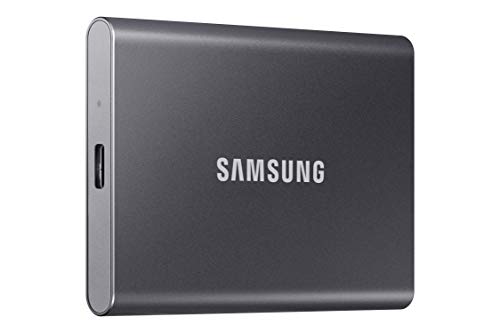
Samsung T7 Portable SSD 1TB — The Polished All-Purpose Drive
The T7 arrives in this roundup with the widest reputation of any pick: Samsung’s portable line is the default recommendation for photographers, students and professionals, and its title addresses exactly those audiences alongside the storage itself. For the Xbox One owner, the relevant facts are the terabyte capacity, the USB 3.2 Gen 2 connection and the stated up to 1,050MB/s. The console will use the drive at its own port’s pace, format it gladly, and load games from it with the full flash improvement — the T7 asks for no special treatment and gives none, which is precisely its appeal.
Where the T7 separates itself is everything around the gaming. Its metal enclosure is slim and pocketable in a way the console-shaped drives are not, and its ecosystem maturity — Samsung’s portable SSD software on computers, broad cable compatibility, a Titan Gray finish that disappears into a laptop kit — makes it the pick most naturally shared between console and computer life. A student with an Xbox One sharing a desk with a coursework laptop is the T7’s natural owner: one drive, formatted for the console during term-time gaming, reformatted for project files when the balance shifts, always pocketable in between.
Its trade-offs are the mirror of its virtues. Nothing in its title speaks Xbox, so the buyer supplies the knowledge this article provides — that a general portable SSD is exactly what the console wants. And its single terabyte, while ample for a working library, lacks the D30 and P50’s postponement power. Buy the T7 for the quality of the drive and the breadth of its life; the console will be one satisfied host among several.
- Capacity: 1TB, Titan Gray
- Connection: USB 3.2 Gen 2
- Stated speed: up to 1,050MB/s
- Audiences named in title: gaming, students, professionals
- Form: portable external SSD
Strengths
- The most pocketable, computer-friendly design in the roundup.
- USB 3.2 Gen 2 with a four-figure stated speed for its life beyond the console.
- Samsung’s portable line carries a long, broad reputation across many uses.
Trade-offs
- Nothing Xbox-specific in the title; the console fit relies on the buyer’s own knowledge.
- One terabyte is mid-field capacity in a roundup that reaches four.
- No bundled console extras of the kind the Seagate includes.
Best for: a buyer prioritising one polished drive shared between an Xbox One and a computer. Not suited for: a gift purchase for a console-only household, where the Seagate’s explicit Xbox design explains itself.
The T7’s restraint in styling pays an unexpected dividend on a media shelf: it looks like nothing in particular. Where the gaming-line drives announce themselves, the Samsung sits unobtrusively beside a console in a living room that was not designed as a gaming den, and its small footprint leaves the shelf’s airflow and cable runs undisturbed. Households where the console shares space with the rest of life consistently underrate this quality until they have lived with a loudly styled accessory for a month.

SANDISK 1TB Extreme Portable SSD — The One That Travels Rough
SanDisk’s title reads like an expedition checklist: up to 2000MB/s transfer speeds, IP65 water and dust resistance, drop protection up to 3 metres, and 256-bit AES hardware encryption. In a roundup of drives that mostly sit beside a console, the Extreme is the one built to leave the house. Its natural Xbox One story is the travelling one — the console at a second home, the drive carried between houses in a jacket pocket, the library that visits friends rather than waiting for them. Rain, dust, a fall from a car seat: the title’s protections address exactly the accidents that portable objects actually have.
The encryption deserves a careful sentence. Hardware encryption protects files on computers that use it; an Xbox One formatting this drive for games will use the volume its own way, and the encryption feature belongs to the drive’s computer life rather than its console life. That dual personality is the Extreme’s essence. On the console it is a fast terabyte of game storage with the usual port-governed pace. Off the console it is among the hardiest and quickest portable drives SanDisk sells, with a stated figure matching the P50 at the top of this field.
Choose it when the drive’s life is genuinely mobile, or when one drive must serve a camera bag and a console in the same week. Choose against it when the drive will live its whole life on a media shelf, where its armour is decoration and its price premium — whatever the day’s figure, ruggedness is never the free option — buys nothing the Seagate does not already provide.
- Capacity: 1TB
- Connection: USB-C 3.2 Gen 2
- Stated speed: up to 2000MB/s transfer speeds
- Protection: IP65 water and dust resistant, up to 3M drop protection
- Security: 256-bit AES encryption
Strengths
- Declared water, dust and drop protection unmatched elsewhere in this roundup.
- Top-tier stated transfer speed for its computer-side life.
- Hardware encryption adds real security for files carried on computers.
Trade-offs
- Encryption serves its computer life; the console formats the drive its own way.
- Rugged design is wasted on a drive that never leaves the media shelf.
- One terabyte is mid-field capacity for a large installed library.
Best for: a buyer working a console drive hard in travel, weather and camera-bag duty. Not suited for: a permanently shelf-bound setup, where its armour answers risks that will never occur.
The Extreme also earns a mention for the households whose console lives somewhere inhospitable: a garage games room, a workshop corner, a holiday property that sits cold and dusty between visits. IP65 sealing and drop protection are wasted on a pampered shelf but decisive in a space where equipment is knocked, splashed and carried in from the weather. Matching the drive’s armour to the room’s reality, rather than to the product’s marketing, is the correct way to value this pick.

Lexar ES3 1TB Portable SSD — The Uncomplicated Terabyte
Lexar’s ES3 closes the field with the roundup’s most businesslike proposition: a terabyte, USB 3.2 Gen 2, up to 1050MB/s, and a compatibility line in the title that names the iPhone, Mac, PS5, XBOX and PC in one breath. That XBOX mention matters more than it might appear to. Several fine portable drives never say the word, leaving console owners to wonder; Lexar prints it, and an Xbox One owner reading the title learns in one line that this drive expects to be plugged into a console. In a silver finish, in a slim shell, with no gaming costume — the ES3 is the drive for an owner seeking the result without the aesthetic.
Its stated speed matches the Samsung T7’s figure exactly, and its positioning alongside that drive is instructive. Both are slim general-purpose terabytes with four-figure stated speeds; the T7 carries the bigger consumer reputation, while the ES3 carries the explicit console compatibility in print. For a buyer deciding between them, that printed XBOX is a legitimate tiebreaker — it signals that Lexar has tested and marketed this drive for the exact use under discussion, and it costs the buyer nothing to prefer the drive whose maker says the quiet part aloud.
The ES3’s absences are the usual mid-field ones: no ruggedness claims, no encryption mention, no bundled extras, and capacity capped at the single terabyte of this listing. None of those absences touches its console performance. As a straightforward answer — a stated speed, a stated compatibility, a sensible capacity — it may be the easiest pick in the roundup to buy with confidence and the hardest to write a dramatic paragraph about, which for storage is a compliment.
- Capacity: 1TB, Silver
- Connection: USB 3.2 Gen 2
- Stated speed: up to 1050MB/s
- Compatibility named in title: iPhone, Mac, PS5, XBOX, Laptop, PC
- Form: portable external SSD
Strengths
- Xbox compatibility printed in the title, removing the console-fit question entirely.
- Stated speed matches the polished T7 at 1050MB/s.
- Slim, plain design suits shared console-and-computer life without gaming styling.
Trade-offs
- No protection or encryption features declared in the title.
- Single-terabyte listing in a field that stretches to four.
- No bundled extras; the proposition is the drive alone.
Best for: a buyer seeking a plainly specified terabyte with console compatibility in writing. Not suited for: a rough-travel role, where the SanDisk’s declared armour is the correct spend.
Lexar’s presence in this field carries one more signal worth reading: the company built its name on memory cards and storage for cameras, a market where compatibility claims are tested brutally by professionals. A maker from that tradition printing XBOX in a compatibility line has done the testing that the claim implies. The ES3 will not be the most dramatic drive ever attached to your console, but storage was never supposed to be dramatic — it is supposed to be believed, and this title gives you the sentence to believe.
How the Six Line Up on Capacity, Pace and Temperament
The honest summary is that the console treats all six nearly identically once formatted — flash is flash over its USB port — so the table below organises the differences that survive that equaliser: how much each holds, what each claims for its computer life, and what extra intent each title declares. Read it as a map of second lives and library sizes rather than as a league table of console performance.
| Drive | Capacity | Stated speed | Declared extra intent |
|---|---|---|---|
| Seagate Game Drive for Xbox | 1TB | Not stated in title | Designed for Xbox One; Game Pass period; rescue service |
| WD_BLACK D30 | 2TB | Up to 900MB/s | Gaming line; Xbox and PC |
| WD P50 Game Drive | 4TB | Up to 2,000 MB/s | PlayStation, Xbox, PC, Mac |
| Samsung T7 | 1TB | Up to 1,050MB/s | Gaming, students, professionals |
| SanDisk Extreme | 1TB | Up to 2000MB/s | IP65, drop protection, AES encryption |
| Lexar ES3 | 1TB | Up to 1050MB/s | XBOX named among compatible devices |
What Happens When the External Drive Fills Up?
Nothing dramatic, which is the good news. A full external drive simply stops accepting new installations, and the console directs future downloads to wherever space remains — usually the internal drive — while everything already installed keeps launching normally. There is no cliff edge in performance as an SSD fills in console service, because the console’s use pattern is dominated by reading games rather than writing them; the full-drive slowdowns that haunt computer system disks are largely a writing phenomenon, and a game library mostly sits still.
The practical responses, when the day arrives, are three. Delete with intent: completed single-player games whose saves live safely in the cloud can leave without ceremony and return by download whenever nostalgia calls. Reorder: move the current rotation onto the SSD if space has been consumed by older titles, keeping the fastest storage under the games in active play. Or expand: the console accepts additional external drives, so a second pick from this very roundup can join the first, and the library grows a new shelf instead of enduring an eviction. Owners choosing capacity generously at the start simply meet this day later — the P50’s buyer may never meet it at all — but it is a manageable day for everyone, and planning for it costs nothing beyond knowing it exists.
Which Buying Mistakes Catch Xbox One Owners?
The expensive mistake is the generational one: buying an expansion card made for the Series X|S — a card that slots into a port the Xbox One does not have — in the belief that newer must mean compatible. It is not compatible, in either direction of wishful thinking, and it is why this roundup states the boundary three times. The second mistake is buying a spinning-disk game drive because its styling matches the SSDs; mechanical external drives improve capacity but surrender most of the loading transformation, and their titles say HDD or hard drive where these say SSD. Read for those three letters.
Two quieter mistakes follow. Buying capacity for the library you had three years ago ignores how modern titles have grown; the delete-to-install shuffle returns within months, and the D30’s second terabyte starts to look less like luxury and more like foresight. And formatting a drive for media storage instead of games — an easy wrong tap during setup — strands an SSD as a music shelf while the internal disk keeps struggling; the fix is a reformat, but it erases the drive, so choose correctly at the first prompt. Every one of these errors is avoidable in the listing title and the first setup screen, which is where this article has tried to keep your attention.
Final Recommendation
Start with the Seagate Game Drive if the question is purely about the console: it was designed for the Xbox One, its extras speak the ecosystem’s language, and a terabyte transforms the machine it was built for. Step to the WD_BLACK D30 when the library has outgrown single-terabyte thinking, and to the P50 when the goal is to install everything you own and retire the subject of storage entirely. The Samsung T7 is the recommendation when the drive will split its life with a computer and travel in a pocket; the SanDisk Extreme when that travel is rough; the Lexar ES3 when you want the compatibility promise printed on the box and nothing else competing for your attention. Whichever you choose, set it as the default install location on day one and move your most-played games across that same evening, so the transformation is complete before the new-drive novelty wears off. An Xbox One with any of these six attached stops feeling like a machine apologising for its age — and the Seagate in particular leaves the console feeling, at last, like it was always meant to be paired with flash.
Frequently Asked Questions
Can an Xbox One play games directly from an external SSD?
Yes. Format the drive for games when the console prompts, and games install to it, launch from it and update on it just as they do on the internal drive — with faster loading, because flash replaces the internal disk’s mechanical delays. That is the entire basis of this roundup. The improvement is broad rather than narrow: every installed title benefits, from the nightly multiplayer game to the slow-loading adventure you abandoned halfway, and it benefits them every session rather than once.
Will an Xbox Series X|S expansion card work in my Xbox One?
No. Those cards use a proprietary slot that exists only on the Series X and Series S. The Xbox One has no such slot; its external game storage connects by USB, which is why every pick here is a USB portable SSD. The card is mentioned in this article only to prevent an expensive misunderstanding.
Does a faster stated speed make Xbox One games load faster?
Only up to the console’s own limit. The Xbox One’s USB connection governs transfer pace, so drives stating 900MB/s and 2,000 MB/s alike run at the port’s speed for console storage — still far quicker than the internal hard drive where it matters, in access time. The higher figures pay off when the drive is used with a modern computer.
How much capacity should I buy?
Count your installed library and your download queue honestly. One terabyte roughly doubles or triples a base console’s usable room and suits a rotating library; two terabytes keeps a large collection installed at once; four terabytes, the P50’s offer, is the whole-archive option for owners finished with deleting games.
Can I move the drive to another console or a PC later?
To another Xbox One, yes — sign in with your account and the library travels with the drive. To a PC or a PlayStation, the drive must be reformatted for that system’s file format, which erases the game library stored on it. Decide the drive’s allegiance before each format, not after.
Can one external SSD serve two Xbox One consoles in the same house?
Yes, with the drive travelling rather than being shared simultaneously. Plug it into either console, sign in with the account that owns the games, and the library is playable there. Households with a living-room console and a second machine elsewhere often keep the main library on a single portable drive for exactly this reason — one more argument for the slimmer picks, the Samsung T7 and Lexar ES3, if the drive will commute between rooms.
What happens to games on the internal drive after I add an SSD?
Nothing, until you move them. Existing installations stay where they are; use the console’s storage settings to move your most-played titles onto the SSD, and set the SSD as the default install location so future downloads land on flash automatically.
Related Guides
Console storage is one corner of a wider upgrade picture. Our roundup of the best solid state hard drives at 1 terabyte covers internal options for computers, the guide to the best laptop solid state hard drives handles portable machines, and our look at the best cheapest SSDs gathers the value end of the market in one place.


