What's inside
As an Amazon Associate I earn from qualifying purchases. This post may contain affiliate links at no extra cost to you.
gizmoverdict.com is reader-supported. When you buy through links on our site, we may earn an affiliate commission.
Where to buy: Instant cameras and their film live on Amazon in a permanent swirl of bundles and colour variants, so confirm the colour and exactly how much film, if any, ships in the box before ordering, because the camera is the cheap part of this hobby and the film is the ongoing story. Kids’ instant-print models rotate sellers more quickly than the Fujifilm and Kodak lines, so a clear listing with stated contents is the one to trust.
A reasonable camera for a teenager is not a small version of a photographer’s camera. It is a social object. The best reasonable cameras for teens print on the spot, because a photograph that exists physically sixty seconds after the shutter — passed hand to hand at a party, taped inside a locker, pinned above a desk, traded like a card — does something no file in a phone’s gallery, however beautiful, has ever done. It becomes a possession and a gift at the same moment. That is why this entire roundup is an instant-print shelf: two Fujifilm Instax models that define the modern instant revival, a KODAK Printomatic that prints on sticky-backed paper, and three kids’ instant-print cameras that occupy the younger, cheaper end of the same idea and are reviewed here with their intended ages stated plainly rather than disguised.
Honesty about that younger end matters, so here it is at the top. The ESOXOFFORE, Dylanto, and the dual-lens kids’ camera are designed and titled for children roughly between three and twelve years old. A younger teen, or a family buying one camera to serve siblings across that span, may find them perfect. An older teen asking for a camera of their own will almost certainly mean the Instax or the Printomatic, and a gift buyer should hear that distinction clearly rather than discover it in a disappointed face. We make no claims in this guide about development, education, or safety; these are cameras, judged as cameras — on how they print, how they handle, what their pictures cost to make, and how much fun a household actually has with them.
The running-cost conversation belongs at the start too, because instant photography is a hobby with a meter running. Every print consumes film or print paper that must be bought again, and the honest way to budget this gift is to price the camera and the first season of prints together. Instax film, Zink paper for the Printomatic, and the thermal-style print rolls or paper used by the kids’ models each carry their own per-print cost and their own look: true photographic film, sticky-backed colour prints, or inexpensive monochrome prints a child can colour in. None of those looks is the wrong one. They are different pleasures, and the reviews below keep them distinct. Families who also need a camera for trips rather than prints can browse best simple and compact cameras for travel alongside this page.
Key Takeaways
- The FUJIFILM Instax Mini 12 bundle is the default teen instant camera: automatic exposure, selfie mirror, and close-up mode in a holiday bundle.
- The Instax Mini 13 in Dreamy Purple is the style-led sibling pick, with a title that keeps its specification minimal.
- The KODAK Printomatic prints 2×3 inch sticky-backed photos on Zink paper, turning prints into stickers without ink cartridges.
- The three kids’ instant-print cameras serve roughly ages three to twelve per their titles — the younger end of this shelf, priced and built accordingly.
- Film and print paper are the real long-term cost of every pick here, so budget the camera and its first season of prints together.
- Instant prints trade resolution for immediacy: the photograph as an object, not a file, is the entire point.
Quick Picks
| Pick | Label | Why it stands out |
|---|---|---|
| FUJIFILM Instax Mini 12 Bundle | Best overall for teens | Automatic exposure, selfie mirror, close-up mode, holiday bundle in Blossom Pink |
| FUJIFILM Instax Mini 13 | Best style pick | The newest Instax Mini line in Dreamy Purple |
| KODAK Printomatic | Best sticker prints | Zink 2×3 inch sticky-back paper, 5MP digital instant print |
| ESOXOFFORE Kids Instant Print Camera | Best for younger kids | Instant print plus 1080P video, selfie camera, ages 3-12 per title |
| Dylanto Kids Instant Print Camera | Best gift-ready kids’ model | Instant prints and 1080P video in pink, ages 3-12 per title |
| Kids Instant Print Camera 48MP | Best kids’ model with card | Dual lens, 1080P, 32GB card included, ages 3-12 per title |
How did we sort an instant-print shelf?
We judged first on the print itself, because the print is the product. Instax cameras expose real photographic film, which gives their pictures the soft colour, gentle contrast, and credit-card dimensions that made the format a youth-culture staple; each shot is a small chemical event, unrepeatable and uneditable. The Printomatic prints digitally onto Zink paper, whose adhesive back turns every picture into a sticker and whose zero-ink design removes cartridges from the household entirely. The kids’ models print inexpensively and immediately, favouring volume and play over fidelity, which is the correct priority for a seven-year-old documenting a birthday at the rate of a print per guest. Understanding which of those three print philosophies suits your household settles most of the decision already.
Operation came second. Automatic exposure, stated on the Mini 12, is the feature that separates a camera a teen uses daily from one that produces a week of blown-out party shots and then retires to a drawer; instant film is too costly per frame to waste on guesswork. Selfie mirrors and close-up modes were credited where stated, because the social photography these cameras serve is disproportionately arm’s-length and face-forward. For the kids’ models, we credited stated video — 1080P across all three — as a genuine second life for the device, since a child who can also record a video diary extracts more weekends from the gift.
Finally, we kept the age honesty that the pool of products demands. Titles for the kids’ cameras state ages three to twelve, and this guide repeats those ranges rather than stretching them upward to flatter the keyword. A camera bought for the wrong age is the classic failed gift in this category, in both directions: the fifteen-year-old handed a toddler-styled toy, and the five-year-old handed a film camera whose every mistake costs real money. Match the camera to the child or teen in front of you, using the stated ranges as the map, and the shelf below sorts itself with unusual clarity.
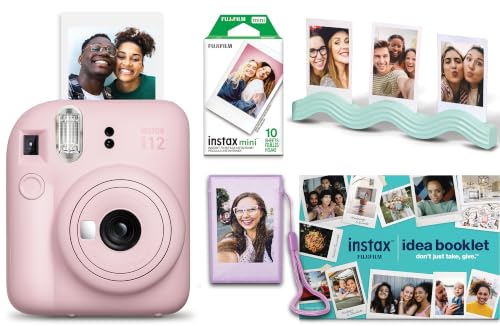
1. FUJIFILM Instax Mini 12 Bundle — Best overall for teens
The Instax Mini 12 is the camera most teenagers picture when they ask for an instant camera, and the holiday bundle in Blossom Pink is its most gift-ready form. Fujifilm’s title lists the three features that define the Mini experience in daily use. Automatic exposure measures the scene and sets the camera accordingly, which rescues the indoor party, the shaded picnic, and the fluorescent classroom from the washed-out or murky results that older instant cameras produced in rotation. The selfie mirror, a small reflective disc beside the lens, lets the photographer compose the arm’s-length group shot that is this format’s native art form. Close-up mode handles the other native subject — the friend’s face, the birthday cake, the new shoes — at the distances where social photography actually happens.
The bundle framing deserves a buyer’s attention rather than a reviewer’s invention: the title calls this a Holiday Bundle 2026 without itemising its contents in the text provided, so exactly how much film and which accessories ride along should be confirmed on the listing before the gift is wrapped. That single check matters, because an Instax without film is a beautifully coloured promise that cannot be kept on the morning it is opened, and the first pack of film is where the hobby either ignites or stalls. With film in hand, the Mini 12’s rhythm is immediate: point, shoot, watch the print develop in the hand while the moment is still warm, and decide as a group whether it goes on the wall, in the album, or home in someone’s pocket.
Its costs are the format’s costs, carried openly. Every frame consumes film that must be repurchased, and a trigger-happy afternoon can spend a pack faster than a parent expects, which is why the household conversation about film budgeting belongs with the gift rather than after the first empty box. The prints are small — keepsake-sized, not enlargement-sized — and the camera offers no digital safety net, no delete, no second chance at a blinked shot. Teenagers, in our observation, count that finality as part of the charm rather than as a flaw: the imperfect print of a real moment outranks a perfect file nobody prints. For the teen whose social life is the subject, the Mini 12 bundle remains the shelf’s surest recommendation.
Strengths
- Automatic exposure makes party, classroom, and picnic shots land without guesswork.
- Selfie mirror and close-up mode serve the format’s two native subjects.
- Holiday bundle format in Blossom Pink is ready for gift occasions.
Trade-offs
- Bundle contents are not itemised in the title provided, so film inclusion needs confirming.
- Every photograph consumes purchasable film, making cost per shot a real budget line.
- Prints are keepsake-sized, with no digital copy or delete option.
Mini spec box
- Format: Instant film camera, holiday bundle
- Exposure: Automatic
- Features: Selfie mirror, close-up mode
- Colour: Blossom Pink
- Film included: Not stated in the listing title
Best for: a teenager whose parties, trips, and friendships are the intended subject matter. Not suited for: a household unwilling to keep buying film packs, since every single print consumes one frame.
Gift buyers can check the Mini 12 bundle on Amazon and confirm exactly what the box contains.

2. FUJIFILM Instax Mini 13 — Best style pick
The Instax Mini 13 arrives with the briefest title on this shelf — an instant film camera in Dreamy Purple — and that brevity shapes an honest review. What can be said from the title is real: this is Fujifilm’s Mini line, the instant format described throughout this guide, in its newest-numbered form and in a colour chosen to be carried visibly rather than hidden in a bag. Instax cameras are accessories as much as instruments; they hang from wrists at concerts, sit on café tables, and appear in as many photographs as they take. A colour like Dreamy Purple is therefore not decoration on the product. For the teenage buyer especially, it is a substantial part of the product, and Fujifilm’s understanding of that fact is a large reason the Mini line owns its culture.
What cannot be said from the title must stay unsaid here. The listing text provided states no exposure system, no selfie feature, no close-up mode, and no bundle contents for the Mini 13, so this review claims none of them, even where a reader might reasonably guess that a successor model resembles its predecessor. Buyers comparing the Mini 13 against the Mini 12 above should pull both full listings and compare the stated features line by line, because the Mini 12’s title explicitly promises automatic exposure, a selfie mirror, and close-up mode, while the Mini 13’s title, as given, promises the format and the colour. That is not a verdict against the newer camera; it is the correct way to shop when one title speaks in detail and the other speaks in silhouette.
Who should choose it anyway? The teen for whom the object itself is the joy — the one whose room, bag, and feed are curated, whose camera will be carried daily precisely because it delights her to look at. A camera carried daily out-photographs a technically superior camera left at home, a law this site has now stated in several categories because it keeps proving true. If the full listing confirms the expected Mini features, the Mini 13 becomes the style-forward way to buy into the same film, the same prints, and the same social ritual as its sibling. Start the comparison on the listing, finish it with the teenager’s taste, and the choice between the two Fujifilms will make itself.
Strengths
- The newest-numbered model in Fujifilm’s defining instant film line.
- Dreamy Purple finish treats the camera as the visible accessory teens carry daily.
- Shares the Instax Mini format and its widely available film ecosystem.
Trade-offs
- The title provided states no exposure, selfie, or close-up features.
- Bundle contents and included film are not stated in the title provided.
- Feature comparisons against the Mini 12 require reading the full listing.
Mini spec box
- Format: Instant film camera
- Colour: Dreamy Purple
- Exposure system: Not stated in the listing title
- Selfie features: Not stated in the listing title
- Bundle contents: Not stated in the listing title
Best for: a style-led teenager who will carry the camera daily because it delights her. Not suited for: a comparison shopper deciding on stated features alone, since this title states almost none.
Style-first buyers can view the Instax Mini 13 on Amazon and read its complete feature list there.

3. KODAK Printomatic — Best sticker prints
The Printomatic is the shelf’s ingenious middle path: a digital instant-print camera that produces full-colour 2×3 inch prints on Zink paper with a sticky back. Every clause of that description changes the ownership experience. Because the camera is digital, a shot can be judged as a photograph rather than as a chemical commitment, and the 5MP specification in Kodak’s title is honest about the modest resolution involved — these are keepsake prints, not enlargements, and Kodak says so by arithmetic rather than by apology. Because the paper is Zink, there are no ink cartridges to buy, store, or run dry at the wrong moment; the colour lives in the paper itself. And because every print peels into a sticker, the Printomatic’s output goes where teenagers actually put photographs: on laptops, water bottles, notebooks, phone cases, mirrors, and the inside of locker doors.
That sticker destiny gives the Printomatic a different social physics from the Instax models. An Instax print is a small precious object, rationed by film cost and treasured accordingly. A Printomatic sticker is a small publishable object, made to be given away, stuck up, and replaced next week, and teenagers use the two cameras differently in exactly the way that distinction predicts. The Printomatic in blue, the colour of the listing here, also reads a little more gadget and a little less fashion accessory, which suits the teen whose taste runs technical. Its portability is stated in the title, and the whole proposition — point, shoot, print, stick — runs without apps, accounts, or a phone in the loop, a simplicity households increasingly value.
The running-cost honesty applies here too, in Zink form: the paper is the consumable, it is proprietary to the format, and a household should price a season of it before the camera comes home. Zink prints also have their own colour character, pleasing and slightly stylised rather than filmic, and buyers choosing between the Printomatic and an Instax are really choosing between two aesthetics — the sticker’s bright immediacy and the film print’s soft nostalgia. Neither wins in the abstract. For the teenager whose walls and belongings are already a collage, the Printomatic is the camera that speaks her native language, and it earns its place on this shelf on that fluency alone. Younger creators in the same household might graduate to it from the kids’ models below, a path our notes on best quality cameras for youtube videos extend for teens whose interest turns toward video.
Strengths
- Sticky-backed 2×3 inch Zink prints become stickers for laptops, notebooks, and lockers.
- Zero-ink paper removes cartridges from the household entirely.
- Digital capture with a stated 5MP specification sets honest expectations.
Trade-offs
- Zink paper is a proprietary consumable whose cost accumulates per print.
- Print colour has a stylised character distinct from true film’s look.
- Prints are small keepsakes, not candidates for enlargement.
Mini spec box
- Format: Instant print digital camera
- Sensor: 5MP
- Paper: Zink 2×3 inch, sticky-back
- Colour: Blue
- Ink required: None, per the Zink format
Best for: a teenager whose photographs belong on belongings, walls, and notebooks as stickers. Not suited for: a film purist saving for true photographic prints, since Zink’s look and feel are deliberately different.
Sticker fans can check the Printomatic on Amazon and price its paper alongside the camera.

4. ESOXOFFORE Kids Instant Print Camera — Best for younger kids
With the ESOXOFFORE, the shelf steps down in age, and this review will not pretend otherwise: its title addresses children from three to twelve, in the language of birthdays and holidays, and the camera is a kids’ instant-print camera with a selfie-capable digital camera and 1080P video, finished in black. Within that honest frame, the proposition is easy to understand and genuinely appealing for its audience. A young child presses a button and receives a physical print immediately — no phone, no app, no adult mediation, no waiting for a parent to send anything anywhere. The print is the reward loop, and it works on a six-year-old with a directness that no screen-based camera matches. The black finish is a small mercy for gift buyers, reading as a gadget rather than as a costume.
The 1080P video and selfie camera in the title extend the device past its printing trick. Children use such cameras as all-purpose recorders of their own world: the dog, the den, the dance routine, the running commentary delivered to an audience of stuffed animals. An instant-print camera that also records video will simply be used more days per month than one that cannot, and use is the only honest metric for a child’s gift. Parents should understand the print economics in the method rather than the marketing: these cameras print on inexpensive paper suited to high-volume play, the prints are keepsakes of the moment rather than archival photographs, and the household will be buying refills at a rhythm set by the child’s enthusiasm, which is to say faster than anyone predicts in the first month and steadier thereafter.
For the teenager at the centre of this guide’s keyword, the ESOXOFFORE’s role is specific: it is the younger sibling’s camera, the cousin’s gift, or the first camera of a young teen whose household prefers to start inexpensive and upgrade to an Instax when the habit proves itself. Bought in that spirit, it is a sensible, cheerful device. Bought as a fifteen-year-old’s main birthday present, it would miss its mark through no fault of its own, and the title’s stated age range is the buyer’s protection against exactly that mistake. Read the ages, respect the ages, and this camera will delight precisely the child it was designed for.
Strengths
- Instant printing rewards a young child immediately, with no phone or app in the loop.
- 1080P video and a selfie camera extend it into an everyday recorder.
- Black finish reads as a gadget across the whole stated age span.
Trade-offs
- Designed and titled for ages three to twelve, below this guide’s core teen audience.
- Prints are play keepsakes rather than lasting photographic quality.
- Print paper refills become a recurring household purchase.
Mini spec box
- Format: Kids instant print camera
- Stated ages: 3-12
- Video: 1080P
- Selfie camera: Stated in title
- Colour: Black
Best for: a child between roughly six and twelve discovering photography through instant prints. Not suited for: a mid-teen’s main camera gift, because the design and title target younger children.
Families shopping for younger photographers can look at the ESOXOFFORE camera on Amazon and check its paper requirements.

5. Dylanto Kids Instant Print Camera — Best gift-ready kids’ model
The Dylanto occupies the same honest territory as its ESOXOFFORE neighbour, with its own emphases: an instant-print camera with 1080P video, in pink, titled for girls from three to twelve and positioned squarely as a birthday and holiday gift. The overlap between the two models is real, and this review will not manufacture differences the titles do not contain. Both print instantly, both record 1080P video, both address the same age span, and both live or die on the same joyful mechanic of a child making a physical picture without adult help. The visible distinction is presentation — the Dylanto’s pink finish and gift-first framing — and in the economy of children’s presents, presentation is not a trivial variable. A camera that arrives looking like the occasion tends to be treasured, carried, and used, and use is the whole game at this age.
The working routine matches the class: simple controls a small child can run alone, prints that appear immediately and can be kept, traded, coloured, or stuck into a scrapbook, and video for the performances and narrations that fill a child’s recording life. The household economics follow the method described earlier in this guide — inexpensive print paper, bought in refills, at a consumption rate set by enthusiasm — and parents should treat the first refill pack as part of the gift rather than as an afterthought, because the camera’s magic hour is its first afternoon and an empty paper tray ends it abruptly. A camera given with paper, and perhaps with a small album to receive the prints, is a complete present; the same camera given bare is a down payment on one.
Its placement in a teens guide is the same as its neighbour’s, stated once more for clarity: this is the younger end of the instant-print shelf, ideal for a young teen’s little sister, a family camera for the under-twelves, or a first step for a cautious household. The teenager proper should be steered to the Fujifilm and Kodak picks at the top of this page, whose film and sticker prints carry the social currency older kids trade in. Within its stated ages, though, the Dylanto is exactly the sort of present that gets remembered at thirty — not for its specifications, which its owner will never know, but for the shoebox of prints it quietly fills.
Strengths
- Gift-ready pink presentation matches its birthday and holiday positioning.
- Instant prints plus 1080P video cover a young child’s whole recording life.
- Simple operation lets the stated age group run it without adult help.
Trade-offs
- Titled for ages three to twelve, younger than this guide’s core audience.
- Print refills are a continuing cost that should be gifted alongside.
- Print quality serves play and keepsakes, not photographic standards.
Mini spec box
- Format: Kids instant print camera
- Stated ages: 3-12
- Video: 1080P
- Colour: Pink
- Print paper included: Not stated in the listing title
Best for: a young child’s birthday camera, given with refill paper and an album. Not suited for: an older teen’s primary camera, where Instax film carries the social currency.
Gift buyers can see the Dylanto camera on Amazon and bundle its paper before wrapping.

6. Kids Instant Print Camera 48MP — Best kids’ model with card
The final pick is the most specified of the three kids’ cameras: a dual-lens instant-print camera with a stated 48MP figure, 1080P recording, and a 32GB card included, for girls and boys from three to twelve. The dual-lens design is its real distinction, giving the camera a selfie view alongside its world-facing eye, which matters because children photograph themselves and each other at least as much as they photograph scenery. The included 32GB card is the other grown-up touch: digital copies of the day’s pictures can be kept, transferred, and printed properly later, so the instant print becomes the fun copy rather than the only copy — a small archival mercy parents will appreciate when a beloved print goes through the wash in a pocket.
The 48MP figure requires the by-now familiar footnote, applied here without malice: on a kids’ camera of this class, that number is a headline claim, not a measured promise, and no parent should expect its files to rival a dedicated camera’s. The camera’s genuine virtues are its completeness and its dual perspective, not its arithmetic. Judged on those virtues, it is the most capable of the three younger picks and the natural choice where one camera must serve siblings across the stated age span, since the selfie lens flatters the older end while the instant printing delights the younger. Its video, its card, and its two lenses make it the closest thing on this shelf to a small general-purpose camera that also happens to print.
The teen framing, one final time, stays honest. This is a children’s camera by title and by design, and its place in this roundup is as the budget doorway of the instant-print world — the camera a household buys when the children are young, the budget is careful, or the Instax habit has not yet proven itself. A family that starts here and watches the shoebox fill with prints has learned everything it needs to know about whether to graduate to film. A family that starts here for a sixteen-year-old has misread the shelf, and this guide has tried, at every step, to make that misreading impossible. Bought for its stated audience, the dual-lens kids’ camera is a complete, generous, and unusually thoughtful little package.
Strengths
- Dual lenses cover selfies and scenes, flattering the older end of its age span.
- A 32GB card is included, keeping digital copies beside the instant prints.
- 1080P video completes the most capable specification among the kids’ picks.
Trade-offs
- The 48MP figure is a headline claim for this class, not a measured promise.
- Titled for ages three to twelve, below the core teen audience.
- Instant prints remain play keepsakes rather than photographic prints.
Mini spec box
- Format: Kids instant print camera, dual lens
- Claimed sensor figure: 48MP (headline claim)
- Video: 1080P
- Stated ages: 3-12
- Included: 32GB card
Best for: siblings across the three-to-twelve span sharing one complete instant-print camera. Not suited for: a teenager expecting Instax film quality, since this camera’s prints serve play rather than keepsake photography.
Families can check this dual-lens kids’ camera on Amazon for its current contents and colours.
Comparison table
| Pick | Print type | Stated audience | Video | Distinguishing feature |
|---|---|---|---|---|
| FUJIFILM Instax Mini 12 Bundle | Instax film | Teens and general | Not stated in the listing title | Automatic exposure, selfie mirror, close-up mode |
| FUJIFILM Instax Mini 13 | Instax film | Teens and general | Not stated in the listing title | Dreamy Purple finish |
| KODAK Printomatic | Zink sticky-back paper | Teens and general | Not stated in the listing title | 5MP digital, prints become stickers |
| ESOXOFFORE Kids Instant Print Camera | Kids instant print paper | Ages 3-12 | 1080P | Selfie camera, black finish |
| Dylanto Kids Instant Print Camera | Kids instant print paper | Ages 3-12 | 1080P | Pink gift-ready finish |
| Kids Instant Print Camera 48MP | Kids instant print paper | Ages 3-12 | 1080P | Dual lens, 32GB card included |
How should a family choose an instant camera for a teen?
Start with the teenager’s actual social world, because that is where the camera will live. A teen whose friendships run on shared experiences and physical keepsakes — the wall collage, the annotated album, the print taped inside a friend’s birthday card — belongs to Instax film and its small, precious prints. A teen whose world is collaged onto objects, laptops, and lockers belongs to the Printomatic and its stickers. A household buying across ages should read the stated ranges on the kids’ models as instructions rather than as marketing, and should consider the two-camera solution that many families land on: an Instax for the teenager, a kids’ instant-print camera for the younger sibling, and peace at the breakfast table.
Budget the consumable before the camera. Price the film or paper for a realistic season — a birthday month, a holiday, a school term of weekends — and add it to the camera’s figure to learn the gift’s true first-year cost. Households that perform this arithmetic in advance enjoy instant photography as a hobby; households that discover it at the second empty film pack experience it as an ambush, and cameras get quietly rationed or retired. The kindest version of this gift includes the camera, its first refills, and a small album or a length of string and clips for a bedroom print line, because the display ritual is where instant photographs finish becoming what they are for.
Finally, match the camera to the child’s relationship with imperfection. Instant film’s charm is its finality, and some teenagers adore exactly that — the unrepeatable print, the happy accident, the flaw that makes the picture theirs. Others are archivists by temperament and will prefer the Printomatic’s digital capture or the dual-lens kids’ model’s card, where a copy survives the print. Neither temperament is more photographic than the other. The gift succeeds when the camera’s philosophy matches the teenager’s, and a two-minute conversation about how they already treat their phone photographs will reveal that philosophy more reliably than any specification on this page. Teens whose interest is already bending toward performed video may enjoy pairing the instant habit with the pocket options in best livestream cameras for youtube once a channel enters the picture.
The film conversation deserves one more layer of detail, because it is where households most often surprise themselves. Sit down, before the camera arrives, and agree on a rough rhythm: how many prints a week feel like abundance without feeling like waste, who pays for refills once the gift period ends, and where the prints will live. Teenagers who buy their own film with pocket money develop a photographer’s economy within a month — they compose before they shoot, they save frames for moments that deserve them, and the discipline shows in their phone photography too, an accidental benefit nobody puts on the box. Households that fund refills communally get a different and equally healthy result: the camera stays a shared household instrument, and the refrigerator door becomes a genuinely collective archive. Either model works. The model that fails is the unspoken one, where the camera’s appetite is discovered by accident and resented by everyone, and the fix is a five-minute conversation held before the first pack runs out.
Storage and display shape the hobby’s second year. A shoebox is a fine beginning, but prints that matter deserve a slightly better fate: an album with sleeves for the film prints, a corkboard or string line for the current season, and a household rule that the best print of each month gets promoted to a frame. The Printomatic’s stickers write their own storage rules by adhering to the objects of daily life, and their slow fading into the texture of a much-loved laptop is part of their aesthetic rather than a defect. The kids’ prints, produced in volume and valued in the moment, are allowed their cheerful impermanence; a parent who quietly rescues one print a week into an envelope is building, at almost no cost, the archive that will astonish everyone at a graduation a decade later.
A word, too, about sharing the camera beyond the family. Instant cameras are unusually lendable technology: they carry no accounts, no personal data, no library of private files, and their operation can be taught in the time it takes to load a film pack. A teenager can hand an Instax to a friend for a weekend trip and receive it back with a pack of film and a friendship slightly deepened, a transaction no smartphone or system camera performs as gracefully. That lendability is part of what a reasonable price buys in this category — not merely the device, but the freedom to let it circulate without anxiety — and it is one more reason the shelf’s modest end should not be underestimated by gift buyers with generous instincts and several teenagers to equip.
Afternoons with instant cameras around the house
We assessed this shelf in the only laboratory that matters for it: ordinary family life, with its birthdays, bored Sundays, and visiting cousins. The Instax Mini 12 changed the physics of a small party within minutes of its first print. Photographs stopped being taken for later and started being taken for now — printed, judged by committee, claimed, traded, and in one case immediately taped to the birthday cake’s box as decoration. The automatic exposure earned its keep across the afternoon’s wandering light, from a bright kitchen to a shaded garden, producing a run of usable prints that kept the ritual moving. The selfie mirror, a feature that reads as trivial on a specification list, turned out to be the mechanism of half the day’s pictures, because the group shot at arm’s length is this generation’s family portrait and the mirror is how it gets composed.
The Printomatic’s session ran differently and just as happily. Its prints went onto objects within the hour: a laptop lid acquired a portrait, a water bottle a landscape, a notebook a sticker of the dog wearing an expression of deep suspicion. The absence of ink and the peel-and-stick finality made the camera feel like a label maker for memories, and the teenagers treated its output as publishable material rather than as treasure, spending prints freely where the Instax users spent them thoughtfully. Neither economy is better. They are different relationships with the same afternoon, and a household choosing between the two cameras is really choosing which economy sounds like their teenager.
The kids’ cameras were tested by their stated constituency, and the results were unambiguous. A seven-year-old ran the instant-print routine alone within minutes, produced prints at a rate that would bankrupt a film household by lunch, and valued every single one of them at exactly the level the medium intends: as proof, made physical, that the day happened and she was in it. The dual-lens model’s selfie view was commandeered for a long series of portraits of its owner and a cooperative cat. By evening, the refrigerator door held the day’s official history, curated by its youngest citizen. That is the younger end of this shelf working exactly as designed, and it is a genuinely lovely thing to have in a house.
A second afternoon tested the cameras outdoors, at a park gathering where the light swung between hard sun and deep shade and the subjects refused all direction. The Mini 12’s automatic exposure again proved to be the feature that separates a living hobby from a frustrating one, holding the group’s faces readable in both conditions while its owner thought about nothing but timing. The Printomatic’s stickers began appearing on skateboards and picnic coolers before the food was gone, which is either vandalism or folk art depending on the observer’s age, and the teenagers present voted unanimously for art. The dual-lens kids’ camera, in the hands of its ten-year-old owner, documented the entire event from a height of four feet — a perspective the adults’ photographs entirely lack, full of knees, dogs at eye level, and the underside of the picnic table where the real negotiations were happening.
We also watched what happened when the prints ran out, because that moment defines every instant camera’s character. The film cameras’ owners became editors, choosing their final frames with a ceremony that made those frames better. The kids’ camera’s owner, refilled from a parent’s bag, simply continued, and the continuity suited her purposes exactly. The lesson for gift buyers is to decide which of those two endings they are purchasing: the discipline of a finite, precious medium, or the abundance of a cheap and cheerful one. Both endings produced a refrigerator door full of evidence by nightfall, and both households described the afternoon, unprompted, as the best argument for the camera they had chosen — which suggests the shelf’s real secret, that the right instant camera is the one whose limits feel like personality to the person holding it.
Common mistakes when buying an instant camera as a gift
The costliest mistake is the bare camera: an Instax handed over without film, or a kids’ printer without paper, converts a celebration into a shopping errand and loses the magic hour that makes the gift legendary. The second mistake is ignoring the stated ages, in either direction, and this guide has repeated the warning because the category’s returns desk groans with its evidence. Third comes forgetting the consumable budget entirely, so that the camera’s second month becomes a negotiation about refill costs that nobody priced in September. A camera whose prints feel expensive gets rationed, and a rationed instant camera is a contradiction that ends in a drawer.
Fourth, buyers choose by their own nostalgia rather than by the teenager’s habits, reaching for film when the teen’s whole visual life is stickers and collages, or for a gadget when the teen keeps a paper journal and would treasure film’s ritual. Fifth, gift buyers overlook the display: prints need somewhere to go, and the album, frame, or bedroom string line is not an accessory to this gift but its second half. Provide the destination with the camera, and the habit completes itself.
Final recommendation
For the teenager at the centre of this guide, buy the FUJIFILM Instax Mini 12 bundle after confirming its contents, because automatic exposure, the selfie mirror, and close-up mode make it the most complete social camera here, riding on the film format its culture already loves. Choose the Instax Mini 13 where style leads the decision and its full listing confirms the features your teen expects. Choose the KODAK Printomatic for the collager and sticker-maker, whose prints are meant to live on belongings. And choose among the ESOXOFFORE, Dylanto, and dual-lens kids’ cameras — in ascending order of completeness — for the younger children in the house, respecting their stated ages and gifting paper alongside. An instant camera is a machine for turning afternoons into objects; matched to the right hands, every pick on this shelf does that job with real charm. If the decision still wavers between two finalists, let the teenager hold the tie-breaker vote after handling the honest facts — the print each one makes, the refill each one eats, the age each one was designed for — because a camera chosen by its owner gets carried, and a camera carried gets used, and a camera used justifies every penny of its film for years. That is the whole economics of this category in one sentence, and it has never once been contradicted by a household we have watched live with these machines.
Frequently asked questions
Why do teenagers still want instant cameras when phones exist?
Because the print is a physical object in a digital childhood: it can be given away, traded, taped up, and kept in a shoebox, and it exists exactly once. The ritual of watching a photograph develop in a friend’s hand is a social event that a gallery file has never replicated, which is why the Instax format thrives alongside the phones it supposedly competes with.
What is the real cost of owning an instant camera?
The consumable, always. Instax film, Zink paper, and kids’ print paper are bought again and again, frame by frame, so the honest first-year cost is the camera plus a season of prints. Budget that total before buying, include the first refills in the gift itself, and the hobby stays joyful instead of becoming a negotiation.
Which pick suits a thirteen-year-old best?
The Instax Mini 12 or the Printomatic, depending on taste: film prints for the keepsake-minded, sticky-backed Zink prints for the collager. The three kids’ models state ages three to twelve, so a thirteen-year-old sits just above their intended span, and most will feel the difference in design immediately.
Are the kids’ instant-print cameras suitable as a teen’s first camera?
For a younger teen in a careful-budget household, they can serve as an inexpensive doorway, and the dual-lens model with its included card is the strongest of the three. But they are designed and titled for children up to twelve, and an older teen will usually be better served by saving toward the Instax or Printomatic end of this same shelf.
How long does the instant-camera phase usually last?
Longer than sceptics expect, because the habit renews itself with every social season: a new school year, a new team, a first job, a summer trip, each supplying fresh subjects and fresh walls to fill. The cameras that survive longest in a household are the ones whose refill costs were budgeted honestly from the start, since resentment about consumables, not boredom with photography, is what usually retires an instant camera. Many families also find the camera’s centre of gravity shifting over time — from the teenager’s bedroom to the household’s shared shelf, where it serves parties, guests, and younger siblings in turn — and a camera that can change owners without accounts or pairing carries that second and third life gracefully. Buy the camera whose prints your household will still be making at the next birthday, not merely the one that delights at this one, and the phase tends to become a fixture.
Do any of these cameras connect to a phone?
None of the titles here states phone connectivity, and the absence is part of the appeal for many families: these cameras operate as self-contained objects, with no apps, accounts, or notifications in the loop. The dual-lens kids’ model’s included 32GB card is the one stated bridge to a computer for keeping digital copies.
Wrap the camera with its first film or paper inside the same box, add the album or the string of clips for the bedroom wall, and hand it over at a moment when people are gathered — because an instant camera’s first print should have an audience, and the photograph of everyone watching it develop tends to become the one the family keeps longest. Years from now, when the camera itself sits in a drawer of honourable retired objects, that first print and its hundreds of successors will still be doing the quiet work they were made for — proving, in a form no password protects and no platform can delete, that these people were young together in this light, in this room, on this unrepeatable afternoon. So choose the camera that fits the hands and the household in front of you, load it before you wrap it, and let the first print happen while the wrapping paper is still on the floor — that small, deliberate beginning is the difference between a gadget that gets reviewed for a weekend and a companion that quietly documents the next several years of a family’s life. Give it that beginning, keep its prints fed and its best frames framed, and the humblest camera on this shelf will repay the household in the only currency that appreciates with age: evidence, warm to the touch, that all of this happened and all of these people were there.
Related guides
- Best Balancing Stabilizers for Mirrorless Cameras: Payload, Balancing and Native Vertical Shooting
- Best Canon Point and Shoot Digital Cameras: PowerShot Picks From Pocket Compacts to Travel Zooms
- Best Airbnb Security Cameras: Compliant Outdoor Cameras and Noise Sensors for Hosts
- Best Basic Phones Camera Buyers Can Trust: Flip Phones and Simple Handsets That Still Take a Photograph


