What's inside
As an Amazon Associate I earn from qualifying purchases. This post may contain affiliate links at no extra cost to you.
gizmoverdict.com is reader-supported. When you buy through links on our site, we may earn an affiliate commission.
Where to buy: Travel compacts move through Amazon in waves, with colours and bundle variants appearing under the same model names, so read the exact listing variant before paying, particularly for battery type and included memory. Brand-name models from Panasonic and Kodak hold steadier listings than the unbranded compacts at the end of this page, whose sellers rotate, so treat a live listing with clear contents as the availability test for those two.
A travel camera earns its place in a bag by being present. That sounds trivial until the third day of a trip, when the mirrorless body with two lenses stays in the hotel safe because the itinerary is a market, a bus, and a viewpoint reached by stairs, while the little compact rides in a jacket pocket and comes home with the day. Travellers hunting for the best simple and compact cameras for travel are really shopping for presence: a camera light enough to forget, simple enough to hand to a stranger for a group photo, and capable enough that its pictures justify carrying anything beyond a phone at all. That last test is the sharp one. A compact must offer something a handset cannot, and in this roundup that something is optical zoom, the one advantage no amount of phone software has honestly replicated.
The six picks divide into three temperaments. The Panasonic LUMIX ZS300 is the enthusiast anchor, built around a 1-inch sensor and a 15x optical zoom reaching from 24mm to 360mm equivalents, a specification that belongs to serious travel photography. The two KODAK PIXPRO models, the FZ55 and the AA-powered FZ45, occupy the simple end: fixed routines, modest zooms, small screens, and prices of attention so low that a grandparent or a teenager can run them within minutes. Between and beyond those poles sit a Panasonic superzoom with a startling 60X optical zoom, and two unbranded compacts whose stated zooms, touchscreens, WiFi, and included cards make them interesting while their headline megapixel figures deserve the usual scepticism. On those two, we judge the stated mechanics and ignore the printed arithmetic, a policy explained in their reviews.
Simplicity, properly understood, is not the absence of capability. It is the absence of friction between seeing a picture and taking it. Every pick below was weighed on that friction: how fast it wakes, how clearly its screen reads in sunlight, how its zoom behaves at the long end, how its battery story survives a long day far from a socket. Travellers who also record for a channel may cross-check our guide to best quality cameras for youtube videos later; this page stays devoted to stills-first travel, with video as a supporting act.
Key Takeaways
- The Panasonic LUMIX ZS300 is the clear quality leader, with a 20.1MP 1-inch sensor and a 15x optical zoom spanning 24-360mm.
- The KODAK PIXPRO FZ45 runs on AA batteries, a decisive travel trait where charging is scarce and shops sell AAs everywhere.
- The KODAK PIXPRO FZ55 adds a rechargeable Li-ion battery and a 28mm wide angle in the same point-and-shoot spirit.
- The Panasonic DC-FZ80D’s 60X optical zoom is the reach champion here, trading pocket size for distant subjects.
- The two unbranded compacts include cards and spare batteries, but their megapixel headlines should be read as unverified marketing.
- Optical zoom, not printed megapixels, is the honest reason to carry any camera on this page instead of relying on a phone.
Quick Picks
| Pick | Label | Why it stands out |
|---|---|---|
| Panasonic LUMIX ZS300 | Best overall travel zoom | 1-inch sensor, 15x optical zoom 24-360mm, 4K video |
| KODAK PIXPRO FZ55 | Best simple rechargeable | 5X optical zoom, 28mm wide angle, Li-ion battery, 1080p video |
| KODAK PIXPRO FZ45 | Best AA-powered pick | 4X optical zoom, 27mm wide angle, runs on AA batteries |
| Panasonic 4K Point and Shoot (DC-FZ80D) | Best for distant subjects | 60X optical zoom with image stabilization and 4K |
| 7X Optical Zoom Digital Camera | Best touchscreen bundle | 7X optical zoom, WiFi, 5-axis anti-shake, 32GB card and 2 batteries |
| 5K Digital Camera 6X Optical Zoom | Best dual-camera novelty | 6X optical zoom, autofocus, dual cameras, 64GB card and 2 batteries |
What made the cut for a travel compact?
Our first filter was optical zoom stated plainly in a title. Travel compresses distance cruelly: the lighthouse sits across the harbour, the eagle settles on the far snag, the grandchild performs on a stage thirty rows away. A camera whose zoom is optical moves glass to gather that scene; a camera relying on digital zoom merely enlarges the middle of its picture and throws the edges away. Every pick here states an optical zoom figure, from the FZ45’s modest 4X to the FZ80D’s enormous 60X, and that single shared trait separates this page from the crowd of decorative compacts that zoom only on the box.
The second filter was carry reality. A travel camera should vanish into a daypack’s smallest pocket or a coat, start quickly, and survive being operated one-handed while the other hand holds a rail, a ticket, or a child’s wrist. Screen size, battery type, and included media all feed that judgement. AA power, often dismissed as old-fashioned, scored highly for remote travel because it converts any village shop into a charging station. Included cards and second batteries scored for the unbranded pair because a camera that arrives incomplete punishes exactly the casual buyer it courts.
The third filter was honesty about figures. Panasonic’s and Kodak’s stated megapixels follow ordinary industry conventions for their sensor classes. The unbranded pair print much larger numbers beside much smaller prices of attention, and those numbers are treated throughout as unverified marketing, with the cameras judged on zoom, screens, stabilization claims, and bundle contents. Video was the final consideration: 4K on the Panasonics, 1080p on the Kodaks, and claimed 4K or 5K on the unbranded pair, useful for clips in every case and decisive in none, because travel stills remain this class’s reason to exist.
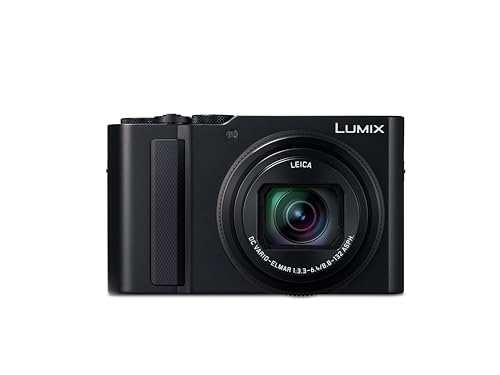
1. Panasonic LUMIX ZS300 — Best overall travel zoom
The ZS300 is what a travel compact becomes when a maker refuses to treat small as a synonym for compromised. Its title states a 20.1MP 1-inch sensor, and that sensor size is the headline that matters: a 1-inch chip gathers several times the light of the tiny sensors in phones and budget compacts, which shows up as cleaner dusk shots, gentler noise in museum interiors, and colours that hold together when a scene mixes bright windows with shaded faces. Around that sensor sits a 15x optical zoom running from 24mm to 360mm in equivalent terms, a range that begins at genuine wide angle for interiors and street scenes and ends at a telephoto reach capable of isolating a seabird, a distant bell tower, or a performer’s expression from the back of a plaza.
That combination — big-for-its-class sensor, long honest zoom, 4K video for clips — is precisely the formula that built the reputation of premium travel zooms, and it explains why this camera anchors the roundup. A traveller can walk a city all day with the ZS300 as the only camera and never meet a scene it cannot attempt: dawn markets at the wide end, architectural detail at midrange, wildlife in a park pond at full stretch. The 4K video statement adds a credible moving record without pretending this is a cinema tool. For photographers stepping down from an interchangeable-lens kit for a lighter trip, this is the pick that asks for the fewest apologies at the evening review of the day’s pictures.
Its costs are the familiar ones of its tier. A 1-inch sensor still trails the APS-C chips in larger cameras when light collapses, and 360mm at the long end demands steady hands or a railing to lean on, because small movements magnify with focal length. The title does not state a screen size or battery type, so we claim neither here. None of that dims its position. Among simple compacts, the ZS300 is the one a serious photographer can respect, and among serious cameras, it is one of the few that genuinely disappears into a jacket. That double identity is rare, and it is why this camera leads the page.
Strengths
- 20.1MP 1-inch sensor delivers the strongest low-light and colour performance in this roundup.
- 15x optical zoom spanning 24-360mm covers interiors through distant wildlife in one lens.
- 4K video adds capable clips without changing the camera’s stills-first character.
Trade-offs
- Full 360mm reach magnifies hand shake, so distant shots reward bracing and patience.
- Screen size and battery type are not stated in the listing title.
- Low-light results still trail larger-sensor cameras once evening deepens.
Mini spec box
- Sensor: 20.1MP 1-inch
- Zoom: 15x optical, 24-360mm
- Video: 4K
- Screen size: Not stated in the listing title
- Battery type: Not stated in the listing title
Best for: a one-camera trip where dawn markets and distant wildlife share the same day. Not suited for: a concert pit in near darkness, where even a 1-inch sensor reaches its light-gathering limit.
Travellers comparing premium compacts can check the ZS300 on Amazon for its current listing details.
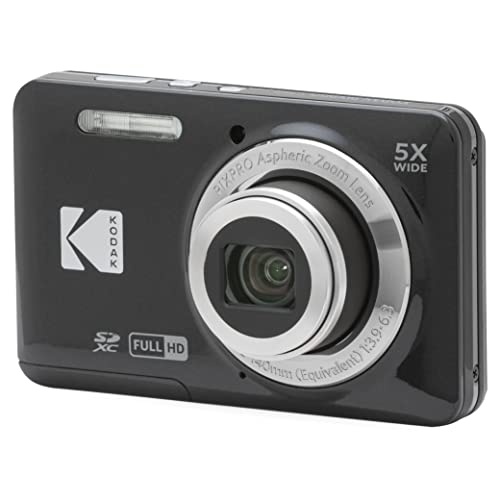
2. KODAK PIXPRO FZ55 — Best simple rechargeable
The FZ55 represents the friendly face of travel photography. Kodak’s title describes a 16MP compact with a 5X optical zoom, a 28mm wide angle lens, a 2.7 inch LCD, 1080p Full HD video, and a Li-ion battery, and every one of those specifications points at uncomplicated picture-taking. The 28mm wide end flatters travel’s most common shots: the hotel room that must somehow fit in one frame, the group gathered around a café table, the street that needs its buildings and its bustle together. The 5X zoom then steps closer for portraits and details without entering the shake-prone territory of long telephotos, which suits a camera designed to be used quickly and put away.
Rechargeable Li-ion power defines its travel rhythm. One cable at night restores the next day, the same routine as a phone, and there are no batteries to buy, carry, or dispose of along the way. For city breaks, festivals, and family holidays with a hotel base, that routine is the most convenient on this page after the ZS300’s unstated arrangement. The 2.7 inch LCD is modest by modern standards, and bright midday sun will challenge it, a fair trade for the camera’s size and simplicity. Kodak sells this model as a vlogging-capable point and shoot as well, and while its 1080p video will not trouble the Panasonics, a traveller’s clips of birthdays and buskers will look perfectly presentable.
Who is it for, in practice? It suits a traveller seeking a dedicated camera that a child can borrow, a partner can operate without a tutorial, and a pickpocket would find unremarkable. There is a liberating quality to carrying a camera whose loss would sting rather than ruin a trip, and the FZ55 occupies that emotional niche as surely as it occupies a pocket. Its pictures will not match the ZS300 at dusk or at distance, and it makes no pretence otherwise. Judged as a simple, honest, rechargeable compact for daylight travel, it is exactly what its title promises, and that reliability of promise is its own form of quality.
Strengths
- 28mm wide angle fits rooms, groups, and streets without backing into walls.
- Li-ion rechargeable battery follows the same nightly routine as a phone.
- 5X optical zoom and 1080p video cover everyday travel subjects cleanly.
Trade-offs
- The 2.7 inch LCD can be hard to read under harsh midday sun.
- Zoom reach ends long before distant wildlife or stage subjects fill the frame.
- Low-light performance reflects its small-sensor point-and-shoot class.
Mini spec box
- Sensor: 16MP
- Zoom: 5X optical, 28mm wide angle
- Video: 1080p Full HD
- Screen: 2.7 inch LCD
- Battery: Li-ion
Best for: a city break where one small rechargeable camera serves the whole travelling party. Not suited for: a safari vehicle watching animals at two hundred metres, where 5X zoom leaves subjects tiny in the frame.
The FZ55’s current figure and colour options are listed on its Amazon page for travellers comparing the simple end of this roundup.

3. KODAK PIXPRO FZ45 — Best AA-powered pick
The FZ45 looks like its sibling’s plainer twin until the battery line in its title changes the entire travel calculation: this camera runs on AA batteries. In an age of proprietary cells and forgotten cables, AA power is a superpower disguised as nostalgia. A traveller on a long bus route through mountains, a volunteer on a rural project, a festival camper far from sockets — each can restore this camera to full strength at a kiosk, a petrol station, or a market stall anywhere on Earth. No charger brick, no hunting for the right USB variant, no anxiety when the battery icon blinks at a viewpoint two hours from the hotel. Spare AAs weigh almost nothing and double as currency for flashlights and radios in a pinch.
The rest of the specification keeps the same honest, modest shape as the FZ55: 16MP, a 4X optical zoom behind a 27mm wide angle lens, a 2.7 inch LCD, and 1080p Full HD video. The 27mm wide end is marginally wider than its sibling’s, helpful in tight interiors and vehicle cabins. One stop less zoom is the price of the AA design’s simplicity, and for the travellers this camera suits, that exchange is gladly made. Kodak positions it for travel and family photos, and the description fits: this is the camera to lend freely, to keep in a glovebox, to hand to a grandparent whose own camera died in 2009 and who will be taking pictures within a minute of holding it.
Running costs deserve a sentence of candour. Disposable AAs become waste on a long trip, so rechargeable AA cells with a small charger make the greener home routine, reserving shop-bought cells for the road. Battery life per set also varies with cell quality in a way Li-ion packs do not, so carrying two spare sets is the seasoned move. Those are manageable habits, and they buy a freedom no other pick on this page offers: the certainty that power, at least, will never strand your camera. For remote itineraries, that certainty outranks a longer zoom or a larger screen, and it earns the FZ45 its distinct place here.
Strengths
- AA batteries can be bought almost anywhere, ending charging anxiety on remote routes.
- 27mm wide angle handles cabins, cafés, and family groups in tight spaces.
- Simple point-and-shoot operation suits lending to family members of any age.
Trade-offs
- 4X optical zoom is the shortest reach in this roundup.
- Disposable cells create waste and variable running costs on long trips.
- The 2.7 inch LCD shares its sibling’s struggles in bright sunlight.
Mini spec box
- Sensor: 16MP
- Zoom: 4X optical, 27mm wide angle
- Video: 1080p Full HD
- Screen: 2.7 inch LCD
- Battery: AA
Best for: a long overland route where the next charging socket may be days away. Not suited for: a birding trip centred on distant perched subjects, because 4X zoom cannot close that distance.
Road travellers can view the FZ45 on Amazon and weigh its AA freedom against the rechargeable models.

4. Panasonic 4K Point and Shoot (DC-FZ80D) — Best for distant subjects
Every roundup has a specification that makes readers blink, and here it is a point-and-shoot Panasonic, model DC-FZ80D, stating a 60X optical zoom with image stabilization and 4K video. Sixty times optical magnification transforms what a travel camera can attempt. The far shore’s lighthouse keeper’s cottage, the climber on a distant ridge, the moon rising over a harbour — subjects that compacts normally surrender to binoculars become framable photographs. Panasonic sells this body for travel vlogging as well, and its bridge-style shape, larger than a true pocket compact, buys the grip and stability a lens of this ambition requires. Travellers whose itineraries feature coastlines, mountains, wildlife reserves, or stadium seats will feel the pull of this specification immediately.
Reach this long brings physics as a travelling companion. At 60X, the atmosphere itself becomes visible as haze and heat shimmer, the tiniest hand tremor becomes a sweeping pan, and image stabilization — stated in the title, to Panasonic’s credit — shifts from luxury to necessity. The seasoned technique is to brace against a post, use the zoom in stages rather than at full stretch by default, and accept that the longest settings serve bright daylight best. Used with that discipline, a superzoom delivers the trip’s most surprising pictures, the ones no phone in the group could even attempt, and that surprise value is a legitimate reason to carry the extra bulk.
Balance the marvel with the title’s silences. No sensor resolution is stated for this model in the listing provided, so we make no claim about its megapixels; the camera earns its place on zoom, stabilization, and 4K video alone. It is also the least pocketable pick here, a camera for a neck strap and a daypack rather than a jeans pocket, which moves it toward the enthusiast end of travel even as its point-and-shoot operation keeps it simple. Travellers torn between this reach and the ZS300’s sensor quality face the classic travel fork: distance or dusk. Itineraries decide. A trip of viewpoints and wildlife belongs to the FZ80D; a trip of old towns and evening streets belongs to its sibling.
Strengths
- 60X optical zoom reaches subjects no other pick here can frame.
- Image stabilization is stated, essential support at extreme focal lengths.
- 4K video extends the reach advantage to moving subjects and scenery.
Trade-offs
- Bridge-style body is the least pocket-friendly design in this roundup.
- Full-zoom shots suffer from haze, shimmer, and shake without careful technique.
- Sensor resolution is not stated in the listing title provided.
Mini spec box
- Model: DC-FZ80D
- Zoom: 60X optical
- Stabilization: Image stabilization stated
- Video: 4K
- Sensor resolution: Not stated in the listing title
Best for: an itinerary of coastlines, ridgelines, and reserves where subjects stay far away. Not suited for: a pocket-only packing list, since the bridge body needs a strap and a daypack.
Reach-first travellers can examine this Panasonic superzoom on Amazon before choosing between distance and dusk.

5. 7X Optical Zoom Digital Camera — Best touchscreen bundle
The first of the unbranded pair presents a bundle assembled with a beginner’s whole checklist in mind: a 7X optical zoom, WiFi, 5-axis anti-shake, a 2.8-inch touchscreen, a 32GB card, and two batteries, aimed explicitly at travel, daily recording, and outdoor use. Read past the headline and the package logic is sound. Seven times optical zoom out-reaches both Kodaks, the anti-shake claim addresses the handheld wobble that ruins casual clips, WiFi moves pictures toward a phone without a cable ceremony, and the touchscreen gives owners raised on phones an interface that needs no translation. Including the card and a second battery removes the two omissions that most often sour a first camera’s first week.
The headline requiring discipline is the phrase Real 4K paired with this class of camera. Unbranded compacts have a long record of resolution claims that describe output dimensions rather than captured detail, and no test evidence in the listing verifies the claim, so we treat the 4K figure as unverified marketing and judge the camera on its stated mechanics instead. On those mechanics it remains a reasonable proposition: a real optical zoom, a stated stabilization system, modern connectivity, and a complete box. A teenager’s first travel camera, a family’s shared holiday camera, or a vlogger’s knockabout second body are all plausible homes for it, provided the buyer’s expectations sit at the level of convenience rather than optical excellence.
Two ownership notes belong with this tier. Sellers of unbranded cameras rotate, so keep order records and test the camera thoroughly during the return window, checking zoom smoothness, touchscreen response, and WiFi pairing while remedies are simple. Also expect menus and manuals a step rougher than Panasonic’s or Kodak’s polish. Neither point disqualifies the camera; both argue for buying it as what it is — a generously bundled starter compact — rather than as a cut-price premium model. Travellers who find its formula appealing but want a bigger sensor should step up to the ZS300 and accept its different bundle arithmetic, while readers shopping for younger photographers may prefer the gentler options in best reasonable cameras for teens.
Strengths
- 7X optical zoom out-reaches both Kodak picks while staying pocket-sized.
- WiFi and a 2.8-inch touchscreen match phone-raised habits for sharing and control.
- 32GB card and two batteries are included, completing the starter kit.
Trade-offs
- The Real 4K claim is unverified marketing for this class of camera.
- Unbranded seller support and documentation trail the established brands.
- The 5-axis anti-shake claim is stated by the seller without independent testing.
Mini spec box
- Zoom: 7X optical
- Claimed video: 4K (unverified marketing figure)
- Stabilization: 5-axis anti-shake, per title
- Screen: 2.8-inch touchscreen; WiFi stated
- Included: 32GB card, 2 batteries
Best for: a beginner’s first travel kit that must arrive complete in a single box. Not suited for: a photographer judging cameras by verified resolution tests, since this model’s 4K claim carries no independent evidence.
Bundle hunters can see this 7X compact on Amazon and inspect exactly what the current box contains.

6. 5K Digital Camera 6X Optical Zoom — Best dual-camera novelty
The final pick adds a party trick with real travel uses: dual cameras. A second, front-facing camera turns a compact into a selfie and vlogging tool without a flip screen, letting a traveller frame themselves against the view they travelled to see, both in one shot’s logic. Around that novelty the title assembles a 6X optical zoom, autofocus, anti-shake, a 64GB card, and two batteries, aimed at teens, beginners, and travel vloggers. The included 64GB card is the most generous media bundle on this page, and autofocus — a feature the simpler Kodaks do not headline — suggests a camera trying to keep moving subjects and quick selfies sharp without owner intervention.
The discipline paragraph is unavoidable here. This camera’s title claims 5K resolution and a 64MP figure, and those numbers, on an unbranded compact of this class, are unverified marketing that no evidence in the listing supports. A 64MP badge does not mean its files will out-resolve the ZS300’s 20.1MP 1-inch sensor; sensor size and lens quality govern real detail, and both favour the Panasonic by a wide margin. So the honest case for this camera rests on its dual-camera design, its optical zoom, its autofocus claim, and its complete bundle — which, to be fair, is a case plenty of casual travellers will find sufficient for daylight albums and social clips.
As with its unbranded sibling, buy it with open eyes and a tested return window: confirm both cameras work, the zoom runs smoothly, and the anti-shake behaves as described during the first days. Expect the front camera to serve framing rather than fine art, and expect menus to reward a patient first evening of exploration. Within those bounds, this is a cheerful, complete, and genuinely distinctive little travel companion, the sort of camera that gets passed around a group trip and comes back with everyone’s favourite candid. Its charm is social as much as optical, and for many trips that is the charm that matters.
Strengths
- Dual cameras enable selfies and self-framed clips without a flip screen.
- 64GB card and two batteries form the most generous media bundle here.
- Autofocus and anti-shake are stated, supporting quick casual shooting.
Trade-offs
- The 5K and 64MP figures are unverified marketing numbers.
- Front-camera quality serves framing and fun rather than detailed enlargements.
- Unbranded documentation and seller longevity trail Panasonic and Kodak.
Mini spec box
- Zoom: 6X optical
- Claimed figures: 5K and 64MP (unverified marketing figures)
- Cameras: Dual, front and rear
- Features: Autofocus and anti-shake, per title
- Included: 64GB card, 2 batteries
Best for: a group trip where selfies and shared candids matter as much as scenery. Not suited for: an enlargement printed large for a wall, where verified sensor and lens quality govern the result.
Groups eyeing a shared camera can look over this dual-camera compact on Amazon for its present bundle and figure.
Comparison table
| Pick | Zoom | Sensor / claimed figure | Video | Battery story |
|---|---|---|---|---|
| Panasonic LUMIX ZS300 | 15x optical, 24-360mm | 20.1MP 1-inch sensor | 4K | Not stated in the listing title |
| KODAK PIXPRO FZ55 | 5X optical, 28mm wide | 16MP | 1080p Full HD | Li-ion rechargeable |
| KODAK PIXPRO FZ45 | 4X optical, 27mm wide | 16MP | 1080p Full HD | AA batteries |
| Panasonic DC-FZ80D | 60X optical | Not stated in the listing title | 4K | Not stated in the listing title |
| 7X Optical Zoom Digital Camera | 7X optical | 4K claimed, unverified | 4K claimed | 2 batteries included |
| 5K Digital Camera 6X Optical Zoom | 6X optical | 64MP claimed, unverified | 5K claimed | 2 batteries included |
How do you pick a compact camera for a trip?
Start from the itinerary, written down, not from the camera shelf. A beach-and-old-town week asks for wide angles, quick starts, and a camera that shrugs at sand-adjacent handling, which flatters the Kodaks and the unbranded pair. A wildlife or coastal itinerary asks for reach above all, pushing toward the Panasonic superzoom or the ZS300’s 360mm long end. A city cultural trip, heavy on museums and evening streets, rewards sensor size, which is the ZS300’s home argument. Matching the camera to the map sounds obvious, yet most travel-camera regret comes from buying for a fantasy trip — the safari that remains hypothetical — while the actual holiday goes under-photographed.
Next, decide your power philosophy. Rechargeable Li-ion suits travellers with a nightly base and a cable routine. AA power suits movement without infrastructure, at the cost of carrying cells and minding waste. Included second batteries suit everyone, because the best travel photograph of any day tends to appear in its final hour, exactly when a single battery fades. While you decide, remember that memory cards follow the same logic: a camera arriving with a card, like both unbranded picks, removes a failure mode that has ruined more first days than any optical flaw.
Then be honest about your relationship with settings. Some travellers enjoy coaxing a camera; most, on holiday, want the machine to vanish. The point-and-shoot picks here are designed for the second group, and there is no shame in that group — holidays are for the place, not the equipment. Photographers who do enjoy control should still prize the ZS300’s larger sensor, because headroom in the file is what post-processing freedom is made of. Finally, test the camera at home before departure: one afternoon of practice with zoom, screen, and file transfer prevents the fumbling that costs pictures when a trip is young and its best light is already moving. Wildlife-focused travellers with a fixed budget may also want our separate guide to best cameras and lenses for wildlife photography under 500 dollars, where interchangeable lenses enter the conversation.
Do not overlook the humble matter of colour and conspicuousness. Every pick here in its common black finish blends into a crowd, and that anonymity is a working feature in busy stations and markets, where a camera that looks ordinary is a camera that can be used ordinarily. Bright finishes photograph beautifully in product pictures and then advertise themselves on every street corner. Similarly, consider how the camera behaves in a cold, gloved hand or a hot, sunscreened one: physical zoom rings and decisive buttons forgive conditions that make touchscreens sulk, while touchscreens repay their owners in calm weather with speed and clarity. A traveller’s climate is part of the specification, even though no title prints it, and matching control style to the weather you actually travel in prevents the slow frustration that makes owners quietly revert to their phones by day four.
Last, think about the album at the end. Travel pictures get viewed on phones, televisions, and the occasional printed book, and each destination forgives different sins. Phone viewing forgives almost everything except missed focus and dead batteries, which is why the simple picks satisfy so many travellers completely. Television viewing exposes noise and soft long-zoom frames, rewarding the ZS300’s sensor and the FZ80D’s braced daylight reach. A printed book is the strictest judge of all, and travellers planning one should weight sensor size and lens quality above every convenience in this roundup. Naming your destination medium before you buy sounds like homework; it is actually the fastest route to buying exactly enough camera and not a gram more.
Sensor size deserves one more plain explanation, because it quietly governs half the rankings on this page. Picture a sensor as a net for catching light. The 1-inch net in the ZS300 catches several times more light per photograph than the small nets in the Kodaks and unbranded compacts, and more caught light means cleaner shadows, smoother colour, and less of the grainy smearing that small sensors produce indoors and after sunset. That is why a 20.1MP 1-inch camera out-photographs a compact claiming far more megapixels on a far smaller chip: the count of buckets matters less than the size of each bucket. Travellers filming birthday dinners, night markets, and cathedral interiors should weight sensor size heavily; travellers shooting beaches and viewpoints at noon can safely weight zoom, price of attention, and battery routine instead, because midday sun forgives small sensors almost completely.
Zoom figures need the same translation. A 15x zoom starting at 24mm ends at 360mm, which is why the ZS300’s title can state both numbers and why they agree with each other. A zoom’s usefulness depends on where it starts: a 5X zoom beginning at 28mm, like the FZ55’s, is a wide-to-portrait tool, while a hypothetical 5X beginning at 50mm would be a portrait-to-detail tool, and the two would serve entirely different trips despite sharing a number. Read zoom as a range with two ends, not a single score. At the long end of any range, remember that magnification multiplies everything, including handshake and atmospheric haze, so the last portion of a big zoom is a fair-weather, braced-elbow resource rather than an everyday setting. The FZ80D’s 60X headline obeys the same rule at larger scale: spectacular for a sunlit headland, humbling for a dusk concert.
One more practical lens on the choice: who else will use this camera? Travel cameras get borrowed constantly — by partners, parents, teenagers, and friendly strangers recruited for group portraits. A camera with a simple automatic routine and a screen that explains itself, like the Kodaks or the touchscreen pair, survives borrowing gracefully. A more capable camera with deeper menus can return from a borrower’s hands with its settings rearranged into a dialect its owner must then unlearn. Neither trait is a flaw, but households and groups should count the borrowers when they choose, because the camera that serves a whole travelling party often produces the trip’s most complete record, even if no single frame in that record is the trip’s finest photograph.
Days on the road with cameras like these
We judged this class against the rhythm of real travel days rather than studio charts. The dawn test put each style of compact at a harbour viewpoint before the ferries started, when light is kind and hands are cold. The ZS300’s sensor showed its breeding here, holding detail in shadowed boats while the sky brightened, and its zoom isolated a lighthouse across the bay without drama. The Kodaks made their dawn pictures more simply and a step noisier, yet their instant readiness meant their owners were shooting while bigger cameras were still being uncapped and configured, and several of the morning’s best-timed frames — gulls scattering, a fisherman mid-cast — belonged to the simple cameras for exactly that reason.
The midday test was a crowded market, the natural habitat of the wide end. The Kodaks’ 27mm and 28mm lenses swallowed stalls and crowds without the photographer retreating into traffic, and their unremarkable appearance drew no attention, a genuine feature where a conspicuous camera changes how people behave. The unbranded pair’s touchscreens felt familiar to every hand we passed them to, and their WiFi moved a lunchtime selection of pictures to phones before the plates were cleared, which is the modern travel ritual in miniature. The superzoom spent midday in the daypack, its moment still to come, which is the honest rhythm of carrying reach: it earns its weight in specific hours, not continuously.
That moment arrived at a cliff-top viewpoint in the last hour, when a distant headland, a passing ship, and finally birds riding the updraft all sat far beyond phone range. The FZ80D’s 60X zoom, braced against the viewpoint rail, produced the frames the whole group later asked to have sent to them, while the ZS300 at 360mm took the cleaner, tighter portraits of individual birds. The evening test in a lamp-lit old town reversed the honours once more, the 1-inch sensor walking away with the usable pictures while smaller sensors smeared and shouted with noise. A whole trip contains all four of these hours, which is why this roundup refuses to crown a single camera for every traveller.
A later leg of our trial followed a rail journey, because trains expose a travel camera’s manners. Through a carriage window at speed, the cameras with the quickest wake and the least menu ceremony captured the passing viaducts and river bends; by the time a deeper menu had been negotiated, the view belonged to the past. At stations, the small Kodaks and unbranded compacts drew no attention from staff or crowds, while still delivering the architectural shots the day demanded. The ZS300, carried on a wrist strap, matched their discretion while quietly out-resolving them on platform clocks, tiled mosaics, and the lettering of old departure boards — the kind of detail that makes a travel album feel crafted rather than merely collected. The superzoom stayed packed until the line crossed a gorge, then justified its entire existence for ninety seconds, which seasoned travellers will recognise as a fair bargain for reach.
We also tracked the unglamorous metrics across the whole trial: shots missed while a battery changed, pictures lost to a full card, evenings spent untangling transfers. The unbranded pair, with cards and second batteries in their boxes, posted the fewest logistical failures despite their modest optics, a result that should humble specification-led thinking. The FZ45 never once worried about power, its owner buying cells at a station kiosk with the same ease as a bottle of water. The FZ55’s owner developed the steadiest routine, one cable beside the bed each night. The ZS300’s owner did the most deliberate file management and was rewarded with the archive most worth managing. Every camera taught its owner a routine within two days; the travellers who struggled were not holding the wrong cameras, they were holding cameras whose routines they had refused to learn.
Weather delivered the final examination. A morning of drizzle at a coastal town sorted the group by handling rather than by specification: cameras that could be operated confidently one-handed, wiped quickly, and sheltered under a jacket between shots kept working, while anything requiring two hands and a dry screen fell silent until the café stop. None of the titles here claims weather sealing, so we credit none of them with it; the lesson is about the photographer’s system — a small dry cloth, a resealable bag, a strap that keeps the camera close — matters more than any single body’s bravado. Travel rewards the prepared generalist, and every pick on this page becomes a better camera inside a prepared generalist’s habits.
Common mistakes when choosing a travel camera
The most expensive mistake is buying megapixels instead of zoom and sensor. Printed numbers on unbranded compacts describe marketing ambition, not captured detail, and travellers return with soft, noisy enlargements wondering what the big number purchased. The second mistake is forgetting the consumables: a camera without a card, a spare battery plan, or a charging routine is a camera that fails on day two, and the failure always coincides with the unrepeatable moment. Third comes packing a camera too precious to use. A body whose loss would end the trip’s good humour stays locked away, and a locked-away camera takes no pictures at all, which is the quiet argument for the Kodaks’ replaceable simplicity on adventurous itineraries.
Two further errors recur in our correspondence with readers. Travellers test a new camera for the first time at the destination, losing the opening days to menus and surprises that a single home afternoon would have settled. And travellers shoot only at the zoom extremes, wide or fully extended, neglecting the middle focal lengths where lenses are sharpest and compositions most natural. Walk closer when you can, zoom when you cannot, and let the middle of the range do more of the work.
Another recurring error is treating the travel camera as a solo purchase when it is really the centre of a small travelling system. A wrist strap that keeps the camera attached during a fumbled moment, a pouch that separates it from keys and coins, a cloth for sea spray and drizzle, and a card large enough to hold the whole trip without deletion anxiety — these humble companions decide how a camera ages across five journeys. Travellers routinely spend the system’s entire budget on the body and then improvise the companions from pockets and hope, and the scratches and losses that follow get blamed on the camera’s build rather than on the missing ten-dollar pouch. Whichever pick leaves this page with you, reserve a little of the budget and a corner of the daypack for its companions, and the partnership will last noticeably longer.
Finally, beware the upgrade treadmill that travel photography invites. Each trip reveals a scene the current camera handled imperfectly — a darker church, a farther bird — and the temptation is to solve last trip’s rarest scene with next trip’s heavier bag. Resist sizing your kit to the exception. The camera that handles the common eighty percent of your travel scenes, carried every day without resentment, produces the fuller album and the happier traveller. If a future itinerary genuinely changes character — a first safari, a first northern-lights expedition — that is the moment to revisit this page’s reach and sensor arguments with fresh eyes, not a moment before.
Final recommendation
Most travellers should buy the Panasonic LUMIX ZS300: its 1-inch sensor and 15x optical zoom form the most capable honest package here, and it will still be earning its pocket space five trips from now. Travellers headed far from reliable power should take the KODAK PIXPRO FZ45 and its AA freedom, while those wanting the same simplicity with a rechargeable routine should take the FZ55. Itineraries built around distant subjects justify the FZ80D’s remarkable 60X reach, and the two unbranded compacts serve beginners and groups who value a complete box, a touchscreen, and a front camera over verified specifications. The best travel camera remains the one that is with you, charged, and understood; these six simply offer different routes to that same happy condition. Choose by itinerary, power, and temperament rather than by the loudest number on a box, and the camera you pick will stop feeling like equipment within a day and start feeling like a habit — the quiet, daily habit of noticing more of the world because you are ready to keep it.
Frequently asked questions
Why carry a compact camera when phones take good photos?
Optical zoom is the standing answer: every camera here physically magnifies distant subjects, while phones crop and compute, which collapses on wildlife, stages, and distant architecture. A dedicated camera also saves the phone’s battery for maps and messages, and gives a travelling party a shared device anyone can pick up.
Are the 64MP and 5K claims on the unbranded cameras real?
They are unverified marketing figures with no test evidence in the listings, and they should not be compared directly with the stated sensors of the Panasonic and Kodak models. Judge those two cameras on their optical zooms, screens, stabilization claims, dual cameras, and included cards and batteries instead.
Which battery type is better for travel, AA or Li-ion?
Li-ion suits trips with a nightly base, because one cable restores the camera alongside a phone. AA suits remote movement, because replacement cells are sold almost everywhere on Earth. The FZ45 is the AA pick here; the FZ55 is its rechargeable counterpart, and both unbranded cameras include two batteries to stretch a day.
What should I do with a new travel camera before departure day?
Give it one full rehearsal at home. Charge or load its batteries, format its card in the camera, set the date so your archive sorts correctly later, and spend an afternoon photographing your own street at every zoom setting, indoors and out, until the controls feel boring. Transfer the results to your phone or computer that same evening, because discovering a cable or pairing problem at home costs an hour, while discovering it in a mountain village costs the trip’s first album. Finish by packing the camera exactly where it will ride each day — pocket, pouch, or daypack — and carrying it on one ordinary errand, so the habit of having it with you is formed before the journey asks anything of it.
How much zoom does a travel camera actually need?
City and family travel is well served by 4X to 7X, which covers groups, portraits, and moderate details. Wildlife, coastlines, and mountain viewpoints reward the ZS300’s 15x or the FZ80D’s 60X, provided the photographer braces at long settings and shoots in decent light, where long zooms perform at their best.
Should I insure or register a travel camera before a big trip?
For the ZS300 and the FZ80D, a household insurance rider or a travel policy that names electronics can be worth the small administrative effort, and photographing each camera’s serial plate before departure takes one minute and settles any later claim or police report. For the Kodaks and the unbranded pair, most travellers reasonably self-insure, since their replacement cost is closer to a nice dinner for two than to a month’s rent, and that replaceability is itself part of their travel charm. Either way, back up pictures nightly to a phone, a second card, or cloud storage when connectivity allows, because the irreplaceable asset on any trip is never the camera — it is the Tuesday in the mountains that no replacement body can revisit.
Can these cameras handle a trip’s video needs too?
For clips, yes. The Panasonics state 4K video, the Kodaks state 1080p Full HD, and the unbranded pair claim higher figures that we treat cautiously. Travel video from any of them will satisfy family albums and social posting, while dedicated creators should look at cameras built around microphones and flip screens.
Pack the camera you chose in the bag you will actually carry, charge or stock its batteries the night before departure, and take one practice walk around your own neighbourhood first — the trip will reward that small rehearsal with pictures from its very first morning, not its third. And when the journey ends, print a handful of the frames you love, even if the camera that made them was the humblest on this page, because a photograph on a kitchen wall outlives every specification debate and quietly argues, each time you pass it with morning coffee in hand, that carrying a real camera was the right decision all along, whatever the weather, the continent, or the company happened to be on the day it was taken.
Related guides
- Best Balancing Stabilizers for Mirrorless Cameras: Payload, Balancing and Native Vertical Shooting
- Best Canon Point and Shoot Digital Cameras: PowerShot Picks From Pocket Compacts to Travel Zooms
- Best Airbnb Security Cameras: Compliant Outdoor Cameras and Noise Sensors for Hosts
- Best Basic Phones Camera Buyers Can Trust: Flip Phones and Simple Handsets That Still Take a Photograph


