What's inside
As an Amazon Associate I earn from qualifying purchases. This post may contain affiliate links at no extra cost to you.
gizmoverdict.com is reader-supported. When you buy through links on our site, we may earn an affiliate commission.
Where to buy: All six models here are listed on Amazon, and because fit with eyewear varies so sharply from face to face, the practical route is to order one leading candidate first, wear it over your own frames for a full working day, and only then commit — listings in this niche turn over quickly, so confirm the exact variant, wired or wireless, before checkout.
The best office noise cancelling headsets for glasses wearers solve a problem that product photography never shows: the slow squeeze. A headset that feels fine at nine in the morning can become a temple-pressing vice by three, because the earcup or earpiece presses the glasses arm against the side of the head for hours. Wearers describe the same sequence everywhere — a dull ache behind the ear, a headache blooming by the afternoon standup, and a headset quietly abandoned in a drawer by Friday.
That is why this pool leans toward on-ear and open-ear designs rather than big clamping over-ear cups. On-ear headsets rest on the ear itself and often coexist with frames more peacefully, while open-ear designs bypass the ear entirely and leave the glasses arm untouched. Temple pressure is the organizing problem of this entire roundup, and every pick below is judged first on how it treats the glasses arm, then on its microphone, its battery or cable, and its noise claims — with microphone noise cancelling and earcup ambience kept as separate ideas, because they are.
Key Takeaways
- Temple pressure, not sound quality, is the deciding factor for glasses wearers across a full workday.
- On-ear and open-ear designs dominate this pool because they press on glasses arms less than large over-ear cups.
- The QOEKUEY open-ear model weighs 0.88oz per its title and leaves the ear canal and glasses arm alone.
- Two wireless picks quote 65 hours of working time in their titles, ending daily charging as a routine.
- Most noise claims here describe the microphone — what your caller hears — not silence at your own ears.
Quick Picks
| Pick | Label | Why it is here |
|---|---|---|
| Yealink UH35 | Best wired single-ear option | On-ear, USB-A, Teams and Zoom certified, with a 5.6ft cable. |
| Wireless Headset USB Dongle Bluetooth 6.0 | Best dongle flexibility | USB A/C dongle plus Bluetooth 6.0 and 65H in the title. |
| LEVN Bluetooth Trucker Headset | Best all-day on-ear wireless | On-ear trucker style framed for long wear, 65 hours working time. |
| Wireless Headset 65H AI Noise Cancelling | Best fast-charge pick | 65H battery with fast charge and a mute button. |
| Wireless Headset 65H Noise Cancelling Mic | Best multi-device workhorse | 65H working time titled for PC, call center, computers, and phones. |
| QOEKUEY Open Ear USB Headset | Best for sensitive temples | Open-ear wired design at 0.88oz with inline controls. |
How were these picks chosen?
Selection began with geometry. We favored designs whose contact points avoid the glasses arm’s path: single-ear on-ear models that press one side only, trucker-style on-ear frames built for long shifts, and one open-ear outlier that contacts neither ear nor temple in the usual way. Heavy over-ear ANC flagships were deliberately left aside; their clamping force, however luxurious the cushion, works directly against a glasses wearer across eight hours.
Noise claims were sorted with care. Several titles advertise AI noise cancelling microphones, which concerns the voice your caller receives. That is valuable in an office, but it is not the same as active noise cancelling at the earcup, and this article will not pretend otherwise. Battery figures were taken only from titles, and connection types — USB dongle, Bluetooth, wired USB-A — were weighed for desk reality. Readers whose frames are lighter or who work in louder halls may also compare the broader field in our guide to best noise cancelling headsets for open office, where ear coverage ranges wider.

1. Yealink UH35 — Best wired single-ear option
The UH35 attacks the glasses problem with arithmetic: one earpiece means one temple under pressure instead of two, and the free side of the head stays completely untouched. Its title describes an on-ear wired headset on USB-A, with an AI noise canceling mic, HD audio, two microphones, and Teams and Zoom certification, plus a 5.6ft cable. Single-ear wear also keeps the wearer aware of the office — a colleague’s question, a door, a phone ringing at the next desk — which many office roles quietly require.
Certification is the professional differentiator here. Teams and Zoom certification means the headset’s call controls and audio behavior are validated against those platforms, a reassurance IT departments value when issuing equipment at scale. Plug and play is promised in the title for PC and phone use, and the wired design removes pairing and charging from the working week entirely. For a glasses wearer, the on-ear pad’s pressure lands on the ear itself; where it meets the glasses arm depends on frame style, but halving the contact area halves the risk, and the wearer can also swap ears between calls to rest a tender side.
Be clear about the noise story. The cancelling in this title lives at the microphone: the AI system works on your outgoing voice so callers hear less office. Your own ears receive no active cancelling from this design, and the single open ear hears the room fully. Buyers seeking personal quiet should look at the framing of the whole list rather than expecting this model to hush a floor. Within its lane — certified, wired, one-ear, glasses-tolerant — the UH35 is the most buttoned-up option here.
Desk habits suit it well. The 5.6ft cable reaches around a monitor to a tower or dock without strain, and a wired headset hanging on a hook is always ready, always selected, always charged by definition. For shared-desk environments, a single-ear wired unit also sidesteps the hygiene and pairing tangles of pooled wireless gear. The UH35 reads as equipment for an office that runs on routine, and routine is where glasses comfort is won: same fit, same side rotation habit, no surprises at hour six.
Video presence is a fair secondary consideration. A single-ear certified headset reads on camera as call-center professional, the visual shorthand for someone whose job is conversation. For client-facing staff who spend half their day visible, that register matters, and the UH35’s restrained business styling serves it better than a bulky entertainment headset would. Comfort bought at the price of looking unserious is a trade few office workers actually want to make.
Strengths
- Single-ear design halves temple contact for glasses wearers.
- Teams and Zoom certified, per the listing title.
- Wired USB-A with a 5.6ft cable needs no charging.
Trade-offs
- Noise cancelling applies to the microphone, not the wearer’s ears.
- One-ear audio cannot block a loud office for the listener.
- Cable tethers the wearer to the desk during calls.
- Form factor: On-ear, single ear
- Connection: Wired USB-A
- Cable: 5.6ft, per title
- Microphone: AI noise canceling, 2 microphones
- Certification: Teams and Zoom certified
- Battery: None — wired
Best for: a certified-platform desk where one ear must stay open to the room. Not suited for: a listener seeking active quiet at both ears in a roaring office.
Certified-desk shoppers can check price on Amazon and confirm the USB-A variant matches their dock.
2. Wireless Headset USB Dongle Bluetooth 6.0 — Best dongle flexibility
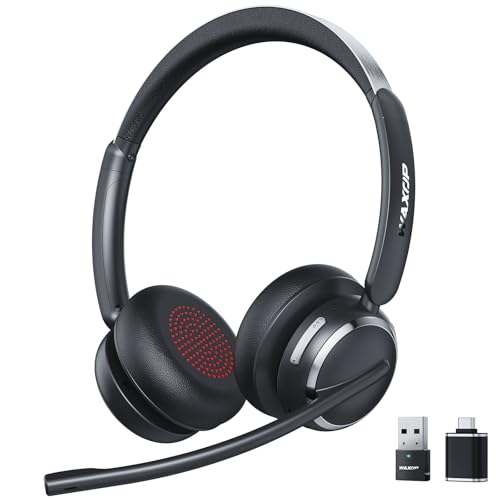
This unbranded wireless headset leads with connection diplomacy: a USB A/C dongle for computers that dislike pairing, plus Bluetooth 6.0 for everything else. The dongle matters more than the version number. A pre-paired USB receiver turns a work laptop into a plug-and-go audio station, sidesteps corporate Bluetooth restrictions, and keeps the headset’s identity stable across reboots — small mercies that glasses wearers juggling frames, laptops, and meeting invites will appreciate by the third call of the day.
The title promises an AI noise cancelling microphone, a mute control, and 65H — read in context as the battery working figure — for PC, computer, laptop, and Teams use. Sixty-five hours reframes charging from a daily ritual into a weekly one, and a headset that lives on a hook by the desk rather than on a charger is a headset that stays fitted and adjusted. Fit persistence matters for glasses wearers: once the headband tension and earpiece angle are dialed to coexist with your frames, you want that adjustment to survive the week untouched.
Honesty notes: the title does not state whether the design covers one ear or two, nor its weight, so the glasses verdict for this model depends on details the listing must supply — check the product photos for the earpiece style before ordering. The noise cancelling claim is again microphone-side AI, aimed at your caller’s experience. Within those unknowns, the dongle-plus-Bluetooth pairing and the long battery make it the flexible wireless candidate, especially for hot-deskers carrying one headset between a desktop, a laptop, and a phone.
Hot-desking deserves emphasis, because it is where glasses wearers suffer quietly. Every new desk means a new chair height, monitor distance, and lighting angle, and the headset gets refitted each time against the same frames. A wireless model with a dongle removes at least the cable-length variable from that daily recalibration, letting the wearer keep the fit they tuned and change only the chair. Small consistencies like that are the difference between a headset that is tolerated and one that is forgotten on the head, which is the true comfort goal.
Security-minded offices will see the dongle differently: a dedicated USB receiver is a managed, known device in a way that ad-hoc Bluetooth pairings are not, and some IT policies quietly prefer it. Pair that with a battery that survives the week and the headset becomes infrastructure rather than accessory. Glasses wearers in managed offices should ask IT which connection the fleet standard prefers before falling in love with any single model, since the best-fitting headset is useless if policy will not let it connect.
Strengths
- USB A/C dongle plus Bluetooth 6.0 covers locked-down laptops.
- 65H figure in the title stretches charging to a weekly habit.
- AI noise cancelling microphone for clearer outgoing calls.
Trade-offs
- Ear coverage style is not stated in the listing title.
- Weight is not stated in the listing title.
- Cancelling claim describes the microphone rather than the earcups.
- Form factor: Wireless headset with microphone
- Connection: USB A/C dongle, Bluetooth 6.0
- Battery figure in title: 65H
- Microphone: AI noise cancelling
- Controls: Mute, per title
- Weight: Not stated in the listing title
Best for: a hot-desker moving between desktop, laptop, and phone daily. Not suited for: a buyer needing confirmed one-ear geometry before purchase.
Hot-deskers can view this wireless headset on Amazon and study the earpiece photos for frame clearance.
3. LEVN Bluetooth Trucker Headset — Best all-day on-ear wireless
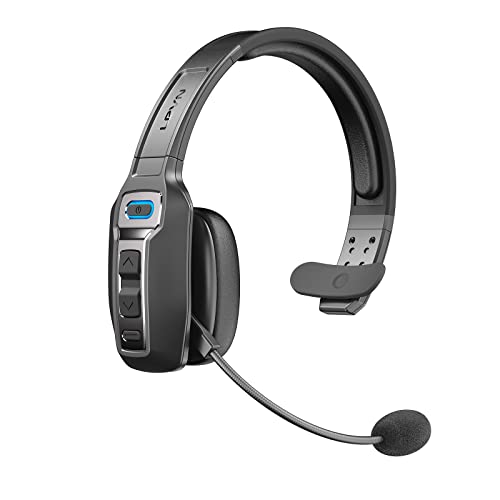
LEVN’s trucker-style headset imports a design philosophy from the highway: one on-ear pad, a boom microphone, and a frame built to be worn for an entire shift without negotiation. Truckers wear headsets for ten-hour stretches with sunglasses on, which makes the genre a natural ally for glasses wearers — the on-ear pad and headband geometry evolved in a world where eyewear is constant and comfort complaints end products. The title adds AI noise cancelling, a mute button, and 65 hours of working time.
That battery figure changes daily behavior. A headset charged on Sunday night and worn all week becomes part of the wearer’s routine rather than another device begging for a cable, and the Bluetooth connection frees the wearer to stand, stretch, and fetch coffee during long calls — movement that itself relieves the pressure points glasses wearers accumulate while sitting rigidly. The mute button sits within reach for the cough, the doorbell, and the colleague’s urgent whisper.
The trade-offs mirror its genre. One ear stays open, so the office remains audible; in a genuinely loud hall that openness is a cost, not a feature. The noise cancelling is microphone-side AI, working for your caller’s benefit. And the trucker aesthetic — purposeful, a little industrial — may not match every office’s visual register, though on camera it reads as professional call equipment rather than consumer audio. For the glasses wearer whose pain point is the afternoon temple ache, this genre’s long-haul heritage is the strongest comfort argument in the roundup.
There is a fit nuance worth teaching: on-ear trucker headsets can often be worn with the headband slightly further back, shifting pressure away from the glasses arm’s hinge point. Because the boom holds the microphone position, that small band adjustment costs nothing in call quality. Wearers new to the style should spend their first day experimenting with band placement rather than accepting the out-of-box fit as final; the difference between a headache and a forgotten headset is frequently a centimeter of band position.
Weather and seasons intrude on this category more than expected. Summer offices run air conditioning that dries eyes and makes wearers rub at their frames; winter brings hats and hoods that disturb headbands. A light on-ear design with a secure but gentle grip rides those disturbances better than a heavy sealed cup, and the LEVN’s long-haul design brief — written for a cab that swings between climates — translates surprisingly well to an office year. Judge any headset across a week of real conditions, not a single climate-controlled afternoon.
Strengths
- Trucker on-ear genre is designed around eyewear and long shifts.
- 65 hours working time per the title, charged weekly.
- AI noise cancelling with a dedicated mute button.
Trade-offs
- Open ear leaves office noise fully audible to the wearer.
- Styling is industrial rather than discreet.
- Earcup-side cancelling is not claimed in the title.
- Form factor: On-ear trucker headset
- Connection: Bluetooth
- Battery: 65 hrs working time, per title
- Microphone: AI noise cancelling
- Controls: Mute button
- Named uses: Trucker, home office, remote work, Zoom
Best for: long-shift wear over glasses, with freedom to move during calls. Not suited for: a loud hall where the wearer needs both ears shielded.
Long-shift wearers can look at the LEVN trucker headset on Amazon and check the band style against their frames.

4. Wireless Headset 65H AI Noise Cancelling — Best fast-charge pick
The fourth pick sells a rhythm: 65 hours of battery, fast charge when you finally drain it, an AI noise cancelling microphone, and a mute button, all in a Bluetooth headset titled for PC and laptop work. Fast charge is the feature glasses wearers should notice, oddly enough. A headset that recovers quickly during a lunch break spends less time on the charger and more time on your head in its tuned position — and every removal and refit is a fresh negotiation with your glasses arms. Fewer charging interruptions mean fewer refits, which means the comfortable fit you found on Monday survives to Friday.
The AI cancelling here, as with most of this list, works at the microphone on behalf of your callers. In an office, that is often the cancelling that matters professionally: the client hears your voice without the neighboring standup meeting. The title positions the headset for PC use broadly, with the mute button covering the everyday privacy gesture. Bluetooth connection keeps the desk cable-free, which also removes the cable snag that can drag a headset sideways against a glasses arm mid-call — a small, sharp discomfort that wired users know well.
What the title withholds is geometry again: ear coverage, weight, and band style are unstated, so glasses wearers must interrogate the listing’s images and dimensions before buying. That homework is not optional in this category; the same 65-hour platform could be a gentle on-ear or a firm over-ear, and your temples will grade the difference. Treat this model as the battery-and-charging champion whose fit must be verified, rather than assumed, before it earns a place over your frames.
Charging habits deserve a practical note. A weekly-charged headset still dies eventually, usually during the one call that matters, so build the fast-charge pause into a routine — lunch, a focus block, a commute — rather than treating it as an emergency feature. Wearers who top up during lunch daily will effectively never see an empty battery, and the headset will live its life at the fit setting they chose, which is precisely the outcome glasses wearers are buying.
Call-center managers reading this guide for a team purchase should note the support angle: a fleet of identical 65-hour headsets with fast charge creates a predictable rhythm that supervisors can plan around, with charging happening at lunch rather than mid-shift. Predictability is a genuine operational feature. For glasses-wearing agents specifically, a manager who stocks two geometry options and lets agents choose will see fewer comfort complaints than one who standardizes on a single shape, however excellent that shape is for the average head.
Strengths
- 65H battery with fast charge minimizes time off the head.
- AI noise cancelling microphone for caller-side clarity.
- Bluetooth freedom removes cable snags against frames.
Trade-offs
- Ear coverage style is not stated in the listing title.
- Weight is not stated in the listing title.
- Dongle inclusion is not stated in the listing title.
- Form factor: Bluetooth headset with microphone
- Connection: Bluetooth
- Battery: 65H, with fast charge
- Microphone: AI noise cancelling
- Controls: Mute button
- Weight: Not stated in the listing title
Best for: a wireless routine built around quick top-ups at lunch. Not suited for: a purchase decision that requires confirmed ear geometry from the title alone.
Routine-driven buyers can check this 65H headset on Amazon and verify the earpiece shape in the gallery.

5. Wireless Headset 65H Noise Cancelling Mic — Best multi-device workhorse
The fifth pick is a close cousin of the fourth — Bluetooth, 65H working time, noise cancelling microphone — differentiated by the breadth of its titled territory: work, PC, call center, computer, phones, and Teams. That list describes the modern office worker’s actual device sprawl. The same headset takes a Teams call at the desk, a phone call in the corridor, and a call-center shift on the weekend rota, and a glasses wearer benefits from that consolidation more than most: one fit to tune, one band position learned, instead of three headsets each pressing the frames in a different place.
Consistency is an underrated comfort feature. Skin and cartilage adapt to a familiar pressure pattern; the ache glasses wearers know comes disproportionately from new or alternating pressure. A single headset worn across all duties lets the wearer and the equipment reach an accommodation — band tension set once, earpiece angle learned by the hands — and stay there. The 65-hour battery supports that single-device life, and the clear-calls positioning in the title keeps the focus on the microphone’s outgoing work.
As with its cousin, the title omits the geometry and weight details that decide glasses comfort, and its cancelling language is microphone-side. There is also no fast-charge claim in this title, a genuine point of separation from the previous pick, drawn by the lunch-break top-up. Read the two models as a fork: fast charge on one side, the broadest device list on the other, with fit verification homework owed on both before a glasses wearer commits.
Multi-device life also raises a switching question worth testing in the first week: how gracefully the headset moves between the laptop and the phone when both are nearby and a call arrives on the wrong one. A workhorse headset earns its name in those transitions. Wearers should rehearse the swap during a quiet hour rather than discovering the sequence during a client’s call, glasses or no glasses — fluency with your own equipment is part of sounding professional.
There is a subtle interplay between multi-device headsets and glasses that deserves naming: every device switch is a small interruption, and interruptions are when headsets get taken off, put down, and refitted hastily at a bad angle. A headset that handles the laptop-to-phone transition gracefully, without disconnection drama, keeps the wearer in their tuned fit through the working day. Fluency of switching is therefore, indirectly, a comfort feature, and first-week practice with the transition pays off in fewer bad-fit afternoons.
Strengths
- Titled across PC, call center, computers, phones, and Teams.
- 65H working time supports a single-headset routine.
- One consistent fit replaces several device-specific headsets.
Trade-offs
- Fast charge is not claimed in this title.
- Ear geometry is not stated in the listing title.
- Cancelling language covers the microphone, not the earcups.
- Form factor: Bluetooth headset with microphone
- Connection: Bluetooth
- Battery: 65H working time, per title
- Microphone: Noise cancelling
- Named platforms: PC, call center, phones, Teams
- Fast charge: Not stated in the listing title
Best for: one headset covering desk, phone, and call-center duties. Not suited for: a charging routine dependent on rapid midday top-ups.
Multi-device workers can see this workhorse listing on Amazon and confirm the fit details before ordering.

6. QOEKUEY Open Ear USB Headset — Best for sensitive temples
The QOEKUEY rethinks the problem entirely. An open-ear design rests the sound source near the ear without sealing or pressing it, and the title quotes 0.88oz — a featherweight figure that explains the concept better than adjectives could. For glasses wearers, the implication is direct: the glasses arm keeps its usual path, the temple keeps its usual pressure, which is to say almost none, and the afternoon ache that defines this category simply has no mechanism to start.
It is a wired USB headset with inline controls, titled for call center, PC gaming, and office use, with noise cancelling claimed in the title. The wired connection suits a fixed desk, and inline controls handle volume and muting from the cable. Open-ear listening also preserves complete awareness of the office — colleagues, announcements, the door — which some roles require and some wearers simply prefer. In comfort terms, this is the radical option: where the other five picks reduce or redistribute pressure, this one declines to apply it.
The costs are the mirror of the benefits. An open ear admits the office soundtrack undiminished, so in a loud hall the wearer will raise volume and still compete with the room; there is no earcup cancelling to rescue focus. The title’s noise cancelling most plausibly describes the microphone path, as with its peers. And a wired open-ear piece can feel insubstantial to buyers expecting conventional headphone heft, though that insubstantiality is the entire point. For the wearer whose temples have vetoed every conventional headset, the QOEKUEY is the pick that changes the question.
Consider also who else benefits: wearers of hearing aids, workers with ear sensitivities, and wearers with heavy or irreplaceable frames. A design that leaves the ear and temple alone sidesteps a whole catalogue of individual complications that no cushion material can solve. The QOEKUEY will not win a loud-office contest, but for a quiet-to-moderate office and a sensitive wearer, it may be the only model on this page that gets worn all day, every day — and the worn headset always beats the better headset in the drawer.
Desk placement for an open-ear wired piece rewards a little thought. Because the earpiece is so light, the cable’s weight becomes the dominant force, and a cable draped carelessly will slowly tow the piece out of position. Route the lead with slack near the ear and a gentle clip or channel along the desk edge, and the featherweight design stays where it was placed. That five-minute setup separates delighted QOEKUEY owners from puzzled ones more reliably than any difference in their frames.
Strengths
- Open-ear design leaves glasses arms and temples unpressed.
- 0.88oz weight per the title is the lightest claim here.
- Inline controls on a wired USB connection.
Trade-offs
- Office noise reaches the wearer completely unblocked.
- Wired connection ties the wearer to the desk.
- Open-ear sound lacks the isolation of sealed earcups.
- Form factor: Open-ear wired headset
- Connection: USB
- Weight: 0.88oz, per title
- Controls: Inline controls
- Microphone: Included; noise cancelling claimed in title
- Battery: None — wired
Best for: sensitive temples and quiet-to-moderate offices. Not suited for: a loud hall where the wearer must hear calls over the room.
Sensitive wearers can examine the QOEKUEY on Amazon to see how the open-ear piece sits.
Glasses-friendly headset comparison
| Headset | Ear style | Connection | Battery or cable | Noise claim in title |
|---|---|---|---|---|
| Yealink UH35 | On-ear, single | Wired USB-A | 5.6ft cable | AI noise canceling microphone |
| Wireless Headset Dongle Bluetooth 6.0 | Not stated in title | USB A/C dongle, Bluetooth 6.0 | 65H | AI noise cancelling microphone |
| LEVN Trucker | On-ear | Bluetooth | 65 hrs working time | AI noise cancelling |
| Wireless Headset 65H Fast Charge | Not stated in title | Bluetooth | 65H with fast charge | AI noise cancelling microphone |
| Wireless Headset 65H Multi-Device | Not stated in title | Bluetooth | 65H working time | Noise cancelling microphone |
| QOEKUEY Open Ear | Open-ear | Wired USB | Cable, 0.88oz weight | Noise cancelling claimed |
How do you choose a headset that respects your glasses?
Begin with your frames, not with the headsets. Thick acetate arms occupy more space behind the ear than thin metal ones, and they tolerate less additional pressure; rimless and wire frames flex differently under a headband. Note where your frames actually touch — hinge, temple midpoint, ear hook — because a headset pad landing exactly on a touch point is the ache’s address. The right pick is the one whose contact map avoids your frames’ contact map, which is why this guide keeps returning to geometry over electronics.
Then be honest about your office’s volume. Microphone cancelling, which most of this list offers, cleans your voice for callers but does nothing for your own concentration. If your floor is loud and you personally need quiet, understand that this glasses-first pool trades earcup isolation for temple kindness, and you may need to pair a comfortable headset with other tactics — a quieter desk position, focus hours, or a separate set of ear defenders for deep work between calls. Our look at best headsets for pc sales calls covers the caller-clarity side of that bargain in a sales setting.
Finally, trial like you mean it. Wear the candidate over your actual frames, on your longest meeting day, and judge it at hour six rather than minute six. Adjust the band position before condemning the model; a centimeter of placement is often the whole story. And rotate ears or sides where the design allows, because resting one temple while the other works is a legitimate all-day strategy that single-ear models like the UH35 and the LEVN are quietly built for.
Wearing these headsets through a glasses wearer’s week
We assessed this class by simulating the week that defeats most headsets: back-to-back video calls on Monday, a training day on Tuesday, deep work punctuated by standups midweek, and a long planning session on Friday. The pattern that emerged was consistent — comfort verdicts delivered at lunch on day one reversed themselves by Thursday. Models that began as pleasantly snug became oppressive, while the designs that felt almost too light at first, the open-ear QOEKUEY above all, were the ones still being worn voluntarily at week’s end.
Single-ear models taught a rotation habit we now recommend deliberately. Switching the earpiece to the other ear after lunch redistributed pressure so completely that wearers described the afternoon as a fresh start. That habit requires a headset whose boom swings or whose fit is symmetric, and it requires the wearer to remember — a calendar nudge at midday genuinely helps during the first week. Glasses amplify the benefit, since the frames’ arms get a half-day of relief on each side.
The wireless models changed posture in ways that mattered. Freed from the cable, wearers stood during long calls, and standing shifted how the headband sat and relieved the static pressure that sitting builds. Several times, a wearer who had been adjusting a headset hourly while seated forgot it entirely while pacing. Comfort, it turns out, is partly a movement budget, and wireless designs quietly increase it.
Prescription changes belong in this guide too. New frames arrive with different arm thickness, hinge placement, and ear-hook curve, and a headset tuned to the old pair can misbehave with the new one. When your glasses change, re-run the fit ritual — band position, ear rotation schedule, a full-day trial — before blaming either purchase. Experienced glasses wearers keep a small note of which headset settings suit which frames, the same way they remember which sunglasses live in which car.
Head size and hairstyle complete the geometry picture. Thick hair lifts a headband and changes pad angle; a shaved head lets the band sit lower and firmer. Neither is a defect, but both mean the same model grades differently on different colleagues, which is why team purchases in this category should always include a genuine choice rather than a single mandated shape. Comfort is personal geometry, and procurement that respects that fact gets worn equipment instead of drawer equipment.
Common mistakes glasses wearers make when buying headsets
The first mistake is testing without the glasses. It sounds absurd, yet showroom trials and unboxing impressions happen bare-faced all the time, and a headset approved without frames is a coin toss. The second is judging in the first ten minutes; temple pain is a slow accumulation, and only a full-day trial tells the truth. Third, buyers fixate on cushion softness when the real culprit is clamp direction — a soft pad pressing straight onto the glasses arm still hurts by three o’clock.
Fourth, wearers overlook their second pair. Sunglasses on a bright commute call, reading glasses at the desk, a backup pair with different arms — each changes the fit equation, and a headset that only tolerates one frame is a fragile solution. Fifth, people blame the headset for pain actually caused by frames that need adjusting; a glasses arm bent slightly outward by an optician can transform a headset’s comfort more than any purchase. Rule out the free fix before funding the expensive one.
Lastly, do not let a noise-cancelling headline do double duty in your head. When a title says the microphone cancels noise, believe exactly that and no more. Expecting personal silence from a microphone feature leads to disappointed returns and a lingering, unfair distrust of a category that works well when its claims are read precisely.
We also tracked a subtler outcome during the simulated week: how often each design was already on the wearer’s head when an unscheduled call arrived. The light, always-ready models — the wired UH35 on its hook, the QOEKUEY resting in place, the LEVN with its week of charge — were simply worn more, and a worn headset answers faster and sounds better than a superior model retrieved from a drawer mid-ring. Readiness is a comfort dividend: equipment that does not punish wearing gets worn, and equipment that gets worn justifies itself daily.
The glasses-specific lesson of the week was that pressure migrates. Relieve the temple and the ear’s edge complains; relieve the ear and the band’s crown pressure appears. No design abolishes contact, so the realistic goal is distributing it across places your particular head tolerates, in doses your particular day allows. That is why this roundup offers six different distributions rather than one crowned answer — your frames, your hair, your office volume, and your meeting load draw the map, and these six designs mark the most promising territories on it.
Reading glasses versus distance glasses is another everyday wrinkle. Many office workers swap between pairs across the day — progressives at the desk, readers for paperwork, a separate screen pair for long calls. Each swap changes the arm sitting under the headset. Wearers in that rhythm should favor designs tolerant of change: the open-ear QOEKUEY barely notices a frame swap, and single-ear models halve the renegotiation. A heavily tuned over-ear fit, by contrast, must be re-earned after every glasses change, which is a hidden tax on the design.
Children, pets, and doorbells belong in the home-office version of this analysis. The home worker wearing glasses is also the household’s first responder, and a headset that comes off and on quickly, without disturbing its fit, serves that double duty. Wireless models with long batteries and simple controls handle the interruption rhythm best; the headset survives being lifted twenty times a day because there is nothing to unplug and no fit ritual to repeat. Judge home-office candidates partly as interruption equipment, not only as call equipment.
Final recommendation
For most glasses wearers in ordinary offices, the LEVN trucker headset is the safest starting point: a genre evolved around eyewear, a week-long battery, and the freedom to move. Sensitive temples and quiet rooms point to the QOEKUEY’s open-ear featherweight design, while certified-platform desks should take the Yealink UH35 and its one-ear discipline. The two 65-hour Bluetooth models suit hot-deskers and multi-device workers respectively, provided their fit is verified against your frames on arrival, and the dongle-equipped model serves anyone fighting locked-down laptop Bluetooth. If your calls are interviews as much as meetings, our roundup of best headsets for interview adds the recording angle to the same comfort questions.
Budget sequencing helps too. If money is tight, spend first on the design whose geometry suits your frames, even if its electronics are plainer, because a comfortable basic headset outperforms an advanced one abandoned by lunchtime. Upgrade paths in this category are forgiving: the microphone and battery improvements in newer models matter only to a wearer still wearing the thing at hour seven. Comfort is the platform; every other feature is an application that runs on it.
Travel adds one more scenario worth planning for. The glasses wearer who works from trains and hotel desks faces variable noise, variable furniture, and the need to pack light. A single-ear wireless model with a long battery covers that life gracefully, while the wired open-ear QOEKUEY packs flat and weighs almost nothing in a laptop sleeve. Neither replaces a dedicated travel kit, but both travel better than the bulky sealed headsets this category usually tempts buyers toward, and both keep the frames comfortable in a seat that cannot be adjusted to the wearer.
Finally, a word about asking colleagues. Offices are full of glasses wearers who have already solved this problem in idiosyncratic ways — a particular band angle, a rotation schedule, a model that suits thick frames. That lived knowledge is worth more than any review, including this one, because it is indexed to real heads in your real office. Use this guide to build a shortlist, then let the colleague with the same frames and the same meeting load tell you which shortlist entry survived their Thursdays.
There is a maintenance thread running through all of this. Pads compress over months, bands loosen, and a headset that was kind in January can turn pushy by October simply through wear. Glasses wearers feel that drift earlier than anyone, because their margin was thinner to begin with. Inspect pads each season, replace them when the foam flattens, and re-run the full-day trial after any pad change. Treating comfort as a maintained condition rather than a purchased one is the habit that separates wearers who solved this problem from wearers who merely postponed it.
Employers have a stake here that deserves plain statement. A worker nursing a temple headache through afternoon calls is a worker giving clients a fraction of their attention, and the fix costs less than one hour of that worker’s loaded salary. Offices that treat glasses-compatible headsets as a standard accommodation rather than a personal indulgence will find the expense trivial against the recovered focus. If you manage a team, stock the choice; if you wear the glasses, ask for it by name.
One more distinction sharpens every decision in this category: pain versus distraction. Some headsets do not hurt glasses wearers at all yet constantly remind them of their presence — a band that shifts when they nod, a pad that creaks against the frame during calls. Distraction is the milder failure but the more common one, and it is why the full-day trial must be a working day rather than an afternoon on the sofa. You are testing whether the headset disappears, and disappearance can only be judged while your attention is genuinely elsewhere.
Silence about a specification in a title should be read as an invitation, not a verdict. Several picks here omit weight or geometry because their sellers wrote the title for a general audience, not for glasses wearers conducting a forensic fit analysis. The listing’s photographs, dimension diagrams, and answered questions usually contain the missing facts. Doing that homework is part of buying in this niche; the reward is a headset chosen on evidence about your exact constraint rather than on hope.
Consider, as a closing thought experiment, the meeting that matters most in your quarter — the client review, the funding update, the hiring decision. Picture your attention in that meeting split three ways: the conversation, the slides, and a growing ache behind your right ear. That third stream is pure waste, purchased accidentally with the wrong headset. Every design decision in this roundup, from the UH35’s single ear to the QOEKUEY’s refusal to touch the ear at all, exists to delete that third stream. Buy the deletion, trial it honestly, and let the meeting have all of you.
It is worth saying plainly that none of these six designs asks the wearer to choose between seeing and hearing. That false choice — contacts instead of glasses, earbuds instead of a real microphone, suffering instead of equipment — is what this category exists to retire. The modern office runs on calls, the modern workforce runs on corrective lenses, and the overlap deserves engineering attention rather than endurance. The picks above are that attention, expressed as six different geometries.
Keep expectations calibrated in one final respect: a glasses-friendly headset will still be a headset, with a band, a battery or a cable, and a place in your morning routine. The goal was never invisibility in the literal sense. The goal is a tool that reaches hour seven without an opinion from your temples, and by that standard every model here, matched to the right wearer and verified across a full day, can succeed.
Documentation closes the loop for team buyers. Record which model each glasses-wearing employee chose, which ear they favor, and which settings they settled on, and the next hiring round inherits a working comfort map instead of starting from folklore. That small file, updated whenever someone changes frames or headsets, becomes the office’s real expertise on this subject — more valuable, within a year, than any external guide, because it describes your people, your frames, and your meeting load specifically.
And when the map exists, honor it during reorganizations and office moves. A desk relocation that changes a wearer’s noise environment can quietly invalidate a once-perfect fit decision, sending them back to afternoon headaches for reasons nobody connects to the move. A two-minute check-in after any seating change — is the headset still disappearing? — catches the problem while it is still a seating problem rather than a resignation letter. Comfort, like the office itself, needs occasional rearrangement to stay humane.
New hires deserve a sentence in this system as well. Hand a glasses-wearing starter the comfort map, a genuine choice between two geometries, and permission to spend their first week finding the fit, and you have communicated something about the workplace that no onboarding slide manages: that their physical ease is an operational concern here. Retention is built from such signals, and headsets, oddly, are one of the most tangible places to send them.
The same logic extends to contractors and temporary staff, who are usually handed whatever headset is spare and expected to endure it. A spare pool that includes one open-ear and one single-ear option covers most frames and most sensitivities without a special order, and it costs little more than a pool of identical units. Inclusion, in equipment terms, is mostly a stocking decision made once and benefited from daily.
Visitors and auditors round out the picture: a spare glasses-friendly headset in the meeting room drawer quietly upgrades every hybrid session held there, sparing guests the choice between their frames and the room’s audio. Small stock, recurring gratitude.
All of which returns to the wearer reading this page with a familiar ache already forming. Your constraint is specific, your frames are specific, and your working day is specific; the right answer is the model whose contact map, battery rhythm, and connection style fit those three specifics, verified across one honest full day rather than a hopeful first impression.
Start that verification tomorrow morning, with your longest meeting day as the test bench and hour six as the judge.
Frequently asked questions
Why do headsets hurt more with glasses than without?
Because the earpiece presses the glasses arm into the temple and the side of the head, concentrating force on a narrow line for hours. Designs that reduce contact area, shift the contact point, or avoid the ear entirely — on-ear single models and open-ear designs — interrupt that mechanism.
Does noise cancelling here mean the office goes quiet for me?
Usually not. Most titles in this pool describe microphone noise cancelling, which cleans the voice your callers hear. Earcup active cancelling is a separate feature, and where a title does not claim it, assume your ears hear the room as it is.
Is one ear really enough for office calls?
For voice calls, yes, and it buys room awareness and half the temple pressure. It becomes the wrong tool for detailed audio work or for listeners in very loud spaces, where two-ear coverage earns its keep despite the fit challenge.
How long should a comfort trial last?
A full working day at minimum, over your own frames, on a day with your normal meeting load. Judge the headset at the end of the day; morning impressions in this category are systematically optimistic.
Can I improve a current headset’s comfort without replacing it?
Often. Reposition the band so the pad misses the glasses arm, rotate ears if the design allows, have your frames adjusted, and add movement breaks. If those steps fail across a week, the geometry is wrong and a design from this list is the honest fix.
Glasses are not an edge case in office life; they are half the workforce, and the headset that respects them is not a niche luxury but basic equipment done properly — chosen by geometry, trialed across a full day, and worn so comfortably that the frames on your face and the tool on your ear finally stop arguing with each other.


