What's inside
- Key Takeaways
- Quick Picks: The Best Mirrorless Cameras With Image Stabilization Less Than 700
- How were these six chosen for a stabilization-first keyword?
- How does sensor-shift stabilization actually work, and where does it stop working?
- Comparison Table
- How do you test stabilization honestly before you trust it?
- Which errors do stabilization buyers repeat most?
- How does a stabilized body change the way you buy lenses afterwards?
- Which genres cash the stabilization cheque most often?
- How do you hold a camera so the stabilization can finish the job?
- When should stabilization be switched off or handed to other tools?
- Final Recommendation
- Frequently Asked Questions
- Related Guides
As an Amazon Associate I earn from qualifying purchases. This post may contain affiliate links at no extra cost to you.
gizmoverdict.com is reader-supported. When you buy through links on our site, we may earn an affiliate commission.
Where to buy: Every camera below links to its own verified listing, and you can check its title yourself at the top of the listing page. This segment’s prices shift constantly, so the budget in the keyword is treated throughout as a segment boundary rather than a per-listing promise; confirm the current figure and the exact contents of any bundle on the listing page before paying.
The best mirrorless cameras with image stabilization less than 700 dollars require this guide to make one distinction with total clarity, because the whole keyword turns on it. Image stabilization is not one technology. True in-body stabilization moves the sensor itself to counteract your hands, and it works with every lens you mount, stabilized or not. Hybrid stabilization, by contrast, pairs electronic correction with whatever the lens provides, and it is a different tool with different limits. Five of the six cameras here carry genuine sensor-shift systems; the sixth, the Panasonic G100, carries the hybrid kind, and it is included honestly labelled rather than quietly passed off as the same thing. Cameras with no in-body system at all — several famous budget models among them — were excluded from this guide entirely, however strong their other claims.
Why does the distinction deserve a whole introduction? Because stabilization decides photographs at the margins where this segment lives: the dim café, the evening street, the handheld video walk, the long lens at dusk. A buyer comparing stop ratings across different technologies is comparing unlike quantities, and a buyer able to name which mechanism a camera actually contains can predict its behaviour in those margins instead of discovering it. The picks below are ordered to teach the distinction while answering the keyword.
Key Takeaways
- Five picks here stabilize by moving the sensor; the Panasonic G100 stabilizes electronically plus through its lens, a hybrid design with real but narrower powers.
- Sensor-shift stabilization works with every mounted lens, including old and unstabilized glass, which compounds its value over years of ownership.
- The OM SYSTEM E-M10 Mark IV kit states 5-axis stabilization and its lens in the title, the most transparent listing in the group.
- The Panasonic G95 listing is a reseller bundle — replacement battery, memory card and a 12-60mm lens — and is described as such throughout.
- Stop ratings are inconsistently stated across these titles; where a figure is absent, the spec box flags it for manufacturer verification.
- The budget is a segment line, not a promise about any single listing on any single day.
Quick Picks: The Best Mirrorless Cameras With Image Stabilization Less Than 700
| Camera | Badge | Why it earns its place |
|---|---|---|
| OM SYSTEM Olympus E-M10 Mark IV kit | The transparent all-rounder | 20 megapixel body with 5-axis stabilization and the 14-42mm EZ kit lens, every important fact stated in its title. |
| Panasonic LUMIX G97 | The modern hybrid kit | Compact Micro Four Thirds body with the 12-60mm zoom, sensor-shift stabilization and a creator-ready brief. |
| Fujifilm X-S20 | The APS-C stabilizer | Body-only Fujifilm with true in-body stabilization, for the shooter whose lenses and light are bigger than the MFT picks allow. |
| Sony Alpha a6600 | The E-mount veteran | Sensor-shift stabilization inside Sony’s deep lens ecosystem, the established APS-C body in black. |
| Panasonic Lumix G95 bundle | The bundled field kit | Sensor-shift hybrid body sold as a reseller bundle with a 12-60mm lens, spare battery and memory card. |
| Panasonic LUMIX G100 | The hybrid exception | Hybrid electronic-plus-lens stabilization in the smallest presenter body here, included with its mechanism honestly labelled. |
How were these six chosen for a stabilization-first keyword?
The gate was mechanical, not reputational: the camera must stabilize in the body, by sensor shift, or — in the G100’s single, labelled case — by a manufacturer-stated hybrid system. That gate excluded several of the segment’s most advertised cameras, whose stabilization lives only in their lenses or nowhere at all. A keyword that names a feature deserves a list that contains the feature, and the exclusions are this guide’s way of keeping the promise the search made.
Beyond the gate, the screens were the usual ones for this site, applied in this order: verified listing with title recorded; configuration honesty, with bundles described as bundles; and usefulness at the segment’s real margins — handheld stills in poor light and walking-pace video, the two jobs stabilization actually performs for owners at this level. Stop figures were used only where a title states them, because stabilization ratings are measured under differing conditions and a guide that ranks unlike numbers teaches false precision.
The final screen was system sense. A stabilized body is a lens platform, and each pick was checked for the catalogue standing behind it: Micro Four Thirds depth for the Panasonic and OM picks, Fujifilm’s prime-rich X mount for the X-S20, and Sony’s E mount for the a6600. Stabilization multiplies the value of every lens in those catalogues that lacks its own, which is most of the affordable ones — the quiet arithmetic that makes this keyword worth a guide. One more consideration shaped the order without ever being announced as a criterion: candour about configuration. The list descends roughly from the listings that tell you the most — a kit that prints its lens, its aperture and its stabilization on its face — toward the listings that tell you the least and ask the most verification of their buyers. That gradient is deliberate. In a segment where the shopper’s budget is the tightest and the cost of a misunderstanding is therefore the highest, the guide rewards the sellers and the systems that meet the buyer halfway with information, and it lets the silent listings carry the burden of their silence in the ranking rather than in the buyer’s wallet.
How does sensor-shift stabilization actually work, and where does it stop working?
The mechanism is elegant. Gyroscopic sensors inside the body measure the direction and speed of the camera’s shake, hundreds of times a second, and the image sensor — mounted on a floating stage — is driven in the opposite direction by precisely the measured amount. Five-axis systems, the kind the OM and Panasonic titles name, correct not only up-down and left-right tilt but also rotation and the small translations that macro and close work introduce. Because the correction happens at the sensor, it applies to every lens equally: the stabilized kit zoom, the unstabilized fast prime, the adapted vintage lens older than its owner.
The limits are physical and worth memorising. Stabilization corrects the camera’s movement, not the subject’s: a stabilized camera photographing a running child at a slow shutter speed produces a sharp background and a blurred child, crisply. It also reaches its travel limits at long telephoto lengths and at very slow shutter speeds, where the sensor’s small range of motion is spent. And its benefit shrinks as shutter speeds rise — at the speeds of bright daylight sport, stabilization is a passenger. The honest summary is that sensor shift buys you shutter speeds in still scenes and smoothness in video, and it buys nothing at all for moving subjects except steadier framing while you track them.
Video is where the two technologies in this guide diverge most visibly. Sensor shift smooths the small, high-frequency tremor of handheld filming beautifully, and it does so without cropping the frame. Electronic stabilization, the G100’s partner mechanism, corrects by analysing and shifting the image itself, which handles larger movements including walking steps, at the cost of a crop and occasional warping at the frame’s edges. Many experienced filmmakers prefer the sensor’s honesty for seated work and accept the electronic crop for walking work; the G100’s hybrid design attempts both, and its section below judges the attempt on its own terms.

OM SYSTEM Olympus E-M10 Mark IV kit — The transparent all-rounder
This listing is the guide’s model citizen. Its title states the camera (a black Micro Four Thirds body), the lens (the M.Zuiko Digital ED 14-42mm F3.5-5.6 EZ kit zoom, aperture included), the sensor (20 megapixels) and the stabilization (5-axis image stabilization) in a single honest sentence. A buyer needs no faith and no footnote: the kit in the box and the mechanism at its heart are printed where they should be. In a category where stabilization claims are often buried three menus deep in a product description, that transparency is itself a recommendation.
The camera behind the title is the friendly enthusiast’s body this line has refined across generations: compact, finder-equipped, and built around the idea that stabilization belongs in every serious camera rather than in the expensive ones. The 14-42mm EZ is a collapsing power zoom that keeps the outfit pocketable, and its modest aperture is exactly the situation sensor shift exists for — the dimmer the lens, the more shutter speed the body buys back. Kit and stabilization are not two features here; they are one argument.
Within Micro Four Thirds, this kit is also the segment’s gentlest system entry. The mount’s lens catalogue is deep and affordable, the used shelves are full, and every future lens inherits the body’s stabilization whether the lens has its own or not. Against the G97 below, the E-M10 trades the newer model’s creator polish for a friendlier pitch and a smaller kit lens; against the APS-C pair, it trades sensor size for system smallness. As the complete, transparent, stabilized starter, it earns the head of this list.
One more virtue belongs to its generation: maturity. The quirks of this line are documented by a decade of owners, its accessories are everywhere, and its failure modes are known rather than rumoured. A budget buyer is rarely buying adventure on purpose, and this kit is the least adventurous complete purchase in the guide — in the best sense of the phrase.
- Sensor: 20MP, Micro Four Thirds system, per the listing title
- Lens included: M.Zuiko Digital ED 14-42mm F3.5-5.6 EZ, per the listing title
- Stabilization stated in title: 5-axis image stabilization (sensor-shift)
- Stabilization stop rating: Not stated in the listing title — verify with OM SYSTEM documentation
- Configuration: camera and lens kit, black
Strengths
- Every load-bearing fact stated in the title itself
- Sensor shift pairs perfectly with the modest kit aperture
- Gentlest entry into the deepest small-system catalogue
Trade-offs
- Smaller sensor sets the low-light ceiling below the APS-C pair
- Collapsing kit zoom is a convenience design, not a fast one
- Stop rating must be verified outside the title
Best for: a buyer seeking a complete, honestly specified stabilized kit for everyday photography. Not suited for: a buyer requiring APS-C light gathering and fast native apertures.
Evening street photography is where this kit quietly proves itself. The stabilized body behind a modest-aperture zoom is the classic night-walk combination: shutter speeds that would smear an unstabilized frame hold steady, the ISO stays out of the noisy attic, and the photographer keeps moving instead of bracing against walls. Owners consistently report that a stabilized kit changes when they photograph as much as what they photograph, because dusk stops being the end of the shooting day.
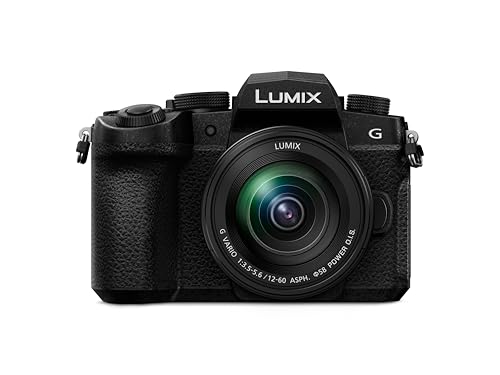
Panasonic LUMIX G97 — The modern hybrid kit
The G97 arrives as the current-generation statement of Panasonic’s compact hybrid idea: a Micro Four Thirds body described in its title as compact and hybrid, sold with the LUMIX G Vario 12-60mm F3.5-5.6 lens. That lens choice distinguishes it from the E-M10 kit immediately — the 12-60mm range reaches from wide interiors to a genuine short telephoto, the span a travel and family kit actually lives across, and it makes this the more versatile single-lens outfit of the two Panasonic-badged MFT kits here.
Its stabilization is the genuine sensor-shift kind, the mechanism this guide’s introduction defined, working with the lens’s own correction where fitted in Panasonic’s dual arrangement philosophy. For the hybrid shooter — stills at the market in the morning, a filmed walkthrough in the afternoon — that pairing covers both of stabilization’s jobs: shutter speeds bought back for stills, and tremor smoothed for video. The title aims the camera at content creators, and for once the aim and the hardware agree: stabilization is the creator feature that cannot be added in editing, only forgiven there.
Against the E-M10, the G97 asks a newer-model premium for a broader lens and a more current design; against the G95 bundle below, it offers the cleaner transaction of a manufacturer’s own kit rather than a reseller’s assembly. Buyers should confirm the current contents and figure on the listing page, as with every pick here, but the shape of the offer is the most modern in the MFT half of this guide.
It is also the pick that best suits the one-camera household kit: a single body and lens that covers the school play, the holiday and the small business’s product clips without a lens change or a second purchase. Versatility is a stabilization-adjacent virtue — a camera that stays mounted with one lens is a camera whose stabilization is always the one you have with you.
- Format stated in title: compact hybrid Micro Four Thirds mirrorless
- Lens included: LUMIX G Vario 12-60mm F3.5-5.6, per the listing title
- Stabilization: sensor-shift in-body system (Panasonic hybrid line) — stop rating not stated in the title; verify with Panasonic documentation
- Brief stated in title: designed for content creators
- Sensor resolution: Not stated in the listing title — verify with Panasonic documentation
- Configuration: camera and lens kit
Strengths
- Broadest kit zoom range in the group
- True sensor-shift stabilization for stills and video
- Current-generation design with a coherent creator brief
Trade-offs
- Key figures, including resolution, are absent from the title
- Newer-model pricing within the segment
- Smaller sensor trails the APS-C picks in dim light
Best for: a buyer seeking one modern stabilized kit for stills and video together. Not suited for: a buyer requiring every specification evidenced in the listing before purchase.
There is a video dividend to this kit’s stabilization that stills-led comparisons understate. Handheld clips from a sensor-shift body carry a floating calm that audiences register as production value, and the 12-60mm’s span means the clip and the still of the same scene come from the same shoulder bag. For the family historian and the small-business documenter alike, that one-kit coverage is the practical definition of a hybrid camera.

Fujifilm X-S20 — The APS-C stabilizer
The X-S20’s title is three words of substance — Fujifilm, the model, a camera body — and yet the body earns its place in a stabilization guide on the strength of what the model is: Fujifilm’s compact APS-C body with true in-body, sensor-shift stabilization, the feature its X-S line was created to bring to this size and segment. This guide states that classification plainly because the evidence for the model supports it, while the spec box below records honestly that the listing title itself prints no stabilization figure, no resolution and no stop rating for a buyer to quote.
Why does APS-C stabilization matter enough to include a body on a silent title? Because of the lenses. Fujifilm’s beloved primes — the compact, characterful glass this system is famous for — mostly lack stabilization of their own, and on a non-stabilized body they are daylight lenses. Behind the X-S20’s sensor shift, they become evening lenses: the café portrait, the night market, the handheld video clip all open up. Stabilization on an APS-C body with this prime catalogue is not a feature; it is a multiplier applied to the best glass in the segment.
The body-only configuration is the planning fact, and the lens pairing should be chosen to exploit the stabilization: a fast prime first, for most owners, because the body has already paid for the shutter speeds that make the prime versatile. Against the a6600, the X-S20 trades Sony’s catalogue depth and battery reputation for Fujifilm’s colour, handling and primes. Against the MFT picks, it trades their kit completeness for a larger sensor and a lens-first budget.
Buyers should do the verification this listing demands: confirm the stabilization and video figures in Fujifilm’s documentation, and price the intended first lens in the same sitting. A body this dependent on its pairing deserves to be bought as a pair, at least on paper, before any money moves.
- Configuration stated in title: camera body only
- Stabilization: in-body sensor-shift system (X-S line design) — not stated in the listing title; verify figures with Fujifilm documentation
- Sensor size and resolution: Not stated in the listing title — verify with Fujifilm documentation
- Video capability: Not stated in the listing title — verify with Fujifilm documentation
- Mount: Fujifilm X, per the product line
Strengths
- Sensor shift unlocks Fujifilm’s unstabilized prime catalogue
- Larger APS-C sensor for dimmer working conditions
- Compact body keeps the stabilized kit genuinely portable
Trade-offs
- Listing title states almost nothing; verification is mandatory
- Body-only purchase makes the lens a full second decision
- Prime-led system rewards spending beyond the segment’s floor
Best for: a buyer seeking APS-C sensor-shift stabilization to pair with fast primes. Not suited for: a buyer requiring a complete kit in one box and specifications in the title.
Consider the photograph this body exists for: a prime lens, a subject lit by a window at the blue end of the day, a shutter speed a full two heartbeats long. On an unstabilized body that frame is a tripod errand; on the X-S20 it is a handheld moment, taken before the light changes its mind. Multiply that moment by every dim interior in a year of photography and the body’s premium over its unstabilized rivals stops looking like a specification and starts looking like a genre.
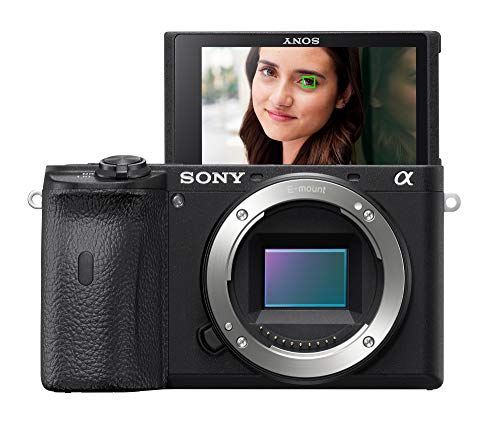
Sony Alpha a6600 — The E-mount veteran
The a6600’s listing title gives a model code, a name and a colour — ILCE6600/B, Alpha A6600, black — and nothing else, which makes it this guide’s second exercise in honest classification. The a6600 is Sony’s established APS-C body with in-body sensor-shift stabilization, the feature that historically separated it from its a6400 sibling in the small-camera guide above. That separation is the entire reason it appears here and the sibling does not: the keyword is stabilization, and this body has the sensor-moving kind.
What the a6600 offers beyond the mechanism is the ecosystem at its most mature. E-mount is the deepest catalogue in this guide — native lenses at every price, third-party glass competing the prices down, and a used market where a stabilized body’s owner can assemble a serious kit gradually. Stabilization compounds inside that catalogue, because the affordable primes and older zooms that lack their own stabilization gain it from the body. An a6600 is therefore not one stabilized camera; it is a stabilization upgrade applied retroactively to every lens its owner will ever mount.
The veteran status cuts both ways. This is an established generation, and a buyer cross-shopping the newest bodies will find younger designs with fresher interfaces elsewhere in this roundup of reviews. The title’s silence means the working figures — stabilization rating, video limits, battery expectations — all require Sony’s documentation and a careful listing check. What does not require faith is the shape of the offer: a sensor-shift APS-C body at the centre of the segment’s deepest lens system, priced by its generation rather than by its novelty.
For the owner already holding E-mount lenses, this is the segment’s simplest decision: the stabilized body that completes the kit they own. For the newcomer, it is the decision to buy a generation’s maturity instead of a generation’s novelty, and to spend the difference on the glass the body will stabilize.
- Configuration: body only, black, per the listing title
- Stabilization: in-body sensor-shift system (model design) — rating not stated in the listing title; verify with Sony documentation
- Sensor size and resolution: Not stated in the listing title — verify with Sony documentation
- Video capability: Not stated in the listing title — verify with Sony documentation
- Mount: Sony E, per the product line
Strengths
- Sensor shift applied to the deepest lens catalogue here
- Established generation with mature pricing and support
- Completes an existing E-mount kit with stabilization
Trade-offs
- Listing title is nearly empty of specifications
- Younger rival designs offer fresher interfaces
- Body-only purchase requires the lens budget alongside
Best for: a buyer seeking sensor-shift stabilization inside the Sony E ecosystem. Not suited for: a buyer requiring title-stated figures throughout and glass included from the start.
Long-service owners give this model a particular compliment: it disappears. The stabilized APS-C body behind a familiar lens becomes the camera reached for without deliberation, and its generation’s quirks are so thoroughly documented that no surprise survives a search. In a segment where novelty is marketed relentlessly, a body whose entire behaviour is known in advance is a form of value that listings cannot print and owners do not surrender cheaply.

Panasonic Lumix G95 bundle — The bundled field kit
Read this listing’s title the way this guide reads every bundle: as an assembly, not a factory kit. The Panasonic Lumix G95 hybrid body is sold here as a reseller bundle whose stated contents are a replacement lithium-ion battery, a memory card and a 12-60mm lens — three items, per the listing. That is not a criticism; a spare battery and a card are the two accessories every new owner buys within a month anyway, and a bundle that includes them can be genuine value. It is, however, a different contract from a manufacturer’s kit: the accessories are the reseller’s choices, their brands and grades are the listing’s fine print, and the wise buyer reads that print before valuing the bundle.
The camera at the bundle’s centre is a sensor-shift body in Panasonic’s hybrid line — the genuine in-body mechanism, in a weather-resistant-style field body that has served travel and outdoor shooters through several seasons. Paired with the 12-60mm range, it covers the same versatile span as the G97 kit, and its stabilization serves the same double duty of stills shutter speeds and video smoothness. Against the G97, the G95 is the elder design offered through the bundle channel; against the E-M10, it is the larger, field-oriented alternative.
Bundle discipline deserves a paragraph of its own, because this segment is full of assemblies dressed as bargains. Value the camera and lens first, as if the accessories were absent. Then value the battery and card at what equivalent reputable items would cost you separately, remembering that a no-name card is worth little in a camera you trust with a holiday. If the bundle still wins after that arithmetic, it wins honestly. If it wins only before it, walk to the manufacturer’s kit instead.
Bought with that discipline, the G95 bundle is the field photographer’s route into sensor-shift stabilization with the starter accessories already in the box — a pragmatic pick for a pragmatic keyword, placed fifth because its contract needs more reading than the four above it.
- Configuration stated in title: reseller bundle, 3 items
- Bundle contents stated in title: replacement lithium-ion battery, memory card, 12-60mm lens (DC-G95DMK)
- Stabilization: in-body sensor-shift system (model design) — rating not stated in the listing title; verify with Panasonic documentation
- Format: Micro Four Thirds hybrid body, per the product line
- Accessory brands and grades: check the listing’s own description before valuing the bundle
Strengths
- Spare battery and card included, the accessories owners buy first anyway
- True sensor-shift stabilization in a field-oriented body
- Versatile 12-60mm span covers the travel curriculum
Trade-offs
- Bundle value depends on accessory grades in the fine print
- Elder design than the G97 kit above
- Stabilization figures require manufacturer verification
Best for: a buyer seeking a stabilized field camera with starter accessories included. Not suited for: a buyer requiring a manufacturer’s own kit with uniform warranty terms.
Field buyers should picture this bundle at a trailhead rather than a desk. The stabilized body, the mid-range zoom, the spare battery already in the box — the assembly is aimed at a day away from sockets, and judged as a day kit rather than a product launch it coheres. Its buyer is not collecting specifications; they are packing. Bundles serve packers well when the packing list is honest, and this one’s list, whatever its fine print, is at least printed.

Panasonic LUMIX G100 — The hybrid exception
The G100 closes this guide as its labelled exception, and the labelling is the service. This camera’s stabilization is a hybrid design: electronic correction working together with the lens’s optical stabilization, rather than a sensor that physically moves. The distinction is not a scandal — it is a design suited to this body’s brief — but a buyer searching this keyword deserves to know which mechanism their money buys, and the G100 is the only pick here whose mechanism is the hybrid kind.
What hybrid stabilization does well suits the G100’s presenter brief precisely. Electronic correction is strong against the larger, slower movements of walking-and-talking footage, the exact motion a solo creator produces, and it asks nothing of the lens beyond its own optical help. At a desk, in a kitchen demonstration, on a gentle stroll with the camera facing its owner, the G100’s footage is steady in the way its audience will actually judge. Its built-in microphone with tracking, stated in the title, completes a brief that is about being watched and heard by people a few feet from the lens.
Where the hybrid design reaches its limits is equally definable: electronic correction crops the frame to find its correction margin, it can warp straight lines at the edges during vigorous movement, and for stills it offers nothing like the shutter-speed dividend a moving sensor pays in dim light. A stills-led buyer in this segment should choose among the five sensor-shift picks above without a backward glance. A presenter-led buyer should choose the G100 knowingly, as the specialist it is, rather than discovering the distinction after the purchase.
Its inclusion, honestly framed, makes the whole guide more trustworthy: a stabilization list that admits its one hybrid, explains the difference, and prices the difference into the ranking is a list a buyer can build on. The G100 is a good camera. It is simply not the same kind of stabilized camera as the five above it, and in this keyword, kind is everything.
- Format stated in title: Micro Four Thirds interchangeable lens system
- Video stated in title: 4K, for photo and video
- Audio stated in title: built-in microphone with tracking
- Lens included: 12-32mm, per the listing title
- Stabilization: Hybrid I.S. — electronic correction plus lens-based stabilization; NOT a sensor-shift system
- Configuration: camera and lens kit
Strengths
- Hybrid correction suits walking-and-talking presenter footage
- Tracking microphone serves the solo creator directly
- Smallest complete filming kit in the group
Trade-offs
- No sensor-shift stabilization for stills in dim light
- Electronic correction crops the frame and can warp edges
- Stills-led buyers are better served by the five picks above
Best for: a buyer seeking steady presenter video in the smallest complete kit. Not suited for: a buyer requiring true in-body sensor-shift stabilization for low-light stills.
The G100’s defenders make one more fair point worth recording: weight is a stabilization feature too. A camera light enough to be held steadily at arm’s length for a full presentation, without the tremor that fatigue adds, can produce steadier real footage than a heavier sensor-shift body in tired hands. The hybrid mechanism’s limits are real, and so is the physics of the arm holding it. Buyers should weigh both, in the hand, before deciding which kind of steady their work requires.
Comparison Table
| Camera | Stabilization mechanism | Lens in box | Format | Configuration |
|---|---|---|---|---|
| OM SYSTEM E-M10 Mark IV kit | 5-axis sensor-shift, stated | 14-42mm F3.5-5.6 EZ | Micro Four Thirds | Manufacturer kit |
| Panasonic LUMIX G97 | Sensor-shift in-body | 12-60mm F3.5-5.6 | Micro Four Thirds | Manufacturer kit |
| Fujifilm X-S20 | Sensor-shift in-body | None | APS-C | Body only |
| Sony Alpha a6600 | Sensor-shift in-body | None | APS-C | Body only |
| Panasonic Lumix G95 bundle | Sensor-shift in-body | 12-60mm (bundle) | Micro Four Thirds | Reseller bundle |
| Panasonic LUMIX G100 | Hybrid electronic plus lens | 12-32mm | Micro Four Thirds | Manufacturer kit |
How do you test stabilization honestly before you trust it?
Test it on your own subjects, at your own shutter speeds, because stabilization is the most personal specification in photography — it corrects your hands, and no two pairs shake alike. The shop test is simple: mount the kit lens, frame a detailed subject across the room, and photograph it at a sequence of slowing shutter speeds with stabilization on, then off. Count the sharp frames at each speed. The speed where your sharp rate collapses is your personal floor, and the gap between the on and off floors is what the system is worth to you, measured in your own currency rather than a laboratory’s stops.
For video, walk the shop’s aisle at your natural pace and then watch the footage at full size. Look at the frame’s edges, where electronic correction confesses its warping, and at the centre, where sensor shift keeps its dignity. Note how the camera behaves when you stop walking and hold a frame — the transition tells you how the system will treat the presenter’s pause, which is where audiences actually look.
One refinement makes the test honest: shoot each speed several times rather than once. A single sharp frame at a slow speed proves the system can do it; a run of frames proves it can do it for you, at your steadiness, on an ordinary day. Keeper rate is the real specification, and it belongs to the partnership between the camera and the hands rather than to either partner alone. Shops understand this ritual better than any other, because it is how their own staff choose the cameras they take home.
Repeat the stills test at the long end of the kit zoom if your photography lives there, because stabilization’s hardest work is telephoto work and its ratings are not earned there. A system that holds your floor at the wide end but abandons you at the long end is a wide-angle feature wearing a general claim, and the ten minutes this test takes is the cheapest insurance in the segment.
Which errors do stabilization buyers repeat most?
The first error is treating the word stabilization as a single feature. This guide exists because it is at least three: sensor shift, lens optical, and electronic, in descending order of what they do for stills and ascending order of what they do for walking video. Buyers who learn the three before shopping read listings like contracts; buyers who learn them after shopping read them like apologies.
The second error is expecting stabilization to freeze subjects. It freezes your shake, nothing else, and the gallery of sharp backgrounds behind blurred children in every camera forum is the monument to this misunderstanding. Moving subjects are governed by shutter speed alone, and the stabilized body’s correct use in that situation is the opposite of the beginner’s instinct: raise the speed, let the ISO climb, and let stabilization do its smaller job of steadying the framing.
The third error is valuing a bundle by its item count. The G95 listing states three items, and three is not a quality — the battery’s origin and the card’s speed class decide whether those items are assets or packing material. The arithmetic in the G95 section, valuing the camera first and the accessories at replacement cost, is the only honest way to price any assembly in this segment.
The last error is buying stabilization for a tripod life. A landscape photographer working from a tripod at base ISO gains almost nothing from sensor shift and should spend the segment’s budget on the sensor and the lens instead. Stabilization is a handheld feature for handheld photographers; knowing which kind you are is worth more than any stop rating in this guide.
How does a stabilized body change the way you buy lenses afterwards?
It reverses the usual advice. In an unstabilized system, the lens must bring its own steadiness, and buyers pay for stabilized versions of the zooms they need while avoiding unstabilized primes for anything but daylight. In a sensor-shift system, the body has already paid the stabilization bill for the whole collection, so the lens decision becomes purely optical: choose by aperture, focal length and character, and let the body handle the tremor. The practical consequence is money — the unstabilized prime is usually the cheaper and often the sharper lens — and the strategic consequence is freedom, because vintage and adapted glass, none of it stabilized, becomes fully usable for handheld work.
This is why the body-only picks in this guide, the X-S20 and the a6600, should not be priced as bodies alone. Each is a stabilization licence applied to a catalogue: every affordable prime in the Fujifilm and Sony shelves becomes an evening lens the day the body arrives. Buyers comparing a body-only stabilized camera against a cheaper unstabilized kit should compare systems across five years of lenses, not boxes across one afternoon, because the licence keeps paying out long after the kit zoom has been replaced.
The MFT picks express the same arithmetic at smaller scale. Micro Four Thirds shelves are full of compact, unstabilized primes designed in the confidence that bodies like the E-M10 and G97 would steady them, and the system’s famously small fast lenses are, in effect, stabilization’s children. A buyer entering that system is not merely buying a stabilized camera; they are buying into the lens philosophy that sensor shift made possible.
Which genres cash the stabilization cheque most often?
Street photography at dusk is the first claimant: unposed, unrepeatable, shot at whatever shutter speed the light allows, in exactly the conditions where two bought-back stops are the difference between a frame and a smear. Interior and documentary work follows — museums, markets, workshops and places of worship where tripods are forbidden and flash is vandalism. Travel photography claims it third, because the traveller’s camera is handheld by definition and the traveller’s best light is the day’s first and last hour, both of them dim.
Macro and close-up work claims it in a different currency. At close distances, tiny movements become large ones in the frame, and the rotational and shift corrections of a five-axis system steady details that no technique fully tames. The segment’s gardeners and product photographers feel stabilization not as extra shutter speeds but as a higher keeper rate on frames they already knew how to compose. Video claims it last and loudest, for the reasons the introduction covered: steadiness is the visible difference between footage that looks witnessed and footage that looks produced.
Knowing your genre’s claim on the feature is the final buying skill this guide can teach. A daylight sports shooter gains little here and should spend elsewhere; an evening street photographer gains the genre itself. The six cameras above are ranked for the second reader, and the first reader is warmly advised to take the segment’s budget to the action guide instead, where their shutter speeds live.
How do you hold a camera so the stabilization can finish the job?
Stabilization corrects small movements, and good holding keeps your movements small enough to correct. The classic stance is unglamorous and effective: elbows tucked to the ribs rather than winged, the camera’s weight carried in the left hand under the lens, the right hand steering rather than lifting, and the finder — where the body has one — pressed to the face as a third point of contact. Photographers who adopt the stance feel the stabilization’s keeper rate climb immediately, because the system is now correcting tremor instead of wrestling sway.
Breathing is the second half of the technique. The stills shooter’s habit of exhaling slowly and releasing the shutter inside the breath’s calm is not mysticism; it measurably reduces the movement the sensor must chase. For video, the equivalent is the soft-kneed walk — shorter steps, weight rolling rather than landing — which keeps the camera’s motion inside the smooth, low-frequency range where both sensor shift and electronic correction perform best. Every pick in this guide rewards these habits, and none of them can substitute for their absence.
Support is the third half, and it is free. A wall, a doorframe, a table edge, a companion’s shoulder with permission — the environment is full of tripods that do not need carrying. The stabilized photographer learns to see them the way a cat sees sunbeams, automatically. Combined with the body’s own correction, a braced elbow on a café table produces shutter speeds that read like misprints, and the photograph — a dim interior, a night portrait, a detail across a dark room — is the kind this entire keyword exists to make possible.
When should stabilization be switched off or handed to other tools?
On a solid tripod, sensor shift has nothing to correct and can wander in search of movement that is not there, so long-exposure and tripod disciplines traditionally switch it off — check your shortlisted model’s own guidance, because some modern systems detect the tripod and settle themselves. In panning work, many systems offer a mode that corrects vertically while letting the horizontal sweep run free, and using it is the difference between a racing subject rendered crisply against a streaked background and a system fighting its owner for the whole frame.
The gimbal question belongs to the video-led buyer. A gimbal corrects large movements superbly and asks for setup, balancing and a second bag; in-body stabilization corrects small movements instantly and asks for nothing. Most solo creators in this segment find the body’s own system sufficient for seated, standing and gentle walking footage, and rent or borrow the gimbal for the assignments that truly need it. Buying the gimbal first and the stabilized body second is the segment’s most expensive ordering mistake, because the body was the tool the weekly work required. The same ordering logic applies at smaller scale to the microphone, the light and the spare battery: the tools used weekly deserve purchase priority over the tools used annually, and a stabilized body is the weekly tool against which all the annual ones should be queued, patiently and in their proper turn. Owners who buy in that order rarely regret the sequence, because each purchase is justified by work already being done rather than by work merely imagined, and imagined work is the most expensive kind there is, because it demands equipment for a life its owner does not actually lead and may never lead at all, despite every good intention declared at the checkout.
Final Recommendation
Start with the mechanism, then choose the camera. For a complete, transparent, stabilized kit, the OM SYSTEM E-M10 Mark IV kit states everything in its title and asks the least faith. For the most versatile single-lens outfit, the Panasonic G97 pairs sensor shift with the broadest kit zoom here. For APS-C ambitions, the Fujifilm X-S20 multiplies a famous prime catalogue, and the Sony a6600 applies stabilization to the deepest lens shelves in the segment. The G95 bundle serves the field buyer willing to read its fine print, and the G100 serves the presenter — knowingly, hybrid mechanism and all. Buy the stabilization your hands actually need, in the system your next lens already lives in, and the dim rooms and long evenings of your photography will quietly change character.
Frequently Asked Questions
What is the difference between in-body and lens stabilization?
In-body stabilization moves the sensor to counteract shake, so it works with every lens mounted, including lenses with no stabilization of their own. Lens stabilization moves an element inside one specific lens and helps only while that lens is fitted. The five sensor-shift picks in this guide stabilize their owners’ whole present and future lens collections; a lens-only system stabilizes one lens at a time.
Is the Panasonic G100’s hybrid stabilization good enough?
For its brief, yes: electronic plus lens-based correction steadies walking-and-talking presenter footage well, which is the work the G100 was designed for. For stills in dim light it cannot pay the shutter-speed dividend a moving sensor pays, and it crops the video frame to find its correction room. Judge it as a presenter tool with a hybrid system, not as a sensor-shift camera with a discount.
Why were some well-known budget cameras excluded?
Because they have no in-body stabilization. Several of the segment’s most popular bodies rely entirely on stabilized lenses or offer no stabilization system in the body at all, and a guide answering this keyword keeps its gate mechanical: no in-body system, no place on the list. Those cameras appear in other guides in this selection, where the keyword does not promise what they do not contain.
Do stop ratings let me compare stabilization across brands?
Only loosely. Ratings are measured under differing conditions and lens pairings, and the same number can describe different real-world behaviour in different hands. This guide uses ratings only where a listing title states them and otherwise flags the figure for manufacturer verification. Your own shutter-speed test, described above, is a better comparison instrument than any two brands’ numbers placed side by side.
Does stabilization help with a tripod or with sports?
Barely, in both cases, and it can be switched off for the first. Tripod work is already still, and sports shutter speeds are already fast enough to freeze the camera’s shake along with the subject. Stabilization earns its price in the handheld middle ground — dim rooms, evening streets, walking video — which is why this guide keeps returning to those margins as the segment’s true territory.
Should the budget figure in the keyword be read as a promise about these listings?
No. It names the segment this guide shopped in, and prices within a segment move with seasons, configurations and retailer decisions — a manufacturer’s kit, a body-only listing and a reseller bundle of the same camera family can sit in different places in different weeks. Read the keyword as the class of camera under discussion, read each spec box for the configuration actually on sale, and confirm the current figure on the listing page at the moment of purchase. That sequence protects you better than any guide’s snapshot can.
Can stabilization rescue a photograph that is out of focus?
No, and the distinction matters for interpreting your own results. Stabilization governs sharpness lost to camera movement; focus governs sharpness lost to the lens settling on the wrong distance. A stabilized frame can be perfectly steady and perfectly focused on the background. When a photograph disappoints, diagnose which failure occurred — motion smears in one direction, missed focus softens evenly — because the remedies differ, and only one of them is the feature this guide is about. Learning to tell the two failures apart in your own archive will improve your photography faster than any single purchase in this segment, because it converts every disappointing frame from a verdict on your equipment into a specific, fixable instruction for your next outing.
Related Guides
The neighbouring guides share this segment’s cast and concerns: the budget guide prices the whole class, the small-camera guide weighs these bodies for carrying, and the Four Thirds guide explores the system four of these picks call home. Continue with the best mirrorless cameras under 1000 dollars, the best small mirrorless cameras with viewfinder and the best mirrorless 4/3 cameras before you settle on a system.
Related guides
- Best 3D Art Tablets
- Best Balancing Stabilizers for Mirrorless Cameras: Payload, Balancing and Native Vertical Shooting
- Best Canon Point and Shoot Digital Cameras: PowerShot Picks From Pocket Compacts to Travel Zooms
- Best Basic Phones Camera Buyers Can Trust: Flip Phones and Simple Handsets That Still Take a Photograph


