What's inside
- Key Takeaways
- Quick Picks: The Best Mirrorless Cameras for Action Photography
- How did these six bodies earn their places?
- What actually decides whether an action frame survives?
- Comparison Table
- How do you set up any of these bodies for a day of action?
- Which errors do action camera buyers repeat most?
- How does the lens mount quietly decide your next decade of action shooting?
- What does an honest action kit look like beyond the body?
- How should a first action assignment change what you buy?
- How do you build action technique before the season makes it urgent?
- Final Recommendation
- Frequently Asked Questions
- Related Guides
As an Amazon Associate I earn from qualifying purchases. This post may contain affiliate links at no extra cost to you.
gizmoverdict.com is reader-supported. When you buy through links on our site, we may earn an affiliate commission.
Where to buy: Each of the six cameras below links to its own verified listing, and the listing title you see on the listing page itself is the only specification source this guide trusts. Action cameras are the most exaggeration-prone corner of the camera market, so check the title wording on the listing page itself before paying, especially where a body-only sale is involved.
The best mirrorless cameras for action photography are not simply the fastest cameras on a chart. Action work is a chain: the autofocus has to find the subject, hold it through clutter and direction changes, the shutter has to fire in a sustained run rather than a hopeful stutter, and the file has to survive a crop when the subject stayed further away than pride planned. Break any link in that chain and the headline specification in the brochure becomes irrelevant. This guide judges six verified bodies on the whole chain, across three sensor sizes and four lens mounts, and it is blunt about the one specification almost no listing title will give you: the burst rate. Where a title stays silent, the spec boxes below say so instead of guessing.
The six split into clear temperaments. Two full-frame bodies bring low-light reach and shallow-focus drama. Two APS-C bodies bring crop-factor telephoto advantage and smaller lenses. One Four Thirds flagship brings a stacked sensor and weather sealing in a system built around compact telephotos. One Fujifilm body arrives with the least title information of the six and the strongest reminder in this guide that a famous name is not a specification. Read the picks as six different answers to the question of what action means: stadium sport, birds in flight, motorsport, school athletics under floodlights, and the dog who only performs when nobody is ready.
Key Takeaways
- Subject-tracking autofocus, not raw burst speed, decides most action keepers; a locked-on slower run beats a fast run of near misses.
- None of the six listing titles states a frames-per-second figure, so every burst claim in this guide is framed as a question to verify rather than a number to trust.
- The OM SYSTEM OM-1 Mark II is the only pick whose title names a stacked BSI sensor, the hardware trait most directly tied to fast readout and reduced rolling-shutter distortion.
- APS-C bodies such as the Canon EOS R7 and Sony a6700 turn a given telephoto lens into a longer effective reach, which matters more at the long end than sensor bragging rights.
- Five of the six picks are body-only listings, so the lens budget is part of the real purchase and belongs in the plan from the start.
- Weather sealing is stated in only one title here; sideline rain is a specification to confirm, not a feature to assume.
Quick Picks: The Best Mirrorless Cameras for Action Photography
| Camera | Badge | Why it earns its place |
|---|---|---|
| OM SYSTEM OM-1 Mark II | Stacked-sensor speedster | The only title here that names its readout hardware, with 5-axis stabilization and IP53 sealing stated outright. |
| Canon EOS R7 | Reach-per-lens champion | A 32.5 megapixel APS-C sensor whose crop stretches telephoto lenses, in a body Canon’s own title aims at sports and action. |
| Sony Alpha a6700 | Compact tracking tool | 26 megapixels and 4K video in a small APS-C body, backed by the deepest native telephoto catalogue in this group. |
| Canon EOS R6 Mark II | Floodlight full-frame | Full-frame gathering power for dim venues, with a 24.2 megapixel file sized for fast turnaround rather than billboard crops. |
| Nikon Z 8 | Professional hybrid brief | Nikon’s title calls it a professional full-frame stills and video hybrid, the heavyweight brief of the six. |
| FUJIFILM X-H2S | The verify-first flagship | A flagship-tier Fujifilm body whose listing title states almost nothing, making it the guide’s clearest lesson in checking before paying. |
How did these six bodies earn their places?
The screen began with the pool: every camera here was confirmed as a real, current listing with its title recorded, and bodies whose titles described bundles built around unrelated accessories were set aside. Action photography punishes vague hardware, so the surviving six had to be bodies a sports, wildlife or motorsport shooter would plausibly shortlist on purpose, not cameras that merely take pictures quickly by accident.
Three judgements then shaped the order. First, autofocus intent: does the body belong to a line designed around subject detection and tracking, the feature that decides whether a burst contains a sequence or a slideshow of misses? Second, readout honesty: a stacked sensor, where a title states one, is treated as meaningful evidence because readout speed governs both electronic-shutter distortion and viewfinder blackout behaviour. Third, system depth: an action body is a lens commitment, and mounts with deep telephoto catalogues at several price levels scored ahead of mounts where the long lens you need exists only at a flagship price.
One more screen deserves naming because it excluded some tempting spec sheets: title evidence. This guide refuses to repeat burst rates, buffer depths and stabilization ratings that the listing title does not state. That refusal makes some spec boxes below look sparse. The sparseness is the point. A buying guide that invents the numbers it cannot source teaches you to trust the wrong thing, and action cameras attract more invented numbers than any other category we cover.
What actually decides whether an action frame survives?
Start with the uncomfortable arithmetic of a burst. Twenty frames of a sprinter crossing the line contain perhaps two with both feet off the ground, the face unobstructed and the expression worth keeping. Autofocus decides whether those two are sharp. Modern subject-detection systems recognise eyes, heads, animals, birds and vehicles, and the practical difference between generations is not whether detection exists but how stubbornly it holds on when the subject passes behind a referee, a fence post or another player. When you compare these six, you are really comparing philosophies of stubbornness, and the honest way to test them is a borrowed body at a real event, tracking the subject you actually shoot.
Readout speed is the second decider, and it is the one the OM-1 Mark II’s title speaks to directly. A stacked sensor reads its rows fast enough that electronic shutters stop bending goalposts and racing wheels into ellipses, and the viewfinder keeps showing the subject between frames instead of a slideshow of what already happened. Conventional sensors can still shoot action beautifully with mechanical shutters, but the photographer’s technique has to absorb what the hardware does not: panning discipline, shorter bursts, and an acceptance that the fastest electronic modes carry distortion risk on the fastest subjects.
The third decider is the file. A 32.5 megapixel APS-C frame and a 24.2 megapixel full-frame frame fail differently: the denser smaller sensor lets you crop into a distant subject and keep printable detail, while the larger sensor gathers cleaner signal when the venue lighting collapses and the ISO climbs. Neither is universally better. A daytime bird photographer and a night-game stringer are shopping for opposite strengths that happen to share a shelf, and this guide keeps both in the six for exactly that reason.
Finally, the unglamorous decider: the photographer’s own position and lens. Every body here will be outshot at some event by a lesser body behind a longer, faster lens in the right seat. Budget honestly across body and glass. The picks below are ordered by how completely each body supports the action chain, not by which badge photographs best on a forum signature.

OM SYSTEM OM-1 Mark II — Stacked-sensor speedster
The OM-1 Mark II leads this guide because its listing title does something rare: it names the hardware that matters. A stacked BSI sensor is stated outright, and stacked architecture is the trait that separates bodies built for electronic-shutter action from bodies that merely tolerate it. Fast readout shrinks rolling-shutter distortion on panning shots, keeps the viewfinder feed close to continuous, and lets the camera spend its processing budget on tracking rather than on reading the sensor. For birds in flight and motorsport, that is not brochure garnish; it is the mechanism the whole shooting style rests on.
The Four Thirds sensor cuts both ways, and the honest account holds both edges. At 20.4 megapixels on a smaller sensor, the file gives you less cropping headroom than the R7’s denser APS-C frame and less low-light forgiveness than the full-frame pair. In exchange, the system’s telephoto lenses are dramatically smaller: the long glass a bird photographer carries all day shrinks to a size that keeps hands steady at hour four, and steady hands are an autofocus feature no processor can simulate. The title also states 5-axis image stabilization and IP53 weather sealing, a pairing that suits the pick’s natural habitat of wet hides and coastal seawatches.
Consider this body the system play of the six. Its action case rests on readout speed, sealing and lens portability rather than on sensor acreage, and photographers whose action happens outdoors, far from the car, at the end of a long lens, will feel the logic immediately. Photographers whose action happens under arena lights should weigh the full-frame picks below before deciding, because no amount of readout speed replaces photons the sensor never gathered.
- Sensor: 20.4MP Four Thirds, stacked BSI, per the listing title
- Video stated in title: 4K
- Stabilization stated in title: 5-axis image stabilization
- Weather sealing stated in title: IP53
- Continuous burst rate: Not stated in the listing title — verify with OM SYSTEM documentation
- Configuration: body only
Strengths
- Stacked sensor named in the title, the strongest readout evidence in this group
- IP53 sealing stated outright, rare candour among these six listings
- Telephoto lenses in this system stay small enough for all-day handheld tracking
Trade-offs
- Smaller sensor gathers less light for floodlit evening sport
- 20.4 megapixels leaves the least cropping room of the six
- Burst rate and buffer depth require verification beyond the title
Best for: a buyer seeking verified fast-readout hardware and sealed weather resistance for outdoor field sports and wildlife. Not suited for: a buyer requiring maximum high-ISO cleanliness under arena lighting as the first priority.
One more consideration belongs to this pick alone: resale and rental gravity. OM SYSTEM’s predecessor bodies built a loyal field-photography community, and the Mark II inherits a used market where long Micro Four Thirds lenses circulate at prices full-frame shooters find startling. A buyer building an action kit gradually, lens by lens across two seasons, will find this system’s second-hand shelves unusually well stocked, and that ecosystem fact never appears in any title.

Canon EOS R7 — Reach-per-lens champion
Canon’s own title for the R7 says the quiet part plainly: this is a hybrid camera for sports and action, built around a 32.5 megapixel APS-C CMOS sensor. That pixel density on a cropped sensor is the R7’s whole argument. Every telephoto lens mounted on it frames tighter than the same lens on a full-frame body, and the dense file tolerates further cropping when the subject still would not come closer. A modest telephoto zoom on an R7 does the framing work of far more expensive glass on the R6 Mark II below, which is why so many wildlife shooters treat this body as the reach bargain of the Canon system.
The APS-C bargain has a second side that action shooters feel at dusk. The smaller sensor’s high-ISO files carry more visible noise than the full-frame picks, and the crop that helps at noon stops helping when the light dies and the lens aperture becomes the ceiling. The R7 also asks its owner to live inside Canon’s RF-S and RF lens strategy, where the long-lens ladder is strong at the top and still filling in at the middle rungs. None of that dents the core case: for daylight action at distance, the arithmetic of this sensor is the most efficient in the guide.
Treat the body-only listing as a prompt to plan the lens pairing at purchase time. The title states 4K video, which keeps the R7 credible for hybrid sideline work, but stills shooters should spend their verification energy on the tracking behaviour and burst figures the title omits, tested against the subjects they shoot rather than against a spec table.
- Sensor: 32.5 megapixel APS-C CMOS, per the listing title
- Video stated in title: 4K
- Positioning stated in title: hybrid camera for sports, action and content creation
- Continuous burst rate: Not stated in the listing title — verify with Canon documentation
- In-body stabilization: Not stated in the listing title — verify with Canon documentation
- Configuration: body only
Strengths
- Densest sensor in the six, purpose-shaped for cropping into distant subjects
- Crop factor multiplies the value of every telephoto lens owned
- Manufacturer’s own title names sports and action as the brief
Trade-offs
- High-ISO files trail the full-frame picks in dim venues
- Mid-priced long lenses in this mount are still a developing catalogue
- Key speed figures are absent from the title and need outside verification
Best for: a buyer seeking the most effective reach from affordable telephoto lenses for daytime sport and wildlife. Not suited for: a buyer requiring full-frame light gathering for indoor evening fixtures above all else.
The R7 also rewards a word about workflow after the whistle. Dense 32.5 megapixel files from a full day of bursts add up to serious archive volume, and the culling discipline described later in this guide matters more here than with any other pick. Shooters who deliver on deadline often set the R7 to a compressed raw format for volume work and reserve full raw for the fixtures that matter most, a habit worth forming in the first month rather than the first crisis.
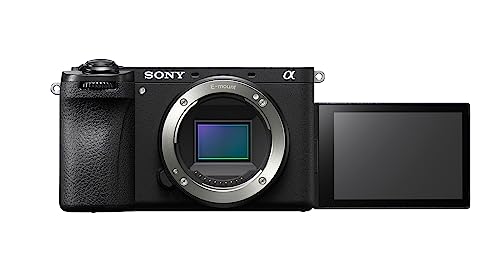
Sony Alpha a6700 — Compact tracking tool
The a6700 packs its case into a small frame: an APS-C body with a 26 megapixel sensor and 4K video, per its title, sitting at the top of Sony’s cropped-sensor line. Its action appeal is less about any single number than about the combination of a mature subject-recognition system, a body small enough to carry as a second camera, and the E-mount telephoto catalogue, which is the deepest in this guide at every price from kit zoom to professional prime. A sports shooter can start with a mid-range telephoto and climb the ladder for years without changing mounts.
Size is the honest trade. A compact body behind a long telephoto balances differently from a gripped flagship, and photographers shooting verticals for hours at a tournament will feel the smaller grip and single-card workflow as real costs rather than spec-sheet trivia. The title also leans toward hybrid work, naming log shooting and LUT handling, which suits the sideline creator filming clips between stills bursts but tells a pure stills shooter little about buffer depth. As with the R7, the decisive figures live outside the title and deserve a hands-on test with your own subjects and your own cards.
Where the a6700 quietly wins is the second-body scenario. Travelling light to a race weekend or a youth tournament, it covers stills action and credible 4K from the same small bag, and its sensor size keeps the telephoto kit portable in a way the full-frame picks cannot match. Judge it as the most portable complete action kit in the six rather than as a shrunken flagship, and its compromises read as design choices instead of deficiencies.
- Sensor: 26MP APS-C, per the listing title
- Video stated in title: 4K, with log shooting and LUT handling named
- Mount: Sony E, per the product line in the title
- Continuous burst rate: Not stated in the listing title — verify with Sony documentation
- Weather sealing: Not stated in the listing title — verify with Sony documentation
- Configuration: body only, black
Strengths
- Deepest native telephoto catalogue of any mount in this guide
- Small body makes a credible second camera for working sports shooters
- Hybrid features named in the title suit sideline video between stills
Trade-offs
- Compact grip tires hands during long vertical-format sessions
- Speed and buffer figures must be verified outside the listing title
- APS-C noise performance sits behind the full-frame pair at high ISO
Best for: a buyer seeking a portable action kit with the widest lens upgrade path in the group. Not suited for: a buyer requiring a deep-gripped, dual-slot professional body as the primary tool.
There is a travel dimension to this pick that pure spec comparisons miss. A body this size, paired with a compact standard zoom, covers a family holiday in the same bag slot it uses for Saturday sport, and the action brief rarely survives contact with real luggage allowances unless the camera earns its space on ordinary days too. The a6700 is the pick most likely in this six to be carried daily, and the camera that is carried is the camera that is practised with.

Canon EOS R6 Mark II — Floodlight full-frame
Evening sport is where full-frame bodies stop being a luxury. The R6 Mark II’s title states a 24.2 megapixel full-frame CMOS sensor, and that moderate pixel count on a large sensor is a deliberate action recipe: bigger photosites, cleaner files as the ISO climbs under floodlights, and file sizes that move fast when a deadline is measured in minutes. For the school-sports stringer and the indoor athletics shooter, this is the pick whose sensor brief matches the working conditions most closely.
The same moderation defines its limits. At 24.2 megapixels, cropping into a distant subject spends resolution the R7 keeps in reserve, so this body rewards photographers who can get close or afford the longer full-frame glass. Canon’s RF telephoto ladder reaches superb lengths, but the rungs cost more than their APS-C equivalents, and the body-only listing means that ladder is part of the purchase conversation from day one. Buyers should also note what the title does not claim: no burst figure, no sealing rating, no stabilization stop count. The R6 Mark II’s real-world reputation is strong, but this guide’s rule stands — verify the speed figures against Canon’s documentation and your own test subjects.
Within the six, this is the pick that treats light as the scarce resource. If your action calendar is dominated by daylight, the R7 gives you more reach per lens and the OM-1 gives you readout speed and sealing. If your calendar is Friday nights, gymnasiums and indoor tracks, the full-frame sensor earns its keep every single outing, and the hybrid photo and video capability named in the title covers the highlight-clip duties modern sideline work demands.
- Sensor: 24.2 megapixel full-frame CMOS, per the listing title
- Capability stated in title: photo and video
- Continuous burst rate: Not stated in the listing title — verify with Canon documentation
- Weather sealing: Not stated in the listing title — verify with Canon documentation
- Configuration: body only
Strengths
- Full-frame sensor sized for clean high-ISO files under floodlights
- Moderate file size suits fast editorial turnaround
- Shares the RF mount with the R7 for a two-body Canon kit
Trade-offs
- Cropping headroom is the thinnest among the Canon pair here
- Full-frame telephoto lenses raise the total kit cost sharply
- Headline speed figures are absent from the title
Best for: a buyer seeking full-frame light gathering for evening and indoor sport. Not suited for: a buyer requiring maximum cropping reach from modest telephoto lenses in daylight.
Canon’s colour and JPEG output deserve a specific mention for this pick, because a meaningful slice of sports work — school programmes, local papers, team social accounts — is delivered as lightly edited JPEGs under time pressure. A body whose straight-from-camera files need less rescue work is, in deadline terms, a faster body than its burst figure suggests. The R6 Mark II’s moderate resolution keeps those JPEGs small enough to move over venue Wi-Fi before the crowd has finished leaving.

Nikon Z 8 — Professional hybrid brief
The Z 8’s listing title is the shortest in this guide and still manages a clear claim: a professional full-frame mirrorless stills and video hybrid, sold as a Nikon USA model. Professional is doing real work in that sentence. It signals the tier of body that working sports and wildlife photographers rent when their primary camera fails — dual-purpose, built for daily punishment, and expected to hold focus on the decisive play while also delivering broadcast-respectable video between whistles.
That brevity cuts the other way for a careful buyer. The title states no megapixel count, no video ceiling, no burst figure and no sealing rating, so nearly every line of this pick’s spec box is a verification task. That is not a criticism of the camera; it is a description of this particular listing’s information, and it is exactly why the guide’s discipline exists. A professional-tier body deserves professional-tier due diligence: read Nikon’s documentation for the figures, confirm the USA-model warranty status on the listing page, and price the Z-mount telephoto you actually intend to mount before the body price seduces you.
Judged within the six, the Z 8 is the heavyweight option for the shooter whose action work is a job rather than a hobby season. Its full-frame sensor promises the low-light behaviour the R6 Mark II trades in, its hybrid billing matches agencies that now demand clips alongside stills, and its mount has matured into a serious telephoto system. It asks the most of your budget and your verification patience, and it is aimed at the photographer who finds both reasonable.
- Format stated in title: professional full-frame mirrorless
- Role stated in title: stills and video hybrid camera
- Market stated in title: Nikon USA model
- Sensor resolution: Not stated in the listing title — verify with Nikon documentation
- Continuous burst rate: Not stated in the listing title — verify with Nikon documentation
- Configuration: body only
Strengths
- Professional-tier positioning for working sports and wildlife use
- Full-frame format for low-light action venues
- Hybrid stills and video brief stated in the title
Trade-offs
- Almost every working specification requires outside verification
- Professional tier means professional-tier lens and accessory costs
- Largest commitment in the six for a hobbyist season of shooting
Best for: a buyer seeking a professional full-frame hybrid body for paid action work. Not suited for: a buyer requiring published speed figures inside the listing before shortlisting a camera.
Buyers considering this tier should also think in terms of support rather than specifications. Professional bodies earn their premium partly through service networks, loaner programmes and firmware support that continues for years after launch. None of that appears in a listing title either, yet for a photographer whose income depends on a body surviving a season, the support question can outweigh a spec-sheet gap. It is the right final question to ask of any professional-tier listing, this one included.

FUJIFILM X-H2S — The verify-first flagship
No pick in this guide teaches the guide’s own lesson better. The X-H2S listing title, in full, is the camera’s name and the words camera body. Nothing else. No sensor size, no resolution, no video figure, no stabilization claim. A buyer scrolling quickly sees a flagship-tier Fujifilm name at a flagship-tier position in search results and learns precisely nothing about the machine from the listing itself. Everything that makes this body interesting to action shooters lives in Fujifilm’s documentation, not here, and this guide will not launder outside knowledge into a title-sourced specification.
What can be said honestly from the listing and the system around it? The body belongs to Fujifilm’s X mount, an APS-C ecosystem with a devoted sports and wildlife following and a telephoto catalogue that has grown serious in recent years. The H designation in Fujifilm’s naming marks its performance-oriented line, distinct from the stills-first bodies elsewhere in this lineup. And the body-only configuration means the lens decision — the decision that decides action results — is entirely yours to fund and verify.
So the X-H2S closes the six as a research assignment with excellent potential. A buyer already invested in X-mount glass has every reason to investigate it deeply. A buyer cross-shopping cold should treat its empty title as a workload warning: the verification the other five listings partially do for you, this one leaves wholly on your desk. In a guide built on title evidence, that earns it last place without earning it a dismissal.
- Configuration stated in title: camera body only
- Mount: Fujifilm X, per the product line in the title
- Sensor size and resolution: Not stated in the listing title — verify with Fujifilm documentation
- Video capability: Not stated in the listing title — verify with Fujifilm documentation
- Continuous burst rate: Not stated in the listing title — verify with Fujifilm documentation
- Stabilization: Not stated in the listing title — verify with Fujifilm documentation
Strengths
- Performance-line Fujifilm body for X-mount action shooters
- APS-C format keeps the telephoto kit comparatively portable
- A clean-slate listing that rewards a careful specification check
Trade-offs
- The emptiest listing title in this guide by a wide margin
- Every action-relevant figure must be sourced from the manufacturer
- Body-only sale leaves the full lens cost outside the headline price
Best for: a buyer seeking a performance-tier body to pair with X-mount lenses already owned. Not suited for: a buyer requiring the listing itself to evidence burst, sensor and video figures before purchase.
Do not let the empty title close the file on Fujifilm’s system, though. X-mount shooters are among the most committed in photography, the mount’s telephoto offerings have matured, and a body from its performance line will not lack for capable glass or community knowledge. The correct conclusion from this listing is narrower and more useful: this particular product page is a name and a price, and a name and a price is not enough information to spend flagship money on. Verify first, then judge the camera on what the verification finds.
Comparison Table
| Camera | Sensor (per title) | Video (per title) | Stabilization (per title) | Configuration |
|---|---|---|---|---|
| OM SYSTEM OM-1 Mark II | 20.4MP Four Thirds, stacked BSI | 4K | 5-axis, stated | Body only |
| Canon EOS R7 | 32.5MP APS-C CMOS | 4K | Not stated in title | Body only |
| Sony Alpha a6700 | 26MP APS-C | 4K with log and LUT support | Not stated in title | Body only |
| Canon EOS R6 Mark II | 24.2MP full-frame CMOS | Photo and video capable | Not stated in title | Body only |
| Nikon Z 8 | Full-frame, resolution not stated | Stills/video hybrid | Not stated in title | Body only |
| FUJIFILM X-H2S | Not stated in title | Not stated in title | Not stated in title | Body only |
How do you set up any of these bodies for a day of action?
Setup begins the night before, with the unglamorous decisions. Format the cards in the camera you will shoot, not in a computer. Set the file type honestly: raw gives you rescue room when floodlights fool the white balance, at the cost of buffer depth and editing time, and many working sports shooters split the difference with compressed raw or high-quality JPEG for the frames that must move at halftime. Charge every battery, then charge the spare you think you will not need, because action days run long precisely when the light turns beautiful.
In the menus, choose the tracking mode and then rehearse its handoff behaviour. Modern systems let you acquire a subject with a wide zone and hand it to subject detection, or start detection immediately and trust it through clutter. Neither is correct in the abstract; the right choice is the one that survives your sport’s typical obstructions, tested in warm-ups rather than discovered during the final. Set a back-button focus arrangement if your hands already know it, and leave it alone if they do not — an action day is the wrong classroom for rebuilding muscle memory.
Shutter choice deserves one honest paragraph. Mechanical shutters avoid rolling-shutter distortion entirely and cost you frame rate and shutter life. Electronic shutters are silent and fast and bend fast-moving straight lines on sensors with slow readout; the stacked sensor in the OM-1 Mark II exists largely to erase that compromise. Whichever you choose, decide before the event, because the distortion you notice in the evening edit was decided by the mode you picked in the morning.
Finally, shoot the warm-up like it counts. The warm-up is where focus limiter settings, monopod height, and your own panning rhythm get calibrated against real subjects at real distances. Ten disciplined warm-up minutes have saved more action galleries than any specification in this guide.
One setup habit separates experienced action shooters from frustrated ones more reliably than any menu setting: pre-focusing on the geography of the play. Note where the action will be — the goalmouth, the finish line, the feeder station in the garden — and set your focus zone and exposure for that ground before the subject arrives. When the moment comes, the camera starts its work already close to the right distance and the right brightness, and the tracking system spends its effort following the subject instead of searching the scenery. It is an old press-photographer’s trick, it costs nothing, and it flatters every body in this guide equally, from the stacked-sensor flagship to the emptiest title on the page.
Which errors do action camera buyers repeat most?
The classic error is buying the burst rate and ignoring the buffer. A camera that fires quickly for one second and then spends twenty seconds writing to a slow card is a one-play camera. Cards are part of the action specification: the fastest card the body accepts is not an accessory upsell but the second half of the burst figure, and titles rarely state either half. Verify both together, and budget for the card the same day you budget for the body.
The second error is pricing the body and discovering the lens. Five of these six listings are body-only, and the telephoto that makes action photography possible can cost as much as the camera it mounts on. Buyers who plan the pair together end up with balanced kits; buyers who plan sequentially end up with a superb body behind a lens that cannot reach the far touchline, which is the most expensive way to own the wrong outfit.
The third error is trusting a famous name to substitute for a specification — the X-H2S listing in this guide is the standing exhibit. A performance reputation earned in reviews and rental fleets may be fully deserved, but the listing in front of you is the contract you are actually signing. Read what it states, verify what it omits, and let the camera’s reputation argue only after the paperwork agrees.
The last error is neglecting the weather you actually shoot in. Only one title in this six states a sealing rating. Sideline rain, coastal spray and dusty motocross are normal action conditions, and a body whose sealing you never verified is a gamble taken on behalf of your wallet. Confirm the rating, use the lens sealing to match, and treat a rain cover as standard kit rather than paranoia.
How does the lens mount quietly decide your next decade of action shooting?
A camera body is a three-to-five-year decision; a lens mount is closer to a decade, because glass outlives bodies and accumulates. That is why this guide keeps returning to catalogues. Sony’s E mount offers the deepest native telephoto selection here, including third-party lenses that undercut first-party prices without adapters. Canon’s RF mount pairs the two Canon picks in this guide into a natural two-body system, an APS-C reach body beside a full-frame low-light body sharing the same long lenses. Nikon’s Z mount has built its telephoto reputation quickly, with long primes and zooms aimed squarely at wildlife work. The Micro Four Thirds mount behind the OM-1 Mark II trades sensor size for the smallest long lenses in the group, and Fujifilm’s X mount serves the photographer who values its handling and colour enough to build within a single-sensor-size system.
The practical test is not the catalogue’s total size but the price of the second lens you will buy. Almost every action shooter follows the same arc: a mid-range telephoto zoom first, then either a faster zoom or a longer prime when the first lens’s limits become personal. Price that second lens in each mount before you choose the body, because the body discount that tempts you today can be repaid with interest at the second-lens step. Adapters soften mount transitions for Canon and Nikon shooters with older glass, and they work well, but adapted lenses rarely focus at the native speed the action brief assumes, so treat adapter savings as a bridge rather than a destination.
There is also a rental reality worth planning around. Major mounts are rentable in most cities, which means the biggest action weekend of your year does not have to be covered by owned glass. A body from a deep rental ecosystem quietly gains capability its spec box never lists: the long prime for the championship final, the fast zoom for the night game. When two bodies in this six otherwise tie, the one whose mount your local rental counter stocks is the one that will shoot above its station twice a year.
What does an honest action kit look like beyond the body?
Budget conversations in this category usually end at the body and the first lens, and that is where the surprises breed. Cards come first: the fastest card standard the body accepts, bought in pairs, because a burst-heavy day fills media faster than stills shooters from the JPEG era expect. Batteries come second, at least one spare per body, since mirrorless cameras sip power through their viewfinders all day rather than only at the moment of exposure. A monopod is the third line item for anyone mounting a long lens for more than an hour; it costs little, saves shoulders, and steadies the panning that autofocus cannot do for you.
Protection deserves its own sentence in the budget. Only one pick in this guide states a sealing rating, so rain covers, a dry bag for the kit bag, and silica gel for the drive home belong in the plan for the other five by default. None of this is glamorous, and all of it decides whether the expensive parts survive the season. Photographers who itemise these costs before buying routinely end up choosing a body one tier lower and shooting better action with it, because the kit around the camera stopped being the limiting factor.
Software is the last hidden line. A day of action produces thousands of frames, and culling them is a workflow, not an afterthought: fast import, ruthless first-pass deletion, and a rating habit that separates the portfolio candidates before the memory of the event fades. The 24.2 megapixel files from the R6 Mark II move through that pipeline noticeably faster than denser files, one of the quieter reasons working shooters prize moderate resolution. Whichever body you choose, its file size is a weekly time cost, and it belongs in the comparison even though no title prints it as a feature.
How should a first action assignment change what you buy?
Let the calendar cross-examine the shortlist. A season of Saturday youth football in daylight asks for reach, battery stamina and a lens that survives being knocked in a kit bag; the R7 and a6700 answer that brief with money left for the telephoto. A winter of indoor basketball asks for clean high-ISO files and fast-aperture glass, which pushes the budget toward the full-frame pair and toward zooms with wider maximum apertures rather than longer focal lengths. A spring of bird photography asks for the crop advantage, the fastest readout you can verify, and sealing for coastal weather — the OM-1 Mark II’s stated combination — plus the patience to learn where the birds actually are, which no purchase accelerates.
Motorsport adds its own twist: panning technique dominates, shutter speeds drop deliberately, and stabilization modes that understand panning become worth more than headline burst figures. School athletics under mixed floodlights adds another: colour casts that make white balance discipline and raw capture worth their buffer cost. The point of the exercise is that action photography is five different hobbies sharing a vocabulary, and the six bodies here each lead a different one of them. The buying mistake is choosing the body that leads somebody else’s version.
One more calibration: shoot a borrowed or rented body at your real event before committing, if the mount allows it. An afternoon of tracking your own subjects teaches more about autofocus temperament than a month of reviews, because tracking feel is personal — how the frame breathes, how the subject box behaves at the edge, how quickly your thumb finds the controls with gloves on. The titles in this guide tell you what each listing claims; your hands at a real fixture tell you the rest.
How do you build action technique before the season makes it urgent?
Technique is the cheapest upgrade in this entire guide, and the preseason is when to buy it. Start with panning drills on ordinary traffic or a local cycling path: track a moving subject smoothly at a slow shutter speed, and judge yourself on how many frames keep the subject’s key detail crisp against a streaked background. Twenty minutes of this a week recalibrates the hands faster than any menu study, and it exposes the truth about your stabilization and grip comfort long before a fixture depends on them. Every body in this six pans differently because every body balances differently behind a long lens, so drill with the exact body-and-lens pairing you intend to compete with.
Next, practise the acquisition moment. Most missed action frames are lost in the first half-second, when the camera is still coming up to the eye and the subject is already moving. Drill raising the camera to a called target — a training partner pointing at random players on a practice field works well — until the subject box lands on the intended subject without a hunting detour across the frame. This is also where you learn your own body’s detection personality: which subjects it grabs eagerly, which it confuses with background clutter, and where you need to help it with a smaller focus zone.
Finally, rehearse the boring logistics until they are automatic. Swap a card and a battery against a timer. Change lenses in the dark of a kit bag without looking. Format, set the clock, and check the file numbering after a firmware update. Action days punish hesitation in the small tasks far more often than they punish a mid-tier specification, and the photographer whose hands already know the small tasks is free to watch the game instead of the camera. That freedom, more than any figure a title could print, is what the six bodies in this guide are ultimately selling.
Final Recommendation
For most action shooters, the OM SYSTEM OM-1 Mark II is the easiest recommendation in this guide to defend: it is the one body whose title evidences the hardware — stacked sensor, 5-axis stabilization, IP53 sealing — that action technique leans on, wrapped in the most portable telephoto system here. Daylight reach hunters should take the Canon EOS R7 and spend the savings on glass, while floodlight and indoor shooters should start with the Canon EOS R6 Mark II and give the Nikon Z 8 a serious professional look if the work is paid. The Sony a6700 is the compact all-rounder with the deepest lens ladder, and the FUJIFILM X-H2S rewards the X-mount loyalist willing to do the verification homework its listing skips. When the winning frame is the one your camera held focus on while everything moved, the body that proves its speed on paper before it proves it on the field is the body that earns the bag space.
Frequently Asked Questions
Why do none of these spec boxes list a burst rate?
Because none of the six listing titles states one. Burst rate is the most advertised action figure and the least title-evidenced in this group, so this guide flags it as a verification task for every pick rather than importing numbers the listings themselves do not claim. Check the manufacturer’s documentation for the exact figure, and check the buffer depth and card standard alongside it, since the three figures only mean something together.
Is a stacked sensor worth prioritising for sports and wildlife?
For electronic-shutter shooting, yes: fast readout reduces the bent-limb and leaning-post distortion that slower sensors produce on rapid pans, and it keeps the viewfinder feed closer to live. The OM-1 Mark II is the pick here whose title states a stacked BSI sensor. If you shoot mostly with a mechanical shutter, the advantage narrows, and autofocus behaviour and lens choice will matter more to your results.
APS-C or full-frame for a first dedicated action body?
Choose by venue. Daylight field sports and wildlife reward the APS-C picks — the R7 and a6700 — because the crop stretches telephoto lenses and the kits stay affordable and portable. Evening, indoor and floodlit work rewards the full-frame picks, whose larger sensors hold cleaner files as sensitivity climbs. Many working shooters eventually run one of each; the order you buy them in should follow your calendar, not a hierarchy.
How much should the lens budget shape the body choice?
Decisively. Five of the six listings are body-only, and the telephoto lens is the component that determines how much of the field fills your frame. Price the body and the long lens you genuinely intend to buy as a single purchase. A mid-tier body behind the right telephoto will outshoot a flagship behind a lens that cannot reach, at almost every event on the calendar.
Does 4K video matter in a stills action camera?
Increasingly, yes. Four of the six titles state 4K or hybrid video capability, reflecting how sideline work now blends stills with clips for the same client or the same family archive. If your action brief is purely stills, treat video as a bonus; if you deliver highlight reels alongside galleries, weigh the hybrid billing of picks like the Z 8 and R7 as a genuine part of the specification.
Should weather sealing change which body I shortlist?
If your action calendar includes rain, spray or dust, treat sealing as a shortlist filter rather than a footnote. Only the OM-1 Mark II states an IP53 rating in its title among these six; the others may well be sealed, but the listing does not say so, and a careful buyer confirms the rating in the manufacturer’s documentation and matches it with a sealed lens before trusting a body to a wet sideline.
Related Guides
Action work rarely travels alone, and the neighbouring decisions matter: sensor size shapes everything downstream, video capability decides whether one body can cover two jobs, and the wider mirrorless field holds options for tighter budgets. Continue with our guides to the best 4K mirrorless cameras, autofocus mirrorless cameras compared and affordable mirrorless cameras worth shortlisting before you commit to a mount.


