Our Top Picks


What's inside
- A rectangle that refused to disappear
- From 1917 to the present catalogue
- Reading case dimensions like a tailor
- The dial: Roman numerals, a railway track, and empty space
- Movements inside a rectangle
- Crystal choice: sapphire clarity against mineral economy
- Three tiers, described without price tags
- Straps, bracelets, and the line of the rails
- Wearing the rectangle with formal clothing
- Buying checks that catch problems early
- One shape, many wrists: sizing beyond gender labels
- Ownership over years: care, storage, and small repairs
- Mistakes that recur in rectangular purchases
- How the rectangle compares with round dress watches
- Details on the wrist: crowns, case backs, and finishing cues
- Check prices on Amazon
- Final judgement for the undecided
As an Amazon Associate I earn from qualifying purchases. This post may contain affiliate links at no extra cost to you.
A rectangle that refused to disappear
Most watch shapes are compromises negotiated between a round movement and a round wrist, but the tank silhouette began as a deliberate refusal of that compromise. When Louis Cartier formalised the design in 1917, the case was drawn as a rectangle whose side rails, called brancards, ran in unbroken lines from one strap end to the other, so the lugs were not additions to the case but continuations of it. Period accounts link the geometry to the overhead view of early armoured vehicles, yet the lasting influence is architectural rather than military: parallel verticals, a flat top surface, and corners that stay crisp instead of melting into curves. More than a century later, that same drawing still organises an entire category, from faithful heritage reissues to inexpensive fashion pieces that borrow only the outline.
Understanding the category starts with proportion rather than decoration. A convincing tank case keeps its length modestly greater than its width, commonly somewhere near a ratio of one to one point three, and it resists the temptation to swell into a square. Squares read as sporty or industrial, while the elongated rectangle reads as tailored, because its long axis follows the forearm and its short axis leaves skin visible on either side. When a so-called tank watch looks wrong on a wrist, the cause is usually this ratio drifting, or rails that taper, or lugs bolted on as separate ears that break the original through-line from strap to strap.
Our research for this guide draws on manufacturer specification sheets, calibre documentation, and published case measurements rather than on handling sessions, so every claim below can be traced to a dimension, a movement reference, or a material standard. Readers comparing rectangular watches for the first time will find that the vocabulary matters: width is quoted without the crown, length may mean either the case alone or the full lug-to-lug span, and thickness figures sometimes exclude a domed crystal. Learning to decode those three numbers will do more for a purchase than any amount of lifestyle photography.
Disclosure, stated plainly at the outset: this publication earns a commission on some purchases made through outbound links on this page. As an Amazon Associate, the site may earn from qualifying purchases, and that relationship never alters which specifications get highlighted or which shortcomings get named. No maker supplied review units, and no brand reviewed this text before publication.
From 1917 to the present catalogue
The earliest tank watches were small by modern standards, with case widths in the mid twenties of millimetres and hand-wound movements fitted into slim rectangular or shaped calibres. Jewelled lever movements of the period were often tonneau or rectangular in outline themselves, because a round calibre inside a narrow rectangle wastes corner space and forces a thicker case. That constraint shaped the whole aesthetic: narrow cases demanded narrow movements, narrow movements demanded modest power reserves, and modest dimensions kept the watch under a shirt cuff, where a gentleman of the era expected it to live.
Through the middle of the twentieth century the form became a fixture of formal dress on both sides of the Atlantic. American makers produced their own rectangular dress watches with stepped cases and applied numerals, Swiss houses offered ultra-thin variants, and the style acquired associations with writers, architects, and heads of state photographed in tailored suits. The quartz crisis of the nineteen seventies paradoxically preserved the shape, because a quartz module is thin, cheap to shape, and indifferent to case geometry, so rectangular fashion watches multiplied even as mechanical production contracted.
The modern revival splits into three streams that this guide will keep separate. First come the direct descendants of the original, made by the house that created it, with precious metal cases, lacquered or guilloche dials, and either hand-wound mechanical calibres or high-grade quartz. Second, established Swiss and Japanese brands sell mid-range interpretations with steel cases, sapphire crystals, and automatic or quartz movements at the centre of their dress collections. Third, a wide field of homage and fashion pieces copies the silhouette in plated alloy or steel, usually with inexpensive quartz modules and mineral glass. The streams share an outline and almost nothing else, which is why comparing them by photograph alone misleads.
One historical detail deserves emphasis because it explains present-day sizing confusion. Vintage rectangular watches were marketed by case length in millimetres or by movement size in lignes, and surviving examples often measure twenty three to twenty nine millimetres across. Modern reissues enlarge those dimensions to suit contemporary taste, sometimes in several case sizes sold under a single model name. A buyer reading vintage forum posts about a twenty five millimetre original and then ordering a thirty three millimetre reissue is not buying the same wearing experience, even when the dial drawing is identical.
Reading case dimensions like a tailor
Width across the case, measured from the left rail to the right rail and excluding the crown, is the figure printed largest in most listings, yet it is the least informative of the three key dimensions for this shape. Length from lug tip to lug tip governs how the watch sits along the forearm and whether the strap departs the case at a natural angle or juts outward over the wrist edges. Thickness determines cuff clearance and how readily the corners catch on a sleeve lining. A complete judgement needs all three, plus an honest look at wrist circumference and the flat width of the wrist top, which varies independently of circumference.
As a working map drawn from published dimensions across current catalogues, small rectangular cases run roughly twenty three to twenty seven millimetres wide with lug-to-lug spans of thirty to thirty six millimetres, suiting wrists under about fifteen centimetres in circumference. Medium cases cluster around twenty eight to thirty one millimetres wide and thirty eight to forty two millimetres lug to lug, covering the broad middle of adult wrist sizes. Large interpretations reach thirty three millimetres wide or beyond, with spans approaching forty five millimetres, and they begin to compete visually with round sport watches rather than whispering under a cuff.
Lug-to-lug deserves its own paragraph because rectangular cases exaggerate its effect. On a round watch, short lugs curve down and forgive a span slightly wider than the wrist. Tank rails, by contrast, extend the case in straight lines, so an over-long span leaves visible daylight between the case ends and the wrist, and the strap must bend sharply downward from a flat shelf. That shelf effect is the most common comfort complaint in owner reports gathered in our research, and it appears whenever span exceeds the flat of the wrist by more than a few millimetres. Measuring the wrist top with a ruler while the hand lies flat gives a more useful ceiling than any circumference chart.
Thickness interacts with shape in a subtler way. A six to eight millimetre case slides under a cuff and keeps the dial close to the wrist, which suits the formal brief. Automatic movements and display case backs push many modern pieces toward nine to eleven millimetres, still manageable but noticeably more present, and the flat sides of a rectangular case make that extra height look larger than the same figure on a curved round case. Buyers who wear fitted shirt cuffs should treat ten millimetres as a practical ceiling and should check whether a quoted thickness includes a raised crystal.
| Size family | Typical width | Typical lug-to-lug | Common thickness |
|---|---|---|---|
| Small heritage | 23–27 mm | 30–36 mm | 6–8 mm |
| Medium contemporary | 28–31 mm | 38–42 mm | 7–10 mm |
| Large modern | 32–35 mm | 42–46 mm | 9–12 mm |
Weight completes the picture, although listings quote it inconsistently, sometimes for the head alone and sometimes with a bracelet fitted. Steel rectangular cases on leather commonly land in a modest range that disappears during desk work, while full steel bracelets can nearly double the total and shift the balance toward the top of the wrist. Because the case footprint is small, extra mass concentrates rather than spreading, so a heavy bracelet version can feel top-heavy even when its headline weight looks unremarkable beside a diver watch.
The dial: Roman numerals, a railway track, and empty space
Open a reference photograph of the original design and the dial explains itself in layers. An outer minute track printed as a fine railway line, the chemin-de-fer, frames the face and gives the rectangle an inner rectangle to echo. Roman numerals mark the hours, elongated to fill their stations, with the four traditionally rendered as four vertical strokes rather than the subtractive form used in text. Blued sword-shaped hands, originally heat-treated steel, point with a softness that balances the severity of the case geometry. A small cabochon, historically synthetic spinel and sometimes sapphire, caps the crown and supplies the single rounded accent on an otherwise rectilinear object.
Variations on that drawing reveal a maker’s priorities. Guilloche dials, engraved with a repeating pattern on a rose engine or stamped to imitate one, catch light across the rectangle and suit precious metal cases. Lacquered dials in white, cream, or deep black stay flat and graphic, emphasising print quality; any wobble in the railway track or pooling at the numeral edges shows immediately at reading distance. Sunray brushed dials belong mostly to modern interpretations and can look handsome in blue or silver, though heavy brushing fights the classical brief and reflects ceiling lights straight into the reader’s eyes at some angles.
Legibility in a rectangle follows different rules from legibility in a circle. The corners are far from the centre, so numerals at twelve, three, six, and nine carry most of the orientation work, and several designs omit the twelve entirely in favour of a brand signature, weakening quick reading. Hands that reach close to the minute track help more than oversized numerals do. A seconds hand, absent on many two-hand dress originals, changes the character completely: with one fitted, the watch feels like an instrument; without one, it feels like jewellery that happens to tell time, and neither answer is wrong.
Date windows create the fiercest arguments in this category. A window at three o’clock amputates a Roman numeral and crowds the railway track, while a window at six can sit more symmetrically if the dial is tall enough. Many purist models omit the date entirely, accepting the inconvenience in exchange for an unbroken dial. Buyers who glance at the date fifty times a day should choose the practical layout without apology, but they should inspect how the window is finished: a stepped or framed aperture with a colour-matched wheel looks deliberate, whereas a raw punched hole with a white wheel behind a cream dial looks like an afterthought.
Readers who spend weekdays tracking notifications alongside hours may enjoy a comparison elsewhere in the catalogue, since anyone weighing connected features against classical restraint can start with best mens smartwatches before deciding which wrist earns the daily slot. That detour matters because a tank watch offers no alerts, no fitness counts, and no glowing screen; its entire proposition is that a wrist needs only one quiet job done beautifully.
Numerals, indices, and the question of lume
Applied metal numerals cost more to produce than printed ones and cast tiny shadows that give a dial depth, yet print suits the flat, poster-like quality of the classic layout. Stick indices push the design toward generic modernism and appear on many fashion homages, where they reduce tooling costs. Luminous material is rare on formal originals and often limited to small plots or filled hands on contemporary versions. Anyone needing to read the time in a dark auditorium should not assume a dress rectangle will cooperate; specifications that omit any mention of luminous compound usually mean there is none.
Movements inside a rectangle
Three movement families power nearly every tank-style watch sold today, and the choice among them shapes thickness, servicing, accuracy, and price tier more than any dial option. Quartz modules dominate by volume. A modern Japanese or Swiss quartz calibre in this class typically holds accuracy within roughly ten to twenty seconds per month, runs for two to four years on a small silver-oxide cell, and allows case thicknesses under seven millimetres. High-end quartz variants add thermocompensation or radio and satellite correction in other categories, but in dress rectangles the appeal is simpler: thinness, reliability, and a crown that rarely needs touching.
Hand-wound mechanical calibres preserve the oldest relationship between owner and object. Winding through a small cabochon crown each morning becomes a ritual, power reserves in shaped movements commonly span roughly thirty six to seventy hours depending on the calibre, and the absence of a rotor keeps the case slim. Shaped movements, built rectangular or tonneau to fill the case, represent serious manufacture; round movements dropped into rectangular cases are far more common in the middle tier and can leave the case back view oddly empty if a display back is fitted. Accuracy expectations should stay realistic, with maker tolerances often quoted in ranges such as minus ten to plus twenty seconds per day for accessible mechanical grades.
Automatic calibres bring self-winding convenience and a thicker stack. In a rectangular case the rotor needs diameter to work efficiently, which pushes designers toward round movements and wider cases, subtly diluting the original proportions. Some mid-range models accept that trade and deliver handsome, everyday rectangles with forty hour or longer reserves, hacking seconds, and quickset dates. Others use small automatic calibres originally designed for ladies’ watches, preserving slimness at the cost of torque and service familiarity. The specification sheet tells the story if read closely: calibre diameter in millimetres, jewel count, beat rate in vibrations per hour, and stated reserve together reveal whether a movement was chosen for fit or merely for availability.
| Movement family | Typical accuracy statement | Case thickness effect | Service rhythm |
|---|---|---|---|
| Quartz | Seconds per month | Slimmest, often under 7 mm | Battery change every few years |
| Hand-wound mechanical | Seconds per day | Slim, no rotor layer | Full service at multi-year intervals |
| Automatic mechanical | Seconds per day | Thickest of the three | Full service at multi-year intervals |
Servicing deserves plain language because shaped and vintage-style movements can cost more to maintain than their purchase tier suggests. Independent watchmakers handle common round calibres readily, while proprietary shaped movements may require the manufacturer’s own service network, with longer turnaround. Quartz sits between the two: battery swaps are trivial, but a full quartz module replacement decades later depends on the maker still supplying that module. Buyers planning to keep a watch for decades should ask which calibre beats inside before falling for a dial, and should favour references whose movements appear across several models in a maker’s range.
Regulation and magnetism rarely headline a dress watch listing, yet both affect daily trust. Mechanical watches worn near laptop speakers, tablet covers, and magnetic clasps can gain dramatically when their balance springs magnetise, a fault any competent workshop can reverse with a demagnetiser. Quartz watches shrug off the same fields until far higher intensities. None of this argues for one family over another; it argues for matching the movement to a life actually lived, at a desk full of electronics or in rooms where a daily winding ritual would be a pleasure rather than a chore.
Crystal choice: sapphire clarity against mineral economy
Glass sounds like a footnote until the first scratch crosses a Roman numeral. Sapphire, synthetic corundum rated nine on the Mohs hardness scale, resists scratching from everything short of diamond, abrasive stone, and some ceramic edges, so it dominates the heritage and mid-range tiers. Its weakness is brittleness at the edge: a hard knock against a door frame can chip or shatter a crystal that a softer material would merely dent. On flat rectangular crystals the risk concentrates at the exposed corners, which is one reason better cases recess the glass slightly below the rail tops or round its edges.
Mineral glass, hardened soda-lime material around Mohs five to six, equips most fashion-tier rectangles. It tolerates knocks gracefully, costs little to replace, and scratches gradually through contact with keys, zips, and masonry, acquiring a haze that owners notice first under direct light. Hardened proprietary variants from Japanese makers sit between the two, improving scratch behaviour without reaching sapphire. Acrylic, once standard on vintage dress watches, survives today mainly on retro reissues; it scratches easily but polishes back with a cloth and compound, and its slight warmth and distortion at oblique angles charm collectors who accept the upkeep.
Crystal shape matters as much as material in this category. The classic profile is flat or very gently domed, preserving the architectural flatness of the case. Strongly domed glass belongs to other genres and looks like a bubble trapped in a picture frame when fitted to a rectangle. Anti-reflective treatment, applied beneath the crystal on better pieces, deepens dial contrast and keeps the railway track readable under office lighting; coatings applied only on top can themselves scratch and are best avoided. Specifications that say merely “scratch resistant” without naming a material deserve a follow-up question to the seller.
Three tiers, described without price tags
At the summit sit the direct descendants and their haute peers: precious metal or high-polish steel cases, dials finished by hand-guided processes, shaped in-house movements or top-grade quartz, and straps cut from alligator or fine calf with signed buckles. Ownership here buys continuity of design, strong service networks, and resale recognition, alongside waiting lists for some references and service bills that match the tier. Nothing about the wearing experience is ten times better than the tier below; the value lives in finishing depth, provenance, and the knowledge that every corner of the object received attention.
The middle tier is where specification per unit of money peaks. Reputable Swiss and Japanese houses offer steel rectangles with sapphire crystals, respected automatic or quartz calibres, water resistance adequate for rain and hand washing, and bracelets or straps that can be replaced from a deep aftermarket. Dial printing is crisp, hands align to their markers, and quality control catches the misalignments that plague the tier below. For a buyer who wants one formal watch to serve for twenty years, our research keeps returning to this band as the rational home, because every component meets a known standard and servicing remains straightforward.
Homage and fashion pieces occupy the entry tier, copying the outline in plated base metal or basic steel, with mineral glass, unsigned quartz modules, and straps whose leather may be a thin veneer over composite. Judged as disposable style, the better examples succeed: the silhouette photographs beautifully and survives a few seasons of occasional wear. Judged as instruments, they disappoint through rattly crowns, uneven dial print, and clasps that loosen. The honest way to buy at this tier is knowingly, treating the watch as costume with a time display, and checking return terms before anything else.
Anyone cross-shopping connected pieces at this decision point might pause over a broader comparison, because readers torn between heritage styling and app-driven features often benefit from best all around smartwatches to see what versatility actually costs in size and charging habits. The rectangle on this page makes the opposite bargain, surrendering every smart function to protect thinness and formality.
Water resistance, stated honestly
Dress rectangles carry the most misunderstood numbers in watchmaking. A rating of thirty metres describes static laboratory pressure, not a licence to swim, and on a slim case with a push-in crown and thin gaskets it translates to protection against splashes and rain only. Fifty metres adds confidence for hand washing and a caught shower. Almost no tank-style watch invites immersion, and leather straps object to water even when the case tolerates it. Crowns on this style rarely screw down, since the cabochon setting and slim rails leave little room for threads, so the rating rests entirely on gasket condition, which ages whether the watch is worn or stored. A pressure check every few years, often bundled with battery service on quartz models, keeps the printed number meaningful.
Straps, bracelets, and the line of the rails
Because the rails run straight into the strap, the strap is not an accessory on a tank watch; it is half the architecture. Smooth calf leather in black or dark brown preserves the formal register, with minimal stitching and a tapered profile that narrows toward the buckle. Alligator, with its squared scale pattern, mirrors the case geometry and anchors the heritage look, while suede and nubuck pull the same case toward smart casual weekends. Strap width at the lugs on rectangles commonly falls between eighteen and twenty two millimetres depending on case size, and the taper, often two millimetres, keeps the buckle end from looking like a plank.
Steel bracelets change the personality more radically here than on round watches. A fine mesh or a brick-link bracelet extends the rails in metal, producing a continuous band of geometry that reads almost like jewellery from the nineteen seventies. Solid link bracelets with polished centre links can overwhelm a slim case, adding visual and actual weight that fights the design’s restraint. Fit also grows trickier, because rectangular cases sit flatter and bracelets articulate less willingly around that flat shelf; micro-adjustment holes in the clasp, ideally three or more, matter more than link design.
Spring bars and lug construction deserve a glance before purchase. Better cases drill their lug holes cleanly and fit shouldered bars that sit flush, so a strap change needs only a fork tool and patience. Some fashion pieces fix the strap with proprietary fittings or integrated bars, locking the owner into the maker’s replacements. Quick-release bars, increasingly common in the middle tier, suit owners who rotate between leather for the office and a woven strap for summer. Whatever the system, the strap should depart the case in line with the rails; a strap that angles down immediately signals a lug-to-lug mismatch with the wearer’s wrist rather than a fault in the strap itself.
Colour coordination follows the case metal and dial rather than fashion cycles. Yellow and rose gold cases pair naturally with warm browns and black, steel cases accept the widest range including navy, grey, and burgundy, and two-tone cases look most coherent with straps that pick up the darker metal. A single vivid strap can rescue a severe black dial from funereal territory, but the rectangle’s formality tolerates less whimsy than a field watch would; saturated colours work best in suede or woven textures that mute their volume.
Wearing the rectangle with formal clothing
Formal dress imposes constraints that a rectangle satisfies almost by birth. The watch must vanish under a cuff until its owner reaches for a glass, it must not fight cufflinks for attention, and its colours must sit quietly beside worsted wool and white cotton. Slimness under eight millimetres, a dial in white, silver, or black, and a leather strap accomplish all three. A medium case on an average wrist reads as deliberate rather than small, because tailoring frames everything at a similar scale: narrow lapels, slim ties, and close cuffs make a modest watch look proportionate.
Black tie stretches the rules without breaking them. Tradition once forbade any watch with evening dress, on the grounds that checking the hour insulted the host, but modern practice accepts a slim dress watch as jewellery. The safest evening configuration pairs a small or medium case in a precious metal or polished steel with a black strap and a dial free of luminous material and date clutter. Anything with a bracelet, a coloured dial, or a case thick enough to prop a cuff open steps down a register toward business attire, where it may still look excellent.
Business and smart casual settings forgive more, and the rectangle rewards the freedom. A blue sunray dial on a bracelet moves the style toward contemporary professional dress, while a cream dial on brown suede sits happily beside knitwear and loafers. What the shape never quite survives is genuinely rugged clothing: the crisp rails and flat crystal look stranded next to hiking boots and technical shells, not because the watch is fragile but because its visual language speaks of drawing rooms. Owners building a small rotation often let a round sport watch cover those days rather than forcing one case to speak every dialect.
Collectors of wrist technology sometimes ask whether a classical rectangle can share a collection with a large connected watch without either looking foolish, and the answer lies in occasion rather than consistency, as a look at best apple smartwatches shows how completely the connected category optimises for screens and sensors instead of silhouette. Owning both is no stranger than owning brogues and running shoes; the error is wearing either one to the other’s event.
Buying checks that catch problems early
Begin any purchase, in a boutique or through a listing, with the three dimensions and a ruler. Confirm width excluding the crown, lug-to-lug span, and thickness including the crystal, then compare the span against the flat of your own wrist measured between its edges. Reject any listing that quotes only a single case number, because a lone figure on a rectangle conceals the dimension most likely to cause regret. If two sizes exist under one model name, confirm which reference the seller actually holds, since photographs rarely disclose the difference.
Next, examine the dial as a printed document. The railway track should run unbroken and evenly inked, Roman numerals should sit centred on their stations, and the hands at six o’clock should align with the marker rather than drifting beside it. On quartz models, watch the seconds hand through a full revolution if one is fitted; a hand that lands between markers betrays a loosely fitted hand or an indifferent assembly line. Check the date change near midnight if possible, and confirm the crown sets the date in the correct position without disturbing the hour hand.
Case finishing separates tiers faster than any logo. Rails should carry a consistent polish without wavy reflections, brushed surfaces should show straight grain, and the junction where rail meets case band should form a deliberate line rather than a melted blend. Run a fingertip along the case back edge and the inner lug surfaces; sharp burrs there predict strap abrasion. The crown should wind or set with even resistance, and its cabochon should sit centred, not tilted on its stem.
- Measure wrist flat width and hold it against the lug-to-lug figure, not the headline width.
- Read the crystal material by name in the specification, and distrust vague hardness claims.
- Identify the exact calibre reference and check its service pathway and stated accuracy range.
- Inspect dial print, hand alignment, and date framing under bright, direct light.
- Confirm strap fitting type, lug width, and whether standard spring bars are used.
- Verify the water resistance figure and the date of the last pressure check on used pieces.
Used and vintage rectangles add their own traps. Rectangular cases were polished enthusiastically by past owners, rounding the crisp rails that carry the design, so compare any candidate against reference photographs of an unpolished example. Dial refinishing was common and destroys collector value while sometimes improving legibility; sellers should disclose it, and price should reflect it. Movement photographs matter more than case photographs on older pieces, because corrosion around a rectangular case seal can invade a shaped calibre that no local workshop can source parts for. Papers and service records, unglamorous as they are, answer most of these questions at once.
Warranty and returns form the final check. New watches from authorised channels carry manufacturer warranties that commonly run from two years upward, with extensions on some brands, while grey market savings trade that coverage for a lower entry cost and a seller backed promise of variable worth. For a first rectangle, the authorised route’s premium buys the right to reject a misaligned dial without argument. Keep the receipt, the calibre reference, and the case dimensions recorded together; future strap orders, service bookings, and resale listings all ask for exactly those three facts.
One shape, many wrists: sizing beyond gender labels
Catalogues still sort rectangular watches into men’s and women’s departments, yet the dimensions tell a more useful story than the department does. The original nineteen seventeen design was drawn for a woman and adopted enthusiastically by men, and the modern size ladder simply continues that shared history. Small cases around twenty four millimetres wide flatter slender wrists of any owner and disappear under narrow cuffs, while medium cases near thirty millimetres have become the de facto unisex centre of the category. Choosing by wrist flat width and cuff style, rather than by department, lands buyers in the right size far more reliably.
Jewellery interaction changes the wearing picture for many owners. A rectangular case worn beside a bracelet stack needs clearance so its corners do not strike neighbouring metal, and a watch worn on the same wrist as a wedding band hand’s cufflink deserves a strap colour that does not clash at handshake distance. Rings matter less than bracelets here, because the rectangle sits high on the wrist bone for some wearers; shifting the watch a centimetre toward the elbow often cures both the bone pressure and the bracelet collision in one move.
Left handed owners and those who wear a watch on the dominant hand should look closely at crown position and size. The cabochon crown is beautiful and deliberately small, which makes it harder to grip with the opposite hand and easier to snag when the watch rides the writing wrist. A dominant hand placement also exposes the flat crystal and polished rails to desk edges and door hardware at a higher rate, tilting the crystal decision firmly toward sapphire and the case decision toward brushed rather than mirror finishes on the rails.
Budget conscious shoppers who also carry a connected watch for exercise sometimes split their spending, reserving the rectangle for occasions and choosing value on the digital side, a strategy outlined for a different screen shape in best affordable round android smartwatches where round cases dominate the affordable end. The pairing works because each device stops pretending to do the other’s job, and the rectangle’s battery or winding routine never competes with a nightly charging habit.
Ownership over years: care, storage, and small repairs
Daily care for a rectangular dress watch is mostly a matter of keeping grit away from flat surfaces that show every mark. A soft cloth after wearing removes the skin oils that dull polished rails, and a watch worn with sunscreen or fragrance benefits from a gentle wipe of the case back and strap lining before storage. Leather straps age fastest at the fold through the buckle and at the lug ends where they flex against the case; rotating two straps, or resting the watch for a day between wearings, extends lining life noticeably. Alligator straps dislike water, perfume, and prolonged sunlight in roughly equal measure, and they should dry at room temperature, never on a radiator.
Storage geometry matters more for rectangles than for round watches. Laying the watch flat on its case back lets the strap hold a natural curve and keeps the crystal clear of surfaces, while standing it on a rail concentrates pressure on one polished edge. Watch boxes with firm pillows suit bracelets, but slim leather strapped pieces often rest better flat in a soft pouch. Mechanical versions benefit from being wound and run periodically rather than sleeping for years, because lubricants age whether or not the gear train turns, and a movement exercised monthly distributes those oils across its jewels.
Battery stewardship on quartz models carries one firm rule: a depleted cell should leave the case promptly. Silver oxide cells can leak as they exhaust, and the corrosive residue attacks movement plates and dial feet in ways that turn a trivial battery swap into a module replacement. Owners who rotate several quartz watches should note fitting dates on a card kept with the watch, and should treat a seconds hand that begins jumping at multi second intervals as the low battery warning it is designed to be on movements with an end of life indicator.
Small repairs divide cleanly into owner tasks and workshop tasks. Strap changes, spring bar replacement, and acrylic crystal polishing belong at home with basic tools and a clean surface. Anything involving the crown tube, case back gasket, hand setting, or dial should go to a watchmaker, because rectangular gaskets compress unevenly when a back is refitted carelessly, and a dial with printed Roman numerals forgives no fingerprints. Sapphire replacement, when a corner chip finally happens, requires the exact rectangular blank for the reference; generic round stock cannot be cut down economically, which is another reason to record the reference number at purchase.
Polishing: the irreversible decision
Few ownership choices carry consequences as permanent as polishing. Each pass on a wheel removes metal, softens the rail edges that define the design, and thins the crisp shoulders around the case band. Light hand polishing of surface haze differs from machine refinishing, and owners of heritage pieces often choose to live with honest scratches rather than surrender geometry. When buying used, assume any mirror bright vintage rectangle has met a wheel, and price it accordingly. Modern mid range pieces tolerate one careful factory refinish during a full service far better, since their cases start with more metal in reserve.
Mistakes that recur in rectangular purchases
The commonest error is buying the photograph instead of the dimensions. Listing images enlarge a twenty five millimetre case to fill a phone screen, and the delivered watch then feels dainty to a buyer who expected presence. The cure is physical: draw the case outline at true scale on card, cut it out, and tape it to the wrist for an afternoon. Cardboard lacks weight and shine, but it reports span, width, and cuff behaviour with complete honesty, and it has saved more buyers from returns than any sizing chart.
A second error treats the crown as decoration. On slim rectangles the crown is the sole control for time, date, and winding, and a crown too small for the owner’s fingers turns every interaction into a fumble. Owners with larger hands or reduced grip should favour references whose crowns stand slightly proud of the rails and carry a defined edge beneath the cabochon. Boutique visits settle this in seconds; mail order buyers should read crown diameter figures where makers publish them and should not hesitate to use a return window when the crown defeats them.
Third, buyers underestimate strap replacement economics. A proprietary strap on a mid range watch can cost a surprising share of the purchase figure, and exotic skins multiply that share. Checking the price and availability of a replacement strap before buying the watch converts a future shock into a planned expense. Where the fitting is standard, the aftermarket opens wide, and a modest third party strap in the correct width and taper lets owners refresh the watch seasonally without touching the case.
Fourth, collectors chase precious metal colour while ignoring dial contrast. A gold case around a champagne dial with gold hands produces an object of great beauty and poor legibility in dim restaurants, precisely where formal watches earn their keep. Specifications rarely state contrast, so buyers must judge from photographs taken in flat light rather than dramatic shadow. Blued, black, or rhodium hands against a pale dial, or pale hands against a dark dial, keep the rectangle readable at the distance of a menu.
How the rectangle compares with round dress watches
Round dress watches dominate sales, so a fair comparison helps undecided buyers. The round case hides its size better, because the eye reads a diameter while the wrist feels a lug span softened by curves; the rectangle declares its full footprint honestly. Round cases accept larger movements and more complications at a given width, which is why perpetual calendars and moonphases cluster there. Rectangles answer with presence per millimetre: a thirty millimetre wide tank draws more comment than a thirty six millimetre round watch, because its shape is rarer and its dial area, corner to corner, displays print and finishing across a wider canvas.
Dial furniture differs in spirit as well. Round dress dials favour baton indices and concentric textures, while the rectangle’s railway track and Roman numerals carry a graphic, almost typographic identity. Buyers drawn to lettering, alignment, and negative space tend to stay with rectangles once they arrive. Buyers who want a watch to disappear into a wardrobe of round faced clocks and instruments usually return to circles. Neither instinct needs defending, but recognising which one you hold prevents an expensive experiment.
Resale and longevity follow recognition. Iconic rectangular references from the originating house hold value with a steadiness that fashion homages never approach, while mid range rectangles from respected makers depreciate like their round siblings and then stabilise as serviceable classics. The shape itself shows no sign of cyclical disappearance; it has survived quartz, the smartwatch wave, and several swings of the size pendulum, each time by returning to the same argument of proportion and restraint.
Details on the wrist: crowns, case backs, and finishing cues
The crown on a rectangular dress watch performs three jobs at once: control, signature, and jewellery. Its cabochon, a small dome of spinel or sapphire set into the crown head, catches light each time the wearer turns a page or lifts a cup, and its colour often provides the only saturated note on the whole object, traditionally a deep blue against steel or gold. Functionally, the crown should pull to its setting positions with distinct detents rather than a vague slide, and winding a mechanical calibre through it should feel evenly geared, without gritty patches that suggest dry stem seals. A crown that spins freely with no resistance on a quartz model usually signals a stripped stem coupling, a small fault that a seller should repair before delivery rather than describe as character.
Case backs divide into three camps with practical consequences. Solid backs, engraved or plain, protect the movement best and suit quartz and hand wound models where nothing needs displaying. Exhibition backs with sapphire windows flatter automatic and finely finished hand wound calibres, but on a rectangle they add thickness and expose a round movement inside a rectangular frame, a visual mismatch some owners love as honesty and others dislike as compromise. Snap backs, still found on fashion tier pieces, seal less reliably than screwed or screw down constructions and should prompt a careful question about gasket replacement whenever the back has been opened for a battery.
Finishing vocabulary in listings deserves translation, because terms such as mirror polish, vertical brushing, and sandblasted recess describe labour that photographs flatten. On a good rectangular case the polished rails act like narrow mirrors with undistorted reflections, the case band between them carries a finer satin grain that hides fingerprints, and the bezel step, where one exists, shows a deliberate change of plane rather than a softened roll. Under a loupe the differences multiply, but even unaided eyes can judge reflection quality by holding the watch beside a window frame and watching whether the reflected lines stay straight across the rail.
Hands and indices repay the same scrutiny. Sword hands should taper symmetrically, their polished facets meeting along a centre ridge that splits light into a bright half and a dark half, which is precisely what makes them readable against both pale and dark dial sectors. Printed indices must sit on the dial surface without doming, while applied indices need feet or adhesive invisible from the side. A misaligned applied numeral, tilted by a degree or two, cannot be unnoticed once spotted, and it signals the tier more truthfully than any movement photograph.
Finally, consider the buckle, the component owners touch most after the crown. A signed tang buckle in matching metal, with a frame thick enough to resist flexing and a pin that seats positively in its hole, completes the object; a thin, sharp edged buckle on an otherwise careful watch betrays where the budget ran out. Deployant clasps appear on some leather strapped rectangles and preserve strap life by avoiding repeated bending at one hole, though they add bulk under the wrist that slim cases were designed to avoid. Trying the closure with the watch on, rather than in the hand, reveals which camp suits a given wrist within a minute.
What paperwork and packaging actually tell you
Boxes impress visitors and inform nobody, but the documents inside a complete set carry real information. A warranty card stamped by an authorised seller anchors the service history, a chronometer certificate where applicable confirms the movement grade rather than the model tier, and an instruction booklet specific to the calibre, rather than a generic brand booklet, signals a maker that expects owners to set and wind correctly. For quartz references the booklet should state the exact cell reference, information that prevents a future technician from fitting a taller substitute cell that strains the case back. Keep digital copies of every document, because paper fades in the same drawers where watches rest, and a legible scan has settled more than one warranty conversation in the owner’s favour.
Gifting a rectangular watch introduces one extra variable, because the recipient’s wrist and wardrobe replace your own as the reference points. Neutral dial colours, a medium case, and a black strap survive the widest range of unknown preferences, while an additional strap in brown, included quietly in the box, doubles the chances that one configuration suits the recipient’s shoes and belt. Engraving a case back should wait until the watch has been worn and accepted, since an inscription converts a returnable gift into a permanent one, and the slim case back of a rectangle offers only a narrow field for lettering in any event.
Check prices on Amazon
Live listings for the shortlist in this guide are pulled from Amazon below, so prices and availability are always current at the moment you look.
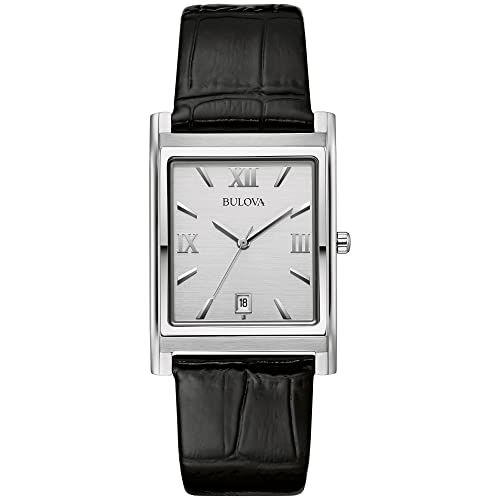
Bulova Men's Stainless Steel 3-Hand Calendar Date Quartz Watch with Black Leather Strap, Rectangle Dial Style: 96B107


Final judgement for the undecided
Shortlist by dimension first, movement second, and dial third, because that order matches how dissatisfaction actually arrives: a watch that overhangs the wrist annoys daily, a movement that mismatches a routine annoys weekly, and a dial detail annoys only when studied. Try the cardboard test, confirm the calibre reference in writing, and inspect one dial under hard light before committing. Treat water figures as splash protection, budget for straps as consumables, and keep the reference paperwork with the watch from the first day.
Choose the tier with open eyes as well. Heritage pieces sell provenance and finishing, mid range pieces sell verified specification and serviceability, and homage pieces sell a season of style. A buyer who knows which of those three goods they are purchasing rarely regrets the rectangle, because the design itself has already passed the longest field trial in watchmaking: a century of wrists, cuffs, and changing taste, met with the same two parallel rails.
When the rails sit flat, the numerals stand straight, and the cuff slides over without a whisper of resistance, a tank watch stops being a style reference and becomes simply the correct shape your wrist had been waiting for.