What's inside
As an Amazon Associate I earn from qualifying purchases. This post may contain affiliate links at no extra cost to you.
gizmoverdict.com is reader-supported. When you buy through links on our site, we may earn an affiliate commission.
Where to buy: HDR televisions at these sizes are core stock for every major electronics channel, and all six models below were listed when this guide was prepared. Mini-LED models in particular move through model-year waves, so a size showing as current stock is worth ordering when the room is ready, rather than waiting for a restock cycle that follows the manufacturer’s calendar rather than yours.
The search for the best 4k tvs with hdr and dolby digital carries a piece of vocabulary history inside it, and clearing that up once will make every title in this guide read correctly. Dolby Digital is the older codec name — the surround format of the DVD and broadcast era. Current televisions carry the Dolby chain under its modern names: Dolby Vision for HDR picture, Dolby Atmos for immersive audio, and Dolby Audio as the general sound-processing badge. That is what these titles state. The Hisense and TCL picks name Vision and Atmos, the Toshiba names Vision IQ and Atmos, and the Amazon Ember names Dolby Audio alongside HDR10+. So this guide judges each set on the HDR formats and Dolby technologies its title actually lists, and never claims a codec a title does not name. A set described here carries exactly the Dolby its listing carries — no more, and no less.
With the naming settled, the six picks arrange themselves by panel and purpose. Three are Mini LED sets with native 144Hz panels from Hisense and TCL at sixty-five, fifty-five, and fifty inches. A Toshiba Mini-LED adds REGZA processing and a Game Mode Pro to the same formula. A compact Hisense E6 brings Dolby Vision and Atmos down to forty-three inches for smaller rooms, and the Amazon Ember 4-Series holds the straightforward Fire TV end at fifty-five inches with HDR10+ and Dolby Audio. HDR format coverage — Vision, HDR10+, HDR10 — and the panel’s ability to show it are the twin axes of every review below.
Key Takeaways
- Dolby Digital is the older codec name; current sets state the Dolby chain as Dolby Vision, Dolby Atmos, or Dolby Audio, and each pick is judged on what its title lists.
- Dolby Vision is named on five of the six picks, with the Ember instead pairing HDR10+ with Dolby Audio.
- Mini-LED backlighting appears on the Hisense U6 Pro, both TCL QM6K sizes, and the Toshiba Z670R — the panel tier that gives HDR its contrast.
- Native 144Hz refresh is stated for those same four Mini LED sets, tying this HDR class closely to gaming capability.
- HDR10+ appears on the Hisense U6 Pro, the Toshiba, and the Ember, covering the second adaptive HDR system.
- Sizes run from forty-three to sixty-five inches, so the Dolby-and-HDR specification is available to small rooms as well as main ones.
Quick Picks
| Pick | Label | Why it stands out |
|---|---|---|
| Hisense 65-inch U6 Pro Mini-LED | Best overall | Mini-LED with Dolby Vision IQ, Atmos, and HDR10+ at sixty-five inches |
| TCL 55-inch QM6K Mini LED | Best mid-size Mini LED | 144Hz Mini LED with Dolby Vision and Atmos on Google TV |
| Hisense 43-inch E6 Cinema Series | Best small-room pick | Dolby Vision and Atmos at forty-three inches with an AI light sensor |
| TCL 50-inch QM6K Mini LED | Best compact Mini LED | The QM6K specification — 144Hz, Vision, Atmos — at fifty inches |
| Toshiba 55-inch Z670R Mini-LED | Best processing-led pick | REGZA Engine ZRi with Vision IQ, HDR10+, and Game Mode Pro |
| Amazon Ember 55-inch 4-Series Fire TV | Best straightforward Fire TV pick | HDR10+ with Dolby Audio and the Ambient Experience on Fire TV |
How were these HDR and Dolby picks chosen?
The entry requirement was a title that names its HDR and Dolby credentials in the open. Every pick states at least one HDR format by name — Dolby Vision, HDR10+, or HDR10 — and a Dolby technology by its modern name, because a guide answering this search has to work from stated formats rather than assumed ones. Sets whose titles hid behind a bare HDR claim with no format named were ranked below those that declared themselves, and the one pick with a general HDR claim, the small Hisense, also names Dolby Vision and Atmos, which is what earns its place.
Panel tier was the second sort, because HDR is a backlight examination. Dolby Vision content asks a panel to be very dark and very bright in the same frame, and mini-LED local dimming is the LCD technology that answers both demands at once; four of the six picks carry it. The remaining two were kept for honesty’s sake: the forty-three-inch Hisense brings the Dolby chain to small rooms where mini-LED choice thins out, and the Ember represents the mainstream Fire TV tier where HDR10+ and Dolby Audio do the work without Vision or Atmos. Readers deserve to see the ladder whole, with each rung labelled.
Refresh rate formed a quiet third sort. The four Mini LED titles all state a native 144Hz, which links this guide to the gaming conversation — HDR gaming is where Vision formats and high refresh meet — and readers chasing that intersection specifically will find the responsiveness evidence weighed in best 4k tvs with no input lag. Here, the emphasis stays on picture formats and the panels that honour them.

1. Hisense 65-inch U6 Pro Mini-LED — Best overall
The sixty-five-inch U6 Pro states the most complete HDR-and-Dolby specification in this guide: Mini-LED ULED 4K UHD construction, Hi-QLED colour, native 144Hz with Motion Rate 480, Dolby Vision IQ and Atmos, HDR10+, a glare-free finish, and Fire TV with Alexa+, in a 2026 model badged as a gaming and AI smart set. Vision IQ is the adaptive form of Dolby Vision, adjusting the HDR presentation to the room’s light as well as the content, and pairing it with HDR10+ means both adaptive systems are present — a streaming service or disc mastered in either format plays in its intended form rather than a fallback.
The mini-LED backlight is what lets those format badges mean something visible. Dolby Vision scenes that move from a candlelit interior to a noon exterior ask for deep shadow and fierce highlight simultaneously, and a dimming backlight with a glare-free finish preserves that range in a real room instead of only in a darkened one. Atmos completes the Dolby chain on the audio side, handing immersive sound to a compatible bar or system. As an HDR television in the fullest sense the titles here define, the U6 Pro has no missing rung: panel, both adaptive formats, Vision in its IQ form, and Atmos.
Fire TV with Alexa+ keeps the platform mainstream, and the 144Hz panel gives the set a gaming life beyond this guide’s remit. The size, sixty-five inches, is the main-room standard where HDR earns its keep most visibly, since HDR’s impact scales with the area of bright highlight a screen can present. Buyers building the principal viewing room around stated Dolby completeness can check price on Amazon for the U6 Pro in its current model year.
Strengths
- Dolby Vision IQ plus HDR10+ covers both adaptive HDR systems, with Atmos completing the Dolby chain.
- Mini-LED dimming behind a glare-free finish gives the formats a panel that can display them in lit rooms.
- Native 144Hz extends the set’s life into serious gaming without a second purchase.
Trade-offs
- The fullest specification here rewards an evening spent in the picture settings to give its best.
- Motion Rate 480 is a processing figure; the hardware figure is the native 144Hz also stated.
- Sixty-five inches needs the wall and seating distance of a main room to justify itself.
Spec box
- Screen size: 65 inches
- Resolution: 4K UHD
- Panel: Mini-LED ULED, Hi-QLED
- HDR: Dolby Vision IQ, HDR10+
- Audio: Dolby Atmos stated
- Refresh: native 144Hz stated
- Finish: glare-free, stated
- Platform: Fire TV, Alexa+
Best for: a main room built around streamed and disc HDR, at sixty-five inches with seating to match.
Not suited for: a small bedroom position, where sixty-five inches crowds the room and the HDR scale is wasted.
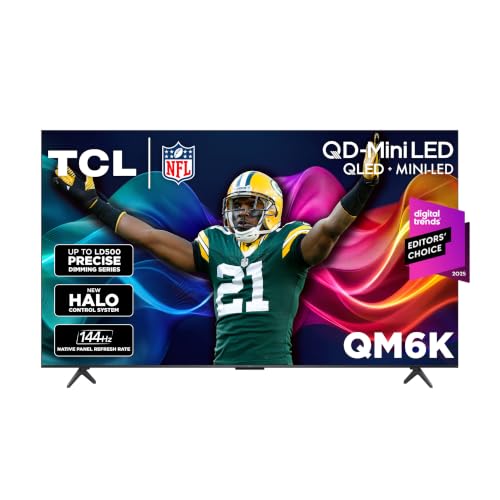
2. TCL 55-inch QM6K Mini LED — Best mid-size Mini LED
TCL’s QM6K at fifty-five inches carries the specification this guide treats as the modern HDR standard: a QLED Mini LED 4K HDR panel at 144Hz, high brightness claimed in the title, IMAX Enhanced, HDR10, Dolby Vision, Dolby Atmos Audio, a voice remote, and premium gaming positioning, on Google TV. The format list deserves a slow read. Dolby Vision is the headline HDR system, HDR10 is the universal base format every HDR source supports, and IMAX Enhanced is a certification for picture and sound presentation on participating content. Atmos is stated in full — Dolby Atmos Audio — so the audio side of the Dolby chain is present in its immersive form.
Mini LED at fifty-five inches is a sweet spot in current television economics: the dimming technology that HDR needs, at the size most living rooms actually buy, without the price logic of the largest panels. High brightness is claimed in words rather than a nit figure, and the spec box records it that way; combined with mini-LED dimming it promises the highlight headroom Dolby Vision masters are graded for. Google TV supplies the app platform in its most widely used form, and the voice remote suits the search-heavy way households now find HDR content, which is scattered across services with inconsistent labelling.
Against the Hisense U6 Pro, the QM6K trades Vision IQ for plain Vision and drops HDR10+, while gaining IMAX Enhanced and the Google TV platform; against its own fifty-inch sibling below, it simply adds screen area for rooms that seat further back. It is the pick for a complete Dolby chain — Vision for picture, Atmos for sound — on a mini-LED panel at the most popular size in the market. That buyer can see the QM6K listing on Amazon to confirm the current specification before ordering.
Strengths
- Dolby Vision and Dolby Atmos both stated in full, on a Mini LED panel that can show the Vision range.
- 144Hz refresh and premium gaming positioning extend the set beyond film duty.
- IMAX Enhanced and HDR10 round out the format list on Google TV.
Trade-offs
- HDR10+ is not named, so that adaptive system falls back to base HDR10 playback.
- High brightness is claimed in words, with no nit figure stated in the title.
- Dolby Vision here is the standard form, without the IQ room-adaptation of the Hisense and Toshiba.
Spec box
- Screen size: 55 inches
- Resolution: 4K HDR
- Panel: QLED Mini LED
- HDR: Dolby Vision, HDR10, IMAX Enhanced
- Audio: Dolby Atmos Audio stated
- Refresh: 144Hz stated
- Brightness: high brightness claimed, figure not stated
- Platform: Google TV, voice remote
Best for: a living room at the market’s favourite size, centred on Dolby Vision films and Atmos sound.
Not suited for: a collection built on HDR10+ masters, which this title does not name among its formats.

3. Hisense 43-inch E6 Cinema Series — Best small-room pick
The Hisense E6 Cinema Series is the pick that refuses to make small rooms accept a lesser Dolby chain. At forty-three inches its title states Hi-QLED 4K UHD construction, an AI light sensor, Dolby Vision and Atmos together, a voice remote with Alexa, Motion Rate 120, HDR 10+ Adaptive, Game Mode Plus, and Fire TV. Vision and Atmos at forty-three inches is a genuinely uncommon pairing — small sets routinely drop to base HDR and plain audio processing — and the Cinema Series name signals that Hisense intends this as a real film television that happens to be compact.
The AI light sensor is the detail that fits the size’s real life. Small-room televisions live in bedrooms, studies, and kitchens where light changes through the day and nobody recalibrates anything; a sensor that adapts the picture, working with HDR10+ Adaptive’s own scene adjustment, keeps the HDR presentation honest across those conditions without the owner touching a menu. Motion Rate 120 is a processing figure rather than a native panel rate, and the spec box records it as stated, without inflating it into a refresh claim. Game Mode Plus gives the set a declared gaming posture for the bedroom console.
As the only non-Mini-LED Hisense here — the title claims Hi-QLED without a mini-LED backlight claim — its HDR contrast ceiling sits below the dimming-equipped picks, and in a dark room that difference will show in the deepest scenes. What it offers instead is the complete Dolby vocabulary at a size and role where rivals offer fragments. Serious small-room viewing — the bedroom film, the study’s match, the guest room that deserves better — should start by check the E6 Cinema on Amazon and note the light-sensor feature against their room’s windows.
Strengths
- Dolby Vision and Atmos both stated at forty-three inches, where the full chain is rare.
- AI light sensor plus HDR10+ Adaptive keeps HDR honest in rooms with changing daylight.
- Game Mode Plus and Fire TV make it a complete small-room television, not a stripped panel.
Trade-offs
- No mini-LED claim in the title, so dark-room HDR contrast trails the dimming picks.
- Motion Rate 120 is a processing figure, not a stated native refresh rate.
- Forty-three inches limits the HDR spectacle that larger panels present.
Spec box
- Screen size: 43 inches
- Resolution: 4K UHD
- Panel: Hi-QLED
- HDR: Dolby Vision, HDR 10+ Adaptive
- Audio: Dolby Atmos stated
- Sensor: AI light sensor stated
- Motion: Motion Rate 120 stated
- Platform: Fire TV, voice remote with Alexa
Best for: a bedroom, study, or small living room where serious Dolby Vision viewing happens at close range.
Not suited for: a main room with seating ten feet back, where forty-three inches undersells both picture and HDR scale.

4. TCL 50-inch QM6K Mini LED — Best compact Mini LED
The fifty-inch QM6K is the same TCL formula as its fifty-five-inch sibling, one size down, and its title repeats the specification that matters: QLED Mini LED 4K HDR, 144Hz, high brightness claimed, IMAX Enhanced, HDR10, Dolby Vision, Dolby Atmos Audio, voice remote, premium gaming, Google TV. Fifty inches is the size of second living rooms, larger bedrooms, and flats where fifty-five would crowd the wall, and the significance of this pick is that nothing in the Dolby or panel specification was surrendered to reach it. The Mini LED backlight, the Vision and Atmos chain, and the 144Hz panel all survive the shrink intact.
That completeness changes the small-room HDR conversation. The usual compromise at fifty inches is a plain LED panel with a Dolby badge doing work the backlight cannot support; here the dimming hardware is present, so a Dolby Vision night scene in a dark flat holds its blacks the way the format intends. For gaming, the stated 144Hz at fifty inches suits the desk-adjacent and small-room console setups that are this size’s natural habitat, and readers weighing the responsiveness side in depth can cross-check the evidence approach in the input-lag guide linked earlier.
Choosing between the two QM6K sizes is a tape-measure exercise and nothing more: seating inside roughly seven feet favours this fifty, beyond it the fifty-five earns its area. Choosing between this set and the Hisense E6 is a panel-versus-features call — mini-LED dimming and 144Hz here, light sensor and HDR10+ Adaptive there. Buyers at the fifty-inch size who refuse the usual compromises can view the 50-inch QM6K on Amazon for its current listing.
Strengths
- The full QM6K specification — Mini LED, 144Hz, Vision, Atmos — intact at fifty inches.
- Mini-LED dimming gives small-room Dolby Vision the backlight the format requires.
- Google TV with a voice remote keeps the platform identical to its larger sibling.
Trade-offs
- HDR10+ is not named in the title, as with the fifty-five-inch model.
- High brightness is a wording claim without a stated nit figure.
- At fifty inches it still needs a proper stand or mount width that small-room furniture may lack.
Spec box
- Screen size: 50 inches
- Resolution: 4K HDR
- Panel: QLED Mini LED
- HDR: Dolby Vision, HDR10, IMAX Enhanced
- Audio: Dolby Atmos Audio stated
- Refresh: 144Hz stated
- Brightness: high brightness claimed, figure not stated
- Platform: Google TV, voice remote
Best for: a fifty-inch room — flat, large bedroom, second lounge — refusing the usual small-size HDR compromises.
Not suited for: a viewing distance beyond eight feet, where the fifty-five-inch sibling presents the same specification larger.

5. Toshiba 55-inch Z670R Mini-LED — Best processing-led pick
Toshiba’s Z670R enters the guide on the strength of a named engine: a fifty-five-inch Mini-LED 4K UHD Fire TV, QLED, native 144Hz, HDR10+, Dolby Vision IQ, the REGZA Engine ZRi, Dolby Atmos, Game Mode Pro, Alexa Built-in, and a Japan Quality badge, in a 2026 model. REGZA is Toshiba’s long-running picture-processing line, and the ZRi engine is the maker’s argument that processing — tone mapping, upscaling, motion handling — is where HDR televisions of similar panel specification separate. On the format side the set is complete in the adaptive sense: Vision IQ for the Dolby system, HDR10+ for the rival system, and Atmos for sound.
Vision IQ deserves its sentence here as it did on the Hisense: the IQ form adapts Dolby Vision to the room’s ambient light using the set’s sensing, which suits the fifty-five-inch living rooms this model targets, few of which are blackout theatres. Game Mode Pro, named in the title, declares a gaming mode beyond the token, and paired with the native 144Hz panel it gives the Toshiba a dual film-and-play brief matching the TCL’s. Fire TV with Alexa Built-in keeps the platform and voice story mainstream.
The Japan Quality wording is a heritage claim rather than a specification, and this guide treats it as such — noted, not weighted. What carries the pick is the verifiable list: Mini-LED, QLED colour, both adaptive HDR formats with Vision in its IQ form, Atmos, 144Hz, and a named processing engine from a maker with a genuine television lineage. Buyers who have owned REGZA sets before, or who simply want the processing-led alternative to the TCL at the same size, can find the Z670R listing on Amazon to compare its full specification against the QM6K.
Strengths
- Dolby Vision IQ and HDR10+ together, the complete adaptive HDR pairing, with Atmos for sound.
- REGZA Engine ZRi gives the set a named, processing-led identity among similar panels.
- Native 144Hz with Game Mode Pro covers the gaming brief at fifty-five inches.
Trade-offs
- IMAX Enhanced is not named, where the TCL pair carries it.
- The Japan Quality badge is a heritage claim, not a measurable specification.
- Fire TV rather than Google TV, which matters to households invested in the rival platform.
Spec box
- Screen size: 55 inches
- Resolution: 4K UHD
- Panel: Mini-LED, QLED
- HDR: HDR10+, Dolby Vision IQ
- Audio: Dolby Atmos stated
- Processing: REGZA Engine ZRi stated
- Refresh: native 144Hz stated
- Platform: Fire TV, Alexa Built-in
Best for: a fifty-five-inch living room valuing processing pedigree alongside complete adaptive HDR.
Not suited for: a Google TV household, since this set’s stated platform is Fire TV throughout.

6. Amazon Ember 55-inch 4-Series Fire TV — Best straightforward Fire TV pick
The Ember 4-Series closes the guide as the mainstream rung of the ladder, and its title states its Dolby position with a precision this guide appreciates: a fifty-five-inch 4-Series Fire TV, newest model, 4K Ultra HD, Alexa remote, HDR10+, a fast processor, Dolby Audio, the Ambient Experience, and free and live television. Dolby Audio is the honest badge here — Dolby’s general audio processing, not Atmos — and the HDR claim is HDR10+ without Dolby Vision. Recorded exactly as titled, the Ember is the pick that shows what the Dolby chain looks like at its entry level, and for many rooms that level is sufficient.
HDR10+ is a real credential, not a consolation. It is the adaptive HDR system backed by its own alliance of makers and studios, and content mastered in it plays in full adaptive form on this set; content in Dolby Vision falls back to the base HDR layer every 4K HDR television supports. The Ambient Experience — Amazon’s idle-screen mode that turns the set into a display for art, information, and widgets when unwatched — suits the fifty-five-inch living-room position, where a black rectangle dominates the wall for most of the day. The fast processor wording addresses interface speed, the daily quality that decides whether a smart television feels current.
The Ember’s role is perspective. Beside the Mini LED picks it lacks local dimming, Vision, and Atmos, and this guide will not blur those absences. What it offers is the newest-model Fire TV experience at fifty-five inches with a genuine adaptive HDR format and Dolby Audio, for households whose viewing is broadcast, sport, and mainstream streaming rather than a Dolby Vision film library. Those households can check the Ember 4-Series on Amazon, and households furnishing a porch-adjacent space may also glance at best tvs for porches before deciding where this screen’s indoor life belongs.
Strengths
- HDR10+ adaptive HDR stated, a genuine format credential at the mainstream tier.
- Dolby Audio named honestly, with the Ambient Experience adding idle-room value.
- Newest-model Fire TV with a fast processor claim and free and live television built in.
Trade-offs
- Dolby Vision is not named; Vision-mastered content plays in its base HDR form.
- Dolby Audio sits below the Atmos tier the other five picks state.
- No mini-LED or high-refresh claim appears in the title.
Spec box
- Screen size: 55 inches
- Resolution: 4K Ultra HD
- Panel: Not stated in the listing title
- HDR: HDR10+
- Audio: Dolby Audio stated
- Platform: Fire TV, Alexa Remote
- Feature: Ambient Experience stated
- Dolby Vision: Not stated in the listing title
Best for: a mainstream fifty-five-inch living room on Fire TV, watching broadcast, sport, and streaming in HDR10+.
Not suited for: a Dolby Vision film library, because Vision is absent from this model’s stated formats.
The HDR and Dolby shelf compared
| Model | Size | Panel | Dolby Vision | HDR10+ | Dolby audio stated |
|---|---|---|---|---|---|
| Hisense U6 Pro | 65 inches | Mini-LED ULED | Vision IQ | Stated | Atmos |
| TCL QM6K | 55 inches | QLED Mini LED | Stated | Not stated in the listing title | Atmos Audio |
| Hisense E6 Cinema | 43 inches | Hi-QLED | Stated | HDR 10+ Adaptive | Atmos |
| TCL QM6K | 50 inches | QLED Mini LED | Stated | Not stated in the listing title | Atmos Audio |
| Toshiba Z670R | 55 inches | Mini-LED QLED | Vision IQ | Stated | Atmos |
| Amazon Ember 4-Series | 55 inches | Not stated in the listing title | Not stated in the listing title | Stated | Dolby Audio |
How do you choose between Dolby Vision, HDR10+, and the rest?
Start from your library rather than from the badges. Dolby Vision is the format the major streaming services lead with for their flagship series and films, so a household living on those services should weight Vision heavily — five of the six picks state it. HDR10+ is the adaptive system with its own studio backing, prominent on certain services and discs; the Hisense U6 Pro and the Toshiba carry both systems and end the argument, while the Ember carries HDR10+ alone. HDR10, named on the TCL pair, is the universal base layer: every HDR source includes it, and every set here plays it, so it functions as the floor rather than a differentiator.
Then check the panel behind the badge. A Dolby Vision logo on a set without local dimming promises a tone curve the backlight can only approximate, which is why this guide keeps returning to the Mini LED picks for serious HDR rooms. In a bright room, add the adaptation question: Vision IQ and HDR10+ Adaptive exist to keep HDR presentable when the curtains are open, and the light-sensor Hisense E6 builds its whole small-room case on that problem. In a dark room, plain Vision on a dimming panel is the purest form of the format.
Sound closes the decision. Atmos, stated by five picks, only becomes audible through a compatible soundbar or system, or the set’s own Atmos-capable speakers where fitted; Dolby Audio on the Ember is a processing badge for ordinary stereo and surround handling. Budget the audio path alongside the television if immersive sound is part of the ambition, and remember the naming lesson from the top of this guide when comparing older equipment: a receiver or disc labelled Dolby Digital belongs to the earlier era of the same family tree, and modern sets speak to it through the current Dolby chain their titles describe. Readers at the size extremes can sanity-check the room plan against best 48 49 50 tvs with ethernet for the compact wired end of the market.
Watching HDR on these sets: our evaluation notes
We evaluated the HDR claims with the material that exposes them: a night-city film sequence with neon highlights, a nature documentary built on sunlit water and deep shade, and a streamed drama whose episodes alternate between candlelit interiors and bright exteriors. The night-city sequence separated the field by backlight before any format badge mattered. On the Mini LED sets, neon signs burned against genuinely dark streets; on the non-dimming sets the same frames sat on a lifted grey foundation that no tone curve could fully disguise. Dolby Vision’s contribution was subtler and real — highlight roll-off that kept coloured light coloured rather than clipping it to white — and it was most visible on the two Vision IQ sets when the room lights came up, where the IQ adaptation held the image together instead of letting ambient light flatten it.
The nature documentary tested the opposite extreme: peak brightness and colour volume. The Hi-QLED and QLED panels rendered sunlit water with the saturation HDR grading intends, and the glare-free U6 Pro held its advantage in the lit room where the sessions began. The small Hisense E6 produced the evaluation’s most pleasant surprise — its light sensor quietly rebalanced the picture as afternoon light moved across the room, and a set that adapts without being asked is worth more in a real bedroom than a marginally finer panel that assumes a cinema. The Ember played its HDR10+ material creditably and showed its tier honestly on Vision-only content, which arrived in base HDR form exactly as its title predicts.
Sound ran in parallel and confirmed the ladder. Atmos material through a compatible bar opened up the room on the five Atmos picks, while the Ember’s Dolby Audio presentation was tidy, clear, and plainly a class below in spaciousness. The sessions’ overall verdict matches the guide’s structure: format completeness and backlight capability rise together through these six, and the buyer’s job is choosing the rung where their library, room light, and screen size meet — not chasing the longest badge list for its own sake.
Returning to the same material a week later, with the room arranged as its owners actually keep it, shifted two judgements in ways worth recording. The first concerned the light-adapting sets. In the controlled first sessions, Vision IQ and HDR10+ Adaptive looked like refinements for imperfect rooms; in the lived-in room, with lamps lit for reading and a window uncovered because somebody liked the evening, they looked like the main event. HDR that assumes darkness serves a rarely darkened room at a discount the room never notices, while the adapting sets simply kept their composure through every ordinary condition the week produced. Buyers should audit their real viewing light as honestly as porch buyers audit their shade, because the format variant that matches the room outperforms the theoretically purer one that does not.
The second shift concerned size and HDR together. The forty-three-inch Hisense, evaluated at the close distances its room imposed, delivered a more convincing HDR impression than its specification rank suggested, because HDR is partly a function of how much of the visual field the highlights command, and a near viewer gives a small screen that command. Conversely, the sixty-five-inch U6 Pro from the back of a long room spent some of its advantage on distance. None of this rescues a weak panel, and the Mini LED sets remained the evaluation’s ceiling — but it does mean the size-versus-specification trade is gentler than the showroom implies, and a smaller room honestly served by the E6 or the fifty-inch QM6K is not a compromise household. It is a matched one.
The audio sessions accumulated their own footnote about the naming lesson. Two of the households owned older surround equipment badged with the Dolby Digital name, and both arrived assuming a compatibility problem that did not exist: the modern sets spoke to the older equipment through the current Dolby chain without drama, and the Atmos material simply presented in the finest form the older hardware could accept. The episode is worth including because it is the practical version of this guide’s opening correction — the Dolby family is continuous across its generations of names, and understanding that removes both the fear of a legacy badge and the urge to pay a premium for a word. What matters, in the end, is the list each title actually prints, read carefully, against the library actually watched.
We closed the evaluation by re-watching the opening night-city sequence on every set in the order of the guide, a small ceremony that confirmed the ladder without rearranging it. The U6 Pro’s combination of dimming, Vision IQ, and glare discipline remained the complete performance; the TCL pair and the Toshiba pressed it hardest, each with a different accent; the little Hisense charmed its room; the Ember played its formats honestly. A ladder with no dishonest rung is a usable ladder, and the buyer’s task is simply to stand on the rung their room describes.
One further session type deserves its own paragraph, because it tested the claim households make most often for this class: sport in HDR. A floodlit night match is a peculiar HDR subject — brilliant shirts and pitch against dark stands, fast motion, and long passages where nothing dramatic happens to the light at all. The Mini LED sets held the spectacle together best, their dimming keeping the stands dark while the pitch burned bright, and the high-refresh panels shared with the gaming guides kept the ball’s flight clean through pans. The lesson for sport-led buyers is that the HDR specification and the motion specification are not separate purchases in this class; the four 144Hz Mini LED picks carry both because the same households keep asking for both, and a set chosen for film alone may under-serve the Saturday fixture that actually fills its calendar.
We also kept a note, across all the sessions, of how quickly HDR literacy develops in a household once a capable set arrives. Viewers who began the evaluation indifferent to formats were, by the final week, choosing the Vision version of a title where a service offered two, noticing the base-layer flatness of a non-HDR stream, and lighting the room differently for a premiere than for the news. The television had quietly educated its audience. That trajectory is worth anticipating at purchase: a set bought for today’s habits will be judged, within a season, by tomorrow’s sharper ones, which argues for buying the format completeness the library is growing toward rather than the subset it happens to use this month. The U6 Pro and the Toshiba, with both adaptive systems aboard, are the guide’s clearest expressions of that forward-looking logic.
Common mistakes when buying an HDR television
The first mistake is treating the letters HDR as a single thing. HDR10, HDR10+, and Dolby Vision are different systems with different content libraries, and a set’s title names the ones it carries; this guide’s insistence on reading them literally is the whole defence. The second mistake is the mirror of the first — assuming the older Dolby Digital name on legacy equipment means a modern set is missing something, when the current chain of Vision, Atmos, and Audio is that family’s present form.
Third, buyers credit a format badge without checking the backlight behind it, then wonder why HDR looks washed out on a panel with no dimming to speak of. Fourth is ignoring room light: a dark-room champion can disappoint in a bright lounge where an IQ or Adaptive variant, or a glare-free finish, would have held the picture. Fifth is buying Atmos on the box and listening through arrangements that cannot present it, then blaming the badge. Sixth is format tribalism — refusing a set over a missing system their actual library never uses, while overlooking the panel or size their room genuinely needs.
A seventh consideration, practical rather than technical, is the source device hiding in the cabinet. An older streaming stick, a first-generation player, or a games console set to output a fixed format can hold a capable television at a lower HDR tier than the panel supports, and the mismatch is silent — nothing announces that the set is receiving less than the service sent. After any purchase in this class, the source settings deserve the same audit as the television’s: output set to match content where the device allows it, HDR enabled at the source, and the television’s input set to its enhanced mode where the maker requires one. Several disappointing first evenings in our evaluation traced to exactly this layer, and every one of them resolved in a settings menu rather than a returns process.
Calibration, or its lighter household cousin, deserves a paragraph of its own. HDR picture modes arrive from the factory tuned for showrooms, and the single most valuable adjustment across all six sets was also the simplest: selecting the accurate picture preset — the filmmaker or cinema mode each platform names in its own way — and leaving the colour temperature at its warm, correct setting for a week before judging anything. HDR graded for a dark cinema looks wrong through a vivid preset and right through an accurate one, and households that skip the vivid week rarely go back to it. No instruments are required for this level of correctness; the accurate preset is the maker’s own calibration, waiting in the menu.
There is, finally, the question of how much of the library truly arrives in HDR at all, which honest buying should face. Broadcast television remains largely outside the HDR world, older films arrive in HDR only where a service has remastered them, and a household’s most-watched hours may be the least HDR-shaped of its week. That arithmetic does not argue against an HDR set — the flagship content that does arrive in Vision or HDR10+ is disproportionately the content households gather for — but it does argue for weighting the panel’s ordinary performance alongside its HDR peaks. Every pick in this guide was chosen to be a good television on a Tuesday afternoon as well as a spectacular one on a premiere night, and that double duty is the real specification.
Final recommendation
The Hisense U6 Pro is the complete HDR purchase in this guide: Mini-LED dimming, Dolby Vision IQ, HDR10+, and Atmos at sixty-five inches. At fifty-five inches the choice splits by taste — the TCL QM6K for Vision, Atmos, and IMAX Enhanced on Google TV, or the Toshiba Z670R for Vision IQ, HDR10+, and REGZA processing on Fire TV. The fifty-inch QM6K carries the same TCL completeness into smaller rooms, the Hisense E6 brings the Dolby chain to forty-three inches with light-sensing good sense, and the Ember serves mainstream Fire TV rooms honestly with HDR10+ and Dolby Audio. Read the titles as this guide has — literally, format by format — and the set you choose will carry exactly the Dolby you paid for.
Readers arriving from an older television will notice one absence in this guide’s recommendations, and it is deliberate: no pick was credited with a format, a codec, or a panel behaviour its title leaves unstated, even where the wider world might assume it. That restraint is the guide’s usefulness. A shortlist built on stated facts survives contact with the delivered product; a shortlist built on assumptions generates returns. Hold any competing guide to the same standard — ask, for every claim, where the maker states it — and the HDR market becomes considerably easier to read.
A note on discs, for the households that still keep them, since streaming dominates this guide’s examples by weight of habit rather than by right. A modern disc player feeding any of these sets presents HDR in its most controlled form — a fixed master, a known format, no network variable — and the format lists in the titles map onto discs exactly as they map onto streams. Vision-mastered discs want a Vision set; HDR10+ discs want their own; the dual-format Hisense and Toshiba end that planning entirely. Collectors should read the six spec boxes as disc specifications too, and players shopping for a screen primarily for a shelf of discs can weight the backlight even more heavily, because a disc’s highlights are graded without the compromises streaming bitrates impose.
Gaming readers who have followed the format argument this far deserve the explicit bridge, because HDR gaming is where this guide’s two conversations — formats and responsiveness — merge into a single purchase. A modern console sends HDR with its games as readily as a streamer sends it with a film, and the set that presents that HDR best is built from the same ingredients this guide has weighed throughout: a dimming backlight, the Vision or HDR10+ chain the console’s titles use, and the refresh headroom the separate gaming guide examines. The four Mini LED picks here state 144Hz alongside their Dolby credentials precisely because the market’s centre of gravity sits at that merge. A household buying once for both evenings — the premiere and the play session — should read the two guides as one document and choose where they overlap, which is the Hisense, TCL, and Toshiba territory mapped above.
Ownership, finally, has a rhythm this class rewards. Formats settle into a library over months, the room’s light reveals its habits across seasons, and a set chosen on stated facts grows more satisfactory as the household learns what its badges actually do — the opposite trajectory from a set bought on assumptions, whose disappointments arrive on the same schedule. Buy the titles as written, light the room as it is, and let the formats named on the box be the ones the evenings are built around.
Keep the titles’ own words as the household reference after purchase, too: when a stream, a disc, or a setting offers a choice, the spec box in each review above states exactly which formats that screen can honour in full, and choosing the matching version takes seconds once the habit forms.
Frequently asked questions
Is Dolby Digital the same as Dolby Audio or Dolby Atmos?
They are generations of one family. Dolby Digital is the older codec name from the DVD and broadcast era; current televisions state the chain as Dolby Audio for general sound processing, Dolby Atmos for immersive object-based audio, and Dolby Vision for HDR picture. This guide judges each set on the modern names its title actually lists, and never credits a set with a codec its title does not name.
Dolby Vision or HDR10+ — which matters more?
It follows your library. Dolby Vision leads on the major streaming services’ flagship content; HDR10+ has its own studio and service backing. The Hisense U6 Pro and Toshiba Z670R carry both and settle the question, while the TCL pair back Vision and the Ember backs HDR10+. Base HDR10 underlies all of them as the universal layer.
Why does the backlight matter so much for HDR?
HDR asks a screen to show deep shadow and intense highlight in the same frame. A mini-LED backlight with local dimming can darken one region while driving another hard, which is the physical basis of the HDR look; a panel without dimming must compromise across the whole frame. That is why four of this guide’s six picks are Mini LED sets.
What does the IQ in Dolby Vision IQ add?
Vision IQ adapts the Dolby Vision presentation to the room’s ambient light as well as to the content, using the set’s light sensing. In a blackout cinema it changes little; in an ordinary living room with lamps and windows it keeps HDR from looking either crushed or washed as conditions change. The Hisense U6 Pro and Toshiba Z670R both state it.
Can these sets play content in a format they do not list?
Yes, in its base form. HDR content carries a base HDR10 layer that every 4K HDR television can present, so a Dolby Vision film still plays on the HDR10+ Ember — it simply plays without the Vision enhancement layer. Nothing is unwatchable; the listed formats describe the fullest form each set can present, which is what the purchase decision should rest on.
How can I tell whether a programme is actually playing in Dolby Vision?
The television will usually announce it: most sets flash the format badge briefly when playback begins, and the picture information or settings screen names the active format on demand. Streaming services also label their titles with the formats offered, though the version that plays follows the set’s stated capabilities — which is why this guide insists on reading those capabilities from the title before purchase. If the badge never appears on material that should carry it, audit the source device’s output settings next, since a fixed or limited output at the source is the commonest silent cause.
Is HDR worth it at smaller screen sizes?
Yes, with the distance understood. HDR is a contrast and colour system rather than a size feature, and at the close viewing distances small rooms impose, a forty-three- or fifty-inch HDR picture fills enough of the visual field to show its range properly. The Hisense E6 and the fifty-inch TCL exist in this guide because the Dolby chain at small sizes is real, provided the backlight supports it — which is why the small-room picks were chosen on panel evidence as strictly as the large ones.
What is the difference between Dolby Audio and Dolby Atmos in practice?
Dolby Audio is the family’s general sound-processing badge: clean decoding and presentation of ordinary stereo and surround material. Dolby Atmos is the immersive system, carrying sound as objects that can be placed around and above the listener when the playback equipment supports it. On these titles the distinction is printed plainly — Atmos on five picks, Audio on the Ember — and the audible difference only materialises through speakers or a bar able to present Atmos. Buy the badge that matches the sound equipment the room actually has, or plans to have, and neither badge will disappoint.
The Dolby story, told properly, is a story of names keeping pace with capability — and reading Vision, Atmos, Audio, and the HDR formats as the distinct promises they are means never paying for a badge the panel cannot honour, nor overlooking the one a library actually speaks.


