What's inside
- Key Takeaways
- Quick Picks
- How Did We Rank Kits Against Bare Pairs for a 2008 GT?
- Why Does the 6×8 and 5×7 Confusion Refuse to Die?
- How Do the Six Compare Side by Side?
- How Do You Swap Mustang Door and Panel Speakers Without Casualties?
- What Mistakes Do 2008 Mustang GT Owners Make With Speakers?
- How Should You Judge the Result on the Road?
- What Should You Diagnose Before Spending Anything on a 2008 GT?
- How Do These Picks Differ in Voice, Not Just in Fit?
- What Does the First Year of Ownership Teach?
- What If Your GT Has the Factory Premium Audio Fitted?
- Where Do Speakers Sit in a Sensible Staged Upgrade?
- How Do You Read a Speaker Listing the Way an Installer Would?
- Final Recommendation
- Frequently Asked Questions
- Related Guides
As an Amazon Associate I earn from qualifying purchases. This post may contain affiliate links at no extra cost to you.
gizmoverdict.com is reader-supported. When you buy through links on our site, we may earn an affiliate commission.
Where to buy: Amazon stocks every kit and pair reviewed below. The names in the Quick Picks table and the review headings link to the precise listings whose titles supplied the sizes, year ranges and the one maximum-power figure quoted in this guide, so verify your door and rear-panel locations against the listing you open.
The best replacement speakers for 2008 Mustang GT owners start from a fitment fact that simplifies everything else: the 2005–2014 Mustang generation speaks one speaker language, and that language is the oval 6×8 — the size Ford also catalogues as 5×7, which is why both numbers keep appearing in the same listings. Your 2008 GT sits squarely inside that generation, so the two Kicker kits titled for Ford Mustang 2005–14 fit your car by their own printed claim, the Harmony Audio set titled for 2005–2009 fits it too, and the three universal oval pairs earn their places by size rather than by name. No pick in this guide requires cutting a door, drilling a panel or abandoning the factory wiring, because a 2008 GT speaker swap is one of the friendliest jobs in car audio when the size is right.
What actually fails in a seventeen-year-old Mustang is worth naming. The factory oval speakers were built to a price, their surrounds harden with heat cycles, and the GT’s cabin — a loud car even by sports-coupe standards, with exhaust and road noise competing at cruise — exposes tired cones mercilessly. Owners describe the same symptoms in different words: a buzz on bass-heavy tracks, a top end that turned to sand, a rear panel that seems quieter than it used to be. Replacement, not amplification, is the correct first answer to all three, and this guide is ordered to help you choose how much replacement to buy: a full kit with harness thinking done for you, or a well-chosen pair at a time.
Key Takeaways
- Your 2008 GT belongs to the 2005–2014 generation, and its factory locations take the oval size listed as 6×8 or 5×7 depending on the brand’s labelling habit.
- Two Kicker kits are titled for Mustang 2005–14 and cover front door and side panel locations; they appear here as two listings of the same concept, not two different tiers.
- The Harmony Audio set is titled for 2005–2009 and mentions a harness in its title — the only pick that puts wiring help in its own name.
- Only one pick states a power figure in its title: the Pioneer TS-A6881F, at 350 watts maximum — a peak figure, not a continuous rating.
- The Rockford Fosgate and JBL pairs name no vehicle at all, so their claim on your GT rests entirely on their oval sizes matching the factory openings.
- Replacing in matched pairs, front first, preserves the stereo image your factory system was balanced around.
Quick Picks
| Pick | Badge | Why it is here |
|---|---|---|
| KICKER Front Door and Side Panel 6×8 Speakers Kit for Ford Mustang 2005-14 | Best full-car kit | A Mustang-titled kit covering front door and side panel locations across the whole 2005–14 generation, your 2008 included by name. |
| KICKER Front Door and Side Panel 6×8 Speakers Kit for Ford Mustang 2005-14 | Alternate kit listing | The same door-and-panel 6×8 kit concept under a second listing, useful when the first listing’s stock or seller terms disappoint. |
| Harmony Audio Fits Ford Mustang 2005-2009 5×7 6×8 Speakers with Harness | Harness included in title | A Mustang set for 2005–2009 that names both oval sizes and a harness in its title, aimed squarely at your car’s exact years. |
| Rockford Fosgate P1572 Punch 5×7 2-Way Coaxial Full Range Speakers (Pair) | Brand-pair alternative | A 5×7 two-way coaxial pair from Rockford Fosgate’s Punch line, sized for the Mustang’s oval openings without claiming the car by name. |
| PIONEER A-Series Standard TS-A6881F 6×8 4-Way Coaxial Speakers 350W Max | Only stated power figure | A four-way 6×8 coaxial pair whose title states 350 watts maximum, for owners who want the multi-driver layout and a printed number. |
| JBL Stage 38627 | Quiet-title option | A JBL Stage-series entry whose title states neither size nor power, included with its verification burden stated plainly rather than hidden. |
How Did We Rank Kits Against Bare Pairs for a 2008 GT?
We gave the vehicle-specific kits the top of the guide because fitment certainty is the scarcest resource in a speaker purchase. A kit titled for Mustang 2005–14 has already answered the questions a universal pair leaves open: does the oval match the opening, does the mounting pattern land on the factory holes, does the connector situation resolve without improvisation. For a 2008 GT — a car old enough that its previous owners may have left surprises inside the doors — removing those unknowns is worth more than a spec-sheet flourish.
The bare pairs were then judged on the honesty of their titles. The Rockford Fosgate P1572 states its size, its two-way coaxial layout and its pair format, which is everything a size-based purchase needs to declare. The Pioneer TS-A6881F states size, a four-way layout and a maximum power figure, clearly labelled as a max. The JBL Stage 38627 states almost nothing, and we have kept it in the guide with that silence flagged in its spec box rather than filling the gap from other JBL models, because a Stage badge and a famous name are not specifications.
We also weighted the harness question. A 2008 car’s factory connectors have survived seventeen years of door slams; a set that includes harness help, as the Harmony title promises, removes the temptation to cut and splice ageing wires. Kits and harnessed sets therefore outrank bare pairs for most owners, even when a bare pair’s brand carries more glamour.
Why Does the 6×8 and 5×7 Confusion Refuse to Die?
Because both labels describe the same oval family, and brands choose between them by tradition rather than by tape measure. Ford’s documentation habitually calls these openings 5×7; the car-audio aftermarket habitually sells the speakers that fill them as 6×8, the difference being whether the measurement flatters the mounting flange or the cone opening. A speaker titled 6×8 and a speaker titled 5×7 are, in this application, suitors for the same hole in your door. The Harmony listing says the quiet part out loud by printing both numbers in one title: 5×7 6×8, same set, no contradiction.
The practical rule follows. Shop your Mustang by the oval family, not by one sacred number, and verify the mounting pattern and depth on the listing rather than agonising over which label a brand preferred. What does not fit is a round 6.5-inch speaker dropped in without an adapter plate, and a 6×9 — the larger oval of older Fords — which belongs to different openings entirely. Owners who internalise the 5×7-equals-6×8 equivalence stop fearing half the catalogue and start comparing the things that actually differ: kit scope, harness help, driver layout and brand voicing.

KICKER Front Door and Side Panel 6×8 Speakers Kit for Ford Mustang 2005-14 — Best full-car kit
This is the purchase for a GT whose speakers are tired everywhere at once. The title promises a front door and side panel kit in 6×8, built for Ford Mustang 2005–14, which places your 2008 in the middle of the stated range rather than at its ragged edge. Covering both location pairs in one kit matters more than it first appears: front doors carry the main stage in this car, the side panels fill the rear, and replacing only the fronts leaves a worn rear pair dragging behind fresh drivers like a backing band a half-step flat. A matched kit restores the car as a system.
Kicker’s long history with Ford oval applications shows in the kit philosophy. Nothing here asks you to become an installer; the value proposition is that the Mustang-specific decisions — size, location coverage, fitment for this generation — were made by the manufacturer before the box reached you. What the title does not state is a power figure, and we have not supplied one from Kicker’s wider catalogue. On factory head-unit power, which is how most 2008 GTs still run, that omission is academic: the kit’s job is clarity and survival, not a wattage contest.
Expect the character change to be largest at cruise. The GT’s exhaust note is part of the car’s charm and part of its audio problem; factory speakers smeared by years of heat lose the midrange definition that lets music sit alongside a V8 rather than underneath it. Fresh matched ovals return that definition, so a guitar riff reads as a riff at seventy miles an hour instead of as texture. If your Mustang still runs its original speakers, this kit is the reference against which the rest of this guide should be measured.
- Fitment years: Ford Mustang 2005–14, per the listing title — includes the 2008 GT
- Speaker size: 6×8 oval
- Locations covered: front door and side panel
- Power handling: Not stated in the listing title — verify with KICKER documentation
- Kit scope: multi-location speaker kit
Strengths
- Refreshes front and rear locations together, keeping the car’s balance matched
- Mustang and year range printed in the title — no size-only guesswork
- Kit format removes the adapter and bracket questions a bare pair leaves open
Trade-offs
- The largest purchase in this guide; overkill when only one pair has actually failed
- No power figure in the title for owners who like a number before they commit
- Committing to both locations means a longer single installation session
Best for: a 2008 GT still running original speakers in every location, ready for one matched refresh. Not suited for: a single failed door speaker, or a car whose audio budget is earmarked for an amplifier first.

KICKER Front Door and Side Panel 6×8 Speakers Kit for Ford Mustang 2005-14 — Alternate kit listing
Two listings, one kit concept, and a deliberate decision in this guide to show both rather than pretend a difference. This second Kicker listing repeats the first pick’s promise almost verbatim — front door and side panel, 6×8, Ford Mustang 2005–14 — under a different ASIN. Parallel listings arise from different sellers, warehouse pools and bundle revisions, and for a seventeen-year-old car’s parts they are genuinely useful: when one listing drifts to an inflated third-party price or shows a delivery date measured in weeks, the other often sits at the sensible price with stock.
Shop the pair of listings the way you would shop two quotes from two fitters for identical work. Compare what the box contains, line by line, on each detail page; a revision can alter included hardware even when the headline promise is unchanged. Compare the seller, too, since a kit for a car you intend to keep deserves a seller whose returns process you trust. What you should not do is construct a hierarchy between the two listings from their titles, because the titles offer no hierarchy to construct — same locations, same size, same years, same brand.
For the 2008 GT specifically, either listing lands identically: your car is mid-range in the stated 2005–14 span, squarely in the generation the kit was drawn for. The choice between them is logistics, not engineering, and treating it that way saves the hours owners sometimes burn hunting for a phantom specification difference.
- Fitment years: Ford Mustang 2005–14, per the listing title — includes the 2008 GT
- Speaker size: 6×8 oval
- Locations covered: front door and side panel
- Power handling: Not stated in the listing title — verify with KICKER documentation
- Listing note: second listing of the same kit concept as the pick above
Strengths
- A second route to the same Mustang kit when the first listing’s price or stock misbehaves
- Identical stated fitment, so switching listings carries no compatibility risk
- Lets you choose by box contents and seller quality instead of by scarcity panic
Trade-offs
- Buys no capability beyond the first listing; it is an alternative door, not a higher tier
- The titles give no clue which listing’s bundle is fresher — detail pages must be read
- Owners must resist imagining a specification gap that the listings never claim
Best for: a GT owner who wants the Kicker kit and found the first listing unavailable, overpriced or oddly bundled. Not suited for: an owner seeking a meaningfully different upgrade from the first pick.

Harmony Audio Fits Ford Mustang 2005-2009 5×7 6×8 Speakers with Harness — Harness included in title
Harmony Audio’s title is the most obliging in this guide: it names the car, narrows the years to 2005–2009, prints both oval labels — 5×7 and 6×8 — and adds the words with harness. Your 2008 GT is not merely inside that range; it is near the centre of it. The harness mention deserves its headline status. In a car of this age, the factory speaker connectors and the short wire tails behind them have endured thousands of heat cycles and door slams, and the difference between a plug-in harness and a cut-and-splice job is the difference between a reversible afternoon and a permanent modification you must explain to the next owner.
The dual size labelling quietly solves the confusion covered earlier in this guide. Harmony is telling you, in the title itself, that the 5×7 your Ford documentation mentions and the 6×8 the aftermarket advertises are the same application. That candour, plus the tighter year range, makes this set the lowest-anxiety purchase in the guide for an owner who wants the decisions pre-made but does not need the Kicker kits’ full multi-location scope in one box.
Consider this set the craftsman’s middle path: vehicle-specific like the kits, bounded like a pair purchase, and respectful of your car’s wiring. Its title states no power figure, and in the context of a factory-powered 2008 GT that matters little; what it states — car, years, sizes, harness — is precisely the information that determines whether a Saturday installation ends in music or in a forum post.
- Fitment years: Ford Mustang 2005–2009, per the listing title — includes the 2008 GT
- Speaker size: 5×7 / 6×8 oval (both labels printed in the title)
- Harness: included, per the listing title
- Power handling: Not stated in the listing title — verify with Harmony Audio documentation
- Kit scope: speaker set with harness
Strengths
- The tightest year range in the guide, centred on your car’s generation slice
- Harness included by title, sparing seventeen-year-old factory wiring from the cutters
- Both oval labels printed, ending the 5×7-versus-6×8 hesitation at the source
Trade-offs
- Year range stops at 2009, so later S197 owners must look at the Kicker kits instead
- No stated power figure for owners who plan around numbers
- A set rather than a full multi-location kit; total-car refreshes may need two purchases
Best for: a 2008 GT owner who values a plug-in harness and exact-year fitment over brand glamour. Not suited for: 2010–2014 Mustangs, which fall outside the title’s stated years.
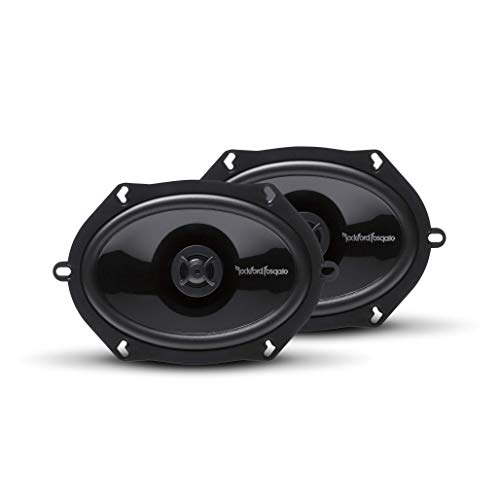
Rockford Fosgate P1572 Punch 5×7 2-Way Coaxial Full Range Speakers (Pair) — Brand-pair alternative
Rockford Fosgate’s Punch line has been the default answer to tired factory ovals for a very long time, and the P1572 states its case with unusual completeness for a universal pair: 5×7 size, two-way coaxial layout, full-range intent, sold as a pair. Nothing in the title mentions your Mustang, and this guide will not pretend otherwise — the fit argument is the oval itself, the same 5×7/6×8 family the Mustang’s doors and panels were built around. That makes the P1572 a size-verified purchase rather than a vehicle-verified one, a distinction worth keeping but not worth fearing, because the oval standard is exactly what makes cross-application pairs like this workable.
The two-way coaxial layout is the conservative, correct architecture for a factory-powered car: a woofer handling the body of the music and a tweeter mounted at its centre restoring the top end that dead factory speakers surrender first. In a GT, where the listening happens over exhaust and tyre noise, that restored top end is not audiophile garnish — it is where consonants, cymbals and the attack of a guitar live, and it is the first thing a driver notices on the drive home.
Buy this pair when one location has failed or faded and the rest of the car can wait, or when brand trust matters more to you than kit convenience. Buy two pairs, eventually, if the whole car is going the same way; staged replacement in matched pairs keeps the stereo image honest in a way that one heroic front pair and two ancient rears never will.
- Fitment years: Not stated in the listing title — verify with Rockford Fosgate documentation
- Speaker size: 5×7 oval (same family as 6×8 in Mustang applications)
- Layout: 2-way coaxial, full range
- Format: pair
- Power handling: Not stated in the listing title — verify with Rockford Fosgate documentation
Strengths
- A complete, honest title: size, layout and pair format all declared
- Punch-line voicing suits a loud cabin that needs presence more than delicacy
- Pair format supports staged, budget-paced replacement location by location
Trade-offs
- No vehicle named in the title; the fit rests on the oval size alone
- No harness promise, so connector solutions are your own homework
- One pair at a time can leave a mismatched cabin if you stop halfway
Best for: a GT owner replacing one faded location with a trusted brand’s oval pair. Not suited for: an owner who wants vehicle-specific kit certainty in a single box.

PIONEER A-Series Standard TS-A6881F 6×8 4-Way Coaxial Speakers 350W Max — Only stated power figure
Pioneer’s A-Series entry is the extrovert of this guide. Its title declares a 6-inch by 8-inch four-way coaxial design and prints the only power number anywhere in the pool: 350 watts max. That last word carries the meaning. A maximum or peak figure describes what the speaker can survive in brief moments, not what it consumes continuously, and it must never be read as a promise that your factory head unit should — or could — feed it anything like that number. Read correctly, the figure simply tells you the speaker will not be the fragile element in a factory-powered system, which is all a 2008 GT owner needs from it.
The four-way layout is Pioneer’s long-standing answer to the oval’s dilemma: one cone must cover a wide range, so additional smaller drivers divide the upper frequencies among themselves. Whether that division flatters your music is a matter of taste — some listeners hear sparkle, others hear emphasis — but in a noisy GT cabin the extra top-end energy rarely goes unappreciated, and Pioneer’s A-Series tuning is deliberately lively rather than neutral. Against the two-way Rockford above, this is the pair for the driver who found factory sound not just tired but dull.
Fitment, as with the other universal pairs, is a size argument: 6×8 is the Mustang’s oval, full stop. The title’s precision about everything except vehicle application is typical of Pioneer’s catalogue style, and the verification step is the same one this guide keeps prescribing — confirm mounting depth and pattern on the detail page against your door, then proceed with confidence.
- Fitment years: Not stated in the listing title — verify with Pioneer documentation
- Speaker size: 6 x 8 inches
- Layout: 4-way coaxial
- Power handling: 350W max, as stated in the listing title (peak figure, not a continuous rating)
- Series: Pioneer A-Series Standard
Strengths
- The guide’s only printed power figure, clearly labelled as a maximum
- Four-way layout brings extra high-frequency energy to a noisy cabin
- A-Series tuning livens up music that factory speakers had flattened
Trade-offs
- Peak wattage invites misreading; it is headroom, not a feeding requirement
- No vehicle in the title — fitment rests on the 6×8 oval alone
- A lively top end may fatigue on long, loud motorway stretches
Best for: a GT driver who wants the brightest, most energetic pair in the guide and understands what a max rating means. Not suited for: a listener who prefers a relaxed, neutral balance on long drives.

JBL Stage 38627 — Quiet-title option
This is the shortest title in the guide and the review must respect what that means. JBL Stage 38627: a respected brand, a recognised series, a model number — and nothing else. No size, no layout, no power figure, no vehicle. This guide includes the pick because the pool verified it for this keyword, but it refuses to decorate the listing with specifications borrowed from neighbouring JBL models, because a Stage speaker in one size is not evidence about another, and a model number is not a measurement.
What can honestly be said is structural. JBL’s Stage line is the company’s factory-replacement tier, built to lift tired standard systems without demanding amplification, and JBL’s house voicing tends toward clarity and presence. If the detail page behind this listing confirms the oval size your Mustang needs, the pick becomes a legitimate brand alternative to the Rockford pair. If it does not, no badge loyalty should talk you into an adapter-plate adventure the keyword never asked for.
Treat this entry, then, as a verification exercise with a worthwhile prize. Open the listing, find the size in JBL’s own figures, match it against the 5×7/6×8 oval family, and let that single fact decide. Owners comfortable doing that homework gain a sixth genuine option; owners who prefer their certainty pre-printed should stay with the Kicker kits or the Harmony set, where the titles do the work.
- Fitment years: Not stated in the listing title — verify with JBL documentation
- Speaker size: Not stated in the listing title — verify with JBL documentation
- Layout: Not stated in the listing title — verify with JBL documentation
- Power handling: Not stated in the listing title — verify with JBL documentation
- Series: JBL Stage
Strengths
- JBL’s factory-replacement Stage line is aimed at exactly this kind of upgrade
- A genuine brand alternative if the listing’s own figures confirm the oval size
- Keeps a sixth option open for owners willing to verify before they buy
Trade-offs
- The heaviest verification burden in the guide — the title declares almost nothing
- Cannot be compared on specifications until the detail page supplies them
- An unverified order risks a size that no Mustang opening wants
Best for: a methodical GT owner who will confirm size and layout on the listing before spending. Not suited for: a one-click purchase made on brand recognition alone.
How Do the Six Compare Side by Side?
| Pick | Vehicle named in title | Size | Scope |
|---|---|---|---|
| KICKER Kit (B0BTP7DKVS) | Mustang 2005–14 | 6×8 | Door + side panel kit |
| KICKER Kit (B09R5M7PP5) | Mustang 2005–14 | 6×8 | Door + side panel kit, alternate listing |
| Harmony Audio Set | Mustang 2005–2009 | 5×7 / 6×8 | Set with harness |
| Rockford Fosgate P1572 | None | 5×7 | 2-way pair |
| Pioneer TS-A6881F | None | 6×8 | 4-way pair, 350W max |
| JBL Stage 38627 | None | Not stated in title | Verify on listing |
The pattern is the lesson: the top half of the table sells certainty, the bottom half sells brand and layout, and the JBL sells homework. A 2008 GT can be served well by any row — provided the row’s own promise is the one you actually read.
How Do You Swap Mustang Door and Panel Speakers Without Casualties?
Begin with the battery disconnected and the window positions noted, then accept the central truth of S197 interior work: the door cards are held by a conspiracy of screws hidden under trim caps and clips that have grown brittle with age. Find the screws first — rushing a card that still has two fasteners in it is how clips die. Work the card free from the bottom with a trim tool, support it while the wiring connectors come apart, and set it somewhere it cannot be stepped on. Photograph the factory speaker’s connector before touching it; seventeen-year-old plastic crumbles politely and without warning.
With the old speaker out, inspect what the years left behind. Door speakers live in a wet neighbourhood — window seals shed water into the door shell by design — so look for corrosion on terminals, perished foam baffles and moisture tracks. A new speaker dropped into a puddle’s path will age on the same schedule as the one you removed, so correct the drainage story if the door shows one. Test the new speaker at low volume before the card returns, checking that both sides play and that a spoken voice sits centred between them; a reversed connection on one side hollows out the bass and pulls voices toward the doors.
The rear side panels ask for patience rather than strength: more clips, tighter access, and trim that resents being flexed in cold weather, so warm the cabin first if the car lives outside. Reassemble in reverse order, replace any clip that came out looking tired — they are pennies — and only then reconnect the battery and take the listening drive described below. Keep the factory speakers boxed for a month; a rattle that develops in week two is far easier to diagnose when the original parts can go back in for comparison.
What Mistakes Do 2008 Mustang GT Owners Make With Speakers?
The classic error is chasing the wrong specification. Owners fixate on the single printed watt figure in this guide — Pioneer’s 350W max — and treat it as a score, when a maximum rating is closer to a survival limit than a quality grade. On factory power, every pair here operates far below its ceiling; the differences you will actually hear are voicing, layout and fit, in that order. The second error is its mirror: dismissing the JBL because its title is quiet, or buying it because its badge is loud. Both responses substitute emotion for the one verification step the listing asks for.
Third, mixing generations of advice. Forums blend S197 guidance with the later S550 cars, whose speaker story differs, and a confident thread about a 2016 Mustang can send a 2008 owner shopping for the wrong hardware entirely. Your anchor is the generation range printed in the kit titles: 2005–14. Fourth, replacing one speaker instead of a pair. A single new driver beside a seventeen-year-old partner unbalances the stage more than two tired speakers ever did; pairs are the smallest honest unit of replacement.
Fifth, cutting factory wires when a harnessed option exists. The Harmony set’s title advertises the polite path, and harness adapters for the universal pairs are a small, reversible courtesy to the car. A GT of this age is entering the years where originality starts to matter to its value; reversible work protects both the sound and the story.
How Should You Judge the Result on the Road?
Grade the swap where the car actually lives: at cruise, windows up, exhaust doing its ordinary work. Bring three familiar tracks and one spoken recording. The voice is the strictest examiner — it should sit steady in the centre of the dash, intelligible without leaning on the volume control. Then the tracks: listen for the bass line separating from the kick drum, for cymbals that exist without fizzing, and for the rear panels contributing envelopment instead of a delayed echo of the fronts. If the stage pulls hard toward one door, suspect a connection before suspecting a speaker.
Give the verdict a week. Fresh speakers in an old, loud car reveal themselves in the small mercies: less volume-fiddling at junctions, a passenger conversation that no longer competes with the stereo, a favourite album whose backing vocals you had forgotten. If a hunger remains after that week, name it precisely — low-end weight points toward a subwoofer conversation, not toward re-buying the speakers you just fitted. Precision about the remaining gap is the whole reward of doing the replacement first and the amplification later.
What Should You Diagnose Before Spending Anything on a 2008 GT?
Twenty minutes of listening, done deliberately, will save you from replacing the wrong parts. Sit in the car with the engine off and play a familiar track at moderate volume, then fade fully forward and fully back, then balance fully left and fully right. You are mapping the damage: which locations still work, which buzz, which have gone quiet or papery. Write the map down. A GT with four uniformly tired speakers is a kit candidate; a GT with one buzzing door and three healthy corners is a pair candidate, and confusing the two profiles is how owners overspend on kits or underspend into a lopsided cabin.
Repeat the test with the engine running and the car rolling, because the GT’s cabin at cruise is a different acoustic country from the GT parked. Exhaust resonance fills the low midrange, tyre roar climbs with speed, and speakers that sounded merely dull at rest can vanish entirely at seventy. If the system collapses only at speed, the speakers are probably uniformly old rather than individually broken — age flattens everything at once. If one corner misbehaves in both tests, in the same way, at the same volume, you have found a mechanical failure, most often a perished surround or a connector that heat has loosened.
Inspect before you order, too. Pop one door speaker out — or have it popped — and look at the surround, the cone and the terminals. Foam surrounds on speakers of this vintage crumble at a touch; rubber ones harden and crack; terminals grow a green-white corrosion that adds its own crackle to every note. A previous owner may also have been here before you: non-factory screws, spliced wires and a speaker of mysterious origin in one door rewrite the plan, because a kit’s promise of plug-in simplicity depends on the factory wiring still being where Ford left it. Knowing which of these cars yours is — untouched, repaired, or previously modified — is worth more than any single product decision in this guide.
Last, be honest about the head unit. Most 2008 GTs still run factory radios, and every pick here was chosen to serve that reality. If your car carries an aftermarket unit fitted by a previous owner, the speakers remain the same physical fit, but expectations shift: stronger, cleaner source power can make a modest pair sound heroic, and it can also expose a cheap pair’s rough edges faster. Either way, speakers first is still the correct order of operations, because no head unit, however modern, can repair a cone that has physically disintegrated.
How Do These Picks Differ in Voice, Not Just in Fit?
Fit gets a speaker into the door; voicing decides whether you still like it in month three. The brands in this guide have recognisable house sounds, and naming them helps you choose by ear rather than by logo. Kicker voices for impact — a forward, energetic presentation that flatters rock and pop and holds its composure when the cabin gets loud. That suits the GT’s character and explains why Mustang-specific kits lean on the brand. Rockford Fosgate’s Punch tuning is a close cousin: muscular, present, built for listeners who want the music to push back a little against road noise.
Pioneer’s A-Series takes a different road, spending its energy at the top of the range. The four-way layout chases sparkle and detail, and in a quiet car that can feel like revelation; in a loud GT at cruise it can feel, to some ears, like emphasis layered on noise. Neither reaction is wrong — they are different listeners describing the same tweeter. Harmony Audio plays the neutral card, aiming for a balanced replacement that resembles a healthy version of what the car came with, which is precisely its appeal to owners who liked the factory balance and only mourn its decay. JBL’s Stage voicing, where its size is confirmed, tends toward clarity and efficiency, making the most of modest factory power.
The practical advice is unfashionable but sound: choose the voice that matches the music you actually play on the roads you actually drive. The GT owner whose commute is forty motorway minutes of talk radio needs midrange intelligibility above all, and every pick here supplies it. The owner whose car is a weekend instrument, top down in spirit even with a fixed roof, should weight presence and top-end energy. There is no voicing so correct that it overrides the music in your own library.
What Does the First Year of Ownership Teach?
Replacement speakers in an ageing sports coupe settle into one of two stories. In the happy version, they disappear: the buzz is gone, the stage is centred, and within a month the driver stops thinking about audio entirely, which is the highest compliment a replacement part can earn. That story belongs to owners who matched the purchase to the diagnosis — kit for uniform wear, pair for a local failure — and who tested before sealing the doors. In the unhappy version, a rattle appears in week three, or one side sounds louder after a hot day, and both symptoms trace back not to the speakers but to a clip left unseated or a connector resting against a panel. The fix is tedious rather than expensive, which is why this guide keeps advising you to keep the old speakers and your installation photographs until the car has done real miles.
Seasonal change is the other teacher. Summer heat softens and stresses surrounds; winter cold stiffens everything and makes brittle trim crackle over bumps in ways owners misread as speaker faults. A buzz that exists only on January mornings over broken tarmac is usually the car, not the cone. Learn your new system’s ordinary behaviour across one full season before judging it, and resist the forum-fuelled urge to upgrade again in month two. The owners who end up satisfied with a 2008 GT’s audio are, almost without exception, the ones who made one considered change and then simply drove the car, letting the exhaust and the stereo divide the soundtrack between them.
What If Your GT Has the Factory Premium Audio Fitted?
Some 2008 GTs left the factory with upgraded audio packages that added amplification and extra low-frequency hardware in the doors, and that fact changes a speaker swap in ways worth checking before you order. In such a car, the door location may be sharing its space and its wiring story with a factory low-frequency driver, and the signal feeding each speaker may already be filtered by a factory amplifier with its own ideas about which frequencies belong where. A full-range replacement pair dropped into a filtered signal will still play, but it will play only the slice of music the factory system sends it, and owners who skip this check sometimes blame new speakers for a balance decision made by an amplifier they forgot they owned.
The check itself is simple observation. Look for the premium system’s badging, inspect the door for the additional driver hardware when the card comes off, and note whether the car has a factory amplifier in the signal path before assuming the head unit feeds the speakers directly. If your GT is a base-audio car — the majority of the survivors — none of this applies and the guide’s straightforward reading holds: pairs and kits on factory power, judged by fit and voice. If yours is a premium-audio car, the same picks remain physically relevant by size, but expectations should be set with the filtering in mind, and the kit route, which replaces locations as a matched set, tends to behave more predictably than mixing one new pair into a factory-tuned ensemble.
Where Do Speakers Sit in a Sensible Staged Upgrade?
Owners of older GTs often arrive with a shopping list written by enthusiasm: head unit, amplifier, subwoofer, speakers, in whatever order the forums ranked them that week. This guide’s position is that speakers come first for a diagnostic reason as much as a sonic one. Until the transducers are healthy, every other component is being judged through damaged evidence. A modern head unit feeding perished cones sounds like a modern head unit failing; an amplifier given tired speakers simply makes their distortion arrive sooner and louder. Healthy speakers reverse the logic — they let each later addition prove itself honestly.
The second stage, if a second stage is wanted at all, should follow the gap your post-swap listening actually named. If voices and guitars now satisfy but the low end feels weightless at cruise, that is a low-frequency conversation, and it belongs to a different guide. If the system is clean but runs out of composure at the volumes your exhaust demands, that is an amplification conversation. If neither gap appears after a month of driving — the common outcome — the correct second stage is none at all, and the money is better spent on the tyres, brakes and bushings a seventeen-year-old performance car always has opinions about. Restraint, staged honestly, is what separates a finished car from a perpetual project.
How Do You Read a Speaker Listing the Way an Installer Would?
An installer reads a listing backwards, starting from the facts that can strand a job. First comes the physical claim: size and mounting pattern, because a speaker that cannot enter the opening has no other virtues. In this guide that means the oval family — 6×8 or 5×7 — and it is why the titles that print a size earn trust faster than the one that prints only a model number. Second comes the electrical claim, and here the installer’s eye goes to what the title refuses to say. A stated maximum wattage, like Pioneer’s, tells you the ceiling of survival; the absence of any figure, as with the Kicker kits, tells you the maker expects the speaker to live on factory power and sees no need to audition with numbers. Neither is a defect. Confusing the two — demanding a number where none is offered, or treating an offered maximum as a continuous appetite — is where buyers go wrong.
Third comes scope, the quiet word that decides your Saturday. Kit, set, pair: three different promises wearing similar photographs. A kit for door and panel locations is a whole-car decision; a pair is a location decision; a set with a harness is a location decision with the wiring courtesy included. Installers price their time by scope, and owners should price their patience the same way. Fourth, and last, comes the brand — deliberately last, because brand voicing is a preference layered on top of fit, electrics and scope, and preferences cannot rescue a speaker that fails the first three tests. Read in that order, the six listings in this guide sort themselves with very little drama, and the drama that remains is the enjoyable kind: Kicker’s impact against Pioneer’s sparkle against Harmony’s calm, argued over a car that all of them fit.
There is a final installer habit worth borrowing: read the questions and answers beneath a listing before the marketing copy above it. Owners of the exact car you drive ask the exact questions you are holding — does it clear the window mechanism, does the connector match a 2008, did the panel sit flush afterwards — and their answers, unlike the copy, were written by people with the door card already off. Ten minutes there is worth an hour of specification archaeology, and it is the closest thing car audio has to a test drive.
Final Recommendation
For most 2008 GTs, the Kicker door-and-panel kit — through whichever of its two listings offers the cleaner purchase — is the correct single decision, because it refreshes every location with Mustang-titled certainty. The Harmony set is the connoisseur’s alternative for owners who prize its harness and its exact-year focus. The Rockford and Pioneer pairs serve staged, location-by-location replacement with honest titles of their own, and the JBL waits for the owner willing to verify its silent title. Fit the pair or kit that matches your car’s actual tiredness, take the listening drive, and let a V8 coupe finally carry a tune as confidently as it carries speed down an empty on-ramp.
Frequently Asked Questions
Are 5×7 and 6×8 speakers really interchangeable in my Mustang?
In this application, yes — the two labels describe the same oval family, which is why the Harmony title prints both. Verify the mounting pattern on whichever listing you choose, and do not confuse the family with the larger 6×9 oval, which your car does not use.
Does my 2008 GT fall inside the kit year ranges?
Squarely. The Kicker kits are titled for Mustang 2005–14 and the Harmony set for 2005–2009, so a 2008 GT is covered by name in both. The universal pairs make no year claim and rely on the oval size instead.
What does the Pioneer’s 350W max figure actually mean?
It is a peak figure — the maximum the speaker is rated to handle in brief moments — as the title’s own wording states. It is not a continuous rating and not a target your head unit needs to reach; treat it as headroom, not homework.
Should I replace the door speakers or the rear panels first?
The doors carry the main stage, so a staged plan starts there. A kit that covers both locations removes the sequencing question entirely, which is part of its appeal for a car whose speakers are uniformly tired.
Do I need to cut my factory wiring?
No. The Harmony set includes a harness by its title, the Kicker kits are built for the application, and the universal pairs can be paired with harness adapters. Cutting seventeen-year-old wires is the one step in this job that cannot be undone, so decline it.
Why does the JBL listing state so little?
Some catalogue titles are simply terse. The remedy is on the detail page: confirm the size and layout from JBL’s own figures there, and buy only if they match the Mustang’s oval openings. This guide marks every unstated field as not stated rather than guessing.
How long should a door and panel swap take a first-timer?
Plan a unhurried afternoon rather than a heroic hour. The first door teaches the clip pattern and always takes the longest; the second door and the rear panels move faster once your hands know the car. Rushing brittle seventeen-year-old trim is the one false economy in the whole job, so the honest schedule includes coffee, photographs and a test listen before each panel goes back on.
Will new speakers make my factory radio sound modern?
They will make it sound healthy, which is a different and more achievable promise. Clarity, balance and freedom from buzz are the gains on the table; streaming features, modern screens and app integration belong to the head unit, not the speakers. Owners who understand that distinction tend to be delighted; owners who conflate the two tend to blame excellent speakers for a radio’s missing features.
Should I keep the factory speakers I remove?
Yes, at least through the first month of driving. They are your diagnostic control group: if a rattle or imbalance appears, refitting an original speaker for ten minutes tells you whether the fault lives in the new hardware or in the car itself. After a clean month they can go to the shelf, where they also serve as the originality evidence a future buyer of a well-kept S197 genuinely appreciates.
Related Guides
Fitment-first thinking travels well beyond one Mustang. Continue with best replacement speakers for other Ford models, best plug and play speakers for Jeep Wrangler and best car amplifiers for factory systems when you are ready to take the next step beyond replacement, whether that step is amplification, low-end support, or simply a second pair fitted with the confidence the first pair taught you over a full season of honest, unhurried, thoroughly enjoyable listening.


