What's inside
- Key Takeaways
- Quick Picks
- How Did These Six Inverter Chargers Earn Their Places?
- How Do the Six Compare Side by Side?
- What Should Be Settled Before Choosing a Pure Sine Inverter Charger?
- How Is an Inverter Charger Installed Without Regrets?
- What Separates High-Frequency Designs From Low-Frequency Ones?
- How Should the First Week With a New Unit Be Spent?
- Which Mistakes Follow Inverter Chargers Home?
- How Does Battery Chemistry Change the Charging Conversation?
- Final Recommendation
- Frequently Asked Questions
- Related Guides
As an Amazon Associate I earn from qualifying purchases. This post may contain affiliate links at no extra cost to you.
gizmoverdict.com is reader-supported. When you buy through links on our site, we may earn an affiliate commission.
Where to buy: Each of the six units below links to a listing held in this site’s verified pool. Where a listing title stays silent about a figure — charge current, transfer behaviour, surge rating — this guide says so on the line where the figure would normally sit, rather than borrowing numbers from a spec sheet the listing itself never printed.
The search for the best inverter chargers with pure sine wave output starts with a distinction that product pages love to blur: an inverter charger is two machines sharing one enclosure. The inverter half turns battery DC into household AC; the charger half reverses the flow when shore power or a generator appears, refilling the battery bank and, on units fitted with a transfer switch, handing the loads over to the incoming AC without a blink. A plain inverter cannot charge anything. A plain battery charger cannot run a microwave off a battery. The combined unit does both, and the six machines gathered here all belong to that combined family — though, as the picks below show, they prove it in their listing titles to very different degrees.
Pure sine wave is the second half of the keyword, and it is not marketing garnish. A pure sine inverter reproduces the smooth waveform of grid electricity, which is what induction motors, microwave ovens, variable-speed tools, medical devices and modern switch-mode power supplies were designed around. Cheaper modified sine wave units approximate that curve with steps, and some loads answer with hum, heat, erratic timers or an early death. Every pick in this guide is sold as a pure sine machine — that claim sits in the Renogy and AIMS titles outright, and the Xantrex, Victron, Samlex and Magnum units are their makers’ sine-wave inverter charger lines — but the honest way to read this pool is title first: what each listing actually prints is what each pick is credited with below.
Read the six by the size of the battery bank and the loads they must carry. The AIMS brings the largest stated output at 4000W. The Victron prints the most complete title in the set, including a 120A charge rating. The Renogy pairs a 2000W rating with Bluetooth monitoring. The Xantrex carries a long-running mobile nameplate. The Samlex aims at solar-paired off-grid cabins. The Magnum arrives with the barest title of the six, which turns its pick into a lesson in verification. Between them they cover boats, RVs, cabins and backup benches — provided the figures are read at the speed the titles actually offer them.
Key Takeaways
- An inverter charger earns the second word only when AC charging is genuinely built in; the Xantrex, Victron, AIMS and Samlex titles say “Inverter/Charger” or “Inverter Charger” outright, while the Magnum title says nothing at all.
- The Victron MultiPlus-II prints the fullest hand of figures: 3000VA, 120VAC, a 12V battery side and a 120A charger rating, all inside one listing title.
- Transfer switches are stated, not assumed — the AIMS title names one explicitly, and the remaining five listings leave the question to the makers’ documentation.
- Pure sine output matters most for motors, microwaves and sensitive electronics; resistive loads such as kettles and heaters care far less about waveform.
- Charge current decides how fast a depleted bank recovers on shore power, yet only the Victron title in this pool prints the number.
- A 12V bank feeding a 4000W inverter draws enormous DC current, so cable gauge and fuse discipline matter as much as the badge on the enclosure.
Quick Picks
| Pick | Badge | Why it earns the slot |
|---|---|---|
| Renogy 2000W Pure Sine Wave Inverter Charger High Frequency with Bluetooth | Best monitored mid-size | A stated 2000W, an explicit pure sine claim and Bluetooth in the title, sized for a single-vehicle or small-cabin bank. |
| Xantrex 818-3010 Freedom XC Pro 3000 Inverter/Charger | Best mobile pedigree | The Freedom line was built for RV and marine electrical bays, and the title states the inverter/charger pairing plainly. |
| Victron Energy MultiPlus-II Inverter/charger 120VAC 3000VA 12V 120A | Fullest stated figures | The only title here that prints its charge current — 120A — alongside its 3000VA and 120VAC ratings. |
| AIMS 4000W 12V Pure Sine Inverter Charger w/ Transfer Switch 120V ETL | Largest stated output | 4000W, a named transfer switch and an ETL mark, all declared in the title rather than implied. |
| Samlex America Solar EVO-3012 Evolution Series Inverter/Charger | Best solar pairing | Sold under Samlex’s Solar banner for off-grid systems where an array and a generator share charging duty. |
| MAGNUM ENERGY MS2012 | The verification exercise | A respected nameplate attached to the emptiest title in the pool — nothing about it may be assumed from the listing alone. |
How Did These Six Inverter Chargers Earn Their Places?
Selection began with the combined function itself. The pool was restricted to machines sold as inverter chargers — units whose listings present inverting and AC charging as one product — and standalone inverters, however powerful, were left out. Within that family, the spread was deliberate: stated outputs run from the Renogy’s 2000W to the AIMS unit’s 4000W, with the Victron expressing its size in VA rather than watts, a reminder that the industry does not even agree on which unit of size to print first.
The second filter was evidence discipline. A pick could be credited only with what its own listing title declares, because titles are the one part of a listing every seller controls and every buyer sees. That rule produces some austere spec boxes below — the Magnum’s especially — and that austerity is the point. A guide that fills silent titles with borrowed figures teaches readers to trust numbers nobody has actually promised them. Where a title is silent, the spec box records the silence and names the maker’s documentation as the place to resolve it.
Third came role separation. Six interchangeable mid-size units would make a useless guide, so the pool was read for distinct jobs: monitored convenience (Renogy), mobile installation heritage (Xantrex), documented completeness (Victron), maximum stated muscle (AIMS), solar-first off-grid duty (Samlex), and the established-name-with-empty-title case (Magnum) that tests whether a brand’s reputation can substitute for a listing’s evidence. It cannot, entirely — but the pick remains instructive, and Magnum’s inverter charger line is a genuine fixture of the North American RV and off-grid world, which is why the nameplate earned examination rather than exclusion.
Finally, every pick had to make sense on a 12V foundation, because that is the shared ground of this pool: the Victron and AIMS titles state 12V outright, and the remaining models are their makers’ 12V-class machines. Twelve-volt banks are the currency of vehicles, boats and small cabins; larger fixed installations often move to 24V or 48V banks for efficiency, and readers planning a whole-house system should treat this guide as a study of the 12V tier rather than a universal shortlist.

Renogy 2000W Pure Sine Wave Inverter Charger High Frequency with Bluetooth — Best monitored mid-size
Renogy built its name selling solar hardware directly to van builders, boat owners and cabin tinkerers, and this unit reads like a product aimed squarely at that audience: a 2000W pure sine inverter charger in a high-frequency design, with Bluetooth monitoring named right in the title. High-frequency topology is the lighter, more compact way to build an inverter — transformerless or small-transformer designs shed the iron weight of low-frequency units — and for a vehicle installation where every kilogram and cubic inch is argued over, that compactness is a real feature rather than a spec-sheet footnote.
The Bluetooth deserves a balanced word. Monitoring an inverter charger from a phone sounds like a luxury until the unit is mounted under a berth or inside a sealed electrical locker, at which point reading battery voltage, load and charging state without opening the compartment becomes the difference between checking the system and guessing at it. Bluetooth range is short and the app becomes one more thing to keep updated, so it should be weighed as a convenience layered on top of the electrical fundamentals — 2000W of stated output and a stated pure sine waveform — not as a substitute for them.
What the title does not give is the charger’s AC charge current, and that omission matters for recovery time. A 2000W-class inverter charger paired with a modest charge rate will refill a depleted bank slowly on shore power, while a strong charge rate turns a short generator run into a full recovery. The listing leaves the figure unstated, so the spec box below records the gap honestly; Renogy’s documentation for the model is where the number lives, and it should be confirmed before the unit is asked to support a generator-dependent routine.
Two thousand watts is a deliberate size. It runs a microwave in short bursts, a small fridge continuously, power tool chargers, a coffee maker with patience, and the ordinary clutter of cabin life — but not several of those at once, and not an air conditioner with any confidence. The Renogy pick suits the installation that has done its load arithmetic and landed under that ceiling, and it will punish the installation that skipped the arithmetic and bought on hope.
- Stated output: 2000W, pure sine wave, as the title prints it
- Charging: built-in AC charging — the title names it an inverter charger
- Design: high-frequency topology, from the title
- Monitoring: Bluetooth, named in the title
- Charge current: Not stated in the listing title — verify with Renogy documentation
- Transfer switch: the title is silent — Renogy documentation carries the answer
Strengths
- Both halves of the keyword — pure sine and inverter charger — are claimed in the title itself.
- Bluetooth monitoring suits units buried in lockers and under-berth compartments.
- High-frequency design keeps the enclosure lighter for vehicle and boat installs.
Trade-offs
- The title never prints a charge current, leaving recovery speed unverified at listing level.
- 2000W is a ceiling that simultaneous heavy loads will find quickly.
- High-frequency designs generally tolerate motor surge less generously than heavy low-frequency units.
Best for: a van, boat or small cabin build with a load list that honestly totals under 2000W and a system owner who will actually use phone-based monitoring.
Not suited for: installations expecting to run air conditioning or stacked kitchen appliances, or generator routines that depend on a charge rate nobody has confirmed.

Xantrex 818-3010 Freedom XC Pro 3000 Inverter/Charger — Best mobile pedigree
The Freedom name has lived in RV and marine electrical bays for decades, and the XC Pro 3000 is the current expression of that line: an inverter/charger whose title states the combined function without decoration. Xantrex’s home ground is the moving installation — motorhomes that alternate between campground pedestals and dry camping, boats that swing between shore cords and anchorages — and the design priorities of that world are compact mounting, tolerance of vibration and temperature swings, and controls that make sense to an owner rather than an electrician.
The 3000 in the nameplate places it a class above the Renogy in stated size, which changes the load conversation: a 3000W-class inverter charger covers the microwave-and-fridge combination with headroom, absorbs motor start surges more calmly, and pairs naturally with the larger battery banks that serious RV installations carry. Size still is not infinite — resistive heating loads remain the enemy of every inverter — but the step from 2000W to the 3000 class is the step where most single-room and single-vehicle load lists stop needing apologies.
As with the Renogy, the title withholds the charger’s current rating, and Xantrex’s own model documentation is the authority for it. That figure interacts with the Freedom line’s typical role: an RV that reaches a pedestal after three dry days needs its bank refilled during a single overnight stop, and the charge rate decides whether morning brings a full bank or a half one. Confirm the number against the size of the bank being planned; a big bank on a slow charger is a mismatch no inverter rating can rescue.
The part number in the title, 818-3010, is worth more respect than it usually gets. Inverter chargers are configuration-sensitive products — input voltage arrangements, neutral bonding behaviour and accessory compatibility all hang off the exact variant — and ordering by the full part number rather than the marketing name is how the correct unit arrives. The pick rewards the careful reader: everything about this listing is plain, and plain listings are the ones that reward checking the maker’s documentation once and installing with confidence.
- Model: 818-3010 Freedom XC Pro 3000, as titled
- Function: inverter/charger, stated outright in the title
- Output class: 3000 in the model name — the watt or VA basis is a Xantrex documentation check
- Charge current: Not stated in the listing title — verify with Xantrex documentation
- Transfer behaviour: unaddressed by the title — Xantrex documentation settles it
- Intended ground: mobile RV and marine installations, per the Freedom line’s positioning
Strengths
- A mobile-first nameplate with a long track record in RV and marine electrical systems.
- The 3000 class covers combined fridge, microwave and outlet loads with real headroom.
- The full part number is printed in the title, reducing variant-ordering mistakes.
Trade-offs
- Charge current and transfer details both require a trip to Xantrex documentation.
- The title does not state the output in watts or VA, only the model numeral.
- Mobile-focused design may omit features that fixed off-grid systems expect as standard.
Best for: a motorhome or cruising boat installation that alternates between shore power and battery days and wants a nameplate built for exactly that rhythm.
Not suited for: a fixed whole-cabin system whose design begins from printed charge rates and transfer specifications rather than a documentation lookup.

Victron Energy MultiPlus-II Inverter/charger 120VAC 3000VA 12V 120A — Fullest stated figures
Read the Victron title slowly, because it is the only one in this pool that behaves like a spec sheet: MultiPlus-II inverter/charger, 120VAC output, 3000VA rating, 12V battery side, 120A charger. Every figure a system designer reaches for first is present, including the one the rest of the pool hides — the charge current. At 120A on a 12V bank, this charger can return energy to a large bank at a pace that transforms generator economics: shorter runs, less fuel, less noise, and a bank that actually reaches full during the hours a generator is welcome.
The 3000VA figure deserves its own sentence, because VA is not watts. Volt-amperes describe apparent power; the watts available to a load depend on that load’s power factor. Resistive loads convert VA to watts almost one-for-one, while motors and some electronics do not. Victron’s choice to print VA is engineering honesty rather than evasion — the MultiPlus line is documented in unusual depth by its maker — but it does mean the comparison against the AIMS unit’s 4000W is not a simple subtraction. The two numbers measure related but different things, and a careful system design treats them accordingly.
The MultiPlus family is also known for behaving like a system component rather than an appliance: these units are built to integrate with the maker’s monitoring, battery management and parallel or split-phase arrangements, and the MultiPlus-II generation refined that ecosystem role. The listing title does not enumerate those capabilities, so this guide does not credit them line by line — but the practical consequence is visible even at title level. A maker willing to print 120A in the title is a maker whose documentation will answer the next twenty questions as well, and for a permanent installation that documentation depth is a form of reliability.
Fit the Victron where the bank is large and the charging hours are precious: the off-grid property that runs a generator in a morning window, the boat that takes shore power for one night between anchorages, the backup bench that must recover between outages. Its 12V foundation keeps it in this guide’s tier; properties designed around 24V or 48V banks will shop the same family in other variants, using the reading habits this pick teaches.
- Stated rating: 3000VA at 120VAC, printed in full in the title
- Battery side: 12V, from the title
- Charge current: 120A — the only pick here whose title prints one
- Function: inverter/charger, as titled
- Surge rating: Not stated in the listing title — verify with Victron Energy documentation
- Transfer behaviour: left to the maker’s documents — Victron Energy publishes it in depth
Strengths
- The most complete title in the pool — rating, voltage, battery side and charge current all printed.
- A 120A charger rating makes short generator windows genuinely productive.
- Victron’s documentation culture backs every figure the title leaves out.
Trade-offs
- The rating is printed in VA, so watt comparisons against rivals need power-factor care.
- Ecosystem depth rewards commitment to the maker’s monitoring and accessories.
- A 12V unit in a world of growing 48V fixed systems — variant choice matters at design time.
Best for: a large 12V bank that must recover quickly during limited shore or generator hours, in an installation planned from documents rather than guesses.
Not suited for: a casual setup that will never use the monitoring ecosystem, or a design already committed to a 24V or 48V bank.
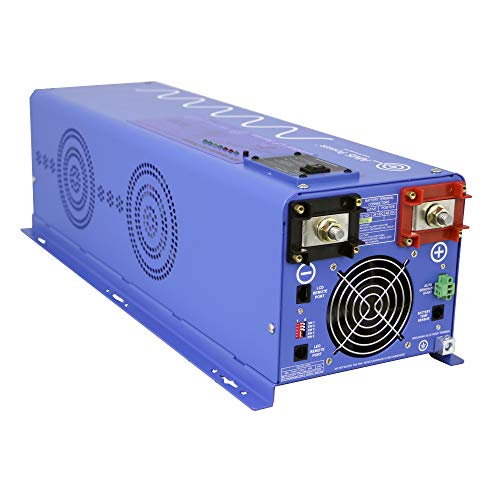
AIMS 4000W 12V Pure Sine Inverter Charger w/ Transfer Switch 120V ETL — Largest stated output
The AIMS title is the loudest in the pool and, to its credit, specific: 4000W, 12V, pure sine, inverter charger, transfer switch included, 120V output, ETL listed. The transfer switch is the headline within the headline. It is the component that watches incoming AC and, when shore power or a generator appears, passes it through to the loads while the charger refills the bank — then drops back to inverting when the AC vanishes. Naming it in the title settles the question the other five listings leave open, and for a backup installation the transfer function is not a detail; it is the entire user experience of an outage.
Four thousand watts on a 12V bank is a serious electrical commitment, and the title’s honesty about the 12V foundation invites the arithmetic the installation will demand. At full output, a 12V inverter draws current in the hundreds of amps once efficiency losses are counted, which dictates short, thick DC cables, correctly rated fusing close to the battery, and terminals torqued like the high-current joints they are. The inverter is the visible purchase; the copper is the real one. Installations that budget for both get the 4000W the title promises; installations that budget for the box alone get heat and voltage sag.
The ETL mark is the quiet figure in the title. It signals that the unit has been tested by a nationally recognised laboratory against the applicable safety standards — the same role UL listing plays — which matters for insurance conversations, for installations in inspected buildings, and for the simple confidence that the enclosure’s behaviour under fault conditions has been examined by somebody other than its manufacturer. Among budget-tier high-wattage inverters, a printed certification is a meaningful separator.
The title leaves the charge current unstated, as most of this pool does, and AIMS documentation carries the figure. For the transfer-switch use case — a property that sits on grid power most of the year and inverts during outages — charge rate matters less than for generator-dependent off-grid life, because the charger has all the quiet grid hours it needs. That is the honest frame for this pick: the biggest stated muscle in the set, aimed at the pass-through backup role, with its one hidden figure being the one its intended role can most afford to leave unhurried.
- Stated output: 4000W pure sine at 120V, as the title declares
- Battery side: 12V, printed in the title
- Transfer switch: included, stated in the listing title — the only pick that names one
- Certification: ETL, named in the title
- Charge current: Not stated in the listing title — verify with AIMS documentation
- Remote monitoring: the title says nothing — AIMS documentation is the source
Strengths
- The largest stated output in the pool, with the transfer switch declared rather than implied.
- An ETL mark in the title eases insurance and inspection conversations.
- The 120V output and 12V foundation are both printed, leaving little to guess at headline level.
Trade-offs
- Full output on 12V demands hundreds of amps of DC cabling done properly.
- Charge current stays unstated, which generator-dependent users must resolve before buying.
- 4000W encourages load ambition that a modest battery bank cannot sustain for long.
Best for: a property backup installation on grid pass-through, where the transfer switch does the daily work and 4000W covers outage loads.
Not suited for: a small vehicle bank, or any install unwilling to fund the heavy DC cabling a 4000W 12V unit requires.

Samlex America Solar EVO-3012 Evolution Series Inverter/Charger — Best solar pairing
The Samlex listing sells an idea before it sells a specification: the word Solar leads the title, and the Evolution Series name follows. That ordering tells the truth about the EVO line’s intended home — off-grid systems where a solar array does the daily charging, a generator covers the grey weeks, and the inverter charger sits between them as the piece that turns battery DC into cabin AC and generator AC back into stored charge. In that architecture the inverter charger is not the star; it is the stage manager, and Samlex has built industrial and off-grid power equipment long enough to understand the role.
Notice what the title refuses to do: it prints no wattage. The model code EVO-3012 carries the information in the maker’s own shorthand, but shorthand is not a specification, and this guide does not decode model numbers into ratings. The honest entry in the spec box is the unstated line, with Samlex documentation named as the source. Readers who find that austere should compare it with the alternative — a guide inventing a confident wattage from a model code — and decide which habit they want governing a purchase that involves hundreds of amps.
The solar framing still earns the pick its place, because system context is a specification of its own kind. An inverter charger destined for a solar cabin will be judged on how gracefully it coexists with a separate solar charge controller, how it treats a small generator’s uneven output, and how its charging behaviour suits banks that cycle daily rather than sitting on float for months. Samlex’s Evolution positioning speaks directly to that context, and the company’s support documentation for the series is written for system builders rather than appliance owners.
Choose the Samlex when the array already exists or is firmly planned, and the inverter charger is being selected as the AC half of a solar-first design. Its pick is a reminder that the best inverter chargers with pure sine wave output are not always the ones with the longest titles — sometimes they are the ones whose intended system is clearest, provided the missing figures are retrieved from the maker before money moves.
- Function: inverter/charger, as the title states
- Series: Evolution Series (EVO-3012), from the title
- Positioning: Samlex Solar line, leading the title
- Stated output: Not stated in the listing title — verify with Samlex documentation
- Charge current: no figure in the title — Samlex documentation holds it
- Battery voltage: unprinted — a Samlex documentation lookup before any design work
Strengths
- Solar-first positioning suits off-grid cabins where an array and a generator share duty.
- Samlex’s industrial power background shows in documentation written for system builders.
- The Evolution Series framing makes the intended architecture clear at a glance.
Trade-offs
- The title prints no output rating, no battery voltage and no charge current.
- Model-code shorthand forces a documentation step before any comparison shopping.
- Readers outside the solar context gain little from this pick’s particular strengths.
Best for: an off-grid cabin design where solar is the primary source and the inverter charger is chosen to serve that architecture.
Not suited for: a buyer comparing raw ratings across listings, since this title offers none to compare.

MAGNUM ENERGY MS2012 — The verification exercise
Six words would be generous for this title; it has four. MAGNUM ENERGY MS2012 — a brand, a model code, and nothing else. No wattage, no waveform claim, no voltage, no charge figure. And yet the nameplate is a genuine one: Magnum Energy’s inverter chargers have been staples of North American RV, marine and off-grid installations for years, and the MS series is the company’s sine-wave line. The pick is included precisely because this situation — a respected product hiding behind an empty listing — is one of the most common in the category, and it deserves a worked example rather than a shrug.
The discipline is simple to state and easy to abandon: the listing earns credit for nothing it does not print. Everything a system design needs from this unit — its rating, its charger behaviour, its transfer arrangements — must be pulled from Magnum’s documentation for the exact model code, and the purchase should not proceed on the strength of the brand’s reputation in adjacent models. Product families drift across years and variants; the MS2012’s own documents are the only authority on the MS2012.
There is a second lesson in the bare title, about listings rather than products. Sellers write titles for search traffic, and a title this empty usually belongs to a listing maintained by a third-party seller rather than the manufacturer. That raises the verification stakes on condition, included accessories and warranty handling — none of which the title addresses either. The counterweight is that established nameplates hold their value and their support networks: parts, remotes and knowledgeable installers exist for Magnum equipment in a way they do not for anonymous high-wattage boxes.
So the Magnum pick is neither an endorsement nor a warning; it is a procedure. Retrieve the model’s documentation, confirm the rating and charger figures against the intended bank and loads, confirm the listing’s seller and terms, and then judge the unit on the same evidence standard as the Victron’s generous title. A product that survives that procedure has earned its place in a system. A listing that resists it has answered the question by itself.
One more consideration belongs to this pick alone, because the empty title changes the shopping mechanics around it. When a listing carries no specifications, the questions a buyer sends the seller become the specification process: confirm the exact model variant, the included remote or its absence, the unit’s age and service history if the listing is not factory-new, and the warranty path if the first power-up disappoints. Sellers of genuine Magnum equipment answer those questions easily, because the answers live in documents they can quote. Evasive answers are information too, and cheaper to receive before the purchase than after it.
- Brand and model: Magnum Energy MS2012 — the whole of the title
- Stated output: Not stated in the listing title — verify with Magnum Energy documentation
- Waveform: unclaimed by the title — Magnum Energy documentation is the authority
- Charge current: no figure offered — retrieve it from Magnum Energy documentation
- Battery voltage: absent from the title — a Magnum Energy documentation check
- Transfer behaviour: unaddressed — Magnum Energy documentation settles it
Strengths
- An established North American nameplate with a real installer and support ecosystem.
- The MS line’s sine-wave pedigree is well documented by the maker, once retrieved.
- A useful test case for evidence discipline — the listing that teaches the method.
Trade-offs
- The emptiest title in the pool: literally every working figure requires verification.
- Third-party-style listings raise condition and warranty questions the title ignores.
- Brand reputation can seduce buyers into skipping the checks this pick exists to teach.
Best for: an experienced installer or system builder comfortable designing from manufacturer documentation and vetting a sparse listing.
Not suited for: a first-time buyer who needs the listing itself to carry the specifications the design depends on.
How Do the Six Compare Side by Side?
| Pick | Stated size | Charge current in title | Transfer switch in title | Defining trait |
|---|---|---|---|---|
| Renogy 2000W Inverter Charger | 2000W | Not stated | Not stated | Bluetooth monitoring, high-frequency design |
| Xantrex Freedom XC Pro 3000 | 3000 (model numeral) | Not stated | Not stated | Mobile RV and marine pedigree |
| Victron MultiPlus-II | 3000VA | 120A | Not stated | Fullest printed figures |
| AIMS 4000W Inverter Charger | 4000W | Not stated | Yes — named | Largest output, ETL mark |
| Samlex EVO-3012 | Not stated | Not stated | Not stated | Solar-first Evolution Series |
| Magnum MS2012 | Not stated | Not stated | Not stated | Established name, empty title |
The table’s pattern of “Not stated” entries is not a failure of the guide; it is an accurate map of the listings. Two picks compete on declared muscle (AIMS, Renogy), one on declared completeness (Victron), one on declared context (Samlex), one on heritage (Xantrex), and one on nothing at all (Magnum). A shortlist built from this table should be a shortlist of documentation tasks: whichever two or three units fit the intended system, their makers’ documents settle the rest.
What Should Be Settled Before Choosing a Pure Sine Inverter Charger?
Begin with the load list, written down, with starting surges included. Motors and compressors draw several times their running watts for the first moments, and an inverter that carries the running total can still trip on the start. The list decides the size class; the battery bank then decides whether that size is honest, because watts out require amp-hours in. A 4000W inverter on a small bank is a sprinter tied to a thimble — the pairing, not the badge, determines how long full output can be sustained.
Next, settle the charging story. Where will AC come from — a campground pedestal, a home circuit, a generator — and how many hours of it will the system realistically get? Multiply the charger’s current by those hours and compare the result with the bank’s capacity and daily consumption. That single multiplication explains most disappointing off-grid installations: the inverter was sized generously, the charger was never sized at all, and the bank lived its life half empty.
Then decide how the system should behave when AC arrives and departs. A transfer switch makes the transition automatic and, on many units, fast enough that clocks and computers never notice. Without one, changeover is a manual ritual of plugs and switches that somebody must perform in the dark, in the rain, at the moment the power failed. Backup installations should treat automatic transfer as close to mandatory; purely recreational systems can weigh the convenience against cost with clearer eyes.
Finally, plan the DC side as engineering rather than plumbing. Cable length and gauge set the voltage drop between bank and inverter; fusing protects the run; ventilation protects the unit; and the battery chemistry’s charging requirements must match what the charger can be configured to deliver. None of these appear in any listing title in this pool, and all of them decide whether the chosen machine performs like its rating or like its regrets.
How Is an Inverter Charger Installed Without Regrets?
Mount the unit close to the battery bank, on a surface that tolerates heat, with the maker’s stated clearances around its vents. Every extra metre of DC cable costs voltage at exactly the currents where voltage is scarcest, so the inverter goes to the batteries — the AC output can travel far more cheaply than the DC input. Keep the unit out of the battery compartment’s corrosive air where the maker forbids it, and never inside a sealed box with the batteries themselves.
Wire the DC side with cable sized for the full rated current plus margin, crimped with proper lugs, protected by a fuse or breaker within a short distance of the battery positive terminal, and torqued to specification. Then wire the AC side with the discipline of house wiring: correct breaker protection, the maker’s instructions on neutral-to-ground bonding followed exactly — bonding is handled differently in inverters than in buildings, and improvisation here creates genuine hazards — and the transfer input connected to a source that can actually supply the charger’s draw plus the passed-through loads.
Commission the system in stages. Charge the bank fully on AC first and watch the charger move through its stages. Then disconnect AC and load the inverter gradually, noting where voltage sags and how the unit reports its state. Restore AC and confirm the transfer behaves as documented, in both directions. A system tested politely on a calm afternoon will behave predictably on the wild night it was bought for; a system first tested by the outage itself is an experiment conducted in the dark.
What Separates High-Frequency Designs From Low-Frequency Ones?
Two engineering schools build inverter chargers, and the Renogy pick names its allegiance in its title: high frequency. A high-frequency design converts power through compact electronics switching tens of thousands of times per second, which shrinks the transformer and with it the enclosure’s weight. The result is a unit one person can mount on a van wall without a second pair of hands, and a price that reflects electronics rather than iron. The trade is surge temperament. Starting a stubborn compressor is a brief act of violence against an inverter, and heavy low-frequency designs — built around a large transformer — absorb that violence with thermal and magnetic mass that a lightweight design simply does not carry.
Low-frequency units, the traditional school behind many long-serving off-grid installations, invert through that big transformer and shrug off motor starts, well pumps and power tools with a composure their spec sheets rarely quantify. They also weigh dramatically more, cost more to ship, and occupy more of the electrical bay. Neither school is the correct one in the abstract. A system whose hardest load is a laptop and a fridge lives happily in the high-frequency world; a system that must start a well pump at dawn for twenty years should at least price the low-frequency alternative before deciding the lighter box is the cheaper one.
The practical reading habit is to ask what the household’s worst five seconds look like. Every load has a running draw and a starting draw, and the starting draw of the largest motor in the system is the number the inverter actually has to survive. Titles in this pool do not print surge ratings — another documentation figure — so the worst-five-seconds question joins the charge-current question on the verification list that follows any pick out of this guide and into a real design.
How Should the First Week With a New Unit Be Spent?
Day one belongs to observation rather than ambition. With the bank fully charged from AC, run the ordinary loads and watch how the system reports itself: the Renogy’s Bluetooth readouts, the status lights and displays of the others. Learn what normal looks like while nothing is at stake, because the night something is wrong, the only diagnostic that matters is the memory of how the system behaved when it was right. Note the resting voltage of the full bank, the voltage under the heaviest regular load, and the charger’s behaviour in the first hour after AC returns.
Midweek, rehearse the failure the unit was bought for. Cut the AC input deliberately, in daylight, with somebody watching the loads that matter — the fridge, the furnace blower, the communications gear. Time the transfer if the unit has one, listen for the complaints of motors restarting, and confirm that nothing essential sits on a circuit the inverter does not feed. Then restore AC and watch the recharge: how the charger stages behave, how long the bulk phase runs, whether the bank genuinely reaches full or stalls at a percentage that flatters the gauge.
End the week by writing the system’s vital numbers somewhere they will be found in February: the bank’s capacity, the charger’s confirmed current, the cable sizes used, the fuse ratings fitted, and the date the bank was last equalised or serviced if its chemistry asks for that. Inverter chargers fail rarely and quietly, usually by being asked to live in a system nobody documented. A single page of honest numbers, taped inside the electrical bay door, is worth more than any extended warranty the listing offered.
Which Mistakes Follow Inverter Chargers Home?
The classic error is buying an inverter when the system needed an inverter charger, discovered on the first night the bank ran low with a generator sitting idle outside. The second is the mirror image: paying for charging capacity sized for a generator routine, in an installation that lives permanently on shore power. Both mistakes come from skipping the charging story in the buying-guide section above.
Waveform regret runs close behind. A modified sine unit bought to save money meets a microwave that groans, a fridge compressor that runs hot, or a tool charger that refuses to work, and the saving evaporates into a second purchase. Every pick here is a sine-wave machine, but the category outside this pool is full of modified sine bargains, and the keyword’s “pure sine wave” clause exists because the distinction has burned so many buyers before.
The third mistake is DC-side skimping: cable chosen by price, fuses chosen by optimism, connections tightened by feel. At the currents a 12V 4000W unit draws, a mediocre connection is a heating element. And the fourth is trusting a model code as a specification — the Samlex and Magnum picks above exist as standing exhibits. A model number is a name, not a number of watts, and treating it as one is how a system gets designed around a figure nobody ever promised.
How Does Battery Chemistry Change the Charging Conversation?
The charger half of an inverter charger speaks to the battery bank in a language of voltages and stages, and the bank’s chemistry decides which dialect it understands. Flooded lead-acid wants a full multi-stage charge with an occasional equalisation it can vent through. Sealed AGM and gel banks want the same stages with tighter ceilings and no equalisation at all. Lithium iron phosphate wants a flatter profile, no float in the traditional sense, and a hard stop that respects its battery management system. A charger that cannot be configured for the bank’s chemistry will either underfeed it — the slow sulphation death of lead-acid — or lean on it in ways that shorten its life expensively.
None of the six titles in this pool prints a word about chemistry profiles, which makes this the third standing documentation task the guide assigns: after charge current and transfer behaviour, confirm that the chosen unit offers a charging profile, or a configurable custom profile, that matches the bank on the floor. This matters most at replacement time. Banks are consumables on a five-to-fifteen-year cycle, and the day a flooded bank is swapped for lithium, the inverter charger installed years earlier becomes either a flexible asset or the next item on the replacement list.
Temperature completes the chemistry picture. Charging voltages are specified at moderate temperatures, and a bank sitting in a freezing equipment shed or a hot vehicle bay needs compensation the charger may or may not provide, often through a remote sensor the listing never mentions. The installations that get a decade from a bank are the ones where somebody read the charging chapter of the manual — all of it, including the appendices — before the first cable was cut. That reader might as well be you, this week, while the manuals are still findable and the system is still on paper.
Final Recommendation
For most readers, the shortlist resolves by role. The Victron MultiPlus-II is the engineer’s choice: the fullest stated figures, a 120A charger printed in plain sight, and documentation depth behind every gap. The AIMS is the backup-power choice, where its named transfer switch and 4000W ceiling serve the outage role directly, and its ETL mark smooths the paperwork of a permanent install. The Renogy suits the compact monitored build, the Xantrex the mobile life it was designed for, and the Samlex the solar cabin whose array does the talking. The Magnum remains the pick that must be earned through verification — which is sometimes exactly what an experienced builder prefers.
Whichever unit leaves the shortlist standing, let the last check be the unglamorous one: the maker’s document for the exact model, open at the specifications page, compared line by line against the bank, the loads and the charging hours the system will really see. A pure sine inverter charger is a decade-long piece of infrastructure, and the installations that age well are the ones whose paperwork was read before the cables were cut — the waveform will be smooth either way, but only the verified system will still be earning its keep when the third winter storm tests it.
Frequently Asked Questions
What does an inverter charger do that a plain inverter cannot?
It charges. A plain inverter only converts battery DC into AC power. An inverter charger also accepts incoming AC from shore power, the grid or a generator, uses it to recharge the battery bank, and — on units with a transfer switch — passes that AC through to the loads while charging. The AIMS title in this pool names its transfer switch explicitly; on the other five, transfer behaviour is a documentation check.
Why does pure sine wave output matter?
Because many loads were designed around the smooth grid waveform. Motors, compressors, microwaves and sensitive electronics run cooler, quieter and more predictably on pure sine power, while modified sine approximations can cause hum, excess heat or outright refusal in some devices. Resistive loads such as heaters and kettles are largely indifferent, which is why the waveform question should be answered from the actual load list.
Is 3000VA the same as 3000W?
No. VA measures apparent power; watts measure real power, and the two coincide only when the load’s power factor is one. The Victron title prints 3000VA, which is the engineering-honest figure, but it means a direct watt-for-watt ranking against the AIMS unit’s 4000W needs care. For resistive loads the figures are close; for motor loads the gap widens.
How fast will the charger refill a battery bank?
At the rate its charge current allows, for as many hours as AC is available. Only the Victron title in this pool states the figure — 120A — which is why its pick emphasises generator-window economics. For the other five units, the charge current must be taken from the maker’s documentation and multiplied by realistic charging hours before the purchase is judged.
Can a 12V inverter charger run a whole house?
A 12V unit in this size range can carry selected circuits — refrigeration, lights, communications, a furnace blower — but whole-house service with electric cooking, water heating and air conditioning belongs to larger systems, usually built on 24V or 48V banks. The 4000W AIMS is the ceiling of this pool, and even it should be matched to a chosen-circuit panel rather than a whole service entrance.
What should be checked first when the unit arrives?
The model code on the carton against the model code ordered, then the maker’s specification document against the figures the design assumed — rating, charge current, transfer behaviour, bonding instructions. Listings in this category are sometimes maintained by third-party sellers, as the Magnum pick illustrates, so condition, accessories and documentation in the box deserve the same scrutiny as the hardware.
Related Guides
Readers building out the rest of a battery-based system may also find our guide to deep-cycle battery banks for off-grid power useful, alongside the roundup of solar charge controllers and the guide to transfer switches and backup power panels that the AIMS pick’s pass-through role depends on.