What's inside
- Key Takeaways
- Quick Picks
- How Did We Choose the Best Digital Point and Shoot Cameras for a Ten Year Old?
- What Should an Adult Set Up Before Handing the Camera Over?
- The Six Picks in Detail
- How Does a Dedicated Camera Compare With a Phone at Ten?
- What Accessories Are Actually Worth Adding Later?
- How Should Families Handle Photographs of Other Children?
- Side-by-Side: How Do the Six Cameras Compare?
- How Can a Ten-Year-Old Get Better Photographs in the First Month?
- What Mistakes Do Families Make With a First Camera?
- Final Recommendation
- What Projects Keep a Young Photographer Going?
- Why Does Printing Matter So Much at This Age?
- What Happens When the Camera Gets Dropped Anyway?
- What Should You Check on the Listing Page Before Ordering?
- Frequently Asked Questions
- Related Guides
As an Amazon Associate I earn from qualifying purchases. This post may contain affiliate links at no extra cost to you.
gizmoverdict.com is reader-supported. When you buy through links on our site, we may earn an affiliate commission.
Where to buy: All six cameras in this guide link to their live Amazon listings, and the listing page is where you confirm the current colour options and exactly what sits in the box, since several of these models ship in more than one bundle. Nothing here is prose-only: this is a well-stocked shelf, and the real work is matching the right camera to the right ten-year-old.
There is a particular moment in a child’s life when the family camera — or worse, a parent’s phone — stops being enough. Ten is often that age. A ten-year-old goes on the school trip, the scout camp, the cousin’s birthday, the first holiday where they wander off with their own view of the place, and they come home wanting to show you what they saw rather than what you pointed at. The best digital point and shoot cameras for ten year old photographers are the ones built for exactly that handover: simple enough to use without a manual, complete enough in the box that nothing else needs buying, and honest about what they are — real cameras that take real photographs the child can keep, print and be proud of.
Two ground rules before the picks, because this category invites exaggeration. First, durability: read the titles below carefully and you will find anti-shake everywhere and ruggedness almost nowhere. Anti-shake is an image-stabilisation feature that steadies the photograph; it says nothing about surviving a drop onto playground concrete. We have not upgraded any title’s claim into a toughness promise, and you should be suspicious of any guide that does. A wrist strap used religiously, a padded pouch, and a child who has been told the camera is a real tool rather than a toy will do more for its lifespan than any marketing adjective. Second, the headline numbers: 48MP and 56MP figures lead several titles. They are the makers’ figures, printed as titled, and a ten-year-old’s photographs will be judged by grandparents on clarity and colour, not on a megapixel count. What actually matters at this age is that the camera focuses, fires quickly, and gets out of the way.
What ten-year-olds photograph is gloriously predictable: friends pulling faces, the family dog mid-yawn, a beetle, a rainbow, the view from the top bunk, a cake. The camera’s job is to make those shots succeed often enough that the hobby catches fire. Face detection and smile capture — named in one title below — exist for the first of those subjects. A 16X zoom, named in most, exists for the beetle and the rainbow. And a card in the box, named in several, exists so that the first afternoon is spent shooting rather than shopping.
Key Takeaways
- Anti-shake in these titles means steadier photographs, not drop protection — no pick here is sold as rugged, and none should be treated as if it were.
- The KODAK PIXPRO FZ55 is the only pick with a true optical zoom — 5X, with a 28mm wide-angle lens — which makes it the most camera-like tool here for a child showing real interest.
- Most of the generic picks state a 16X zoom without calling it optical; treat those figures as the makers’ headline numbers and judge the cameras on their included cards, batteries and simplicity.
- Boxes that include the memory card and a second battery remove the two commonest first-week disappointments: nothing to save to, and a flat battery at the party.
- An adult should do the unboxing setup — date, language, card formatting, strap fitted — then hand over a camera that only asks the child to point and press.
Quick Picks
| Pick | Badge | Why it earns a place |
|---|---|---|
| KODAK PIXPRO FZ55 | Best real-camera feel | A named brand, 5X optical zoom, a 28mm wide-angle lens and 1080p video in a proper compact body. |
| Camkory Digital Camera FHD 1080P | Most generous box | 32G card, two batteries and charger included, in pink, aimed squarely at young photographers. |
| Digital Camera for Kids 48MP | Straightforward all-rounder | 48MP headline, 1080P video, 16X zoom and anti-shake in a compact body pitched at boys, girls and teens. |
| Digital Camera 4K for Kids (48MP, autofocus) | Best for young vloggers | Autofocus and 4K video positioning with a 32GB card included, in black. |
| 2026 Digital Camera 56MP for Kids | Most child-specific features | Face detect and smile capture, a lanyard in the box, and a 32GB TF card, in pink. |
| Digital Camera FHD 1080P (32GB card) | Easy starter in black | Filters and a date stamp for fun, a 32GB card included, and easy-to-use positioning for starters. |
How Did We Choose the Best Digital Point and Shoot Cameras for a Ten Year Old?
We applied a child’s-eye test first: could a ten-year-old, handed this camera at a birthday party, take a good photograph within sixty seconds without an adult configuring anything? That test rewards a short control list — power, shutter, zoom, playback — and punishes anything that buries the basics under modes. It is why every pick here is a fixed-lens compact with automatic behaviour at its core, and why the one camera with an optical zoom and a wide-angle lens, the Kodak, leads the list for children whose interest is already visibly deepening: it behaves like the cameras adults use, in miniature seriousness, without demanding adult patience.
The second test was the box. A child’s camera that arrives without a card is a disappointment with a bow on it, so we credited every title that names its storage — and doubly credited the one that names two batteries and a charger, because the second battery is the difference between a camera that lives in a school bag, ready, and one that is always flat when the moment comes. The third test was honesty about numbers. Where a title says 16X zoom without the word optical, we report it as titled and do not pretend it equals the Kodak’s optical figure; where a title claims a megapixel count, we print it as the maker’s claim. Parents comparing this shortlist with the wider shelf will find the same tests applied in our guide to the best affordable point and shoot cameras, where several of these models compete against adult-budget compacts.
What Should an Adult Set Up Before Handing the Camera Over?
Fifteen minutes of adult attention on day one saves a month of small frustrations. Charge both batteries if the box has two. Fit the strap or lanyard properly and make it a house rule from the first photograph — the strap is this camera’s only real armour. Insert the card, format it in the camera rather than a computer, and set the date and time, because a ten-year-old’s archive becomes a family treasure and ‘IMG_0047, someday’ is a poor caption for it. Set the resolution to a sensible middle option rather than the maximum: the headline settings fill cards quickly and slow the camera down, and no school-project print ever needed the maker’s largest file.
Then take three photographs together — the dog, the garden, each other — and review them on the screen, showing your child the playback and delete buttons and, just as firmly, the idea that deleting is editing and editing is allowed. Agree where the photographs will live: a folder on the family computer named for the child, copied across together on a Sunday, is a ritual that turns a gadget into a practice. Finally, set expectations about other people: photograph friends who are happy to be photographed, ask first at parties, and never point the camera where someone has asked you not to. A camera at ten is also an education in being trusted with other people’s images.
The Six Picks in Detail
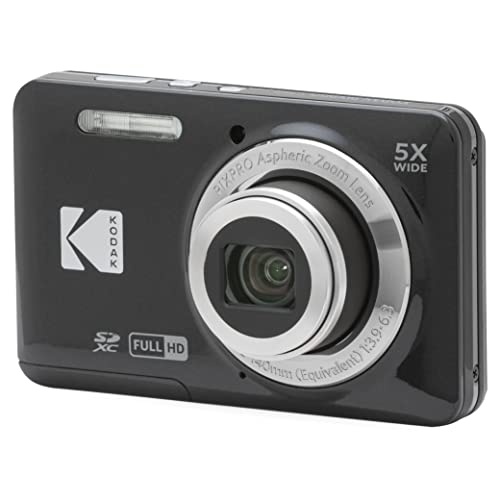
KODAK PIXPRO FZ55 — Best real-camera feel
The FZ55 carries a name that grandparents recognise and a specification that reads like a shrunken grown-up camera: 16MP, a 5X optical zoom, a 28mm wide-angle lens, 1080p Full HD video and a 2.7 inch LCD, powered by a Li-Ion battery. The optical zoom is the headline for a thoughtful buyer. Optical means the lens itself moves to magnify, so a face across the playground stays crisp in a way that digital zoom — cropping the middle of the picture and enlarging it — never matches. For the ten-year-old who has started composing deliberately, framing with a real zoom and reviewing honestly on the screen, this is the camera that teaches photography rather than merely permitting it.
The 28mm wide angle earns a sentence of its own: group shots at parties and interiors on school trips are where children’s photographs usually amputate someone’s head or lose half the room, and a genuinely wide lens end is the cure. The black finish and point-and-shoot description in the title position it as a camera rather than a toy, which for many ten-year-olds is precisely the appeal — it looks like the real thing because it is the real thing, at a scale and price a family can hand over without hovering. The title also mentions vlogging, and the 1080p video covers the school-project film and the cousin-interview genre perfectly well.
- Resolution stated in title: 16MP
- Zoom stated in title: 5X optical zoom
- Lens stated in title: 28mm wide angle lens
- Video stated in title: 1080p Full HD video
- Screen stated in title: 2.7 inch LCD
- Battery stated in title: Li-Ion battery
- Colour stated in title: Black
- Memory card in the box: Not stated in the listing title — verify with the maker’s documentation
Strengths
- The only true optical zoom here, so distant subjects keep their detail instead of dissolving into pixels.
- A 28mm wide end that fits the whole party, the whole classroom, the whole view from the hill.
- A recognised camera brand with a grown-up design a serious-minded ten-year-old will be proud to carry.
Trade-offs
- No card is named in the title, so add one to the order or the first afternoon stalls.
- Its 16MP headline looks modest beside the 48MP and 56MP claims around it, even though the optics matter more.
- Black only, as titled — a child set on a colour will look further down this list.
Best for: the ten-year-old whose interest is already real, who will feel the difference an optical zoom and a wide lens make. Not suited for: a first camera for a rough-and-tumble child, since nothing in its title claims any protection against drops or water.
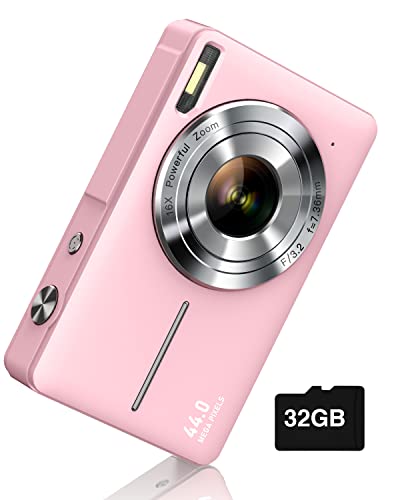
Camkory Digital Camera FHD 1080P — Most generous box
Camkory’s title is written by someone who has watched a child’s birthday in real time. The camera is FHD 1080P with a 16X zoom and anti-shake; it is pink; and then comes the part that matters at 4pm on the day itself — a 32G card, two batteries and a charger, all included. A camera that can be unboxed, charged briefly and used at its own party, then used again the next morning because a second battery exists, understands the assignment better than a technically superior box that arrives incomplete. The title says ‘easy for kids’ and ‘perfect for parties, trips, birthdays’, and for once the marketing and the contents list agree.
Position it fairly: the 16X zoom is stated without the word optical, so expect the reach to soften at its far end, and the anti-shake helps hand-held shots without making the camera itself tough. What you are buying is completeness and friendliness — a compact that a child can operate in automatic everything, in a colour many ten-year-olds will choose enthusiastically, with the logistics of power and storage solved before they can become disappointments. As a gift bought by a grandparent who cannot be there to troubleshoot, that completeness is worth more than specifications.
- Video stated in title: FHD 1080P
- Zoom stated in title: 16X zoom
- Stabilisation stated in title: Anti-shake
- In the box as titled: 32G card, 2 batteries, charger
- Colour stated in title: Pink
- Optical zoom: Not stated in the listing title — verify with the maker’s documentation
- Lens specification: Not stated in the listing title — verify with the maker’s documentation
Strengths
- The fullest box in the guide — card, spare battery and charger — so the camera works at its own birthday party.
- Two batteries end the flat-camera disappointment that kills more young hobbies than any other cause.
- Pink finish and kid-first positioning make it an easy, confident gift choice.
Trade-offs
- The zoom is not stated as optical, so far-end reach will be softer than the Kodak’s lens.
- Anti-shake steadies pictures only; the title claims no protection against drops, knocks or water.
- A single colour, as titled, narrows its appeal for a child who dislikes pink.
Best for: a birthday gift that must work completely, immediately, with no follow-up shopping by the giver. Not suited for: a child already composing seriously, since the unspecified zoom type gives up the Kodak’s optical clarity at distance.

Digital Camera for Kids 48MP — Straightforward all-rounder
This is the list’s uncomplicated middle: a compact point and shoot titled at 48MP with FHD 1080P video, a 16X zoom and anti-shake, pitched at boys, girls, teens and beginners. Nothing in the title is exotic, and that is the recommendation — a camera whose every named feature serves the standard repertoire of a ten-year-old’s photography, in a portable body that fits a school bag’s front pocket. The 48MP figure is the maker’s headline; the working truth is a camera that shoots stills and 1080P video, zooms generously, and steadies small hands.
Where it sits against its neighbours: it lacks the Camkory’s named card-and-batteries generosity, so check the listing for box contents before gifting, and it lacks the Kodak’s optical zoom, so it will not teach at quite the same level. What it offers instead is balance — no feature missing that a ten-year-old will ask for in the first year, no gimmick demanding explanation. For the child whose interest is genuine but unproven, the all-rounder is often the wisest money: capable enough not to be outgrown by Christmas, simple enough to be used daily rather than admired, and neutral enough in its styling to be inherited by a younger brother or sister without a murmur when its first owner graduates to something more ambitious in a year or two.
- Resolution stated in title: 48MP (maker’s figure, as titled)
- Video stated in title: FHD 1080P
- Zoom stated in title: 16X zoom
- Stabilisation stated in title: Anti-shake
- Audience stated in title: Boys, girls, teens, beginners
- Memory card in the box: Not stated in the listing title — verify with the maker’s documentation
- Battery count in the box: Not stated in the listing title — verify with the maker’s documentation
Strengths
- A balanced, no-gimmick specification covering stills and video in one compact body.
- Anti-shake helps young hands produce keepers in indoor light at parties and school events.
- Positioned for a wide age span, so it can be handed down to a younger sibling without feeling babyish.
Trade-offs
- Box contents are not spelled out in the title; card and battery arrangements need checking on the listing.
- The zoom is not described as optical, so distance shots will not match the FZ55’s crispness.
- No child-specific extras — no face or smile features are named — so it relies on plain competence.
Best for: a capable first camera for a child whose enthusiasm is promising but still being tested. Not suited for: gift-givers who cannot check box contents, since the title leaves card and battery inclusion unstated.

Digital Camera 4K for Kids (48MP, autofocus) — Best for young vloggers
Autofocus is the word in this title that separates it from the pack, and for the child it matters most to — the one already filming — it is the right word. This camera is positioned as a vlogging camera: 4K video, 48MP stills, autofocus, a 32GB card included, anti-shake, in black. A ten-year-old making videos — the school science demonstration, the skateboard progress diary, the extremely serious cooking show — fights one enemy above all: the shot that looked fine on the little screen and turns out soft on the television. Autofocus that actively holds the subject is the direct answer, and it is named here where its rivals are silent.
The included 32GB card matters more for video than for stills, because video eats storage at a rate that surprises every new owner; starting with a card in the box means the first production is not rationed. Read the 4K claim as the title’s own — plenty of young creators will shoot at lower settings for file size and battery life, and the camera’s value does not depend on the badge. What it offers is a stills-and-video compact that takes moving pictures seriously, in a grown-up black finish that suits a child who would reject anything that looks like a toy.
- Video stated in title: 4K
- Resolution stated in title: 48MP (maker’s figure, as titled)
- Focus stated in title: Autofocus
- Zoom stated in title: 16X zoom
- Stabilisation stated in title: Anti-shake
- In the box as titled: 32GB card
- Colour stated in title: Black
- Second battery in the box: Not stated in the listing title — verify with the maker’s documentation
Strengths
- Named autofocus directly serves video-making children, whose subjects rarely sit still.
- A card is included, and video appetites make that inclusion more valuable here than anywhere else in the list.
- Black, toy-free styling respects a ten-year-old’s fierce sense of what counts as a real camera.
Trade-offs
- Video at maximum settings will drain a single battery and fill the card faster than a stills day ever does.
- The zoom is not stated as optical, so long-reach stills remain the Kodak’s territory.
- No flip screen is named in the title, so self-filming means framing by guess and review.
Best for: the young film-maker whose camera will shoot as much video as stills, and who re-shoots least when focus behaves. Not suited for: a stills-first child, since its advantages sit in video and autofocus while its zoom stays unspecified.

2026 Digital Camera 56MP for Kids — Most child-specific features
Two features in this title exist for one reason: children photograph people, and people blink. Face detect tells the camera where the faces are so focus and exposure favour them; smile capture waits for the smile before firing. In adult hands these are novelties. In a ten-year-old’s hands at a family gathering, they are the difference between a run of almost-photographs — eyes shut, faces dark against the window — and the shot of grandad laughing that gets printed for the fridge. Add the stated 56MP headline, FHD 1080P video, 16x digital zoom, anti shake, a 32GB TF card, a battery and a lanyard in the box, in pink, and this is the most deliberately child-shaped camera in the guide.
The lanyard deserves the same respect as the smile capture. It goes around the neck, which is where a camera survives a school trip; the title’s inclusion of it signals a maker who understands that a child’s camera lives outdoors, on the move, in a crowd. Be clear-eyed about the rest: the zoom is stated as digital, so its far end is a crop, and 56MP is a headline figure rather than a promise anyone can cash. Judge this one as the social camera — friends, family, parties, trips — and on that brief it is arguably the most fun per feature in the list.
- Resolution stated in title: 56MP (maker’s figure, as titled)
- Video stated in title: FHD 1080P
- Zoom stated in title: 16x digital zoom
- Features stated in title: Face detect, smile capture, anti shake
- In the box as titled: 32GB TF card, battery, lanyard
- Colour stated in title: Pink
- Optical zoom: Not stated in the listing title — verify with the maker’s documentation
Strengths
- Face detect and smile capture are purpose-built for the portraits and party shots children take most.
- A lanyard in the box puts the camera around the neck, the safest place a school-trip camera can live.
- Card and battery included, so the box is a working kit rather than a promise.
Trade-offs
- The zoom is digital by the title’s own wording, so distant subjects lose detail fastest here.
- Pink, as titled, is the only colour story — a firm preference either way will decide quickly.
- One battery is named; long trip days will want the charging routine planned around it.
Best for: the sociable ten-year-old whose camera points mostly at friends and family, and whose adults value the lanyard as much as the lens. Not suited for: a child keen on wildlife or sport at a distance, since a digital zoom cannot hold detail the way an optical lens does.
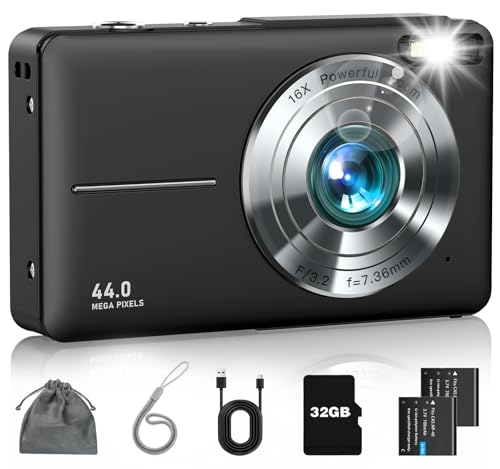
Digital Camera FHD 1080P (32GB card) — Easy starter in black
The last pick trades cleverness for ease, and says so in its title: easy to use, a gift for boys and girls who are starters, in deep black. Its specification is the class standard — FHD 1080P, 16X zoom, anti-shake, a 32GB card included — and its personality lives in two features the others do not name: filters and a date stamp. Filters let a child make a photograph look vintage, vivid or monochrome in the camera, which sounds trivial and is not: playful effects are how many children discover that a photograph is something you make decisions about, not just something that happens. The date stamp burns the day into the corner of the image, old-school style, and for a family archive of a childhood, that little orange timestamp becomes more charming every year.
It is pitched in the title as a compact small vlogging camera as well, so the video side is present for the school project and the holiday diary. Against the list: no autofocus claim, no face features, no second battery named — it is the simple end of the shelf, and its buyer should know that is what they are choosing and why it might be right. For a child who is easily overwhelmed by gadgets, or a first camera whose main job is to be picked up daily, simplicity is not the absence of features. It is the feature.
- Video stated in title: FHD 1080P
- Zoom stated in title: 16X zoom
- Stabilisation stated in title: Anti-shake
- Features stated in title: Filters, date stamp
- In the box as titled: 32GB card
- Colour stated in title: Deep black
- Positioning stated in title: Easy to use, for starters
- Autofocus: Not stated in the listing title — verify with the maker’s documentation
Strengths
- Filters and a date stamp give a beginner playful, visible results from the very first afternoon.
- Easy-to-use positioning and a card in the box make it the lowest-friction start in the guide.
- Deep black finish looks like a proper camera, which matters to a ten-year-old’s pride.
Trade-offs
- No autofocus or face features are named, so moving subjects and portraits get less help.
- The zoom is not stated as optical, sharing the class’s usual softness at full reach.
- A keen child may outgrow its simplicity sooner than the Kodak or the autofocus model.
Best for: a gentle first camera for a child who warms to gadgets slowly and will play with filters for hours. Not suited for: a child filming moving subjects often, since no autofocus is stated in its title.
How Does a Dedicated Camera Compare With a Phone at Ten?
Many parents ask why a camera at all, when a hand-me-down phone takes fine pictures. Three answers hold up in practice. The first is focus of purpose: a camera does one thing, so the child holding it is a photographer, while the child holding a phone is one notification away from being something else. The second is ownership and consequence — a phone is usually borrowed and therefore supervised anxiously, while a camera at this price can be genuinely the child’s, carried on the trip, lent to a friend for one shot, learned on without an adult’s contacts and accounts riding along. The third is craft: a zoom ring or lever, a shutter button with a half-press, a screen used only for pictures — these small physical rituals are how photography becomes a skill rather than an app.
None of that makes the phone a villain. Families often run both: the phone for the quick share to grandparents, the camera for the trip, the project, the archive. But if the goal is a child who comes home from camp with a considered set of photographs and the beginnings of an eye, the dedicated compact is the tool shaped for the job — and the absence of accounts, feeds and uploads in every title in this guide is, for many families, not a missing feature but the entire point.
What Accessories Are Actually Worth Adding Later?
Resist the bundle of forty accessories; a child’s camera needs three things beyond its box. A padded pouch that fits the camera and nothing else, so it travels in the school bag without rattling against lunchboxes and pencil cases. A second card, kept in the pouch, because cards fill on exactly the day — the trip, the tournament — when no shop is near; several picks include the first card, and the spare is the cheapest insurance in photography. And a small cleaning cloth, with a five-minute lesson in using it, because ten-year-old fingers find lenses with a reliability that borders on the supernatural, and half of all ‘my camera went blurry’ is a thumbprint.
Beyond those, let the child’s habits choose. A mini tripod earns its place if the young film-maker’s videos wobble; a photo printer or a monthly printing order earns its place if the fridge-door gallery becomes a family institution. What does not earn its place: a bigger bag, a strap collection, a lens kit for a fixed-lens camera. The hobby grows by photographs taken, not by equipment accumulated, and a ten-year-old with one camera, one pouch and a year of Sundays in the archive is richer than one with a shelf of gadgets and a card full of test shots.
How Should Families Handle Photographs of Other Children?
A camera in a ten-year-old’s hands photographs a world populated by other people’s children, and a short, kind set of house rules keeps that wholesome. Ask first — a habit that takes one conversation to install and protects friendships for years. Accept ‘no’ instantly and without negotiation, including from adults. Keep the camera’s photographs in the family archive rather than posting them onward; a dedicated camera makes this easy, because nothing on it uploads anywhere by itself, and the copying ritual gives a parent a natural moment to see what exists and talk about what sharing would mean. School trips add their own rules, and the camera should follow the school’s policy exactly as a phone would.
Framed positively, this is not a restriction on the hobby but part of its education. Photographers are trusted people; they carry a tool that can delight or embarrass, and learning at ten — with a parent nearby and stakes at the level of a birthday party — is exactly when the ethics of the craft are cheapest to learn. Children rise to this trust visibly. The young photographer who asks, who shows friends the picture and deletes the unflattering one on request, is practising a courtesy many adults with phones never learned.
Side-by-Side: How Do the Six Cameras Compare?
| Camera | Zoom as titled | Video as titled | In the box as titled | Standout fact |
|---|---|---|---|---|
| KODAK PIXPRO FZ55 | 5X optical | 1080p Full HD | Not stated in title | 28mm wide-angle lens, named brand |
| Camkory Digital Camera FHD 1080P | 16X | FHD 1080P | 32G card, 2 batteries, charger | Most complete box, pink |
| Digital Camera for Kids 48MP | 16X | FHD 1080P | Not stated in title | Balanced all-rounder |
| Digital Camera 4K for Kids | 16X | 4K | 32GB card | Autofocus for video |
| 2026 Digital Camera 56MP for Kids | 16x digital | FHD 1080P | 32GB TF card, battery, lanyard | Face detect, smile capture |
| Digital Camera FHD 1080P (32GB card) | 16X | FHD 1080P | 32GB card | Filters and date stamp |
How Can a Ten-Year-Old Get Better Photographs in the First Month?
Three habits, each learnable in a weekend. First, light before zoom: walk toward the subject or move the subject toward the window, because every camera in this guide produces its best pictures in good light at modest zoom, and its worst in dim light at full stretch. Second, fill the frame: the classic child’s photograph is a tiny dog in a huge garden, and the cure is feet, not buttons — three steps closer transforms it. Third, take three and choose one: photographers of every age shoot in small bursts and keep the best, and teaching a child to review and pick a favourite is teaching them editing, the second half of photography. A weekly family ritual helps all three stick: Sunday’s copy-across to the computer, one photograph chosen together for printing or the family chat, one thing spotted that could be better next week.
Give the hobby somewhere to go, too. A printed photograph on the fridge outperforms a hundred files on a card. School projects, a photo diary of a pet, a documented build of a Lego city, a nature log from the same garden corner each month — projects turn a camera from a novelty into an instrument, and they are the reason the adult setup ritual matters: an archive with dates and folders is what lets a ten-year-old see their own progress across a year, which is the most encouraging thing a young photographer can be shown.
One more quiet skill separates the children who keep going: learning to see the photograph before taking it. Play the framing game on walks — hold up hands in a rectangle, find the picture inside the view, then check how close the camera’s version came. Ten-year-olds take to this instantly, because it turns every outing into a treasure hunt, and within a month their photographs start arriving pre-composed: subjects placed rather than centred by default, backgrounds noticed rather than discovered later. No feature in any title in this guide teaches that. It is taught by an adult who plays the game twice and then, wisely, stops teaching and lets the child win at it.
What Mistakes Do Families Make With a First Camera?
The first is buying on the headline number. A 56MP badge does not photograph a birthday better than a 16MP camera with a real optical zoom, and the parent who understands the difference buys the better tool instead of the bigger figure. The second is skipping the strap because it looks fiddly; the strap is the only drop protection any camera in this guide actually has, and the first drop usually happens in week one. The third is handing over the camera with no plan for the photographs — no folder, no copying ritual, no printing — so the card fills, the camera slows, and the hobby quietly drowns in its own archive.
There is a fifth mistake, quieter than the rest: buying the camera as a test the child can fail. If the unspoken deal is that the camera must be ‘worth it’ within a month, the child will feel the examination in every outing and the hobby will carry a weight it never asked for. Cameras at this level should be bought the way sketchbooks are bought — as an invitation with no deadline attached. Some children fill theirs in a frenzy and demand a second; some return to it in seasons, intensely, then not at all, then intensely again at thirteen with a suddenly professional eye. Both patterns are the hobby working. The archive does not care about the gaps; it simply keeps what the seasons produced.
The fourth is hovering. A ten-year-old’s camera should produce ten-year-old photographs: wonky horizons, forty pictures of the cat, one accidental masterpiece. Adults who art-direct every shot teach a child that the camera is an exam. Set it up, set the safety and courtesy rules, then let the archive be gloriously theirs. If the interest deepens, the natural next step is the brand-led shelf in our guide to the best canon point and shoot digital cameras.
Final Recommendation
Match the camera to the child in front of you. The budding photographer: the KODAK PIXPRO FZ55, for its optical zoom and wide lens. The birthday gift that must simply work: the Camkory, with everything in the box. The unproven interest: the 48MP all-rounder. The young film-maker: the autofocus 4K model. The portrait-taker of friends and family: the 56MP model with face detect, smile capture and a lanyard. The slow warmer: the easy starter with filters. Every one of them will take photographs a family keeps; they differ in which child they will delight most, and you know that child better than any specification can. Sellers of childhood clear-outs may also enjoy our guide to the best cameras for ebay pictures, where some of these same compacts earn their keep photographing the toys that get outgrown.
A word about money, since grandparents will ask. This is a shelf where the complete box beats the clever specification: the camera that arrives with its card, its battery situation solved and its strap in the box will be loved longer than a marginally finer camera that spends its first week waiting for accessories. If the budget stretches to one extra thing, make it the spare card or the printing habit rather than a more expensive body — the photographs, in the end, are the product, and everything that protects them or turns them into prints pays compound interest in a way that headline megapixels never will.
Whichever box you open, fit the strap, charge the battery, take the first three photographs together — and then hand it over properly, because the camera becomes truly, completely, unmistakably theirs the moment you stop reaching for it.
What Projects Keep a Young Photographer Going?
The camera that survives the year is the one attached to a project, and ten is a wonderful age for them because the world is still full of firsts. The garden-corner project: the same view, the same day each month, watching a year turn — it teaches patience, framing and the astonishing discovery that the same scene is never the same photograph twice. The pet biography: a portrait a week of the family dog, from dignified to ridiculous, printed in a row at Christmas. The A-to-Z hunt: one photograph for every letter, found rather than staged, which turns a half-term week into an expedition and produces arguments about whether a zebra crossing counts for Z that are themselves worth the price of the camera.
School quietly rewards all of this. The child who can document a science experiment, a DT build or a field trip in clear, ordered photographs has a skill teachers notice and classmates borrow. And the archive compounds: the ten-year-old’s wobbly first month, kept and dated, becomes the sixteen-year-old’s evidence of how far their eye has come. Projects, rituals and an honest archive — that is the ecosystem these six cameras are really being bought into, and it is why the guide keeps returning to cards, batteries and copying Sundays rather than to headline numbers.
Why Does Printing Matter So Much at This Age?
Because a file is an abstraction and a print is an achievement. A ten-year-old who watches their photograph come out of a printer, who sees it pinned at school or framed by a grandparent, receives a verdict no screen delivers: this was worth making permanent. Printing also teaches selection more honestly than any lecture — when only a few photographs get printed, choosing them becomes a serious, enjoyable judgement, and the child starts shooting with the print in mind. You do not need a photo printer at home to build the habit; a monthly small order of prints from the Sunday copying session, or a school-term photo book assembled from the archive, does the same work and gives relatives a gift with genuine authorship behind it.
Keep the prints and the files together in spirit: the print on the wall, the dated folder on the computer, the card wiped only after both exist. Children lose interest in cameras whose pictures vanish into a parent’s phone backup; they stay with cameras whose pictures keep turning up in the physical world — on the fridge, in a frame, in a book they can hand to a cousin and say, with complete accuracy, I took all of these.
What Happens When the Camera Gets Dropped Anyway?
Plan for the probability rather than pretending it away. None of these six titles promises survival of a fall, so the family’s protection is behavioural and financial: the strap rule, the pouch rule, and a price point chosen so that a genuine accident is a disappointment rather than a catastrophe. That last point is a real argument for this shelf over a hand-me-down flagship phone or an expensive compact — a ten-year-old should be able to carry their camera into the world without an adult’s anxiety following it out of the door. If a drop does happen, check the lens and screen calmly, test with a fresh photograph, and treat whatever follows as part of the education: tools that get used occasionally get hurt, and a child who reports a breakage honestly has learned something worth more than the camera.
The same thinking applies to loss. Label the camera and the pouch with a name and a phone number; school and camp lost-property boxes reunite labelled cameras with their owners at a rate that would surprise most parents. And keep the copying ritual sacred — a lost camera whose photographs were copied on Sunday is a sad week; a lost camera holding three uncopied months is a small family tragedy. The archive, once again, is the real treasure. The camera is just the delightful machine that fills it.
What Should You Check on the Listing Page Before Ordering?
Because several titles leave box contents unstated, the listing page is where a careful buyer finishes the job this guide started. Confirm four things. The card: is one included, of what size, and if not, add the right format to the same order so the gift is complete. The battery: how many, and are they proprietary or a standard size your household already owns. The cable: what charging and transfer cable the camera uses, and whether one is in the box — a camera that charges over a cable you already own is a small mercy that repeats weekly. And the colour: several of these models exist in more than one finish across their listings, and the child who has announced a preference will feel heard or unheard at the unboxing in direct proportion to this check.
Finally, read the title you are actually buying one more time on the listing itself. This class of camera is sold in variant bundles whose names differ by a word — a card here, a battery there — and the disciplined habit of matching the delivered box against the promised title takes ninety seconds and prevents the particular sadness of a camera that arrives on a birthday missing the one component that makes it work.
Frequently Asked Questions
Are any of these cameras drop-proof or waterproof?
None of the six titles claims drop-proofing or waterproofing, and anti-shake — which several titles do claim — is about steadier pictures, not surviving falls. If your child genuinely needs a camera that shrugs off drops and water, that is a different, explicitly rugged class of camera; within this guide, protection means a strap that gets used, a padded pouch, and clear expectations.
Does my child need 48MP or 56MP?
No photograph a ten-year-old takes requires those figures, which are the makers’ headline numbers as titled. Prints for school projects, the fridge and family sharing are satisfied many times over by every camera here. Spend your attention on the zoom type, the box contents and the features your child will actually touch.
What is the difference between optical and digital zoom for a child?
Optical zoom magnifies with the lens, keeping detail; digital zoom crops and enlarges the middle of the picture, losing detail as it goes. In this guide only the Kodak states an optical zoom (5X) and only the 2026 model states its zoom as digital (16x); the rest say 16X without specifying, so treat their far reach as a convenience rather than a quality feature.
How much adult supervision does a first camera involve?
A quarter-hour of setup, a conversation about asking before photographing people, and a weekly few minutes copying pictures to a shared folder. After that, the camera should be the child’s. There are no accounts, feeds or uploads built into any of these compacts as titled — one of the quiet advantages of a dedicated camera over a phone at this age. It also means the photographs move at family speed, arriving in the shared folder when you copy them together, and that gentle delay — a day, a weekend — turns out to suit childhood rather well: the trip gets remembered twice, once in the living and once in the looking, and the second telling is where the stories grow.
Which of these is best for a school trip?
The one with power and a strap sorted: the Camkory’s two batteries and included card, or the 2026 model’s lanyard and included card and battery. A trip day is long, the camera lives around a neck or in a rucksack pocket, and the photographs that come home — friends, views, the museum’s biggest dinosaur — reward the camera that was still alive and still attached at 4pm. Pack the charger in the adult’s bag rather than the child’s, agree the evening routine of battery-in, camera-by-the-door, and the trip archive will come home complete instead of ending, as so many do, at the service station on the way there.
Is a camera like this suitable for a child younger than ten?
Often, yes, with the same rules — the picks here are simple compacts, and a careful seven- or eight-year-old will use the easy starter or the face-detect model happily. What changes with younger children is the adult’s share: more setup, more supervision of the asking-first rule, shorter sessions before the camera is forgotten on a bench. The ten-year-old framing of this guide is about independence — carrying it on the trip, keeping the archive — and that independence, more than any button layout, is what the younger child is still growing into.
How long will the battery last on a day out?
None of the titles states a shot count, so plan by behaviour rather than by figure: start the day charged, prefer the camera’s screen over constant playback, and treat video as the expensive habit it is. The Camkory’s second battery is the only titled answer to a long day; for the others, a midday top-up from a family power bank during lunch is the practical routine on trips.
Related Guides
When the weather turns and the adventures move outdoors, the best point and shoot waterproof cameras cover the explicitly rugged shelf this guide deliberately did not claim for its picks.
Related guides
- Best Balancing Stabilizers for Mirrorless Cameras: Payload, Balancing and Native Vertical Shooting
- Best Canon Point and Shoot Digital Cameras: PowerShot Picks From Pocket Compacts to Travel Zooms
- Best Airbnb Security Cameras: Compliant Outdoor Cameras and Noise Sensors for Hosts
- Best Basic Phones Camera Buyers Can Trust: Flip Phones and Simple Handsets That Still Take a Photograph


