What's inside
- Key Takeaways
- Quick Picks
- How Were These Cards Chosen for High-Frame-Rate Work?
- Why Does Slow Motion Punish Cards That Feel Fast?
- How Do You Match a Card to Your Camera’s Slow-Motion Modes?
- What Does a Slow-Motion Session Do to a Card Over a Season?
- How Do Burst Stills and Slow Motion Differ as Card Workloads?
- How Do the Six Cards Compare Side by Side?
- How Should You Care for Cards That Record Slow Motion?
- What Mistakes Do Slow-Motion Shooters Make When Buying Cards?
- Final Recommendation
- Frequently Asked Questions
- Related Guides
As an Amazon Associate I earn from qualifying purchases. This post may contain affiliate links at no extra cost to you.
gizmoverdict.com is reader-supported. When you buy through links on our site, we may earn an affiliate commission.
Where to buy: The six cards below all come from this site’s verified product pool and link to their own listings. Every pick is a full-size SD card on the UHS-II bus; where a title states a video class or a write figure, the review quotes it, and where a title is silent, the review says so and tells you what that silence means for slow-motion work.
The best sd cards for shooting slowmo are chosen by a single principle that the rest of card marketing is designed to distract from: slow motion is a sustained-write problem. When a camera records at high frame rates, it is not taking more photographs in spirit — it is producing a far denser stream of data per second of recording, and the card must absorb that stream continuously, without a sag, for as long as the moment lasts. A card that is merely fast in bursts will betray you in the middle of the one take that cannot be repeated: the dive, the strike, the landing, the laugh. This guide therefore ranks its picks by certified write floors and stated write figures first, and treats the big read numbers on the packets as what they are — the speed of the journey home, not the speed of the capture.
The credential that certifies a sustained floor is the video speed class. V90 guarantees a minimum sustained write in the ninety-megabyte class under the SD Association’s testing; V60 guarantees the sixty class. Two picks here print V90 in their titles, one prints both its read and write ceilings at professional levels, and the rest ask to be judged by family and figure with their paperwork gaps labelled openly. That mix is deliberate and it is honest: slow-motion shooters work across many cameras, and the right card for a moderate high-frame-rate mode is not automatically the flagship. What is not acceptable at any tier is a card whose sustained behaviour is a rumour.
One boundary governs the whole guide. This page does not print frame rates, bitrates or recording-time promises for any camera, because those belong to each camera maker’s documentation for the specific mode you shoot, and a card guide inventing them would be inventing the very numbers your purchase depends on. Instead, the guide teaches the matching method — read your mode’s demands from your camera’s manual and its card requirements, buy the class that covers them with margin, and test at home at your exact settings — and then ranks the pool’s cards as instruments for that method.
Key Takeaways
- Slow motion spends sustained write speed; the video class — V90 or V60 — is the guarantee that matters.
- Every pick is a full-size UHS-II SD card, the bus this class of work is built on.
- Stated write ceilings and certified floors are different things; the floor is what records your take.
- Two titles here state neither class nor write figure, and their reviews prescribe the verification that replaces paperwork.
- Test any card at your camera’s exact slow-motion settings at home before the day that cannot be repeated.
Quick Picks
| Pick | Badge | Why it earns its place |
|---|---|---|
| Delkin Devices Power 128GB SDXC UHS-II | Both ceilings, professional size | The title prints 300MB/s read and 250MB/s write — the pool’s clearest statement of write-side intent at 128GB. |
| SanDisk 256GB Extreme PRO SDXC UHS-II | Capacity in the pro line | Extreme PRO family at 256GB on UHS-II, for long slow-motion days, with its title’s silence on figures flagged. |
| Sony TOUGH-G SDXC UHS-II 64GB, V90 | Certified floor, armoured shell | V90 stated with 300MB/s read and 299MB/s write ceilings, in Sony’s rugged one-piece TOUGH build. |
| ProGrade Digital SDXC UHS-II V90 Iridium 128GB | Specialist’s V90 | The cinema-media specialist’s V90 line at the working capacity, class stated plainly in the title. |
| Lexar 1800X 256GB SDXC | Lineage at capacity | Lexar’s professional multiplier line at 256GB, included on family standing with the least paperwork in the pool. |
| SanDisk 256GB Extreme PRO SD, UHS-II | Fastest stated read | Up to 310MB/s read — the pool’s highest printed figure — on the Extreme PRO line at 256GB. |
How Were These Cards Chosen for High-Frame-Rate Work?
The screen had a format gate and a philosophy. The gate: full-size SD on the UHS-II bus, because slow-motion-capable cameras with SD slots implement that bus, and a UHS-I card in such a slot surrenders the headroom the work exists to consume. The philosophy: prefer paperwork. A title that prints a video class, or a write ceiling, or both, outranks a famous name with a silent title — because the slow-motion buyer is purchasing a sustained behaviour, and behaviour should be committed to in writing by the seller wherever the market allows it.
The pool that survived has an instructive shape. Sony and ProGrade print V90. Delkin prints a 250MB/s write ceiling, a figure aimed squarely at sustained work even though a ceiling is not a floor. The two SanDisk listings print, respectively, nothing but family and capacity, and the pool’s highest read figure. The Lexar prints a line name with a professional pedigree and no figures at all. Rather than hide that spread, the guide ranks within it transparently: the reviews tell you, card by card, exactly how much of the case is paperwork and how much is reputation, and the verification ritual grows correspondingly heavier as the paperwork thins.
Capacity was screened for the shape of slow-motion days rather than for bragging rights. High-frame-rate recording consumes card space at a multiple of ordinary recording — every second of captured action holds many more frames — so the pool runs from 64GB to 256GB with the working centre at 128GB and above. The single 64GB pick survives because its paperwork is the pool’s best and because short, deliberate slow-motion work — a product shoot, a sports drill, a handful of considered takes — fills cards by the take, not by the hour.
Why Does Slow Motion Punish Cards That Feel Fast?
Because the feeling of speed most owners know comes from stills bursts, and bursts are a lie about sustained behaviour. A burst writes hard for two seconds and rests while the camera thinks; a card can be brilliant at that rhythm with a modest sustained floor, the way a sprinter can be brilliant over a distance a marathoner would laugh at. Slow motion removes the rests. The stream runs at its elevated rate for the whole take, the card’s controller and memory heat and labour continuously, and the only figure that describes survival in that regime is the sustained write — certified by the V class, or approximated by a maker’s stated write ceiling, and by nothing else on the packet.
This is also why the failure mode is so cruel. A card does not usually fail on the first take, when it is cool and empty. It fails on the seventh take of the session that matters, warm now, partly full, its easiest work behind it — which is to say it fails at the exact moment the day’s best action arrives. Every prescription in this guide flows from that cruelty: buy the floor with margin, test at home under session conditions rather than single-take conditions, and retire cards at the first dropped take rather than the fifth.
Read speed’s role in this world is confined to the aftermath, and it is not nothing. Slow-motion days produce enormous files, and the transfer home is measured in real evenings; the stated read figures in this pool — up to 310MB/s at the top — govern that wait in a matched UHS-II reader. But sequencing matters in a buying decision: a card that records everything and transfers slowly has given you footage and a wait. A card that transfers beautifully and drops the decisive take has given you a wait and no footage. Rank accordingly.
How Do You Match a Card to Your Camera’s Slow-Motion Modes?
Start with the camera, not the card aisle. Every serious camera maker publishes, in the manual or the support documentation, the card requirements for its high-frame-rate modes — usually expressed as a minimum video class or a minimum sustained write figure. That published requirement is the floor of your purchase, and it outranks any guide, including this one. Find it, write it down, and let it divide this pool for you: cards whose stated class or write paperwork covers the requirement with margin are candidates; cards whose paperwork is silent must prove themselves in your camera, at your settings, before they are trusted.
Then test like the session, not like the shop. At home, format the card in the camera, set your exact slow-motion mode, and record a sequence of takes that mimics the real day: several long recordings back to back, until the card is warm and a third full. Play every take back in full. A card that survives the simulation has told you the truth about itself in your host; a card that stumbles has saved you the only failure that would have mattered, at the price of a return label.
Finally, buy the pair. Slow-motion work concentrates a day’s value into a handful of unrepeatable seconds, and a single card is a single point of failure standing between those seconds and posterity. Two cards at the right class, rotated and offloaded under the discipline the care section describes, are the actual product this guide is recommending; the individual picks below are its interchangeable components.

Delkin Devices Power 128GB SDXC UHS-II Memory Card — Both ceilings, professional size
Delkin’s Power card makes the most write-forward paperwork statement in this pool: its title prints a 300MB/s read ceiling and a 250MB/s write ceiling, side by side, on a 128GB UHS-II card. Hold the distinction this guide insists on — a write ceiling is the maker’s best-case figure, not a certified sustained floor, and the title prints no V-class — and the statement still matters. A maker who leads with a write number is telling you which side of the card the engineering budget defended, and for slow-motion work that is the side that records the take. Delkin, an American maker whose business is professional memory for cameras, sells this line into exactly the sustained-write world.
At 128GB, the card sits at the working centre of slow-motion media: large enough for a serious session of high-frame-rate takes, small enough to rotate in pairs and offload without an evening’s commitment. The rotation point matters more in this discipline than in ordinary video, because slow-motion days are usually event days — the match, the performance, the product launch — where the footage’s value peaks immediately and a single card holding all of it is a risk concentration no professional would accept on purpose.
The verification prescription for this pick is the standard one, sharpened by its paperwork style. The class floor is unstated, so the home session test — your camera, your slow-motion mode, back-to-back takes to a warm third-full card — is not a courtesy but the purchase’s second half. A Power card that passes it has converted a ceiling into your own measured confidence. Buy it in pairs, label them as a matched set, and let the Delkin’s write-forward paperwork do the rest.
Delkin’s smaller scale beside the giants in this list cuts in a familiar direction: thinner retail presence, thicker specialisation. The company’s identity is bound up with professional card media and the support culture around it, which is the trade this pick offers — a specialist’s card, verified by your own test, in place of a giant’s card verified by its logo.
Sports work flatters this card’s profile in a specific way: the action photographer’s slow-motion cousin, the videographer at the training ground, shoots in clusters — twenty takes in an hour, then nothing while the drill resets. Cluster work warms a card in waves and punishes weak sustained behaviour at exactly the peaks. A write ceiling printed at this level, from a maker of Delkin’s focus, is the profile that pattern asks for, provided the buyer’s session test confirms it in the host that matters.
- Capacity: 128GB, per the listing title
- Format: SDXC, full-size, UHS-II
- Read speed: 300MB/s, as printed in the title
- Write speed: 250MB/s, as printed in the title — a ceiling, not a certified floor
- Video class: not stated in the listing title — verify with Delkin documentation
- Series: Power, Delkin’s professional line
Strengths
- Write ceiling printed in the title — the pool’s clearest write-side intent.
- 128GB rotation size from a professional-media specialist.
- Read ceiling of 300MB/s keeps heavy slow-motion offloads moving.
Trade-offs
- No V-class in the title, so the sustained floor must be proven by home testing.
- A ceiling is a best case; session-length behaviour is the buyer’s to verify.
- Specialist brand, with a thinner shelf presence than the giants here.
Best for: a slow-motion shooter willing to run the home session test, who wants a write-forward card from a professional specialist. Not suited for: a purchase that requires the sustained floor certified in the listing itself, since this title certifies ceilings instead.

SanDisk 256GB Extreme PRO SDXC UHS-II Memory Card — Capacity in the pro line
This SanDisk listing is the pool’s study in reputation carrying a silent title. What it states: 256GB, Extreme PRO, SDXC, UHS-II. What it does not state, in the portion recorded: any speed figure, any video class. The Extreme PRO name is SanDisk’s professional SD line — the family that serves working photographers and videographers across the industry — and on UHS-II at 256GB it is plainly aimed at serious recording. But slow motion is the discipline where this guide’s paperwork rule bites hardest, because the purchase is a sustained-write behaviour, and behaviour unprinted must be behaviour proven.
So this pick’s review is a protocol wearing a recommendation’s clothes. The capacity is genuinely useful: slow-motion recording devours space at a multiple of ordinary rates, and 256GB is the size that lets a shooter cover a full event’s high-frame-rate work without a mid-day media change. The family is genuinely professional. And the verification is genuinely mandatory: face marks on arrival, the maker’s documentation for the class, and the home session test at your exact settings before the card is trusted with an unrepeatable second of anything.
There is a buyer for whom all of that is perfectly rational: the shooter whose kit already runs Extreme PRO media, whose other bodies and other cards wear the same name, and whose workflow already includes the session test as a standing ritual for every new card regardless of paperwork. For that buyer, fleet consistency is a real operational value — one card behaviour to know across every slot — and this pick extends the fleet into slow-motion capacity. The buyer who tests nothing and trusts titles should choose from the pool’s printed V90s instead, and this guide says so in the pick’s own verdict rather than in a footnote.
One more capacity note, because 256GB of slow-motion footage is a particular object: it offloads long and verifies longer, and the end-of-day ritual for this card should be scheduled like part of the shoot. Shooters who run big cards happily are shooters who start the copy before dinner and check it after — a rhythm the care section below formalises.
Event videographers should note the quiet synergy between this capacity and slow motion’s highlight economy: at a wedding or a match, the high-frame-rate camera often runs as the second angle, accumulating atmosphere — confetti, warm-ups, reactions — in takes scattered across hours. Nobody swaps that card mid-day, and nobody should have to. A 256GB professional card is what the second angle’s indifference to administration is made of, once its floor has been proven at home.
- Capacity: 256GB, per the listing title
- Format: SDXC, full-size, UHS-II
- Series: Extreme PRO, SanDisk’s professional line
- Read speed: not stated in the listing title — verify with SanDisk documentation
- Write speed: not stated in the listing title — verify with SanDisk documentation
- Video class: not stated in the listing title — verify with SanDisk documentation and the delivered card’s face marks
Strengths
- 256GB matches slow motion’s multiplied appetite for space.
- Professional Extreme PRO family with UHS-II bus stated.
- Fleet consistency for kits already standardised on this line.
Trade-offs
- Title states no figure and no class; verification carries the whole case.
- Big-card offload and verify time must be scheduled, not improvised.
- Reputation is context — the session test is the credential.
Best for: an Extreme PRO fleet owner adding slow-motion capacity, whose standing workflow already tests every new card at working settings. Not suited for: an untested-trust buying habit, where a printed V90 elsewhere in this pool is the safer purchase.

Sony TOUGH-G Series SDXC UHS-II Card 64GB, V90 — Certified floor, armoured shell
The Sony TOUGH-G is the paperwork champion of this pool and the capacity minimalist, and the combination is a deliberate professional statement. Its title prints everything a slow-motion buyer asks for: V90 — the certified sustained floor in the ninety class — alongside Class 10 and U3, and both ceilings, up to 300MB/s read and up to 299MB/s write. Then it offers all of that at 64GB, the smallest capacity here. Read the pairing as the card’s philosophy: this is media for deliberate work, bought by shooters who record slow motion in considered takes rather than in continuous hours, and who would rather own the best-documented 64GB than a rumoured 256GB.
The TOUGH construction is the second half of the proposition. Sony builds this line as a one-piece moulded card, without the delicate write-protect switch and segmented shell of ordinary SD media, aimed at the bending, crushing and dropping that location work inflicts. Slow-motion shooting lives in those locations — touchlines, poolsides, skate parks, workshops — where the camera is close to the action and the card case is in a pocket being sat on. This guide claims for the design only what its construction visibly is, since the title’s own claims are class and speed; but a shooter whose media has died by shell before will recognise the argument on sight.
Capacity discipline is the price, and it should be paid knowingly. Sixty-four gigabytes of high-frame-rate footage is a session, not a day: the card asks for rotation in multiples and offload breaks designed into the shoot, which professional slow-motion work usually has anyway — takes are reviewed, setups change, the card cycles. Shooters who plan in takes will find 64GB ample and its documentation priceless. Shooters who plan in hours should take the hint the capacity is giving and look at the pool’s larger V90, the ProGrade, instead.
As with its appearance in this batch’s cinema guide, the TOUGH-G is infrastructure-grade media: the V90 UHS-II standard it embodies is the current professional tier across cameras, so a set of these cards outlives the body they were bought for and slots into the next one without a downgrade in any specification that matters. Buy the set once, label it well, and the slow-motion media question is answered for years.
Product and studio slow motion is this card’s home fixture: the pouring liquid, the dropping tool, the mechanism cycling on a bench — takes of seconds, repeated under controlled light, reviewed instantly. In that world 64GB is not a constraint but a workflow, the card cycling to the reader between setups while its twin records. The TOUGH’s paperwork and armour are almost surplus in a studio, and its floor is the entire point, which is why studio shooters may be this pick’s most satisfied owners.
- Capacity: 64GB, per the listing title
- Format: SDXC, full-size, UHS-II
- Classes stated: V90, CL10, U3
- Read speed: max 300MB/s, as printed in the title
- Write speed: max 299MB/s, as printed in the title — a ceiling; the guarantee is the V90 floor
- Series: TOUGH-G, Sony’s ruggedised one-piece construction
Strengths
- V90 floor certified in the title — the guarantee slow motion actually spends.
- Both speed ceilings printed beside the class; the pool’s fullest paperwork.
- Rugged one-piece build for the touchline environments slow motion inhabits.
Trade-offs
- 64GB is a session’s capacity; rotation in multiples is the real purchase.
- Printed write figure is a ceiling and must not be read as the floor.
- Premium documentation and build answer needs casual shooters may not have.
Best for: a deliberate slow-motion shooter who works in takes, rotates media, and wants the floor certified and the shell armoured. Not suited for: recording slow motion in continuous hours on one card, where 64GB forces mid-session administration.

ProGrade Digital SDXC UHS-II V90 Iridium Memory Card (128GB) — Specialist’s V90
ProGrade’s Iridium brings the V90 guarantee at the working 128GB capacity, from the maker in this pool whose entire business is professional recording media. The title’s economy is a specialist’s signature: format, bus, class, line name, capacity. No ceilings are printed in the recorded title, so none are quoted; the card’s case rests on the certified V90 floor and on what the Iridium line is — ProGrade’s current flagship SD tier, positioned above its own Gold V60 line that appears elsewhere in this batch. For slow-motion buying, that is a coherent case: the floor is the product, and the floor is printed.
The capacity deserves its sentence of praise. At 128GB, a V90 card holds a serious slow-motion session — an afternoon of takes at high frame rates, with room for the ordinary footage around them — while remaining a rotation citizen: buyable in pairs, offloadable in a break, losable without losing the day. It is the size where the V90 class becomes a system rather than a splurge, and the Iridium is the pool’s only V90 offered at exactly that size, which makes it the natural centre of a slow-motion media drawer built from this list.
ProGrade’s specialist nature shows in the ecosystem around the card: the company designs its media and its readers as one workflow, and its documentation speaks to recording professionals in their own vocabulary of sustained rates and verified performance. None of that appears in a title, and this guide will not pretend otherwise — but readers who have dealt with consumer card support scripts will understand why a maker whose support conversations begin with recording settings earns a premium of trust in this particular discipline.
Pair the Iridium with the session-test ritual anyway. A V90 mark certifies a floor under the Association’s conditions; your camera, your mode and your seventh warm take are your conditions, and the home test is how a certified card becomes a known card. ProGrade’s buyers, of all buyers, tend to run that test as a matter of professional hygiene — which is another way of saying this pick knows its audience.
Consider the Iridium for the hybrid day as well: the shooter whose morning is interviews and whose afternoon is the slow-motion sequence the piece will be remembered by. One card class that covers the day’s hardest hour without a media change at the worst moment is an operational simplification worth money — the drawer holds one population, the case holds one behaviour, and the afternoon’s settings never have to negotiate with the morning’s card.
- Capacity: 128GB, per the listing title
- Format: SDXC, full-size, UHS-II
- Class stated: V90
- Read speed: not stated in the listing title — verify with ProGrade documentation
- Write speed: not stated in the listing title — verify with ProGrade documentation; the guarantee is the V90 floor
- Series: Iridium, ProGrade’s flagship SD line
Strengths
- V90 floor at the rotation-friendly 128GB, the pool’s only such pairing.
- Cinema-media specialist maker, with a matched reader ecosystem.
- Flagship line positioning within its maker’s own range.
Trade-offs
- No ceilings printed, so transfer planning leans on ProGrade’s documentation.
- Specialist distribution is narrower than the consumer giants’.
- V90 economics still ask for pairs; the single card is half a system.
Best for: a serious slow-motion shooter building a rotating V90 drawer at working capacity from a specialist maker. Not suited for: planning offloads around a printed read figure, since this title prints none.
Lexar 1800X 256GB SDXC Memory Card — Lineage at capacity
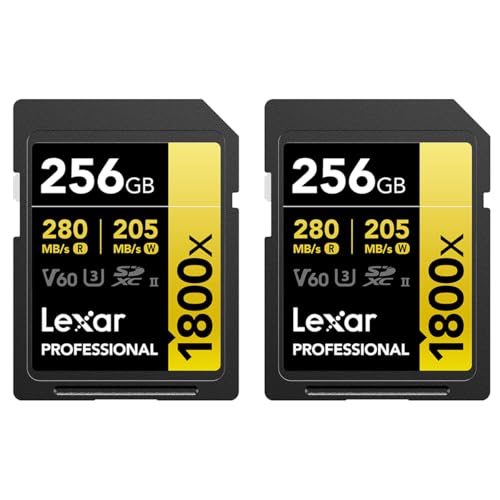
The Lexar 1800X is this pool’s exercise in buying on lineage. Its recorded title states the line name, the capacity and the format — 1800X, 256GB, SDXC — and no bus, no class, no figure. The 1800x designation belongs to Lexar’s professional multiplier naming tradition, the same heritage as the 1667x line that appears in this batch’s cinema guide with its credentials fully printed; but heritage is not paperwork, and this guide will not transfer the sibling line’s specifications across listings. What can be said is what the name and capacity say: a professional-line card at the size slow-motion days consume.
That makes this pick’s review the most protocol-heavy in the list, and it should be read as such. On arrival: read the delivered card’s face for its bus and class marks, which are the credentials that count. In documentation: confirm the card’s class against your camera maker’s published requirement for your slow-motion modes. At home: run the session test — back-to-back takes, warm card, third full — before any footage that matters depends on it. A card that clears those three gates has earned its place in the drawer on evidence, which is the only currency this guide ultimately accepts.
Why keep such a pick in a guide that prizes paperwork? Because capacity and lineage are real axes of the market, and Lexar’s professional cards are stocked, discounted and warrantied through channels many shooters already use. A guide that listed only perfectly titled products would be a guide to a market that does not exist. The honest service is the one performed here: the pick is present, its documentation gap is labelled in the largest type the review can give it, and the verification path is spelled out step by step.
There is also a fleet scenario where this card is the rational first choice: the shooter standardising an entire kit on Lexar professional media across cameras — cinema body, stills body, slow-motion body — for whom one maker’s behaviour across every slot simplifies media management more than any single title’s paperwork could. That shooter will run the tests anyway; they always do. For them, 256GB of the house line is a system purchase, and the guide’s protocols are already their habits.
There is one more scenario where this pick’s capacity quietly wins: the slow-motion B-roll library. Shooters who build a personal library of high-frame-rate material — water, fire, crowds, machinery — accumulate it in dedicated cards that live outside the job rotation. A 256GB professional-line card is a shelf of that library in itself, and buying it for the archive, with the verification ritual run once at the start, is a legitimate life for a card whose paperwork asked questions its performance then answered.
- Capacity: 256GB, per the listing title
- Format: SDXC, full-size
- Series: 1800X, Lexar’s professional multiplier line
- Bus: not stated in the listing title — verify with Lexar documentation and the delivered card’s face marks
- Video class: not stated in the listing title — verify with Lexar documentation
- Read/write figures: not stated in the listing title
Strengths
- 256GB capacity matched to slow motion’s appetite.
- Professional Lexar lineage and the fleet consistency that comes with it.
- Wide channel availability through Lexar’s established retail presence.
Trade-offs
- The pool’s thinnest paperwork: bus, class and figures all unstated in the title.
- Every credential must be established by the buyer’s own verification.
- Lineage is a reason to test the card, never a reason to skip testing it.
Best for: a Lexar-standardised shooter who verifies every card as standing practice and wants slow-motion capacity in the house line. Not suited for: a first-time slow-motion buyer without a testing habit, where the pool’s printed V90 cards carry their credentials with them.

SANDISK 256GB Extreme PRO SD Memory Card, Up to 310MB/s Read Speeds, UHS-II — Fastest stated read
The second SanDisk listing in this pool is the first one’s mirror: where its sibling printed nothing, this one prints the pool’s largest number — up to 310MB/s read speeds — alongside the Extreme PRO name, 256GB and the UHS-II bus. That figure is a transfer figure, and this guide will give it its due in exactly that role: slow-motion days generate the heaviest files in ordinary camera work, and a card that empties at the pool’s fastest stated rate, through a matched UHS-II reader, returns real time to the end of every such day. Offload speed is a quality-of-life specification, and at 310MB/s this card leads the pool in it.
The write side of the title, however, is silent — no class, no write ceiling — and slow motion is bought on the write side. So the review’s structure repeats the guide’s standing bargain with SanDisk’s professional line: the family is the industry’s reference professional tier, the bus is stated, the capacity is right, and the sustained floor must be established by the delivered card’s face marks, the maker’s documentation, and the home session test. Owners who run that ritual — and this guide argues every slow-motion shooter should, for every card — will find this pick’s combination of capacity and transfer speed genuinely compelling.
Distinguish the two SanDisks in this pool clearly before ordering, because their listings are easy to confuse at a glance: this is the one whose title carries the 310MB/s read figure. If your workflow’s pain is the evening transfer — the multi-hundred-gigabyte slow-motion day that must be verified before sleep — this is the SanDisk aimed at you. If your pain is paperwork, the pool’s printed V90s remain the straighter path, and the final recommendation below keeps that ordering honest.
One workflow note completes the picture: a stated read ceiling is only reachable through a reader that implements UHS-II at full speed, and pairing this card with an elderly UHS-I reader quietly refunds its headline advantage. The reader is part of the purchase in every practical sense; budget the pair together and the 310MB/s stops being a packet number and becomes your evening.
News and documentary turnaround is the other natural home of this pick’s one printed figure: when the slow-motion sequence is the story — the finish, the collapse, the save — the transfer is part of the deadline, and a card whose ceiling empties it fastest through a proper reader is buying minutes that editors can spend. That is a narrow, real virtue, and it belongs to this listing alone in the pool at this capacity.
- Capacity: 256GB, per the listing title
- Format: SD, full-size, UHS-II
- Read speed: up to 310MB/s, as printed in the title
- Write speed: not stated in the listing title — verify with SanDisk documentation
- Video class: not stated in the listing title — verify with SanDisk documentation and the delivered card’s face marks
- Series: Extreme PRO, SanDisk’s professional line
Strengths
- Highest stated read figure in the pool, at up to 310MB/s.
- 256GB capacity with the UHS-II bus stated outright.
- Extreme PRO professional family behind the card.
Trade-offs
- Write class unstated; the floor slow motion spends is unverified by the title.
- Read ceiling needs a UHS-II reader to become real.
- Two similar SanDisk listings in one pool demand care at ordering.
Best for: a high-volume slow-motion shooter whose bottleneck is the verified evening offload, and who tests cards as a standing habit. Not suited for: a buyer choosing on the big number alone, since the figure governs transfers while the unstated write floor governs the recording itself.
What Does a Slow-Motion Session Do to a Card Over a Season?
A season of slow-motion work is a particular kind of ageing. The writes are long, the cards run warm, the fills are deep — a slow-motion card may write its full capacity several times in a single event week, where a stills card takes a season to do the same. Flash memory wears by writing, so the slow-motion drawer ages faster than any other in the building, and its management should be planned on that basis: cards bought in dated batches, their purchase month marked on the case, and a retirement horizon thought about in seasons rather than in the decades owners casually grant their stills media.
The practical consequence is a rotation of a different kind — not within the day, but across the year. New cards enter at the top of the drawer and take the headline events; last season’s cards, still perfect on their records, take the training sessions and the second camera; the season before that’s cards drift to ordinary video and stills, where a failure costs a frame instead of a moment. Nothing is wasted, everything is demoted by evidence, and the drawer as a whole is always younger at the top than the work deserves — which is the correct direction for the inequality to run.
Budget honesty belongs in this section too. Slow-motion media is a consumable with a professional appetite, and productions that price it as a one-time capital purchase discover the truth at the worst moment of the third season. Treat the drawer as a rolling programme — a pair a year, say, sized to your calendar — and the cost becomes a predictable line instead of a surprise failure. The picks in this guide span the paperwork and capacity range precisely so that a programme like that can be built at more than one level of commitment.
How Do Burst Stills and Slow Motion Differ as Card Workloads?
Many shooters meet slow motion from stills, carrying a burst shooter’s instincts, and the instincts mislead in instructive ways. Burst work is a sprint repeated: enormous instantaneous demand, then recovery. Its cards are judged by how much buffer they swallow and how fast the camera feels ready again. Slow motion is a middle-distance run at a punishing pace: the demand is lower than a flagship’s burst peak and utterly without recovery, sustained for the length of the take and repeated across a hot afternoon. A card can be a hero of the first discipline and a liability in the second, because the qualities are genuinely different — peak absorption versus sustained endurance.
The buffer illusion is the specific trap. In burst work, a large camera buffer forgives a modest card, absorbing the peak and metering it out to the card during the rests. In slow motion there are no rests for the buffer to exploit; once it fills — and at high frame rates it fills — the card’s sustained rate becomes the recording’s rate, and anything the card cannot sustain is simply not recorded. Owners who judge a card by how their stills bursts feel are measuring the buffer. Slow motion measures the card.
None of this makes burst cards bad purchases for their own discipline; it makes discipline-matching the skill. The shooter who works both should expect the slow-motion drawer to be specified separately, by floor rather than by feel, and should resist the economy of assuming last year’s burst hero has been promoted by familiarity. Test it under session conditions if it must serve — the guide’s standing ritual — and let evidence, not sentiment, do the promoting.
How Do the Six Cards Compare Side by Side?
| Card | Capacity | Class stated | Read figure stated | Write figure stated |
|---|---|---|---|---|
| Delkin Power | 128GB | Not stated | 300MB/s | 250MB/s |
| SanDisk Extreme PRO 256GB (silent title) | 256GB | Not stated | Not stated | Not stated |
| Sony TOUGH-G | 64GB | V90 | Max 300MB/s | Max 299MB/s |
| ProGrade Iridium | 128GB | V90 | Not stated | Not stated |
| Lexar 1800X | 256GB | Not stated | Not stated | Not stated |
| SanDisk Extreme PRO 256GB (310MB/s) | 256GB | Not stated | Up to 310MB/s | Not stated |
Read the table from the class column outward. Two cards certify the floor in print; one prints a serious write ceiling; three ask for verification of varying depth. Capacity and read figures — the columns marketing would sort by — sit at the right of the table where they belong: real considerations, in their proper order, after the guarantee that records the take.
How Should You Care for Cards That Record Slow Motion?
The care regime for slow-motion media is the professional regime with one addition: heat awareness. Format in the camera before a session, never delete in a computer to make room, and offload under the verified-copies rule before any card returns to service. Then the addition: slow-motion sessions warm cards as stills work never does, so build the day’s rhythm with cooling in mind — rotate to the second card between sequences rather than running one card continuously, and let a warm card rest in its case rather than in a closed pocket against the body. Cards rarely announce heat stress; they simply begin, one day, to drop the take you needed.
Retirement discipline matters more here than in any other guide in this batch, because the failure is silent until it is expensive. A card that drops a single take, stalls a recording, or needs a second insertion to mount has given its notice. Copy it, mark it, demote it to ordinary stills duty where a failure costs a frame rather than a moment, and replace it in the slow-motion drawer without a second offence being required. The drawer should hold only cards with perfect records, because the work it serves permits no other kind.
Travel adds one more care item that studio shooters never meet: airport and venue security trays, car boots and kit bags are where loose cards go to be lost, and slow-motion media is too valuable per gram to ride loose. The case is not an accessory; it is the card’s vehicle, and a card outside the camera should be inside the case with the same automaticity as a lens cap returning to a lens. Build the reflex before the first away day, not after the first loss.
Storage between sessions is the last detail: cards in their cases, cases in the camera bag’s one appointed place, full and empty populations kept visibly separate by whatever orientation code you will actually honour at midnight in a car park. Systems that survive are systems that work tired; design yours accordingly.
What Mistakes Do Slow-Motion Shooters Make When Buying Cards?
The first is sorting by read speed, the industry’s favourite misdirection, and arriving at the session with a card whose transfer pace is magnificent and whose sustained floor is a rumour. The second is buying UHS-I media for a UHS-II slot to save money, surrendering the bus headroom the camera’s high-frame-rate modes were designed around. The third is the opposite vanity: buying the flagship V90 for a camera whose slow-motion modes a V60-class card covers completely, and paying for margin a whole year of shooting never calls on — money that belonged to the second card.
The fourth mistake is testing wrong: one short clip, at home, on a cool empty card, declared a verification. Slow-motion failure lives at take seven, warm and third-full; test there or do not call it a test. The fifth is treating a dropped take as a camera glitch and continuing on the same card, when the card has just given the only warning it ever gives. Every dropped take is a retirement interview. Conduct it.
Final Recommendation
Buy the floor first. For the shooter who wants the guarantee printed and the capacity workable, the ProGrade Iridium is this guide’s first purchase: V90 stated, 128GB of rotation-friendly room, a specialist maker behind it. The Sony TOUGH-G is its equal in class and its superior in paperwork and armour, at a session-sized 64GB that suits deliberate, take-based work. The Delkin Power is the write-forward alternative for the tester, and the two SanDisk listings and the Lexar serve fleet owners and transfer-burdened workflows whose verification rituals are already standing habits.
One last operational word: order the pair together, from the same listing, in the same week. Cards bought as a matched purchase share a production era and arrive with identical paperwork, which makes the session test a single verdict on the drawer rather than two separate judgements — and when a card in the pair eventually retires, its sibling’s age and history are known quantities rather than archaeology. Slow-motion kits are small; keep their biographies simple.
Slow motion exists to rescue moments too fast for the eye; the right card is the one that never makes you choose between watching the moment and trusting the media.
Frequently Asked Questions
What does V90 mean, and is it required for slow motion?
V90 is a video speed class certifying a minimum sustained write in the ninety-megabyte class under the SD Association’s testing. Whether your camera’s slow-motion modes require that class depends on the modes themselves; camera makers publish the card requirement for their high-frame-rate settings, and that published figure is the authority. Buy the class that covers your modes with margin — which is V90 for the most demanding SD-slot work, and a lower class for many real modes.
Why does this guide not state which frame rates each card supports?
Because frame-rate support is a property of the camera, its mode and its data rate together, not of the card alone — and any table printed here would be wrong for most readers’ cameras. Your camera’s documentation states the card class its modes require; this guide’s method — match the certified floor to that requirement, then test at your exact settings — works for every camera, which a printed table never could.
Is a stated write speed like 250MB/s the same as a V90 guarantee?
No. A stated write figure is the maker’s ceiling under favourable conditions; a V class is a certified minimum sustained rate under the standard’s test. Ceilings describe the best the card can do, floors describe the worst it is certified to do, and slow motion spends the floor. This is why the Delkin’s printed write ceiling is treated here as strong intent, while the Sony’s and ProGrade’s V90 marks are treated as guarantees.
Can a UHS-I card be used for slow motion in a UHS-II slot?
It will mount and record, at UHS-I behaviour — which surrenders exactly the headroom high-frame-rate modes are built around. For occasional, moderate slow-motion work a good UHS-I card may hold; as a buying recommendation for this discipline it fails the margin principle, and every pick in this guide is UHS-II for that reason.
How many cards should a slow-motion kit hold?
A working pair at your chosen class, minimum, with the rotation and offload discipline the care section describes — plus a third card if your days run long or your events cannot pause. The right count is the one where no card is ever both the only copy of a session and the card the next session needs.
Does card brand need to match across a multi-camera slow-motion shoot?
It needs to match in class and verification, not necessarily in name. Multi-camera slow-motion work multiplies every media variable, and the professional habit is to standardise the drawer on cards whose floors are certified to the same class and which have all passed the same session test in their respective bodies. Mixed brands at a verified V90 are a system; matched brands at an unverified anything are a hope. Standardise the guarantee first, the logo second, and label every card for the body it was tested in.
Why did a card that passed a short test fail during a real session?
Because the test did not resemble the session. Sustained-write weakness appears under accumulated load — repeated takes, a warming card, a filling file system — and a single cool clip exercises none of that. Test with back-to-back recordings at your working settings until the card is warm and substantially full, and play every take back; that simulation is the only audition whose verdict transfers to the day.
Related Guides
For more on fast media and how to choose it, see also: best V90 SD cards, best SD cards for 4K video and best SD cards for sports photography.