What's inside
- Key Takeaways
- Quick Picks
- How Did We Match Sound Systems to an 82-Inch Screen?
- Comparison Table
- What Room Does an 82-Inch Television Actually Need?
- How Do You Install a Multi-Box System Without Regret?
- What Mistakes Do Big-Screen Sound Buyers Make?
- What Does Q-Symphony Add, and Is It Worth Chasing?
- How Do These Systems Handle Games and Sport?
- What About Music in a Room This Size?
- How Should You Think About Value at Flagship Level?
- How Does Night Listening Work in a Flagship System?
- What Should You Check on the Television Before Ordering?
- How Do These Systems Age Over a Decade of Ownership?
- Which System Suits Which Kind of 82-Inch Household?
- What Does the Subwoofer Owe a Room This Large?
- What Should Happen in the First Week of Ownership?
- How Do You Keep a Big System Welcome in a Shared House?
- Final Recommendation
- Frequently Asked Questions
- Related Guides
As an Amazon Associate I earn from qualifying purchases. This post may contain affiliate links at no extra cost to you.
gizmoverdict.com is reader-supported. When you buy through links on our site, we may earn an affiliate commission.
Where to buy: Every system below links to a listing verified in this site’s product pool. These are flagship-class packages — bars with subwoofers and rear speakers — and the guide grades them on scale, room fit and honesty about what their channel counts can and cannot do in a real room.
Choosing the best soundbars for 82 inch tv owners is a problem of proportion. An 82-inch screen is not a television so much as a wall that shows films, and a sound system that would flatter a 55-inch set can sound like a radio left on in the next county beneath it. Dialogue must travel further, effects must widen to meet the picture’s edges, and the low end must fill a room that is usually large because the screen demanded one. Every pick in this roundup is therefore a multi-piece system: a substantial bar, a subwoofer, and rear speakers in some form, because at this screen size those pieces stop being upgrades and become the entry fee.
The six divide by philosophy. Samsung fields two generations of its 11.1.4 flagship formula. LG answers with two systems built around truly wireless rear speakers. Sony offers a 5.1 system of the traditional wired-rear school at a step down in ambition. JBL closes the list with a flagship whose surround speakers detach from the bar itself. What unites them is that none is a bare soundbar, and what separates them is how each expects a large room to be wired, furnished and lived in.
Key Takeaways
- At 82 inches, a bar alone is outmatched; all six picks are systems with subwoofers and rear speakers, by design rather than by upsell.
- Samsung’s Q990D and Q990F share an 11.1.4 layout with wireless Dolby Atmos and rear speakers included — the F is the newer generation, bundled in its listing with extended coverage.
- LG’s S90TR and S80TR distinguish themselves with true wireless rear speakers, removing the cable question that dominates other systems’ installations.
- Sony’s HT-S40R is the traditionalist: a 5.1 system whose simplicity and wired architecture suit rooms that can run cables once and forget them.
- JBL’s Bar 1300XMK2 detaches its surround speakers from the bar, serving rooms where rears can appear for film night and vanish afterwards.
- Room size, ceiling shape and seating distance will decide among these six more than brand preference will.
Quick Picks
| Pick | Badge | Why it earns its place |
|---|---|---|
| SAMSUNG Q990D | Most Complete System | 11.1.4 channels, wireless Dolby Atmos audio, rear speakers included and Q-Symphony television pairing. |
| Samsung HW-Q990F | Newest Samsung Flagship | The Q Series successor at 11.1.4 with subwoofer and rear speakers, its listing bundling two-year extended coverage. |
| LG S90TR | LG’s True Wireless Answer | 7.1.3 channels with true wireless rear speakers for rooms that refuse rear cabling. |
| LG S80TR | Step-Down LG With Real Rears | 5.1.3 channels keeping the true wireless rear design at a lower rung of the range. |
| Sony HT-S40R | Wired-Rear Value System | A 5.1 home theatre system of the classic school — bar, subwoofer and rears, honestly specified. |
| JBL Bar 1300XMK2 | Detachable Flagship | Dolby Atmos with surround speakers that detach from the bar for film night and dock afterwards. |
How Did We Match Sound Systems to an 82-Inch Screen?
The first criterion was scale honesty. An 82-inch television anchors rooms where the main seat commonly sits ten to sixteen feet from the screen, and sound thins with distance in ways no specification can repeal. Systems were therefore favoured when their titles confirmed the architecture that distance demands: multiple channels, a real subwoofer, and rear speakers that place effects behind the listener rather than simulating them from the front. All six pool picks for this keyword met that bar, which is itself a finding — the market knows what this screen size requires.
The second criterion was installation realism. Rear speakers divide into three schools in this list: wireless pairs that still need power, wired pairs fed from a subwoofer or amplifier, and JBL’s battery detachables that need nothing but a charging habit. Each school suits a different house, and the verdicts grade the match rather than declaring a universal winner. Ceiling shape entered the assessment too, because the Atmos ambitions in these titles depend on height effects reaching the listener — vaulted and beamed ceilings tax every up-firing design equally.
Finally, television pairing was weighed without superstition. Same-brand features like Samsung’s Q-Symphony, which lets the television’s own speakers join the system, are genuine conveniences; they are not requirements, and a cross-brand system properly connected by eARC will outperform a same-brand system badly placed. Placement beats pedigree at this size, every time.

SAMSUNG Q990D — Most Complete System
The Q990D is the reference against which this category is usually measured, and its title states the formula without ornament: 11.1.4 channels, wireless Dolby Atmos audio, rear speakers included, and Q-Symphony. Eleven ear-level channels, one subwoofer and four height channels is the fullest layout in this roundup, and beneath an 82-inch screen it earns that fullness honestly — the soundstage can be as wide as the picture, effects can genuinely orbit, and height material has dedicated channels rather than processing promises.
The wireless architecture deserves precise description, because “wireless” in flagship systems means something specific: the bar, subwoofer and rear speakers communicate without signal cables, while each box still needs mains power. Rooms gain freedom from long cable runs, not from sockets. Within that honest definition, the Q990D’s arrangement is liberating — rears can sit where the room wants them, the subwoofer can hunt for its best corner, and the only wire crossing the space is the one the household chooses to hide.
Q-Symphony is the Samsung-television dividend: the set’s own speakers join the system rather than falling silent, widening the front stage further. Owners of other television brands lose that layer and keep everything else, which remains a great deal. The Q990D’s real demand is commitment — four boxes to place well, a room large enough to justify them, and a household that will leave the geometry alone once calibrated. Given that commitment, it is the most complete answer this guide can give an 82-inch screen.
One further virtue appears only after weeks of ownership: consistency. A system with dedicated speakers for every channel does not lean on processing tricks that vary by content type, so broadcast sport, streamed drama and disc-based films all arrive with the same composed balance. Households upgrading from years of television speakers often describe the difference less as louder or bigger than as settled — the sound simply stops being a subject of attention, which at flagship level is the highest available praise.
- Configuration: 11.1.4 channels (per listing title)
- Atmos delivery: wireless Dolby Atmos audio (per listing title)
- Rear speakers: included (per listing title)
- Television pairing: Q-Symphony (per listing title)
- Power note: each box still needs a mains socket
Strengths
- Fullest channel layout in this roundup
- Wireless links free the rears from signal cabling
- Q-Symphony adds the television’s speakers on Samsung sets
Trade-offs
- Four boxes demand placement care and sockets
- Height effects depend on a cooperative ceiling
- Oversized for rooms that merely squeezed the screen in
Best for: a large, settled media room with a Samsung television and film-first viewing.
Not suited for: a room where rear speakers would need to move for every gathering.

Samsung HW-Q990F — Newest Samsung Flagship
The Q990F is the Q Series’ next generation, and its listing title keeps the family’s 11.1.4 architecture — subwoofer and rear speakers included — while adding a detail the D’s title lacks: a two-year extended coverage bundle, named in the title through the Amber programme. That bundling is worth noticing for what it signals rather than what it promises. Flagship systems are long-term furniture; a listing that packages extended coverage acknowledges the ownership horizon honestly, and buyers comparing the two Samsung generations should count it among the F’s practical differences.
Generational steps in flagship soundbars are rarely revolutions, and readers should not expect the F to invalidate the D. The meaningful questions are the ownership ones: newer production, longer manufacturer attention, and the refinements a flagship line accumulates year over year in tuning and connectivity behaviour. In the room, both systems pursue the same goal — a seamless dome of sound around an enormous picture — and either will overwhelm an 82-inch screen’s own speakers so completely that the comparison between them is a matter of fine margins and purchase timing.
Choosing between the Samsungs therefore comes down to circumstance. A household buying the television and sound together today will naturally lean to the current F, coverage bundle included. A household that finds the D favourably positioned during a model changeover loses remarkably little. What neither buyer should do is split the difference with a lesser system out of indecision: at this screen size, the flagship formula is the point, and both generations deliver it.
The F also inherits the family’s one standing instruction: give the calibration room to work. Systems of this density measure and adjust to the space, and furniture moved afterwards quietly unmakes their work. Set the room, run the setup, and then defend the geometry against domestic drift — the system will repay the discipline every single evening.
- Configuration: 11.1.4 channels (per listing title)
- System contents: subwoofer and rear speakers (per listing title)
- Coverage: two-year extended coverage bundled in the listing (per listing title)
- Series: Q Series flagship generation following the Q990D
- Atmos: wireless Dolby Atmos is the Q Series formula (per family listing)
Strengths
- Current-generation flagship with the fullest layout
- Extended coverage bundled at purchase
- Same complete architecture as the reference Q990D
Trade-offs
- Generational gains over the D are refinements, not reinvention
- Flagship footprint and socket count apply in full
- Coverage bundle’s terms should be read before valuing it
Best for: a buyer purchasing screen and sound together who wants the current flagship generation.
Not suited for: a bargain hunter — the Q990D serves that instinct better during changeovers.

LG S90TR — LG’s True Wireless Answer
LG’s S90TR builds its identity around three words in its title: true wireless rears. Where Samsung’s rear speakers are wireless in signal yet conventional in form, LG leans into the cable-free proposition for the surround pair in a 7.1.3 home theatre layout — seven ear-level channels, a subwoofer, and three height channels. For the many large rooms where the sofa floats in open space and any cable to the rears must cross a doorway, a rug’s border or a partner’s patience, that proposition is not a convenience but the difference between surround sound existing and not existing.
The channel count invites a comparison the guide should make carefully. 7.1.3 against Samsung’s 11.1.4 is a real difference in paper architecture, and in very large rooms the Samsung’s additional channels can render motion more granularly. But a slightly leaner system that can actually be installed as designed will outperform a denser system whose rears end up misplaced for cabling reasons. The S90TR’s wager is that installation truth beats specification arithmetic, and in open-plan houses — the natural home of 82-inch screens — that wager wins often enough to take seriously.
LG television owners gain the family’s usual pairing courtesies, though as with Q-Symphony, the system stands on its own through eARC with any brand. The S90TR’s natural buyer has already walked the room, imagined the cable runs, and rejected them. For that buyer, this is not the second-best system in the list; it is the only architecture that fits the house, wearing a flagship’s clothes.
Ownership rhythm matters with wireless rears of any brand: keep their firmware in step with the bar’s through the maker’s app, and resist scattering them to decorative positions far from the listening seat. Surround speakers earn their keep at ear height behind the shoulders, and wireless freedom is best spent achieving exactly that placement without a cable argument, rather than achieving a merely convenient one.
- Configuration: 7.1.3 channels (per listing title)
- Rear speakers: true wireless (per listing title)
- System type: home theatre soundbar package (per listing title)
- Subwoofer: included in the channel count
- Best architecture for: open-plan rooms with floating sofas
Strengths
- Rear placement freed from signal cables entirely
- Height channels included for Atmos material
- Installs as designed in rooms that defeat wired rivals
Trade-offs
- Fewer channels than the Samsung flagships
- Wireless rears still need power and firmware care
- Leaner architecture shows in the very largest rooms
Best for: an open-plan room where the sofa floats and rear cables are impossible.
Not suited for: a dedicated cinema room with cable channels already built in.

LG S80TR — Step-Down LG With Real Rears
The S80TR keeps the S90TR’s defining idea — true wireless rear speakers — and steps the architecture down to 5.1.3 channels. That step deserves defence rather than apology. Five ear-level channels with a subwoofer and three height channels is the layout most film soundtracks are actually mixed around, and in rooms at the smaller end of the 82-inch world — the screen is huge, the seating is twelve feet away, the walls are not far behind — the S80TR’s simpler array can be the more coherent one, with fewer channels competing to fill a space that does not need them.
The buyer profile sharpens accordingly. This is the system for the household that wants the LG wireless-rear freedom and genuine surround, without flagship density or flagship commitment. Television series, sport and streamed films — the actual diet of most large screens — live comfortably inside 5.1.3, and the height channels keep Atmos material honest. What is surrendered against the S90TR is headroom for the grandest rooms and the most aggressive mixes, a surrender many households will never detect because their rooms never asked the question.
There is also an upgrade-path honesty to acknowledge: systems like these are bought as packages, and the S80TR should be chosen as a destination rather than a down payment. Chosen that way — room measured, channels matched to the space, rears placed by the wireless freedom the design exists to provide — it is one of the most rational packages in this guide, the point where LG’s range stops adding architecture the room cannot hear.
Practical placement mirrors its bigger sibling: rears at ear height behind the main seat, subwoofer given a few candidate positions before judgement, and the bar centred precisely on the screen, because at 82 inches even a few inches of offset becomes visible in the sound’s relationship to the picture. The S80TR rewards that modest care with a balance that feels tailored rather than merely loud.
- Configuration: 5.1.3 channels (per listing title)
- Rear speakers: true wireless (per listing title)
- System type: home theatre soundbar package (per listing title)
- Position in range: step below the S90TR
- Best architecture for: mid-size rooms hosting a very large screen
Strengths
- Wireless-rear freedom at a lower commitment than the flagship
- Channel layout matches most real soundtracks
- Height channels keep Atmos in the picture
Trade-offs
- Less headroom for very large rooms than the S90TR
- Fewer channels render complex mixes less granularly
- Package design offers little piecemeal upgrading
Best for: a mid-size room with an 82-inch screen and a floating sofa.
Not suited for: a cavernous media barn that can hear every channel a flagship offers.

Sony HT-S40R — Wired-Rear Value System
The Sony HT-S40R is the traditionalist in a list of wireless modernists: a 5.1-channel home theatre soundbar system in which the rear speakers belong to the classic wired school, fed through the system’s subwoofer-centred architecture. Its title is the plainest here — the name, the channels, the colour — and the product matches the title’s temperament. No height channels, no detachable theatre, no app-driven novelty: five channels of surround, a subwoofer, and Sony’s long experience making exactly this category behave.
The wired design reads as a limitation only until its virtues are counted. Wired rears never need charging, never drop a wireless link, and never ask for firmware diplomacy; they are placed once, cabled once, and then forgotten for a decade. In rooms with a rug to run cables beneath, a sofa against a wall, or a planned installation where wires can be hidden at setup, that permanence is not a compromise at all. It is the reason systems of this architecture filled living rooms for a generation.
Against an 82-inch screen, the S40R’s honest ceiling is scale. A 5.1 layout without height channels will not reproduce the Atmos dome the flagships construct, and its components are sized for rooms at the modest end of this screen class. What it offers instead is proportionate value: genuine surround geometry, a real subwoofer, and a price of admission — in complexity as much as money — far below the flagships. For the household whose 82-inch set hosts sport, series and family films rather than reference cinema, that proportion may be the wisest money in this guide.
Sony’s tuning character completes the case. The company’s systems favour a composed, dialogue-respecting balance that flatters the broadcast material large televisions actually show most, and in a family room that temperament ages better than showroom drama. Buy the S40R for the room’s real diet, place its wired rears with the care permanence deserves, and it will still be doing its job when flashier systems are two firmware generations into retirement.
- Configuration: 5.1 channels (per listing title)
- System type: home theatre soundbar system (per listing title)
- Rear speakers: wired school, fed through the system architecture
- Height channels: none in the stated layout
- Colour: black (per listing title)
Strengths
- Wired rears: no charging, pairing or link dropouts
- Genuine 5.1 surround geometry with a real subwoofer
- Composed tuning suits broadcast and family viewing
Trade-offs
- No height channels for Atmos overhead effects
- Cable runs must be planned and hidden at setup
- Scale suits the smaller end of 82-inch rooms
Best for: a family room that can hide cables once and wants surround without flagship complexity.
Not suited for: a renter forbidden from running any cable across the room.
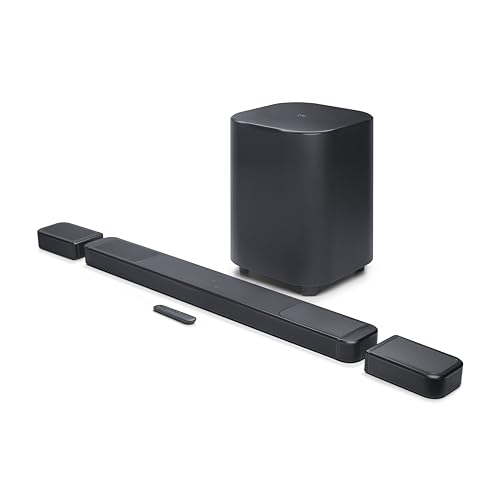
JBL Bar 1300XMK2 — Detachable Flagship
JBL’s flagship answers the rear-speaker problem with theatre: the Bar 1300XMK2’s surround speakers detach from the ends of the main bar, move to the back of the room for film night, and dock home to recharge when the credits roll. Its title confirms Dolby Atmos and the detachable design, in the MK2 generation of JBL’s range-topping concept. Beneath an 82-inch screen the proposition is distinctive — flagship immersion on demand, in a room that returns to a clean single-bar silhouette every morning.
The detachable idea is sometimes dismissed as a gimmick by owners of dedicated cinema rooms, which misses its actual market entirely. This system is for the beautiful, compromised rooms where most 82-inch televisions live: the open-plan space that is kitchen, office and cinema by turns, where permanent rear speakers would colonise a dining area. Battery rears dissolve the colonisation. They also travel — a garden screening, a borrowed projector evening — in a way no wired or socket-bound rival can imitate.
The ownership contract is the charging habit, stated plainly. Rears left behind the sofa for a fortnight will be flat when wanted; households with reliable routines will never notice the requirement, and households without them should choose the always-ready LG or Samsung architectures instead. JBL’s sound signature — bold, cinematic, generous in the low end through its subwoofer — suits the flagship film brief, and the MK2’s refinements polish a concept the first generation proved in real rooms.
One placement dividend deserves note: because the rears are repositioned for each serious session, listeners can tune their distance and angle to the evening’s seating rather than to a fixed furniture plan. Film night with guests arranged differently is no longer a compromise the system was calibrated against in another season. Flexibility of that kind is a genuine acoustic feature, and only this architecture in the guide offers it.
- Format named: Dolby Atmos (per listing title)
- Surround: detachable speakers docked in the bar (per listing title)
- Generation: MK2 flagship (per listing title)
- Subwoofer: part of the Bar flagship system layout
- Ownership rhythm: rears recharge by docking
Strengths
- True surround that disappears into the bar afterwards
- Rears can be repositioned for each session’s seating
- Bold cinematic tuning with flagship low end
Trade-offs
- Detachable rears depend on a charging habit
- Single-bar mode between sessions is a lesser system
- Flagship complexity at setup exceeds the Sony’s
Best for: an open-plan showpiece room that becomes a cinema on film night only.
Not suited for: detachable rears left docked and forgotten until their batteries run flat — the charging habit is the price of this design.
Comparison Table
| System | Channels | Rear style | Defining trait |
|---|---|---|---|
| SAMSUNG Q990D | 11.1.4 | Wireless, included | Q-Symphony flagship formula |
| Samsung HW-Q990F | 11.1.4 | Included | Newest generation, coverage bundle |
| LG S90TR | 7.1.3 | True wireless | Cable-free surround placement |
| LG S80TR | 5.1.3 | True wireless | Step-down with real rears |
| Sony HT-S40R | 5.1 | Wired | Traditional value system |
| JBL Bar 1300XMK2 | Atmos system | Detachable, battery | Surround that packs away |
What Room Does an 82-Inch Television Actually Need?
Before choosing among these systems, measure the room the way the sound will experience it. Seating distance is the governing figure: at ten feet, the S80TR’s architecture is ample; at sixteen, the Samsung flagships’ channel density starts paying rent. Ceiling height and shape govern the Atmos question — flat ceilings of ordinary height reflect height channels as designed, while vaulted, beamed or very high ceilings scatter them, narrowing the real-world gap between the height-equipped systems and the Sony’s honest 5.1. Wall construction matters at the margins: masonry rooms hold bass tightly, stud-wall rooms leak it to the neighbours, and both facts should tune the subwoofer’s final level more than any preset does.
Furniture completes the acoustic picture. A large screen usually faces a large sofa, and upholstered mass behind the listener is a gift to surround placement — rears can sit on side tables or stands at ear height with their sound absorbed rather than echoed. Glass-heavy modern rooms, by contrast, return every effect twice, and in them the composed tunings and careful calibration routines of the flagship systems earn their keep nightly. Measure honestly, and the shortlist often shortens itself.
How Do You Install a Multi-Box System Without Regret?
Sequence is everything. Place the bar first — centred on the screen, front edge of the stand, clear of the television’s sensor — and connect it by eARC before any other box leaves its packaging, confirming that ordinary television sound works through the bar alone. Add the subwoofer second, trying at least two positions: bass that booms in one corner may sit perfectly a metre along the wall, and the difference costs only patience. Add the rears last, at ear height when seated, angled toward the main seat, and only then run the system’s calibration with the room in its real evening state — curtains as they will be, doors as they will be.
Cable and power discipline separates installations that age well from those that unravel. Wireless boxes still need sockets; plan them before the furniture settles, keep power leads off the floor’s traffic paths, and photograph the rear connections before pushing the stand back, because future-you will bless that photograph. Finally, live with the calibration for a week before fine-tuning levels by ear. New owners who chase perfection on night one usually tune the system to a demo scene; a week of ordinary viewing reveals the levels the household actually wants.
What Mistakes Do Big-Screen Sound Buyers Make?
The defining mistake is buying a bar alone for a screen this size and discovering the mismatch at leisure. The second is its mirror image: buying the densest flagship for a room whose seating sits eight feet away, where half its channels have no space to distinguish themselves. The third is treating “wireless” as “no wires anywhere” and planning no sockets for the rears — every system here except JBL’s battery pair needs power at the back of the room, and JBL’s needs a household that remembers chargers exist.
A fourth mistake is ignoring the television’s settings after spending flagship money: the set must be told to output through eARC, to pass the formats the system can decode, and to stop helping with its own processing. Ten minutes in those menus is the cheapest performance upgrade in this entire guide, and skipping it leaves premium systems fed on leftovers.
A fifth mistake is measuring the screen and forgetting the audience. An 82-inch television in a room where most viewing happens from a kitchen counter or a desk chair at the side is not the same proposition as the same screen facing a dedicated sofa, and the system’s rear speakers, subwoofer position and calibration should all be aimed at the seats that are actually occupied — including the unglamorous ones. Sound follows the household’s real geography or it follows nobody, and the calibration microphone does not know which chair matters until the owner tells it by placing the main seat honestly at the centre of the plan.
What Does Q-Symphony Add, and Is It Worth Chasing?
Q-Symphony, named in the Q990D’s title, lets a Samsung television’s built-in speakers play alongside the soundbar system instead of muting themselves the moment a bar connects. The practical gain is a broader, taller front stage: the screen’s own drivers sit higher than the bar and can reinforce the sense that dialogue and effects emanate from the picture itself. On a large Samsung set the effect is genuinely pleasant, and owners of those televisions should count it as a real, if secondary, reason to favour the Samsung systems in this list.
Secondary is the operative word. Q-Symphony refines a flagship system; it does not rescue a weak one, and its absence in a cross-brand pairing costs far less than poor placement of the system that replaces it. A household with an LG or Sony screen should feel no pressure to change televisions for a sound feature. The correct hierarchy is room, architecture, placement, and only then brand synergy — a hierarchy this guide has applied in every verdict, and one that keeps the two Samsung flagships recommended for their channel architecture first and their television trick second.
How Do These Systems Handle Games and Sport?
An 82-inch screen is a gaming monument, and these systems divide interestingly under that load. The flagship Samsungs and the JBL bring the low-latency, eARC-fed performance modern consoles expect, with surround layouts that place a game’s audio cues — footsteps, weather, crowd swell — in genuine space around the player. The detachable JBL rears have a particular gaming charm: a player can bring the surround pair close for a solo session, enjoying a near-field bubble that fixed installations cannot offer, then dock them when the room returns to family duty.
Sport rewards a different virtue: stability. Commentary must stay nailed to the centre while crowd noise breathes around it for three hours, and systems with dedicated centre architecture — which is to say all six here, in their different ways — hold that balance without the pumping and wandering that afflicts television speakers. The Sony S40R, for all its modesty beside the flagships, is a notably composed sport system, one reason it suits the family rooms where most big-screen sport is actually watched.
What About Music in a Room This Size?
Large rooms ask music systems for scale, and the multi-box packages here answer with the same hardware they aim at films. The Samsung flagships’ channel density creates a genuinely enveloping stereo image when fed good material, the LGs offer their wireless convenience for whole-room listening, and the JBL’s subwoofer gives bass-led genres a physical ease the others approach only at higher effort. None of these systems was designed music-first, and a dedicated hi-fi would out-refine them all in a small room — but the room in question is not small, and filling it pleasantly is precisely the talent on sale.
Everyday music behaviour matters as much as the showcase: how the system wakes for a morning radio stream, whether a phone can hand it a playlist without a ceremony, and how it behaves at the low volumes of background listening while the household works around it. Judge those behaviours during the returns window with the household’s real habits, because a system loved for film night but ignored for music is using half its purchase. The flagships in particular repay being treated as the room’s main speakers in every sense, not merely its cinema voice.
How Should You Think About Value at Flagship Level?
These six systems span a wide band of commitment, and the honest value question is not which is cheapest but which architecture the room will actually exploit. A Q990F installed in a room that seats four people nine feet from the screen is money spent on channels nobody can distinguish; an S80TR in the same room is not a compromise but a match. Conversely, the S40R asked to fill a converted barn will be condemned for a failure of arithmetic that was the buyer’s, not Sony’s. Value at this level is fit, measured in years of evenings where the system and the room agree with each other.
Longevity reinforces the point. Soundbar systems of this class commonly serve through two televisions, and the parts that age are the smart features rather than the speakers. Buy the acoustic architecture for the decade and treat connectivity as the renewable layer, and either flagship becomes a defensible anchor purchase. Buy for a feature list instead, and the system will feel dated while its speakers are still in their prime — the most expensive mistake in the category, because it triggers replacement of hardware that had years left to give.
How Does Night Listening Work in a Flagship System?
Power creates a domestic problem: the same subwoofer that makes a starship landing physical at eight in the evening makes it antisocial at midnight, particularly in rooms whose size suggests a detached house but whose walls adjoin a neighbour’s anyway. Every system in this class offers some form of level control over its low end and overall dynamics, and the households that thrive with flagship systems are the ones that build a night configuration deliberately — subwoofer trimmed, overall volume capped by habit, dialogue still clear at the reduced level because the centre architecture does not depend on loudness to work.
This is another quiet argument for genuine multi-channel systems over a single loud bar. A flagship can whisper convincingly because its clarity is structural: dedicated speakers near the listener’s ears, front and rear, deliver detail at low absolute volume. A lone bar must push its whole presentation from the front, and at night levels the rear of the room hears a murmur. Families with staggered bedtimes should audition the night configuration as seriously as the demo crescendo; it is the configuration the system will use for a third of its life.
What Should You Check on the Television Before Ordering?
The television is half the system, and its checklist is short but absolute. Confirm an HDMI socket labelled ARC or eARC exists and note which one it is, because on many large sets only one socket carries the full feature set. Confirm the set can pass through the audio formats the chosen system decodes, in its sound menu’s digital output options. Check the stand or wall-mount geometry against the bar’s width and height: flagship bars are wide and tall enough to trouble an 82-inch set’s lower bezel or its remote sensor when the screen sits on a low stand, and a slim riser solves a problem that is much easier to foresee than to forgive.
Also count the household’s sources. Consoles, disc players and streaming boxes should connect to the television, with the bar fed by the single eARC path, unless the bar itself offers the inputs and switching the household prefers. Deciding that topology before the system arrives turns installation day into assembly rather than architecture, and it prevents the commonest flagship complaint of all — not that the system sounds poor, but that nobody can remember which remote makes the film start.
How Do These Systems Age Over a Decade of Ownership?
Speakers are among the longest-lived electronics in a house, and flagship systems compound that durability with modularity of a sort: a subwoofer can be repositioned as rooms change, rears can follow a sofa to a new house, and the whole package can migrate from a living room to a dedicated media space when the household’s fortunes allow. The parts that date — wireless protocols, app interfaces, format support — sit in the bar itself, which is also the part most likely to be carried forward by firmware for years after purchase by the major makers represented here.
The ownership habit that protects that lifespan is boring consistency: keep firmware current, keep the calibration honest by re-running it after furniture moves, and keep dust and heat away from the bar’s vents in the media unit. Households that do so routinely hand systems like these down a room or a generation. That prospect belongs in the purchase calculation — a flagship divided by twelve years of evenings is a different proposition from the same flagship divided by three, and the build quality on this page is priced for the longer arithmetic.
Which System Suits Which Kind of 82-Inch Household?
Profiles clarify what specifications blur. The dedicated film household — lights dimmed, discs and premium streams, a sofa that has not moved in years — is Samsung territory, with the Q990D as the settled choice and the Q990F for those buying the whole wall today. The design-led open-plan household, where the screen shares space with a kitchen and a dining table, belongs to LG’s wireless rears or JBL’s vanishing ones, the choice between them turning on whether surround should be permanent-but-cableless or occasional-but-total. The family room that happens to have a huge television — sport on Saturdays, cartoons at dawn, a console in between — is the Sony S40R’s parish, where durability and simplicity outrank the last degree of immersion, with the S80TR waiting for the same family in a room whose sofa floats.
Notice what does not appear in those profiles: a household for whom a bare bar suffices. At 82 inches there is no such household in this guide’s judgement, only households at different distances from the flagship ideal. Naming that honestly is the roundup’s real service, because the expensive error at this screen size is not choosing the wrong system — it is choosing a category too small and spending the following year apologising for it.
What Does the Subwoofer Owe a Room This Large?
Low frequencies are where large rooms stop forgiving. A subwoofer that fills a modest lounge can sound lost in a high-ceilinged space, not because it is weak but because the air volume it must pressurise has multiplied. Every system here includes a subwoofer sized by its maker for the package’s ambitions, and the flagships’ units are substantial; the buyer’s contribution is placement and restraint. Corner loading buys output at the price of boom, wall-adjacent positions trade a little drama for evenness, and the correct setting is the one where dialogue scenes carry no rumble the scene did not intend.
Large rooms also tempt owners toward a second subwoofer someday, and while none of these packages is being sold here as a component ecosystem, the instinct is acoustically sound: distributed bass smooths the peaks and nulls that make one seat thunder while another hears little. Households on that path should simply know that packaged systems vary in how gracefully they accept additions, and the question belongs in the maker’s documentation, checked before the flagship money moves — one more instance of this guide’s recurring moral that the document, not the hope, should decide.
What Should Happen in the First Week of Ownership?
Resist the urge to judge the system by its first film. Spend the first evenings varying the content — a dialogue-led series, a loud premiere, a match, a concert — and note where the balance pleases and where it argues, adjusting one control at a time and writing down what changed. Multi-box systems reveal their character across material, and the household that maps that character calmly in week one stops touching the settings by week three, which is the true beginning of ownership. Keep the packaging until that week is survived; flagship boxes are large, but so is the cost of discovering a room mismatch with the cardboard already recycled.
How Do You Keep a Big System Welcome in a Shared House?
Flagship sound in a family house is a negotiation conducted in decibels, and the systems here succeed socially when their owners treat the rest of the household as part of the specification. Agree the evening ceiling for the subwoofer before the first complaint, not after. Keep the television remote as the single instrument of daily control so nobody needs a tutorial to watch the news. And when guests fill the room, resist demonstrating the system at reference level uninvited — the fastest way to make a magnificent system unpopular is to make it somebody else’s headache. The households that keep flagships longest are the ones where the sound is famous for suiting the occasion, loud when the room asks for loud and invisible when it does not, and that reputation is built by the owner’s restraint far more than by the manufacturer’s engineering.
Final Recommendation
The Samsung Q990D remains the complete answer for a settled, film-first room: the fullest layout, wireless rears, and Q-Symphony where the television allows it. The Q990F is the same argument in its newest generation, with extended coverage bundled for buyers purchasing everything today. Between them, most flagship shoppers can stop reading — the choice is timing and terms, not capability.
The LG pair owns the rooms Samsung’s arithmetic does not fit, the S90TR for larger open spaces and the S80TR for mid-size ones, both through rear speakers that go where cables cannot. The Sony S40R is the wise economy for cable-friendly family rooms, and the JBL 1300XMK2 is the showpiece for rooms that transform. An 82-inch screen deserves sound with the same sense of occasion — and in this list, the Q990D sets the standard the occasion is measured by.
Frequently Asked Questions
Can a single soundbar ever be enough for an 82-inch TV?
For casual viewing in a small room, a capable single bar still improves noticeably on the television’s speakers, but it cannot widen sound enough to meet an 82-inch picture or place effects behind the listener. That is why every pick in this guide is a system with a subwoofer and rears: at this screen size, the architecture itself is the heart of the recommendation.
What does 11.1.4 actually mean?
The numbers count channels: eleven ear-level channels, one subwoofer channel, and four height channels. The same notation runs through this whole guide, so the LG systems’ 7.1.3 and 5.1.3 figures and the Sony’s plain 5.1 can be compared at a glance once the pattern is understood. More channels let a system place sounds more precisely around and above the listener — provided the room gives those channels space to work, which is why this guide weighs room size alongside the arithmetic.
Do wireless rear speakers need power sockets?
Yes, in the Samsung and LG systems here: wireless describes the audio link between the boxes, not the power supply feeding them. Only JBL’s detachable rears run on batteries, and they repay that freedom by needing to be docked on the bar to recharge between sessions.
Will these systems work with a television from another brand?
Yes. Connect by HDMI eARC and any modern set can feed any of these systems. The one preparation worth making is to update the television’s own firmware before the system arrives, since eARC behaviour is an area makers still refine, and a set running old software can make a flawless soundbar look temperamental during its first evening in the house. Same-brand features — Samsung’s Q-Symphony is the example in this list — are bonuses layered on top, not requirements, and no system here should be excluded solely for wearing a different badge from the television.
How important is the ceiling for Dolby Atmos?
Height effects in these systems are designed around reflection from a reasonably flat, ordinary-height, unobstructed ceiling above the seating area. Vaulted or heavily beamed ceilings scatter that reflection and soften the effect. The systems still sound excellent as surround packages in such rooms; the Atmos layer simply contributes less, which may argue for the step-down picks.
Where should the subwoofer go in a large room?
Start near a front corner, where walls reinforce the low end, then try positions along the front wall while listening from the main seat to familiar material. Recruit a second person for this experiment if the household allows it — one listener seated, one moving the subwoofer in increments — because the difference between a good position and a great one is usually a single step sideways, and nobody can judge that difference from beside the subwoofer itself. The right spot is the one where bass sounds even and physical without booming on dialogue-heavy scenes; in large rooms a few feet of experimentation outweighs any rule of thumb.
How wide is the bar itself, and why does it matter at 82 inches?
Flagship bars are wide — often spanning much of a large screen’s width — and that width is functional: it separates the left, centre and right channels enough for the soundstage to track an enormous picture. On a wall-mounted installation the same width becomes a visual decision as well, since a bar noticeably narrower than the screen can look like an afterthought beneath it, while one approaching the screen’s span reads as part of the same object. Makers publish their bars’ dimensions in full documentation even when titles omit them, and at this size the tape measure deserves the same respect in the living room that it received in the short-bar guide elsewhere on this site. Measure the stand or wall space before ordering, confirm the bar will not block the television’s remote sensor, and treat any overhang beyond the stand’s edges as a reason to wall-mount rather than to balance hopefully.
Is the Q990F worth choosing over the Q990D?
For a buyer purchasing today, the F offers the current generation and a two-year extended coverage bundle named in its listing, which are real if modest advantages. Read the coverage bundle’s own terms before assigning it weight in the decision, since extended plans differ in what they repair, where, and how quickly — but even discounted to zero, the F’s case rests on being the flagship’s present tense, and that case does not need the bundle to stand. For a buyer who finds the D favourably timed during the changeover, the architecture — and therefore the experience — is essentially the flagship formula either way. Decide on timing and terms, not on anxiety.
Related Guides
For other rooms and priorities, see our guides to soundbars to match a Sony Bravia, soundbars for clear dialogue and short soundbars of 28 inches or less.


