What's inside
- Key Takeaways
- Quick Picks
- How Did We Judge Bars Meant for Hearing Dialogue Clearly?
- Comparison Table
- Why Has Television Dialogue Become So Hard to Hear?
- How Should You Set Up a Dialogue Bar for the Best Results?
- What Mistakes Do Dialogue-Bar Buyers Make?
- How Does Room Furnishing Change What a Dialogue Bar Can Do?
- What Should Two Viewers With Different Hearing Do?
- Which Programmes Test a Dialogue Bar Most Honestly?
- How Long Does a Dialogue Bar Stay the Right Answer?
- What About Headphones, Earbuds and Other Alternatives?
- How Should You Maintain Clarity Once the Bar Is Installed?
- How Do You Talk About This Purchase Inside a Family?
- What Does a Week of Living With a Dialogue Bar Teach?
- Final Recommendation
- Frequently Asked Questions
- Related Guides
As an Amazon Associate I earn from qualifying purchases. This post may contain affiliate links at no extra cost to you.
gizmoverdict.com is reader-supported. When you buy through links on our site, we may earn an affiliate commission.
Where to buy: All six bars below link to listings verified in this site’s product pool. Three come from one specialist maker whose entire reputation rests on voice clarity; the other three are mainstream bars whose dialogue behaviour is judged here on structure and tuning rather than on promises their listing titles never made.
The search for the best soundbars for hearing dialogue clearly usually begins with a small domestic frustration: a drama everyone else seems to follow effortlessly, while one viewer keeps asking what was just said. Modern television mixing deserves part of the blame — dialogue is recorded quieter relative to music and effects than it once was — and television speakers, thin and rear-firing, deserve the rest. A dedicated bar can repair both problems, but only if speech is its genuine priority rather than a bullet point beneath the bass claims.
This roundup is therefore built around evidence of intent. ZVOX designs its AccuVoice bars around voice boost with multiple adjustable levels, and three of its models anchor the list. Against them stand a Bose television speaker, an Amazon Fire TV bar with a true centre channel, and the compact Sonos Ray. One boundary is drawn firmly at the outset: ZVOX markets its technology with the phrase “Hearing Aid Technology,” and that phrase appears in this guide only as the manufacturer’s own description of its approach. Nothing here is a medical device, nothing here promises to treat hearing loss, and any reader whose difficulty extends beyond the television should raise it with a hearing professional rather than a product page.
Key Takeaways
- Adjustable voice boost is the feature that matters most: the three ZVOX bars offer six, twelve or twenty levels of lift, letting each listener find a personal setting.
- “Hearing Aid Technology” is ZVOX’s own marketing phrase for its AccuVoice approach — a manufacturer’s claim about dialogue processing, not a medical promise, and this guide treats it strictly that way.
- A true centre channel, like the Fire TV Soundbar Plus’s 3.1 layout, helps dialogue structurally by giving speech its own dedicated speaker.
- The Bose TV Speaker and Sonos Ray state no dialogue feature in their listing titles, so their clarity case rests on compact tuning and placement rather than a named voice mode.
- Volume is not clarity: raising overall loudness raises the music and effects burying the words by exactly the same amount.
- Subtitles are a complement, not a defeat — the best setup is the one where the household stops rewinding.
Quick Picks
| Pick | Badge | Why it earns its place |
|---|---|---|
| ZVOX AccuVoice AV157 | Most Adjustable Voice Boost | Twelve levels of voice lift in a dialogue-clarifying bar built for exactly this problem. |
| ZVOX AccuVoice AV835 | Finest-Grained Voice Control | Twenty levels of voice boost, the most granular adjustment in this roundup. |
| ZVOX SB500 | Fullest Sound of the ZVOX Trio | Six voice-boost levels plus a built-in subwoofer for viewers who also want body in films. |
| Bose TV Speaker (2nd Gen) | Simplest Mainstream Option | A compact Bose television speaker whose title states no dialogue mode, judged here on simplicity and tuning. |
| Amazon Fire TV Soundbar Plus | Centre Channel Advantage | 3.1 channels with a built-in subwoofer, giving dialogue a dedicated speaker of its own. |
| Sonos Ray | Compact Ecosystem Pick | The smallest bar here, from the Sonos family, with no dialogue feature stated in its listing title. |
How Did We Judge Bars Meant for Hearing Dialogue Clearly?
The judging began with the listing titles in the verified pool, because a maker’s own headline reveals its priorities. Where a title names voice boost and counts its levels, that is a product engineered around speech, and it was graded accordingly. Where a title stays silent — the Bose and the Sonos — the guide says so and evaluates those bars on what can be defended: cabinet design, channel layout, and the listening habits they suit. No dialogue mode was invented for a bar whose maker did not claim one.
Structure came next. A centre channel is not marketing garnish; it is the physical home of film and television dialogue, and a 3.1 bar routes speech to a dedicated driver instead of splitting it between left and right. Adjustability followed: hearing differs between viewers and between programmes, so a single fixed “clear voice” preset scores below a ladder of levels a listener can climb gradually. Finally, the guide weighed domestic reality — remote simplicity, cabinet size under real televisions, and whether a bar remains pleasant for the other people in the room who hear perfectly well.
Two exclusions apply throughout. No fixed prices or star ratings appear, because both drift. And no health outcome is promised for any product: these are television speakers with speech-focused engineering, assessed as television speakers.

ZVOX AccuVoice AV157 — Most Adjustable Voice Boost
The AV157 is the bar this keyword was invented for. ZVOX calls it a dialogue clarifying soundbar and gives it twelve levels of voice boost, which in practice means the listener is not asked to accept one engineer’s idea of clarity. Level three might rescue the evening news; a mumbled prestige drama might want level eight; a visiting parent might prefer ten. That ladder is the product. Everything else about the bar — its compact footprint, its straightforward remote philosophy — exists to keep the ladder easy to climb.
Understanding what the boost does helps set expectations. AccuVoice processing lifts and isolates the frequency region where speech lives while holding competing sounds down, so words emerge without the whole programme growing louder. ZVOX describes the underlying approach with its “Hearing Aid Technology” phrase, borrowing techniques from that field; treat the phrase as the company’s explanation of its processing, not as a clinical claim, and judge the bar the way its owners do — by whether the rewinding stops. For many households it does, and the twelve-step range is wide enough that most listeners find a rung below the maximum, leaving headroom for worse-mixed programmes.
The compromises are the honest ones of a specialist tool. A bar tuned this single-mindedly for speech will not deliver the cinematic low end of the subwoofer systems in other roundups, and music plays second fiddle to dialogue by design. In a household where one viewer’s clarity is the bottleneck for everyone’s enjoyment, that trade is not a weakness at all — it is the entire point, purchased deliberately.
- Voice boost: 12 levels (per listing title)
- Product type: dialogue clarifying soundbar (per listing title)
- Technology naming: AccuVoice; maker describes its approach as “Hearing Aid Technology”
- Subwoofer: none named in the listing title
- Focus: speech clarity above cinematic bass
Strengths
- Twelve-step adjustment fits different listeners and programmes
- Purpose-built for dialogue rather than adapted to it
- Compact cabinet suits smaller televisions and shelves
Trade-offs
- Low-end weight is modest beside subwoofer systems
- Music takes second place to speech in the tuning
- Maximum levels can sound processed on already-clear broadcasts
Best for: a viewer who misses lines in dramas and wants a dial, not a guess, for fixing it.
Not suited for: a film-first room that measures a bar by subwoofer impact.
One practical detail deserves emphasis for AV157 households: the boost level belongs to the listener, not the television. When several people watch together, agree the setting as a household rather than letting it become a nightly negotiation conducted through the remote. Many families land on a compromise level that the clarity-seeking viewer supplements with seating position — the chair nearest the bar hears a subtly clearer picture than the far corner of the sofa, and arranging the room so the person who needs help sits in the bar’s sweet spot costs nothing and helps every single evening.
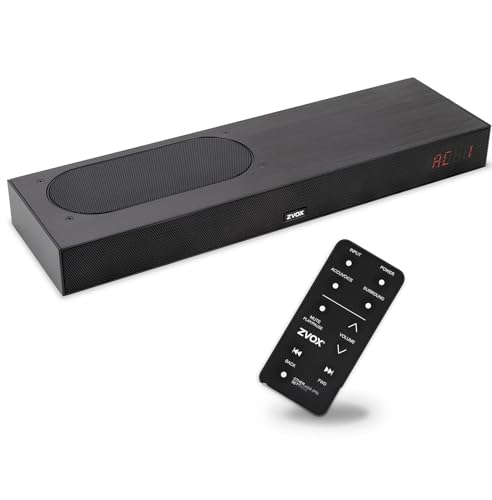
ZVOX AccuVoice AV835 — Finest-Grained Voice Control
If the AV157’s twelve levels sound generous, the AV835’s twenty levels of voice boost reframe the question entirely. Twenty steps is not about power — the top of the range serves the hardest cases — but about resolution. Hearing difficulty rarely arrives as a single fixed deficit; it varies with fatigue, with the programme, with whether the grandchildren are narrating over the nature documentary. A finer ladder lets a listener settle at the precise rung where consonants sharpen without the sound turning thin or fatiguing, and small differences at that margin decide whether a bar gets used nightly or abandoned in a drawer of good intentions.
The AV835 shares the AV157’s philosophy and its maker’s framing: dialogue clarifying by design, with ZVOX’s “Hearing Aid Technology” wording describing the processing approach in the company’s own terms. The repetition of that phrase across the range is worth one more clarification here — it signals the techniques the engineers borrowed, and it should never be read as a substitute for an audiologist. A listener who struggles with conversation in a quiet room has a question for a professional; a listener who follows conversation fine but loses actors inside a film mix has a question this bar is built to answer.
Choosing between the two AccuVoice bars is refreshingly simple. Households with one viewer and moderate difficulty will likely live happily in the AV157’s range. Households where two viewers need different amounts of help, or where the difficulty is pronounced enough that finer steps matter, justify the AV835. Either way, the discipline is the same: start low, climb one level per programme, and stop the moment the words settle — clarity lives at the lowest effective setting, not the highest available one.
- Voice boost: 20 levels (per listing title)
- Product type: dialogue clarifying soundbar (per listing title)
- Technology naming: AccuVoice; maker’s phrase “Hearing Aid Technology” describes its processing
- Adjustment style: fine-grained ladder for individual listeners
- Subwoofer: none named in the listing title
Strengths
- Twenty levels give the most precise personal fit here
- Same speech-first engineering as its twelve-level sibling
- Headroom at the top of the range for difficult mixes
Trade-offs
- Fine steps reward patience during the first week’s setup
- Bass presence remains secondary to speech
- Two similar ZVOX models require a deliberate choice between them
Best for: a household where the amount of help needed varies by viewer, programme or time of day.
Not suited for: a listener wanting one fixed preset and no adjustment decisions at all.
The AV835 also rewards a word about patience during its first week. Twenty levels tempt new owners into a long evening of toggling, comparing the same scene at level nine, eleven, fourteen, until every setting sounds identical and the whole exercise feels absurd. Resist that method. Set a level, live with it for two full programmes, and adjust only between programmes rather than within scenes. Hearing adapts slowly and judges comparatively; decisions made across days are the ones that survive the month, while decisions made across thirty seconds of rewound dialogue rarely do.

ZVOX SB500 — Fullest Sound of the ZVOX Trio
The SB500 answers the objection the other two ZVOX bars invite: what if the household wants its dialogue fixed without giving up the body of a film soundtrack? ZVOX’s answer pairs six levels of voice boost with a subwoofer built into the cabinet, trading some of the AccuVoice ladder’s granularity for a fuller, weightier presentation. Six levels still cover the realistic range for most viewers — the difference between six and twelve matters less than the difference between some adjustment and none — while the integrated bass restores the floor of the sound that speech-only bars let fall away.
The built-in subwoofer design carries its own domestic logic. There is no separate box to place, pair or trip over, and the single cabinet keeps the installation to one power lead and one television connection. The bass on offer is reinforcement rather than spectacle: scores gain warmth, doors close with conviction, and action scenes stop sounding like they happen in the next postcode. Viewers graduating from television speakers will hear the improvement immediately; viewers cross-shopping against separate-subwoofer systems should calibrate expectations to the physics of one enclosure.
Within the ZVOX family, then, the SB500 is the peacemaker — the bar for a couple where one partner needs the words lifted and the other refuses to watch films that sound like radio plays. It also suits rooms where a separate subwoofer simply has no home: a bedroom dresser setup, a rental with no floor space to spare, a second television in a study. The voice-boost identity remains unmistakably ZVOX; only the supporting cast has grown.
- Voice boost: 6 levels (per listing title)
- Bass: subwoofer built into the cabinet (per listing title)
- Product type: soundbar for TV (per listing title)
- Technology naming: ZVOX voice-boost engineering, maker’s “Hearing Aid Technology” phrase
- Installation: single cabinet, no separate bass box
Strengths
- Voice help and real bass weight in one cabinet
- No subwoofer placement or pairing to manage
- Six levels still cover most viewers’ needs
Trade-offs
- Fewer voice levels than the AV157 and AV835
- Built-in bass cannot match a separate subwoofer’s depth
- Larger single cabinet needs the shelf depth to sit properly
Best for: a couple balancing one viewer’s dialogue needs against the other’s love of full film sound.
Not suited for: listeners needing the finest voice-boost granularity the range offers.
There is also a placement dividend built into the SB500’s single-cabinet bass. Separate subwoofers interact unpredictably with room corners, sometimes booming, sometimes vanishing, and their ideal position rarely coincides with a power socket. Bass generated inside the bar’s own cabinet arrives already integrated with the voices it supports, consistent from seat to seat in a way that suits the shared viewing this bar is bought for. What is surrendered in ultimate depth is partly repaid in this evenness — nobody in the room gets the boomy chair while somebody else gets the thin one.
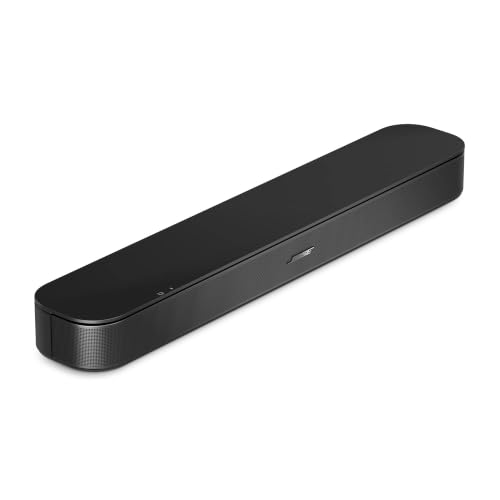
Bose TV Speaker (2nd Gen) — Simplest Mainstream Option
The Bose TV Speaker arrives with the shortest listing title in this roundup — the product name and its generation, nothing more. That brevity sets the terms of its assessment honestly: no dialogue mode, voice boost or clarity feature is stated in the listing title, so none is claimed for it here. What can be said is what the product line is: a compact, deliberately simple television speaker from a maker whose small bars are tuned to make speech and everyday broadcast sound fuller than the television’s own drivers manage.
Simplicity is a genuine feature in this category, and it is undervalued by specification tables. The viewer who struggles with dialogue often also struggles with layered menus, app pairings and remotes with forty buttons. A bar that connects, turns on with the television and simply sounds clearer addresses the whole problem rather than its audio slice alone. Bose’s second-generation television speaker lives in that tradition: one cabinet, an uncomplicated setup story, and a presentation that lifts the midrange region where voices sit, because that is where a general-purpose TV speaker earns its keep.
The honest shortlist logic follows. If the difficulty is mild — television speakers are thin, the room is small, the viewer wants everything a notch clearer without new habits to learn — the Bose is a rational, low-friction answer. If the difficulty is specific and stubborn, the adjustable ZVOX ladders above exist precisely for it, and no amount of brand comfort substitutes for a voice-boost control. Buy the Bose for ease; buy a ZVOX for adjustment.
- Product type: compact television speaker, second generation (per listing title)
- Dialogue feature: not stated in the listing title — verify with Bose documentation
- Design intent: simple single-cabinet TV sound improvement
- Subwoofer: none named in the listing title
- Controls: simplicity is the line’s hallmark
Strengths
- Lowest-friction setup and daily operation in this group
- Compact cabinet fits crowded television stands
- Balanced tuning flatters everyday broadcast viewing
Trade-offs
- No adjustable voice boost to personalise clarity
- Small cabinet limits bass and maximum scale
- Title confirms no dedicated dialogue processing
Best for: a smaller room where television speakers sound thin and the viewer wants one simple upgrade.
Not suited for: a pronounced dialogue problem that needs adjustable voice lift.
A word, too, about who should not overthink the Bose’s missing specifications. A great many dialogue complaints trace back to a five-year-old television whose speakers have been slowly cooking behind a hot panel, in a room where the set sits inside a cabinet niche that muffles what remains. In that common situation, almost any competent bar transforms the experience, and the Bose’s freedom from setup rituals gets the transformation done in an afternoon. The specialist bars earn their premium when the complaint survives a decent television in an open room — context, as ever, is the real specification.

Amazon Fire TV Soundbar Plus — Centre Channel Advantage
The Fire TV Soundbar Plus attacks the dialogue problem with architecture instead of processing. Its listing title confirms a 3.1-channel layout with a built-in subwoofer, and that middle “1” in 3.1’s companion — the centre channel — is where film and television speech is mixed to live. A dedicated centre speaker means dialogue arrives from a driver whose only job is the words, positioned directly beneath the faces speaking them, rather than being shared between left and right channels and smeared across the cabinet.
In practice, centre-channel bars have a particular steadiness: voices stay anchored to the screen when characters move, and they hold their clarity as volume drops, which matters for evening viewing in households with thin walls and sleeping children. The built-in subwoofer keeps the Plus to a single cabinet while giving the low end somewhere real to come from, so the centre channel is not asked to carry weight it cannot. As the newest model in its line, per its title, it also represents Amazon’s current thinking on what a television-first bar should be.
One flag belongs to a different roundup but deserves a line here for cross-shoppers: this bar’s listing title does not mention Alexa, whatever the Fire TV name might suggest, so voice-assistant expectations should be checked against Amazon’s documentation rather than assumed. For the dialogue question itself, no such caveat applies — the 3.1 structure is stated plainly, and structure is a promise a bar keeps every minute it plays.
- Configuration: 3.1 channels (per listing title)
- Bass: subwoofer built in (per listing title)
- Centre channel: dedicated dialogue driver in the layout
- Model status: newest model in its line (per listing title)
- Alexa: not stated in the listing title — verify with Amazon documentation
Strengths
- Dedicated centre channel anchors speech to the screen
- Single cabinet with genuine low-end support
- Dialogue stays clear at modest evening volumes
Trade-offs
- No adjustable voice-boost ladder for personal tuning
- Built-in subwoofer depth trails separate-box systems
- Fire TV branding invites assistant assumptions its title does not confirm
Best for: a film and drama viewer whose dialogue vanishes into wide stereo mixes.
Not suited for: a listener needing several levels of personal voice adjustment.
The Plus has one more dialogue asset that rarely appears in comparisons: consistency across inputs. Because the centre channel does the work physically, clarity survives whether the evening’s viewing arrives from broadcast television, a streaming stick or a games console, with no per-source mode to remember. Households whose confusion is partly procedural — the right setting exists, but only on the input nobody can find — benefit from a bar whose clarity is architectural. Turn it on, and the words are simply where they should be, every night, on every source.

Sonos Ray — Compact Ecosystem Pick
The Sonos Ray’s listing title, like the Bose’s, is a name and nothing else. No dialogue feature is stated there, and this guide claims none for it. The Ray’s case rests on different pillars: it is the compact entry point to the Sonos family, a small bar designed for smaller televisions and secondary rooms, from a company whose tuning consistently favours a clear, forward vocal presentation because its products spend so much of their lives playing speech-driven content in kitchens and bedrooms.
Size is the Ray’s defining decision. It fits the televisions and rooms the other five picks overwhelm — the bedroom set on a dresser, the study screen, the guest-room television that currently sounds like a phone in a biscuit tin. In those spaces, a modest bar with tidy tuning can transform intelligibility simply by pointing real drivers at the listener from a sensible position, where the television’s own speakers fire at the wall. Placement, in small rooms, is half of clarity, and the Ray is the easiest bar here to place well.
The ecosystem consideration completes the picture. A household already running Sonos elsewhere gains an app it knows and a speaker that can join that family’s groupings; a household starting fresh should weigh whether that family is where it wants to live. For the specific dialogue mission, the Ray is the gentlest intervention in this roundup — appropriate where the problem is a bad television in a small room, less appropriate where the problem follows the viewer from room to room, which is ZVOX territory.
- Product type: compact soundbar (listing title gives name only)
- Dialogue feature: absent from the listing title — consult Sonos documentation
- Ecosystem: Sonos app and family groupings
- Scale: designed for smaller televisions and rooms
- Subwoofer: none in the cabinet class; family subwoofers exist separately
Strengths
- Smallest, easiest placement of the six
- Clear vocal presentation suits speech-heavy small-room viewing
- Joins an existing Sonos household without new habits
Trade-offs
- No named dialogue mode or voice adjustment
- Compact scale caps bass and room-filling volume
- Value depends heavily on Sonos ecosystem membership
Best for: a bedroom or study television in a home that already speaks Sonos.
Not suited for: a main living room where dialogue difficulty is the central complaint.
Finally, the Ray makes an underrated gift purchase, which is a real use case in this category: adult children frequently buy dialogue help for a parent, and a present that demands a new app ecosystem and a smartphone-driven setup can die unopened. The Ray still belongs to an app family, so it is not the zero-learning option — the Bose holds that title — but within Sonos households the gift extends a system the family may already support remotely, and a bar the giver can help configure carries a practical advantage no specification sheet captures.
Comparison Table
| Bar | Dialogue mechanism | Adjustment | Bass arrangement |
|---|---|---|---|
| ZVOX AV157 | AccuVoice voice boost | 12 levels | None named |
| ZVOX AV835 | AccuVoice voice boost | 20 levels | None named |
| ZVOX SB500 | Voice boost | 6 levels | Built-in subwoofer |
| Bose TV Speaker (2nd Gen) | Not stated in title | None named | None named |
| Fire TV Soundbar Plus | Dedicated centre channel | None named | Built-in subwoofer |
| Sonos Ray | Not stated in title | None named | None in cabinet |
Why Has Television Dialogue Become So Hard to Hear?
The problem is not imagination, and it is not only hearing. Film sound is now mixed for cinemas and high-end systems with enormous dynamic range: whispers are mixed genuinely quiet, explosions genuinely loud, and dialogue is expected to emerge from a capable centre channel at reference level. Compressed into a television broadcast or a streaming feed and played through two small drivers aimed at the wall, that mix collapses. Add actors who mumble in the modern naturalistic style, scores mixed proudly over lines, and rooms with hard floors and bare walls bouncing sound into echo, and even young viewers find themselves riding the volume control.
This is why the remedies in this guide are structural and electronic rather than simply louder. A centre channel restores the mix’s intended geometry. Voice-boost processing rebalances the relationship between speech and everything else. Both approaches accept the mix as it is and repair the playback end, which is the only end a household controls. Understanding that also explains the failure of the commonest home remedy — a bigger, bass-heavier bar bought for clarity can actually bury dialogue deeper, because it amplifies the competition more effectively than the words.
How Should You Set Up a Dialogue Bar for the Best Results?
Position comes first. The bar belongs directly below or above the screen, centred on the main seat, at roughly ear height when seated, with nothing in front of it — no ornaments on the same shelf edge, no cabinet door waiting to be closed over it. Pull the bar to the front edge of its shelf so its sound does not reflect off the surface beneath. Then choose the television’s audio output deliberately: HDMI ARC where available, the television’s internal speakers fully off, and any “surround” processing in the television’s own menu disabled so the bar receives a clean signal to work with.
Calibration of a voice-boost bar is a ritual worth doing properly. Pick a programme the household actually watches — not a test disc — and start at the lowest boost level. Watch ten minutes. If lines are still being missed, climb one level and repeat. Most listeners settle lower than they expect, and the lowest effective setting preserves the most natural sound for everyone else. Save the discovery process for a calm evening rather than the first night of a new series, and write the chosen level on a note inside the remote’s battery cover if two viewers need different settings; small kindnesses like that decide whether technology gets used or resented.
Night listening deserves its own calibration pass. At low volumes the ear’s sensitivity to the frequencies carrying consonants falls away faster than its sensitivity to bass, which is why a drama perfectly clear at seven in the evening can turn to soup at eleven even though nobody touched a setting. Run the level-finding ritual once at the household’s late-evening volume as well, and keep that second number beside the first. Bars with genuine adjustment ladders make this trivial; fixed-preset bars force a compromise that satisfies neither hour. It is one more quiet argument, discovered only by living with the equipment, for buying the ladder rather than the button.
What Mistakes Do Dialogue-Bar Buyers Make?
The first mistake is shopping for bass when the problem is speech; the second is assuming a “clear voice” button on any bar equals the adjustable ladders the specialist makers offer. A fixed preset helps some viewers and overshoots others, with no middle rung to land on. The third mistake is placement sabotage — a dialogue bar shoved to one side of the stand, or behind the television in a tangle of cables, cannot aim speech at the listener no matter how sophisticated its processing.
A fourth mistake is medical in the opposite direction: expecting a soundbar to compensate for hearing loss that affects daily conversation. These products repair television playback; they do not assess ears. The honest sequence is to fix the television chain first — it is inexpensive and often sufficient — and to treat any difficulty that persists across rooms, telephones and conversations as a reason to book a hearing check, where real help exists in forms a soundbar cannot imitate.
A fifth mistake is quieter: buying for the room the household wishes it had. A dialogue bar chosen for a future open-plan renovation will be judged, unfairly, in the small room it actually serves this winter, and a compact bar bought for a flat will be condemned in the larger house after a move. Purchase for the seats, walls and television in front of you today; the adjustable picks in this guide forgive a great deal of change, but no product forgives being bought for a different life.
How Does Room Furnishing Change What a Dialogue Bar Can Do?
Rooms edit sound before any electronics hear it. A living room with a rug, upholstered seating, curtains and bookshelves absorbs reflections, letting a bar’s direct sound dominate — the kindest possible environment for speech. The fashionable opposite, a hard-floored room with leather, glass and bare plaster, returns every syllable to the listener several times from several directions, and the brain must excavate the original from its own echoes. In such rooms, even excellent processing fights the architecture, and the cheapest clarity upgrade available is often a rug between the television and the sofa.
Seating distance compounds the furnishing effect. Speech clarity decays as the direct sound weakens relative to the room’s reflections, so a listener eight feet from the bar lives in a different acoustic world from one at sixteen feet, even at identical volume. Households with a deep room should consider it a legitimate part of the purchase: bring the main seat closer, angle the bar slightly toward it, or choose the bar with adjustment headroom — the AV835’s upper levels exist partly for listeners whom geometry has placed at a disadvantage no preset anticipates.
None of this requires acoustic panels or professional treatment. Soft furnishings placed where life already puts them, a bar positioned with intent, and a seat chosen with the listener in mind deliver most of the available improvement. Electronics then finish a job the room has stopped sabotaging, which is the correct order of operations for every pick in this guide.
What Should Two Viewers With Different Hearing Do?
Shared viewing with unequal hearing is the scenario this category quietly serves most, and it deserves direct advice. The adjustable bars solve it best: set the voice level for the viewer who needs more help, then let overall volume serve the other. Because boost changes the balance rather than the loudness, the second viewer typically hears a presentation that is merely clear, not aggressive — the common fear that a dialogue bar makes everything shrill for everyone is largely a memory of crude treble controls from older equipment.
Where tastes still diverge, small rituals help. Alternate who holds the remote by programme rather than by scene. Keep subtitles available for the hardest-mixed series without treating them as surrender. And revisit the setting monthly for the first season: as the household adapts to clearer sound, the level that seemed necessary in week one often drifts downward, because part of the original difficulty was the room, the television speakers and habit, all improving at once. The bars that survive in shared homes are the ones whose adjustments became boring — set, forgotten, and quietly doing the work every night.
Which Programmes Test a Dialogue Bar Most Honestly?
Showroom demonstrations flatter every bar, because demo material is mixed to impress. Honest testing uses the household’s own hardest programmes. Prestige dramas with whispered confrontations are the classic trial: if a bar clarifies those without making the score screech, its processing is behaving. Nature documentaries narrated over music and weather test a different balance, where the voice must float above a deliberately rich bed of sound. Panel shows and interviews, recorded in lively rooms with several people interrupting, test whether consonants survive crosstalk — the everyday failure behind most “I can’t follow the conversation” complaints.
Sport deserves a mention of its own, because commentary sits atop crowd noise mixed loud enough to sell atmosphere. A dialogue bar that can hold a commentator steady through a goal celebration has solved a genuinely hard separation problem. News, by contrast, is the control condition: studio speech arrives clean, and any bar that needs heavy processing to make a newsreader intelligible is compensating for a placement or television-setting fault rather than a mixing one. Run these five programme types during the returns window, at the household’s real volumes, from the real seats, and the right bar identifies itself without a single specification being consulted.
How Long Does a Dialogue Bar Stay the Right Answer?
Hearing and households both change, which argues for adjustment range as a form of future-proofing. A viewer whose difficulty is mild today may need two more levels in five years; the AV835’s ladder and even the AV157’s dozen steps buy that future in advance, while a fixed-preset bar must be replaced when its single setting stops sufficing. This is the quiet economic case for the specialist picks: the cheapest bar is the one bought once, and adjustability is what “once” is made of.
The mainstream picks age differently. The Bose and Ray serve a stage of need — thin television sound, small rooms, mild difficulty — and serve it gracefully; if the need deepens, they retire honourably to a bedroom while a specialist takes the main room. The Fire TV Plus’s centre channel does not expire at all, because geometry does not go out of date. Thinking in these stages helps households buy for the present honestly while knowing which purchase is a stepping stone and which is a destination, and it prevents the commonest waste in this category: replacing an adequate bar with an identical one because nobody identified what had actually changed.
What About Headphones, Earbuds and Other Alternatives?
Fairness requires naming the rivals outside this category. Wireless television headphones solve the dialogue problem completely for one listener, with the added gift of private volume, and for a viewer who mostly watches alone they may be the most effective purchase of all. Their costs are social and practical: conversation during a programme becomes impossible, a second viewer needs a second solution, and something must be charged, worn and eventually replaced at the ears. A soundbar keeps the room shared, which for most households is not a compromise but the entire point of television.
Television settings deserve an honourable mention as the zero-cost first step. Many sets hide a dialogue or clarity mode in their sound menus, and switching off the set’s own surround processing sometimes recovers a surprising amount of speech before any money moves. Those modes share the fixed-preset limitation discussed throughout this guide, and television speakers remain physically small, but a household should always spend one evening with the menus it already owns before spending anything on hardware. If the problem survives the menus, it is a real problem, and the bars above are ranked for exactly that survivor.
Hearing aids themselves, for readers who wear them, increasingly connect to televisions through streamers and Bluetooth accessories supplied by their makers. That route is arranged through the audiologist who fitted the aids, and it sits outside this guide’s scope — but it is worth knowing it exists, because for some households the clearest television sound will arrive by that path, with a soundbar serving everyone else in the room at ordinary clarity.
How Should You Maintain Clarity Once the Bar Is Installed?
Clarity drifts for mundane reasons. Televisions receive updates that reset audio menus to defaults; a new streaming device arrives and its own volume levelling fights the bar’s; the bar gets moved for cleaning and returns two inches further back, reflecting off the shelf it used to clear. A household that checks three things twice a year — the television’s output setting, the bar’s position at the shelf’s front edge, and the saved voice level — will never experience the mysterious decline that owners often blame on a product “wearing out,” when in truth nothing wore out at all.
Dust and obstruction matter more than pride admits. Drivers behind a film of dust still work, but a bar gradually buried under post, ornaments and a creeping stack of remotes loses the clear path its sound needs. Treat the bar’s frontage like a windscreen: keep it swept and unobstructed. And when a particular series suddenly sounds worse than everything else, suspect the series before the setup — some productions are simply mixed defiantly, and the correct response is two extra levels of boost and the subtitles, not a weekend of recabling a system that was working on Tuesday.
How Do You Talk About This Purchase Inside a Family?
A surprising number of dialogue bars are bought badly because they are discussed badly. Framed as equipment for one person’s deficiency, the purchase can feel like a verdict; framed as a repair to a television the whole household finds badly mixed, it becomes what it actually is — an upgrade everyone benefits from, including the viewers with perfect hearing who were also rewinding more than they admitted. The evidence supports the generous framing: modern mixes challenge young ears in cinemas of living-room size every night, and clearer dialogue is a universal comfort rather than a concession.
Practical diplomacy follows from that framing. Let the person who struggles most choose the test programmes, because their judgement is the instrument that matters. Invite the rest of the household to judge comfort rather than clarity — whether the sound is pleasant at the chosen setting — since both criteria must pass for the bar to survive. And if the bar is a gift, include the setup in the gift: an installed, calibrated bar with the chosen level already found is a kindness, while a sealed box and a manual can feel like homework assigned to the person least equipped to enjoy it. The technology in this guide is simple; the generosity around it is what makes it work.
What Does a Week of Living With a Dialogue Bar Teach?
The first evening teaches the setting; the week teaches the household. By the third night, viewers usually discover that the benefit they notice most is not any single rescued line but the absence of effort — shoulders down, no leaning toward the screen, no low-grade vigilance for the rewind button. Listening fatigue is cumulative and mostly invisible until it lifts, which is why returns-window judgements made in the first hour so often mislead: the bar’s real product is relaxation across an evening, and that can only be sampled across evenings.
The week also exposes the remaining faults honestly. A programme that still defeats the setup at sensible levels is information, not failure — it marks the boundary where subtitles take over, and knowing the boundary ends the fiddling. A second viewer who finds the shared setting slightly bright can be answered with seating or a one-level compromise rather than a new purchase. Households that grant the bar this probationary week, adjusting between programmes instead of within them, almost always end it with a configuration they then leave untouched for years. That stillness, in the end, is the truest review any of these six products can earn.
Final Recommendation
For the clearest expression of this category, the ZVOX AV157 is the recommendation to beat: twelve levels of voice boost, a cabinet built around nothing else, and enough range for most households to find their setting within the first evening. The AV835 extends that same idea for listeners who need finer steps or more headroom, and the SB500 folds the concept into a fuller sound for households unwilling to surrender film weight. Between them, the three ZVOX bars cover nearly every honest version of the dialogue problem. Readers choosing between the AV157 and AV835 should simply ask how much the needed help varies across the week: steady difficulty favours the twelve-level bar, while fluctuating difficulty, multiple listeners and larger rooms all argue for the twenty-level ladder and its patience-testing abundance of choice.
The Fire TV Soundbar Plus earns its place for viewers whose mixes feel wide and scattered, where a centre channel’s anchoring does the repair. The Bose and Sonos serve the mildest cases with the least friction. Whichever bar a household chooses, the measure of success is unglamorous and absolute: the rewind button gathers dust, the volume wars end, and the question “what did she say?” finally leaves the room. That departure, noticed somewhere around the third episode of the first long series watched together in complete peace, is worth more than every specification debated on the way to it.
Frequently Asked Questions
Will a voice-boost bar help with every programme?
It helps most where dialogue is buried by music and effects, which describes a large share of modern drama and film. Live sport and news, mixed with speech forward already, may need little or no boost. That variability is exactly why adjustable levels outperform a single fixed clarity preset.
Is “Hearing Aid Technology” the same as a hearing aid?
No. The phrase is ZVOX’s own description of the processing approach behind its AccuVoice bars — techniques adapted from that field to lift television dialogue. A soundbar is a consumer speaker, not a medical device, and it makes no promise about hearing health. Persistent difficulty hearing conversation deserves a professional assessment.
Why not simply turn the television up louder?
Because loudness raises the words and the sounds masking them together, preserving the ratio that caused the problem. Voice processing changes the ratio itself. Louder also punishes everyone else in the room and the neighbours, while a well-set boost level can leave overall volume lower than before.
Do subtitles still matter once a dialogue bar is installed?
For many households, subtitles shift from necessity to safety net — switched on for the most mumbled productions, off for everything else. There is no virtue in struggling without them; the goal is following the story comfortably, by whatever combination of sound and text achieves it.
Which bar suits a viewer who hates complicated remotes?
The Bose TV Speaker makes the strongest simplicity case among the mainstream picks, while the ZVOX bars concentrate their remotes on the few controls that matter, chiefly the voice level itself. In both cases the television remote should keep governing volume through the HDMI connection, so daily operation stays familiar.
Can a dialogue bar work in a bedroom?
Yes, and bedrooms are where modest volumes make clarity hardest, which is why the SB500’s single-cabinet design and the Ray’s small footprint both appear in this guide. Keep the bar close to the screen, set the boost at the lowest level that works at pillow distance, and avoid maximum settings that will sound harsh in a small, quiet room.
Should the voice level stay the same for films and television series?
Rarely. Films are mixed for cinemas and tend to bury dialogue deeper than episodic television, so many households keep two habits: a series setting and a film setting, two or three levels apart on the ZVOX ladders. Note both numbers somewhere durable. Rebuilding the discovery from scratch every Friday night is the sort of friction that quietly kills good technology, while a written pair of numbers turns the adjustment into a two-second ritual.
What if only one programme sounds unclear while everything else is fine?
Then the programme is the problem, and it should be treated as an exception rather than evidence. Streaming catalogues contain notoriously difficult mixes, and even broadcasters occasionally ship a drama whose dialogue sits beneath its score. Raise the boost for that title, use subtitles without resentment, and return to the household setting afterwards. A setup judged by its worst-mixed programme will be perpetually misadjusted for everything else.
Related Guides
Companion reading includes our guides to soundbars that connect to a Google Home hub, short soundbars of 28 inches or less and soundbars that work with Alexa, each written for a different living-room priority.


