What's inside
- Key Takeaways
- Quick Picks
- How did this shortlist get assembled?
- What do you give up, and what do you gain, by choosing hands over a screen?
- The six hybrids, one at a time
- All six in one view
- Where do hybrid buyers most often go wrong?
- How should you wear and keep a hybrid?
- How do the three Withings models divide the territory?
- What is daily life with a tiny window or a hidden screen actually like?
- How does a hybrid age, and what is it worth in five years?
- Final Recommendation
- Which occasions does each style of hybrid suit best?
- What should you verify in person or on the listing before committing?
- How do hybrids handle water, work and workouts in practice?
- Frequently Asked Questions
- Related Guides
As an Amazon Associate I earn from qualifying purchases. This post may contain affiliate links at no extra cost to you.
gizmoverdict.com is reader-supported. When you buy through links on our site, we may earn an affiliate commission.
Where to buy: all six watches below are Amazon listings, and each name in the shortlist and in the detailed reviews links to its listing, where case finishes, strap options and box contents can be verified before ordering. Hybrids reward that check more than most categories, because two watches with the same model name can differ in case colour and band material, and the variant in the photograph is not always the variant in the basket.
The appeal of the best smartwatches that look like a regular watch is easiest to understand in a meeting room. On one wrist sits a glowing rectangle announcing notifications to the whole table; on the other, a pair of hands over a quiet dial, indistinguishable from the watches worn for a century. The second watch is counting steps, watching sleep, and — in the case of the Withings models below — carrying an ECG function, yet it asks for no attention and offers no screen to tap. That discretion is not a compromise version of a smartwatch. For a large group of wearers it is the entire point: the health tracking of a modern device with the manners, battery life and appearance of an ordinary timepiece.
The hybrid class achieves this with real analog hands over a hidden or minimal display. Three of the six picks are Withings ScanWatch models, the line that defined the modern hybrid: the ScanWatch 2 in 38mm, the larger and more instrumented Nova, and the simpler Light. Garmin answers with two very different machines — the Vivomove Trend, a fashion-leaning hybrid with a hidden touchscreen, and the Instinct Crossover Solar, which wraps analog hands in a shock-resistant outdoor case with solar charging. The sixth pick, the Pininfarina PURA, approaches from the luxury end, an Italian-designed analog watch with a 30-day battery and a pointedly subscription-free pitch. Battery life is the class’s shared superpower: four of the six titles claim around thirty days, a figure no full smartwatch can approach.
A note on health language before the details. The Withings titles claim FDA-cleared AFib detection, and this guide quotes that as the listings’ claim, attributed to the listings, without adding medical promises of its own. Where a title says a watch monitors heart rate, tracks sleep or scans respiration, the reviews describe those features in the listings’ terms. Nothing here diagnoses, and any wearer who sees an irregular-rhythm notification should treat it as a prompt to see a clinician, which is what the makers themselves say in their own documentation.
Key Takeaways
- All six picks have real analog hands; the smart layer hides behind the dial, in a small display window, or in a touchscreen that vanishes when idle.
- Four titles claim roughly thirty days of battery — the ScanWatch 2, Nova, Light and PURA — while the Vivomove Trend claims five days and the Instinct Crossover leans on solar charging.
- The Withings ScanWatch 2 and Nova titles both claim FDA-cleared AFib detection alongside ECG; that wording is the listings’ claim, repeated here as such.
- The Instinct Crossover Solar is the outlier in spirit: a 45mm shock- and thermal-resistant outdoor case that happens to keep analog time.
- The Pininfarina PURA is the only pick whose title promises no subscription, a quiet but real ownership advantage.
- None of these watches runs third-party apps or answers messages from the wrist; the trade for the classic look is a deliberately narrow smart layer.
Quick Picks
| Pick | Badge | Why it is here |
|---|---|---|
| WITHINGS ScanWatch 2 (38mm) | The complete hybrid | ECG, connected GPS, temperature monitoring and a 30-day battery inside a 38mm case that reads as an ordinary dress watch. |
| WITHINGS ScanWatch Nova | The instrumented flagship | Adds SpO2 and a respiratory scan to the ScanWatch formula, in a green-dial design with the same 30-day claim. |
| WITHINGS ScanWatch Light | The gentle entry | Heart rate, sleep, steps and cycle tracking in a white-dial hybrid that drops the clinical instruments and keeps the month-long battery. |
| Garmin Vivomove Trend | The hidden touchscreen | Analog hands over a display that appears only when touched, in a peach gold and ivory fashion case with a charger bundle in the box. |
| Garmin Instinct Crossover Solar | The rugged hybrid | Solar charging, thermal and shock resistance and built-in sports apps behind analog hands, in a 45mm graphite case. |
| Pininfarina PURA Hybrid | The luxury route | An Italian-designed analog watch with heart rate and HRV, sleep and activity tracking, notifications and no subscription, for up to 30 days per charge. |
How did this shortlist get assembled?
The entry requirement was strict: physical hands, moving on a dial, as the primary way the watch tells time. That rule excluded the many full smartwatches with an analog-style watch face on a screen, because a picture of hands is not the product this search asks for — the wearer wants the object, not the image. Survivors were then weighed on the honesty and completeness of their titles: which health features are actually claimed, what battery figure is stated, whether phone compatibility is named, and whether the case size appears in print. The ScanWatch 2’s title, for example, states its 38mm size outright; the PURA’s does not, and its spec box records that gap rather than filling it from other sources.
Two attractive hybrids were left out deliberately. One carried a famous fashion brand’s name but a title that promised no battery figure and no health features beyond steps, leaving nothing to review honestly. Another described itself as hybrid while its own photographs showed a full touchscreen with a decorative fixed bezel — a regular smartwatch in costume. The class is small enough that padding it with impostors would have helped no reader. For a wider view of how these discreet designs compare with the mainstream, the best mens smartwatches roundup covers the conventional end of the same shelf.
What do you give up, and what do you gain, by choosing hands over a screen?
The gains are easier to feel than to list. A hybrid is not charged weekly, so it does not develop the dead-watch days that quietly end most smartwatch habits; a month-long battery means the watch is simply always on the wrist, gathering sleep and activity data with a completeness that a frequently charging device cannot match. It also ages differently: a clean dial in a steel case looks current for a decade, while a screen-based watch looks dated the year its display generation passes. And it behaves in company — no glow, no buzz-lit wrist in a dark cinema, no visible temptation to scroll during dinner.
The sacrifices are equally real. There is no app store, no replying to messages, no maps on the wrist, and in most hybrids no screen large enough to read a notification beyond a vibration and perhaps a headline. Music control, contactless payment and voice assistants are mostly absent from this class; where a neighbouring category offers them, as the best smartwatches for google pay guide shows, it does so with full Wear OS screens. The hybrid buyer is trading breadth for depth in a few chosen channels — health sensing, battery, appearance — and the trade is wise exactly when those channels are the ones the buyer actually uses. A hybrid owner who secretly wanted a wrist phone will be miserable; a screen-watch owner who only ever checked the time and their sleep was carrying the wrong device all along.
The middle path in this set is Garmin’s. The Vivomove Trend hides a touchscreen under its hands, so notifications and controls appear when summoned and vanish when not, while the Instinct Crossover keeps a small window and leans on physical buttons and sheer toughness. Withings and Pininfarina stay purer: tiny display windows or none, with the phone app carrying the data. Neither philosophy is correct in the abstract; they answer different levels of appetite for the digital layer, and the reviews below keep score accordingly.
The six hybrids, one at a time

WITHINGS ScanWatch 2 (38mm) — The benchmark hybrid
The ScanWatch 2 is the watch this category is measured against, and its title shows why: hybrid smartwatch, ECG, connected GPS, 38mm black case, an FDA-cleared AFib detection claim, fitness and sleep tracking, temperature monitoring, a 30-day battery, Bluetooth, and compatibility with iOS and Android. Read that list again and notice what is absent — no apps, no calls, no screen size, because the display is a small window in the dial and the hands are the interface. The instrument set is the deepest in the Withings trio for everyday health: an ECG function on demand, the listing’s AFib detection claim, and temperature monitoring that feeds trend data to the app across nights.
The 38mm size deserves emphasis, because it is the dimension that makes the disguise work. At 38mm in black, this is the footprint of an ordinary mid-century dress watch, wearable on smaller wrists and under shirt cuffs without negotiation. Connected GPS means walks and runs borrow the phone’s positioning rather than carrying a GPS radio in the case — a reasonable trade that preserves the battery and the size, at the cost of leaving the phone behind. The 30-day battery claim completes the proposition: this is a health instrument you charge roughly monthly, wear constantly, and forget is smart until the app shows you a month of unbroken sleep data. For most readers drawn to this category, the ScanWatch 2 is where the search ends.
- Case: 38mm, black, per the title
- Health features as titled: ECG, FDA-cleared AFib detection (listing claim), temperature monitoring, sleep and fitness tracking
- Positioning: connected GPS, using the phone
- Battery: 30 days claimed in the title
- Compatibility: iOS and Android, Bluetooth
- Strap material: Not stated in the listing title — verify with the maker’s documentation
Strengths
- The deepest everyday health instrument set in a genuinely discreet 38mm case.
- A 30-day battery claim that turns health tracking into a constant rather than a rota.
- Temperature monitoring adds a trend channel the rest of this class mostly lacks.
Trade-offs
- Connected GPS requires the phone along on tracked outings.
- The small dial window shows little at a glance; detail lives in the phone app.
- No payment, app or calling layer exists here at all, by design.
Best for: ECG-class features and month-long wear, for health tracking inside a watch nobody at all identifies as smart. Not suited for: phone-free runs that need onboard GPS, because positioning here is borrowed from the handset through the connected-GPS arrangement.
WITHINGS ScanWatch Nova — The maximalist’s hybrid
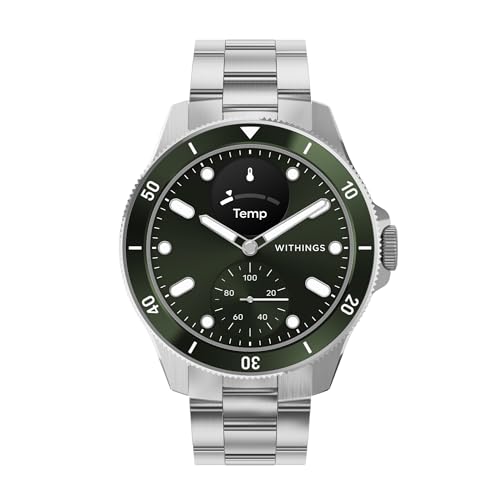
The Nova takes the ScanWatch architecture and turns every dial toward the enthusiast. Its title lists ECG, SpO2, temperature, the same FDA-cleared AFib detection claim, a sleep score, a respiratory scan, the 30-day battery, Bluetooth and iOS/Android compatibility — and dresses it in green, a dial colour chosen to be noticed by watch people rather than to disappear entirely. That is the Nova’s subtle difference in mission: where the ScanWatch 2 wants to pass as any good watch, the Nova wants to pass as a particularly handsome one, with the most complete sensor suite in this guide riding behind the glass.
The respiratory scan and SpO2 are the additions that matter. Blood oxygen and breathing-disturbance data belong to the night, and a watch worn continuously for thirty days gathers them with a consistency that sporadically worn devices cannot — the same continuity argument as the ScanWatch 2, extended to two more channels. The case size is not stated in the title, an odd omission for the flagship, and the spec box records it; buyers with smaller wrists should confirm dimensions on the listing before assuming the Nova wears like the 38mm model. Nothing else in the six combines this depth of overnight sensing with this little visible technology, and for the data-hungry traditionalist the Nova is the natural summit of the class.
- Finish: green dial design, per the title
- Health features as titled: ECG, SpO2, temperature monitoring, FDA-cleared AFib detection (listing claim), sleep score, respiratory scan
- Battery: 30 days claimed in the title
- Compatibility: iOS and Android, Bluetooth
- Case size: Not stated in the listing title — verify with the maker’s documentation
- GPS arrangement: Not stated in the listing title — verify with the maker’s documentation
Strengths
- The broadest overnight sensing in the guide: oxygen, respiration, temperature and sleep scoring together.
- A dial colour and finish aimed at watch enthusiasts rather than gadget buyers.
- The same 30-day battery claim as its smaller sibling, despite the heavier sensor load.
Trade-offs
- Case dimensions are absent from the title, leaving wrist fit to be confirmed elsewhere.
- The extra sensing is wasted on a wearer who never opens the app to read it.
- Its presence is larger in spirit than the discreet ScanWatch 2, which some buyers are specifically avoiding.
Best for: data-maximalist tracking, with every overnight channel the hybrid class offers packed inside a handsome traditional case. Not suited for: small wrists working from the title alone, since the listing never states the case size those wrists need to judge.

WITHINGS ScanWatch Light — The essentials, kept light
The Light is the honest simplification of the family formula. Its title keeps the essentials — heart rate monitoring, fitness tracking, cycle tracking, sleep monitoring, steps and activity, the 30-day battery, Bluetooth, iOS and Android — in a white-dial case, and drops the ECG, the AFib claim, the oxygen and temperature instruments that headline its siblings. That subtraction is a feature for the right buyer. Not everyone wants a wrist clinic; many wearers want a beautiful watch that quietly counts their steps, watches their sleep and notes their heart rate, and the Light is the Withings answer to exactly that person.
Cycle tracking in the title marks the intended audience clearly, and the white finish keeps the design in classic territory that pairs with anything. What the Light preserves matters as much as what it drops: the month-long battery, the continuous wear it enables, and the app ecosystem behind it. A wearer who starts here and later wants the deeper instruments can move up the same family without relearning anything, which makes the Light a sensible first hybrid as well as a settled final choice for the sensor-minimalist. It is the least intimidating object in this guide, and for many wrists that is the highest praise available.
- Finish: white dial, per the title
- Health features as titled: heart rate monitoring, sleep monitoring, cycle tracking, steps and activity tracking
- Battery: 30-day battery life claimed in the title
- Compatibility: iOS and Android, Bluetooth
- ECG function: not claimed in this model’s title
- Case size: Not stated in the listing title — verify with the maker’s documentation
Strengths
- All the everyday tracking most wearers actually consult, with nothing clinical to manage.
- The 30-day battery survives the simplification intact.
- Cycle tracking is named in the title, a feature its two siblings do not headline.
Trade-offs
- No ECG or AFib-detection claim, so the heart picture stops at rate and rhythm trends in the app.
- No oxygen or temperature channels for overnight depth.
- Case size goes unstated in the title, as with the Nova.
Best for: a first hybrid, or settled minimalist use, carrying steps, sleep, heart rate and cycle tracking in a classic white dial design. Not suited for: on-demand ECG use, because this model’s title makes no ECG claim of any kind.

Garmin Vivomove Trend — Hands over a hidden screen
Garmin’s Vivomove Trend cheats the hybrid definition in the most enjoyable way: the touchscreen is there, spread across the whole dial, but invisible until a tap wakes it, at which point the analog hands sweep aside and the digital layer appears. Its title describes a stylish hybrid with a hidden touchscreen and a five-day battery, dressed in a peach gold steel bezel with an ivory case and a silicone band, bundled with a USB wall charger adapter and extras. This is the fashion entry of the six, the one most likely to be chosen as jewellery first and as technology second.
The five-day battery is the honest price of that hidden screen, and it reframes the ownership rhythm: not monthly charging like the Withings trio, but a weekly-ish habit closer to a smartwatch’s, in exchange for real on-wrist information when summoned. Garmin’s fitness ecosystem stands behind it, which matters to wearers already inside that world of activities and challenges. The bundle extras in the title — the wall charger and the unspecified more — suggest a gift-ready box. Buyers should simply go in clear-eyed: the Trend is the least pure hybrid here and the most capable glanceable device, and which of those phrases sounds like praise depends entirely on the wrist it is headed for. Readers who like Garmin’s approach but want the full-screen version of it will find the contrast drawn out in our running-watch coverage elsewhere on the site.
- Display: hidden touchscreen behind analog hands, per the title
- Battery: 5 days claimed in the title
- Case and band: peach gold steel bezel, ivory case, silicone band
- In the box as titled: bundle with USB wall charger adapter and more
- Health sensor detail: Not stated in the listing title — verify with the maker’s documentation
- Case size: Not stated in the listing title — verify with the maker’s documentation
Strengths
- A full hidden touchscreen gives real on-wrist information without a visible screen at rest.
- The peach gold and ivory styling is the most jewellery-like presentation in the six.
- Garmin’s activity ecosystem stands behind the tracking.
Trade-offs
- Five days of battery is a weekly charging habit, far from the monthly rhythm of the Withings picks.
- The title names no specific health sensors, so the instrument set needs confirming from the maker’s documentation.
- A silicone band on a fashion case may prompt an early strap upgrade for formal wear.
Best for: a style-led design where notifications and controls appear on demand, then disappear completely from view. Not suited for: set-and-forget wear measured in months between charges, because a five-day battery makes this a weekly charging commitment.

Garmin Instinct Crossover Solar — The hybrid that goes outdoors
Every other pick in this guide disguises itself as a town watch. The Instinct Crossover disguises itself as an expedition instrument that happens to have hands. The title specifies a 45mm graphite hybrid with solar charging, thermal and shock resistance, long battery life, accurate analog timekeeping and built-in sports apps. That is the Instinct family’s rugged DNA — a case built to be knocked against rock and dunked without ceremony — with a pair of real hands laid over the top for at-a-glance time in any light, at any battery state, forever. The hands are not nostalgia here; they are redundancy, the one display that cannot crash, dim or die.
Solar charging changes the battery conversation from days to conditions: the title claims long battery life without a figure, and the honest reading is that endurance depends on light exposure, which suits the outdoor wearer this watch is built for and frustrates the desk-bound one. Built-in sports apps put it in a different league from the fashion hybrids for training, and Garmin’s platform depth stands behind them. At 45mm with a shock-resistant case, it is also the largest presence in the six, and the least interested in passing under a cuff. Choose it as a tool watch with analog manners, not as a dress watch with outdoor hobbies, and its priorities make complete sense.
- Case: 45mm, graphite, per the title
- Charging: solar charging, with long battery life claimed without a stated figure
- Durability as titled: thermal and shock resistant
- Software: built-in sports apps
- Timekeeping: analog hands with accurate analog timekeeping claimed in the title
- Battery life in days: Not stated in the listing title — verify with the maker’s documentation
Strengths
- Shock and thermal resistance make it the only pick here built for genuinely rough environments.
- Solar charging stretches endurance for wearers who live outdoors.
- Analog hands guarantee readable time regardless of the digital layer’s state.
Trade-offs
- A 45mm rugged case is the opposite of discreet on smaller wrists and under formal cuffs.
- Solar endurance depends on light, so indoor lives get less of the headline benefit.
- The title gives no day-count for battery life, leaving the central figure unquantified.
Best for: outdoor and manual work where a watch gets knocked, frozen and sunlit, and where hands that never die are a safety feature. Not suited for: formal settings that need a watch to vanish under a shirt cuff, since a 45mm shock-resistant case announces itself in every room.

Pininfarina PURA Hybrid — The design-house route
The PURA arrives carrying a name from Italian automotive and industrial design, and its title leans into that heritage: a luxury analog watch and hybrid smartwatch with heart rate and HRV, sleep and activity tracking, smart notifications, up to 30 days of battery, and — stated as a selling point in its own right — no subscription. That last phrase is doing quiet work. Several health-watch ecosystems increasingly reserve their deeper analysis for paying members, and a buyer who resents rent-seeking on data their own body generated will find the PURA’s position refreshing: buy the watch, own the features.
The sensor set is the considered middle of this guide: heart rate with heart-rate variability, which feeds recovery and stress pictures in the app, plus sleep and activity tracking and notifications — enough to be useful daily, without the clinical instruments of the Withings flagships. Notifications on a hybrid mean a vibration and the knowledge that the phone wants attention, a level of filtering many executives actively prefer. Case size, water resistance and phone compatibility go unstated in the title, and the spec box records those gaps; a luxury purchase deserves that homework done on the listing and the maker’s documentation. What the title does establish is a coherent proposition — design first, sensing second, no rent — and coherence at this end of the market is rare enough to be the story.
- Design: luxury analog watch from Pininfarina, per the title
- Health features as titled: heart rate and HRV, sleep and activity tracking
- Notifications: smart notifications stated in the title
- Battery: up to 30 days claimed in the title
- Subscription: none, per the title
- Case size and water resistance: Not stated in the listing title — verify with the maker’s documentation
Strengths
- A design-house case that competes with ordinary luxury watches on looks alone.
- Heart-rate variability adds a recovery channel the simpler hybrids lack.
- No subscription, stated outright, keeps the body’s data free of rent.
Trade-offs
- No ECG, oxygen or temperature instruments appear in the title.
- Case dimensions and water resistance are unstated, homework a luxury buyer should not have to do.
- Notifications are alerts only; the phone still does all the talking.
Best for: a design-led case carrying quiet health tracking and notifications inside a watch that holds its own beside conventional luxury pieces themselves. Not suited for: daily swimming, because the title states no water-resistance rating to swim on.
All six in one view
| Watch | Battery as titled | Defining instrument or idea | Character |
|---|---|---|---|
| ScanWatch 2 (38mm) | 30 days | ECG and temperature monitoring | Discreet all-rounder |
| ScanWatch Nova | 30 days | SpO2 and respiratory scan | Overnight data flagship |
| ScanWatch Light | 30 days | Heart rate and cycle tracking | Gentle essentials |
| Vivomove Trend | 5 days | Hidden full touchscreen | Fashion with a secret |
| Instinct Crossover Solar | Long life, solar | Shock resistance and sports apps | Rugged tool watch |
| Pininfarina PURA | Up to 30 days | HRV, no subscription | Luxury minimalist |
Where do hybrid buyers most often go wrong?
The first mistake is expecting a smartwatch’s breadth from a hybrid’s discretion. Buyers who secretly want to answer messages, pay at tills and run apps from the wrist will resent a hybrid within a month, however beautiful it is; the class rewards wearers whose digital needs are genuinely narrow. The second mistake is ignoring case size because the photographs flatter every wrist. A 45mm Instinct and a 38mm ScanWatch are different objects in daily life, and titles that omit dimensions — three of the six here — make the listing page and the maker’s documentation essential reading rather than optional diligence.
Third, buyers undervalue the app. On a hybrid, the app is the screen, the record and the entire data experience; a beautiful watch married to a neglected app will disappoint in slow motion. Fourth, gift buyers misjudge the recipient’s appetite for health data: an ECG-carrying watch given to someone who finds health metrics anxious-making is a burden in a handsome case, while the Light or the PURA would have been kindness itself. Finally, some buyers assume analog hands mean mechanical romance throughout, then feel cheated by a quartz heart and a charging cable. A hybrid is an electronic instrument wearing a classic face, and loving it requires loving exactly that arrangement.
How should you wear and keep a hybrid?
Wear it like the health instrument it secretly is: snug enough that the rear sensors keep contact through the day and night, on the wrist you sleep with most naturally, since sleep data is where continuous wear pays its dividend. The month-long batteries invite a monthly ritual — charge on the first Sunday, check the strap for wear, glance at the month’s trends in the app with actual attention. That half-hour is the hybrid owner’s version of the smartwatch owner’s daily dashboard habit, and wearers who keep it get the compounding value of unbroken data; wearers who skip it own a lovely watch with an unread diary inside.
Strap choice quietly shapes the whole experience. The band a hybrid ships with is rarely the band it should grow old with: leather for the office, silicone or steel for weekends, and the case’s classic proportions accept standard straps gracefully, which is one more advantage of dressing as a normal watch. Keep the original strap for resale or return completeness, and remember that sensor contact depends on fit, so a fashionably loose bangle fit will cost you the very data the watch exists to gather. The best all around smartwatches guide makes an instructive counterpoint read, showing what the same money buys when discretion is not a requirement at all.
How do the three Withings models divide the territory?
Because one brand supplies half this shortlist, the intra-family choice deserves its own map. Think of the trio as three depths of curiosity about the same body. The Light assumes a wearer who wants the gentle layer: steps walked, nights slept, heart rate drifting through the day, cycles noted. Its data answers the question how am I living, in broad strokes, and asks nothing clinical in return. The ScanWatch 2 assumes a wearer who wants instruments: an ECG taken deliberately, temperature tracked across nights, the listing’s AFib detection claim standing behind the rhythm data. Its data answers the question what is my heart doing, with tools that invite a clinician into the conversation when the trends warrant it.
The Nova assumes the maximalist: everything the 2 measures, plus oxygen saturation and a respiratory scan, worn by someone who reads their sleep score the way other people read the weather. The practical divider is not money but temperament. A wearer who will never open the app beyond the sleep page gains nothing from the Nova’s extra channels and loses nothing by choosing the Light; a wearer who annotates their health data will feel the Light’s ceiling within a month. All three share the thirty-day rhythm and the same design language, so the choice can be made purely on appetite for data — which is exactly how a family of products ought to be organised, and rarely is.
What is daily life with a tiny window or a hidden screen actually like?
New hybrid owners go through a predictable adjustment in the first fortnight. The hand reaches to tap a dial that does not respond; the eye searches for a notification count that does not exist; the wrist feels oddly quiet in rooms where it used to glow. Then the recalibration completes, and most owners report the same discovery: almost nothing they used the screen for was urgent, and the few things that were — a call, a calendar threshold — still arrive as a vibration that sends them to the phone with intent rather than reflex. The watch returns to being furniture for the wrist in the best sense: present, handsome, and silent until the app is opened on purpose.
The Vivomove Trend’s owners adjust differently, because their screen exists but hides. The gesture — tap, watch the hands sweep aside, read, let it fade — becomes a small ceremony that rations attention rather than abolishing it. That middle path suits people whose work genuinely pushes information to the wrist: a nurse who needs message previews without a glowing screen on a ward, a teacher who must triage alerts without performing distraction in front of a class. The purer hybrids cannot serve those moments at all, and honesty requires saying so: discretion has a cost in glanceable information, and the Trend is the one pick here engineered to pay less of it.
Sleep is where the class quietly wins its converts. A slim hybrid under no charger-deadline gets worn to bed by default, and bed is where heart rate, oxygen, temperature and respiration data live. Screen watches, bulkier and forever being charged overnight, systematically miss the night — which is why the overnight channels headline the Nova’s title and why continuous wear is this guide’s recurring theme. A hybrid’s data advantage is not sensor quality; it is attendance.
How does a hybrid age, and what is it worth in five years?
Conventional smartwatches depreciate like phones, because they are phones in miniature: the screen generation dates them, the battery tires, the software support window closes. A hybrid depreciates like a watch. Its face does not date, its battery is replaceable-scale rather than device-ending for most owners’ horizons, and its core job — telling time beautifully while counting quietly — does not become obsolete when a new model appears. The risks are different in kind: the companion app must survive, the maker’s servers must keep answering, and a discontinued app can strand a healthy watch. That is a real consideration when choosing between an established platform like Withings or Garmin and a design-house entrant, however lovely the entrant’s case may be.
Straps are the hybrid’s renewal mechanism. Because these cases follow classic watch proportions, a five-year-old hybrid on a fresh strap reads as a new watch to everyone except its owner, and standard lug widths across much of the class make that refresh cheap and pleasurable. Owners who rotate straps seasonally report the paradoxical result that the least technological watch they own feels the most personal — a sentence no rectangle of glowing glass has ever earned, and a fitting summary of why this category keeps growing while promising less.
Final Recommendation
Start from the ScanWatch 2 unless a specific need pulls you elsewhere: it is the class in its most complete and wearable form. Pull toward the Nova if overnight data is your passion, toward the Light if it is not, toward the Vivomove Trend if you want a screen that knows when to hide, toward the Instinct Crossover if your life is rough on objects, and toward the PURA if design and freedom from subscriptions outrank instruments. Every one of the six keeps the same promise in a different accent — a watch that looks like a watch, behaves like a gentleman in company, and quietly knows more about your days and nights than it ever lets on to the room.
Which occasions does each style of hybrid suit best?
Map the six onto a week and the differences sharpen. The ScanWatch 2 in black at 38mm is the boardroom and the wedding: a case size and colour that predate smartwatches entirely, worn by someone whose health tracking is nobody else’s business. The Nova in green is the enthusiast’s dinner-party watch, the one another watch person notices and asks about, its dial colour a deliberate conversation. The Light in white is the summer watch and the clinical-professional watch — clean, bright, unthreatening on a ward round or a holiday. The Vivomove Trend in peach gold and ivory is the jewellery-led choice, bought to complete outfits, with its hidden screen as a private convenience rather than a public display.
The Instinct Crossover owns the trailhead, the site cabin and the boat deck, places where its bulk reads as competence rather than excess. The PURA owns the design-conscious office and the evening out, where a subscription-free health layer under an Italian case flatters both the wrist and the wearer’s opinions about data ownership. None of the six is the best watch in the abstract; each is the best watch for a recognisable life, and the fastest route to the right choice is to name the room you will wear it in most often and let that room vote.
What should you verify in person or on the listing before committing?
Three physical checks decide satisfaction in this class, and all three are easy to neglect online. First, lug-to-lug length and case thickness, the dimensions that decide whether a watch sits on a wrist or perches on it; titles here often omit case size entirely, so take the figures from the maker’s documentation and compare them against a watch you already own and like. Second, hand legibility: polished hands over a pale dial can vanish at certain angles, and a hybrid you cannot read at a glance has failed its first job, whatever its sensors do. Third, the crown and pusher arrangement, because on a hybrid those controls drive the small display and the ECG ritual, and a crown that fights its owner will be fought daily.
Then verify the digital contract with the same care: that the app supports your phone’s current operating system, that the data the watch gathers can be exported if you ever leave the platform, and that the features named in the title are features of the watch itself rather than of a paid tier — the PURA’s no-subscription stance exists precisely because that distinction has become necessary to check. A hybrid is bought for a decade of wrists; an hour of this diligence is the cheapest insurance in the whole purchase.
How do hybrids handle water, work and workouts in practice?
A hybrid’s working life differs from a smartwatch’s in small, compounding ways. At a desk it is simply a watch, immune to the micro-distractions of a lit wrist, and its classic case draws compliments instead of questions about notifications. In the gym it tracks without offering the live metrics a screen athlete expects, which pushes hybrid owners toward a healthier relationship with training data: run the run, read the record later. The Garmin pair bend furthest toward exercise — the Instinct Crossover with its sports apps and armour, the Vivomove Trend with Garmin’s activity platform behind it — while the Withings trio and the PURA treat workouts as one input among many in a day that also includes sleep, steps and stillness.
Water deserves a plain warning. Several titles in this guide state no water-resistance figure at all, and a classic-looking case invites the dangerous assumption that it can be treated like a diver. Until the maker’s documentation confirms a rating, treat any hybrid here as a watch to remove before swimming, however splash-proof it may prove in practice. The same conservatism applies to saunas and hot showers, which test seals and straps harder than cold water does. A hybrid’s longevity is its selling point; protecting it from the two environments most hostile to seals is how that longevity is actually achieved, and owners who observe the caution will likely hand these watches on in working order — the final proof that dressing a computer as a timepiece was a good idea all along.
Frequently Asked Questions
Do hybrid smartwatches have real moving hands?
Yes — that is the definition of the class as this guide applies it. The six picks all use physical hands driven by the watch’s movement, with the smart layer in a small window, behind the dial, or in the Vivomove Trend’s case, in a touchscreen hidden beneath the hands until summoned.
How long do hybrid batteries really last?
Four of the six titles claim around thirty days, the Vivomove Trend claims five days, and the Instinct Crossover claims long life through solar charging without a figure. Real endurance varies with sensor use and notifications, but even discounted, the class outlasts full smartwatches by weeks.
Can a hybrid smartwatch take an ECG?
Two picks here claim it in their titles: the ScanWatch 2 and the ScanWatch Nova both list ECG, alongside a claim of FDA-cleared AFib detection that this guide attributes to the listings. The other four titles make no ECG claim, and their spec boxes say so.
Will a hybrid work with both iPhone and Android?
The three Withings titles state iOS and Android compatibility outright. Where a title is silent — the PURA’s, for instance — the spec box in its review flags the gap, and the listing or maker’s documentation should be checked before ordering.
Do hybrids show notifications?
Mostly as vibration alerts rather than readable text. The PURA’s title names smart notifications, and the Vivomove Trend’s hidden touchscreen can show more than most. If reading and answering messages on the wrist matters, a full smartwatch remains the right tool.
Are hybrids a good gift for someone who is not technical?
They are among the best technology gifts available, precisely because the technology hides. A recipient who would strand a full smartwatch in a drawer within a month will wear a handsome hybrid daily, charge it monthly, and absorb its health tracking passively through an app a family member can help set up once. The Light and the PURA make the gentlest gifts; the Nova and ScanWatch 2 suit recipients who enjoy their health data; and the Trend suits the recipient who likes jewellery that happens to be clever. Match the instrument depth to the recipient’s curiosity, and the watch will still be on their wrist at the next family gathering.
Can a hybrid be my only watch?
For a growing number of wearers, yes — that is the class’s quiet ambition. A watch that tells time beautifully, survives a month between charges, tracks health continuously and offends in no setting covers the whole of most people’s watch-wearing life. The exceptions are the activities that genuinely need a screen: navigation on the wrist, message replies, contactless payment where offered by other categories, and serious training metrics. A wearer whose life contains none of those needs loses nothing by letting one discreet object do the whole job.
What happens to my health data if I switch hybrid brands later?
That depends on the platform you are leaving, which is why this guide keeps returning to export as a buying criterion rather than an afterthought. Years of sleep and heart data are the real asset a hybrid accumulates, worth more than the hardware by the time a replacement is considered. Before committing to any of the six, spend five minutes confirming how its app exports history and whether your records can move with you. Makers who make that easy deserve the confidence their openness implies; makers who make it hard are telling you how they intend to keep you.
Why do hybrids cost as much as full smartwatches when they do less?
Because the money goes to different places. A full smartwatch spends its budget on a display, a processor and radios; a hybrid spends it on a case, a dial, hands and the miniature engineering of moving physical parts alongside sensors, in volumes far smaller than the screen giants ship. You are paying for materials and restraint rather than computation, and for a product designed to be worn for a decade rather than replaced in three years. Judged per year of wrist life, a well-kept hybrid is often the cheaper object — a calculation worth making in a category where the purchase is closer to buying furniture than buying a phone.
Do the hands ever need setting or calibrating?
Occasionally, and the mechanism is part of hybrid ownership worth knowing before purchase. Because the hands are driven by tiny motors under digital control, a hard knock or a battery change can leave them a fraction off the markers, and makers provide a calibration routine in the app to walk them back to true. It takes a minute and needs doing rarely, but a buyer who would find any such ritual irritating should know it exists. The Garmin Instinct Crossover’s title claim of accurate analog timekeeping nods at exactly this concern, and in practice owners treat calibration the way mechanical-watch owners treat regulation: a small, satisfying act of maintenance on an object they intend to keep.
Should I worry that a hybrid will be discontinued and its app abandoned?
A measured amount of worry is rational, and it should be distributed by evidence rather than by brand size alone. Look at how long the maker’s current app has been maintained, whether the same app serves several watch generations — a sign of a platform rather than a product — and whether the watch keeps its core functions, time and step counting, even when the phone is away for a week. The Withings and Garmin picks sit on long-lived platforms; a design-house entrant asks for more faith, which its case and its subscription-free stance are designed to repay. Faith, in this category, is part of the specification.
Can I change the strap on a hybrid like a normal watch?
Generally yes, and it is one of the class’s underappreciated pleasures. Classic proportions mean standard straps in the case’s lug width usually fit, letting one watch move between a steel bracelet for the office, leather for the evening and silicone for the weekend — with the caveat that sensor contact depends on a snug fit, so decorative loose wearing costs health data. Confirm the lug width and any proprietary fitting on the listing before ordering a strap wardrobe, and keep the original band safe: returns, resale and warranty conversations all go more smoothly with the watch complete as sold.
Related Guides
Compare the discreet end against the mainstream in the best mens smartwatches, see the payment-focused alternative in the best smartwatches for google pay, or browse the best all around smartwatches for the full field without the analog constraint.
A watch face that hides its technology has a low-power ancestor, and our guide to the best eink smartwatches traces the e-paper class and the displays that inherited its readers.
Related guides
- Best Balancing Stabilizers for Mirrorless Cameras: Payload, Balancing and Native Vertical Shooting
- Best Canon Point and Shoot Digital Cameras: PowerShot Picks From Pocket Compacts to Travel Zooms
- Best Basic Phones Camera Buyers Can Trust: Flip Phones and Simple Handsets That Still Take a Photograph
- Best Sony Full Frame Cameras for Astrophotography: Sensitivity vs Resolution


