What's inside
- Key Takeaways
- Quick Picks
- How was this size-focused shortlist built?
- What does case size actually change, beyond comfort?
- The six watches in detail
- Six cases, one table
- What are the recurring errors in small-watch shopping?
- How do you measure your wrist for this band?
- Why does this band own the night?
- How do straps and lugs complete the size picture?
- How do the six divide by phone and by philosophy?
- Final Recommendation
- What changes at work, at the gym and in formal dress?
- How should a first-time buyer in this band use the return window?
- Frequently Asked Questions
- Related Guides
As an Amazon Associate I earn from qualifying purchases. This post may contain affiliate links at no extra cost to you.
gizmoverdict.com is reader-supported. When you buy through links on our site, we may earn an affiliate commission.
Where to buy: each watch below is an Amazon listing, and the names in the shortlist table and the detailed reviews link to those listings, where band sizes, case finishes and the exact variant on offer can be confirmed. Size-focused shopping makes that check essential, because the same watch family often sells two case sizes through near-identical pages, and the wrong one is a return waiting to happen.
The hunt for the best smartwatches 38 to 40mm is really a hunt for proportion. A case in this band sits on a wrist the way a classic watch does — present but not dominant, readable but not theatrical — and for smaller wrists, slimmer arms and anyone who sleeps in their watch, those two or three millimetres below the mainstream sizes change everything about daily comfort. This guide takes the band seriously and also honestly: four of the six picks live inside it or are sold squarely into it, and two sit just outside — the Garmin vivoactive 5 at 42mm, just over the band, and the Garmin Lily 2 at 35mm, just under it. Those two are labelled as out-of-band every time they appear in this guide, in the tables, the spec boxes and the verdicts, because a size guide that blurs its own boundaries is no guide at all.
A second honesty problem haunts this category: many titles never state a case size at all. The Fitbit Versa 4 and the Amazfit GTS 4 Mini are compact watches sold into this end of the market, but their titles here quote features rather than millimetres, and one unbranded pick quotes a 1.27-inch display, which is a screen measurement and not a case measurement at all. Where a title is silent, the spec boxes say so and point to the maker’s documentation, because a buyer choosing by size deserves numbers that are actually case numbers. What the guide can do from the titles is compare everything else — battery claims, GPS arrangements, health suites, call handling — and map each watch to the wrist and the life it fits.
Why does this size band inspire such loyalty? Because the mainstream watch market drifted large, chasing screen-led features, and left a population behind: smaller wrists on which a 45mm case overhangs, formal dressers whose cuffs negotiate with every millimetre, side sleepers whose watch presses into the wrist bone all night, and athletes who want data without a sail on the arm. The six watches below serve that population from six directions — Apple, Fitbit, Garmin twice, Amazfit and an unbranded value listing — and the differences between them are more interesting than their shared dimensions.
Key Takeaways
- Two picks are deliberately out of band and labelled so everywhere: the vivoactive 5 at 42mm sits just over the band, and the Lily 2 at 35mm sits just under it.
- The Apple Watch SE 3 at exactly 40mm is the band’s anchor, with its size, case material and band size all stated in the title.
- Two titles — the Versa 4 and the GTS 4 Mini — state no case size, so their dimensions must be confirmed from the makers’ documentation before ordering by size.
- The unbranded women’s watch quotes a 1.27-inch display; a display diagonal is not a case size, and this guide never treats it as one.
- Battery claims diverge wildly inside one size band: the GTS 4 Mini claims 15 days, the Versa 4 claims more than 6 days, and the rest leave the figure unstated in their titles.
- The Lily 2, though under the band at 35mm, is the only pick whose title names a payment system — Garmin Pay — which may matter more to some buyers than two millimetres.
Quick Picks
| Pick | Badge | Why it is here |
|---|---|---|
| Apple Watch SE 3 GPS (40mm) | The 40mm anchor | Exactly on the band’s ceiling, in midnight aluminium with a navy sport band, carrying fitness, sleep, cycle, heart rate and vitals tracking. |
| Fitbit Versa 4 | The battery-friendly all-rounder | Built-in GPS, round-the-clock heart rate and a claimed six-plus days of battery in Fitbit’s compact fitness-watch form. |
| Garmin vivoactive 5 (42mm) | Just over the band — 42mm | Two millimetres past the ceiling, labelled as such, in exchange for Garmin’s full health platform with Sleep Coach and Body Battery. |
| Smart Watch for Women (1.27″) | The value caller | Calls and answering on the wrist, heart rate, sleep and oxygen tracking and over 100 sports modes in rose gold, at the unbranded end of the market. |
| Amazfit GTS 4 Mini | The fortnight battery | A claimed 15-day battery, built-in GPS and more than 120 sport modes in Amazfit’s mini format for Android and iPhone. |
| Garmin Lily 2 (35mm) | Just under the band — 35mm | Five millimetres below the floor, labelled as such: the small and stylish option with built-in GPS and Garmin Pay in the title. |
How was this size-focused shortlist built?
The first pass was subtraction. Most search results for small smartwatches are not watches at all but replacement bands and accessories trading on the same keywords, and those were excluded at screening, as the pool for this guide records. What remained was screened for honest size evidence: a case dimension in the title earned a pick its band position outright, while compact-format watches without a stated dimension were admitted only where their whole design brief is the small end of the market — and then flagged, in their spec boxes, as needing a dimension check before a size-led purchase.
The two deliberate boundary-crossers were kept for a practical reason: real shoppers in this band constantly meet them. The vivoactive 5 at 42mm, just over the band, is the watch a 40mm hunter gets offered by every algorithm, and the Lily 2 at 35mm, just under the band, is the one small-wrist shoppers actually fall for. A guide that pretended neither existed would fail its readers at the exact moment of decision. Instead both are reviewed fully and labelled relentlessly, so the compromise — two millimetres more, five millimetres less — is made with open eyes. Readers who want the wider context of how these compact cases sit against the full market can step back to the best all around smartwatches roundup after finishing here.
What does case size actually change, beyond comfort?
Millimetres govern four practical things. The first is fit geometry: a case wider than the wrist’s flat top overhangs, catches on cuffs and desks, and shifts during exercise, which loosens sensor contact exactly when heart-rate data matters most. The second is sleep: a watch worn overnight presses its case and crown into the wrist through every change of position, and smaller cases simply intrude less on the night they are measuring. The third is legibility physics — a smaller case means a smaller screen, so glanceable information must be designed tighter, and wearers with presbyopia will feel the difference between a 40mm canvas and the Lily 2’s 35mm one, just under the band, more than any spec sheet admits.
The fourth is social proportion. A watch is read by other people as part of an outfit and a silhouette, and the 38-to-40mm band is where smartwatches rejoin the proportions that a century of watchmaking settled on for average wrists. That is why the category overlaps so naturally with the best smartwatches that look like a regular watch conversation, where discretion is the entire brief. Battery, interestingly, does not scale simply with size: the two longest claims in this guide — fifteen days and six-plus days — come from the efficiency-led Fitbit and Amazfit designs rather than from the biggest case, which is the 42mm vivoactive 5, just over the band, whose title makes no battery claim at all.
Band size is the silent partner in every size decision. The Apple listing states its sport band as S/M outright, a small courtesy that prevents the commonest sizing return in the category. Where titles omit band sizing — most of the rest — the listing page and the maker’s documentation carry the figures, and a buyer between sizes should treat strap range as part of the case-size decision, because a perfectly sized case on a strap at its last hole is a badly sized watch.
The six watches in detail

Apple Watch SE 3 GPS (40mm) — Exactly on the ceiling
The SE 3 is the reference point for this entire guide because its title does everything right: a GPS smartwatch at exactly 40mm, in a midnight aluminium case with a navy blue sport band in S/M, tracking fitness, sleep and cycles, with heart rate, vitals and safety features named. No inference is required anywhere. For an iPhone owner shopping by size, this is the cleanest proposition in the six — Apple’s current entry platform in the band’s exact ceiling size, with the case material and the band size printed where a buyer can see them.
The health framing in the title is worth a pause: vitals as a named category signals the overnight-metrics direction of Apple’s recent software, where sleep and background measurements are gathered into a morning picture. The safety wording is likewise part of the title, and this guide notes it as a titled feature without embellishing it into promises. What the title does not state is battery life or any cellular option — this is the GPS model, so the phone remains the connection to the world — and the ecosystem boundary is absolute: an Apple Watch needs an iPhone, full stop. Inside that boundary, the SE 3 at 40mm is the size band’s most complete citizen, and every other pick in this guide is, in some way, an answer to it.
- Case: 40mm, midnight aluminium, per the title — inside the band
- Band: navy blue sport band, S/M, per the title
- Connectivity as titled: GPS model (phone-paired)
- Tracking as titled: fitness, sleep, cycle tracking, heart rate, vitals, safety features
- Battery figure: Not stated in the listing title — verify with the maker’s documentation
- Phone requirement: an iPhone, as with every Apple Watch
Strengths
- The only title here that states case size, case material and band size together.
- Vitals tracking in the title points at a serious overnight health platform.
- Exactly 40mm makes it the band’s benchmark for fit comparisons.
Trade-offs
- An iPhone is mandatory; Android households cannot consider it at any size.
- No battery figure appears in the title, so endurance must be confirmed from the maker’s documentation.
- The GPS model keeps the phone in charge of connectivity, with no cellular variant implied by this listing.
Best for: an iPhone pairing, with the size decision made cleanly at exactly 40mm, and the platform’s full health suite included. Not suited for: any household without an iPhone, because the watch cannot be set up or used outside Apple’s ecosystem at all.
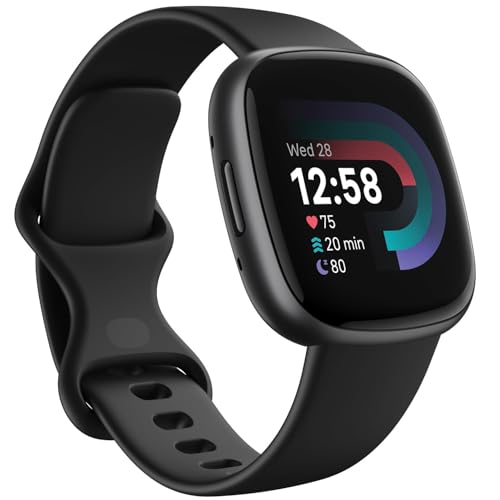
Fitbit Versa 4 — The compact all-rounder with stamina
The Versa 4’s title sells a formula rather than a dimension: a health and fitness smartwatch with GPS, round-the-clock heart rate, sleep tracking, workout modes, built-in Alexa, water resistance, and a battery claim of six-plus days, in black. That battery figure is the review’s headline. In a size class where several titles stay silent on endurance, a stated six-plus days redraws the ownership week — charge on Sunday, forget the cable until the weekend — and built-in GPS means runs and rides can be tracked without the phone along, a freedom the phone-dependent picks here cannot offer.
The size honesty point stands, though, and the spec box enforces it: this title never states the case size, so a buyer shopping strictly by millimetre must take the dimension from Fitbit’s documentation and confirm the Versa 4’s compact form against their own wrist before ordering. What can be said from the title is that the Versa line is Fitbit’s mainstream smartwatch form, distinct from its smaller tracker bands, and that the feature architecture — GPS, Alexa on the wrist, workout modes, water resistance for the pool-adjacent life — is the most complete all-round set in this guide outside the Apple ecosystem. For Android households especially, this is the balanced default of the six.
- Case size: Not stated in the listing title — verify with the maker’s documentation
- Positioning: built-in GPS, per the title
- Battery: 6+ days claimed in the title
- Health as titled: heart rate around the clock, sleep tracking, workout modes
- Assistant: built-in Alexa
- Water resistance: stated in the title without a depth figure
Strengths
- A stated six-plus-day battery, the second-longest claim in this guide.
- Built-in GPS frees runs and rides from the phone.
- Alexa on the wrist adds a voice layer none of the other titles here claim.
Trade-offs
- The case dimension is absent from the title, an odd gap in a size-led purchase.
- Water resistance is claimed without a depth or rating figure to plan swims by.
- Fitbit’s platform direction should be checked by buyers who keep watches for many years.
Best for: an Android or mixed household that wants GPS freedom and a weekly charging rhythm in a compact mainstream form. Not suited for: size-led purchases requiring the case dimension guaranteed by the listing itself, because this title never prints the millimetres.

Garmin vivoactive 5 (42mm) — Just over the band, fully loaded
Label first, as promised: the vivoactive 5 is a 42mm watch, just over the band this guide is built around, and it appears here because its health platform is the one that 40mm shoppers most often stretch for. The title describes a health and fitness GPS smartwatch in orchid, with round-the-clock health monitoring, built-in sports apps, a Sleep Coach, Body Battery energy monitoring, and workout benefit and recovery time readouts. That is Garmin’s full mainstream health stack, the deepest interpretive platform in this six — Body Battery alone, with its single-number picture of the day’s charge and drain, has converted more casual wearers into data readers than any feature in the category.
The question the review must answer is whether the platform is worth two millimetres. On a medium wrist, honestly, the difference between 40mm and the vivoactive 5’s 42mm, just over the band, is visible mainly in photographs; on a genuinely small wrist it is felt at the lugs and at night. The orchid finish signals the intended audience plainly — this is the colourful, lifestyle end of Garmin rather than the expedition end — and the built-in sports apps give it training depth the Versa and the SE match only partially. Buyers whose wrists can absorb the size get the richest health platform in the guide; buyers who came here precisely because 42mm has failed them before should hold their line and look at the Lily 2’s opposite compromise, just under the band, below.
- Case: 42mm, orchid — just over the band, as labelled throughout this guide
- Positioning: GPS smartwatch, per the title
- Health as titled: health monitoring around the clock, Sleep Coach, Body Battery energy monitoring
- Training as titled: built-in sports apps, workout benefit and recovery time
- Battery figure: Not stated in the listing title — verify with the maker’s documentation
- Band sizing: Not stated in the listing title — verify with the maker’s documentation
Strengths
- The deepest health interpretation in the six, with Sleep Coach and Body Battery working together.
- Workout benefit and recovery time turn raw training data into guidance.
- Built-in sports apps give it genuine training depth beyond step counting.
Trade-offs
- At 42mm it sits just over the band, which is the whole reason some readers are here.
- No battery claim appears in the title despite the platform’s endurance reputation.
- The orchid finish narrows its wardrobe range compared with the neutral cases elsewhere in the six.
Best for: a medium wrist willing to stretch two millimetres past the ceiling for Garmin’s full health platform. Not suited for: the smallest wrists that came to this guide to escape overhang, because a 42mm case, just over the band, reproduces exactly the fit problem they are solving.

Smart Watch for Women (1.27″) — The rose-gold value caller
The unbranded entry in this guide competes on a simple proposition: the most everyday features per pound in the set. Its title describes a women’s smartwatch with a 1.27-inch display, call making and answering, heart rate, sleep and blood oxygen monitoring, more than 100 sports modes, compatibility with iPhone, Samsung and Android phones, in rose gold. The call handling is its distinction — none of the branded picks in this six headlines wrist calls — and for a wearer whose phone lives in a bag or a kitchen drawer, answering from the wrist is a daily convenience that outweighs platform prestige.
The size evidence needs the guide’s standard care. The 1.27 inches in the title is the display diagonal, not the case size, and the spec box records the case dimension as unstated: a buyer choosing strictly by case millimetres cannot complete that judgement from this title and should take the figure from the listing’s specification section or the maker’s documentation. What the title does support is a coherent value picture — broad phone compatibility across both ecosystems, a full basic health suite, triple-digit sports modes, and a finish aimed at buyers who found the branded options too sporty or too severe. The unbranded caveats apply as ever: app quality and longevity are the unknowns the price of admission buys into.
- Display: 1.27 inches, per the title — a screen measurement, not the case size
- Case size: Not stated in the listing title — verify with the maker’s documentation
- Calls: make and answer calls, per the title
- Health as titled: heart rate, sleep and blood oxygen monitoring
- Sports modes: more than 100, per the title
- Compatibility and finish: iPhone, Samsung and Android; rose gold
Strengths
- Wrist calling headlines a feature set the branded picks here mostly leave out.
- Compatibility spans iPhone and Android alike, rare in this guide.
- More than 100 sports modes plus oxygen monitoring is a lot of stated capability at the value end.
Trade-offs
- The case size is never stated, and the quoted 1.27 inches measures the screen, not the case.
- An unbranded listing leaves the companion app’s polish and lifespan unanswerable from the title.
- No GPS claim appears, so outdoor tracking leans on the phone.
Best for: a bag-carrying, phone-in-another-room setup, with calls taken on the wrist and broad compatibility in a rose-gold case. Not suited for: a strictly size-led purchase, because the case dimension cannot be confirmed from anything the title states.

Amazfit GTS 4 Mini — Fifteen days between charges
The GTS 4 Mini’s title leads with the number that defines it: a 15-day battery life claim, in a smartwatch for women and men with Alexa built in, GPS, more than 120 sport modes, heart rate and blood oxygen monitoring, and compatibility with Android phones and iPhone, in black. Fifteen days is not an incremental advantage; it is a different ownership species. The watch can be taken on a fortnight’s holiday without its cable, worn through two working weeks of sleep tracking without a gap, and generally treated like the classic watches this size band imitates — objects that are simply always ready.
The rest of the title supports the pitch rather than decorating it. Built-in GPS at this endurance level is genuinely unusual, since satellite tracking is the hungriest feature a watch carries, and 120-plus sport modes give that GPS something to do. Alexa built in adds the voice layer the Versa also claims. As with the Versa, the title states no case size — the Mini name and the compact brief must be converted into millimetres from Amazfit’s documentation by a strict size shopper — and the spec box records that. Judged on what is stated, though, this is the endurance champion of the six by a wide margin, and for the traveller or the charge-forgetter it may be the only pick that matters.
- Case size: Not stated in the listing title — verify with the maker’s documentation
- Battery: 15-day battery life claimed in the title
- Positioning: GPS built in, per the title
- Sports modes: more than 120, per the title
- Health as titled: heart rate and blood oxygen monitoring
- Assistant and compatibility: Alexa built in; Android phone and iPhone compatible
Strengths
- A 15-day battery claim that removes charging from the weekly routine entirely.
- Built-in GPS alongside that endurance, a pairing few compact watches offer.
- More than 120 sport modes is the deepest stated library in this guide.
Trade-offs
- The case dimension is absent from the title, so size-led buyers must verify elsewhere.
- No call handling is claimed, keeping conversations on the phone.
- Sleep features are not headlined in the title, unlike several rivals here.
Best for: travel and charge-forgetting households, on a compact watch that simply never asks for its cable. Not suited for: size-led purchases requiring the case size warranted by the listing text, since the millimetres never appear in this title.

Garmin Lily 2 (35mm) — Just under the band, unapologetically small
Final label, stated as plainly as the first: the Lily 2 is a 35mm watch, just under the band, and it is in this guide because for the smallest wrists it is not a compromise at all but the correct answer. The title describes a small and stylish smartwatch in coconut, with a small and stylish design, built-in GPS, Body Battery, a sleep score, fitness tracking and sports apps, and Garmin Pay. Read that feature list against the case size and the engineering achievement sharpens: GPS and a payment system inside 35mm is a packing feat none of the in-band picks attempts, and the Lily line’s patterned-lens design disguises the display so thoroughly that the watch reads as jewellery until it lights.
Garmin Pay in the title deserves its sentence: it makes the Lily 2, just under the band, the only pick here whose own listing promises wrist payment, a fact that will outweigh five missing millimetres for a certain buyer — and readers comparing payment routes should note it sits outside the Google Wallet world covered in the best smartwatches for google pay guide, running Garmin’s own system instead. Body Battery and the sleep score bring Garmin’s interpretive platform down to this size intact. The trade is screen: at 35mm the canvas is small, text is brief, and anyone who reads their watch at arm’s length through the day will feel the limit hourly. For the wrist it was designed for, that trade is not a flaw but the definition of the product.
- Case: 35mm, coconut — just under the band, as labelled throughout this guide
- Positioning: built-in GPS, per the title
- Payment as titled: Garmin Pay
- Health as titled: Body Battery, sleep score, fitness tracking and sports apps
- Design as titled: small and stylish design
- Battery figure: Not stated in the listing title — verify with the maker’s documentation
Strengths
- The only genuinely small case in the six, proportioned for wrists the band itself still overwhelms.
- Built-in GPS and Garmin Pay inside 35mm is remarkable packaging.
- Garmin’s Body Battery and sleep score survive the miniaturisation intact.
Trade-offs
- At 35mm it sits just under the band, five millimetres below the range this guide is named for.
- The small canvas limits glanceable text and notification reading.
- No battery figure appears in the title, leaving endurance to the maker’s documentation.
Best for: the smallest wrists, fitted with a watch that reads as jewellery first and technology second in daily use. Not suited for: notification-heavy use read at arm’s length, because a 35mm canvas, just under the band, shows a headline rather than a message.
Six cases, one table
| Watch | Case position | Battery as titled | Signature stated feature |
|---|---|---|---|
| Apple Watch SE 3 GPS | 40mm — in band | Not stated in the title | Vitals tracking, S/M band size stated |
| Fitbit Versa 4 | Not stated in the title | 6+ days | Built-in GPS and Alexa |
| Garmin vivoactive 5 | 42mm — just over the band | Not stated in the title | Sleep Coach and Body Battery |
| Smart Watch for Women | Not stated (1.27-inch display) | Not stated in the title | Make and answer calls |
| Amazfit GTS 4 Mini | Not stated in the title | 15 days | GPS with 120+ sport modes |
| Garmin Lily 2 | 35mm — just under the band | Not stated in the title | Garmin Pay and built-in GPS |
What are the recurring errors in small-watch shopping?
The first is confusing screen size with case size, an error one pick in this guide could cause all by itself: a 1.27-inch display tells you nothing directly about the case that frames it, and buyers who treat the numbers as interchangeable end up surprised in both directions. The second is assuming smaller means lesser. The Lily 2, just under the band, carries GPS and payments; the GTS 4 Mini carries a fortnight of battery; small cases in this generation are design choices, not feature apologies. The third error is buying the case and forgetting the strap: lug width, strap range and the S/M-versus-M/L question decide daily comfort as surely as the case does, and only one title in this six states its band size outright.
Fourth, shoppers project their current wrist habits onto a smaller canvas without testing legibility — a wearer who reads long notifications hourly will suffer on any screen in this band and should admit it before ordering. Fifth, the boundary picks get bought by accident: a shopper who did not notice the vivoactive 5’s 42mm, just over the band, or the Lily 2’s 35mm, just under it, has been failed by listings that bury dimensions — which is why this guide labels both at every appearance, and why the final check before any purchase in this category is a tape measure against your own wrist and a ruler against a watch you already like.
How do you measure your wrist for this band?
Use a soft tape or a strip of paper marked against a ruler, wrapped at the wrist bone where a watch actually sits, neither slack nor tight. Then take a watch you already own and like, and measure its case across without the crown, and its lug-to-lug length — the second figure predicts overhang better than the first. Compare those numbers, not impressions from photographs, against the maker’s stated dimensions for any pick whose title omits them. If your wrist’s flat top measures under about 38mm across, expect even in-band cases to sit large and give the Lily 2, just under the band, a serious look; if it measures well over 40mm, the vivoactive 5’s 42mm, just over the band, will likely wear as the in-band watches wear on others. Proportion is personal, measurable and knowable before a box is opened — the only unforgivable sizing error is guessing.
Why does this band own the night?
Sleep tracking is where compact cases quietly defeat their larger rivals, and the reason is simple attendance. A watch that presses into the wrist bone, catches on the pillow or drags a heavy case across the face at 3 a.m. gets taken off, and a watch on the nightstand tracks the nightstand. The watches in this band — and the Lily 2 at 35mm, just under it, most of all — are the ones still on the wrist at dawn, which is why so many of their titles headline sleep: the SE 3’s sleep and vitals, the Versa 4’s sleep tracking, the vivoactive 5’s Sleep Coach at 42mm just over the band, the Lily 2’s sleep score. The data quality in this category is decided less by sensors than by whether the object is tolerable for eight unconscious hours, and tolerability is a sizing property before it is a technology property.
Side sleepers feel the difference most, since the watch wrist often ends up under a cheek or a pillow, where case height matters as much as case width — another dimension titles rarely state, and another entry for the maker’s-documentation checklist. If overnight data is a buying motive, weigh the night test as heavily as the day test during any return window: two nights worn, honestly assessed, will tell you more than a week of daytime impressions, because a watch can charm at noon and still be abandoned by midnight.
How do straps and lugs complete the size picture?
A case dimension is only the beginning of fit. Lug-to-lug length decides whether the case sits within the wrist’s flat top or cantilevers past it; strap material decides whether the watch stays centred or migrates; and the strap’s hole spacing decides whether the correct tightness exists at all, since sensor contact wants a snugness that falls between two holes on badly spaced straps. The Apple listing’s stated S/M sport band is the only title here that engages with any of this, which is why returns in this category so often cite fit while meaning strap. Before ordering any of the other five, find the strap range in the maker’s documentation and compare it with your measured wrist, leaving margin at both ends: a strap at its final hole has no adjustment left for summer swelling or winter shrinkage, both of which are real at the precision this band operates at.
After purchase, the strap is also the cheapest personality change available. A compact case accepts a leather strap for the office, a woven one for weekends and the stock silicone for training, and because the case itself is proportionate, each change reads as a different watch rather than as a gadget in costume. Owners of in-band watches report keeping them longer than their larger predecessors for exactly this reason — the object stays, the wardrobe rotates — and longevity is a legitimate buying criterion in a category whose products are otherwise replaced on a phone-like cycle.
How do the six divide by phone and by philosophy?
Draw the ecosystem map first, because it eliminates faster than any feature comparison. The SE 3 belongs wholly to iPhone households. The unbranded women’s watch spans both ecosystems, as its title states. The Versa 4, the GTS 4 Mini and both Garmins live in the cross-platform world, with the Garmins at 42mm just over the band and 35mm just under it offering the same app family at opposite size extremes — a neat illustration that platform loyalty and size loyalty can be satisfied independently. A household already invested in Fitbit’s or Garmin’s history should weigh that accumulated data as an asset: years of sleep and activity records have a gravity of their own, and switching platforms for two millimetres may cost more in continuity than it gains in fit.
Philosophy divides the six just as cleanly. Apple and Samsung-style platforms — represented here by the SE 3 — treat the watch as a phone’s closest companion, rich in interaction. Fitbit and Amazfit treat it as a health instrument with a screen, optimised for battery and quiet competence. Garmin treats it as a training and body platform that also tells time, at both of this guide’s labelled extremes. The unbranded pick treats it as an appliance: calls, basics, done. None of these philosophies is wrong at 40mm, but they produce very different second years of ownership, and the buyer who names their own philosophy honestly will choose better than the buyer who shops the feature grid alone.
Final Recommendation
Anchor on the Apple Watch SE 3 if an iPhone is in your pocket, because its title settles every sizing question in print. Android households should start from the Versa 4’s balance or the GTS 4 Mini’s fortnight of battery, choosing between GPS-with-Alexa polish and sheer endurance. Then make the boundary decisions consciously: stretch to the vivoactive 5 at 42mm, just over the band, only if Garmin’s health platform is worth two millimetres on your wrist, and drop to the Lily 2 at 35mm, just under the band, if smallness itself is the feature you have been hunting. Whichever name survives that process, the watch will disappear into your days the way well-proportioned objects do — noticed only in the moment someone asks how something so small keeps track of so much.
What changes at work, at the gym and in formal dress?
At a desk, the in-band watch is the only smartwatch class that never argues with a keyboard or a cuff: it slides under a shirt sleeve, rests lightly during eight hours of typing, and its crown stops digging into the back of the hand when the wrist bends — a small, daily mercy that large-case owners recognise instantly. In meetings it reads as a watch rather than as a device, which changes how its glances are judged by the room; the wearer of a 40mm case checking the time is a person in a meeting, while the wearer of a glowing 45mm slab checking a notification is a person leaving it, whatever the truth of the glance.
At the gym the calculus reverses in one respect: a smaller screen shows fewer simultaneous metrics, so interval sessions driven by live numbers feel cramped, while steady training — runs, rides, swims, classes — loses nothing at all. The GPS-equipped picks here handle the outdoor work phone-free, and the lighter cases stay put through movement that sets larger watches sliding. In formal dress the band simply wins outright, since proportion is the whole language of a dressed wrist; a 38-to-40mm case under a cuff is the reason this category exists, and the Lily 2 at 35mm, just under the band, extends that win to wrists the band itself still dresses too largely.
How should a first-time buyer in this band use the return window?
Treat the first fortnight as a fitting, because that is what it is. Wear the watch through the full rotation of your real life — workdays, a workout, a formal occasion if one arises, and at least four nights — and keep a ruthlessly honest note of every moment you noticed it: each catch on a cuff, each dig of the crown, each night it ended up on the nightstand. A well-proportioned watch produces a nearly empty note. Then test the two functions you bought it for, whether that is the SE 3’s vitals picture, the GTS 4 Mini’s GPS on a known route, or the Lily 2’s Garmin Pay at a familiar till, since a size success with a functional disappointment is still a return.
If the note fills up with fit complaints, do not negotiate with it. Move one step in the direction the complaints point — down toward the Lily 2’s 35mm, just under the band, for overhang and night discomfort; up toward the vivoactive 5’s 42mm, just over the band, for cramped reading and fiddly interaction — and refit. Size is the one property of a watch that no software update will ever change, and the buyers who end up loving this category are uniformly the ones who treated getting it right as the purchase itself, with the model choice as a detail inside it.
Frequently Asked Questions
Is 40mm a good size for a woman’s wrist?
It depends on the wrist rather than the label: 40mm suits medium wrists comfortably and larger small wrists well, while the smallest wrists often find even 40mm dominant — which is why this guide includes the 35mm Lily 2, just under the band, and a measuring method rather than a gender rule.
Why are two picks outside the 38-to-40mm band?
Because real shoppers meet them constantly at this band’s edges: the vivoactive 5 at 42mm, just over the band, and the Lily 2 at 35mm, just under it. Both are labelled at every appearance so the stretch or the drop is a conscious decision, never a listing accident.
Does a smaller watch mean a smaller battery?
Not in this six. The longest claim — fifteen days — belongs to the Amazfit GTS 4 Mini, and the Versa 4 claims six-plus days, while several larger or in-band titles state no figure at all. Efficiency of the platform matters more than case volume at this scale.
Can I trust a display size as the case size?
No. A display diagonal, like the 1.27 inches quoted by one pick here, measures the screen only; the case adds bezel and body around it. Always take the case dimension from the maker’s documentation when the title does not state it.
Which pick should a runner in this size band choose?
The built-in GPS picks: the Versa 4, the GTS 4 Mini, the vivoactive 5 at 42mm just over the band, and the Lily 2 at 35mm just under it all state GPS in their titles, while the SE 3’s GPS naming refers to its model line and phone pairing — check the maker’s documentation for the tracking arrangement that suits phone-free runs.
Is a 38-to-40mm watch big enough for notifications and apps?
For headlines, alerts and quick interactions, yes — that workload is what this band was designed around, and millions of wrists run their days on it. For reading long messages, typing replies or studying maps, no canvas in this band competes with the large sizes, and a buyer whose watch is a second phone screen should shop above the band honestly rather than buy small and resent it. The middle habit that suits this size is triage: glance, decide, and let the phone handle anything longer than a sentence.
What if I am between the band and the Lily 2’s size?
Then fit, not features, should cast the deciding vote, and the return window is your laboratory. Order with returns in mind, wear the candidate through two full days and two nights, and judge by whether you forgot it was there — the true test of proportion. A watch at 35mm, just under the band, that vanishes on the wrist will gather more data and more affection than an in-band watch that announces itself hourly, and data gathered beats data specified in every comparison this guide can make.
Do compact watches hold their value and support as long?
Support horizons follow platforms rather than case sizes, so the SE 3’s prospects ride on Apple’s update policy and the Garmins’ on Garmin’s, regardless of millimetres. Physically, smaller cases often age better — less glass to crack, less mass in every drop — and the strap-rotation habit described in this guide keeps them looking current. The honest variable is the maker’s app commitment, which is worth five minutes of research for any pick here, exactly as it is at larger sizes.
Does case thickness matter as much as case width?
For comfort, often more. Width decides overhang, but thickness decides how the watch behaves under cuffs, against desks and beneath a sleeping cheek, and titles almost never state it — one more figure for the maker’s documentation. A buyer who has measured only width has done half the fitting; take the thickness of a watch you already like as your benchmark, and treat any candidate substantially thicker as a different wearing experience whatever its width promises. The watches in this guide were chosen at the compact end of their makers’ ranges, where thickness is usually tamed along with width, but usually is a word to verify rather than to bank on.
Are there good reasons to buy above this band instead?
Several, and naming them keeps this guide honest. Large-case watches offer bigger batteries in some platforms, more simultaneous training metrics, easier typing and map reading, and a presence that some wrists and styles genuinely prefer. The 38-to-40mm band is the right answer for proportion, sleep and discretion — not a universal verdict on the market. A buyer whose priorities are screen-first should shop screen-first, and the vivoactive 5 at 42mm, just over the band, shows how small the step up can be when the platform rather than the size is the attraction.
How do I stop a compact watch spinning or sliding on a slim wrist?
Start with the strap rather than the case: a strap with closely spaced holes, or a loop-style band with continuous adjustment, holds a light case centred far better than a coarse buckle strap worn a hole too loose. Position matters too — worn just above the wrist bone, on the flatter part of the forearm, a compact case settles and its sensors keep the contact that heart-rate and sleep tracking depend on. If a watch still migrates, a slightly grippier strap material usually solves what tightness alone could not, and the fix matters beyond comfort: a sliding watch is a sensor platform sampling the air half the night, which no algorithm downstream can repair.
Should I buy the previous generation in this size to save money?
Sometimes, with eyes open about what ages. Case sizes persist across generations, so last year’s 40mm wears identically to this year’s; what changes is the sensor set, the software horizon and the remaining support life. A previous-generation compact watch from a platform with a long update record can be the shrewdest purchase in this guide’s whole territory, while the same saving on a platform nearing its support horizon buys a watch whose app may fade before its battery does. Check the maker’s support policy with the same care as the case dimension — in this category the two checks together are the purchase.
What is the single most common reason these watches get returned?
Proportion disappointment that a tape measure would have prevented: a case that overhangs a slim wrist in life though it looked fine in photographs, or a screen that reads smaller in the hand than the product images suggested. The defence is the measuring routine in this guide — wrist width, a known watch’s lug-to-lug, the candidate’s stated dimensions — performed before ordering rather than after unboxing. Returns in this category are rarely about quality; they are about geometry discovered too late, and geometry is the one property that can be known in advance with certainty.
Can a watch in this band handle contactless payment?
One pick here promises it in its own title: the Lily 2 at 35mm, just under the band, lists Garmin Pay, running on Garmin’s payment system rather than Google’s. The broader payment landscape — which platforms pay from which wrists, and what the titles do and do not establish — is the subject of the google pay guide linked below, and the lesson transfers directly: in payment as in sizing, the printed claim in the title is the only claim worth building a purchase on.
How tight should a watch in this band be worn for accurate tracking?
Snug enough that the case cannot slide when you shake your hand, loose enough that the strap leaves no deep mark an hour after removal — a narrower window than most wearers assume, and the reason strap hole spacing earned its own section in this guide. During exercise, one notch tighter than the daytime setting is the common practice, returned to afterwards so the night’s wear stays comfortable. The payoff for this small discipline is the entire health proposition of the category: sensors pressed consistently against the same patch of skin produce the trends worth reading, at every size in and around this band.
A final word on gifting a watch from this band?
Measure the recipient’s favourite existing watch rather than guessing from their build: people of every size wear surprising proportions happily, and the case they already love is the strongest evidence of the case they will love next. Match that measurement first, choose the platform second, and the gift will be worn daily instead of admired briefly — the only outcome a gifted watch is really for.
Related Guides
Continue with the best smartwatches for google pay for the payment-first view, the best smartwatches that look like a regular watch for the discretion-first view, or the best all around smartwatches for the unrestricted field.
Related guides
- Best Balancing Stabilizers for Mirrorless Cameras: Payload, Balancing and Native Vertical Shooting
- Best Canon Point and Shoot Digital Cameras: PowerShot Picks From Pocket Compacts to Travel Zooms
- Best Basic Phones Camera Buyers Can Trust: Flip Phones and Simple Handsets That Still Take a Photograph
- Best Sony Full Frame Cameras for Astrophotography: Sensitivity vs Resolution


