What's inside
- Key Takeaways
- Quick Picks
- How We Chose These Picks
- Dolby Vision, HDR10+ or Both: What Is a Movie Buyer Actually Choosing?
- How Should a Movie Buff Set Up a New Set on the First Night?
- The Six Movie Televisions, One by One
- How Do the Six Sets Compare for Cinema?
- Where Should the Seats Go? Viewing Angle and Distance for Film
- How Much of a Film Collection Is Really 4K HDR?
- What Does the First Month With a Serious Movie Set Teach?
- Which Mistakes Do Movie Buyers Make With Capable Sets?
- Final Recommendation
- Frequently Asked Questions
- Related Guides
As an Amazon Associate I earn from qualifying purchases. This post may contain affiliate links at no extra cost to you.
gizmoverdict.com is reader-supported. When you buy through links on our site, we may earn an affiliate commission.
Where to buy: each television below is sold through its Amazon listing, and the names in this guide link to those listings so the HDR formats, dimming claims and audio configurations can be checked in the makers’ own words. Movie televisions are bought on specifications that listings love to abbreviate, so read the full title of any set you shortlist — in this category the difference between two near-identical model names is often a whole HDR ecosystem.
The best TVs for movie buffs are decided in the dark. Daylight specifications — brightness for sport, motion for games — matter here too, but cinema is the discipline of shadow: a night scene in a thriller lives or dies on whether the panel can hold true black beside a candle flame without smearing either, and a streamed epic stands or falls on whether the set speaks the HDR language the film was mastered in. The six sets in this guide were chosen on the cinema axis as their titles state it — HDR format support first, local dimming and panel technology second, film-oriented processing third — and they divide into a clear pattern: four are 55-inch sets, one is a 65-inch, and every one of them is a Mini-LED or Neo QLED design except where the title says otherwise, because controlled backlight zones are what shadow detail is made of.
The field’s extremes mark its range. At one end, Hisense’s U8QG arrives with the loudest title in this batch — up to LD5600, a maker-stated 5000 nits, Dolby Vision IQ, IMAX Enhanced, a 4.1.2-channel audio system — a specification sheet aimed at the viewer who reads them. At the other, Roku’s Plus Series MiniLED says almost nothing except Dolby Vision, Dolby Atmos and the platform, a set whose cinema case rests on format fluency and MiniLED hardware stated plainly. Between them sit Toshiba’s Z670R with its REGZA engine, Hisense’s larger U6 Pro, TCL’s T7 with the guide’s most classical movie specification, and Samsung’s QN70H Neo QLED with its colour-volume claim. Five of the six name Dolby Vision in some form; the HDR format war is the first thing a movie buyer should understand, and it is where the guide sections begin.
A discipline note, because this category invites invention: brightness figures appear in this article only where a title states them, in the maker’s wording — the U8QG’s 5000 nits is Hisense’s figure, not this guide’s measurement — and local-dimming zone counts are treated the same way. Where a title is silent, the article is silent, and the reader is sent to the full listing rather than handed a borrowed number from a different model year. Movie buffs, of all buyers, know the difference between a specification and a rumour.
Key Takeaways
- Every pick was judged on the cinema axis as titled: HDR format support, local dimming or Mini-LED panel design, and film-oriented processing.
- Five of the six titles name Dolby Vision — four of them the adaptive Dolby Vision IQ — and all six name HDR10+ or Dolby Vision, most naming both.
- The Hisense U8QG carries the guide’s most extreme stated figures: up to LD5600, 5000 nits as the maker states it, IMAX Enhanced and 4.1.2-channel audio.
- Samsung’s QN70H is the colour argument: Neo QLED Mini LED with 100% Color Volume with Quantum Dot in its title.
- The TCL T7 is the classical cinema pick — native 120Hz, Dolby Vision and Atmos — without gaming-led headline numbers.
- The Hisense U6 Pro at 65 inches is the size option, with a glare-free claim that serves lit-room viewing as well as dark.
Quick Picks
| Pick | Badge | Why it is here |
|---|---|---|
| Hisense U8QG 55″ Mini-LED | The specification ceiling | Up to LD5600 and a stated 5000 nits, Dolby Vision IQ, IMAX Enhanced and 4.1.2 audio in one 55-inch title. |
| Toshiba Z670R 55″ Mini-LED | The engine room | REGZA Engine Zri driving a Mini-LED panel with Dolby Vision IQ, HDR10+ and Atmos at native 144Hz. |
| Roku Plus 55″ MiniLED | The quiet format-keeper | MiniLED hardware with Dolby Vision and Atmos, stated plainly, on the simplest platform in the guide. |
| Hisense U6 Pro 65″ Mini-LED | The big screen | The cinema specification at 65 inches — Dolby Vision IQ, HDR10+, native 144Hz — with a glare-free claim. |
| TCL T7 55″ QLED 120Hz | The classicist | Native 120Hz with Dolby Vision and Atmos — the traditional film panel, honestly specified. |
| Samsung QN70H 55″ Neo QLED | The colourist | Neo QLED Mini LED with 100% Color Volume with Quantum Dot and Samsung’s NQ4 AI processing. |
How We Chose These Picks
The filter was the cinema axis, applied strictly to listing titles from the verified pool. A set qualified by naming the machinery of film presentation: an HDR format family — Dolby Vision or its adaptive IQ variant, HDR10+ — a dimming architecture — Mini-LED, Neo QLED’s Quantum Mini LED, full-array local dimming language — or a film-facing credential such as IMAX Enhanced. Sets whose titles led with gaming refresh or smart-platform features and mentioned nothing cinematic were passed over, however good they might be at other jobs; the two picks here with strong gaming numbers, the U8QG and the Z670R, earned their places on dimming and HDR credentials that happen to share a panel with fast refresh, not on the refresh itself.
Within the six, the judging weighted format coverage first. A movie library in 2026 is split between Dolby Vision and HDR10+ masters, and a set fluent in both — as five of these six claim, in one combination or another — never has to present a film in a fallback format. Dimming came second, because HDR formats are instructions and dimming is the machinery that obeys them: the U8QG’s up-to-LD5600 wording, read as the maker’s zone architecture claim, is the strongest such statement in the guide. Audio placed third — the U8QG’s 4.1.2-channel title claim and the Atmos support across the field matter to film sound, though most serious movie rooms will add dedicated audio eventually. Refresh rate, the specification other guides lead with, was deliberately last: cinema runs at twenty-four frames, and everything above that is processing headroom, useful, welcome, and not the point.
The guide also kept one seat for restraint. Roku’s Plus Series title is nearly bare beside the Hisense flagships, and it stayed in the six because a movie buff’s household still has to live with a television daily — platform manners, an enhanced voice remote, a set that the whole family can run. A guide that recommended only specification monsters would fail the readers who watch films in real rooms with other people in them.
Dolby Vision, HDR10+ or Both: What Is a Movie Buyer Actually Choosing?
HDR formats are competing instruction sets for the same panel. A film mastered in Dolby Vision carries scene-by-scene guidance for how bright, dark and saturated each moment should be; HDR10+ carries a similar philosophy from a rival camp; plain HDR10 gives the set one static instruction for the whole film. Dolby Vision IQ, named by four sets here, adds the room itself to the calculation, adapting the presentation to ambient light so a film watched at noon and the same film at midnight are each presented as intended rather than identically. For a movie buff the practical consequence is library-shaped: the major streaming services and disc releases divide their allegiances, and a set fluent in both adaptive formats — the U8QG, both Hisense and Toshiba flagships here — never presents a major release in a lesser dialect.
One clarification belongs here, because the format names mislead newcomers: a set does not need to choose a camp permanently. Streaming boxes and disc players negotiate with the television per title, and a set fluent in both formats simply never has the negotiation fail. The practical shopping rule that follows is to audit your own shelf before admiring any row of the comparison table — list the services and disc labels your household actually uses, note which format each leads with, and let that audit, not a brand’s reputation, rank the importance of Dolby Vision against HDR10+ in your decision. Ten minutes of auditing has saved more cinema rooms than any single specification in this guide.
The second half of the HDR story is whether the panel can execute the instructions, which is where local dimming earns its keep.
A bright object in a dark scene — a lantern, a moon, headlights — asks the backlight to be fierce in one small area and absent everywhere else. Mini-LED architectures divide the backlight into many small zones to answer that request, and the zone philosophy is what Hisense’s LD5600 wording and Samsung’s Quantum Mini LED language are both, in their own dialects, claiming. No zone system is perfect, and the honest artefact to watch for is blooming, a faint halo around bright objects in dark scenes; more zones with better control shrink it. Readers who want the panel-technology question pursued on its own should see the roundup of the best mini led tvs, and those whose rooms are fully dark should compare the self-lit alternative in the guide to the best oled tvs for movies and video games.
How Should a Movie Buff Set Up a New Set on the First Night?
Start by betraying the showroom. New televisions ship in vivid, shop-floor picture modes engineered to win a brightly lit aisle, and every one of those modes is wrong for film: oversaturated colour, sharpening that invents edges, motion processing that turns cinema’s twenty-four frames into soap-opera glide. Find the film-oriented picture mode — the one whose name promises cinema or filmmaker intent — and make it the default for the movie inputs before watching anything. Then kill the motion smoothing for film sources specifically; sport may keep its processing, but a feature film should move the way it was shot, and every set in this guide has the refresh headroom to present that motion honestly.
While the menus are open, one more first-night task pays for itself all year: label the inputs and delete the ones the household will never use, so the film source is never buried under a parade of empty sockets and demonstration apps when the evening’s viewer sits down with the remote.
Sound follows the same principle of removing help. If the set will use its own speakers for a while — the U8QG’s titled 4.1.2-channel system is the most ambitious built-in arrangement here — choose its cinema or theatre voicing and switch off any volume-levelling that flattens a film’s dynamics, because a whispered scene followed by an orchestral hit is the film working as intended. Finally, calibrate the room rather than the panel for the first week: watch the darkest scene you own at your usual lighting, and adjust the set’s brightness to that reality rather than to a test pattern. A movie television is finished not when its numbers please a meter but when a night scene in your room holds its shadows and its faces at once.
The Six Movie Televisions, One by One

Hisense U8QG 55″ Mini-LED — The specification ceiling
The U8QG’s title is the longest argument in this guide, and it is worth reading as an argument: a 55-inch U8 Series ULED Mini-LED 4K UHD Google TV with QLED colour, native 165Hz, VRR 288, up to LD5600, a stated 5000 nits, HDR10+, Dolby Vision IQ and Atmos, IMAX Enhanced certification language, and 4.1.2-channel audio. For cinema, the load-bearing claims are the dimming and the formats. LD5600, in Hisense’s wording, describes the local-dimming architecture — the machinery that lets a starfield stay black between stars — and the maker’s 5000-nit figure describes the ceiling that HDR highlights are mastered toward. Both figures are the maker’s, reported as such; what they signal, even discounted as headline numbers, is a panel built with unusual headroom in exactly the two dimensions films stress.
IMAX Enhanced is the title’s cinema credential proper — a programme whose presence signals the set meets a standard for presenting IMAX-format content at home — and the 4.1.2-channel audio claim makes this the only pick whose built-in sound is specified like a system rather than mentioned as a feature. The 165Hz native refresh and VRR 288 belong to the gaming half of the panel’s life and are, for film, simply headroom. The U8QG is the pick for the movie buff who reads specifications the way other viewers read reviews, and who wants the strongest stated version of every cinema variable in one 55-inch object. Its abundance is also its question: a household that will never open a settings menu may be buying headroom it never visits.
- Screen size, as titled: 55-inch (55U8QG)
- Panel, as titled: ULED Mini-LED 4K UHD, QLED
- Dimming and brightness, as titled: up to LD5600, 5000 nits
- HDR, as titled: HDR10+, Dolby Vision IQ, IMAX Enhanced
- Audio, as titled: Dolby Atmos, 4.1.2 Ch audio
- Refresh, as titled: native 165Hz, VRR 288
- Platform, as titled: Google TV
- Not stated in the listing title — verify with the maker’s documentation
Strengths
- The strongest stated dimming and brightness figures in the guide, both from the maker.
- Dolby Vision IQ and HDR10+ together, plus IMAX Enhanced — full format coverage.
- 4.1.2-channel built-in audio is specified like a system, unique among these titles.
Trade-offs
- Headline figures are maker claims; the panel’s real-world manners need the full listing’s detail.
- 165Hz-class gaming hardware is headroom a pure film household pays for without using.
- At 55 inches it is not the guide’s answer for a large cinema room — that is the U6 Pro’s seat.
A word about the Google TV platform in a flagship’s title, since platform is where flagship buyers least expect compromise. Google TV gives the U8QG the broadest app reach of the three platforms here and a recommendation engine that learns a film household’s taste with unnerving speed; it also surfaces promoted content with an enthusiasm the Roku pick never attempts. Neither trait touches the picture. The enthusiast’s settlement is the usual one — the platform runs the library, the panel shows the film, and the two are judged by different standards — but a buyer choosing between this set and the Toshiba is choosing Fire TV against Google TV as surely as REGZA against LD5600, and should admit it in the decision.
Best for: a specification-led movie buff building a serious 55-inch film setup. Not suited for: a viewing room with seating past three metres, where 55 inches shrinks the cinema the hardware is trying to create.

Toshiba Z670R 55″ Mini-LED — The engine room
Toshiba’s entry makes its case through processing. The 55-inch Z670R is a Mini-LED 4K UHD Fire TV with QLED colour, native 144Hz, HDR10+, Dolby Vision IQ, Dolby Atmos, Game Mode Pro, Alexa built in — and, named like a signature, the REGZA Engine Zri, with Japan Quality closing the title. Where the U8QG argues with numbers, the Z670R argues with a named engine: the processor is the component that interprets HDR instructions, manages the dimming zones, upscales the older films in a collection, and generally decides whether a panel’s raw capability becomes a picture. A maker that titles its engine is telling the movie buff where its money went, and Toshiba’s television heritage gives the claim a lineage the newer brands cannot print.
The format coverage matches the flagship pattern — Dolby Vision IQ and HDR10+ together, Atmos for sound — and the 144Hz native panel with Game Mode Pro gives the set the same consolidation virtue as its 65-inch sibling in the cord-cutting guide: one screen that takes films seriously and consoles competently. Fire TV as the platform is the household consideration, busier than Google TV or Roku in its surfacing habits. Against the U8QG, the Z670R states fewer extreme figures and asks to be believed on refinement instead — the classic Toshiba proposition, and for viewers whose collections run to older, lower-resolution films that live or die on upscaling quality, it may be the more relevant one.
- Screen size, as titled: 55-inch (55Z670R, 2026 new)
- Panel, as titled: Mini-LED 4K UHD, QLED
- Refresh, as titled: native 144Hz
- HDR, as titled: HDR10+, Dolby Vision IQ
- Engine, as titled: REGZA Engine Zri
- Audio, as titled: Dolby Atmos
- Platform, as titled: Fire TV, Alexa built-in
- Not stated in the listing title — verify with the maker’s documentation
Strengths
- A named processing engine — REGZA Engine Zri — is the title’s centrepiece, aimed at picture refinement.
- Full adaptive format coverage: Dolby Vision IQ plus HDR10+, with Atmos audio.
- Native 144Hz and Game Mode Pro let one set serve films and consoles alike.
Trade-offs
- No dimming-zone or brightness figure is stated, where the U8QG prints both.
- Fire TV’s content-forward interface will not suit every film household’s taste.
- No IMAX Enhanced credential appears in the title.
The Japan Quality phrase at the title’s end is doing quiet work. It is a maker’s positioning statement rather than a measurable specification, and this guide treats it as such — but positioning matters in a category where several brands are younger than their customers’ film collections. Toshiba’s proposition across both its appearances in this batch is continuity: an engine with a name, a panel philosophy held across sizes, a company that was building televisions when the oldest films in a serious library were new. A buyer unmoved by heritage should ignore the phrase entirely; a buyer who keeps equipment for a decade may reasonably count it.
Best for: a film collector whose library spans decades and resolutions, where processing earns its keep nightly. Not suited for: a purchase process that requires dimming figures stated outright on the specification sheet, since this title argues by engine instead.
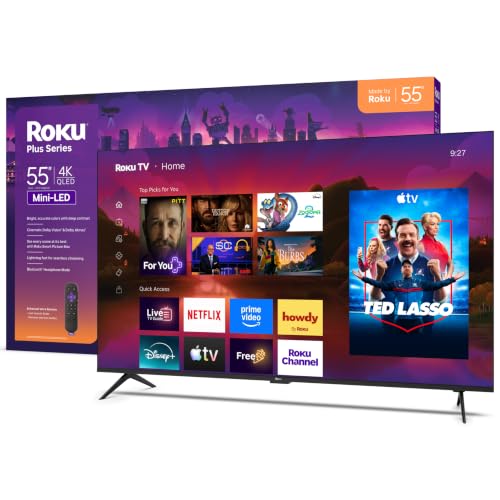
Roku Plus 55″ MiniLED — The quiet format-keeper
Roku’s Plus Series title is a study in understatement: a 55-inch 4K QLED MiniLED TV for 2026, flat screen, with Dolby Vision, Dolby Atmos and Wi-Fi for streaming sports, news, free and live TV, and an enhanced voice remote. Strip the platform language away and the cinema skeleton is exactly right — MiniLED backlight architecture for the shadows, Dolby Vision for the format most film-led services lead with, Atmos for the sound. What is absent is equally clear: no IQ variant is named, no HDR10+ appears, no dimming or brightness figure is offered. This is the guide’s honest middle — a set that covers the main cinema bases in plain words and declines to compete in the numbers war being fought above and below it on this page.
The Roku platform is the pick’s second argument, and for movie households it cuts both ways in an interesting direction. Roku’s interface is the least theatrical in the guide — no aggressive surfacing, a simple grid, a voice remote that searches across services — which suits the viewer who arrives knowing the evening’s film and wants the television to get out of the way. The same plainness means fewer cinema-facing flourishes are advertised. Buy the Plus for the household where the film matters and the television’s personality should not; it is the set in this guide most likely to be described by its owner as just working, which from a certain kind of movie buff is the highest available praise.
- Screen size, as titled: 55-inch
- Panel, as titled: 4K QLED MiniLED, flat screen
- HDR, as titled: Dolby Vision
- Audio, as titled: Dolby Atmos
- Model year, as titled: 2026 RokuTV
- Remote, as titled: enhanced voice remote
- Not stated in the listing title — verify with the maker’s documentation
Strengths
- MiniLED hardware with Dolby Vision and Atmos — the cinema essentials, plainly stated.
- Roku’s unobtrusive interface keeps the film, not the platform, at the centre.
- Enhanced voice remote suits search-led viewing across streaming services.
Trade-offs
- Dolby Vision is named without the IQ variant, and HDR10+ is absent from the title.
- No dimming, brightness or refresh figure is stated for comparison.
- Live and free TV language in the title shows a generalist brief, not a cinema-only one.
There is a temperament this pick serves that specifications never capture: the viewer who keeps a mental list of films, not of features. Roku built its reputation on removing steps between intention and picture, and on a MiniLED panel with the main HDR format present, that removal is the product. The Plus will not win a specification argument at a dinner party of enthusiasts, and its owner will not care, because the argument they actually had with their old television — the menus, the buffering, the buried settings — ended the day this one was hung.
Best for: a film household that wants MiniLED and Dolby Vision without the flagship theatre. Not suited for: a collector with a large HDR10+ disc library, since that format is not claimed in this title.

Hisense U6 Pro 65″ Mini-LED — The big screen
Size is a cinema specification, whatever the format tables say, and the U6 Pro is this guide’s size pick: a 65-inch Mini-LED ULED 4K UHD Fire TV with Hi-QLED colour, native 144Hz, Motion Rate 480, Dolby Vision IQ and Atmos, HDR10+, a glare-free claim, and Alexa+. The format coverage matches the flagships — both adaptive HDR families present — and the 65-inch canvas changes the viewing arithmetic completely: at this size, a letterboxed epic fills the visual field the way a cinema screen does, and the Mini-LED dimming has to hold its discipline across a much larger area, which is the honest test of the technology. Hisense titles this set as a Pro model in its U6 line, a step below the U8 flagship in the maker’s own hierarchy, and the title’s confidence suggests the step is about headline figures rather than about format fluency.
The glare-free claim deserves its sentence in a movie guide, because not every film is watched in a cave. The household whose cinema is a living room — curtains that leak, a kitchen’s light behind the seating, Sunday-afternoon films — benefits from a panel that refuses to mirror the room, and Dolby Vision IQ’s ambient adaptation works the same problem from the processing side. Motion Rate 480 is Hisense’s composite motion wording, reported as the maker’s term rather than a native figure; the native 144Hz beside it is the verifiable number. For the buyer whose room and budget both point at 65 inches, this is the set the guide’s logic converges on.
- Screen size, as titled: 65-inch (65U6SF Pro, 2026 new)
- Panel, as titled: Mini-LED ULED 4K UHD, Hi-QLED
- Refresh, as titled: native 144Hz, Motion Rate 480
- HDR, as titled: Dolby Vision IQ, HDR10+
- Finish, as titled: glare-free
- Audio, as titled: Dolby Atmos
- Platform, as titled: Fire TV, Alexa+
- Not stated in the listing title — verify with the maker’s documentation
Strengths
- The full cinema specification — both adaptive HDR formats, Mini-LED — at 65 inches.
- Glare-free finish plus Dolby Vision IQ serves lit-room film viewing unusually well.
- Native 144Hz stated plainly alongside the maker’s motion wording.
Trade-offs
- It sits below the U8 line in Hisense’s hierarchy; extreme dimming figures are not claimed.
- Motion Rate 480 is composite maker wording, not a panel measurement.
- A 65-inch set demands the room and the viewing distance to justify it.
The Pro designation invites one more comparison inside Hisense’s own line, because the U8QG above is the obvious temptation. The flagship’s advantages are real — the stated dimming ceiling, the brightness figure, the IMAX credential, the audio system — and they are all 55-inch advantages in this guide. A household whose room honestly fits 65 inches faces a genuine fork: the smaller set’s finer control, or the larger set’s greater immersion with the same format fluency. Cinema history votes for immersion more often than specification sheets expect; the extra diagonal does more for a film’s scale than any single processing feature, which is why the U6 Pro, not the flagship, is the recommendation this guide would defend for the average large room.
Best for: a living-room cinema at 65 inches that must also survive daylight viewing. Not suited for: a small dedicated dark room, where the 55-inch flagships’ finer dimming claims matter more than size.

TCL T7 55″ QLED 120Hz — The classicist
The T7’s title could have been written a decade ago by someone who understood televisions: a 55-inch T7 Series 4K 120Hz QLED Google TV with Dolby Vision HDR and Atmos, HDR10+, Game Accelerator 240 and VRR for sports and gaming, Alexa+, and a native 120Hz refresh rate. No dimming architecture is named — QLED is the panel language, full stop — and no brightness figure is waved. What the classicist specification understands is that 120Hz native is the film-friendly refresh: an exact multiple of cinema’s twenty-four frames, so film motion can be presented without the judder arithmetic that 60Hz panels perform. Add both HDR families’ headline formats and Atmos, and the T7 covers the movie brief with the least exotic hardware in the guide.
That restraint defines both its appeal and its ceiling. Without a Mini-LED claim in the title, the T7 cannot promise the shadow discipline the dimming sets argue for, and in a dark room, on a dark film, that difference is the whole conversation — readers building a cave should weight the picks above it. In a normal living room, at normal hours, the calculus flips: colour, formats and honest motion carry most films most nights, and the T7’s Google TV platform and gaming headroom make it the household all-rounder of the six. It is the pick for the movie buff whose realism about their room outruns their romance about the format.
- Screen size, as titled: 55-inch (55T7, latest model)
- Panel, as titled: QLED 4K
- Refresh, as titled: native 120Hz
- HDR, as titled: Dolby Vision HDR, HDR10+
- Audio, as titled: Dolby Atmos
- Gaming, as titled: Game Accelerator 240 and VRR
- Platform, as titled: Google TV, Alexa+
- Not stated in the listing title — verify with the maker’s documentation
Strengths
- Native 120Hz is the classically correct refresh for film presentation.
- Dolby Vision and HDR10+ together give full headline format coverage.
- An honestly stated specification with no inflated figures to discount.
Trade-offs
- No Mini-LED or local-dimming architecture is claimed in the title.
- Dolby Vision appears without the IQ ambient-adaptive variant.
- Dark-room shadow performance is the open question the title leaves unanswered.
There is a budget logic embedded in the T7’s restraint that the guide should state rather than imply. Money not spent on dimming architecture is money available for the parts of a film setup that outlast any television — seating, light control, the eventual sound system — and a household building a cinema gradually, in the right order, may serve its films better with the classicist set and blackout curtains than with a flagship panel in a bright, echoing room. The T7 is not the consolation pick of this six; it is the pick that understands a film room is a system, and that the television, even for movie buffs, is only its most replaceable component.
Best for: a living-room film habit at 55 inches, with gaming and sport in the same week. Not suited for: a blacked-out cinema room built around night scenes, where dimming architecture is the deciding technology.

Samsung QN70H 55″ Neo QLED — The colourist
Samsung’s entry argues the third cinema variable: colour. The 55-inch QN70H is a Neo QLED Mini LED 4K smart TV for 2026 whose title names Samsung Vision AI, Quantum Mini LED, 100% Color Volume with Quantum Dot, the NQ4 AI processor, 4K upscaling and Alexa built in. Colour volume — the ability to hold saturation at high brightness, where lesser panels wash their reds toward pink — is the specification that decides sunlit scenes, animated films and the saturated palettes of modern cinematography, and Samsung prints its claim as a full 100 percent with Quantum Dot, the maker’s figure in the maker’s words. Quantum Mini LED is Samsung’s name for its Mini-LED dimming architecture, so the shadow machinery is present in the title too, wearing Samsung’s dialect.
What the title does not name is any HDR format at all — no Dolby Vision, no HDR10+ — and in a movie guide that silence must be reported plainly rather than papered over with platform knowledge. Samsung’s format allegiances are its own affair; the listing’s full details are where a buyer confirms what this set decodes, and a Dolby Vision-led household should do exactly that before ordering. What can be said from the title is that the processing story is strong — the NQ4 AI processor and 4K upscaling speak directly to collections full of older material — and that the colour claim is the boldest single-variable statement in the guide. The QN70H is the pick for the viewer whose eye goes to saturation first and whose format homework will be done in the listing, not assumed from the brand.
- Screen size, as titled: 55-inch class
- Panel, as titled: Neo QLED Mini LED 4K
- Colour claim, as titled: 100% Color Volume with Quantum Dot
- Dimming language, as titled: Quantum Mini LED
- Processing, as titled: NQ4 AI processor, 4K upscaling, Samsung Vision AI
- Model year, as titled: 2026
- Not stated in the listing title — verify with the maker’s documentation
Strengths
- 100% Color Volume with Quantum Dot is the guide’s strongest stated colour claim.
- Quantum Mini LED dimming is present under Samsung’s own naming.
- NQ4 AI processing with 4K upscaling serves older film collections directly.
Trade-offs
- No HDR format is named in the title — a real gap a movie buyer must resolve in the listing.
- No refresh rate is stated, unlike most rivals here.
- The colour figure is the maker’s claim, to be weighed as such.
Animated film is the QN70H’s home ground and deserves the mention. Animation lives on saturated colour held at full brightness — skies, costumes, painted skies behind painted characters — which is precisely the colour-volume test, and precisely where panels with weaker volume quietly pale. A household whose cinema includes a great deal of animation, from classic hand-drawn restorations to modern computer-generated spectacle, should weight Samsung’s claim more heavily than a household of noir devotees should, for whom the same money chases dimming instead. Every pick in this guide has such a centre of gravity; matching it to the shelf is the buyer’s real work.
Best for: a colour-led viewer with a mixed-era collection, on Samsung’s platform. Not suited for: a Dolby Vision-first collection, unless the format support is verified in the full listing before buying.
How Do the Six Sets Compare for Cinema?
| Pick | Size | HDR, as titled | Dimming language, as titled | Distinguishing claim |
|---|---|---|---|---|
| Hisense U8QG 55″ Mini-LED | 55″ | Dolby Vision IQ, HDR10+ | Up to LD5600 | 5000 nits, IMAX Enhanced, 4.1.2 audio |
| Toshiba Z670R 55″ Mini-LED | 55″ | Dolby Vision IQ, HDR10+ | Mini-LED | REGZA Engine Zri |
| Roku Plus 55″ MiniLED | 55″ | Dolby Vision | MiniLED | Platform simplicity |
| Hisense U6 Pro 65″ Mini-LED | 65″ | Dolby Vision IQ, HDR10+ | Mini-LED | Glare-free at 65 inches |
| TCL T7 55″ QLED 120Hz | 55″ | Dolby Vision, HDR10+ | Not stated in the title | Native 120Hz classicism |
| Samsung QN70H 55″ Neo QLED | 55″ | Not stated in the title | Quantum Mini LED | 100% Color Volume claim |
Two empty cells in one table tell the guide’s whole method: formats and dimming are claimed in titles or they are not claimed at all, and the reader is trusted with the difference. For the room that is truly dark, the companion guide to the best tvs for dark movies pursues shadow performance as its only subject.
Where Should the Seats Go? Viewing Angle and Distance for Film
Every panel in this guide is a direct-lit LCD design, and LCD has a physical temperament the cinema room must respect: its contrast and colour are truest viewed squarely, and they thin as the viewer moves off to the side. A wide sofa arranged in an arc will therefore not give every seat the same film — the centre seat gets the panel the specifications describe, the end seats get a paler relative. The practical responses are seating discipline (the best seat is a real position, claimed by the household’s keenest viewer without guilt), a gentle arc rather than a straight wide line, and viewing distance close enough that the screen fills the field the way a cinema does. For the 55-inch sets, that means roughly two to two and a half metres from screen to eyes; the 65-inch U6 Pro stretches the same immersion to around three metres.
Height matters more quietly. A screen mounted with its centre at standing eye level — the art-television compromise described in the neighbouring guide to the best tvs that look like art — asks seated viewers to look up for two hours, and necks file their complaint by the second act. A film set belongs lower, centre near seated eye height, tilted not at all. Households splitting the difference between display and cinema should know they are splitting it: choose the height for the activity the set performs most, and forgive the other.
How Much of a Film Collection Is Really 4K HDR?
Less than the marketing implies, and the admission reorganises what a movie buff should pay for. A serious collection spans a century: silent-era restorations, black-and-white classics whose HDR grade would be vandalism, DVD-era titles that never received a high-definition master, television box sets shot on video. Even a modern streaming library is mostly standard dynamic range at the moment of any given evening’s choosing. The consequence is that a cinema television spends much of its working life as an upscaling and tone-handling device, presenting material far below its panel’s ceiling with grace — which is why the processing claims in these titles, REGZA Engine Zri and the NQ4 AI processor and 4K upscaling, are not filler between the HDR badges. They are the specification for Tuesday’s film, where the HDR formats are the specification for Friday’s.
This also reframes the brightness race honestly. HDR highlights — the sun through a window, the muzzle flash, the neon street — are moments, not averages, and a panel’s peak figure describes its best moment rather than its evening. A set with strong processing and disciplined dimming will present a whole film more convincingly than a brighter set with crude control, because films are watched whole. The U8QG’s claim to both the figures and the formats is what makes it this guide’s summit; the T7’s lack of any dimming claim is what makes its honesty bittersweet. Buy for the whole film, not for its brightest second.
What Does the First Month With a Serious Movie Set Teach?
It teaches the room’s faults first. New owners discover the lamp that reflects in the screen’s left corner, the curtain gap that stripes Sunday matinees, the seat from which the panel’s viewing angle thins its blacks — and they fix the room, because the set has made the room’s compromises visible for the first time. It teaches the household’s real format exposure: a month of noting which badge the opening screen shows — Dolby Vision, HDR10+, plain HDR — tells a buyer more about their next purchase than any guide can, and most households are surprised by how mixed their library’s allegiances are. And it teaches the settings that matter by the failures that announce them: one soap-opera-smooth classic exposes the motion processing left on, one grey night scene exposes the vivid mode, one drowned whisper exposes the volume levelling.
By the second month the set disappears, which is the entire goal. The households that chose well stop discussing the television and resume discussing films. That disappearance is the standard this guide has quietly applied throughout — every specification argued for above is, in the end, an argument for a machine that removes itself between the viewer and the work.
Which Mistakes Do Movie Buyers Make With Capable Sets?
The most common is leaving the showroom mode on for a year. Vivid defaults flatter a bright shop and vandalise a film — skin goes waxy, night scenes go grey, motion goes liquid — and the saddest part is that the owner concludes the panel is mediocre when only the preset is. The second mistake is format blindness at purchase: buying a set whose title never promised the HDR format the household’s library is mastered in, then blaming the films. This guide’s comparison table exists to make that mistake impossible to make innocently; check your two most-watched services’ preferred formats against the row before you buy the row.
Room mistakes follow. A flagship dimming panel installed opposite a bright window spends its life fighting reflections its specification never mentioned, which is why the U6 Pro’s glare-free claim and Dolby Vision IQ’s ambient adaptation deserve more respect from living-room buyers than purists grant them. Sound is the neglected half: film audio through small television speakers wastes Atmos support entirely, and the household that plans a soundbar or speaker system within the year should buy the set for its picture without apology — only the U8QG’s titled 4.1.2 system argues otherwise. And the collector’s mistake is forgetting the archive: half a serious library is standard dynamic range and older resolutions, where processing and upscaling — Toshiba’s REGZA argument, Samsung’s NQ4 argument — quietly matter more than any HDR badge.
Final Recommendation
A closing observation from the whole comparison: the six titles divide almost perfectly into sets that argue with numbers and sets that argue with names — engines, colour systems, platforms. Neither rhetoric is more honest; they are evidence of where each maker believes its advantage lives, and a buyer who learns to hear that difference can read any future listing in this category without a guide at all. Judge the numbers as claims, the names as priorities, and the silences as questions to carry into the full listing.
For the dedicated film room at 55 inches, the Hisense U8QG is this guide’s summit
— the dimming figures, the format coverage, the IMAX credential and the audio system all point the same way. For the collector with a deep, mixed-era library, the Toshiba Z670R’s engine-first argument may serve more films more nights. At 65 inches the U6 Pro stands alone in this six and earns it. The TCL T7 is the honest living-room classic, the Roku Plus the set for households that want the cinema essentials without the theatre of specifications, and the Samsung QN70H the colour-led choice for a buyer willing to confirm formats in the listing. Whichever panel arrives, spend the first evening in its film mode with the smoothing off — the best television for movie buffs is partly bought and partly, on that first night, correctly allowed to be one.
Frequently Asked Questions
Is Mini-LED or OLED better for movies?
They win different rooms, and the honest answer begins with admitting which room is yours rather than the room in the advertisement photograph. OLED’s per-pixel light control gives perfect blacks and no blooming, which is why the dark-movie guide linked earlier treats it as the cave standard. Mini-LED, the technology across this guide, counters with higher brightness headroom for HDR highlights and large sizes, and modern zone control has narrowed the shadow gap considerably. In a lit living room the Mini-LED case is stronger than purists admit; in a blacked-out room, OLED’s case is stronger than brightness figures suggest.
What does Dolby Vision IQ add over ordinary Dolby Vision?
The IQ variant adapts the film’s presentation to the light in the room, using the set’s awareness of ambient conditions to keep shadow detail visible in daylight without altering the intended look after dark. Four sets in this guide title the IQ variant. For a dedicated dark room the addition matters least; for the living-room cinema it is one of the most practically valuable phrases in any of these titles.
Do I need a soundbar if a set lists Dolby Atmos?
Atmos in a title means the set can decode and handle the format, not that its built-in speakers can stage it. Television speakers can give Atmos content clarity and some height impression, and the U8QG’s titled 4.1.2-channel system is a genuine attempt at more. Most movie households still add external audio within the first year, so treat Atmos support as future-proofing for that purchase rather than a substitute for it.
Why do several titles avoid stating a brightness figure?
Because brightness numbers are the most gamed figures in television marketing — measured differently, quoted at peaks, in small windows, for instants. This guide prints the one figure a title states, the U8QG’s 5000 nits, labelled as its maker’s. The other makers’ silence is not evidence their panels are dim; it is evidence only that the figure is not in the title, and the full listings are where a comparison shopper should hunt the rest.
Does a high refresh rate help films?
Indirectly. Cinema runs at twenty-four frames per second, and panels whose refresh is an exact multiple — 120Hz classically, as the TCL T7 titles — can present each frame an equal number of times without judder. The higher rates here, 144Hz and 165Hz, are gaming specifications that also give motion processing more headroom. No refresh rate above the multiple adds frames to a film; what it adds is smoothness of handling, which is worth having and not worth leading a purchase.
How long will a set bought today stay current for films?
Longer than for any other use of a television, comfortably longer, because cinema’s fundamentals move slowly: 4K resolution, the two HDR families and twenty-four-frame presentation will describe the overwhelming majority of films for years. The parts that date are platforms and app support, which is one more reason the Roku Plus’s plainness and the big platforms’ reach matter — and why a set chosen on panel and formats, as this guide insists, ages more gracefully than one chosen on launch-year smart features.
Is IMAX Enhanced worth seeking out?
It is a genuine credential — a certification programme for presenting IMAX-format content at home — and only the U8QG’s title carries it in this guide. Its value scales with how much of the household’s viewing is IMAX-formatted material, which for most libraries is a minority of evenings. Treat it as the tiebreaker it is: meaningful between near-equal sets, not a reason to overlook a format or dimming gap elsewhere in a title.
Should a movie buff care about gaming specifications like ALLM and VRR?
Only if a console shares the screen. Those features govern how the set behaves with games — latency, refresh matching — and they neither help nor harm film presentation. Their presence in titles like the Z670R’s and the U8QG’s is best read as evidence of a current, capable panel generation, in the same way a car’s top speed evidences its engineering without being the reason a family buys it.
What size should a movie buff buy?
The largest the room’s seating distance and the budget’s honesty allow — cinema is the use case where size is a quality, not a luxury. This guide’s four 55-inch sets suit seating around two to two and a half metres; the 65-inch U6 Pro serves deeper rooms. Measure from the seat to the wall, not across the room diagonally, and remember that a slightly smaller flagship usually out-serves a larger set whose dimming and formats were traded away to buy the inches.
Related Guides
The neighbouring guides in this batch approach the same wall from other directions: the best tvs for cord cutting for the household reorganising how television arrives, and the best tvs for hard of hearing for the household where the soundtrack’s words matter as much as its score.


