Our Top Picks
 Sony SS-CS5M2 3-Way 3-Driver Hi-Res Compact Bookshelf Speakers8.7 x 7 x 13.2 inches1 poundsCheck on Amazon


What's inside
- One driver, no crossover, no excuses
- Reading the driver: Thiele-Small parameters
- Enclosures: where the bass comes from
- Amplifiers: the low-power marriage
- Listening geometry: the narrow beam and the near field
- A short history of doing without
- Breakup, distortion and the honest graph
- The build-it-yourself dimension
- Sensitivity, honestly converted
- Placement: the room finishes the design
- Suspensions, surrounds and time
- The motor: magnets and voice coils
- Cabinets that do not sing along
- The repertoire decides
- Driver sizes: the trade, diameter by diameter
- The impedance curve as biography
- The vintage and second-hand market
- The counterargument, in full
- Excursion: the wall every design meets
- One speaker, honestly: the mono footnote
- Equalisation: correcting the uncorrectable, carefully
- Stands, spikes and the last mechanical inch
- Verifying at home: tones, voices and patience
- The loudness budget, worked in decibels
- Where the money goes
- Living with the furniture-scale options
- A community that publishes its homework
- The first watt
- Pairs, matching and the stereo reality
- The desk system: the category’s complete small world
- Wiring and terminals: the honest minimum
- Myths of the category, examined
- The horn, in a little more detail
- Care across decades
- Rated power, and why it barely matters here
- Finished, kit or plans: choosing your depth of involvement
- Check prices on Amazon
- How to choose a single-driver speaker
As an Amazon Associate I earn from qualifying purchases. This post may contain affiliate links at no extra cost to you.
One driver, no crossover, no excuses
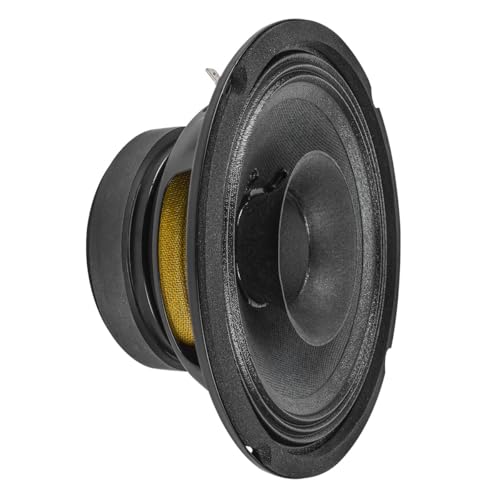
The single-driver speaker is the simplest loudspeaker that can exist: one cone, driven across the whole audible range, in a cabinet, with no crossover network dividing the signal between specialised drivers. Its devotees prize what the simplicity preserves — a single point source, phase coherence, sensitivity high enough for flea-powered amplifiers, and a midrange directness that multi-way speakers spend heavily to imitate. Its critics recite what the simplicity costs — limited bass depth, limited treble extension, limited loudness, and a treble beam that narrows as frequency climbs. Both are right, and both positions are measurable, which makes this the most honestly arguable category in audio. This guide argues it with numbers: the Thiele-Small parameters that describe the driver, the enclosure mathematics that give it bass, the sensitivity and impedance figures that choose its amplifier, and the listening geometry that flatters or exposes it.
A single driver doing everything must compromise everywhere, and the art of the category is choosing which compromises to buy. A larger cone moves air for bass and beams treble into a narrow corridor. A smaller cone disperses beautifully and runs out of bass and loudness. Every design in this guide is a point on that trade, and the buyer’s job is to pick the point that matches their room, their amplifier and their music — which is why the parameters come before the products in everything that follows.
Reading the driver: Thiele-Small parameters
A raw driver’s behaviour is summarised by a set of measured parameters named for Thiele and Small, and a buyer of single-driver speakers — often sold as drivers plus plans, or as finished speakers whose drivers are specified — should learn the core four. Fs is the free-air resonance frequency, the floor below which the driver’s output falls away and around which the enclosure design revolves. Qts is the total damping figure, summarising how controlled the resonance is; it predicts which enclosure families will suit the driver, with higher Qts drivers favouring larger or open enclosures and lower Qts drivers suiting horns and reflex boxes. Vas is the volume of air with equivalent springiness to the driver’s suspension, a proxy for how large a cabinet the driver “wants”. Xmax is the linear excursion limit, the honest ceiling on how much air the cone can move before distortion, and therefore on bass loudness.
Supporting figures complete the picture. Sensitivity, conventionally quoted in decibels at one watt and one metre, is the category’s headline because single-driver systems pair with low-power amplifiers: figures in the mid-90s and above are the prize, and the quote deserves scrutiny — a sensitivity measured at 2.83 volts flatters an 8-ohm driver by exactly the conversion the honest makers state. Nominal impedance, usually 8 or 16 ohms in this world, interacts with the amplifier’s output impedance in ways detailed below. The frequency response graph, where published, tells the truth about the treble: most full-range drivers rise, peak and break up through the top octaves rather than gliding flatly to 20 kilohertz, and the shape of that misbehaviour is the speaker’s tonal signature.
Cone, whizzer and phase plug
The treble problem is mechanical: a cone large enough for bass cannot move as one piston at high frequencies, so it flexes, and the flexing is both the treble mechanism and its distortion. Designers answer three ways. The whizzer cone — a small secondary cone attached at the centre — radiates the treble while the main cone handles the lows, a mechanical crossover built into the driver. The phase plug replaces the dust cap with a stationary shaped plug that improves dispersion and cools the voice coil, letting the main cone’s own breakup be voiced by geometry. Treated paper, the classic material, damps its own breakup gracefully; metal and exotic composites trade that grace for stiffness and a more dramatic breakup that must be engineered around. There is no free choice here, only chosen consequences, and they are audible in the top octave of every design.
Enclosures: where the bass comes from
A bare driver makes almost no bass, because its front and rear waves cancel. The enclosure is therefore not furniture but the second half of the instrument, and the category’s five classic alignments divide by how they use the rear wave. The sealed box simply contains it, giving the gentlest bass roll-off, the least bass, and the easiest build. The bass reflex port tunes the rear wave to reinforce the bottom octave, buying depth and efficiency at the price of a steeper fall below tuning. The transmission line routes the rear wave down a long, damped path that emerges in phase support at the bottom. The back-loaded horn amplifies the rear wave through an expanding folded horn, achieving the category’s deepest, most efficient bass from modest drivers at the price of the largest cabinets and the least forgiving builds. The open baffle abolishes the box entirely, mounting the driver on a panel, and trades bass quantity for a spaciousness many listeners find addictive, with room placement as its tax.
Matching driver to enclosure is arithmetic before it is carpentry: the Qts and Vas figures nominate the alignment family, the enclosure volume and tuning follow from the formulas their inventors published, and simulation software — free and mature — predicts the result before wood is cut. Finished speakers in this category should be evaluated by the same logic in reverse: the cabinet’s type and volume, against the driver’s published parameters, tell a knowledgeable buyer whether the pairing is engineered or merely assembled.
Amplifiers: the low-power marriage
Single-driver speakers are the natural partners of low-power amplifiers — single-ended triode designs of a handful of watts, small class-A solid-state, and modest modern class-D — because their sensitivity converts milliwatts into music. The arithmetic is worth doing once: a speaker at 95 decibels for one watt reaches concert-adjacent levels in a small room on eight watts, with headroom. But the pairing has a subtlety that separates the category’s devotees from its casualties: output impedance. Low-power valve amplifiers without feedback present output impedances of an ohm or more, and through the damping relationship, the amplifier stops gripping the cone firmly; the speaker’s own impedance curve — which rises at resonance and through the treble — then shapes the frequency response audibly, adding warmth at the resonance and lift in the treble. Devotees call this synergy and voice their systems by it; the specification-minded call it an interaction to be chosen knowingly, since the same amplifier on a flatter-impedance speaker behaves entirely differently.
Modern low-impedance amplifiers grip the cone hard and reveal the driver as it is, which flatters well-designed drivers and exposes ragged ones. Either marriage can be happy. The buying error is ignorance — pairing a high-output-impedance amplifier with a wildly swinging impedance curve by accident, then blaming the speaker for a response shape the amplifier co-authored.
Listening geometry: the narrow beam and the near field
A full-range driver’s treble disperses in a cone that narrows with frequency, so the listening position is part of the specification. On axis, the treble is full and sometimes fierce; off axis it recedes quickly, which designers exploit by recommending toe-in angles that trade the beam’s heat for its width. The practical consequence is that these speakers reward a defined listening seat more than multi-way designs do, and punish casual, whole-room listening with dullness at the edges. Near-field listening — the desk, the small room, the chair placed deliberately — is their native habitat, where modest loudness limits never bind and the point-source imaging is at its most magical: a single driver per side cannot misalign its own arrival times, so voices and instruments hang in space with a coherence that is the category’s founding argument.
Imaging deserves its sentence of physics. A crossover divides a voice between two drivers at two heights arriving at two times; the ear forgives it, mostly, in good designs. The single driver never asks the question. What it asks instead is acceptance of its bandwidth limits, and the exchange — coherence for extension — is the category’s entire philosophy stated in one trade.
What they cannot do, stated plainly
Honesty requires the debit column. Deep bass below the enclosure’s design floor is absent, not diminished, and orchestral and electronic music will find the edge. Maximum loudness is bounded by one cone’s excursion; a large room at party level is beyond the design brief. The top octave is voiced rather than flat, and listeners raised on studio monitors may hear character where devotees hear charm. Subwoofer integration is the common remedy for the first failing and it works — a crossover at the system level, below the driver’s working range, preserves the coherence argument where it matters, in the midrange — but it must be admitted that the purist single-driver system with a subwoofer has quietly become a two-way system with an unusually gifted midrange.
A short history of doing without
The single driver is not a modern eccentricity; it is the original loudspeaker. The radio consoles and early hi-fi of the mid-twentieth century ran on full-range drivers because crossovers and multiple drivers were expensive complexities, and some of those drivers — the British Lowther line above all, descended from Paul Voigt’s pre-war designs — achieved a speed and coherence that created a cult which has never dispersed. Japan sustained the tradition through the decades when the West chased multi-way specifications, and the ready availability of well-documented drivers from makers there turned the full-range speaker into the entry point of the DIY audio world. The modern category is that lineage with better measurement: the same whizzer cones and folded horns, now simulated before they are built and measured after, their virtues argued in decibels rather than only in devotion. Knowing the lineage matters to a buyer because it explains the market’s shape — raw drivers with published parameters, plans and kits beside finished speakers, and a community that treats the enclosure as a musical instrument to be voiced, not a box to be hidden.
Breakup, distortion and the honest graph
Every cone misbehaves at the top of its range, flexing into patterns that radiate unevenly; the engineering word is breakup, and its signature on a frequency graph is a series of peaks and dips through the treble. The category’s design philosophies divide by their relationship to breakup. One school damps it — treated paper cones, lossy surrounds, response that rolls the top octave away gently and asks the listener to accept a mellow ceiling. The other school rides it — stiff light cones whose breakup peaks are arranged, by geometry and phase plugs, into something resembling extended response, accepting a livelier, more exposed treble as the price of air. Distortion measurements complete the honest picture: a single driver working hard at low frequencies modulates its own midrange, an intermodulation effect that sets the practical loudness ceiling for complex music more firmly than the amplifier’s wattage ever will. Graphs and distortion figures, where makers publish them, are therefore the category’s most valuable documents, and their absence on a premium product is a statement in itself.
The build-it-yourself dimension
No other speaker category so thoroughly invites its buyers to become its builders. Drivers arrive with parameter sheets; enclosure plans circulate freely; flat-pack kits remove the saw from the equation. The DIY route changes the buying analysis in ways this guide should honour. The parameters stop being evaluation tools and become design inputs, the enclosure alignment becomes a choice the buyer makes rather than audits, and the cost structure inverts — money migrates from cabinetry and brand to the driver itself. The risks are equally real: a misaligned reflex port, an under-braced panel, a horn folded by optimism rather than by the expansion law. Simulation software has narrowed the risk to the point where a careful first-time builder following a proven plan can reach results commercial products struggle to match at the price, which is precisely why the category’s centre of gravity sits where it does. Buyers not inclined to build should still read the plans for their shortlisted speakers’ drivers; nothing else so quickly reveals whether a finished product’s cabinet is the size its driver requested.
Sensitivity, honestly converted
The category’s favourite number is also its favourite fiddle. Sensitivity properly means the sound pressure produced by one watt of input at one metre. Because one watt into 8 ohms is 2.83 volts, the two quotes coincide for an 8-ohm speaker — but into 4 ohms, 2.83 volts delivers two watts, and a sensitivity quoted “at 2.83 volts” for a low-impedance driver is flattered by 3 decibels, a doubling of apparent efficiency bought with a footnote. Single-driver speakers are usually 8 or 16 ohms, which limits the mischief, but the discipline stands: convert every quote to one watt before comparing, and treat a maker who states the basis plainly as a maker whose other numbers may also be trusted. The stakes are practical, since the whole low-power amplifier marriage is negotiated in these decibels — three of them is the difference between an amplifier loafing and an amplifier labouring at the same listening level.
Placement: the room finishes the design
Boundaries are bass components. A speaker near a wall gains low-frequency reinforcement from the boundary’s pressure doubling; in a corner it gains more, and back-loaded horns are often designed to spend exactly that gain, their mouths completing themselves against the room’s surfaces. Open baffles obey the opposite geometry, needing distance from the wall behind them so the rear wave’s cancellation arrives late and low enough to spare the working range. The general law is that a single-driver speaker’s bass balance is a placement decision as much as a design fact, and the buyer’s room — its size, its available distances, its tolerance for speakers standing in open floor — belongs in the specification from the start. This is also why demonstrations mislead: the same speaker is bass-light in a showroom’s open floor and generous in a small room’s corners, and only the home geometry grades it fairly.
Suspensions, surrounds and time
A driver’s suspension — the spider and the surround — is a spring that ages. Foam surrounds perish in a decade or two; rubber and treated cloth endure far longer; the compliance of any suspension shifts measurably in the first hours of use, which is the physical kernel inside the folklore of break-in: the parameters genuinely drift toward their settled values as the materials flex, and a driver measured fresh from its box is not quite the driver of the following month. For buyers of vintage full-range drivers — a real market in this category — surround condition is the first inspection, since a perished surround changes the parameters the enclosure was designed around, and re-foaming restores them approximately rather than exactly. Longevity otherwise favours the category: with no crossover capacitors to dry out and one voice coil instead of several, a well-kept single-driver speaker is among the longest-lived objects in audio, its cabinet joinery likely to be its first failure.
The motor: magnets and voice coils
Behind the cone sits the motor, and its design choices echo through every parameter in this guide. The magnet material sets the field strength available in the gap: ferrite is the economical standard, neodymium packs more field into less bulk, and alnico — the vintage material, still made for this market — is prized by devotees for a perceived sweetness that correlates, more prosaically, with its behaviour under the voice coil’s own magnetic influence. The voice coil’s geometry relative to the gap defines linearity: an underhung coil, shorter than the gap is deep, stays in uniform field through its travel at the cost of efficiency; an overhung coil buys excursion and spends linearity. The former is the connoisseur’s choice for midrange purity at modest levels, the latter the pragmatist’s for bass and volume. Former material, cooling arrangements and the coil’s inductance — which rises to form a natural treble filter the designer must voice around — complete a specification that the best driver makers publish in full, because in this category the driver is the product and its motor is its character.
Cabinets that do not sing along
A cabinet’s job is to be an enclosure, not an instrument, and its failure mode is panel resonance — the walls flexing with the music and adding a voice of their own, usually a boxy coloration in the lower midrange where the ear is unforgiving. The countermeasures are thickness, bracing that ties opposite panels together, and materials chosen for damping as much as stiffness; the classic cabinet woods of the category, quality plywoods, are favoured because their layered construction damps as it stiffens. Internal damping material tunes the enclosure’s behaviour at resonance and absorbs the midrange energy that would otherwise exit through the cone. In horn enclosures the stakes double, since the horn’s walls are the instrument’s bore and their rigidity is its tuning. A buyer evaluating finished speakers can learn much from the unglamorous evidence: cabinet weight relative to size, the knuckle test’s dull thud against a hollow ring, and bracing visible through the driver aperture during inspection. The silent cabinet is an achievement of carpentry that specifications rarely itemise and listeners always hear.
The repertoire decides
Musical diet is the final specification. The single driver’s fortress is the territory between roughly the cello’s bottom and the voice’s top, recorded simply: voices, chamber music, jazz combinations, folk, spoken word, the great singer-songwriter shelf. There, its coherence and immediacy are not a compromise but a superiority. The repertoire that besieges it is equally definite: full orchestra at scale, organ, electronic music built below 40 hertz, metal at live levels, and film soundtracks whose effects budgets assume subwoofers. A buyer whose listening lives in the fortress can choose this category with confidence and spend the savings on the amplifier marriage. A buyer at the frontier should choose with the subwoofer admitted into the plan from the start, or should honestly shop elsewhere — the category’s philosophy is a trade, and trades are only wise when both sides are named.
Driver sizes: the trade, diameter by diameter
The catalogue divides by cone diameter, and each size is a distinct bargain. The small drivers, three to four inches, are desktop and near-field specialists: dispersion wide enough to forgive the listener’s movement, treble the least tortured in the category, bass a rumour unless a horn or a desk’s boundary lends it, and loudness for one listener at arm’s length. The middle sizes, five to six and a half inches, are the category’s centre of gravity — enough cone for credible bass in a reflex or transmission-line cabinet, treble still manageable, the classic bookshelf full-range. The large drivers, eight inches and beyond, belong to the horn and open-baffle traditions: real bass authority and concert ease in the midrange, paid for with the narrowest treble beam and the strongest dependence on a fixed, on-axis seat. Choosing the size is choosing the listening life — solitary and close, social and small-room, or dedicated-chair — and it should be made from the chair’s location backwards, not from the driver’s specifications forwards.
The impedance curve as biography
One published graph repays more study than any other: impedance against frequency. Its tall peak marks the resonance, Fs made visible, and its height reports the damping the enclosure and amplifier must negotiate. Its minimum in the midrange is the load the amplifier actually works into for most music, often well below the nominal figure on the badge. Its rise through the treble is the voice coil’s inductance asserting itself, predicting both the natural top-octave roll-off and the interaction with high-output-impedance amplifiers, which will pour extra energy into exactly that rise and brighten the speaker accordingly. A buyer fluent in this one graph can predict the amplifier marriage, the enclosure’s tuning and the treble voicing before hearing a note — which is why the best makers publish it and why its absence, on a driver sold to a measurement-literate market, speaks so clearly.
The vintage and second-hand market
Full-range drivers outlive their cabinets, their fashions and sometimes their makers, and a vigorous second-hand market trades them. Its disciplines are the ones this guide has built: verify the surround before the magnet’s mythology, measure or obtain the parameters of the actual unit where possible — production spread in vintage drivers is real, and a matched pair is worth more than two strangers — and treat any claimed specification from memory as folklore until a datasheet corroborates it. Cabinets from the classic era deserve the same scepticism as their drivers: joinery dries, panels loosen, internal damping crumbles into dust that was once foam. Bought with open eyes, vintage full-range equipment offers the category’s character at its most distilled; bought on romance, it offers a restoration project with a soundtrack.
The counterargument, in full
The multi-way speaker exists because the single driver’s compromises are real physics, and the crossover — for all its phase arithmetic — buys genuine goods: a tweeter that disperses treble like light from a small lamp, a woofer unbothered by midrange excursion, power handling and loudness an order beyond one cone’s reach, and a response that can be made flat by dividing labour among specialists. Listeners whose rooms are large, whose music is wide in bandwidth and level, or whose listening is social and off-axis are correctly served by that bargain. The single-driver philosophy is not a refutation of the multi-way but a different weighting of the same physics, optimising for coherence, sensitivity and the near field at the price of extension and scale. Guides that pretend either bargain is free are selling something. This one has tried to price both, because the buyer who understands the counterargument and still chooses the single driver has chosen well, and the buyer who discovers it afterward has merely shopped.
Excursion: the wall every design meets
Loudness at low frequencies is cone excursion multiplied by cone area, and no enclosure cleverness repeals it. A driver’s Xmax states how far the coil may travel while the motor stays linear; beyond it, distortion climbs steeply, and beyond the larger mechanical limit, damage begins. Horn loading is the category’s one true cheat, using the horn’s acoustic leverage to produce level with a fraction of the excursion — which is why horn systems play loudest with the least apparent effort and why their cabinets are furniture-scale. For reflex and sealed designs, the excursion budget is the honest predictor of how the speaker will handle the loud, low passage in the buyer’s favourite record, and it can be estimated from published Xmax and cone area before purchase. Systems that will live near that wall deserve the subwoofer conversation early, while systems in small rooms at civilised levels will never meet the wall at all — one more reason the room, not the catalogue, opens the choosing process.
One speaker, honestly: the mono footnote
A heretical corner of the category deserves its paragraph: the single speaker, in mono. Much of the recorded catalogue is effectively centred, the point-source argument reaches its purest form with one source, and a single excellent full-range speaker in a horn can fill a room with a presence that startles stereo-accustomed listeners. Kitchens, workshops and small cafés are its natural territory, and several makers sell singles without apology. The buyer considering it should simply be clear-eyed that stereo’s spatial theatre is being traded away whole, rather than compromised — a legitimate trade, made by listeners who value tone and presence over imaging, and a reminder that this entire category is a series of such trades, each defensible, none free.
Equalisation: correcting the uncorrectable, carefully
Digital equalisation tempts every owner of a speaker with a voiced top octave, and the category divides over it. The purist objection is philosophical — a correction chain reintroduces the processing the design abolished — but the practical analysis is more useful. Equalisation can genuinely help where the flaw is a smooth, minimum-phase response trend: a gentle treble shelf tames a rising response, and a modest cut at a room mode helps any speaker. It cannot help where the flaw is breakup’s ragged peaks, which vary with angle, nor where the flaw is excursion, since boosting bass into a driver at its limit buys distortion at the rate of the boost. Used as seasoning — a decibel or two of broad correction, measured at the seat — equalisation is a legitimate finishing tool even in this purist category. Used as a rescue, it is a confession that the wrong point on the size-and-enclosure trade was bought, and no filter setting will relocate it.
Stands, spikes and the last mechanical inch
The supporting hardware of a small speaker is part of its acoustic circuit. A stand’s job is to hold the driver at ear height, motionless, while contributing no resonance of its own; mass and rigidity are its virtues, and the coupling between speaker and stand — spikes, putty, compliant pads — should be chosen for stability first, since a rocking speaker modulates its own imaging. Floor-standing horns and towers ask the same of their feet and of the floor beneath. These are small expenditures with audible returns in this category precisely because its pleasures are fine-grained: a system resolving a single voice’s coherence will also resolve a cabinet’s wobble. The buyer should budget the stands with the speakers, not after them, and should treat the manufacturer’s height guidance as a specification — in a design whose treble beam is a corridor, the seat and the stand together aim the corridor.
Verifying at home: tones, voices and patience
A buyer can confirm the essentials of a single-driver system at home with a tone generator and the repertoire test. Slow sine sweeps reveal the bass floor — the frequency where the room stops answering — and expose cabinet rattles and room resonances as local enthusiasms in the sweep. A familiar voice recording, ideally one the listener knows from other systems, grades the midrange coherence that is the category’s promise. A loud passage from the buyer’s own library, played at the highest level the room will actually use, tests the excursion wall honestly. None of this requires instruments beyond a phone, and all of it converts the return window into a laboratory. The discipline is the one this guide has applied to every category it touches: the specifications nominate, the measurements confirm, and the buyer’s own material, in the buyer’s own room, delivers the verdict.
The loudness budget, worked in decibels
The pairing of speaker and amplifier can be settled with three numbers and a logarithm. Start from the listening level the room actually demands — conversational-plus for near-field, the mid-80s of decibels for a full small-room experience, peaks twenty decibels above the average for honest dynamics. Subtract the speaker’s one-watt sensitivity, adjusted for distance: each doubling of distance in a room costs roughly three to six decibels depending on the room’s reflections. What remains is the power the amplifier must deliver on peaks, and the conversion is unforgiving — every three decibels doubles the watts. A 95-decibel speaker at two metres asks for single-digit watts on peaks where an 85-decibel multi-way asks for a hundred, which is the entire economic argument for the category in one subtraction: sensitivity is amplifier money saved, heat unmade, and simplicity purchased. Buyers should run their own three numbers before any purchase in this category, because the result selects the amplifier class, the driver size and, honestly, whether the category fits the room at all.
Where the money goes
Prices in this category distribute unusually. At the entry, the money is mostly driver — a competent full-range unit and a simple cabinet — and the value is startling because so little else exists to pay for. In the middle, the money migrates to cabinetry: horn folds, transmission-line labyrinths and furniture-grade finishing are labour sold by the hour, and the driver may be the same unit the entry product used, finally given the enclosure it deserved. At the top, the money buys motors — exotic magnets, underhung coils, hand-assembled drivers in small numbers — and the law of diminishing returns arrives on schedule. The informed buyer reads a price by asking which of the three layers it is paying for, and whether that layer is the one their room and repertoire will actually exercise. Money spent on a magnificent motor driving the wrong enclosure alignment is the category’s characteristic waste, and it is avoidable with the parameters in this guide and an hour of arithmetic.
Living with the furniture-scale options
The category’s most ambitious enclosures are domestic commitments. A back-loaded horn is a wardrobe that sings; an open baffle is a panel that must stand in open floor, away from walls, in the room’s traffic. Their owners arrange their rooms around them, and the honest buying guide must price that arrangement alongside the invoice: the listening chair’s position is fixed by the beam, the baffle’s position by its physics, and the household’s other members become stakeholders in the specification. None of this is an argument against — the devotees consider the arrangement a feature, the room declaring what it is for — but it is an argument for choosing the enclosure with the household in the room, tape measure in hand, before the cabinet is. The smaller alignments ask less: a reflex bookshelf on stands integrates into ordinary rooms with ordinary diplomacy, which is why the category’s centre of gravity remains there even as its legends live in the horns.
A community that publishes its homework
Single-driver audio sustains an unusually measurement-literate culture, born of its DIY roots: builders publish their parameter measurements, their enclosure simulations and their finished response curves as a matter of honour. For the buyer this is an endowment. A shortlisted driver can usually be found measured by third parties, its parameters compared against the datasheet’s promises, its behaviour in several enclosure alignments documented by people with no stock to sell. Commercial buyers who never intend to build anything should still drink from this well, because it converts the purchase from a leap of faith into an inspection of evidence — the same conversion this guide has attempted for every product it covers. Where a finished speaker’s driver is identifiable, the community’s archive on that driver is the most honest review the speaker will ever receive.
The first watt
An old audio saying holds that if the first watt sounds wrong, the other ninety-nine will not save it, and this category is where the saying lives. Most listening happens at fractions of a watt — the sensitivity arithmetic in this guide makes the point numerically — so a system’s character is set by its behaviour at milliwatts: the amplifier’s distortion profile at whisper level, the driver’s suspension moving in its most linear region, the absence of crossover components drawing their toll at low signal. Single-driver systems built around sensitive drivers and small amplifiers are optimised, by construction, exactly where listening happens, which explains the quality devotees describe as immediacy and sceptics eventually concede as low-level detail: quiet passages rendered with their texture intact rather than as a dimmer version of loud ones. Evening listening in real homes, at levels that respect the household, is this category’s home fixture, and buyers who listen mostly after dark should weight it accordingly.
Pairs, matching and the stereo reality
Two drivers from the same production run are brothers, not twins: sensitivity and resonance vary within published tolerances, and in a category with no crossover to hide behind, the variance is audible as a slight wander of the stereo image or a tonal tilt between channels. Serious makers measure and match pairs, and the specification to seek is a stated tolerance — drivers matched within a decibel across the working range is careful work. DIY buyers can measure their own pairs with the parameter tools of the community and assign the slightly brighter driver to the room’s duller side, an old trick that costs nothing. The broader point returns to the category’s theme: with one component per speaker, every component’s honesty is exposed, and matching is simply honesty applied twice.
The desk system: the category’s complete small world
The desktop is where the single-driver proposition assembles itself most completely. A pair of small full-range speakers at arm’s length, driven by a handful of watts, in the near field where room acoustics recede — every compromise of the category falls outside the brief, and every virtue is on the desk. Bass that would be absent across a room is adequate across a desk, helped by the boundary of the desk itself; loudness limits never bind; the beam is aimed once, at one chair, and forgotten. Buyers building a desk system should choose the small drivers without apology, spend on the stands or isolation that set the height exactly, and resist the upgrade itch toward larger cones whose dispersion at arm’s length is worse, not better. It is the one hi-fi use case where the simplest system is also, on the evidence of the physics in this guide, close to the correct one.
Wiring and terminals: the honest minimum
A category this simple has little wiring to discuss, which is itself a specification point: one pair of terminals per speaker, a short internal run to one driver, no bi-wiring theatre. What matters is mechanical — terminals that grip and stay gripped, internal connections soldered or properly crimped rather than clipped by hope — because a single intermittent connection in a one-driver speaker is not a channel imbalance but silence, and its intermittency will be billed to the amplifier’s reputation before anyone checks the back panel. Owners of high-output-impedance amplifiers should also know that long, thin cable runs add resistance in series with the amplifier’s own, deepening the damping interaction described earlier; short, adequate-gauge runs keep the marriage as designed. In a system with this few parts, each part’s condition is a large fraction of the whole, and the wiring is where that arithmetic is cheapest to honour.
Myths of the category, examined
Three claims follow this category around and deserve examination rather than repetition. The first is that a crossover-less speaker is distortion-free; in truth it trades the crossover’s small, well-understood distortions for the cone’s larger mechanical ones, and the trade is a preference, not a purity. The second is that single drivers suit only old or acoustic recordings; the physics cares about bandwidth and level, not vintage, and a modern recording of a voice and a guitar is as native to the category as a 1950s one, while a vintage orchestral recording will find the same bass floor as a new one. The third is that sensitivity figures settle the amplifier question alone; the impedance curve and the room’s size are co-authors of that answer, as this guide’s arithmetic showed. A category with this much genuine virtue does not need mythology, and its serious makers and writers increasingly decline to supply it — one more reason the published parameters, and not the legends, should steer the purchase.
The horn, in a little more detail
Because the back-loaded horn is the category’s flagship alignment, its mechanism deserves a closer look. A horn is an acoustic transformer: it couples the small, high-pressure region at the driver’s rear to the large, low-pressure region of the room through a passage whose cross-section grows by a mathematical law — exponential in the classic designs. The growth rate sets the horn’s lowest working frequency, and the mouth must be large enough to terminate that frequency honestly, which is why true full-range horns are the size of furniture and why corner placement, borrowing the room’s walls as the mouth’s extension, is a design technique rather than a compromise. The folded path inside the cabinet delays the rear wave so it emerges supporting the front wave’s bass rather than cancelling it, and the chamber between driver and throat tunes the transition. Every element is computable, and the classic designs were computed — with slide rules, which is part of their legend — but the sensitivity to build accuracy is equally real: a horn whose internal folds deviate from the expansion law announces the error as a lumpy bass response that no amplifier can smooth. Buyers of horn speakers are buying joinery as acoustics, and the maker’s demonstrated command of the one is the evidence for the other.
Care across decades
A speaker designed to outlive its purchaser’s amplifiers deserves a paragraph of husbandry. Paper cones dislike direct sunlight and damp; a room’s bright corner will fade and eventually embrittle what a shaded wall preserves, and the whizzer’s thin edge is the most vulnerable surface in the system. Dust is removed with a soft brush and restraint, never with a vacuum’s nozzle near an unsupported cone. Cabinets in real wood ask for the same wax-and-shade regime as the furniture they resemble. Electrically, the kindest regime is regular use at sane levels: suspensions stay supple, and the occasional full-range exercise at moderate volume is worth more than any storage ritual. Owners who keep the parameter sheet and a note of the enclosure’s design with the speaker perform one final service — to the next owner, in a market where, as this guide has noted, these objects circulate for generations and are judged each time by the documents that travel with them.
Rated power, and why it barely matters here
One familiar specification deserves demotion in this category: the power rating. A full-range driver’s wattage figure describes thermal survival — how much heat the voice coil can shed — in a system whose working life is spent at milliwatts and whose audible limits are set by excursion long before temperature matters. The pairing error the rating invites is the oversized amplifier bought for safety, whose extra watts purchase nothing but the ability to destroy the driver more quickly if a fault or a fumbled volume control sends them all at once. The sensible protections are the category’s own: an amplifier sized by the loudness budget, a listener who knows the sound of a cone reaching its excursion wall — a hardening, doubling quality in the bass — and the discipline to treat that sound as a specification being exceeded rather than a challenge. In a category built on the first watt, the hundredth is mostly a liability with a heatsink.
Finished, kit or plans: choosing your depth of involvement
The category sells the same physics at three depths, and the choice among them is a legitimate part of choosing the speaker. Finished speakers sell certainty: measured pairs, voiced cabinets, a warranty, and a price that includes the maker’s hours. Kits sell the same designs with the labour transferred to the buyer, at prices that reward the transfer, and with the enclosure’s critical geometry pre-cut so the acoustics survive amateur assembly. Plans sell only information, for the price of a book, and assume a workshop. The evaluation discipline is identical at all three depths — parameters, alignment, the loudness budget, the repertoire — but the risk being priced differs: workmanship risk moves from maker to buyer as the price falls. First-time entrants to the category are usually best served at the kit depth or by a modest finished speaker, reserving the plans-and-timber route for the second system, when their ears know what their hands are building toward.
Check prices on Amazon
Live listings for the shortlist in this guide are pulled from Amazon below, so prices and availability are always current at the moment you look.


How to choose a single-driver speaker
Start with the room and the chair. A small room and a defined listening position flatter everything the category does well; a large open space argues against it entirely. Match the amplifier next, by sensitivity and by output impedance understood as a voicing choice: high sensitivity for the low-power marriage, and an impedance curve examined against the amplifier that will drive it. Then choose the driver’s size by the music’s centre of gravity — smaller cones for voice and chamber music in near field, larger cones and horn or transmission-line enclosures where bass weight matters — and read the Thiele-Small figures to confirm the enclosure on offer is the enclosure the driver asked for.
Before ordering, ask for the paperwork this category runs on: the driver’s full parameter sheet, the impedance and response graphs, the enclosure’s alignment and volume, and the pair-matching tolerance. Makers who live by these numbers supply them without being chased; the request itself is a filter, and its results should be weighted like one. Where the purchase is a kit or a plan, confirm the enclosure dimensions against the driver’s Vas and the intended alignment with the simulation tools the community maintains — an hour of arithmetic that has saved more buyers than any review.
Finally, audition with the actual test this category fears and rewards: a single voice, unaccompanied, at the actual seat. A single-driver speaker that renders a voice as a person in the room has justified its philosophy in the only court it recognises. One that cannot has merely omitted a crossover.
Disclosure: this guide is reader-supported; purchases through links in our guides may earn us a commission, which funds the parameter research behind pages like this. We state no prices and no availability in the text, as both change constantly — verify them, and the driver specifications, before ordering.
Judge a single-driver speaker by its coherence at the listening seat — one voice, one cone, no seams, no arithmetic between the amplifier and the air — and by the honesty of its published parameters, because in a design with nowhere to hide, the numbers and the music are unusually the same story, told in two notations, and a buyer fluent in either can check the other’s translation — which is why, alone among speaker categories, this one rewards the reader of datasheets exactly as much as the listener in the chair, and why the two should ideally be the same person, arriving at the same verdict by both roads — the graph that predicts the voice, and the voice that confirms the graph, in a small room, at a civilised hour, on the first honest watt. Everything this category asks — the fixed seat, the modest levels, the arithmetic done in advance, the repertoire chosen with open eyes — is repaid in that single experience, which no specification in this guide can finally describe and every specification in it — every parameter, curve, alignment and conversion — exists, in the end, to protect against the day the buyer stops reading, sits down in the one good chair, and simply listens.

