What's inside
- Key Takeaways
- Quick Picks
- How Did We Choose the Best Self Powered Outdoor Speakers Compatible With Alexa?
- Group 1 — Alexa Built In, for Covered Outdoor Spaces
- Group 2 — Outdoor Powered Speakers That Pair With an Echo
- How Do the Best Self Powered Outdoor Speakers Compatible With Alexa Compare?
- How Do You Set Up Alexa Control for an Outdoor Space?
- What Weather Can Outdoor Speakers Actually Handle?
- What Mistakes Do Buyers Make With Outdoor Alexa Setups?
- Which Outdoor Spaces Count as Covered?
- How Does Sound Behave Outdoors Without Walls?
- How Should You Care for Outdoor Speakers Across the Seasons?
- Final Recommendation
- Frequently Asked Questions
- Related Guides
As an Amazon Associate I earn from qualifying purchases. This post may contain affiliate links at no extra cost to you.
gizmoverdict.com is reader-supported. When you buy through links on our site, we may earn an affiliate commission.
Where to buy: The six speakers below link to listings confirmed against this site’s verified product pool, and each section labels honestly how its Alexa connection works — built into the speaker, or supplied by a separate Echo device speaking to a powered outdoor speaker. No prices and no star ratings appear in this guide; weather ratings and battery figures are quoted exactly as each maker states them.
Start with the honest correction this whole category needs: the best self powered outdoor speakers compatible with alexa do not exist in the single-product form the search implies. There is no mainstream speaker that is simultaneously a true outdoor speaker — sealed against weather, powered for outdoor spaces — and a speaker with Alexa built in. Voice-assistant smart speakers are indoor devices. So this guide does the truthful thing and splits its six picks into two clearly labelled groups. Group one is Alexa built in, for covered outdoor living: the Sonos Era 100 and the Amazon Echo Dot Max, used on a sheltered porch, under a pergola roof or in a covered outdoor kitchen where they are protected from direct weather. Group two is genuinely outdoor, self-powered speakers — the Plyee wall-mount pair, the JBL PartyBox 310, the ION Tailgater Boom and the Bose SoundLink Flex (2nd Gen) — which become Alexa-compatible in the practical way: you ask an Echo device indoors, or use the Alexa app on your phone, and the music plays outside on a speaker built to be there.
Neither group is a compromise version of the other. If your outdoor life happens under a roof — and most patios, porches and pool houses qualify — group one gives you true voice control with nothing else to buy. If your speakers must survive open sky, group two gives you weatherproofing and power that no smart speaker can match, with voice control one Echo away. The sections below keep the groups labelled at every step, because a guide that blurred this distinction would send an indoor smart speaker out into the rain on the strength of a keyword, and that is exactly the purchase this page exists to prevent.
Key Takeaways
- No mainstream speaker is both truly weather-sealed for open outdoor use and Alexa-built-in; this guide’s two groups — Alexa built in for covered spaces, and outdoor-powered speakers paired with an Echo — are the honest ways to satisfy the brief.
- Group one (Sonos Era 100, Echo Dot Max) delivers hands-free Alexa where a roof keeps weather off: covered porches, pergolas, outdoor kitchens and pool houses.
- Group two (Plyee pair, JBL PartyBox 310, ION Tailgater Boom, Bose SoundLink Flex 2) is built for open sky, with batteries or outdoor mounting — Alexa reaches them through a separate Echo or the phone app.
- The Plyee set is the only permanently installed option: an active plus passive wall-mount pair with its own amplifier, made for patios and pool areas.
- Voice control outdoors depends on Wi-Fi reach as much as on the speaker; a covered-porch smart speaker still needs a network signal where it sits.
- Weather ratings are quoted from each listing; where a listing states no rating, this guide says so rather than implying one.
- Outdoor sound escapes to the sky instead of reflecting off walls, so coverage comes from placing speakers near listeners — mounted pairs, linked units, a portable on the table — rather than from turning one speaker up.
- Rehearse the system before the season’s first gathering: charge the batteries, re-test the pairing, confirm the porch Wi-Fi, and let the household, not one person, know how it all works.
Quick Picks
| Pick | Badge | Why it earns its place |
|---|---|---|
| Sonos Era 100 | Group 1 — Alexa built in, covered spaces | A Wi-Fi smart speaker with Alexa enabled and stereo-pairing ability — the covered porch’s best-sounding voice-controlled option. |
| Amazon Echo Dot Max | Group 1 — Alexa built in, covered spaces | Amazon’s own Alexa speaker with room-filling sound for its size, designed for Alexa+ — the native voice endpoint for a sheltered patio. |
| Plyee Outdoor Powered Wall-Mount Pair | Group 2 — outdoor powered, Echo-paired | An active-plus-passive wall-mount pair with a built-in amplifier, made to live on patio and pool walls permanently. |
| JBL PartyBox 310 | Group 2 — outdoor powered, Echo-paired | A wheeled party speaker with long battery life and a light show — the big-gathering outdoor engine your Echo can feed. |
| ION Tailgater Boom | Group 2 — outdoor powered, Echo-paired | A 60W water-resistant tailgate speaker with radio, microphone input and app control — the event all-rounder. |
| Bose SoundLink Flex (2nd Gen) | Group 2 — outdoor powered, Echo-paired | A waterproof, dustproof portable with hi-fi tuning and 12 hours of battery — the carry-anywhere outdoor speaker. |
How Did We Choose the Best Self Powered Outdoor Speakers Compatible With Alexa?
The choosing began with the correction in the introduction, because it dictates everything else. We divided the brief into its two physically possible forms — Alexa built into a speaker that lives under cover, and Alexa supplied to a speaker built for the open air — and then selected the strongest examples of each form, three considerations guiding us. For group one, the questions were voice quality, audio quality and how gracefully the speaker lives outdoors-adjacent: on a porch, in a pool house, in the covered corner of a deck. For group two, the questions were power source, weather construction and how naturally the speaker accepts a feed from an Echo-controlled source — Bluetooth from a phone running Alexa, or a wired or wireless link from an indoor system.
Self-powered was treated as a hard requirement in both groups, because the keyword asks for it and because outdoor audio’s classic alternative — passive speakers wired to an indoor amplifier — fails the brief’s spirit: long cable runs, an amplifier that must stay inside, and no flexibility when the gathering moves. Every pick here carries its own amplification: the smart speakers by design, the Plyee pair through the amplifier built into its active cabinet, and the three portables through their battery-powered designs. Installation permanence was then used as a sorting axis rather than a score: the Plyee pair installs once and stays; the portables travel; the smart speakers sit on a shelf under a roof.
Pool verification came before linking here, and the labelling discipline came from that check itself: we describe each speaker’s Alexa relationship and weather construction exactly as its listing supports, no further. Where a listing states a protection claim, we quote it; where it states none, the spec boxes say so. A guide about a keyword built on a misunderstanding has one job above all — to leave the reader understanding their own purchase better than the keyword did.
Group 1 — Alexa Built In, for Covered Outdoor Spaces

Sonos Era 100 — Group 1: the covered porch’s smart speaker
The Era 100 is the best-sounding way to put Alexa under a roof outdoors, and the label matters: this is a Wi-Fi smart speaker with Alexa enabled, per its listing — an indoor device by design that serves covered outdoor living beautifully. On a sheltered porch, in a pool house, on the counter of an outdoor kitchen with a roof over it, the Era 100 gives you hands-free voice control of music, timers, weather checks and smart-home scenes, wrapped in Sonos’s dual-tweeter acoustic architecture that plays far bigger than the cabinet suggests. Its listing notes a processor substantially faster than its predecessor generation and the ability to pair two units for stereo or use them as surround channels, which makes a covered terrace with a pair of Era 100s a genuinely considered audio setup rather than a smart speaker doing overtime.
Why Sonos rather than a second Echo for this slot? Because the covered porch is where outdoor living actually concentrates — morning coffee, evening drinks, dinners that migrate outside — and that listening deserves a speaker voiced for music, with an ecosystem that treats multi-room grouping as its home territory. Ask Alexa for a playlist and it arrives with body; move the party indoors and the same system continues in the kitchen. The discipline is purely about weather: keep it under cover, keep it dry, bring it in for the winter storms if your climate deals them, and the Era 100 will serve outdoor living for years. Expose it to open rain and you have ignored the label this guide printed in bold.
- Alexa relationship: Alexa enabled, built in — voice control directly on the speaker
- Connections: Wi-Fi and Bluetooth, per the listing title
- Pairing: pair two for stereo or surround, per the listing title
- Weather construction: indoor smart speaker — covered, sheltered placement only; no outdoor weather rating stated
- Power: mains powered smart speaker (self-powered amplification built in)
Strengths
- True hands-free Alexa with Sonos-grade music reproduction — the finest sound in group one.
- Stereo pairing lets a covered terrace become a proper two-channel listening space.
- Belongs to a multi-room ecosystem, so porch listening and indoor listening are one system.
Trade-offs
- Not an outdoor speaker: no weather rating is stated, and open-sky placement will eventually destroy it.
- Voice features depend on Wi-Fi reaching the porch — a network problem before it is a speaker problem.
- Its talents are wasted in a spot where only occasional background music is wanted; an Echo costs less attention.
Best for: a covered porch, pergola or pool house where outdoor living is daily and music quality matters.
Not suited for: an uncovered deck, a garden wall, or any position the rain can reach — choose a group two speaker there.

Amazon Echo Dot Max — Group 1: the native Alexa endpoint
If the Era 100 is the audiophile’s route to porch Alexa, the Echo Dot Max is the native one: Amazon’s own Alexa speaker, described in its listing as delivering room-filling sound with nearly twice the bass of its class, designed for Alexa+. On a covered patio or in a sheltered outdoor room, it does the thing the keyword literally asks for — you speak, Alexa answers, music plays — with the deepest integration into Amazon’s ecosystem available: routines that run the porch lights at dusk, announcements that reach the garden gathering, smart plugs and outdoor lighting under voice command from the seat where you are already sitting.
Its natural deployment is as the voice anchor of an outdoor system rather than its only voice. An Echo Dot Max under cover can control the smart home, take requests and handle the everyday soundtrack at conversational volume; when the gathering grows, it is also the natural controller to have feeding or directing bigger sound. Amazon positions it for living rooms and medium-sized spaces, and a covered porch is honestly a medium-sized space with better air — within that envelope its sound is composed and its microphones are practiced at hearing over conversation, which is precisely the acoustic environment of a patio dinner.
It also earns a mention as the household diplomat. Because the Echo Dot Max speaks fluent Alexa natively, it becomes the device guests intuitively address — visitors ask it for the weather, the score, the timer — in a way they never quite do with a phone-fed portable. For hosts, that social fluency is a real feature: the covered porch gains a concierge, and the host gains both hands back for the evening.
The same label discipline applies, without exception: this is an indoor smart speaker that serves covered outdoor spaces. It has no business on an open fence post, and this guide lists it in group one so that nobody buys it for group two’s job. Used as labelled — sheltered, powered, within Wi-Fi reach — it is the simplest Alexa-outdoors purchase that exists.
- Alexa relationship: Alexa built in, designed for Alexa+, per the listing title
- Sound: room-filling with nearly 2x bass for its class, per the listing title
- Intended spaces: living rooms and medium-sized spaces, per the listing title — covered outdoor rooms by extension
- Weather construction: indoor smart speaker — covered, sheltered placement only; no outdoor rating stated
- Power: mains powered smart speaker
Strengths
- The deepest Alexa integration available — routines, announcements and smart-home control from the porch seat.
- Compact enough for a shelf or counter corner in any covered outdoor room.
- Strong voice pickup practised on indoor conversation translates well to patio gatherings.
Trade-offs
- Not weather-rated: open-sky placement is outside its design, full stop.
- Audio scale suits covered spaces, not open lawns or large uncovered decks.
- Its smart features need household Wi-Fi at the seat — an extender may be part of the real purchase.
Best for: a covered patio or outdoor room that wants native Alexa control of music and the smart home around it.
Not suited for: an open garden, a poolside position without shelter, or a large uncovered entertaining area needing real outdoor output.
Group 2 — Outdoor Powered Speakers That Pair With an Echo

Plyee Outdoor Powered Wall-Mount Pair — Group 2: the installed patio pair
The Plyee pair is the only pick in this guide that installs like infrastructure. The listing describes the arrangement: an active plus passive wall-mount speaker pair — one cabinet carries the built-in amplifier and powers the other — with Bluetooth and aux input support, made for patios, porches, garages and pool areas, sold as a two-pack. Mount them under the eaves or on the patio wall once, run the cable between them once, and the outdoor sound system simply exists thereafter: no charging, no carrying, no speaker appearing and disappearing with the weather’s mood. For households whose outdoor entertaining happens in one defined space, permanence is the feature every portable quietly envies.
Alexa compatibility here follows the group two pattern, and it works smoothly in practice: the pair’s Bluetooth input accepts the stream from your phone, where the Alexa app takes requests, or from an Echo device within range — ask the kitchen Echo to play, route the music to the patio pair, and the voice interaction happens indoors while the sound happens where the people are. It is one step removed from the group one speakers’ built-in microphones, and in exchange you receive speakers actually constructed for outdoor walls, positioned at height, aimed at the seating, always ready. Many owners will judge that trade the most sensible in the guide.
Installation honesty applies: wall-mounting is a small project, involving fixings, a power source for the active cabinet and the inter-speaker cable run, and it should be planned rather than improvised. But it is a project done once, and the listing’s intended venues — patio, porch, garage, pool — are exactly the spaces where a mounted pair disappears into the architecture and simply serves.
- Alexa relationship: compatible via Bluetooth feed from a phone running Alexa or an Echo device — no built-in Alexa
- Configuration: active plus passive wall-mount pair, built-in amplifier, per the listing title
- Inputs: Bluetooth and aux in, per the listing title
- Intended venues: patio, porch, garage and pool areas, per the listing title
- Power: mains powered active cabinet (self-powered amplification built in)
Strengths
- Permanent installation ends the charge-carry-store cycle every portable imposes.
- Mounted height and aim give even coverage across a defined patio or pool area.
- Built-in amplification keeps the system self-contained — no indoor receiver or long amplifier runs.
Trade-offs
- Voice control needs a phone or Echo as the front end; the speakers themselves have no microphones.
- Mounting is a one-time project with fixings and cable routing to plan.
- The sound stays where the walls are — gatherings that migrate to the lawn leave the system behind.
Best for: a defined patio, porch or pool area that hosts regularly and wants outdoor sound permanently in place.
Not suited for: renters who cannot mount hardware, or entertainers whose gatherings roam the whole garden.
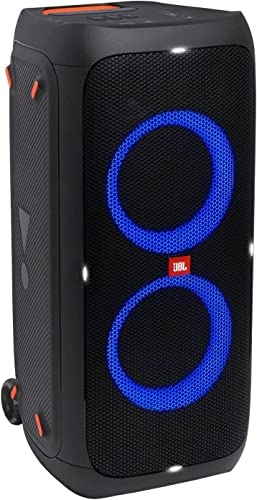
JBL PartyBox 310 — Group 2: the big-gathering engine
Some outdoor spaces are not patios but venues — the long garden, the hired field, the driveway party that becomes the street’s event — and the PartyBox 310 is built at that scale. JBL’s listing promises powerful JBL sound, a long-lasting battery and an exciting light show, in a wheeled cabinet designed to be hauled into position and to anchor an evening. This is the group two speaker for crowds: output that covers open air, where sound has no walls to help it and dissipates into the sky, and the stamina to keep that output going for the length of a real party rather than a demonstration.
Its Alexa relationship is the group two standard, executed at scale: the music source is your phone or an Echo-fed stream, the PartyBox is the muscle. In practice the arrangement suits events better than built-in voice would — at a loud gathering, nobody is whispering requests to a speaker across the lawn; the host’s phone is the request line, and Alexa on that phone handles the asking. The light show, meanwhile, does outdoors what it does indoors in this batch’s large-room guide: it turns a speaker into the gathering’s focal point as the light fades, which in an open garden is worth real money in atmosphere.
Think of it, too, as the anchor of an outdoor system rather than a solitary purchase. A household whose summers include two or three genuinely large gatherings does not need that scale every weekend — it needs it on those weekends, and the rest of the time the 310 waits in the garage while a Flex or the porch speakers handle daily life. Event equipment earns its storage space in peaks, and judged by its peaks — the wedding in the garden, the milestone birthday on the lawn — the PartyBox is the pick in this guide most likely to be described by its owners as the best money the summer ever spent.
Scale is its cost as well as its talent. The 310 is transport, not décor — it wheels rather than sits, and a small covered porch neither needs nor flatters it. Buy it for the gatherings that define your summers and it will feel underpriced; buy it for Sunday-morning coffee outdoors and it will feel like hiring a marquee for a picnic.
- Alexa relationship: compatible via a phone or Echo-fed source — no built-in Alexa
- Format: portable wheeled party speaker, battery powered
- Battery: long lasting, per the listing title (maker’s description)
- Extras: light show, per the listing title
- Weather construction: built for outdoor events; a specific IP rating is not stated in the listing title — verify with the maker’s documentation
Strengths
- Open-air output that covers lawns and large gatherings where smaller speakers evaporate.
- Battery stamina matched to full events, with wheels that make its size a feature rather than a burden.
- The light show anchors evening gatherings visually as well as sonically.
Trade-offs
- Oversized for patios and covered porches, where group one or the Plyee pair serve better.
- No built-in voice control; Alexa arrives through your phone or an Echo source.
- Its event character — lights, scale, presence — is more than quiet outdoor listening asks for.
Best for: large gardens, outdoor parties and events where the speaker is the evening’s sound system.
Not suited for: a small covered balcony, or a household wanting discreet background music under the eaves.

ION Tailgater Boom — Group 2: the event all-rounder
The Tailgater Boom is the speaker for outdoor events that are not only about music. ION’s listing stacks the practical features: 60 watts of output, water resistance, a radio, a microphone input, USB charging for phones, stereo linking to a second unit, bass boost and app control. Read that list as an event kit — the barbecue where someone makes a speech, the sports-day gathering that wants the radio commentary, the tailgate where phones die by the fourth quarter and a charging port is worth more than another lighting mode. Among group two’s portables, this is the one designed by someone who has actually run an outdoor event and itemised its small emergencies.
The microphone input deserves emphasis because it changes the speaker’s social role. A music-only speaker serves listeners; a speaker with a microphone serves a host — announcements, toasts, quiz questions, the coach’s half-time talk — and outdoor gatherings generate those moments constantly. Paired with the group two Alexa pattern (your phone or an Echo supplies the smarts and the stream), the Tailgater covers both halves of an event’s audio: the requested playlist and the human voice that organises the day around it. Stereo linking then extends coverage when the gathering outgrows one cabinet, the honest outdoor route to scale.
There is a community dimension to this pick that the spec list only hints at. Speakers like the Tailgater end up owned by the person who runs things — the coach, the club organiser, the family member whose garage hosts the neighbourhood — because its features answer organisational needs: the announcement before the game, the radio during it, the charged phone at the end of it. If that description sounds like you, the Tailgater is less a purchase than a piece of kit for a role you already play, and its value compounds across every event it quietly makes run smoother.
Its presentation is unapologetically utilitarian — a working box for working events — and its sound priorities follow: presence, clarity and features over hi-fi refinement. The Bose below makes the opposite trade. Knowing which kind of outdoor day you host is the whole decision between them.
- Alexa relationship: compatible via a phone or Echo-fed source — no built-in Alexa
- Stated output: 60W, per the listing title (maker’s figure)
- Features: water resistant, radio, microphone input, USB charging, stereo linking, bass boost, app control — per the listing title
- Format: portable battery speaker for outdoor events
- Intended use: parties and outdoor events, per the listing title
Strengths
- The microphone input and radio make it an event system, not merely a music speaker.
- USB charging rescues guests’ phones — the feature every outdoor host eventually needs.
- Stereo linking lets coverage grow to a second unit when gatherings outgrow one cabinet.
Trade-offs
- Utilitarian styling and event-first tuning will not satisfy listeners chasing refined sound.
- Water resistant is a lighter claim than the Bose’s waterproof construction — know the difference.
- No built-in Alexa; voice control arrives through a phone or separate Echo.
Best for: tailgates, sports days, barbecues and community events where announcements share the day with music.
Not suited for: a quiet garden listening setup, or a permanently installed patio where the Plyee pair fits better.
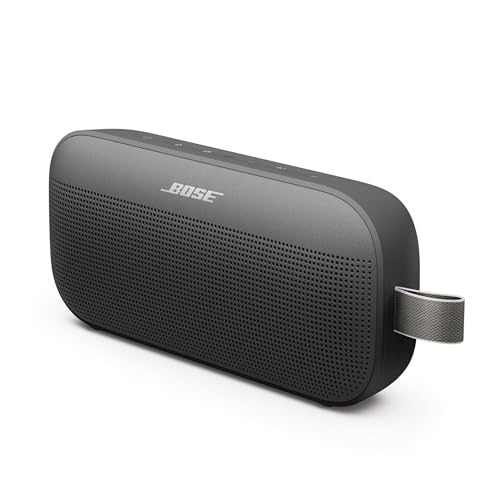
Bose SoundLink Flex (2nd Gen) — Group 2: the carry-anywhere speaker
The SoundLink Flex closes the guide with the opposite philosophy from the Plyee pair: instead of installing sound in one outdoor place, carry excellent sound to every outdoor place. Bose’s listing describes a portable outdoor speaker with hi-fi audio, waterproof and dustproof construction, USB-C charging and up to 12 hours of battery life. It is the smallest speaker here and, for two people on a deck, a blanket on a lawn or a table at a campsite, very likely the best-sounding per kilogram — Bose’s portable tuning extracts a warmth and completeness from small cabinets that the event speakers do not attempt.
Its Alexa compatibility is group two in its most everyday form: your phone is already the gathering’s music source, the Alexa app already answers requests on it, and the Flex simply plays what it is sent, superbly, wherever it has been set down. There is a freedom in that arrangement the installed and built-in options cannot match — the speaker picnics, travels, visits the allotment and the beach house, and its waterproof, dustproof build means none of those places require a risk assessment first. For households whose outdoor life is mobile rather than patio-centred, this is not the budget option in the guide; it is the correct one.
It is also, not incidentally, the pick most likely to be borrowed — by teenagers heading to the park, by a partner for a worksite radio upgrade, by guests who heard it at dinner. Small, sealed and excellent is a combination households fight over, and more than one owner of a speaker in this class has ended up buying a second simply to restore the peace.
The limits are scale and permanence. Twelve hours is a day, not a weekend festival; a small cabinet covers a gathering, not a field; and a speaker that travels is a speaker that is sometimes in the car when the patio needs it. Households with a fixed outdoor room should install or shelter accordingly — and many will end up owning both philosophies, which this guide considers a perfectly rational outcome.
- Alexa relationship: compatible via a phone running Alexa or an Echo-fed source — no built-in Alexa
- Protection: waterproof and dustproof, per the listing title
- Battery: up to 12 hours, per the listing title
- Charging: USB-C, per the listing title
- Format: compact portable outdoor speaker
Strengths
- Waterproof and dustproof construction suits genuinely mobile outdoor life — beach, campsite, garden, boat.
- Hi-fi tuning delivers the most refined sound per kilogram in this guide.
- USB-C charging matches the cables a household already carries.
Trade-offs
- Coverage is gathering-scale, not field-scale; big events belong to the PartyBox or Tailgater.
- Twelve-hour battery covers a day out, not a multi-day festival without charging.
- A travelling speaker is occasionally absent from the patio that also wants it.
Best for: mobile outdoor life — picnics, decks, campsites and gardens where the speaker goes where the people go.
Not suited for: a fixed large venue needing permanent installation or event-scale output.
How Do the Best Self Powered Outdoor Speakers Compatible With Alexa Compare?
| Speaker | Group | Alexa route | Power | Outdoor construction |
|---|---|---|---|---|
| Sonos Era 100 | 1 — built in | Alexa on the speaker | Mains | Indoor speaker — covered spaces only |
| Amazon Echo Dot Max | 1 — built in | Alexa on the speaker | Mains | Indoor speaker — covered spaces only |
| Plyee Wall-Mount Pair | 2 — Echo-paired | Bluetooth feed from phone or Echo | Mains, built-in amplifier | Outdoor wall-mount pair for patio and pool |
| JBL PartyBox 310 | 2 — Echo-paired | Phone or Echo-fed source | Battery, wheeled | Outdoor event speaker; rating not stated in title |
| ION Tailgater Boom | 2 — Echo-paired | Phone or Echo-fed source | Battery | Water resistant, per listing title |
| Bose SoundLink Flex (2nd Gen) | 2 — Echo-paired | Phone or Echo-fed source | Battery, up to 12 hours | Waterproof and dustproof, per listing title |
One row of the table deserves a second look: power. Group one and the Plyee pair are mains-fed, which outdoors means the installation conversation — sockets, cable routes, shelter — is part of the purchase, while the three battery portables convert that conversation into a charging habit instead. Neither is superior; they are different relationships with the same space, one architectural and one portable, and your answer to “will this speaker live here or visit here” selects between them more reliably than any feature comparison.
The table’s middle column is the one the keyword hoped to hide. Read it honestly and the purchase makes itself: if the speaker will live under a roof and you want to speak to it, buy group one; if it will live under the sky, buy group two and let an Echo or your phone do the talking.
How Do You Set Up Alexa Control for an Outdoor Space?
Begin with the network, because every disappointment in this category is a network disappointment wearing a speaker’s clothes. Stand where the speaker will live and check the Wi-Fi on your phone: if the signal there is a single bar and a prayer, a group one smart speaker will stutter, drop requests and sour you on the whole idea. The fixes are mundane — a mesh node nearer the garden wall, an outdoor-rated access point for serious setups, or simply siting the Era 100 or Echo Dot Max on the house side of the porch rather than its far edge. Voice control is a radio service before it is an audio one, and the porch’s far corner is often ten decisive metres from the router.
For group two setups, the choreography is simple but worth rehearsing before the first gathering. Decide which device is the voice front end — the kitchen Echo, a phone, a second Echo under cover — and pair it to the outdoor speaker in advance: Bluetooth pairing for the Plyee pair or the portables, tested from the seats, at the distance the host will actually stand. Create the routine or playlist naming you will use aloud, because “play the barbecue playlist on the patio” only works if the names exist before the guests do. Then run one full rehearsal: request, stream, volume, announcement. Ten minutes of this turns the event itself into a non-event technically, which is the highest state outdoor audio can achieve.
Power planning completes the setup. Group one speakers and the Plyee pair want outdoor-safe mains arrangements — sockets rated for the location, cables routed out of traffic and weather’s direct path, installed by someone qualified where the work requires it. The battery portables want a charging habit: a known shelf, a cable that lives there, and a rule that the speaker returns to it. Outdoor audio fails socially, not technically — the dead battery and the unplugged smart speaker are the category’s only real villains, and both are defeated by routine rather than money.
What Weather Can Outdoor Speakers Actually Handle?
The vocabulary matters, so let this guide be precise with the listings’ own words. The Bose SoundLink Flex is described as waterproof and dustproof — the strongest construction claim here, suited to rain, splashes and dusty environments as the maker defines them. The ION Tailgater Boom is described as water resistant — a lighter claim, appropriate for splashes and light weather rather than sustained exposure. The JBL PartyBox 310’s listing in this pool states no specific rating, so this guide claims none for it: it is an outdoor event speaker by design and positioning, and owners should consult the maker’s documentation for its exact limits. The Plyee pair is built and marketed for outdoor mounting in patio and pool areas — its natural shelter is the eave or covered wall where such pairs are installed.
Group one’s discipline is different and absolute: the Era 100 and Echo Dot Max carry no outdoor rating in their listings, and none should be inferred. Covered means covered — a roof that keeps direct rain off, a position splash-free, and a household habit of bringing them in when storms turn serious or winter closes the porch. Owners who respect that boundary report years of porch service from indoor smart speakers; owners who test it become the cautionary tales in product reviews.
Sun and temperature deserve a mention the ratings omit. Direct afternoon sun on a dark cabinet is hard on batteries and finishes alike, and any of these speakers will live longer in the shade’s side of the patio. Cold shortens battery days; heat shortens battery lives. Outdoor audio rewards the same instinct as gardening: know your space’s exposures, and place accordingly.
What Mistakes Do Buyers Make With Outdoor Alexa Setups?
The founding mistake is the one this guide opened with: buying an indoor smart speaker for an open-sky position because a search phrase implied it belonged there. The Era 100 and Echo Dot Max are excellent — under a roof. Every season, porches collect the consequences of that misunderstanding, and the two-group labelling throughout this guide exists so that its readers are not among them. If your position has no roof, your shortlist is group two, and no review’s enthusiasm should talk you out of it.
The second mistake is neglecting the network until the party. Voice control that works in the kitchen fails at the pool fence, and the failure is discovered in front of an audience. Test the Wi-Fi where the speaker will live, extend it if the test fails, and rehearse the group two pairing before the event. Outdoor Alexa is a system — speaker, network, front-end device — and systems are only as good as their least-tested link.
The third mistake is buying scale for the wrong gathering. A PartyBox 310 dominating a small covered balcony is as misplaced as an Echo Dot Max asked to cover a lawn. Outdoor spaces differ more than indoor ones — a courtyard focuses sound like a room, a lawn lets it escape to the sky — and the right speaker is the one sized to your actual space and your actual crowd, which is why this guide keeps returning to the honest description of your outdoors as the first step of the purchase.
Which Outdoor Spaces Count as Covered?
Since group one’s whole legitimacy rests on the word, it deserves a definition you can apply to your own house. A covered space, for this guide’s purposes, is one where a speaker on its intended surface stays dry in ordinary rain: a porch with a real roof and enough depth that wind-driven rain does not reach the back wall, a pergola with a solid cover rather than open slats, a pool house or outdoor kitchen with walls or screens on the weather side, a garage, a covered balcony deep enough to have a dry zone. The test is empirical — stand where the speaker would sit during the next downpour, in your imagination if the sky is currently kind, and ask whether that spot gets wet. If the honest answer is “only in a storm,” you are at the boundary: group one with a bring-it-in habit, or group two with no habit required.
Some spaces fail the test while feeling covered. A shade sail stops sun, not rain. A pergola with climbing plants is a photograph, not a roof. A carport’s open sides admit weather at an angle that surprises everyone the first time. And the eaves of a house protect a narrow strip — which is precisely where the Plyee pair is designed to mount, in the building’s own rain shadow, rather than on a free-standing post in the garden. Match the speaker to the wettest day of the season, not the average one, because a speaker’s weather life is decided by its worst night, not its typical afternoon.
There is also a middle path worth naming for the genuinely undecided: put group one’s voice where it is safe and group two’s muscle where it is wet, as one system. An Echo Dot Max in the covered porch becomes the household’s outdoor voice — requests, announcements, routines — while a SoundLink Flex or a mounted Plyee pair handles playback at the pool or the lawn’s edge. This is not indecision; it is the architecture the category’s physics actually supports, and many of the happiest outdoor setups this guide’s research encountered were built exactly this way, one honest component at a time.
How Does Sound Behave Outdoors Without Walls?
Indoors, walls are unpaid members of your audio system: they reflect sound back toward the listeners, reinforce bass, and let a modest speaker feel ample. Outdoors, the walls resign. Sound radiates into open air and simply leaves, bass most eagerly of all, which is why outdoor gatherings so often sound thin even through speakers that seemed mighty in the shop. The practical consequences shape this guide’s picks. Output headroom matters more outside than in — the PartyBox 310’s scale, the Tailgater’s event tuning — and placement matters differently: a speaker near the house wall borrows that wall’s reinforcement, while the same speaker in the garden’s centre plays to the sky in four directions at once.
Distance behaves worse outdoors too. Indoors, reflections fill the gaps as you move away from a speaker; outdoors, level simply falls, and the far end of a long garden receives a fraction of the near end’s sound. This is the honest argument for the two-speaker strategies in this guide — the Plyee pair spread across a patio wall, the Tailgater’s stereo link to a second unit — because two sources halve the distance any listener sits from a speaker, and halved distance beats doubled volume for comfort every time. It is also the argument for aiming: mounted speakers angled down at the seating, portables raised on a table rather than sitting in the grass that swallows their output.
Neighbours complete the physics lesson. A garden has no ceiling for the street’s benefit either, and outdoor volume that feels reasonable at your table carries further than intuition suggests on a still evening. The civilised outdoor system is therefore not the loudest one but the nearest one — speakers placed close to the listeners, at moderate level, sounding full where the people are and mercifully faint at the fence. Every pick in this guide can be deployed that way, and the ones that cannot resist being deployed otherwise, the big party cabinets, at least have the excuse of the occasions they were built for.
How Should You Care for Outdoor Speakers Across the Seasons?
Outdoor audio is a four-season commitment even in gentle climates, and the households whose systems last are the ones with a small, definite routine. Battery portables want to be stored charged but not cooked: a shelf indoors beats a sealed car or a sun-baked shed, and a speaker put away for winter at partial charge, then topped up in spring, will outlive one abandoned flat or brimmed. The PartyBox and Tailgater, as event equipment, benefit from the event habit of cleaning as you pack — a wiped grille and a checked port today prevent the archaeology of next summer’s first party.
Installed and covered-space equipment wants inspection more than intervention. Once a season, look at the Plyee pair’s mounts and cable run for weather’s slow work — a loosened fixing, a cable jacket the sun has worried — and check the porch smart speakers’ positions against the season’s new rain patterns, because a moved chair or a trimmed hedge can quietly change which corner of a covered space stays dry. Group one equipment, especially, lives on borrowed shelter, and shelter is a condition to be re-verified rather than a fact to be assumed.
Finally, keep the system’s knowledge in the household rather than in one person’s head: where the outdoor speaker charges, which Echo feeds the patio pair, what the playlist is called. Outdoor gatherings are social events, and a system only its owner can operate is a system that fails the first time its owner is flipping burgers. A note on the fridge — unglamorous, decisive — is part of the installation.
Final Recommendation
If your outdoor living happens under a roof — and for most homes it does — group one is the answer the keyword was reaching for: the Sonos Era 100 for the covered space where music quality leads, the Echo Dot Max where native Alexa integration and smart-home control lead. If your speakers must live under the sky, group two carries the brief properly: the Plyee pair installed on the patio wall for permanent readiness, the JBL PartyBox 310 for gatherings at field scale, the ION Tailgater Boom for events that need a microphone and a radio as much as music, and the Bose SoundLink Flex for the outdoor life that moves.
A word, in closing, about why this category’s honest answer is also its most enjoyable one. The two-group architecture is not a workaround — it is how outdoor voice audio actually flourishes in real homes: a smart speaker where voices are, weatherproof sound where weather is, and a household that stops thinking about the join between them because the join was designed rather than improvised. The porch Echo that runs the lights, the mounted pair that has simply always been on the wall, the little Bose that goes to the beach — each is doing the job it was built for, and systems built that way are the ones still working, unremarked and unmissed, five summers from now.
Whichever group you choose, you will have bought the truth about your own setup — a speaker whose Alexa relationship and weather construction match the place it will actually live — and in this category, that match is worth more than any single feature on any listing.
Frequently Asked Questions
Can I leave an Echo or Sonos speaker outside permanently?
Only in a genuinely covered position — under a roof, protected from direct rain and splashing — and even then, bringing it in during severe storms or an unused winter is the habit that makes porch service last. Neither group one speaker carries an outdoor rating in its listing, so open-sky permanence is outside their design. For a speaker that lives outdoors by intention, choose from group two.
How does Alexa control a speaker that has no Alexa built in?
Through a front end. You speak to an Echo device indoors, or to the Alexa app on your phone, and the resulting audio is sent to the outdoor speaker — by Bluetooth for the Plyee pair and the portables in this guide. The request, the smarts and the streaming live on the front-end device; the outdoor speaker does the playing, with the weather construction the job requires.
Do outdoor speakers need Wi-Fi?
Group one speakers do — their voice features and streaming run on your home network, which is why network reach to the porch matters. Group two speakers mostly do not: they receive audio by Bluetooth or aux from a phone or Echo, so the Wi-Fi requirement sits with the front-end device rather than at the poolside. A garden beyond Wi-Fi range can still have Alexa-driven music through a phone’s own connection.
What is the difference between water resistant and waterproof here?
They are different strengths of claim, and this guide keeps each maker’s own wording. The ION Tailgater Boom is listed as water resistant — suited to splashes and light weather. The Bose SoundLink Flex is listed as waterproof and dustproof — a stronger construction for wetter, dustier use. Neither wording should be stretched beyond the maker’s documentation, and neither applies at all to the group one smart speakers.
Can I pair two outdoor speakers for stereo?
Some can: the ION listing states stereo linking, and the Sonos Era 100’s listing describes pairing two units for stereo in its covered-space role. Others make no such statement in their listings, so check the specific model’s documentation before planning a stereo installation. For most patios, one well-placed speaker — or a mounted pair like the Plyee set, designed as a pair from the start — covers the space more simply.
Is a mounted pair better than a portable speaker?
For a fixed outdoor room, usually: the Plyee pair is always in position, always powered and aimed at the seating, with no charging routine. A portable wins when the outdoor life moves — lawn, deck, campsite, beach house. Many households eventually run both, an installed pair for home base and a portable like the SoundLink Flex for everywhere else, and this guide regards that as the category’s natural end state.
Can one system cover both the porch and the pool?
Yes, if it is designed as the two-group architecture this guide describes: a group one voice anchor under the porch roof for requests and control, feeding or accompanying group two playback where the water is. The Plyee pair covers a pool area from its wall; a SoundLink Flex covers it from a table. What does not work is asking one indoor smart speaker to be both halves — the pool end of that arrangement is where speakers go to be replaced.
What should I do before the first outdoor event of the season?
Run the rehearsal this guide prescribed at setup, because winter forgets things: recharge every battery portable fully, re-test the Bluetooth pairing between your front-end device and the outdoor speakers, confirm the Wi-Fi still reaches the porch after any router changes, and play one full song at event volume to check for the crackle of a weather-worn cable or mount. Fifteen minutes in April saves the first barbecue in May.
Related Guides
For the neighbouring questions, see best bluetooth speakers to fill a large room for the indoor end of the same problem, best tower speakers for music without a seperate sub for a permanent stereo system, and best desktop computer speakers with bluetooth under 100 for wireless sound at desk scale.


