Our Top Picks




What's inside
- What the EN-EL14a Standard Actually Specifies
- Genuine Packs Versus Third-Party Alternatives
- Decoded Chips and Camera Communication
- Charging Options: The MH-24, Dual Bays, and USB
- Cycle Life and Capacity Fade
- Storage, Transport, and Safety Practice
- How Many Spares a Photographer Actually Needs
- Reading Specifications Without Being Misled
- Reading a Field Scenario: Weddings and Long Event Days
- Firmware, Bodies, and Mixed Pack Generations
- The MH-24 Lamp Language in Detail
- Contact Care and Terminal Hygiene
- Why Two Smaller Spares Beat One Large Promise
- Seasonal Rotation for Occasional Shooters
- Disposal and Recycling Obligations
- Matching Charger Speed to Real Schedules
- Travel Kits and Redundancy Planning
- How Temperature Ratings Should Be Read
- Counterfeit Packs and Market Risks
- Understanding Self-Discharge in Storage
- When a Pack Reports Inconsistent Percentages
- Grip Accessories and Alternative Power Paths
- Label Literacy: Dates, Codes, and Regions
- Balancing Price Against Cost per Year
- Environmental Conditions in the Camera Bag
- Questions to Ask Before Buying Any Spare
- How Shot Count Ratings Are Measured
- Mirrorless Habits That Drain Packs Faster
- Third-Party Charger Displays: Useful or Decorative
- Why a Pack Can Show Full and Die Quickly
- Pairing Packs With Flash-Heavy Workflows
- The Role of the Thermistor Contact
- Recalibrating Expectations After a Body Upgrade
- Humidity, Condensation, and Cold-to-Warm Transitions
- How Professionals Label and Track Their Packs
- Understanding Watt-Hours Across a Whole Kit
- Safety Certifications and What They Test
- When to Charge Before a Shoot: Timing Strategy
- Diagnosing a Charger That Blinks Fault
- The Difference Between Capacity and Endurance
- Buying Discontinued and New-Old-Stock Packs
- How Altitude and Air Travel Affect Packs
- Why Genuine Chargers Charge Slowly on Purpose
- Reading Reviews of Third-Party Packs Critically
- The Cost of Leaving Packs in the Camera
- Emergency Power Etiquette on Shared Shoots
- A Short History of the Pack Family
- How the Camera Estimates Remaining Shots
- Protection Against Reverse Polarity and Shorts
- What Happens Inside a Charging Cell
- Comparing Pack Weight Across a Travel Kit
- The Signal in a Pack That Charges Too Fast
- Seasonal Buying Patterns and Counterfeit Waves
- How Battery Doors and Seals Interact With Packs
- Why Studios Tether Power Differently
- Interpreting the Age Indicator Honestly
- Charging Etiquette in Shared Field Vehicles
- The Physics of the Cold-Weather Pocket Trick
- What a Multimeter Can and Cannot Tell You
- Planning Spares for Time-Lapse Work
- How Recycling Programs Handle Camera Packs
- Deciding Between One Body With Spares and Two Bodies
- Insurance, Kits, and Documenting Battery Condition
- Why Some Shoots Demand a Fresh Pack Regardless of Charge
- How Pack Behavior Changes Across a Wedding Season
- Keeping Packs Ready in a Rental or School Kit
- The Subtle Role of Image Stabilization in Runtime
- How to Break In a New Pack Sensibly
- What Separates a Spare From a Liability
- Check prices on Amazon
- Disclosure
As an Amazon Associate I earn from qualifying purchases. This post may contain affiliate links at no extra cost to you.
What the EN-EL14a Standard Actually Specifies
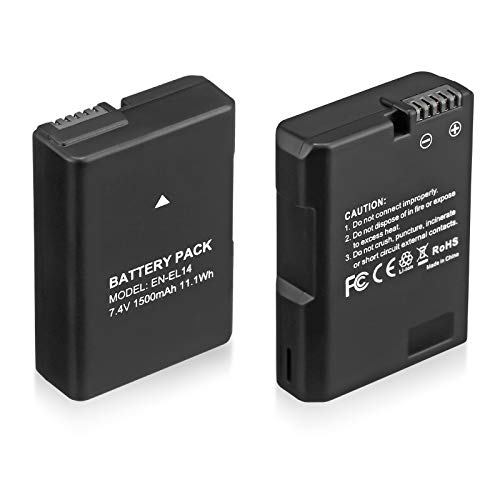
The EN-EL14a is a rechargeable lithium-ion battery pack rated at 7.2 volts with a typical capacity of 1,230 milliamp-hours, which works out to roughly 8.9 watt-hours of stored energy. Nikon introduced the pack as a revision of the earlier EN-EL14, keeping the same physical dimensions and contact layout while raising capacity from 1,030 milliamp-hours, an increase of about nineteen percent that translates directly into more exposures per charge on compatible bodies.
Compatibility runs in both directions with one important caveat. Cameras designed around the EN-EL14a accept the older EN-EL14 without restriction, while some earlier bodies need a firmware update before they can read the newer pack correctly, because the fuel-gauge communication between battery and camera changed slightly between generations. Nikon publishes the supported body list in the battery manual, and the distinction matters when a photographer mixes packs bought several years apart.
The pack uses a lithium-ion cell chemistry with a nominal cell voltage of 3.6 volts per cell, two cells in series producing the 7.2 volt output. Like all lithium-ion packs, its usable voltage range runs from about 8.4 volts fully charged down to a cutoff near 6.0 volts, at which point the camera shuts down to protect the cells from deep discharge damage.
Physical identification is straightforward once you know what to look for. A genuine pack carries the Nikon name molded into the housing, a holographic label, printed capacity and voltage figures, a serial code, and recycling marks including the Li-ion designation. The terminal block sits at one end with recessed contacts that mate with spring pins inside the camera, a design that keeps pocket lint and moisture away from the electrical interface.
Genuine Packs Versus Third-Party Alternatives
The central difference between a genuine Nikon pack and a third-party equivalent is not the cell itself but the electronics wrapped around it. Inside every EN-EL14a sits a small circuit board that reports charge state to the camera, monitors temperature through a thermistor, and enforces current limits. Nikon calls attention to this communication in its support documents because the camera relies on those reports to display the battery meter and to log shot counts in the battery info menu.
Reputable third-party manufacturers license or reverse-engineer that communication protocol so their packs report charge state correctly and charge on the original Nikon MH-24 charger. Packs described as fully decoded behave this way: the camera shows the percentage meter, the battery info screen displays cycle data, and charging proceeds normally. Packs sold as non-decoded or partially decoded may power the camera yet show a fixed or blinking indicator, refuse to charge in the original charger, or trigger a warning message on certain bodies.
Cell quality varies far more than listings suggest. Capacity claims printed on third-party labels sometimes exceed the physical limits of the cell format; a pack in this housing cannot honestly hold dramatically more than the genuine 1,230 milliamp-hours because the internal volume is fixed. When a label promises half again as much capacity in the same shell, the figure deserves skepticism, and independent discharge measurements published by photography forums routinely show such packs delivering less than the genuine article.
Protection circuitry is the other dividing line. A well-built pack includes overcharge protection, over-discharge cutoff, short-circuit protection, and a temperature sensor that the charger and camera can read. The cheapest packs sometimes omit the thermistor or substitute a fixed resistor, which defeats temperature monitoring during charging. That omission rarely matters on a mild day and matters a great deal when charging in a hot car or a cold mountain hut.
Warranty and recourse differ as well. Nikon warrants its packs against defects, and a genuine pack that swells or fails early has a clear service path. Third-party warranties range from multi-year coverage by established accessory brands to effectively none from anonymous sellers. For a working photographer, the practical question is not which pack wins on paper but which failure mode is acceptable on an assignment where a dead battery means missed frames.
Decoded Chips and Camera Communication
The decoding question deserves its own explanation because it drives most compatibility complaints. The camera does not simply draw current from the pack; it polls the pack electronics for identity, remaining capacity, temperature, and cycle history. A decoded pack answers those polls in the format the camera expects, so every battery-related feature works, including the in-camera charge indicator on bodies that support USB charging of this pack type and the detailed battery information screen.
An undecoded pack typically supplies power through the main terminals while answering polls incorrectly or not at all. Symptoms include a battery icon that never changes, a camera that refuses to start with a message about unsupported power sources, or a charger whose lamp blinks an error pattern instead of settling into its normal charging indication. Nikon documents the MH-24 lamp patterns: a blinking lamp during normal charging, a steady lamp at completion, and rapid blinking for a fault or an incompatible pack.
Firmware updates occasionally change how strictly a body validates packs, which is why a third-party battery that worked for years can draw a warning after an update. This is not planned sabotage so much as tightened validation, but the effect on the owner is identical. Photographers who depend on third-party packs often delay non-critical firmware updates until the accessory maker confirms compatibility, a cautious habit worth adopting.
Charging Options: The MH-24, Dual Bays, and USB
The standard charger for this pack is the Nikon MH-24, a wall charger that takes the pack directly and charges at a modest rate suited to the cell size, completing a depleted pack in roughly one hour and thirty-five minutes according to Nikon documentation. The gentle rate is deliberate: slower charging generates less heat, and less heat means slower capacity fade over the pack’s service life.
Dual-bay third-party chargers add convenience for event work, charging two packs simultaneously and often adding a small display that reports voltage and approximate charge percentage per bay. Better models charge each bay independently with its own termination logic, while cheaper units split a single output between bays, so two depleted packs take proportionally longer. Anyone comparing chargers should look for independent channel specifications rather than a headline total current shared across slots, a distinction also familiar from guides such as best aa and aaa battery chargers where per-slot current determines real-world speed.
USB charging changes the travel equation. Compact chargers powered from a USB port or power bank let a photographer top up packs in a car, at a cafe, or from a laptop, typically at lower current than the wall charger and therefore over a longer session. Input requirements matter: a charger expecting 5 volts at 2 amps will crawl when fed by an old 500 milliamp laptop port. Some USB chargers for this pack family accept USB-C Power Delivery input and negotiate higher voltage for faster conversion, and reading the input specification before a trip prevents disappointment.
Charging behavior follows the standard lithium-ion profile: constant current until the pack approaches 8.4 volts, then constant voltage while current tapers, terminating when current falls to a small fraction of the initial rate. A pack that feels warm during the first phase is behaving normally; a pack that becomes hot to the touch, hisses, or swells is not, and charging should stop immediately with the pack moved away from flammable material.
For photographers managing many cell formats at once, the ecosystem overlaps with cylindrical-cell gear covered in best 18650 chargers, though the charging logic differs because camera packs carry their own protection and identification electronics while bare cylindrical cells rely entirely on the charger for safety decisions.
Cycle Life and Capacity Fade
Nikon rates the EN-EL14a for service measured in hundreds of full charge cycles, and lithium-ion aging follows predictable rules. A cycle means the cumulative discharge of the full capacity, so two half discharges equal one cycle. Kept at moderate temperatures and charged at standard rates, a quality pack typically retains around eighty percent of original capacity after several hundred cycles, which for most owners spans years of regular shooting.
Heat is the dominant accelerator of fade. Storing a fully charged pack in a warm environment combines the two worst conditions, high state of charge and high temperature, and can permanently cost several percent of capacity in a single season. Calendar aging proceeds even on a shelf: a pack bought as a spare and never used still loses capacity slowly, which is why buying five spares at once rarely pays unless they rotate into service.
The camera’s battery info menu, on bodies that support it, reports charge state, shots since last charge, and an age indicator for genuine packs. Watching the age indicator move gives a practical retirement signal. When a pack’s real-world shot count falls to roughly two-thirds of its early performance, or the age indicator reaches its final stage, retiring it to backup duty prevents mid-event surprises.
Cold weather produces a different, temporary effect. At temperatures below freezing, internal resistance rises and available capacity drops noticeably, sometimes by a quarter or more, recovering as the pack warms. The classic field technique of rotating two packs, one in the camera and one in an inside pocket, works precisely because body heat restores the waiting pack. This is capacity suppression, not damage, and it reverses fully at room temperature.
Storage, Transport, and Safety Practice
For storage longer than a few weeks, manufacturers of lithium-ion packs consistently recommend a partial charge, roughly forty to sixty percent, in a cool dry place. Storing fully charged stresses the cell chemistry; storing fully depleted risks the voltage sliding below the protection threshold during self-discharge, after which some chargers refuse to revive the pack. A mid-charge stored pack should be checked every few months and topped back to the storage band if it has drifted down.
Air transport rules treat camera batteries as carry-on items. Spare lithium-ion packs belong in hand baggage with terminals protected against short circuit, either in their original packaging, a battery case, or with tape over the contacts. The EN-EL14a at about 8.9 watt-hours sits far below the 100 watt-hour threshold that triggers airline approval requirements, so individual photographers carrying several spares remain within standard allowances, though carriers ask that spares never ride in checked baggage.
Swelling is the failure sign that demands immediate action. A pack whose housing bulges, rocks on a flat surface, or resists sliding into the camera bay has internal gas generation from cell degradation. It should be removed from service, kept away from heat, and taken to a battery recycling point rather than household trash. Puncturing, crushing, or attempting to discharge a swollen pack converts a manageable disposal task into a fire risk.
Water exposure deserves similar respect. The pack is not sealed for immersion, and moisture across the terminals can corrode contacts and confuse the protection electronics. A pack dropped in water should be dried externally, left unused for an extended period, and watched during its next charge; any unusual heat ends its career. Terminal corrosion on the camera side can be cleaned gently with a dry cloth, never with abrasive material that strips the contact plating.
Households that keep larger charging setups for workshop and field gear, of the kind surveyed in best 10 amp battery chargers, should apply the same discipline to small camera packs: charge on a non-flammable surface, keep chargers ventilated, and avoid leaving any lithium-ion pack charging unattended overnight as a routine habit.
How Many Spares a Photographer Actually Needs
Shot ratings published for cameras using this pack typically fall in the range of several hundred exposures per charge under standardized measurement, with real-world counts swinging widely based on live view use, image review habits, wireless features, and temperature. Video recording drains the pack far faster than stills, and a body recording long clips may exhaust a pack in well under an hour of accumulated footage.
A practical spares strategy follows from that arithmetic. A stills photographer shooting a full day outdoors usually manages with the pack in the camera plus one spare. An event photographer using flash heavily, reviewing constantly, and shooting into the evening is better served by three packs in rotation. Video-focused work justifies four or more, or a shift to external power solutions for static setups.
Rotation discipline extends pack life across the set. Numbering packs and using them in order equalizes cycle counts, so the whole set ages together instead of one pack dying young while others sit unused. Marking the purchase date on a small label helps too, because age alone eventually retires a pack regardless of cycle count, and a dated label removes guesswork three years later.
Multi-bay charging stations, including the high-bay-count units discussed in best 16 bay battery chargers, suit studios maintaining packs for several bodies at once; the same termination and temperature principles apply at that scale, multiplied across a shelf of packs that all need individual monitoring rather than a shared timer.
Reading Specifications Without Being Misled
Three numbers define any listing for this pack type: voltage, capacity in milliamp-hours, and energy in watt-hours. Voltage should read 7.2 or 7.4 volts nominal; both describe the same two-cell configuration at different points of convention. Capacity should cluster near 1,230 milliamp-hours for a truthful label. Watt-hours, the figure airlines use, should land near 8.9. A listing whose numbers disagree with each other, promising high milliamp-hours at low watt-hours, reveals careless or invented specifications.
Weight offers a quiet honesty check. A genuine pack weighs roughly 49 grams. Cells and housing cannot shrink much below that while holding the stated energy, so a suspiciously light pack has likely traded cell material for empty space. Heft alone proves nothing, but a pack noticeably lighter than the original invites doubt about its capacity claim.
Certification marks matter more than marketing adjectives. Look for the standard safety marks applicable in your market and a named manufacturer with a traceable address. Lithium-ion packs are regulated articles in most jurisdictions, and legitimate makers print compliance information because they must. A label carrying nothing but a capacity figure and a brand invented last month is telling you something.
Reading a Field Scenario: Weddings and Long Event Days
An event day exposes every weakness in a battery plan. The ceremony demands silent, reliable operation, the reception adds flash-heavy frames in dim light, and image review between moments keeps the display lit. Photographers who log their pack usage across a season discover their personal shot-per-pack figure, which is the only number that should drive how many spares ride in the bag, rather than any standardized rating measured under laboratory conditions with the display mostly dark.
Firmware, Bodies, and Mixed Pack Generations
Bodies spanning several release years treat the same pack slightly differently. Older firmware may display only a coarse three-segment meter where newer firmware reports percentage, and the battery info page exists on some bodies while others omit it entirely. When a kit mixes generations, the oldest body’s behavior defines what the photographer can verify in the field, so testing each pack in each body before an important shoot is cheap insurance against a surprise refusal message.
The MH-24 Lamp Language in Detail
The charger’s single lamp communicates more than owners usually learn. A slow blink marks normal charging, a solid light marks completion, and rapid blinking signals a fault condition that includes an incompatible or failed pack and, in some cases, a pack too hot or too cold to charge safely. Leaving a pack to rest at room temperature and retrying resolves temperature-related faults, while a pack that faults repeatedly across chargers has announced its retirement.
Contact Care and Terminal Hygiene
Intermittent power complaints often trace to film on the contacts rather than failing cells. Skin oil, oxidation, and pocket debris raise contact resistance, and at camera current draws the resulting voltage drop can mimic a depleted pack. Wiping contacts with a clean dry cloth, and the camera’s spring pins with the same care, restores reliable connection. Solvents and abrasives do more harm than good on plated contacts, thinning the very surface that resists corrosion.
Why Two Smaller Spares Beat One Large Promise
External battery grips and oversized solutions tempt photographers who fear running dry, yet for bodies built around this pack the flexible answer remains multiple standard packs. Two genuine-capacity spares can rotate through a charger during downtime, distribute wear, and keep working if one fails, while a single oversized solution concentrates risk and often relies on cells of uncertain origin feeding through an adapter tray.
Seasonal Rotation for Occasional Shooters
Photographers who shoot monthly rather than daily face calendar aging more than cycle wear. Their best routine is a short one: store packs at partial charge, note the date, bring each pack to full the day before a shoot, and run a full discharge through normal use a few times a year so no pack sits for years at one charge level. This light discipline preserves most of the capacity that neglect quietly removes.
Disposal and Recycling Obligations
Retired packs enter a regulated waste stream in most regions. Retailers and municipal collection points accept lithium-ion packs at no charge, taping terminals before drop-off as a courtesy and a safety measure. A pack must never be incinerated or placed in household refuse, because damaged cells in collection trucks have caused documented fires. Responsible disposal closes the loop on a product whose materials include recoverable metals worth reclaiming.
Matching Charger Speed to Real Schedules
Charge time only matters relative to turnaround. A photographer with overnight gaps gains nothing from aggressive charging and benefits from the gentler standard rate, while a sports shooter rotating packs between halves of a doubleheader needs the fastest safe turnaround available. Choosing charging gear by schedule rather than specification keeps both heat and spending proportionate to the actual problem.
Travel Kits and Redundancy Planning
A travel kit built around this pack benefits from deliberate redundancy: two chargers rather than one, because a failed charger strands every pack at once, and a USB charging option as the second unit covers hotel rooms, vehicles, and delays where wall outlets are scarce. Photographers crossing regions with different plug types should carry a single quality plug adapter and rely on the chargers’ universal voltage input, checking the fine print for the 100 to 240 volt range that makes that possible.
How Temperature Ratings Should Be Read
Published operating ranges for lithium-ion camera packs generally span from freezing to about forty degrees Celsius for discharge, with charging restricted to a narrower band above freezing. Charging a cold-soaked pack immediately on entering a warm room is poor practice; condensation and cell temperature lag both argue for letting the pack reach room temperature first. The charger’s fault lamp exists partly for this situation, refusing packs outside the safe window.
Counterfeit Packs and Market Risks
Counterfeit packs copy labels, holograms, and packaging closely enough to fool casual inspection, and they concentrate in the lowest price tier of large marketplaces. The risks are practical rather than theoretical: overstated capacity, missing temperature sensors, and cells of unknown provenance. Buying from authorized dealers or established accessory brands, and treating prices far below the genuine article as a warning sign, remains the most reliable defense available to an individual buyer.
Understanding Self-Discharge in Storage
Lithium-ion cells lose a small percentage of charge each month on the shelf, far less than older nickel-based chemistries but enough to matter across a year. The protection circuit adds a tiny parasitic draw of its own. A pack stored at half charge therefore has a wide safety margin before voltage drifts anywhere near the protection cutoff, which is precisely why the half-charge storage rule exists and why a yearly check suffices for healthy packs.
When a Pack Reports Inconsistent Percentages
A percentage display that falls in sudden steps, or a camera that shuts down while showing remaining charge, usually indicates a pack whose cells have aged unevenly or whose gauge has drifted from reality. A full charge followed by a complete discharge in normal use can recalibrate the gauge estimate. If the behavior persists, the pack’s usable capacity has genuinely shrunk, and the honest remedy is retirement rather than another calibration attempt.
Grip Accessories and Alternative Power Paths
Some bodies accept battery grips that hold two packs or a larger tray, extending runtime for vertical shooting and long events. A grip doubles capacity only when both slots carry healthy packs, and it inherits every compatibility rule of the single-pack bay, including decoded communication. For studio work, dummy-battery couplers fed from mains power remove runtime limits entirely, at the cost of a cable that anchors the camera to one position.
Label Literacy: Dates, Codes, and Regions
Genuine packs carry production codes that support staff can interpret, and regional variants differ mainly in printed regulatory marks rather than electrical behavior. A pack bought abroad works identically in a home-market body because the standard is global; what changes is warranty handling, which typically follows the region of purchase. Keeping the receipt with the pack’s purchase date noted simplifies any later service conversation.
Balancing Price Against Cost per Year
A pack’s real cost is its price divided by years of dependable service. A genuine pack serving five years costs less annually than a bargain pack replaced every eighteen months, before counting the shoots a failure can spoil. This arithmetic favors quality for anyone whose photography has deadlines attached, while casual shooters with tolerant schedules can reasonably accept shorter-lived alternatives with spares on hand.
Environmental Conditions in the Camera Bag
A camera bag left in a vehicle cycles through the widest temperature swings in a photographer’s life, baking at midday and chilling overnight. Packs stored in that bag age faster than identical packs kept indoors, and the difference compounds across a single summer. Moving packs into the cabin, or into the house between shoots, is a zero-cost habit that preserves capacity more effectively than any accessory purchase.
Questions to Ask Before Buying Any Spare
A short checklist filters most poor purchases: Is the capacity claim plausible for the format? Does the maker state decoded compatibility with your specific body? Is a temperature sensor listed among the protections? Does the seller offer a warranty with a real address behind it? A listing that answers all four clearly has earned consideration; one that dodges them has answered in a different way.
How Shot Count Ratings Are Measured
Manufacturers measure shots per charge under an industry test method that mixes operations on a fixed schedule: shots at intervals, periodic power cycling, and limited review time. Real photographers deviate in both directions. A landscape shooter using a tripod, manual focus, and long exposures may exceed the rating comfortably, while a sports shooter running continuous autofocus, image stabilization, and constant review lands well below it. The rating is a comparison tool between bodies, not a promise to any individual user, and treating it that way prevents most disappointment.
Mirrorless Habits That Drain Packs Faster
Electronic viewfinders and rear screens draw power continuously while composing, which changes the economics of a shooting day compared with an optical finder that consumes nothing between frames. Keeping the camera awake at the neck for an hour of street photography can cost more charge than the frames taken during that hour. Power-saving settings, shorter display timeouts, and the discipline of switching off between scenes recover a surprising share of a pack without changing how anyone photographs.
Third-Party Charger Displays: Useful or Decorative
Small screens on aftermarket chargers report voltage and a percentage estimate, and their usefulness depends on how the estimate is derived. Voltage read directly from the terminals is genuinely informative, since it maps to charge state along a known curve. Percentage figures computed from that voltage are approximations, honest within a few points in the middle of the range and unreliable near full and empty. Treat the display as a progress indicator rather than a laboratory instrument and it earns its place.
Why a Pack Can Show Full and Die Quickly
A charger terminates on voltage and taper current, so an aged pack reaches the termination voltage quickly precisely because its capacity has shrunk. The camera then reports full, and the pack delivers a fraction of its original shots. This is the signature of capacity fade rather than a charging fault, and it is why judging packs by real shot counts, not by how fast they charge, gives the truer picture of their health.
Pairing Packs With Flash-Heavy Workflows
A hot-shoe flash draws from its own cells, yet flash-heavy work still drains the camera pack faster through constant metering, focus assist illumination, and the review habit that follows every burst. Photographers shooting receptions often discover the camera pack, not the flash cells, ends the night first. Planning spares around the camera’s consumption, and enabling the flash’s own power management, balances the two systems so they finish the event together.
The Role of the Thermistor Contact
Beyond the positive and negative terminals, the pack presents a temperature-sensing contact that the charger and camera read through a thermistor whose resistance varies predictably with heat. This signal lets the charger pause when a pack arrives hot from a summer car ride and lets the camera warn before thermal stress compounds. Packs that fake this signal with a fixed resistor remove a genuine safety layer, which is why the thermistor’s presence belongs on any serious buyer’s checklist.
Recalibrating Expectations After a Body Upgrade
Moving to a newer body on the same pack standard changes runtime even with identical batteries, because processors, displays, and wireless radios differ between generations. Owners sometimes blame new packs for shorter days that the body itself causes. Measuring the new body’s draw with a known older pack first establishes the honest baseline, after which spare counts can be adjusted to the new reality instead of to suspicion about battery quality.
Humidity, Condensation, and Cold-to-Warm Transitions
Bringing a cold camera into a warm room condenses moisture on every surface, including battery contacts and the pack’s seams. The field remedy is patience: seal the camera in a bag before entering warmth so condensation forms on the bag instead, and let packs acclimatize before charging. Charging a pack with moisture across its terminals invites corrosion and erratic protection behavior, and the wait costs nothing but a few minutes of foresight.
How Professionals Label and Track Their Packs
Working photographers treat packs like small assets: numbered labels, purchase dates, and a simple log of which packs served which job. When one pack’s runtime sags, the log shows whether the cause is age, cycles, or a single bad actor in the rotation. This bookkeeping takes seconds per shoot and converts battery management from guesswork into evidence, especially across a kit of six or more packs that all look identical in the bag.
Understanding Watt-Hours Across a Whole Kit
Comparing energy across formats clarifies travel planning. This pack holds about 8.9 watt-hours; a large power bank holds five to ten times that, minus conversion losses each time energy changes form. A photographer estimating how many field recharges a power bank provides should divide its usable output, roughly seventy percent of its label figure, by the pack’s watt-hours. The arithmetic sets realistic expectations for multi-day trips away from wall power.
Safety Certifications and What They Test
Certification programs for lithium-ion packs subject samples to crush, puncture, thermal, and short-circuit abuse, plus charge and discharge cycling under supervision. A certified pack has demonstrated that its protection responds correctly when conditions go wrong, which is the scenario that matters. Uncertified packs may be built identically, but the buyer has only the seller’s word for it, and the price difference rarely compensates for that uncertainty.
When to Charge Before a Shoot: Timing Strategy
Charging the night before balances readiness against time spent at full charge. Lithium-ion packs prefer not to sit full for weeks, yet a single overnight at full costs negligibly, so the practical rule is simple: charge within a day or two of use, store at partial charge otherwise. Photographers with unpredictable schedules keep one pack near full as the ready pack and rotate which pack holds that role, spreading the minor wear evenly.
Diagnosing a Charger That Blinks Fault
A fault blink narrows the suspects in order: try the pack in another charger, try another pack in this charger, clean every contact, and let everything reach room temperature before judging. If one pack faults everywhere, it has failed. If every pack faults in one charger, the charger has failed. If the fault appears only in one pairing, contact geometry is the likely story, and a close look at the terminals usually confirms it.
The Difference Between Capacity and Endurance
Capacity is a laboratory figure measured at a gentle, steady discharge. Endurance is what a pack delivers under a camera’s spiky real load, with autofocus motors, stabilization, and displays drawing in bursts. Two packs with identical rated capacity can post different endurance when their internal resistance differs, because resistance wastes energy as heat during each burst. Aged packs lose endurance before they lose nameplate capacity, which is why old packs feel tired before measurements prove it.
Buying Discontinued and New-Old-Stock Packs
Because this standard spans many camera generations, new-old-stock packs surface years after production. A sealed pack manufactured long ago has aged on the shelf regardless of its untouched state, and its first charges may report oddly until the gauge calibrates. Such packs can be sound value when priced to reflect their calendar age, but a buyer should verify the production code’s era and avoid paying fresh-pack prices for shelf-aged stock.
How Altitude and Air Travel Affect Packs
Cabin pressure changes do not meaningfully affect a healthy sealed pack, and the watt-hour rating sits far below airline approval thresholds. The real travel variables are temperature in transit and the temptation to pack spares loosely among metal objects. Terminal covers or individual pouches eliminate short-circuit risk, and keeping packs in the cabin keeps them in the mildest temperature environment available on the aircraft.
Why Genuine Chargers Charge Slowly on Purpose
The standard charger’s modest rate reflects a deliberate trade: slower charging produces less heat, less heat slows the chemical side reactions that consume capacity, and the pack survives more cycles at higher retained capacity. Fast third-party charging has its place against a deadline, but a photographer who charges gently by default and quickly only when necessary gets both readiness and longevity from the same set of packs.
Reading Reviews of Third-Party Packs Critically
Useful reviews of alternative packs share traits: measured capacity from a discharge rig, decoded behavior verified on named camera bodies, and follow-up notes after months of use. Reviews consisting of unboxing impressions and a single charge cycle cannot detect the failure modes that matter, which emerge over seasons. Weighting long-term reports over launch-day enthusiasm is the reader’s best filter in this category.
The Cost of Leaving Packs in the Camera
A camera switched off still draws a minute standby current, and over months that trickle can pull a stored pack toward deep discharge. For any storage beyond a few weeks, removing the pack protects both the battery and the camera, whose contacts stay cleaner in an empty bay covered by its door. The habit also forces a deliberate choice of which pack goes in next, supporting even rotation across the set.
Emergency Power Etiquette on Shared Shoots
Second shooters and assistants borrowing packs mid-event is normal, and a labeled kit prevents the confusion of mixed ownership when the night ends. A simple convention, colored tape per owner, keeps everyone’s rotation intact and avoids the slow drift of packs between bags that leaves one photographer short at the next event. Small courtesies of this kind are part of why experienced teams treat batteries as managed equipment rather than consumables.
A Short History of the Pack Family
Nikon’s EN-EL14 arrived with the D3100 generation and served a long line of entry and mid-range bodies before the EN-EL14a revision raised capacity while preserving the bay dimensions that millions of cameras already used. That continuity is why the standard remains relevant: a photographer who upgraded bodies twice may still draw spares from the same pool bought years earlier. Nikon kept the MH-24 charger across the transition as well, so the ecosystem of chargers, grips, and cases carried forward without forcing owners to replace accessories that had nothing wrong with them.
How the Camera Estimates Remaining Shots
The shot estimate a camera displays blends the pack’s reported charge with the body’s recent consumption, which is why the number moves non-linearly and sometimes rises after a rest. Voltage recovery during idle periods makes a worked pack look healthier than it is, and the first frames after a pause draw on that recovered surface charge. Experienced users learn their own pack’s behavior across a day rather than trusting the estimate’s early optimism, particularly in cold weather when the gap between estimate and reality widens.
Protection Against Reverse Polarity and Shorts
The recessed terminal geometry makes accidental short circuits during handling genuinely difficult, since a flat metal object cannot easily bridge contacts set into the housing. Inside, the protection board watches for current beyond safe limits and disconnects the cells within milliseconds when a short occurs. These layers explain why genuine-format packs have a strong field safety record, and why damaged packs with cracked housings deserve retirement: the geometry that protects the terminals is part of the safety system.
What Happens Inside a Charging Cell
Charging drives lithium ions from the cathode back into the graphite anode, where they intercalate between carbon layers. Side reactions at the electrode surfaces slowly build the solid electrolyte interphase layer, consuming a small amount of cyclable lithium each cycle. Heat accelerates those reactions, deep discharge stresses the anode structure, and time at very high charge voltage stresses the cathode. Every storage and charging recommendation in this guide is, at bottom, a strategy for slowing those three processes.
Comparing Pack Weight Across a Travel Kit
At roughly 49 grams each, four spare packs add under two hundred grams to a bag, less than most lenses and trivial beside a tripod. Weight is therefore a weak argument against carrying adequate spares, and photographers who ration batteries to save grams usually trade away shooting confidence for an imperceptible difference. The meaningful constraint is volume and organization, solved by a simple pouch that keeps charged and depleted packs in separate compartments so the two never mix by feel in the dark.
The Signal in a Pack That Charges Too Fast
A pack that reaches full suspiciously quickly is announcing reduced capacity, because the charger terminates on voltage behavior that a shrunken cell reaches early. Owners sometimes celebrate the speed until the same pack dies early in the field. Tracking charge time alongside shot count gives a two-signal picture of health: falling shot counts with falling charge times confirm fade, while falling shot counts with normal charge times point toward camera-side consumption or contact problems instead.
Seasonal Buying Patterns and Counterfeit Waves
Demand for spares spikes before holiday travel and wedding season, and counterfeit supply follows the same calendar. Prices that look like seasonal generosity in peak months deserve extra scrutiny, particularly from marketplace sellers with short histories. Buying spares a month ahead of need, from established channels, avoids both the rush premium and the riskiest listings, and it leaves time to cycle a new pack twice before trusting it on an important day.
How Battery Doors and Seals Interact With Packs
The battery door and its seal keep the bay dry and the pack seated against its spring contacts. A pack that swells even slightly can strain the door latch and compromise the seal, an early mechanical warning that appears before electrical symptoms. Any resistance when closing the door on a familiar pack warrants removing and inspecting that pack rather than pressing harder, because forcing a swollen pack into the bay converts a battery problem into a camera repair.
Why Studios Tether Power Differently
Studio photographers working at fixed positions often choose mains couplers over packs entirely, eliminating changeovers during long product or portrait sessions. The coupler occupies the same bay and speaks the same electrical language, while a regulated supply feeds it indefinitely. The trade is mobility, and the hybrid pattern is common: coupler on the tripod body, packs in the roaming body, and a charger cycling spares in the corner for the moment the session moves outdoors.
Interpreting the Age Indicator Honestly
The age indicator on supporting bodies advances through stages as the pack’s measured capacity declines, and it does not move backward. Owners sometimes hope a few careful cycles will restore an earlier stage; they will not, because the indicator records cumulative fade rather than current treatment. Its proper use is planning: a pack in its final stage becomes the designated spare for short outings, while fresh packs take the assignments where failure carries real cost.
Charging Etiquette in Shared Field Vehicles
Expeditions and press pools share vehicle power among many devices, and a USB battery charger drawing modest current is a good citizen compared with an inverter running a wall charger. Agreeing rotation order for the single socket, and topping packs opportunistically during transit rather than demanding full charges, keeps the shared resource fair. The same courtesy applies in media rooms where outlets vanish quickly: a compact multi-bay charger serving one owner’s whole kit beats three separate bricks hunting for sockets.
The Physics of the Cold-Weather Pocket Trick
Body heat through a jacket pocket holds a spare pack near twenty degrees Celsius even when the air sits far below freezing, preserving the low internal resistance that cold destroys. Swapping packs every half hour or so keeps both in their productive range, and the resting pack recovers indicated capacity as it warms. The technique costs nothing and routinely doubles effective cold-weather endurance, which is why it appears in every experienced winter photographer’s routine regardless of brand.
What a Multimeter Can and Cannot Tell You
A resting voltage reading offers a rough charge estimate: near 8.3 volts suggests full, around 7.4 volts suggests the storage band, and anything approaching 6 volts signals deep depletion. What voltage cannot reveal is capacity under load, because an aged pack shows healthy resting voltage and collapses when the camera draws current. Owners with a genuine diagnostic need should judge by delivered shot counts, the only field measurement that captures resistance and capacity together.
Planning Spares for Time-Lapse Work
Time-lapse sequences punish small packs because the camera stays awake for hours, exposing at intervals with the display and metering active between frames. A sequence that looks modest in frame count can consume a pack entirely. Practitioners measure their interval and test runtime at home, then plan couplers or multiple packs with changeover points written into the shooting plan, since discovering the limit mid-sequence wastes the entire run rather than a few frames.
How Recycling Programs Handle Camera Packs
Collection programs aggregate small lithium-ion packs and ship them to processors who discharge, dismantle, and recover cobalt, nickel, and lithium compounds for new cells. Taping terminals before drop-off protects handlers during that aggregation, when thousands of packs share containers. The photographer’s part is small but real: a pack in general waste risks fire in collection vehicles, while the same pack in the recycling stream returns part of its material cost to the next generation of batteries.
Deciding Between One Body With Spares and Two Bodies
Some event photographers solve runtime by carrying a second body rather than more packs, gaining redundancy against every failure mode at once, battery included. The pack standard’s presence across many body generations makes this strategy cheaper, since both bodies draw from one spare pool. Where budget forces a choice, the deciding factor is failure tolerance: a wedding justifies the second body, while a landscape trip is served perfectly well by one body and disciplined spares.
Insurance, Kits, and Documenting Battery Condition
Photographers who insure their kits list packs among the serialized accessories, and a simple condition record supports both claims and resale. Noting purchase dates, approximate cycle habits, and any swelling or fault history per pack takes minutes across a year. When a pack is sold with a body, honest disclosure of its age stage and runtime lets the buyer plan spares correctly, and a kit documented this way consistently commands better prices than an identical kit with unknown batteries of unknown age.
Why Some Shoots Demand a Fresh Pack Regardless of Charge
Certain assignments, a rocket launch viewing, a once-a-year ceremony, a wildlife moment that may not repeat, justify starting on the freshest pack even when a partly used one would probably suffice. The cost of the precaution is one pack swap performed calmly in advance; the cost of the alternative is a changeover at the worst possible second. Professionals build this bias into their preparation because batteries are the cheapest insurance carried in the entire bag.
How Pack Behavior Changes Across a Wedding Season
A team shooting every weekend watches its pack pool age in fast-forward: cycle counts climb, charge times shorten slightly, and the weakest pack reveals itself by midsummer. Rotating stock at season scale, retiring the weakest unit each year and adding one fresh pack, keeps the pool’s average health high without a large single purchase. The same annual rhythm suits any photographer whose shooting concentrates in one demanding season.
Keeping Packs Ready in a Rental or School Kit
Shared kits in schools and rental houses punish batteries hardest, because no single user owns the rotation discipline. Managers of such kits impose it externally: numbered packs, a sign-out habit, chargers that live in one place, and a monthly check where every pack is charged, rested, and inspected for swelling. The system sounds bureaucratic until the first semester passes without a dead-pack complaint, at which point the routine has quietly paid for every minute it consumes.
The Subtle Role of Image Stabilization in Runtime
Lens and sensor stabilization systems draw continuous power while active, and their consumption grows in low light as corrections multiply. A photographer shooting handheld evenings may attribute the resulting short runtime to a weak pack when the true cause is a stabilization system working at its hardest. Testing the same pack on a bright day, where stabilization idles, separates battery health from workload and prevents a healthy pack from being retired on suspicion.
How to Break In a New Pack Sensibly
Modern lithium-ion packs need no ritual break-in, yet the first two or three cycles serve a real purpose: they let the camera’s gauge learn the pack’s true capacity so percentage and shot estimates become trustworthy.
What Separates a Spare From a Liability
A spare earns its place by being ready: charged within the last day, verified in the body it will serve, and stored where hands find it without looking.
Check prices on Amazon
Live listings for the shortlist in this guide are pulled from Amazon below, so prices and availability are always current at the moment you look.


Disclosure
Some pages on this site contain affiliate links, and if a reader follows one of those links and completes a purchase, the site may earn a commission that supports its publishing costs. That relationship never changes the specifications, standards or safety guidance presented in this guide, which are drawn from manufacturer documentation and published technical standards.
Choose the pack whose electronics your camera can read, charge it gently, store it half full, and it will quietly outlast the memory cards around it.