What's inside
- Key Takeaways
- Quick Picks
- How did we choose projectors that can honestly work outdoors in daylight?
- What do the best projectors for daytime outdoor use actually need to overcome?
- How should you read lumen claims before trusting any of them?
- Which content survives daylight best, and which should wait for dusk?
- Which of these six should you look at first for your kind of daylight?
- How do the six compare on the things daylight actually tests?
- How do you set up a projector outdoors in daylight, step by step?
- What changes when the daytime event is sport, teaching or a celebration?
- What mistakes ruin more daytime outdoor screenings than any other?
- Final Recommendation
- Frequently Asked Questions
- Related Guides
As an Amazon Associate I earn from qualifying purchases. This post may contain affiliate links at no extra cost to you.
gizmoverdict.com is reader-supported. When you buy through links on our site, we may earn an affiliate commission.
Where to buy: All six machines below are business or installation-class projectors sold through Amazon, because genuine daylight work demands brightness figures from the serious end of the catalogue rather than the portable toy shelf. Every pick is linked twice — once in the Quick Picks table and once at the head of its full review — so you can verify the current listing, the exact light-source type and the stated output before committing.
Hunting for the best projectors for daytime outdoor use starts with an uncomfortable truth that most roundups soften: no projector beats the sun. A projected image is reflected light competing against ambient light, and full midday sun on a screen delivers more illumination than any machine in this guide can overcome. What the right projector can do — and what separates the six below from the crowd of dim portables — is hold a watchable, legible image in shade, under a canopy, on a covered patio, or in the bright hours at the edges of the day when the light is strong but no longer striking the screen directly.
The second truth concerns the numbers printed on boxes. Brightness claims in the projector market come in several dialects, and they are not interchangeable. ANSI lumens come from a standardised measurement procedure and can be compared across brands with reasonable confidence. Plain “lumens” without the ANSI label usually describe the light source output under the maker’s own conditions, which tends to flatter the result. Cheapest of all are “LED lumens”, a marketing figure with no standard behind it at all, sometimes several times higher than the ANSI figure the same machine would produce on a test bench. This guide repeats a brightness number as fact only where a listing states ANSI lumens, treats unlabelled lumens as a maker’s claim to be read with suspicion, and refuses to quote LED-lumen figures as if they were measurements.
With those ground rules set, the selection logic becomes simple to state and hard to fake. Daylight viewing outdoors is a brightness-per-square-foot problem: the bigger the image, the more light each part of it needs, so a modest screen in shade is a realistic goal while a giant screen at noon is not. The six projectors here span from a 4,000 ANSI lumen laser business machine to a 6,200-lumen Panasonic installation unit, and each earns its place by offering output that survives contact with a bright sky when the setup around it is done properly.
Key Takeaways
- Shade is the real accessory: every pick here still needs the screen kept out of direct sun.
- Trust ANSI lumens when a listing states them; treat plain lumens as a claim and LED lumens as advertising.
- Laser light sources hold their brightness far longer than lamps and suit machines that work outdoors often.
- Smaller images survive daylight better — brightness per square foot decides what the eye sees.
- The Panasonic PT-VMZ61 tops this list on stated output; the BenQ LH650 is the most honestly specified all-rounder.
- Outdoor daytime sound needs help: plan a powered speaker for anything beyond a small patio group.
Quick Picks
| Pick | Badge | Why it earns a daylight slot |
|---|---|---|
| BenQ LH650 Business Projector Laser 1080p 4000 ANSI Lumen, SmartEco Power Saving, REC.709 | The honest daylight benchmark | A laser business machine whose listing states 4,000 ANSI lumens outright, with REC.709 colour and both auto and 2D keystone for awkward outdoor angles. |
| ViewSonic LS740HD 1080P Laser Projector, 5500 Lumens, Full HD Home Theater | The brightness ceiling for home screens | ViewSonic rates this laser model at 5,500 lumens with optical zoom and corner adjustment — output aimed at bigger shaded screens and bright halls alike. |
| ViewSonic LS741HD 5000 Lumens 1080p Laser Projector with H/V Keystone, 4 Corner Adjustment | The networked workhorse | A 5,000-lumen laser machine with a wide 1.6x zoom, LAN control and a 24/7 operation rating — the pick for venues that project all day, every day. |
| Optoma UHD38x Bright, True 4K UHD Gaming Projector | The 4K double-life pick | A true 4K UHD machine rated at 4,000 lumens with gaming-grade response — bright enough for shaded daytime sport, then genuinely special after dark. |
| Optoma EH412 1080P HDR DLP Professional Projector | The straightforward lamp professional | A professional DLP rated at 4,500 lumens with a 15,000-hour lamp life claim and 4K HDR input — the uncomplicated bright-room tool. |
| Panasonic PT-VMZ61 WUXGA LCD Laser Projector, 6200 Lumens, White | The heavy artillery | Panasonic’s WUXGA LCD laser rated at 6,200 lumens — the largest stated output here, for the biggest shaded screens and brightest venues. |
How did we choose projectors that can honestly work outdoors in daylight?
The filter began with light output, because nothing else matters if the image washes out. We required stated figures at the serious end of the market — roughly four thousand lumens and upward on the maker’s own scale, with preference given to listings that name ANSI lumens outright — and we favoured laser light sources, which lose brightness slowly over years instead of dimming noticeably within a lamp’s first seasons. Resolution mattered second: full HD or better, since daylight viewing already taxes contrast and a soft image on top of a washed one becomes unreadable.
Correction and placement tools came next, because outdoor setups are rarely square-on. Screens lean against walls, stand on uneven grass and hang from canopy frames, so keystone correction, corner adjustment and optical zoom all earned real weight in the ranking. A projector with generous zoom can sit where the shade is rather than where the geometry wishes it were, and that freedom is worth more outside than any menu feature.
Finally we weighed the practicalities of working outside: how the machine handles heat, whether it can run long sessions without complaint, what it offers for sound, and whether its connections suit a laptop, a streaming stick or a media player carried into the garden. Machines that were bright on paper but fragile, fiddly or clearly built only for a darkened boardroom did not survive the cut.
What do the best projectors for daytime outdoor use actually need to overcome?
Start by picturing the light your screen will live in. Direct sun delivers on the order of ten thousand lux or more to a surface; a bright overcast day or deep shade sits far lower, and it is in that shaded band — under trees, beneath a pergola, on the shadow side of a house, inside a marquee with the sides open — that a strong projector produces an image people can genuinely follow. The practical test is contrast: the projector’s white must clearly beat the ambient light falling on the screen, and its blacks will never be darker than that ambient light makes them. Dark scenes in films suffer first, while presentations, sport and bright animation survive remarkably well.
Screen choice multiplies or wastes whatever brightness you buy. A plain white surface reflects light in all directions, including the daylight bouncing around your garden. Matte screens with some gain, and ambient-light-rejecting surfaces designed to throw back light arriving from the projector’s direction while absorbing light from above, can transform the same projector’s daytime performance. Size discipline matters just as much: halving the image width quarters the area the same lumens must cover, so a tight 80-inch image in shade will look punchier than a sprawling 150-inch one from the very same machine.
Timing is the cheapest upgrade of all. The hour after sunrise and the two hours before sunset give you strong ambient light for the gathering itself but far weaker light on a well-placed screen. Many so-called daytime events — a garden sports screening, a school fete display, an outdoor training session — actually run in exactly those windows, and a projector chosen from this list will look genuinely impressive in them rather than merely adequate.
How should you read lumen claims before trusting any of them?
Three labels circulate in listings and only one is a measurement standard. ANSI lumens follow a defined procedure: brightness sampled at nine points across a full-white image and averaged, which is why two honest ANSI figures from rival brands can be compared directly. When a listing says simply “lumens” it may be describing the same quantity loosely or the raw output of the light source before the optics take their share; the figure is a claim, not a certificate. “LED lumens” goes further into marketing territory — it leans on the eye’s tendency to perceive saturated LED colours as brighter and inflates the number accordingly, with no test you could repeat at home.
The working rule for this guide is therefore conservative. Where a title states ANSI lumens, we say so and use the number. Where it states plain lumens, we report the figure as the maker’s rating and lean on the rest of the specification — light source, resolution, correction tools — to judge the machine. Where a cheap listing leans on LED lumens, we ignore the number entirely; none of the six picks here needed that crutch, which is itself a sign of the class this list is drawn from.
One more subtlety deserves a sentence: colour brightness. A projector can post a strong white-light figure while its colour output trails behind, leaving images that measure bright but look washed and grey-green. Three-chip designs and makers who publish colour figures alongside white ones are safer daylight bets, and it is one reason business-class machines from established brands dominate this selection over anonymous high-number portables.
Which content survives daylight best, and which should wait for dusk?
Rank your content by its shadows. Broadcast sport, news, presentations and bright animation carry their meaning in bold shapes and saturated colour, and they survive ambient light with their dignity intact. Prestige drama, horror and anything graded for a dark cinema carries its meaning in shadow detail — the very thing ambient light erases first — and will look like a rumour of itself at midday. A well-planned daytime event schedules accordingly: the bright, bold material while the sun is up, the moody material as the light falls, and the projector appears to gain power through the evening when in truth the programme has simply met it halfway.
Text deserves its own rule. Slides and data survive daylight only at sizes and contrasts that a cinema audience would call crude: large type, dark text on light grounds or the reverse, and nothing important in the bottom third where glare pools. If your daytime event involves teaching or information, rehearse with the real deck at the real hour; a slide that reads beautifully on a laptop at midnight can be illegible on a shaded screen at two in the afternoon, and discovering that in rehearsal is free.
Finally, brightness of scene is a setting as well as a property of the content. Most projectors in this class offer a bright or dynamic picture mode that trades a measure of colour accuracy for punch, and in daylight that trade is nearly always correct. Save the calibrated, accurate mode for the evening, when the room can appreciate it, and let the daytime mode do the unglamorous work of being seen.
Which of these six should you look at first for your kind of daylight?
The order below runs from the most honestly specified all-rounder to the heaviest artillery. Read the verdicts closely: in daylight work, the right answer depends on your screen size and your shade far more than on the ranking.

BenQ LH650 Business Projector Laser 1080p 4000 ANSI Lumen, SmartEco Power Saving, REC.709 — The honest daylight benchmark
The LH650 leads this guide because its listing does the one thing daylight shopping most needs: it states 4,000 ANSI lumens, a measured figure you can compare against any other honest specification. Behind that number sits a laser light source, which matters outdoors for two reasons beyond raw output. Laser machines reach full brightness quickly when a session starts, and they keep that brightness across years of use instead of fading the way a lamp does, so the projector you test in your garden this summer behaves the same next summer.
The rest of the specification reads like it was written for real rooms rather than a test bench. Full HD resolution keeps text and faces respectable on a shaded screen, REC.709 colour coverage gives skin tones and team kits their proper saturation instead of the grey-green cast weak colour brightness produces, and the correction toolkit — auto keystone, 2D keystone and corner fit — squares the image onto screens that lean, hang or stand at imperfect angles. USB-C and wireless projection cover the two ways content actually arrives at a garden screening: a laptop on a table and a phone in someone’s pocket.
Its limits are the honest limits of its class. Four thousand ANSI lumens is a shade-and-canopy figure, not a licence to project onto a sunlit wall at noon, and the single 10W speaker is a patio courtesy rather than a public address system. Treat it as the centre of a sensible setup — shaded screen, moderate image size, separate speaker for crowds — and it is the pick in this list that asks the fewest favours from the weather.
One practical note belongs to this pick alone: its wireless projection and USB-C input make it the easiest of the six to feed from the devices people actually carry into a garden. A laptop that only offers USB-C needs no adapter ceremony, and a phone can hand over a slideshow without a cable crossing the lawn. In daylight work, where the setup is rebuilt every time and the audience is already arriving, that small fluency is worth real money — the best projector is the one showing a picture when the first guest looks up, not the one still negotiating with a dongle.
Daylight buyers should also interrogate the warranty and service story more than indoor buyers do, because a machine that travels to the garden lives a harder life than one bolted to a ceiling. BenQ’s business range is sold into offices with exactly that expectation of support, and the LH650 inherits the culture: it is a tool with a service network behind it, not a gadget with a returns label. For a purchase expected to anchor years of outdoor events, that backing is part of the specification.
- Light source: laser, per the listing title
- Stated output: 4,000 ANSI lumens — a measured ANSI figure
- Resolution: 1080p full HD
- Colour: REC.709 wide colour gamut as listed
- Correction: auto keystone, 2D keystone and corner fit
- Connections and audio: USB-C, wireless projection, 10W built-in speaker
Strengths
- ANSI-stated output you can compare honestly
- Laser source holds brightness across years
- Corner fit rescues imperfect outdoor screen angles
Trade-offs
- Still a shade projector, not a noon-sun solution
- Built-in speaker suits small groups only
- Business feature set, no smart-TV apps built in
Best for: a covered patio, canopy or shaded garden screen up to roughly 100 inches, fed by a laptop or streaming stick
Not suited for: an uncovered midday setup or a crowd spread across a large lawn expecting cinema volume from the built-in speaker
Listings and bundles for the LH650 shift with the season, so check price on Amazon on the day you order rather than trusting any figure quoted elsewhere.

ViewSonic LS740HD 1080P Laser Projector, 5500 Lumens, Full HD Home Theater — The brightness ceiling for home screens
Where the BenQ leads on specification honesty, the LS740HD leads on appetite. ViewSonic rates the machine at 5,500 lumens — the listing does not attach the ANSI label to that figure, so read it as a strong maker’s rating rather than a certified measurement — and pairs it with a laser light source and full HD resolution. In practice this is the class of output that lets a shaded screen grow: the sports screening that felt tight at 100 inches can stretch toward 120 or beyond under a deep canopy while keeping its composure.
The placement tools suit the way outdoor screens actually get rigged. Optical zoom lets the projector sit back where the shade and the power socket are, corner adjustment squares each corner of the image independently onto a screen that is not perfectly hung, and the listing even notes 360-degree projection, a flexibility that matters more for events and installations than for a garden but signals the machine’s installation-grade bones. ViewSonic also pitches it at classrooms, auditoriums and golf simulation, which tells you the duty cycle it was built for: long sessions, often repeated, without drama.
Two cautions keep it in second place rather than first. The unlabelled lumen figure means you cannot line it up against the BenQ’s ANSI number and declare a winner by arithmetic, and a machine of this output class deserves a proper mount or a very stable stand rather than a wobbling garden table. Buy it for the bigger shaded screen and the longer sessions, and house it like the semi-professional tool it is.
Heat is the unlisted specification of every outdoor session, and installation-class machines like this one are built with the airflow and thermal headroom that long, bright afternoons demand. Park it in shade, keep its vents clear of the hedge it sits beside, and it will run a full day of fixtures or a fête programme without the thermal sulks that small portables develop at full brightness. That stamina, more than the zoom range, is what separates a venue-grade tool from a bright toy when the sun is doing its worst.
A final placement virtue: machines of this output class usually offer the zoom and shift flexibility to sit on a rear table or a high shelf rather than in the middle of the gathering, and the LS740HD’s optical zoom is there to be used that way. Every metre between the projector and the audience is a metre of cable-free, shadow-free space, and a daylight event with the machine quietly at the back simply feels better run.
- Light source: laser, per the listing title
- Stated output: 5,500 lumens — maker’s rating, not labelled ANSI in the title
- Resolution: 1080p full HD
- Optics: optical zoom fitted
- Correction: keystone plus corner adjustment
- Orientation: 360-degree projection listed
Strengths
- Highest home-class output rating in this guide
- Optical zoom frees placement in awkward gardens
- Built for long, repeated sessions
Trade-offs
- Lumen figure is a maker rating, not ANSI-labelled
- Deserves a mount or very stable stand
- Overkill for a small shaded patio screen
Best for: a large shaded screen for garden sport, a marquee event or a bright hall that doubles as a teaching space
Not suited for: a small terrace where a 70-inch image in deep shade is the whole ambition
Seasonal offers move this model around considerably, so check price on Amazon before deciding how it compares with the rest of the list.

ViewSonic LS741HD 5000 Lumens 1080p Laser Projector with H/V Keystone, 4 Corner Adjustment — The networked workhorse
The LS741HD is the LS740HD’s more institutional sibling, and the differences tell a story about where it belongs. Its rating is 5,000 lumens, again a maker’s figure rather than an ANSI-labelled one, but the supporting specification is pure workhorse: a 1.6x optical zoom that is unusually generous for placement, horizontal and vertical keystone with four-corner adjustment, LAN control for managing the machine over a network, and an explicit rating for 24/7 operation. That last line is the giveaway — this projector was built for signage, venues and facilities that never really switch off.
For daytime outdoor use, that toughness translates into confidence at events that run long: a school fete cycling content from morning to evening, a sports club showing a full day of fixtures on a shaded wall, a training provider working through a bright marquee. The wide zoom range means the projector can live at the back of the space, out of the crowd and under cover, while still filling the screen; the network control means the person running the event is not climbing a ladder to change settings.
The trade is domestic convenience. Nothing in its listing courts the home user — no smart apps, no lifestyle portability — and its talents are wasted on a Saturday-evening garden screening that a smaller machine would handle. Choose it when the outdoor screen is part of a venue’s working life rather than a family treat, and its specification stops looking like excess and starts looking like insurance.
The 24/7 rating deserves translating into domestic language: it does not mean you should run it forever, but that its maker has engineered the light source, cooling and electronics for continuous duty and will stand behind that use. For a club or school whose outdoor screen works whole days across a season, that engineering shows up as an absence — no dimming surprises in August, no mid-event shutdowns, no lamp diary. Absence of drama is the most expensive feature in professional projection, and this pick has paid for it.
For facilities managers there is a fleet argument too: a model that can be monitored and controlled over the network can be checked from an office rather than visited, its hours and health read before an event rather than during one. Outdoor screens at schools and clubs fail socially when they fail at all — in front of everyone — and the LS741HD’s management story is cheap insurance against that particular embarrassment.
- Light source: laser, per the listing title
- Stated output: 5,000 lumens — maker’s rating, not labelled ANSI in the title
- Resolution: 1080p full HD
- Optics: 1.6x optical zoom, a wide placement range
- Correction: horizontal and vertical keystone, four-corner adjustment
- Endurance and control: 24/7 operation rating, LAN control
Strengths
- Rated for continuous 24/7 duty
- Wide zoom suits back-of-venue placement
- Network control for managed installations
Trade-offs
- Lumen figure not ANSI-labelled in the title
- No smart-platform conveniences for home use
- Institutional design, larger presence than home picks
Best for: a venue, school or club running long daytime sessions on a shaded screen, week after week
Not suited for: an occasional family film afternoon where portability and apps matter more than endurance
Institutional models discount irregularly through the year, so check price on Amazon and compare the delivered specification rather than the headline saving.

Optoma UHD38x Bright, True 4K UHD Gaming Projector — The 4K double-life pick
The UHD38x is the only true 4K machine in this daylight selection, and that shapes both its appeal and its compromises. Optoma rates it at 4,000 lumens — again, the title does not label the figure ANSI — and builds the rest of the pitch around gaming: a 4.2ms response figure at 1080p with its enhanced gaming mode, refresh support up to 240Hz, and HDR10 and HLG handling. None of that makes the sun any weaker, but it makes the machine the strongest here at leading two lives: shaded daytime sport on Saturday, reference-grade 4K film and gaming once the light goes.
Resolution earns its keep in daylight in a specific way. Ambient light erodes contrast first and fine detail second, and starting from a genuinely sharp 4K image leaves more legibility standing when the erosion happens — score bugs, timing graphics and the text overlays of a training video all survive better. The bright picture modes of a machine in this class also tend to be tuned for exactly the punchy, saturated look that reads well against ambient light, provided you keep the screen shaded and the size sensible.
The cautions are practical. This is a lamp-era design philosophy in a laser-leaning list, so long-term brightness behaviour follows lamp rules, and its daylight case rests on a maker-rated figure rather than an ANSI certificate. Buy it when the evening performance is the main event and daytime duty is the supporting act; buy the BenQ or the Panasonic when noon-adjacent brightness is the whole job.
There is a second life hiding in this machine that the daylight brief undersells: the same response figures and refresh support that serve games make broadcast sport look unusually fluid, with pans across a pitch holding together instead of smearing. A household that screens the afternoon match in the garden and then stays out for an evening gaming session gets both performances from one box. Judge it as a daylight machine first — that is this guide’s contract — but know that its after-dark talents are the strongest argument for stretching to it.
Gamers reading a daylight guide may wonder why response figures headline a pick here at all. The answer is the shared calendar: the households most likely to project outdoors in daylight are the sport-and-games households, and a machine that covers the afternoon match, the evening film and the late gaming session without weakness in any of them is the one that never gets replaced. The UHD38x is in this guide because its daylight case is adequate and its everything-else case is superb.
- Stated output: 4,000 lumens — maker’s rating, not labelled ANSI in the title
- Resolution: true 4K UHD as listed
- Gaming figures from the title: 4.2ms response at 1080p in enhanced gaming mode, up to 240Hz refresh
- HDR: HDR10 and HLG supported
- Role in this guide: the daytime-capable machine that becomes a 4K cinema after dark
Strengths
- True 4K detail survives ambient wash better
- Gaming response figures lead this list
- HDR handling for evening film work
Trade-offs
- Brightness figure is a maker rating, not ANSI
- Lamp-based brightness behaviour over time
- Daylight is its second job, not its first
Best for: a household whose projector must cover shaded daytime sport and serious 4K evenings with one machine
Not suited for: a work-first outdoor screen where certified output and laser endurance outrank resolution
Gaming-oriented models see frequent promotional movement, so check price on Amazon rather than anchoring on any earlier listing figure.
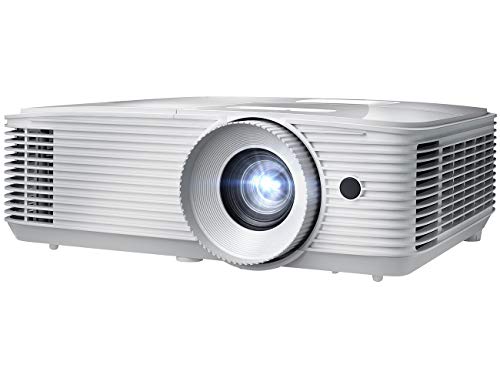
Optoma EH412 1080P HDR DLP Professional Projector — The straightforward lamp professional
The EH412 is the traditionalist of the six: a lamp-based professional DLP whose listing leads with a 4,500-lumen rating, full HD resolution and a working life pitched at presentations, classrooms and meeting rooms. That professional framing is precisely why it belongs in a daylight guide. Machines built to hold a room’s attention against windows and ceiling lights are solving the same problem as a shaded garden screen, just with better-dressed surroundings, and the EH412’s specification — including a built-in speaker and acceptance of 4K HDR input signals — is aimed squarely at that job.
Its lamp deserves an honest paragraph. Optoma states a lamp life of up to 15,000 hours, which is long for the technology, but lamp brightness still declines gradually across that life in a way laser output does not, and a replacement lamp is an eventual running cost the laser picks avoid. Set against that, lamp machines are mechanically simple, well understood by every installer, and this one’s rated output sits above the BenQ’s ANSI figure on paper — though the two numbers are different currencies, a maker rating against a measurement, and this guide will not pretend otherwise.
Choose the EH412 when the outdoor screen is really a bright-room screen that sometimes travels: the village hall that hosts a summer fete display, the training room whose summer sessions spill onto a shaded terrace. In that mixed life its simplicity, its speaker and its presentation manners make sense, and its limitations only bite if it becomes a daily outdoor workhorse.
Ownership of a lamp professional in 2026 is a deliberate, defensible choice rather than a compromise. Lamps are replaceable by the user in minutes, the technology’s behaviour is understood by every AV volunteer in the country, and the EH412’s stated lamp life is long enough that a hall using it weekly may replace it once in a decade. Keep a note of the lamp hours in the same drawer as the remote, budget the replacement as a known future cost rather than a surprise, and the machine’s simplicity becomes its charm.
There is a discipline this pick rewards: log the lamp hours and the setting you use. A hall that knows its lamp is at hour nine thousand can plan the replacement for a quiet month instead of meeting the dimming during the Christmas concert. Lamp ownership is only a burden when it is a surprise; managed on a calendar, it is simply maintenance, of the same kind as the piano tuning and the boiler service.
- Stated output: 4,500 lumens — maker’s rating, not labelled ANSI in the title
- Resolution: 1080p full HD, DLP design
- Lamp: stated life up to 15,000 hours
- Signals: accepts 4K HDR input as listed
- Audio: speaker built in
- Intended rooms per the title: presentations, classrooms and meeting rooms
Strengths
- Strong rated output for bright spaces
- Simple, installer-friendly lamp design
- Built-in speaker suits presentation duty
Trade-offs
- Lamp output fades gradually with age
- Replacement lamp is a future running cost
- Rating is a maker figure, not ANSI-labelled
Best for: a hall, classroom or club whose screen mostly fights indoor light and sometimes moves into shade outside
Not suited for: a permanent daily outdoor installation where laser endurance pays for itself
This long-running professional model is often discounted by resellers, so check price on Amazon, and make sure the model in the basket is the EH412 rather than a neighbouring Optoma.

Panasonic PT-VMZ61 WUXGA LCD Laser Projector, 6200 Lumens, White — The heavy artillery
Every daylight guide needs a ceiling, and the PT-VMZ61 is this one’s. Panasonic rates the machine at 6,200 lumens — the title states the figure without the ANSI label, so it stands as a major manufacturer’s rating rather than a certified measurement — and builds it as an LCD laser projector at WUXGA resolution, a step above full HD that keeps text and data crisp when the image grows. Panasonic’s installation heritage matters here: this is a machine from the range that equips lecture halls, museums and corporate venues, engineered for long hours and unglamorous reliability.
What the extra output buys outdoors is area. Brightness per square foot is the governing equation of this whole guide, and a rating in this class lets a shaded screen grow toward genuinely communal sizes — the school sports day, the fan-zone wall, the outdoor ceremony relay — while keeping the image legible. The LCD design also carries a colour argument: three-chip architectures deliver their colour brightness alongside their white brightness, so the picture holds its saturation against ambient light instead of washing toward grey.
The responsibilities are real. A machine of this class wants a proper mount or a substantial stand, a power supply treated with respect, and an owner who understands they are buying infrastructure rather than a gadget. Its price band, its size and its installation manners are all professional. For the household garden it is glorious excess; for the venue that asked the daylight question seriously, it is the answer the rest of the list is measured against.
A machine of this class also changes the conversation about the screen. At 6,200 stated lumens, the limiting factor in most venues stops being the projector and becomes the surface: a proper high-quality screen material, evenly tensioned and kept clean, will return more visible quality than any further step up in output could. Pair the Panasonic with a screen budget worthy of it, and the combination will still be embarrassing cheaper projectors a decade from now — installation equipment bought once, correctly, is the opposite of expensive.
The last word on the flagship is about proportion. Six thousand two hundred stated lumens will not make a sunlit wall behave — nothing in this guide will — and Panasonic’s machine should not be bought as a spell against physics. It should be bought as the end of compromise inside the laws physics allows: the largest shaded image, the longest day, the biggest crowd, all served without the picture ever looking like it is trying. That is what the money is for.
- Stated output: 6,200 lumens — manufacturer rating, not labelled ANSI in the title
- Resolution: WUXGA, above full HD
- Design: LCD laser projector
- Maker: Panasonic installation range
- Role in this guide: the maximum-output option for large shaded screens
Strengths
- Highest stated output in this guide
- WUXGA resolution keeps big images sharp
- Installation-grade engineering and duty expectations
Trade-offs
- Professional size, mounting and ownership demands
- Far more output than a family patio can use
- Rating is a manufacturer figure, not ANSI-labelled
Best for: a school, venue or community screen that must stay legible at communal sizes in bright shade
Not suited for: a family garden where the screen is modest and the projector must live in a cupboard
Installation-class machines are priced by channel and configuration, so check price on Amazon carefully and confirm exactly what the listing includes.
How do the six compare on the things daylight actually tests?
| Pick | Daylight-relevant summary |
|---|---|
| BenQ LH650 Business Projector Laser 1080p 4000 ANSI Lumen, SmartEco Power Saving, REC.709 | 4,000 ANSI lumens (measured), laser, 1080p, corner fit — the honest all-round daylight specification. |
| ViewSonic LS740HD 1080P Laser Projector, 5500 Lumens, Full HD Home Theater | 5,500 lumens (maker rating), laser, 1080p, optical zoom — the most output aimed at home-scale screens. |
| ViewSonic LS741HD 5000 Lumens 1080p Laser Projector with H/V Keystone, 4 Corner Adjustment | 5,000 lumens (maker rating), laser, 1.6x zoom, 24/7 rated — the endurance pick for daily outdoor duty. |
| Optoma UHD38x Bright, True 4K UHD Gaming Projector | 4,000 lumens (maker rating), true 4K UHD, gaming-tuned — resolution is its daylight defence. |
| Optoma EH412 1080P HDR DLP Professional Projector | 4,500 lumens (maker rating), lamp DLP, 1080p — the bright-room professional that travels into shade. |
| Panasonic PT-VMZ61 WUXGA LCD Laser Projector, 6200 Lumens, White | 6,200 lumens (manufacturer rating), WUXGA LCD laser — the output ceiling of this selection. |
Read the brightness column with the lumen guide above in mind: figures labelled ANSI are measurements, figures labelled simply as lumens are the maker’s rating, and the two kinds should not be treated as identical currency even when the numbers look close.
How do you set up a projector outdoors in daylight, step by step?
Begin with the screen, not the projector. Walk the space at the hour you plan to watch and find where shadow naturally falls: the side of the house that shades itself, the ground beneath mature trees, the wall a fence protects. Fix the screen there, as taut and flat as you can make it, because wrinkles catch light at angles and advertise every imperfection once the image lands. If the screen must stand in open ground, angle it slightly away from the sun’s path and accept a smaller image in exchange for placing it in the shadow of a gazebo or canopy.
Place the projector next, using its zoom range to fill the screen from a position that stays shaded and safe from foot traffic. Run the keystone and corner tools only after the machine is physically as square to the screen as the site allows; correction is for the last few degrees, not for rescuing a projector parked at a wild angle, because heavy correction throws away resolution and brightness at exactly the moment you can spare neither. Set the picture mode to its brightest honest setting, raise brightness cautiously rather than contrast, and check a scene with faces and a scene with text before the audience arrives.
Finish with the unglamorous layer: power and sound. Outdoor sessions need a properly rated extension lead, connections kept off damp grass, and a weather eye on the forecast, since none of these machines belongs in rain. For audio, seat a powered speaker near the screen so voices come from where the faces are; a projector’s built-in speaker is a courtesy for a small circle, not a public address system. Pack a microfibre cloth for the lens, because pollen and dust are the silent tax on every outdoor screening.
What changes when the daytime event is sport, teaching or a celebration?
Live sport is the kindest content daylight can meet. Broadcast pictures are bright, colourful and high in contrast, commentary carries the detail when a replay washes slightly, and nobody needs shadow detail in a stadium scene. A garden screening of an afternoon match is where this class of projector genuinely shines, and where the step from a dim portable to one of these machines is most dramatic. Keep the image moderate, keep the screen shaded, and the picture will hold together in a way that surprises guests who only know projectors from dark rooms.
Teaching and training outdoors — a site induction on a shaded wall, a coaching session with video analysis, a school activity under a canopy — leans on text legibility rather than cinematic contrast. That shifts the priority toward resolution and raw output together, and toward machines whose keystone and corner tools can square an image onto an imperfect wall quickly. It also argues for laser light sources, since a machine used for work every week should not be dimming its way through lamp changes.
Celebrations sit between the two: a slideshow of photographs at a garden party, a video message at an outdoor anniversary, lyrics on a screen for an evening that starts in daylight. Photographs carry more shadow detail than sport, so expectations need managing — show the bright, joyful frames early while light is strong and save the moody evening shots for dusk, when every projector in this guide suddenly looks twice as powerful.
What mistakes ruin more daytime outdoor screenings than any other?
The classic failure is believing a headline number from a listing that never mentions ANSI, then discovering at noon that the miracle machine produces a ghost of an image. The second failure is scale: stretching a picture to fill the largest screen the garden allows, when the same projector at two-thirds the size would have looked twice as confident. Brightness per square foot is the whole game, and greed spends it.
Placement errors follow close behind. A screen positioned for the audience’s convenience rather than the sun’s position, a projector left in full heat with its vents near a wall, cables crossing the walkway to the drinks table — each is small alone and together they end sessions. Heat deserves special respect: projectors working at full brightness on a hot afternoon are already near their thermal comfort, and direct sun on the casing adds a load the fans were not promised to handle.
Finally, sound is chronically under-planned. A picture people can see paired with voices they cannot hear reads as failure even when the image is good. Budget the speaker, the stand and the cable into the plan from the start, and test the whole chain — source, projector, speaker — in the garden the day before, at the same hour, rather than discovering a missing adapter in front of an audience.
Final Recommendation
For most households, the BenQ LH650 is the recommendation that needs the fewest apologies: a laser machine with an honestly stated 4,000 ANSI lumens, sensible correction tools and the connections a laptop-and-streaming-stick life requires. Gardens that regularly host bigger crowds should look up the range to the ViewSonic LS741HD or the Panasonic PT-VMZ61, while the Optoma UHD38x is the indulgent route when the daytime session is really a prelude to serious 4K viewing after dark.
One last consideration belongs to the calendar rather than the catalogue. A daylight projector earns its money across a season of events — matches, fêtes, birthdays, outdoor lessons — and the households that get the most from this class are the ones that build the screen, the shade and the speaker into a kit that lives together and deploys in minutes. Buy the machine that anchors that kit, store the kit as one thing, and the question “could we watch it outside?” answers itself for years.
Whichever machine you choose, spend as much thought on shade, screen and sound as on the projector itself, because daylight success is a system, not a specification. Set the screen in shadow, keep the image modest, and let the evening arrive as your picture quietly turns spectacular — that patience, more than any lumen figure, is what makes an outdoor screening feel effortless.
Frequently Asked Questions
Can any projector show a clear picture in full direct sunlight?
Realistically, no. Direct sun delivers more light to the screen than a projector can overcome, and the image will look faint whatever the specification says. The honest goal for daytime outdoor use is a strong picture in shade, under cover or in the bright hours near the start and end of the day, which is exactly the work the six machines in this guide are built and rated for.
Why does this guide keep distinguishing ANSI lumens from other lumen claims?
Because the labels are not measuring the same thing. ANSI lumens follow a standard test that can be compared between brands. Plain lumens in a listing are the maker’s own rating, and LED lumens are a marketing figure with no standard test behind them, often far higher than the ANSI result for the same machine. Comparing a cheap LED-lumen claim against an ANSI figure is how households end up with a projector that disappoints at noon.
Is a laser projector worth choosing over a lamp model for outdoor use?
For a machine that will work outdoors regularly, yes, in most cases. Laser light sources hold their output far longer, reach full brightness quickly and tolerate being moved between sessions without the fragility lamps carry. A lamp model such as the Optoma EH412 in this guide still earns its place on stated output and simplicity, but its brightness will fade gradually across its lamp life in a way the laser picks will not.
What screen size should I plan for a bright garden screening?
Let the shade decide. An image around 80 to 100 inches in good shade will look stronger than a 150-inch image in open light from the same projector, because brightness is spread across the area. If your event needs a genuinely large picture, either move it toward evening or step up to the highest-output machines here, such as the Panasonic PT-VMZ61, and still keep the screen out of direct sun.
Can I leave one of these projectors outside permanently?
No. These are indoor machines being used outdoors for sessions, not weather-sealed installations. Bring the projector in after every event, keep it out of rain and heavy dew, and let it cool before covering or casing it. The screens, mounts and cables in an outdoor setup need the same discipline if they are to survive a season.
What should I do about sound for a daytime screening?
Plan a powered speaker near the screen from the start. A projector’s built-in speaker, such as the 10W unit in the BenQ LH650, covers a small patio circle adequately, but voices for a garden audience need a dedicated speaker placed where the picture is, connected by cable where possible so the sound and the image stay in step.
What is the single cheapest upgrade to a daytime setup I already own?
Shade, arranged deliberately. A canopy, a repositioned screen or a session timed an hour later will improve a daytime picture more than any accessory sold for the purpose, because every one of them reduces the ambient light the projector must defeat. After shade, a better screen surface is the next honest upgrade; after that, a smaller image. The projector itself is the last thing to replace, which is why choosing a strong one from this list at the start pays for years.
Related Guides
Projector screens that fight ambient light outdoors Laser versus lamp projectors for heavy weekly use How to run power safely to a garden cinema setup See also outdoor projectors for halloween displays on a garage door.


