Our Top Picks
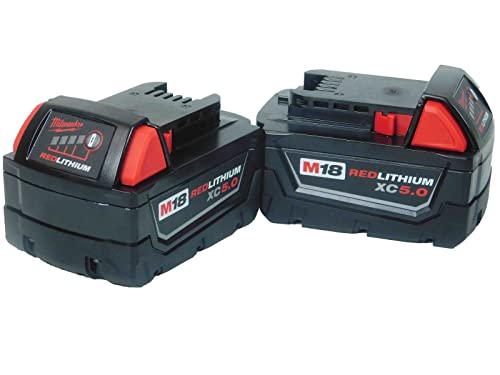 Milwaukee M18 48-11-1850 5.0 AH Batteries 5.0 18V2 Count (Pack of 1)5 x 3 x 6 inches3.37 poundsCheck on Amazon
 Milwaukee 48-11-1850R M18 18V 5Ah XC Extended Capacity2 Count (Pack of 1)7 x 7 x 6 inches3.2 poundsCheck on Amazon

What's inside
- Why third-party M18 packs can undercut the original so far
- The management electronics are the whole argument
- Fuel gauges that flatter, drift and occasionally lie outright
- Uneven cells and the lottery sealed inside the shell
- Warranty exposure on both the pack and the tools it feeds
- Recognising a compatible pack that deserves consideration
- When the genuine pack remains the rational purchase
- The watt-hour audit: testing a capacity claim without a laboratory
- Total cost across a working life, counted properly
- Charging behaviour as a window into hidden quality
- Heat, seasons and storage for packs of uncertain pedigree
- Reading a product listing the way an investigator would
- What a tool experiences when its battery misreports reality
- End of life, recycling and the packs nobody should inherit
- Check prices on Amazon
- A defensible mixed fleet, and the roles that make it work
As an Amazon Associate I earn from qualifying purchases. This post may contain affiliate links at no extra cost to you.
In the interest of daylight: this page contains referral links, and when a reader follows one and buys something, the retailer may pay this site a commission for the introduction. The amount you pay is exactly what you would have paid without the link, and the existence of that commission does not soften, sharpen or reorder any judgement below. Every claim here rests on published manufacturer documentation, recognised safety literature and patterns visible across large volumes of owner feedback, because a battery that hides its internals asks to be judged by evidence rather than by promises.
Why third-party M18 packs can undercut the original so far
The Milwaukee M18 platform supports an enormous professional fleet, and every tool in that fleet draws from the same battery interface, which makes replacement packs one of the most frequently repeated purchases in a working life. Genuine packs carry the full weight of the originating company’s engineering programme, dealer network, service centres and warranty reserves, and their pricing honestly reflects that structure. Independent makers watch the same installed base and see a simpler opportunity: build a pack that mounts on the same rails, powers the same tools and sells for noticeably less, then let the arithmetic persuade owners whose original batteries have aged out of service.
Some of that price gap is legitimate efficiency. A small independent brand spends a fraction of the originator’s budget on tool development, sponsorship, retail distribution layers and global support infrastructure, and it often sells through direct listings that strip out middlemen entirely. Cell sourcing follows a different path as well, because the original manufacturer buys graded cells under a controlled programme with tight matching tolerances, while an independent maker shops the open cell market, where prices vary with grade, season and availability. Assembly, packaging and marketing shrink to match, and a real portion of those savings can honestly reach the buyer.
Other portions of the gap are quieter subtractions that no photograph reveals. A compatible pack may deliver somewhat less real capacity than its label announces, rely on a simpler protection board, skip the communication refinements that let a genuine pack negotiate politely with an intelligent charger, or arrive backed by a warranty so narrow and so distant that exercising it becomes a hobby rather than a remedy. Each subtraction trims cost invisibly at the factory and visibly only months later, when runtime disappoints, a gauge misleads, or a charger refuses to begin a cycle it cannot interpret with confidence.
Understanding that mixture is the entire skill this guide tries to teach. The aftermarket is neither a scam nor a bargain bin; it is a spectrum running from careful engineering by accountable brands down to cheerful corner-cutting wearing nearly identical colours. Two packs can share a silhouette, a label font and a capacity claim while differing in every way that determines whether they will still be working, safely, after a year of professional use. The buyer’s job is to locate a given product on that spectrum using evidence, and the sections that follow take the evidence category by category.
Start by discarding the idea that the sticker comparison settles anything. The meaningful comparison is cost per trustworthy working season, a figure that folds in real delivered capacity, failure probability, warranty enforceability and the value of the tools placed at risk while running the pack. Judged on that basis, some compatible packs genuinely earn their place in a kit, and others reveal themselves as expensive lessons wearing a discount costume. Neither conclusion can be reached from a listing photograph, which is why the deeper inspection below matters more than any headline saving.
The management electronics are the whole argument
Inside every modern lithium tool pack, a battery management system watches the voltage of each cell group, tracks temperature, meters current in both directions and disconnects the pack before abuse becomes damage. In the M18 ecosystem that supervision extends beyond the pack itself, because genuine batteries exchange information with the tool and the charger throughout every cycle. The tool can moderate its demand when the pack reports heat or exhaustion, and the charger can adjust its behaviour when the pack describes its own condition honestly. A substitute battery inherits the obligation to join that conversation convincingly, and the quality of its impersonation varies enormously between makers.
The impersonation problem is harder than it first appears. Mechanical compatibility requires only that plastic, rails and terminals align, which any competent moulding shop can achieve. Electronic compatibility requires the pack to answer questions it may not fully understand, in a protocol it did not design, across conditions ranging from a frozen morning start to a rapid charge after a heavy cutting session. Makers who invest in proper engineering solve most of this; makers who copy a minimal handshake solve only the part that makes a tool spin on a showroom bench. The difference stays invisible until the pack meets a situation its shortcuts never anticipated.
Symptoms of a weak management system follow recognisable patterns in owner feedback. Chargers reject the pack outright, or accept it while charging blindly without the usual information exchange. Tools run but lose the protective behaviours that depend on truthful temperature reporting, so a pack can be driven hotter and deeper than its cells should tolerate. Gauges drift into fiction, a subject given its own section below. In the worst documented cases, a board tolerates over-discharge or overheating until cells suffer permanent harm, converting a modest saving into a destroyed battery and occasionally into collateral damage inside an expensive tool.
Heat is where weak electronics and weak cells conspire most dangerously. A management board that samples temperature slowly, or places its sensor where airflow keeps it cool while cells bake elsewhere, will permit conditions the original system would have interrupted. Professional users generate exactly those conditions: sustained grinding, repeated high-torque driving, rapid charging between bursts of work. Published safety literature for lithium packs treats the protection circuit as the non-negotiable core of the product, and that judgement applies with extra force to any pack imitating a managed platform designed around constant communication.
Buyers cannot inspect a circuit board through a sealed housing, so they must read proxies instead. A maker who publishes the protection features of the pack in specific language, names the cell source, and documents behaviour on genuine chargers is signalling engineering confidence. A maker whose entire technical description consists of a capacity number and the word compatible is signalling the opposite, whatever the discount attached. In this category, vagueness is not a marketing style; it is the visible surface of missing substance.
For background on how differently chargers supervise the packs entrusted to them, the comparison at best 10 amp battery chargers offers a useful education, because it shows how much intelligence modern charging assumes the battery will contribute to the partnership.
Fuel gauges that flatter, drift and occasionally lie outright
The charge indicator seems like the simplest feature on a battery, a row of lights answering a single question, yet on compatible packs it is frequently the least honest component fitted. A genuine gauge draws on the management system’s accumulated knowledge of the cells, integrating current flow over time and correcting for temperature and age. A cheap substitute may estimate charge from instantaneous voltage alone, or drive its display segments from crude thresholds chosen to look generous. The result, described again and again in owner feedback, is a gauge that sits proudly at full through most of a job and then collapses within minutes, stranding the tool at the least convenient moment imaginable.
Voltage-based estimation fails for a physical reason worth understanding. Lithium cell voltage sags under load and recovers at rest, so a gauge reading taken while a saw strains through timber will look alarming, while the same pack measured on the bench appears healthy. Better systems compensate for that behaviour; crude ones simply report the weather inside the pack at that instant. Cold compounds the confusion, because chilled cells show lower voltage for the same stored charge, and a pack judged empty outdoors in January may reveal a third of its capacity remaining once warmed indoors. Owners who rely on a crude gauge in winter end up charging healthy packs and distrusting honest ones.
The practical cost of a lying gauge depends on where the work happens. On a bench beside a charger and a shelf of spares, it is a mild annoyance absorbed by routine. On a roof, inside a ceiling void, up a ladder or at the far end of a site, it becomes lost time, broken rhythm and occasionally a safety compromise as workers improvise around a dead tool. Professionals price their hours honestly, and a gauge that wastes twenty minutes twice a month quietly consumes the entire saving that justified the pack, with interest. Reliability information is a feature, and its absence belongs in the cost column.
There are workable defences for owners who already own a suspect pack. Timing real runtimes on known tools builds a personal calibration that replaces the display, and marking the pack with its honest delivered capacity turns folklore into data. Rotating the questionable battery into gentle duties, lights and fans and radios, removes the planning risk while extracting its remaining value. What cannot be defended is trusting the display of an unproven pack during work where a sudden stop carries consequences beyond inconvenience.
Gauge behaviour also serves as an early diagnostic for the whole product. A maker who could not be bothered to calibrate a simple indicator has revealed something about the invisible engineering deeper inside, where calibration matters far more and verification is far harder. Conversely, a compatible pack whose gauge tracks reality closely across temperature and load has passed a test its maker did not need to pass to make a sale. In a market defined by hidden quality, such visible honesty is one of the few signals money can actually buy information from.
Uneven cells and the lottery sealed inside the shell
Every multi-cell pack is a team, and its performance is set by the weakest member, because cell groups wired in series can deliver no more than the smallest capacity among them. Reputable cell manufacturers grade their output carefully, and the most consistent cells flow toward buyers who pay for that consistency, including the original battery programme. Lower grades, surplus lots and occasionally reclaimed cells circulate through the open market at prices that make very cheap packs arithmetically possible. A compatible battery built from mismatched cells begins life with an internal imbalance that no external care can correct.
The imbalance compounds with use in a predictable spiral. The weakest group reaches empty first during discharge, so the management system ends the cycle while stronger groups still hold charge, and total delivered capacity shrinks toward the weakest link. During charging the same group reaches full first and absorbs disproportionate stress, ageing faster than its partners and widening the gap further. Within a season, a pack that began merely mediocre can become genuinely poor, and its owner blames lithium chemistry in general rather than the grading decision sealed inside the housing on the day it was assembled.
Capacity labelling interacts with cell quality in ways buyers should interrogate. A label states the sum the maker wishes to claim, while watt-hours offer a cross-check that exposes some inflation, since energy cannot be conjured by typography. Weight provides the crudest and most reliable audit of all: genuine capacity requires genuine cell mass, and a featherweight pack claiming heavyweight numbers is contradicting physics in a way no firmware update can repair. Experienced buyers in this market weigh packs, literally and figuratively, before believing them.
Self-discharge tells another quiet story. Healthy, matched cells hold charge across weeks of shelf time with modest losses, while poor or damaged cells bleed energy noticeably and drag their series partners down with them. A compatible pack that arrives healthy but empties itself in a drawer within a fortnight is displaying a symptom that experienced technicians treat as a verdict. Owners buying any unfamiliar pack should charge it, rest it, and observe it across a couple of weeks before trusting it with real work, because that simple patience test filters out a surprising share of the market’s worst products.
None of this means every independent pack hides bad cells. Makers who name a respected cell manufacturer in their documentation, and whose claimed numbers match the known capabilities of those cells, are playing an honest game that buyers can verify from public datasheets. The lottery exists only where the maker refuses to say what is inside. Refusal, in a category where good makers volunteer the information proudly, is itself the loudest data point on the listing.
Readers curious about the smaller cells that sit at the heart of all these packs will find the discipline of cell-level charging explored in the roundup at best 18650 chargers, where matching charger intelligence to cell limits is treated with the seriousness the chemistry deserves.
Warranty exposure on both the pack and the tools it feeds
Warranty analysis in this category must count two separate risks, and most buyers count only the smaller one. The first risk is the pack itself: a cheap battery that fails early may carry a seller promise, yet enforcing that promise against a distant marketplace vendor, sometimes operating under a name that changes with the seasons, differs sharply from presenting a genuine pack at a service counter. Shipping a lithium battery back for assessment adds friction and cost that the original discount rarely budgeted for. Many owners simply absorb the loss, which retroactively converts the bargain into one of the most expensive packs they ever owned.
The second and larger risk attaches to the tools. Manufacturer warranty documents for professional platforms commonly reserve the right to decline coverage where damage arises from a non-genuine power source, and a tool that fails while running a substitute pack invites exactly that argument, fairly or not. The owner then faces an evidentiary dispute instead of a repair, with the burden of proving that the battery played no part in the failure. A single declined repair on a major tool can erase the accumulated savings from a whole shelf of discounted packs, which is why warranty exposure belongs near the top of the decision, not in the fine print beneath it.
Chargers sit inside the same web of exposure. Feeding a substitute pack on a genuine rapid charger concentrates trust in the substitute’s electronics, because the charger was designed expecting a cooperative, communicative partner. Some independent makers supply their own chargers to sidestep that negotiation, which solves the compatibility question while adding cost, bench clutter and yet another proprietary relationship to manage. Owners comparing charging strategies across equipment generally may find the multi-bay overview at best 3 bank chargers helpful, since fleet charging is where incompatible assumptions collide most often in busy workshops.
None of this argues that warranty paperwork should rule every decision with fear. Tools long out of warranty have nothing left to lose on that axis, and for them the calculus genuinely changes in favour of vetted alternatives. A well-used drill in its sixth year, feeding on a carefully chosen compatible pack, risks little beyond the pack itself. The mistake is applying that relaxed logic to new, expensive equipment still inside its coverage window, where the paperwork retains real monetary value that a discount can silently destroy.
Documentation habits soften the risk wherever it remains. Keeping receipts for tools, packs and chargers in one folder, noting which battery was paired with which tool during heavy work, and photographing any failure before discarding evidence all strengthen an owner’s position in any later discussion with a service desk. Such habits cost minutes across a year and can be worth a tool’s replacement value on the single occasion they are needed. In a market where accountability is the scarcest commodity, the buyer who keeps records manufactures a little of it personally.
Recognising a compatible pack that deserves consideration
Trustworthy substitutes announce themselves through specifics rather than slogans, and learning to read those signals is the most transferable skill in this entire guide. Their documentation names the cell maker inside the housing, states capacity in both amp-hours and watt-hours without inflation, and describes compatibility limits in plain language instead of promising universal perfection. Their listings acknowledge which chargers are supported, which tool behaviours may differ, and what the protection system actually does. A maker willing to publish limits is a maker who expects scrutiny, and that expectation correlates strongly with engineering substance.
Certifications form the second layer of evidence, provided they are genuine and relevant. Recognised safety marks from established testing organisations indicate that a sample of the product survived an independent examination of its electrical and thermal behaviour. Buyers should treat vague badges, invented logos and uncheckable certificate numbers as decoration rather than evidence, and should favour marks they can verify against the issuing body’s public records. In a category plagued by optimistic printing, verifiability is the dividing line between a credential and a costume.
The seller’s own structure tells the third part of the story. A stable trading identity maintained across years, a reachable support channel staffed by people who answer technical questions, spare parts or replacement policies stated in advance, and a returns window measured in weeks rather than days all describe a business planning to exist next year. Disposable storefronts behave differently in every one of those dimensions, and they behave that way because their model depends on never meeting the same customer twice. Choosing between those two business models matters more than choosing between two capacity labels.
Owner feedback deserves a particular reading technique in this category, because raw averages conceal the patterns that matter. Search the comments for the failure vocabulary of the platform: charger rejection, swelling, sudden death, gauge collapse, heat during ordinary work. A handful of such reports scattered across years may reflect the background failure rate of any lithium product, while clusters of identical complaints describe a design flaw with a mailing address. Feedback mentioning specific tools, runtimes and charging behaviour carries far more weight than generic praise posted within days of delivery, before the pack has lived through anything worth reporting.
Finally, stage the commitment. Buy one pack, not a fleet, and put it through a supervised probation: charge it on the intended charger, rest it to observe self-discharge, run it on a mid-demand tool while watching heat and gauge honesty, and only then decide whether its maker has earned further business. Probation converts an irreversible gamble into a cheap experiment with a defined cost, and it mirrors how careful fleet managers evaluate any new supplier. A maker whose product survives probation has demonstrated more than any advertisement could claim.
Owners building background knowledge about charging across voltage classes often start with the survey at best 12 volt battery chargers, and the habits of scrutiny learned there transfer directly to judging whether an unfamiliar pack and a serious charger are likely to cooperate.
When the genuine pack remains the rational purchase
Some situations argue for the original battery so strongly that the discussion ends almost before it begins. Tools still inside their warranty period deserve the power source their paperwork assumes, because preserving a valid claim on an expensive machine outweighs any plausible saving on the pack that feeds it. High-draw equipment makes the same argument from physics rather than paperwork: large saws, heavy grinders and demanding outdoor machines lean hardest on pack communication and thermal honesty, extracting the full value of the original engineering while punishing weak substitutes fastest and most visibly.
Professional context sharpens the argument further. A tradesperson whose income stops when a battery misbehaves is buying continuity as much as energy, and the genuine premium shrinks to modest proportions when measured against a single lost morning, a delayed handover or a return visit to finish work a dead pack abandoned. Crews add a coordination argument: a uniform fleet of genuine packs behaves predictably across every charger and tool on the truck, while a mixed fleet introduces small uncertainties that multiply across people, sites and deadlines. Predictability is a working asset, and its price belongs in the comparison.
Cold and heat extremes tilt the decision the same way. Genuine packs publish operating envelopes backed by a service network that will honour them, whereas the envelopes claimed by unknown makers are unverifiable until the day they fail in a freezing van or a sun-baked site cabin. Workers whose seasons include genuine extremes are not being cautious when they choose the documented option; they are matching the battery’s evidence base to the severity of their conditions. The harsher the environment, the more the burden of proof shifts onto any substitute asking to be trusted there.
There is also a resale dimension that fleet owners notice at replacement time. Tools sold with genuine batteries command stronger confidence and cleaner transactions than tools bundled with unfamiliar packs, whose value a buyer discounts for exactly the uncertainties this guide describes. Owners who rotate equipment regularly recover part of the genuine premium at the exit, narrowing the true cost gap further. The aftermarket discount, by contrast, evaporates entirely at resale, because no second buyer pays extra for somebody else’s gamble.
None of this converts the genuine pack into a moral obligation. It converts it into the default that a substitute must beat with evidence, in a specific role, for a specific owner. Where the evidence is strong and the role is gentle, the substitute wins honestly. Where the evidence is thin and the consequences are heavy, the original wins by the same logic. Keeping that burden of proof in the right place is the difference between a procurement strategy and a series of hopeful accidents.
The watt-hour audit: testing a capacity claim without a laboratory
Buyers possess one honest weapon against inflated capacity claims, and it requires nothing more exotic than arithmetic and a familiar tool. Watt-hours, printed on many labels and derivable from voltage and amp-hours everywhere else, describe total stored energy in a unit that marketing cannot stretch. A pack claiming a large amp-hour figure at platform voltage is claiming a corresponding energy total, and that total must be physically consistent with the number and type of cells a housing of that size can contain. When the claimed energy exceeds what the known cell formats could deliver inside that shell, the claim has failed a physics examination before the pack ever meets a charger.
Runtime benchmarking supplies the second half of the audit using equipment the owner already has. Choose a tool with a steady, repeatable appetite, a fan on a fixed setting or a light at constant brightness serves beautifully, and record how long a fully charged pack sustains it under calm indoor conditions. Repeat the exercise with a genuine pack of known rating, and the ratio between the two runtimes describes the substitute’s honest capacity more truthfully than its label does. The method lacks laboratory precision, yet it reliably separates the broadly honest products from the fantasies, which is the only separation a buyer actually needs.
Repeating that benchmark across the first months of ownership adds the dimension listings never discuss: the slope of decline. All lithium packs fade gradually, but a substitute built from weak cells fades along a visibly steeper path, and a benchmark repeated quarterly exposes the trajectory while the returns window or warranty conversation is still alive. Owners who log those numbers, even as pencil marks on the housing beside a date, convert suspicion into evidence at exactly the moment evidence becomes valuable. The habit takes minutes per season and has ended more arguments with sellers than any other practice in this guide.
Temperature honesty belongs in the same audit. A pack that benchmarks respectably in a mild workshop but collapses during the first cold morning is revealing the quality of its cells and the candour of its management electronics simultaneously. Buyers in cold regions should therefore schedule their probation during realistic weather rather than during the kindest week of the year, because a battery that only performs in gentle conditions has answered the buying question by itself. Evidence gathered under the owner’s real sky outranks every specification gathered under a manufacturer’s ideal one.
Total cost across a working life, counted properly
The discount on a compatible pack is a single visible number, while its true cost arrives as a slow series of small, easily forgotten debits. Shorter real runtime means more swaps and more charging cycles consumed per project, which spends the pack’s finite cycle life faster and brings its replacement date closer. A failure outside an enforceable warranty converts the entire purchase into waste. A tool repair disputed because of the pack’s presence can dwarf years of accumulated savings in a single invoice. Counting properly means pricing each of those probabilities, however roughly, rather than pretending the sticker is the whole story.
Time is the debit owners most consistently underprice. Every unexplained shutdown, every charger rejection investigated, every early trip back to the bench interrupts work whose value, professional or personal, exceeds the hourly cost of the battery many times over. A pack that saves a modest sum and then steals three scattered hours across a season has not saved anything at all; it has merely converted money into frustration at a poor exchange rate. Genuine packs are not immune to failure, but their failure behaviour is statistically calmer and administratively simpler, and both properties have cash value.
The honest counterweight deserves equal emphasis: for gentle roles, the arithmetic genuinely favours vetted substitutes, and pretending otherwise wastes money in the opposite direction. A work light does not care about discharge pedigree, a fan forgives a drifting gauge, and a radio will never dispute a warranty claim. Insisting on premium batteries for such duties buys protection against consequences that cannot occur, which is its own form of poor accounting. Total-cost thinking, applied without prejudice, sends each pound of spending to the role where it purchases real risk reduction.
Fleet scale changes the calculation once more. A single substitute among genuine packs is a contained experiment whose worst case is known and small, while a fleet converted wholesale concentrates correlated risk: the same weak cells, the same optimistic electronics, the same distant warranty, all ageing together and all likely to announce their shared flaws during the same busy season. Gradual adoption is therefore not timidity but portfolio management, and the owners who convert slowly, role by role and season by season, are applying the same discipline that governs every other serious equipment decision they make.
Charging behaviour as a window into hidden quality
The first charge a new substitute pack ever takes deserves the owner’s full attention, because that quiet hour reveals more than any specification sheet. A well-matched pack communicates with a genuine charger in the expected rhythm: indicators progress sensibly, the housing warms modestly and evenly, and the cycle ends with the calm finality owners recognise from genuine batteries. Warning signs announce themselves just as clearly to a patient observer. Unusual heat concentrated in one area, a charger that restarts its cycle repeatedly, indicators that contradict the pack’s own gauge, or a cycle that ends suspiciously fast for the claimed capacity all describe a partnership that is improvising rather than conversing.
Rapid charging raises the stakes of that partnership considerably. Fast cycles push current hard and lean heavily on temperature reporting from inside the pack, which is precisely the data a weak management board supplies least reliably. Owners of substitutes they otherwise trust often adopt a simple protective rule: gentle charging for the substitutes, rapid charging reserved for genuine packs whose reporting they have no reason to doubt. The rule costs a little patience and buys a wide margin around the least verifiable component in the entire system, which is an exchange experienced technicians tend to accept without argument.
Storage behaviour between charges completes the picture that charging begins. A substitute that leaves the charger full and returns from a fortnight in the drawer noticeably diminished is confessing to high self-discharge, a symptom associated with weak cells, parasitic board drain or both. Neither cause improves with time, and both predict a pack whose useful life will disappoint even if its early runtimes seemed respectable. The drawer test requires no equipment and no expertise, only the discipline to charge, wait and observe before the returns window closes, yet it filters out a remarkable share of the market’s weakest products.
None of these observations demands paranoia about a normal process. Genuine and well-made compatible packs charge uneventfully for years, and that uneventfulness is exactly the standard a newcomer should be held to during its probation. Boredom, in battery behaviour, is the signature of competence. The pack that makes charging interesting, through heat, delay, contradiction or surprise, is communicating its quality in the only language it cannot fake, and the wise buyer listens the first time it speaks.
Heat, seasons and storage for packs of uncertain pedigree
Every care rule that applies to genuine lithium packs applies with doubled force to substitutes, because their margins are the least documented numbers in the building. Heat remains the chief accelerant of decline, and a compatible pack stored in a sun-baked vehicle is spending a lifespan that was probably shorter than advertised to begin with. Shade, ventilation and indoor storage are free longevity for any battery, but for an inexpensive one they can represent the difference between a serviceable second season and a disappointment discovered at the worst possible moment.
Cold exposes a different weakness in uncertain products. Genuine packs publish low-temperature behaviour that owners can plan around, while a substitute’s behaviour in a freezing van is an experiment conducted at the owner’s expense. The prudent pattern mirrors the charging rule already described: in harsh weather, let genuine packs take the exposed work and keep substitutes for sheltered duties until they have survived enough winters to have written their own documentation. Experience, logged honestly, is the only certification programme available inside a private workshop, and it works when owners bother to run it.
Storage charge deserves particular care with substitutes because their self-discharge rates vary so widely. The familiar guidance, keep idle lithium packs near a partial charge in a cool dry place, assumes a pack that holds that level steadily across months. A leaky substitute parked at the same level may drift toward deep discharge long before spring, crossing thresholds from which ordinary chargers refuse to revive it. Owners storing substitutes seasonally should check them more often than genuine packs, topping gently when the gauge sags, because the cost of the habit is minutes and the cost of skipping it is the entire battery.
Physical inspection closes the seasonal routine. Seams that begin to separate, latches that lose their positive click, terminals that discolour or a housing that no longer sits flat all describe a product ageing faster than its calendar. Such signs on a genuine pack prompt a warranty conversation; on a substitute they should prompt retirement planning without nostalgia. The mixed fleet philosophy only stays safe while its weakest members are watched the most closely, which is a fair summary of the entire aftermarket bargain: the savings are real, and the vigilance is the price.
Reading a product listing the way an investigator would
A listing for a compatible pack is a document written to persuade, yet it still leaks the truth to a reader who knows where documents usually hide it. Begin with the numbers and test them against each other: capacity in amp-hours, energy in watt-hours, cell count implied by the housing size, and weight. Honest figures form a consistent family in which each value predicts the others within a narrow band. Inflated figures quarrel among themselves, because the maker invented them separately and never checked whether physics would let them coexist on the same page.
Move next to the language of compatibility, where precision and evasion are easy to distinguish. A careful maker states which tool generations and which chargers the pack supports, notes any functions that behave differently, and warns where the product should not be used. An evasive maker promises universal fit in the largest available font and answers every specific question with the same photograph. In a category where the genuine system communicates electronically, a seller who cannot describe the conversation should not be trusted to have engineered it.
Photographs reward the same scepticism. Images of a real product show seams, latch geometry, terminal plating and label printing at a quality a buyer can judge, while rendered images hide exactly those details behind perfect lighting. Labels matter more than shells: a professionally printed label carrying a model number, a batch reference, safety marks and a manufacturer’s name describes a product embedded in an accountable production system. A generic label with a capacity claim and nothing else describes a product whose maker prefers anonymity, and anonymity in a safety-relevant category is a decision the buyer should price accordingly.
The question-and-answer sections of retail listings often contain the most honest sentences on the page, because sellers answer specific fears there in plainer language than the headline copy allows. How a seller responds to reports of charger rejection, whether by publishing a compatibility clarification or by deleting and deflecting, predicts the warranty experience with uncomfortable accuracy. Investigators call this behaviour under mild pressure, and it generalises: a company that is evasive before the sale will not become transparent after it.
Finally, compare the listing against the maker’s presence elsewhere. A brand with its own documentation library, firmware or compatibility updates, spare housings or published service addresses is investing in a future that includes its customers. A brand that exists only as a rotating set of marketplace storefronts is investing in distance from them. The product may be identical on the day of delivery, yet the ownership experiences diverge from that day forward, which is why the investigation weighs the seller as heavily as the cells.
What a tool experiences when its battery misreports reality
It helps to imagine the relationship from the tool’s side of the terminals. A modern brushless tool is not a simple switch feeding a motor; its controller budgets current continuously, protecting its own electronics and the operator’s work from sudden collapse. To budget honestly it depends on the pack’s reports about temperature, remaining capacity and sustainable discharge. A substitute that reports optimism instead of data does not merely risk itself. It corrupts every decision the tool makes downstream, from how hard to drive a fastener to when to warn the operator that the end is near.
The first casualty is usually grace under pressure. A tool that believes its pack is cooler and fuller than reality will keep demanding current until the pack’s own crude protection intervenes all at once, producing the abrupt shutdowns owners describe as the battery falling off a cliff. The genuine system choreographs that ending, tapering performance and signalling through the gauge, because its components share truthful information. The cliff edge is therefore not a lithium inevitability but a communication failure, and it is one of the clearest behavioural fingerprints separating engineered substitutes from assembled ones.
Fasteners and workpieces absorb the second casualty. Inconsistent power delivery during the final seating of a structural screw, or halfway through a cut that must remain straight, transfers the battery’s dishonesty into the finished work. Professionals notice this before they notice runtime, because their hands are calibrated instruments for torque and feed resistance. A pack that makes a familiar tool feel subtly unpredictable has failed a test no benchmark captures, and experienced operators retire such packs to gentle duties on instinct that this section exists to validate.
The charger experiences its own version of the same problem during every cycle. Presented with a partner that answers questions approximately, it must choose between refusing the relationship and proceeding on assumptions, and different charger designs choose differently, which is why one substitute can behave acceptably on one charger and disgrace itself on another from the same system. Owners puzzled by that inconsistency are not imagining it; they are watching a negotiation succeed or fail depending on how much improvisation each side tolerates.
All of which returns the decision to its proper foundation. The question was never whether a substitute can make a tool spin, because almost any competent assembly of lithium cells can manage that on a mild afternoon. The question is whether the substitute can sustain an honest, protective, predictable conversation with an entire ecosystem of tools and chargers across heat, cold, age and workload. Products that can, deserve their savings. Products that cannot, are borrowing their reputation from the platform they imitate, and the loan always comes due during somebody’s working day.
End of life, recycling and the packs nobody should inherit
Every battery discussion eventually arrives at the shelf where old packs gather, and substitutes complicate that shelf in ways worth planning for. A genuine pack approaching retirement carries a known history, a documented chemistry and a service network that will accept it back through published recycling channels. A substitute of uncertain origin may contain cells its maker never identified, assembled under standards nobody recorded, which makes responsible handlers more cautious and makes honest labelling by the owner more important. Marking an unknown pack clearly before it enters any recycling stream is a small courtesy to everyone downstream of the decision.
Inheritance is the risk hiding inside second-hand generosity. Used genuine packs circulate widely and usually deserve their reputation for continued service, but used substitutes arrive with two unknown histories multiplied together: the maker’s original quality and the previous owner’s treatment. A gifted or bundled substitute should therefore restart the full probation described earlier in this guide, regardless of the confidence with which it was handed over. Politeness accepts the gift; prudence tests it before trusting it beside tools that matter.
The retirement signals themselves do not change with pedigree. Swelling that makes a pack rock on a flat surface, a latch that no longer holds positively, terminals damaged by heat discolouration, or a housing repaired with tape all end a battery’s working life on the spot. What changes is the temptation structure: an inexpensive pack feels disposable enough to mistreat and, paradoxically, cheap enough to keep using long past the point where a valuable genuine pack would have been retired protectively. Owners should resist both instincts with the same rule, because stored energy does not grade its hazards by purchase price.
Planning replacements before failures force them is the final maturity this market rewards. A fleet whose ages and roles are recorded can schedule its next genuine purchase calmly, retire its weakest substitute deliberately, and never face the emergency listing, bought in haste at midnight, that introduces the least scrutinised battery in the building. Nearly every bad aftermarket story begins with urgency, and nearly every good one begins with a buyer who had time to investigate. Protecting that time, by planning one purchase ahead, may be the most valuable habit in this entire guide.
Households passing tools between generations meet a gentler version of the same duty. A parent handing a drill, two genuine packs and one substitute to an adult child owes that child the fleet’s biography: which battery is which, which roles each has served, and which one should never be trusted on the big saw. That conversation takes five minutes and transfers the real asset, which was never the plastic or the lithium but the accumulated knowledge of what each pack has proven itself to be. Fleets fail socially before they fail electrically, and a spoken handover is the cheapest reliability upgrade available to any family workshop.
One last inheritance deserves a sentence of its own: the charger bench itself. When a workshop upgrades its charging equipment, the older units often migrate to a second bench or a site cabin, and substitutes that behaved acceptably on the original charger may meet a stricter partner there. Recording which packs were proven on which chargers, as part of the fleet’s ordinary notes, prevents a confusing afternoon months later when a familiar battery suddenly refuses a familiar-looking socket in a different building.
Check prices on Amazon
Live listings for the shortlist in this guide are pulled from Amazon below, so prices and availability are always current at the moment you look.


A defensible mixed fleet, and the roles that make it work
Between the two purist positions sits the arrangement many experienced owners actually run: a genuine anchor fleet for critical work, supplemented by carefully vetted compatible packs in roles where failure costs nothing but convenience. The genuine batteries feed the saws, the high-torque drivers and anything still under warranty, while proven substitutes run work lights through the evening, keep a fan moving air in a stuffy room, power a radio, or serve as the spare that lives in a second vehicle. That division respects both budget and risk simultaneously, placing the least certain energy exactly where its uncertainty is harmless.
Role discipline is what separates that strategy from slow-motion chaos. Packs should be marked by role and purchase date, with substitutes never quietly promoted into critical duty because they happened to be charged and nearby. The moment an unproven pack finds itself feeding the tool that must not stop, the strategy has collapsed into the gamble it was designed to avoid. Simple labelling, a paint marker and a sentence of explanation to anyone sharing the kit, maintains the boundary with almost no effort.
Retirement rules complete the system. Any pack, genuine or otherwise, that swells, overheats during gentle charging, loses charge rapidly at rest or suffers a cracked housing leaves service immediately and travels a published recycling route. Substitutes earn extra suspicion after drops and after any episode involving a charger behaving strangely, because their internal construction is the least documented variable in the building. A fleet with clear retirement rules ages gracefully; a fleet without them accumulates quiet risks on the same shelf as its most trusted tools.
Reviewed across a full working year, the mixed fleet usually delivers most of the available savings at a small fraction of the available risk. The genuine packs absorb the cycles that matter, the substitutes absorb the hours that do not, and the owner’s records show exactly which products earned trust and which merely rented it. That evidence then sharpens the next purchase far beyond anything a listing page can offer, because it describes performance inside this particular workshop, on these particular tools, under these particular habits. Local truth, patiently collected, beats imported opinion every season of the year.
Standing back from the whole question, the aftermarket rewards exactly one personality: the buyer who treats a battery as a system of cells, electronics and accountability rather than as a shaped piece of plastic with a number printed on it. That buyer will find genuine value in this market, will know precisely which corners of the kit it belongs in, and will never need luck to explain why the tools kept working.