What's inside
- Key Takeaways
- Quick Picks: Six Television Headset Systems, Honestly Described
- How Were These Six Chosen Once the 5.1 Premise Was Corrected?
- Inputs, Latency and Listening Shapes: the Television Six Compared
- What Does Virtual Surround Actually Do to a Television Programme?
- How Do You Connect a Headset System to a Modern Television Without Breaking the Room’s Sound?
- Which Household Shapes Should Choose Which System Here?
- How Does a Headset System Age Across Years of Evenings?
- What Should the First Evening With a New System Look Like?
- What Mistakes Follow From Believing the 5.1 on the Box?
- Final Recommendation
- Frequently Asked Questions
- Related Guides
As an Amazon Associate I earn from qualifying purchases. This post may contain affiliate links at no extra cost to you.
gizmoverdict.com is reader-supported. When you buy through links on our site, we may earn an affiliate commission.
Where to buy: the six systems below are sold through their Amazon listings, so use the pick links to reach those pages, compare the transmitter connections named in each title against the audio outputs on the back of your own television, and check whether extra receivers or headphones can be added later, because that expansion path differs sharply across this pool and decides how a system grows with a household.
Begin with the correction this keyword needs before any product is discussed. No mainstream television headset decodes discrete Dolby Digital 5.1 inside the headset itself. The best wireless tv headsets dolby 5.1 shoppers are actually choosing among are systems that receive a stereo or downmixed feed from a television-side transmitter and apply virtual surround or 3D processing to it, widening and staging the sound so a film feels spacious without six speakers standing in the room. That is not a disappointment to bury; virtual processing done well is genuinely enjoyable, and it is the honest basis on which the six systems here were gathered and judged.
Once the premise is corrected, the real axes of the category come into focus, and none of them is a channel count. The transmitter’s inputs decide whether the system can join your television at all: optical connections are the common language, HDMI ARC appears on the most television-aware design here, and older analogue outputs still serve older sets. Latency decides whether lips and voices stay married, which matters more in a headset than in any other listening format because there is no room sound to forgive a delay. Dialogue clarity decides whether the purchase survives its first drama series.
The pool divides into three temperaments. Sennheiser fields three RF and Bluetooth-era systems spanning the classic dedicated design, a virtual-surround bundle and a modern low-latency model with speech clarity and Auracast among its stated features. Avantree’s entry is the television-integration specialist, built around HDMI ARC, soundbar coexistence and expandable listening. The final two aim at listeners who prioritise voice prominence and simple setup, one with balance and tone controls shaped for its audience, one with a very long stated play time and a charging base that promises plug-and-play manners.
A reader arriving from best bluetooth headsets for hearing aids will notice the family resemblance: the television corner of the house keeps generating its own product classes because the problems there, personal volume, dialogue buried in a mix, a partner asleep or reading beside you, are domestic rather than technical. This guide keeps the discussion on that domestic ground, with the surround processing described as the processing it is, and with every pick’s spec box carrying the same honest line about what its title does and does not claim.
One more expectation to set before the reviews: a headset system is furniture as much as electronics. Its transmitter will live beside your television for years, its charging arrangement will shape your evenings, and its comfort across a three-hour film will decide whether it is loved or tolerated. Judge the six below the way you would judge a sofa purchase, by the evenings they will actually host, and the virtual surround question will settle into its proper place as one ingredient among several.
Key Takeaways
- No pick here decodes discrete Dolby Digital 5.1 in the headset; all six apply virtual surround or 3D processing to a television feed, and are judged on that honest basis.
- The Sennheiser RS 275 is the modern face of the pool: low latency in its title, virtual surround, speech clarity, Auracast and a stated 50-hour battery.
- Avantree’s Crescendo 3D is the integration specialist, with HDMI ARC, soundbar support and the ability to add more headphones.
- The RS 195 remains the classic dedicated RF system for a single listener who values a proven television-only design.
- SIMOLIO’s SM-823D Pro shapes its controls around voice prominence, with left-right balance and tone adjustment named in its title.
- The 1Mii ClearLinkTV H3 competes on simplicity and stamina, claiming 75 hours of play time and connections for optical, AUX and RCA outputs.
Quick Picks: Six Television Headset Systems, Honestly Described
| Pick | Badge | Why it earned its place |
|---|---|---|
| Sennheiser RS 195 | Classic dedicated RF system | A long-running RF wireless headphone system from Sennheiser’s television line, built for one listener and one job. |
| Sennheiser RS 255 | Virtual surround bundle | Television headphones with transmitter bundled, and virtual surround sound named plainly in its title. |
| Sennheiser RS 275 | Modern low-latency flagship | Bluetooth headphones and transmitter bundle with low latency, virtual surround, speech clarity, Auracast and a stated 50-hour battery. |
| Avantree Crescendo 3D | HDMI ARC integration specialist | Wireless television headphones with HDMI ARC and 3D sound, soundbar support, room for more headphones, ambience and noise modes, and a charging dock. |
| SIMOLIO SM-823D Pro | Voice-prominence control set | Television headphones for seniors in its title’s words, with loud and clear voice positioning, left-right balance and tone control, soundbar compatibility and a stated 164-foot range. |
| 1Mii ClearLinkTV H3 | Plug-and-play stamina pick | Wireless television headphones with a transmitter charging base, 2.4G low latency in its title, a 75-hour play time claim and optical, AUX and RCA connections. |
How Were These Six Chosen Once the 5.1 Premise Was Corrected?
The first act of selection was linguistic honesty. Any product whose listing implied true discrete decoding inside a headset was set aside, and the survivors are products whose titles describe what they actually do: virtual surround sound, 3D sound, or simply a well-built wireless television system with no surround vocabulary at all. That last group matters, because a system that promises nothing about surround and delivers excellent dialogue and comfort may serve a household better than a louder claim, and the RS 195’s presence in this pool makes that argument in product form.
Transmitter inputs formed the second sort, because a television headset that cannot connect to your television is an ornament. Optical coverage was treated as the baseline language of the category, HDMI ARC as the modern television’s preferred handshake, and analogue RCA or AUX as the bridge to older sets. The pool was balanced so that a buyer with a current set, a buyer with a soundbar already in place, and a buyer nursing a decade-old television can each find a first candidate without an adapter expedition.
Latency and dialogue were weighed together as the viewing experience’s twin foundations. Titles that name low latency earned attention because headset viewing exposes delay mercilessly, and titles that name speech clarity or voice prominence earned equal attention because most television frustration is dialogue frustration. The wider context in best surround sound headsets shows how the gaming world chased the same processing ideas down a different road, while this pool stays in the living room where the processing must serve stories rather than scores.
The final filter was household shape. A system had to declare, by its design, whether it serves a solitary viewer, a couple with different volumes, a listener who needs balance control between ears, or a home where the soundbar must keep its job while a headset joins for late viewing. Six systems survived with six distinguishable answers, and the reviews below hold each to its own declared brief rather than to a single imaginary standard.

Sennheiser RS 195 — Classic dedicated RF system
The RS 195 is the pool’s elder statesman: an RF wireless headphone system in Sennheiser’s long-running RS television family, with a transmitter that lives at the television and a substantial headset that lives on its charging cradle between films. Its title is almost ostentatiously plain, naming the system and its maker and little else, and in a category inflated with processing vocabulary that plainness reads as confidence. This is the pick for a listener who wants the television problem solved by a specialist and then forgotten.
RF transmission is the design’s foundation, a dedicated radio link between the television-side base and the headset rather than a Bluetooth negotiation with the set. Dedicated links of this kind earned their reputation on stability across a room and freedom from the pairing rituals that general-purpose wireless audio imposes, and for a single-listener household that stability is the entire user experience: sit down, lift the headset, watch.
On the corrected premise of this guide, the RS 195’s surround story is the modest one its title tells, which is to say it makes no decoding claim at all, and its spec box in this guide carries the mandated honest line. What the system offers instead is Sennheiser’s television tuning heritage: a presentation shaped for programmes, dialogue carried with the authority of a maker that has voiced several generations of living rooms, and comfort engineered for film-length sessions rather than song-length ones.
The single-listener shape is both its virtue and its boundary. A household where one person watches late while another sleeps is this system’s natural home. A household wanting two headsets on one film should look at the expandable designs below, and a buyer wanting phone streaming alongside television should look at the RS 275, because the RS 195’s dedication is total and deliberately so.
Choose it when the brief is permanence: a transmitter that becomes part of the television furniture, a headset with a home, and a brand whose television line predates the streaming era and has been refined inside it. In a pool of expanding feature lists, the RS 195 argues that a narrower promise, kept completely, is its own kind of sophistication.
Longevity in this family is aided by the system’s very unfashionableness: it does not chase phone operating systems, application updates or wireless fashion, and a unit installed carefully can expect to be judged by the same standards in five years as today. For a guest room, a parent’s house or any television that changes slowly, that stability is a purchasing argument all by itself.
- Format: RF wireless television headphone system with transmitter
- Surround format: Not stated in the listing title — verify with the manufacturer documentation.
- Connection base: television-side transmitter in the RS system pattern
- Listening shape: single dedicated television listener
- Maker line: Sennheiser RS television headphone family
Strengths
- Dedicated RF link avoids television pairing rituals entirely
- Specialist television tuning from a long-running headphone line
- Charging cradle gives the headset a permanent home
Trade-offs
- Single-listener design does not grow to a second headset
- No phone streaming role beyond the television system
- Title offers few modern feature names for comparison shoppers
Best for: solo late-evening viewers who want a permanent, specialist television system and no other jobs asked of it.
Not suited for: couples wanting simultaneous headsets or buyers wanting one device for phone and television.
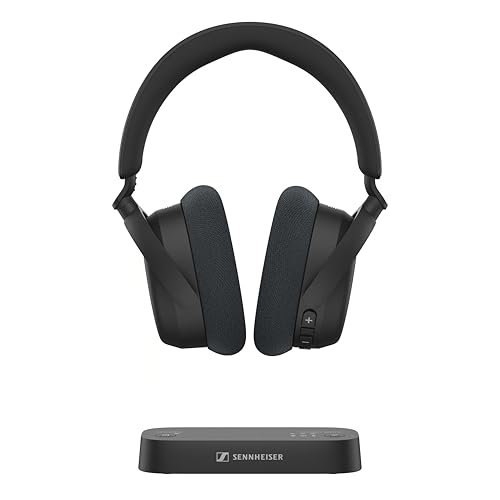
Sennheiser RS 255 — Virtual surround bundle
The RS 255 states the category’s honest proposition in its own title: virtual surround sound. Those three words are the corrected premise wearing a product badge, a promise that processing will stage a television feed spaciously inside a headset rather than decode discrete channels, and Sennheiser’s willingness to print the word virtual deserves the credit this guide gives it. Buyers who understand that sentence understand the entire category, and this bundle is built for them.
The bundle form matters. Headphones and transmitter arrive as a matched system, which removes the compatibility guessing that haunts mix-and-match television audio, and places the whole installation within one box’s responsibility. For a household upgrading from television speakers for the first time, that completeness shortens the distance between delivery and the first film to a single evening’s setup.
Within the Sennheiser trio in this pool, the RS 255 occupies the middle temperament: more explicit about its spatial processing than the classic RS 195, less laden with modern wireless vocabulary than the RS 275. That middle position suits the buyer whose priority is film presentation itself, the sense of a soundtrack occupying a space wider than the head, while dialogue remains anchored where the actors are. Virtual processing lives or dies on exactly that balance, and a television specialist’s tuning is the safest hands for it.
Judge the surround effect with the right material and the right expectations. A sweeping score and a crowded action sequence will show the staging at its most generous; a two-person dialogue scene should sound like two people talking, not like a cathedral. If the second test passes as convincingly as the first, the processing is doing honest work, and that pair of tests is worth more than any channel arithmetic printed anywhere.
Recommend it to film-first households making their first dedicated television-headset purchase, who want the spatial experience described truthfully and delivered by the category’s most established television name, without needing the newest wireless features to justify the evening.
Bundle buyers should still perform the household-shape check before ordering: a matched pair of headphones and transmitter solves connection compatibility completely, and solves listener-count questions not at all. If a second headset joins the household’s evenings within the year, the expandable Avantree design is the pool’s honest detour, and taking it early is cheaper than replacing a closed system later.
- Format: television headphones with transmitter bundle
- Surround format: Not stated in the listing title — verify with the manufacturer documentation.
- Processing described in title: virtual surround sound
- System shape: matched headphones and transmitter in one bundle
- Maker line: Sennheiser television headphone range
Strengths
- Virtual surround named honestly in the title itself
- Matched bundle removes transmitter compatibility guesswork
- Film presentation is the clear centre of the design brief
Trade-offs
- Newer wireless features sit with the RS 275 instead
- Bundle completeness means less freedom to mix components
- Surround effect remains processing, however skilful, not discrete channels
Best for: film-first households wanting truthfully described spatial processing in one matched box.
Not suited for: buyers chasing Auracast or the newest Bluetooth-era feature set.

Sennheiser RS 275 — Modern low-latency flagship
The RS 275 reads like Sennheiser’s answer to a decade of television change. Its title assembles the modern vocabulary in one breath: Bluetooth headphones with a transmitter bundle, low latency, virtual surround sound, speech clarity, Auracast technology and a 50-hour battery claim. Each phrase answers a known television-headset complaint, delay, buried dialogue, single-listener limits, nightly charging, and together they describe the most complete contemporary statement of the category in this pool.
Low latency leads the list for a reason this guide has emphasised from its first page: in a headset, delay has nowhere to hide. A dedicated transmitter working with its matched headphones is the architecture most likely to keep voices married to lips, and a buyer whose viewing is dialogue-dense drama rather than music programming should weight this phrase more heavily than any surround wording in any title here, including this one.
Speech clarity is the second phrase that matters, naming the processing priority most television listeners actually buy these systems for. Auracast is the third, connecting this headset to the broadcast audio ecosystem described in this guide’s hearing-aids companion: a transmitter broadcasting in a format that compatible receivers, including suitably enabled hearing aids, can share. That makes the RS 275 the natural bridge pick for households whose listening equipment is gradually converging on the broadcast model.
The 50-hour battery claim, read as the maker’s figure in the usual way, changes the domestic rhythm from nightly docking to occasional charging, which suits a headset that may serve long film weekends and visiting grandchildren alike. Virtual surround remains on the corrected premise: processing that stages the feed, described in the title with the honest adjective intact.
Choose the RS 275 as the pool’s forward-looking default when the budget allows the flagship step: the newest connection thinking, the clearest dialogue pitch and the longest stated stamina among the Sennheiser trio, in one system that treats the television as a modern source rather than a legacy one.
There is a small ritual worth adopting with a feature-rich system: change one setting per evening during the first week, and note which combination of latency behaviour, clarity processing and surround staging suits your programmes. Flagship systems reward that patience with a personal configuration that a single out-of-box evening rarely finds, and the notes spare you from rediscovering it after any future reset.
- Format: Bluetooth television headphones with transmitter bundle
- Surround format: Not stated in the listing title — verify with the manufacturer documentation.
- Latency: low latency design named in the listing title
- Stated battery: 50 hours in the title
- Broadcast feature: Auracast technology named in the title
Strengths
- Most complete modern feature statement in the pool
- Speech clarity and low latency target the real television frustrations
- Auracast connects the system to the emerging broadcast ecosystem
Trade-offs
- Flagship positioning carries the trio’s highest commitment
- Feature density asks for a careful first setup evening
- Auracast value depends on the household’s other equipment
Best for: households wanting the current-generation television headset with dialogue clarity and broadcast futures in one system.
Not suited for: buyers wanting the simplest possible dedicated system with nothing to configure.

Avantree Crescendo 3D — HDMI ARC integration specialist
The Crescendo 3D is the pool’s systems thinker. Its title leads with HDMI ARC, the connection through which modern televisions prefer to speak to external audio, and adds HDMI soundbar support, which acknowledges the reality of contemporary living rooms: the soundbar already has a job, a place and a constituency, and a headset system that fights it will lose to one that cooperates with it. Avantree’s design lets the headset join the room’s audio politics as a citizen rather than a coup.
The 3D sound wording is this pick’s version of the corrected premise, processing that stages a feed in three-dimensional terms, and its spec box carries the same honest line as every pick here about what the title does not claim. Around that processing, the title assembles a domestic toolkit: the ability to add more headphones, which turns a solitary system into a shared one as a household’s needs change; ANC and ambience modes, which let the wearer choose how much of the room joins the programme; roomy ear cups, a comfort phrase aimed at film-length wear; a charging dock; and replaceable parts, a longevity promise rare enough in consumer audio to deserve its sentence.
Replaceable parts deserve emphasis because television headsets live long lives in one home. Cushions compress, batteries age, and a system whose wear parts can be renewed is a system that can plausibly serve a decade of evenings, which changes the value arithmetic of the whole purchase. Avantree’s television specialism shows in such details: this is a maker that thinks about year five of a product’s life beside a particular sofa.
The integration brief carries one obligation: setup deserves an unhurried evening with the television’s audio settings, the soundbar’s behaviour and the transmitter’s placement all considered together. Households that give it that evening gain the pool’s most flexible arrangement, in which late viewers, hard-of-hearing partners, sleeping households and film nights each find a configuration without renegotiating the wiring.
Recommend the Crescendo 3D to the household whose television corner is already an ecosystem, with a soundbar to respect, more than one potential listener, and a preference for equipment that can be maintained rather than replaced. It is the least solitary product in this guide, and proudly so.
Households with an existing Avantree product will feel a familiarity dividend in setup language and accessory logic, while newcomers should budget the integration evening honestly rather than scheduling it against a film premiere. The system’s flexibility is real, and like most real flexibility it is purchased with configuration attention paid once, up front, by somebody patient.
- Format: wireless television headphones with charging dock
- Surround format: Not stated in the listing title — verify with the manufacturer documentation.
- Television connection: HDMI ARC named in the listing title
- Expansion: supports adding more headphones per the title
- Modes: ANC and ambience modes named in the title
Strengths
- HDMI ARC and soundbar support respect an existing television setup
- Expandable to additional headphones as household needs grow
- Replaceable parts promise a maintainable, long service life
Trade-offs
- Integration richness rewards a careful setup evening
- Feature breadth exceeds a single simple viewing habit’s needs
- 3D processing remains processing under the corrected premise
Best for: households with a soundbar in place and more than one listener’s needs to serve over time.
Not suited for: a single viewer wanting the plainest dedicated system available.

SIMOLIO SM-823D Pro — Voice-prominence control set
SIMOLIO’s SM-823D Pro is the pool’s most audience-specific design, addressed in its title to senior television listeners and shaped around the controls that audience actually reaches for: loud and clear voice positioning, left and right balance control, and tone control. Balance deserves particular attention, because listeners whose two ears prefer different volumes are poorly served by every single-dial system in the world, and a headset that lets each ear be set independently solves a real, common and rarely discussed problem in one control.
Tone control extends the same philosophy. A listener who follows dialogue best with the programme’s brightness adjusted can shape the feed to their preference rather than raising the whole volume and hoping clarity follows loudness, which it often refuses to do. This guide describes those controls as the listening-shaping tools they are, in the maker’s own framing, and the fair home test remains a favourite programme’s hardest scene at a comfortable overall level.
The title adds working-with-soundbar compatibility, a stated 14 hours of rechargeable battery, an ambient mode and a 164-foot range figure. The range claim, read as the maker’s figure under open conditions in the usual way, speaks to listeners who keep a headset on for a trip to the kitchen during a programme, a small domestic freedom that tethered-to-the-sofa systems quietly remove. Ambient mode returns the room’s soundscape on demand, useful for doorbells, partners and kettles.
Fourteen hours is the pool’s shortest stated stamina, and it should be read as a nightly-docking rhythm rather than a flaw: a headset that returns to its base after each evening’s viewing will never be found empty, provided the household keeps the habit. The system’s whole design assumes that rhythm and rewards it with controls that stay where the listener left them.
Choose the SM-823D Pro when the listener’s own shaping of the sound, balance between ears above all, is the deciding requirement, and when a soundbar already serves the room. It is the most personally adjustable pick here, and for the right listener that adjustability outweighs every surround adjective in the category.
The ambient mode deserves its domestic sentence: a listener wearing a headset through a long programme becomes unreachable by ordinary speech, and a mode that admits the room on demand prevents the small domestic friction of shouted names and waved hands. For households where the headset wearer is also the person who hears the door, that feature may quietly outrank every processing claim in the title.
- Format: wireless television headphones with transmitter system
- Surround format: Not stated in the listing title — verify with the manufacturer documentation.
- Listener controls: left-right balance and tone control per the title
- Stated battery: 14 hours rechargeable in the title
- Stated range: 164 feet in the listing title
Strengths
- Independent balance control serves listeners with uneven preferences
- Tone shaping aims directly at dialogue followability
- Soundbar compatibility fits an existing television corner
Trade-offs
- Shortest stated battery asks for a nightly docking habit
- Range figure is the maker’s open-condition claim, as usual
- Control richness may exceed a listener wanting one volume dial only
Best for: listeners who want personal balance and tone control over their television sound, with a soundbar in the room.
Not suited for: households wanting multi-day battery freedom from the dock.

1Mii ClearLinkTV H3 — Plug-and-play stamina pick
The ClearLinkTV H3 competes on the two virtues television households underrate until they live without them: stamina and simplicity. Its title claims 75 hours of play time, the longest figure in this pool by a generous margin, and describes a transmitter charging base with plug-and-play intent. A headset that is always charged and never needs a settings expedition is a headset that gets used every evening, and usage, in this category, is the whole game.
The connection list is the second half of the simplicity argument: optical, AUX and RCA audio outputs are all named, which means the H3 can join a current television through its digital output or an elderly set through the analogue sockets that were standard when it was bought. Households keeping an older television in service, in a spare room, a workshop or a holiday home, will recognise that breadth as the difference between a system that fits their life and one that fits a showroom.
The 2.4G low latency wording describes the dedicated radio link between base and headphones and the design’s delay intention, the property that keeps dialogue married to faces. As with every claim in this guide, the phrase is the maker’s description; the home verification is a dialogue-dense programme watched with the same scepticism you would bring to a dubbed film, where any drift announces itself within minutes.
The title addresses senior listeners, and the design’s manners suit that address: a base that charges, a setup that avoids menus, controls that serve the programme rather than the specification sheet. Its surround story, under this guide’s corrected premise, is the silent one recorded in its spec box; the H3 sells clarity, stamina and welcome rather than spatial theatre, and there are many households for whom that is the correct hierarchy of virtues.
Recommend it where the television is older, the evenings are long, the listener values a charged headset above a clever one, and the household’s technical patience is a resource to be spent on programmes rather than on equipment. In the pool’s division of labour, the H3 is the pick that asks the least and lasts the longest between charges.
Spare-room and second-television buyers form this pick’s quiet constituency: the set is older, the viewing is occasional but long, and the system must simply work after weeks of neglect. A charging base that keeps the headset ready through those gaps, and connections that match the elderly set’s sockets, describe that job exactly, and no flagship feature list improves on a headset that is charged when the grandchildren visit.
- Format: wireless television headphones with transmitter charging base
- Surround format: Not stated in the listing title — verify with the manufacturer documentation.
- Connections: optical, AUX and RCA audio outputs per the title
- Stated play time: 75 hours in the listing title
- Link: 2.4G low latency connection described in the title
Strengths
- Longest stated play time in the pool by a wide margin
- Three connection types cover new and elderly televisions alike
- Charging base keeps the plug-and-play promise physically
Trade-offs
- No surround processing headline for film-space enthusiasts
- Feature set is deliberately plain beside the flagship picks
- Play time figure is the maker’s claim under its own conditions
Best for: older televisions, long evenings and listeners who want a charged, simple system above all.
Not suited for: buyers seeking Auracast, HDMI ARC or expandable multi-headphone arrangements.
Inputs, Latency and Listening Shapes: the Television Six Compared
With the surround premise corrected, the table can do honest work: it compares how each system joins the television, how it treats delay and dialogue, and whose evenings it was shaped to serve. The right column is the one to shop by, because a system matched to the wrong household shape disappoints however good its processing sounds.
| Pick | Connection | Fit and form | Control style | Strongest suit |
|---|---|---|---|---|
| Sennheiser RS 195 | Dedicated RF transmitter | Single listener, classic frame | Television tuning heritage | Permanent solo viewing seat |
| Sennheiser RS 255 | Matched transmitter bundle | Single listener, film frame | Virtual surround staging | First dedicated film system |
| Sennheiser RS 275 | Bluetooth transmitter bundle | Single listener, modern frame | Low latency and speech clarity | Current-generation feature set |
| Avantree Crescendo 3D | HDMI ARC connection | Expandable listener frame | 3D processing with modes | Soundbar households, growing needs |
| SIMOLIO SM-823D Pro | Television transmitter system | Single listener, adjustable frame | Balance and tone controls | Personally shaped listening |
| 1Mii ClearLinkTV H3 | Optical, AUX and RCA base | Single listener, simple frame | 2.4G low latency link | Older sets and long evenings |
What Does Virtual Surround Actually Do to a Television Programme?
A television sends a headset system a feed that the set itself has prepared, commonly a stereo or downmixed version of the programme’s soundtrack. Virtual surround processing then works on that feed with timing, level and tonal cues that suggest direction and space to the listener’s two ears. A score can feel wider, a crowd scene can feel larger, and effects can seem to arrive from beyond the headset’s physical edges. What cannot happen is the recovery of discrete channels that never arrived; the processing composes an impression of space from the ingredients it receives.
Judged on those terms, good processing is a genuine pleasure rather than a consolation. Film soundtracks are mixed to be experienced spatially, and a skilled virtual presentation honours more of that mix than a flat stereo feed inside a headset does. The failures are equally recognisable: dialogue that echoes as if spoken in a hall, effects that wander from the action that caused them, and a general sense of listening through architecture. Those failures are tuning failures, which is why the maker’s television heritage carries weight in this category beyond brand comfort.
The gaming world pursued a parallel path with its own virtual formats, surveyed in best 7 1 gaming headsets, and the comparison is instructive: game processing chases positional advantage, while television processing chases narrative clarity, and a system tuned for one does not automatically serve the other. This pool was chosen entirely from the television side of that divide, where the actor’s next line matters more than any footstep behind you.
Your own audition should therefore use your own programmes. A nature documentary’s narration over weather, a courtroom drama’s overlapping dialogue and one action sequence you know by heart will reveal a system’s staging, its dialogue discipline and its honesty within twenty minutes. Trust that audition over every adjective in every title in this guide, including the ones this guide has repeated in good faith.
How Do You Connect a Headset System to a Modern Television Without Breaking the Room’s Sound?
Start at the television’s audio output settings, because the set decides what its sockets send. Optical outputs commonly offer a choice of formats, and headset transmitters generally prefer the simpler stereo setting, which the corrected premise of this guide makes easy to choose without regret: the processing in the headset works from that feed by design. Change one setting at a time, test with a dialogue scene, and write down what you changed, because television menus are labyrinths that punish improvisation.
HDMI ARC arrangements, the Crescendo 3D’s home ground, route through the same handshake the soundbar uses, so plan the port allocation before plugging anything in. Decide whether the soundbar keeps the ARC socket with the headset joining by another route, or whether the system’s own soundbar support reorganises the chain, and let the household’s everyday remote-control habits arbitrate. The best wiring diagram is the one nobody has to think about after the first evening.
Protect the room’s other listeners while you install your own arrangement. Most television headset systems are valued precisely because the set’s speakers or the soundbar can keep serving the room at its volume while the headset serves one listener at theirs, but that behaviour depends on the television’s output configuration and should be verified, not assumed, on the first evening. A partner’s patience during setup is a renewable resource only if the setup visibly respects it.
Finish by placing the transmitter where its link to the sofa is unobstructed and its charging base is reachable without furniture rearrangement. The television corner’s geography decides daily satisfaction as surely as its electronics do, a lesson the sofa-listening specialists in best headsets for listening to tv repeat in every dialect, because a system that begins each evening with a small expedition will end the season in a cupboard.
Which Household Shapes Should Choose Which System Here?
The solitary late viewer, watching films after the household sleeps, is the category’s founding citizen, and the classic dedicated systems serve that citizen with the least apparatus: the RS 195 for permanence, the RS 255 for film staging, the H3 for stamina and an older set. Their shared assumption is that one listener’s preferences rule the evening, and within that assumption each optimises a different scarcity: setup simplicity, spatial pleasure or charging freedom.
The couple with different volumes is the second household shape, and it needs either an expandable system, the Crescendo 3D’s speciality, or a headset that coexists gracefully with the room’s speakers, which several picks here support through their television-side design. What this household must avoid is a system that solves one listener’s evening by confiscating the other’s, because a television purchase that creates a nightly negotiation has failed at its only real job.
The listener with personal shaping needs, different balance between ears, a preference for brighter dialogue, forms the third shape, and the SM-823D Pro was designed around that listener with unusual directness. The fourth shape is the converging household, whose aids, phones and television are gradually adopting broadcast audio; the RS 275’s Auracast feature speaks to that household’s direction of travel, and buying toward it is reasonable when the rest of the equipment map agrees.
Name your household’s shape out loud before ordering, and notice how the six-way choice narrows to two candidates almost immediately. The remaining decision is then about temperament, brand heritage, feature appetite and charging rhythm, which are exactly the grounds on which a household can decide happily and defend the decision a year later.
How Does a Headset System Age Across Years of Evenings?
The first year of a television system is dominated by novelty and comparison; the years that follow are dominated by cushions, batteries and habits. Ear cushions compress and their surfaces tire, and a system whose cushions can be replaced, the Crescendo 3D’s stated virtue, ages on a gentler curve than one sealed against maintenance. Battery capacity fades in every rechargeable pick here, which is why the longest stated figures buy not just convenience today but a longer road before the fade becomes the evening’s problem.
Transmitters age differently: they age by television replacement. A household that changes its set every several years should prefer connection breadth, optical at minimum and ARC awareness ideally, so the system survives the television it was bought for and joins its successor without a crisis. The pool’s spread of inputs was chosen with that succession in mind, and buyers planning a television upgrade within the year should say so in their own notes before choosing.
Habits complete the ageing story. A system with a dock that is used becomes infrastructure; a system stored in a drawer becomes archaeology. When you audition a candidate, audition its storage as honestly as its sound, because the corner it will occupy, the cable it will trail and the hand that will reach for it nightly are all part of the product you are actually buying.
What Should the First Evening With a New System Look Like?
Give the installation its own evening, separate from any programme you care about. Connect the transmitter, work through the television’s audio output menu slowly, and test with a familiar dialogue scene after each change, keeping a note of the setting that marries voice to lips. Then test the household arrangement: speakers or soundbar at the room’s volume, headset at yours, a partner’s verdict invited early rather than discovered late.
Set the charging geography in the same session. The base belongs where the headset will be taken off, not where the wiring was easiest, and a cable run that crosses a walkway will be resented nightly by people who never mention it in reviews. Small geography decisions made on the first evening compound across years, in both directions, with interest.
Finish by watching one complete programme without adjusting anything. The discipline sounds austere and teaches more than an evening of tweaking: it reveals the system’s defaults as the household will actually experience them on tired evenings, which are the evenings the purchase was made for. Adjust tomorrow, with notes, if the programme gave you a reason written in experience rather than in anticipation.
What Mistakes Follow From Believing the 5.1 on the Box?
The founding mistake is shopping for channel counts in a category that processes stereo feeds. A buyer who ranks these systems by the numbers in their marketing will systematically undervalue dialogue clarity, latency and comfort, the three properties that decide every evening’s satisfaction, and will pay for arithmetic that the physics of two ears and one feed cannot honour. Read titles for the honest words, virtual, 3D, clarity, and let the dishonest arithmetic go.
Connecting a transmitter and never opening the television’s audio settings is the second mistake. Sets ship with output configurations chosen for soundbars and receivers, and a headset fed the wrong format can sound distant, desynchronised or silent while every component is working perfectly. Ten minutes in the audio menu, changing one setting at a time, is the difference between a system that seems broken and a system that seems miraculous, and the hardware is identical in both stories.
Buying a solitary system for a two-listener household, or an expandable ecosystem for a determined solitary viewer, wastes money in both directions. Household shape is this category’s true specification, and it is knowable before purchase with one honest conversation about who watches what, when, and at whose volume. Have that conversation in daylight, not during the first film the new system was bought to improve.
Judging a television headset by music is a category error that sends good systems back. These are programme instruments: their tuning, latency priorities and comfort all serve dialogue and film soundtracks across hours. A buyer who auditions with a favourite album is testing the one job the system was not hired for, rather as the drivers in another category would fail a call headset by judging its concert performance.
The last mistake is neglecting the dock. A television headset without a charging home becomes a treasure hunt with a battery deadline, and the evening it is found empty is the evening the household concludes the system is unreliable. Every pick here offers a base, a cradle or a dock in its design; honour that design by giving it a permanent place in the television corner from the first day.
One more mistake hides in the calendar: buying the system during a holiday visit, a house move or a new-television week, when three unfamiliar things arrive at once and every fault is blamed on whichever box was opened last. Television headsets deserve a quiet week in a settled room for their audition, because the judgement formed in chaos attaches to the product for years, fairly or not, and households rarely grant a second audition with an open mind.
Final Recommendation
A closing observation about value in this category: the most expensive mistake available is not any system in this pool, but a cheap disappointment bought twice, once in a hopeful version and once in the version that replaced it, so weigh the household’s shape and the television’s sockets heavily enough that the purchase happens once, deliberately, and then disappears into years of unremarkable evenings.
On the corrected premise, the RS 275 stands as this guide’s modern default: low latency and speech clarity aimed at the real frustrations, Auracast for the converging household, and stamina that frees the evening from charging arithmetic. The Crescendo 3D is the better answer where a soundbar and multiple listeners complicate the room, the RS 255 serves film-first buyers who want their spatial processing honestly labelled, the RS 195 remains the permanent solo seat, and the SIMOLIO and 1Mii divide the personally shaped and the plainly enduring territories between them with equal legitimacy.
Whichever system takes the place beside your television, judge it on a wet Tuesday in a month’s time, by whether the dialogue was effortless and the headset was forgotten, because a television system has truly arrived when nobody in the household talks about it anymore.
Frequently Asked Questions
Can any television headset give me true Dolby Digital 5.1 surround?
No, and this guide’s opening correction exists because the question matters. Mainstream television headsets receive a stereo or downmixed feed from a television-side transmitter and apply virtual surround or 3D processing to stage it spaciously. That processing can be genuinely enjoyable and is what every pick here is judged on, but it is not discrete decoding of separate channels inside the headset, and no title in this pool claims otherwise when read carefully. Shoppers who hold that sentence firmly will find the rest of this category suddenly easy to navigate, because every remaining difference between these six systems is a real one that an evening’s audition can settle.
What connection should I look for between the transmitter and my television?
Match the transmitter to the outputs your set actually offers. Optical is the category’s common language and suits most modern televisions; HDMI ARC is the contemporary handshake the Crescendo 3D specialises in, particularly where a soundbar shares the television; and the 1Mii system’s optical, AUX and RCA spread serves older sets whose digital outputs may be absent. Check the back of your own television before ordering, because that census decides the shortlist faster than any review. Photograph the socket panel if reaching behind the set is difficult; the photograph will answer questions all week without moving the furniture again.
Why does latency matter more for headsets than for speakers?
Because a headset removes every forgiving element from the room. With speakers, distance and room sound soften small delays; with headphones sealed to your ears, a voice arriving late against its lips is immediately and continuously noticeable, and dialogue-dense programmes become tiring within minutes. That is why low-latency wording in the RS 275 and H3 titles carries real weight in this guide’s judgements, and why your first audition should be a conversation scene rather than a concert. Music programming forgives delay almost completely, which is why a system can seem flawless through a concert broadcast and then fail a courtroom drama on the following evening; audition in the genre that will judge you hardest.
Can my partner keep listening through the television or soundbar while I use a headset?
In many arrangements yes, and it is one of the category’s founding comforts, but the behaviour depends on your television’s output configuration and on the system chosen. The Crescendo 3D is designed explicitly around soundbar coexistence, and several other picks assume the room keeps its sound while one listener takes a personal feed. Verify the arrangement on the first evening through the television’s audio settings, because that shared-volume peace is worth ten deliberate minutes. Households with a sleeping baby or a night-shift partner in the next room tend to rank this feature above every other line in the comparison table, and they are right to.
What does Auracast add to the RS 275 for my household?
Auracast is broadcast Bluetooth audio: a transmitter sends, and compatible receivers in range can listen, which is why the feature interests households whose other equipment, including suitably enabled hearing aids, is adopting the same format. Its value in your home depends on that equipment map. If nothing else you own speaks Auracast today, treat the feature as future-proofing inside an already strong system rather than as the reason for the purchase. Treat it the way careful buyers treat any young standard: welcome when present, never the sole pillar of the decision.
How should I judge virtual surround quality during a trial?
Use three scenes you know well: a dialogue exchange in a quiet room, which should sound intimate and centred rather than echoing; a crowded or weather-filled scene, which should open up without swallowing the voices; and a familiar action sequence, where effects should feel placed rather than merely loud. A system that passes all three with dialogue discipline intact is doing honest processing, whatever numbers its marketing prefers. If a system fails the first scene and passes the other two, suspect the programme’s own mix before the processing, because even excellent staging cannot rescue dialogue that the original soundtrack buried.
Related Guides
Listeners whose television questions began with hearing equipment should read best bluetooth headsets for hearing aids beside this guide, since the Auracast thread runs through both, and anyone comparing processing claims across categories will find the gaming interpretation of virtual staging in best 7 1 gaming headsets a useful contrast to the living-room priorities defended here. Both detours return to the same sofa with better questions than the ones the 5.1 label tried to answer for you.
The office and the sofa ask opposite things of a headset, and our guide to the best call center biaural headsets argues the office case in full.
Surround processing for the sofa and a plain cable for the console share a virtue — no battery anxiety — as our guide to the best wired headsets for switch shows.


