What's inside
- Where Should You Buy a Dye-Based Inkjet Printer, and Why Won’t the Listings Say “Dye”?
- Key Takeaways
- Quick Picks
- How Did We Choose These Picks?
- What Is the Real Difference Between Dye and Pigment Ink?
- How Does Ink Supply — Tank or Cartridge — Change Photo Printing?
- Which of These Six Printers Belongs on Your Desk?
- Which Photo Paper Finishes Suit Which Photographs?
- How Do You Proof a Photograph Before Committing the Large Sheet?
- What Can the All-in-One Picks Do for a Family’s Old Photographs?
- How Do Tanks, Cartridges and Formats Separate the Six Picks?
- How Do You Get the Best Photograph Out of a Dye Inkjet?
- What Mistakes Make Home Photo Prints Disappoint?
- How Should You Manage Ink Supply — Bottles, Cartridges and Subscriptions?
- How Do You Keep an Inkjet Photo Printer Ready for the Next Print?
- Can Dye Printers Handle Black-and-White Photography Well?
- How Should You Choose a Format — Letter, 13-Inch or 13-by-19?
- Final Recommendation
- Frequently Asked Questions
- Related Guides
As an Amazon Associate I earn from qualifying purchases. This post may contain affiliate links at no extra cost to you.
gizmoverdict.com is reader-supported. When you buy through links on our site, we may earn an affiliate commission.
Where Should You Buy a Dye-Based Inkjet Printer, and Why Won’t the Listings Say “Dye”?
Buy the best dye based inkjet printers from a general retailer or photo supplier, and go in knowing a strange truth about this category: almost none of the listings will use the word dye. Of the six machines in this guide, exactly one — the Canon PIXMA PRO-200S — states its ink system in its listing title, where it declares an 8-color dye ink system outright. The others describe tanks, functions and wireless features and leave the ink chemistry unstated, because manufacturers market outcomes — photo quality, running cost, convenience — rather than the dye-versus-pigment distinction that quietly decides how a print looks on glossy paper and how it ages in an album. So this guide does two jobs at once: it ranks six printers that belong to the dye-ink photo tradition, and it teaches that tradition in class terms, while marking honestly, in every spec box except one, that the ink system is not stated in the listing title.
Why does the chemistry matter enough to build a guide around? Dye ink dissolves its colourant completely in liquid, and on glossy and resin-coated photo papers that dissolved dye sinks into the coating and produces the smooth, saturated, high-gloss colour that made home photo printing famous — deep skies, glowing skin tones, gradients without visible grain. Pigment ink, its great rival, suspends solid particles that sit on the paper’s surface; it shrugs off water and time better and behaves beautifully on matte and fine-art papers, but on gloss it can show a duller, sometimes uneven sheen where light catches the particle layer. Neither chemistry is better in the abstract. Dye is the gloss-and-vibrancy choice, pigment the longevity-and-matte choice, and a buyer who knows which life their prints will live can choose a printer family with confidence instead of luck.
The six picks divide by the second question every photo printer buyer faces: how the ink is supplied. Two are refillable-tank MegaTank machines built for low-fuss volume, one is a cartridge-based professional 13-inch printer, one is a wide-format machine reaching 13 by 19 inches, and two are compact home all-in-ones for households that print photographs among everything else. Ink yields are not quoted anywhere in this guide, because the listings do not state them and invented yield figures are how printer guides lie. What can be compared honestly — format, functions, tank versus cartridge architecture, and the class behaviour of dye ink itself — is compared in full. Readers whose interest in dye began with fabric rather than paper will find the sibling technology in the best affordable sublimation printers guide, where dye is driven into polyester by heat instead of into paper by a printhead.
Key Takeaways
- Only the Canon PIXMA PRO-200S states its dye ink system in its listing title; every other pick’s ink-system spec line in this guide reads “Not stated in the listing title”, and dye behaviour is taught in class terms.
- Dye ink’s home ground is glossy photo paper: dissolved colourant, deep saturation and smooth gradients. Pigment’s home ground is matte paper, water resistance and archival life.
- The Canon PIXMA G620 and G3290 bring refillable MegaTank architecture to photo printing, trading cartridges for tanks you refill from bottles.
- The Epson XP-15000 is the wide-format pick, printing up to 13 by 19 inches for home-studio photographers who think in enlargements.
- The HP Envy Photo 7975 and Canon PIXMA TS4320 are the household all-in-ones — photographs plus scanning, copying and everyday documents in one compact box.
- Photo paper is a consumable partner, not an accessory afterthought: dye ink shows its best only on the glossy and resin-coated papers it was made for.
Quick Picks
| Printer | Badge | Why it made the list |
|---|---|---|
| Canon PIXMA G620 MegaTank Photo | Tank Photo All-in-One | A wireless MegaTank photo all-in-one with print, copy and scan, built for households that print photographs in real quantity. |
| Canon PIXMA PRO-200S | Declared Dye Professional | The one pick whose title states its 8-color dye ink system — a 13-inch professional photo printer with a colour LCD. |
| Epson Expression Photo HD XP-15000 | Wide-Format Enlarger | Prints up to 13 by 19 inches with 6-colour wide-format photo printing, for home studios that sell or hang enlargements. |
| HP Envy Photo 7975 | Household Photo Hub | A wireless colour inkjet photo all-in-one with mobile printing and an Instant Ink trial, tuned for busy homes. |
| Canon PIXMA TS4320 | Compact Budget All-in-One | A cost-efficient, compact wireless machine with print, copy and scan for homes printing photos among everyday jobs. |
| Canon MegaTank G3290 | Tank Home-and-Office | A refillable-tank all-in-one with a colour touchscreen and duplex printing, spanning photo work and office duty. |
How Did We Choose These Picks?
The selection rule for this guide was stricter than usual, because the category itself is partly invisible. A pick had to be a photo-capable inkjet from the dye-ink tradition as the class is understood — photo all-in-ones, MegaTank photo machines and declared dye printers — and the guide then had to be transparent about the evidence: the PRO-200S carries its dye identity in its title, while the other five carry theirs as class knowledge, labelled as such in every spec box rather than dressed up as listing facts. Readers deserve to know which kind of claim they are reading, and the distinction is maintained from the first pick to the last.
Coverage was the second rule. A useful dye-ink guide must span the formats real buyers choose between — letter-size household printing, refillable tanks for volume, 13-inch enthusiast printing and 13-by-19 wide format — because the wrong format is a more common purchase regret than the wrong brand. The third rule was consumable honesty: photo papers, ink bottles and cartridges appeared throughout the research as separate products, and none is a pick, because none prints. They are discussed as the running partners of these machines, with the paper’s role given its full weight in the buying guide. Event photographers who need instant dry prints rather than inkjet’s considered pace should cross to the best event photo printers guide, where dye-sublimation rather than dye inkjet owns the night.
What Is the Real Difference Between Dye and Pigment Ink?
Hold two prints to the light and the chemistries announce themselves. A dye print on glossy paper has a surface like still water: the colour lives inside the coating, the gloss is unbroken, and saturated areas glow with a depth that comes from light passing into the colour and back out. A pigment print on the same glossy sheet can look fractionally veiled, its particles sitting on the surface and scattering light unevenly — an effect photographers call bronzing when it shifts colour at an angle, or gloss differential when dark and light areas shine unequally. Move both prints to matte paper and the verdict reverses: pigment sits happily on matte’s textured surface with rich, even blacks, while dye can sink into matte fibres and lose its punch. Paper and ink are a marriage, and dye’s vows are written for gloss.
Longevity tells the other half of the story. Dye molecules, dissolved and exposed within the paper coating, are more vulnerable to light, ozone and humidity over years; pigment particles are inherently hardier, which is why gallery and archival printing standardised on pigment. For the prints this guide’s readers actually make — family photographs for albums and frames, enlargements for home walls, portfolio pieces for a season — dye’s life is measured in years that satisfy most households, especially when prints live in albums or behind glass rather than in direct sun. The honest summary is a division of labour: dye for vibrancy on glossy in the present tense, pigment for matte and for the archive. A buyer whose walls face south windows and whose prints must outlive them should hear pigment calling; a buyer printing birthdays, holidays and glossy enlargements for the fridge and the family wall has dye’s name written on the box — even when, as established, the box itself declines to say so.
How Does Ink Supply — Tank or Cartridge — Change Photo Printing?
The tank revolution changed home photo printing’s psychology. A cartridge machine rations its owner: every large print spends a visible fraction of a cartridge, and photographers learn to print small, print rarely and hoard the good paper for certainties. A refillable-tank machine — the MegaTank architecture of the G620 and G3290 picks — replaces cartridges with reservoirs filled from bottles, and the psychology inverts: printing a test, a proof and a second, better proof costs so little worry that photographers experiment again. For photo work, where the first print of a difficult image is rarely the best one, that freedom is a quality feature disguised as an economy feature.
Cartridges keep two honest advantages. They are cleaner to handle — a sealed unit swapped in seconds, with no bottles to pour and no reservoir windows to monitor — and on machines like the PRO-200S they carry an expanded colour set, where each additional ink colour widens the reproducible gamut in the saturated regions dye printing is loved for. The choice is therefore not modern versus obsolete; it is volume psychology versus colour-set ambition. Households printing photographs weekly belong to tanks. Enthusiasts printing fewer, larger, more considered images may rationally choose the cartridge machine whose ink set serves the image. Both architectures appear in the picks, and the pick sections judge each machine inside its own logic.
Which of These Six Printers Belongs on Your Desk?

Canon PIXMA G620 MegaTank Photo — Tank Photo All-in-One
The G620 is the pick for households where photographs are a habit rather than an occasion. Its listing describes a wireless MegaTank photo all-in-one — print, copy and scan — that works with Alexa, and the MegaTank word carries the argument: refillable reservoirs instead of cartridges, in a machine whose identity is photographic rather than clerical. A photo-first tank machine matters because ordinary tank all-in-ones are office machines that tolerate photographs; the G620 reverses the priority, aiming its paper handling and colour work at photo output while still scanning the school form and copying the recipe card when asked.
In a family workflow that means the printer stops being a rationed resource. Children print project photographs without a parental cost audit, the household’s archivist works through shoeboxes of scanned-and-reprinted family history, and proofs stop being a luxury. Wireless placement frees it from the desk — a shelf in the family room serves as well — and voice-assistant compatibility, stated in the listing, suits households already running that ecosystem. Its boundaries are the household’s boundaries: it is not the wide-format enlarger and not the declared professional dye system, and a photographer selling 13-inch prints should read on. For the photograph-printing household, though, the G620 is the machine that makes printing feel abundant again.
- Functions stated: Print, copy, scan — wireless all-in-one
- Ink supply: MegaTank refillable reservoirs
- Ink system: Not stated in the listing title
- Extras stated: Works with Alexa
Strengths
- Tank refills remove the cartridge rationing that suppresses home photo printing.
- Photo-first design inside a full all-in-one’s convenience.
- Wireless and voice-assistant fit suit shared household placement.
Trade-offs
- Letter-class format cannot serve enlargement ambitions.
- Tank care — keeping reservoirs sensibly filled — replaces cartridge simplicity.
- Not the declared professional dye system the next pick offers.
Best for: photo-printing households that want volume without cartridge anxiety. Not suited for: wide-format sellers or enthusiasts chasing a declared multi-colour dye set.

Canon PIXMA PRO-200S — Declared Dye Professional
This is the guide’s anchor of evidence: a professional 13-inch wireless inkjet photo printer whose listing title states, in plain words, an 8-color dye ink system, alongside a 3-inch colour LCD. Savour how much that declaration simplifies a buyer’s life. Eight dye colours mean the gamut conversation is explicit — extra ink colours extend the saturated reds, greens and shadow gradations where dye printing earns its reputation — and the dye identity is a listing fact rather than a class inference, the only such case among these six picks. The 13-inch width moves the product from album photographs to hangable enlargements and portfolio prints, and the colour LCD puts settings and status on the machine rather than demanding a computer for every adjustment.
The PRO-200S suits the enthusiast whose printing is deliberate: fewer images, larger, judged critically, reprinted until the proof matches the intention. Its cartridge architecture fits that rhythm, because a considered printer’s ink spend is spread across months of careful work rather than a household’s weekly flow, and each cartridge change is a moment in a workflow that already includes paper selection and soft-proofing. Wireless connection keeps a studio desk uncluttered. Its honest limits are the professional tier’s usual ones — it prints, only prints, with no scanning or copying to offer the household, and its running pattern rewards commitment rather than casual use. As the one machine here whose dye credentials arrive printed on its own title, it is also the guide’s recommendation to the buyer who wants the chemistry question answered by the manufacturer, not by a reviewer.
- Format stated: Professional 13-inch photo printer, wireless
- Ink system stated in listing title: 8-Color Dye Ink
- Display stated: 3-inch colour LCD
- Functions: Dedicated photo printing
Strengths
- Declared 8-colour dye system widens gamut where dye shines most.
- 13-inch width serves enlargements and portfolio work.
- On-machine colour LCD supports a deliberate, computer-light workflow.
Trade-offs
- Print-only — no scan or copy for household duty.
- Cartridge architecture suits considered printing, not household volume.
- Professional focus is wasted on occasional snapshot printing.
Best for: enthusiasts and semi-professionals printing deliberate 13-inch dye photographs. Not suited for: households needing one all-in-one for everything.
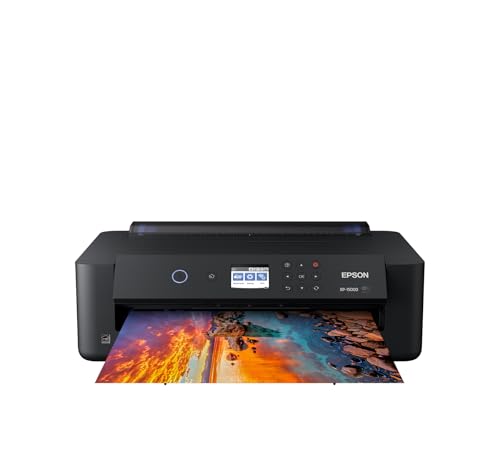
Epson Expression Photo HD XP-15000 — Wide-Format Enlarger
The XP-15000’s listing is a study in wide-format intent: a wireless wide-format inkjet printer offering 6-colour wide-format photo printing up to 13 by 19 inches, at up to 9.2 pages per minute, with automatic two-sided printing, aimed at photographers and home studios. The 13-by-19 figure is the headline because it changes what a home printer can be: at that size a print is wall art, a saleable enlargement, a portfolio centrepiece — the size where photography stops being filed and starts being hung. Six colours serve that ambition with a wider palette than a basic four-colour machine, and the stated speed and duplexing acknowledge that a home studio also prints documents, proofs and paperwork between enlargements.
Working with a wide-format machine teaches respect for paper. Large glossy sheets show every handling flaw, cost enough per sheet to make proofs deliberate, and demand storage that keeps them flat and clean — the home studio that adopts this printer adopts a paper discipline with it. In return, the photographer gains the full arc of the craft at home: shoot, edit, proof small, print large, hang. Its fit is the serious hobbyist or selling photographer whose images deserve the wall and whose volume does not yet argue for a dedicated professional wide-format line. Households seeking a family all-in-one should look at the compact picks below instead; this machine’s desk footprint and appetite are a studio’s, proudly.
- Format stated: Wide format, up to 13 x 19 inches
- Colour set stated: 6-colour photo printing
- Ink system: Not stated in the listing title
- Stated speed: Up to 9.2 ppm, with auto 2-sided printing
Strengths
- 13-by-19 output turns home printing into wall art and saleable enlargements.
- Six-colour set widens the photographic palette beyond basic machines.
- Duplex and stated speed keep studio paperwork moving between prints.
Trade-offs
- Large paper demands storage, handling care and deliberate proofing.
- Studio footprint and focus exceed a family all-in-one’s brief.
- Wide-format ambition is wasted on 4×6 household printing.
Best for: home-studio photographers printing and selling enlargements. Not suited for: compact family corners or document-first offices.

HP Envy Photo 7975 — Household Photo Hub
HP’s Envy Photo 7975 is the generalist’s answer in this guide: a wireless colour inkjet photo printer with print, scan and copy, easy setup, mobile printing, a best-for-home positioning, a three-month Instant Ink trial included, and AI-enabled features per its listing. Read that feature list as a portrait of its household: phones are where the photographs live, so mobile printing is the front door; setup patience is scarce, so easy setup is a headline; and the ink subscription trial speaks to families who would rather have ink arrive by post than discover an empty cartridge on the morning of a school deadline.
The Envy’s photographic role is the everyday album — holiday prints, school projects, family photographs for frames and fridges — printed among the household’s documents without ceremony. Its all-in-one functions keep it employed daily, which matters for inkjet health as much as convenience: a printer used every day is a printer whose nozzles stay exercised. The subscription question deserves a household’s honest arithmetic in class terms: families that print steadily often value the predictability, while very light printers may prefer buying cartridges as needed, and the included trial exists precisely to let a household learn its own pattern before deciding. Choose the Envy when the printer must be the home’s single, friendly hub and photographs are its favourite job rather than its only one.
- Functions stated: Print, scan, copy — wireless colour inkjet
- Ink system: Not stated in the listing title
- Ink programme stated: 3-month Instant Ink trial included
- Positioning stated: Best-for-home, mobile printing, AI-enabled
Strengths
- Mobile-first printing matches where family photographs actually live.
- Full all-in-one duty keeps the machine exercised and useful daily.
- Included ink trial lets a household learn its real printing pattern.
Trade-offs
- Generalist design cannot match the dedicated photo machines’ focus.
- Subscription value depends entirely on the household’s steady volume.
- Letter-class format only — no enlargement path.
Best for: busy households wanting one friendly hub whose favourite job is photographs. Not suited for: enthusiasts printing large or chasing a declared dye ink set.

Canon PIXMA TS4320 — Compact Budget All-in-One
The TS4320 represents the honest floor of this category: a wireless colour inkjet printer with print, copy and scan, described as a cost-efficient multi-function photo printer in a compact design with easy setup, for home use. Compact and cost-efficient are the operative virtues. Not every home has a desk to surrender or a printing habit to justify a tank machine, and the student room, the small flat and the grandparents’ side table all need a printer that prints a photograph creditably, copies a document when asked, and otherwise stays out of the way and out of the budget’s nightmares.
Judge it inside that brief and it shines: photographs for frames and projects emerge with the dye-class gloss this guide celebrates, the scanner handles the household’s paper surprises, and the whole machine asks little space, little setup and little ongoing ceremony. Its trade-offs are the floor’s trade-offs — cartridge printing at household scale rewards moderation, the format is letter-class, and a family that discovers a serious photo habit will outgrow it toward the G620’s tank abundance. That outgrowing is a success story rather than a failure: the TS4320 is the printer that lets a home discover whether it prints photographs at all, at the smallest commitment the category honestly offers, and thousands of households will find the discovery ends here happily.
- Functions stated: Print, copy, scan — wireless
- Design stated: Compact, easy setup, cost-efficient multi-function
- Ink system: Not stated in the listing title
- Role in this guide: The accessible entry pick
Strengths
- Smallest space and fuss commitment in the guide.
- Full all-in-one functions despite the compact brief.
- Creditable dye-class photo output for everyday home printing.
Trade-offs
- Cartridge economics punish a growing photo habit.
- No tank abundance, no wide format, no professional ink set.
- Built for moderation — heavy households should start higher.
Best for: small homes, students and light printers wanting photos plus everyday all-in-one duty. Not suited for: high-volume photo households or enlargement work.

Canon MegaTank G3290 — Tank Home-and-Office
The G3290 closes the pick list by spanning the guide’s two worlds. Its listing describes a MegaTank all-in-one wireless printer with print, copy and scan, mobile printing, a 2.7-inch colour touchscreen, a refillable tank system and duplex printing, for home and office use. Where the G620 leans photographic, the G3290 leans universal: the touchscreen makes shared use by a whole household or small office straightforward, duplexing serves document duty properly, and the tank system keeps the running-cost psychology relaxed across both photographs and paperwork.
That universality suits the home that works — the household with a home office in the corner, homework on the table and photographs in the same queue. One machine, abundantly inked, touchscreen-simple for whoever approaches it, becomes infrastructure rather than a specialist’s tool. Photographers should note the ordering of its virtues honestly: it will print their photographs gladly within a generalist’s design, while the G620 above is the tank machine whose brief is photo-first. Offices and families should note the reverse. Between the two MegaTank picks, the choice is a portrait of the buyer — photo-led abundance or everything-led abundance — and this guide’s final service is to insist the portrait be drawn truthfully before the box is opened.
- Functions stated: Print, copy, scan — wireless, mobile printing
- Ink supply: Refillable MegaTank system
- Ink system: Not stated in the listing title
- Display stated: 2.7-inch colour touchscreen; duplex printing
Strengths
- Tank abundance across both photo and document duty.
- Touchscreen and duplex suit shared home-office use.
- One machine covers the working household’s whole queue.
Trade-offs
- Generalist brief — the G620 is the photo-first tank alternative.
- No wide format or declared professional ink set.
- Tank refilling replaces cartridge simplicity with bottle care.
Best for: working households and small offices wanting one abundant all-in-one. Not suited for: photo specialists or wide-format printers.
Which Photo Paper Finishes Suit Which Photographs?
Gloss is dye ink’s showcase, but it is not the whole wardrobe. A high-gloss sheet delivers the deepest blacks and the most saturated colour, and it also delivers every fingerprint and every reflection of the room’s lighting — glorious for a landscape behind glass, trying for a portrait handled at a family gathering. Satin and lustre finishes split the difference: the colour depth survives, the reflections soften, and fingerprints lose their stage, which is why portrait and wedding printing traditionally lives on lustre. Matte paper mutes dye’s punch — the colourant sinks toward the fibres — yet flatters black-and-white work, illustrations and anything destined for a portfolio sleeve where reflections are the enemy. Metallic and specialty finishes exist for effect printing and should be treated as new materials to qualify, one pack at a time, with test prints before any image that matters.
Weight matters mechanically as much as aesthetically. Every printer’s feed path has a thickness comfort zone; a heavyweight sheet fed through a path that bends it sharply can emerge with surface marks or refuse the bend entirely, which is why the manual’s paper guidance — and any straight-through or rear feed option a machine offers — deserves reading before the expensive pack is opened. Store paper flat in its packet, handle it by edges, and keep the printer’s environment ordinary: humidity curls sheets, dust prints as white specks where it blocked the ink, and a sheet that sat loaded in the tray for a month has been collecting both. The households that love their photo printers treat paper as a photographic material, because it is one — the print is ink and paper in equal partnership, and this guide’s dye-versus-pigment teaching only ever describes half of any finished photograph.
How Do You Proof a Photograph Before Committing the Large Sheet?
Proofing is the discipline that separates printing from gambling, and dye machines reward it because their proofs are honest: a small print on the same paper family predicts the large print’s colour and density closely. Proof at a size that shows the image’s problem areas — faces, skies, deep shadows — rather than a thumbnail that hides them, and judge the proof rested, dry and in the light the final print will live under. Adjust in deliberate steps: exposure first, because density errors masquerade as colour errors; then saturation, sparingly, because dye on gloss saturates more generously than a screen suggests; then colour balance, against a known reference in the image — a face, a grey card’s memory, a white that should be white.
Keep the winning proof. Pin it, with the file name, paper and driver settings written on its back, where the printer lives, and it becomes the household standard against which future prints — and future papers, inks and machines — are judged. When a print disappoints months later, the standard proof separates the variables instantly: if the standard still prints true, the file changed; if it prints wrong, the machine, ink or paper did. Photographers call this a control print, and it costs one small sheet. The wide-format pick makes the economics plainest — a proof costs a fraction of a 13-by-19 sheet — but the habit pays on every machine in this guide, because the cheapest print is always the small one that prevents the large mistake.
What Can the All-in-One Picks Do for a Family’s Old Photographs?
Four of the six picks scan, and scanning is where a dye printer earns a second life as the family archive’s printing press. The workflow is gentle and methodical: clean the old print, scan it at a resolution generous enough to allow the reprint size you dream of, repair the worst damage in an editor — the tear, the stain, the worst of the fading — and print the restoration on modern glossy paper, where dye’s saturation quietly returns the colour the decades stole. Grandparents’ weddings regain their dresses’ true shade; the faded holiday snaps of the seventies lose their orange cast; copies multiply so every sibling holds the same restored set, and the fragile originals retire to a box that is opened rarely and handled like the heirloom it is.
Two habits keep archive projects joyful rather than endless. Work in batches by album or by family branch, finishing each batch completely — scanned, repaired, printed, labelled with names and dates on the back — before opening the next box, because a half-restored archive is just a second, digital shoebox of chaos. And write the names down while the generation that knows them can still be asked; a dye printer can restore a face’s colour, but no printer made can recover the identity of the aunt in the third row once nobody remembers her. The machines in this guide are, in this role, time machines with a paper tray — one of the better arguments for the all-in-one picks over the dedicated PRO-200S, and one households rarely foresee when they buy.
How Do Tanks, Cartridges and Formats Separate the Six Picks?
| Pick | Ink supply | Ink system evidence | Format and functions |
|---|---|---|---|
| Canon PIXMA G620 | MegaTank refillable reservoirs | Not stated in the listing title | Wireless photo all-in-one: print, copy, scan |
| Canon PIXMA PRO-200S | Cartridges, 8-colour set | Stated in the listing title: 8-Color Dye Ink | 13-inch dedicated photo printer, colour LCD |
| Epson XP-15000 | Cartridges, 6-colour set | Not stated in the listing title | Wide format to 13 x 19 inches, auto 2-sided |
| HP Envy Photo 7975 | Cartridges, with Instant Ink trial | Not stated in the listing title | Wireless home all-in-one: print, scan, copy |
| Canon PIXMA TS4320 | Cartridges, cost-efficient design | Not stated in the listing title | Compact wireless all-in-one: print, copy, scan |
| Canon MegaTank G3290 | MegaTank refillable reservoirs | Not stated in the listing title | All-in-one with touchscreen and duplex |
That evidence column is this guide in miniature. One row states its chemistry; five rows decline to, and the guide prints the decline rather than papering over it. Buy on format, supply and function — the facts the listings do state — and let the dye-versus-pigment teaching guide the family you shop in.
How Do You Get the Best Photograph Out of a Dye Inkjet?
Start with the paper, because dye ink’s magic is a paper partnership. Load a glossy or resin-coated photo paper of the weight the printer’s feed handles confidently, select that exact paper type in the driver — the setting changes how much ink the machine lays down, and glossy stock driven on a plain-paper setting floods and dulls — and let the printer, not your impatience, declare the print finished. Handle fresh prints by their edges and give them a short rest before stacking or framing, because the coating’s surface settles after printing and a fingerprint in the first minute is a permanent signature.
Work on the file with the print in mind. Screens glow; prints reflect, so an image that sings on a monitor can print a shade darker and a touch flatter — proof the important photographs small, on the same paper family, and adjust exposure and saturation in small steps between proofs rather than gambling a full sheet on an untested correction. Keep the printer’s own housekeeping honest: run its alignment and nozzle utilities when banding or colour drift appears, print something colourful weekly so heads stay exercised, and store photo paper flat, in its packet, away from humidity. None of this is professional mystique; it is the short list of habits that separates households whose photo printer delights them from households whose photo printer is a rumour in a cupboard.
What Mistakes Make Home Photo Prints Disappoint?
The champion mistake is paper betrayal: dye ink printed on plain office paper, where the colourant wicks into uncoated fibres and a vivid file becomes a soggy approximation, followed by the printer being blamed for a paper’s crime. Buy the photo paper; it is half the product. Second is driver mismatch — the paper in the tray and the paper type in the settings telling different stories — which produces flooding, bronzing or anaemia that no file adjustment can cure. Third is judging the print wet and instantly, under the room’s warmest bulb, then correcting a file that was never wrong; judge rested prints in daylight.
Fourth is cartridge-era rationing surviving into tank ownership, or its mirror: printing everything at maximum quality on the largest paper when a proof would have caught the cropping error at postcard size. Fifth is the cupboard printer — an inkjet left unprinted for months until its heads dry into banding, when a weekly colourful page would have kept it alive. Sixth is expecting dye to be pigment: sending dye prints into a sun-blasted window display or an unprotected outdoor notice and mourning the fade that the class teaching in this guide predicted. Match the chemistry to the print’s life, and disappointment becomes a rare visitor.
How Should You Manage Ink Supply — Bottles, Cartridges and Subscriptions?
Ink supply is where photo printing’s running costs actually live, and each architecture in this guide asks a different management style. Tank owners manage bottles: buy the correct ink line for the machine — formulations are model-family specific, and the wrong bottle is not a saving but a slow fault — store bottles upright and sealed, and refill reservoirs in good light with a steady hand, because a dye spill is as permanent on a desk as it is beautiful on paper. The reward for that small care is the tank psychology this guide keeps praising: ink as a utility, checked at a glance through the reservoir windows, rather than a ration counted in cartridges.
Cartridge owners manage spares and, with the Envy pick, may manage a subscription. The sealed spare set, bought before it is needed, converts an empty-cartridge crisis into a thirty-second swap; the subscription converts the whole question into a delivery rhythm matched to pages printed, which suits households whose printing is steady and whose appetite for supply errands is low. The honest test for a subscription is your own history: a household that prints in bursts around holidays and school terms should count its real pages across a year before assuming the steady-plan logic fits, while the included trial on the Envy exists precisely to replace assumption with evidence. Professional cartridge users, on the PRO-200S pattern, manage colour by colour — the extra inks in an eight-colour set deplete unevenly, with the light and photo colours typically working hardest in portrait-heavy printing — and keep the fast-moving colours doubled on the shelf.
Across all three styles runs one rule: never let a machine sit empty. A printhead parked dry while its owner waits for a delivery is a printhead ageing by the day, and the rescue cleaning that follows a long dry spell spends more ink than the spare would have cost in attention. Ink supply, like paper supply in the other guides of this batch, is inventory — small, cheap to hold, and catastrophic to lack at the moment a print actually matters.
How Do You Keep an Inkjet Photo Printer Ready for the Next Print?
Inkjet printheads are exercised or they are endangered; there is no third state. A colourful page a week keeps nozzles wet and honest, and it doubles as a health record — banding, a missing colour, a drift in density all announce themselves on the weekly page before they can ambush an important print. When the weekly page shows a fault, run the machine’s lightest cleaning cycle and re-test before reaching for deeper purges, which spend ink freely and should be the second resort rather than the first. Alignment utilities matter after any move or jolt of the machine, and a printer that lives on a rickety stand prints its environment’s vibrations into fine detail, so give it a solid surface as a first principle.
Tank machines add their own small liturgy: glance at reservoir levels as you pass, refill before a colour runs to empty mid-print, keep the correct ink bottles for your model — ink lines are machine-specific, and a bargain bottle of the wrong formulation is the most expensive saving in printing — and wipe the occasional dust from the paper path with a dry, lint-free hand. Cartridge machines ask instead for sealed spares stored cool and upright, and for the discipline of replacing a cartridge when the machine asks rather than shaking it into a final, banded page. Both liturgies take minutes a month. The alternative — the cupboard printer discovered dead on the morning of the birthday — is the category’s most common obituary, and it is always written by neglect rather than by the machine.
Can Dye Printers Handle Black-and-White Photography Well?
Black-and-white exposes a colour printer’s manners, because a neutral grey built from colour inks can lean green, magenta or warm depending on the light it is viewed under — a chameleon fault called metamerism that colour prints forgive and monochrome cannot hide. The honest class answer is that dye machines produce beautiful black-and-white on glossy paper when the file is prepared as a true greyscale or a deliberately toned image, and when the driver’s own black-and-white or greyscale mode is used where offered, since those modes discipline the ink mix toward neutrality. Warm-toned and split-toned monochrome — where the lean is the aesthetic — suits dye’s glossy depth particularly well, and many photographers prefer their intimate monochrome work printed exactly this way.
The practical method mirrors the colour proofing discipline: one reference monochrome print, judged under daylight and under the room’s evening light, kept as the standard. If neutrality matters critically — a portfolio judged by strangers under gallery light — that is one of the few briefs where the pigment class argues its case, and this guide’s dye-versus-pigment teaching exists to make that call consciously rather than accidentally. For the home wall, the family album and the toned portrait, dye monochrome is not a compromise; it is a tradition older than the inkjet itself, reaching back to the dye-based darkroom papers these machines unknowingly imitate.
How Should You Choose a Format — Letter, 13-Inch or 13-by-19?
Format is destiny in photo printing, because it decides which walls, albums and customers your prints can serve, and it cannot be upgraded by any accessory. Letter-class machines — the G620, Envy, TS4320 and G3290 — own the album, the frame-with-a-mount and the family wall gallery, where many modest prints together outshine one large one. The 13-inch PRO-200S owns the single statement print and the portfolio page. The 13-by-19 XP-15000 owns the poster-scale enlargement, where the photograph becomes the room’s furniture. Choose by the prints you have actually made or genuinely plan, counted over the last year rather than imagined over the next decade, because a wide-format machine bought for hypothetical enlargements becomes a very large letter printer with an expensive appetite.
There is also a compositional truth: printing larger is a skill that grows with the machine. Photographers stepping from letter to 13-by-19 discover that resolution, noise and focus tolerance all tighten at enlargement scale, and that the big printer improves their shooting as surely as their printing — files are exposed more carefully when a wall-sized verdict awaits them. That growth argument is the wide-format pick’s secret virtue, and it is why this guide presents format as a creative decision wearing a specification’s clothing. Buy the format your photography is reaching for, not merely the one it has settled into, provided the reach is real.
Final Recommendation
Choose by format and ink supply, and let the chemistry lesson choose your family. Photo-printing households should take the G620’s tank abundance, working households the G3290’s touchscreen universality. The enthusiast who wants the dye question answered by the manufacturer, at 13 inches with an eight-colour set, has exactly one address: the PRO-200S. Home studios thinking in wall-sized enlargements belong to the XP-15000. And homes that simply want one friendly machine whose favourite job is photographs should split between the Envy Photo 7975’s mobile hub and the TS4320’s compact economy by the size of their printing habit. Feed whichever you choose the glossy paper dye ink was born for, and your walls will fill with colour that looks like the day it remembers.
Frequently Asked Questions
How can I tell if a printer uses dye or pigment ink if the listing does not say?
Often, from the listing alone, you cannot — and this guide models the honest response by printing “Not stated in the listing title” in five of its six spec boxes. That is not a failure of research; it is the market’s actual state, in which ink chemistry is treated as a specialist detail while tank size and wireless logos take the headline. A buyer who understands the two chemistries can still navigate confidently, by shopping inside the dye tradition’s product families as this guide does and confirming chemistry on the manufacturer’s specification pages before money moves. The manufacturer’s full specification pages and ink product names usually settle it, since ink lines are chemistry-specific. What you should not do is trust a review that asserts the chemistry without evidence; the PRO-200S shows how a listing sounds when a maker actually declares it.
Do dye prints fade too quickly to bother with?
No — they ask for ordinary respect rather than archival paranoia. In albums, frames behind glass and normal room light away from direct sun, dye prints serve families for years. The fade stories belong to prints baked in sunny windows, unprotected outdoors, or stored hot and damp. If a print must survive decades on a sunlit wall, that specific job belongs to the pigment class; the birthday, holiday and enlargement traffic of a normal home is dye’s home ground.
Tank or cartridge — which is cheaper to live with?
In class terms, refillable tanks lower the cost per print and, just as importantly, lower the anxiety per print, which is why the MegaTank picks suit households and volume. Cartridges cost more per print but arrive sealed, clean and — on machines like the PRO-200S — in expanded colour sets that tanks do not offer. This guide quotes no yield figures because the listings state none; judge by your printing volume and by whether your priority is abundance or gamut.
Can these printers print my documents too?
The all-in-ones — G620, Envy Photo 7975, TS4320 and G3290 — print, and mostly copy and scan, documents as everyday duty, and the XP-15000 adds duplex for studio paperwork. The PRO-200S is the exception: a dedicated photo printer that leaves documents to another machine. Households buying one box for everything should choose among the all-in-ones and let the photo quality follow them home.
Is a photo printer worth it when phone screens are so good?
A screen shows a photograph; a print gives it away, hangs it, frames it and finds it in a drawer in thirty years without a password, a charged battery or a surviving cloud account. Households keep printers because physical photographs do social work screens cannot — the fridge door, the grandparent’s mantel, the album passed hand to hand — and because printing selects: the act of choosing which images deserve paper is itself the family archive being edited in real time. If your photographs live happily as a camera roll and nothing more, no printer will change that; the moment you want one on a wall, the question answers itself, and this guide’s six machines are the six honest ways to put it there.
What photo paper should a beginner buy first?
One pack of glossy photo paper in the size you will print most, from the printer maker’s own range or a reputable photo-paper brand, in a weight your machine’s feed is rated for. Resist the beginner’s variety pack instinct: five finishes in unfamiliar weights teach nothing, because every variable changes at once and no print can be compared with the last. One paper, learned thoroughly, gives you a baseline eye — and once you own a baseline, every later experiment with satin, matte or heavier stock becomes a readable difference instead of another shrug. The second pack you buy will be a decision; make sure the first one was a lesson. Learn that one paper completely — its driver setting, its drying manners, how your files translate onto it — before experimenting with matte, satin or fine-art surfaces, because a known paper turns every print into information and a rotating cast of papers turns every print into a guess.
How should I display dye prints so they live longest?
Behind glass or in albums, away from direct sun and steamy rooms, dye prints live the long life this guide promises. Framing deserves two small cares: let a print rest and fully settle before it goes behind glass, so no residual moisture is sealed against the surface, and use a mount or spacer so the print’s face does not rest directly on the glazing, where seasons of humidity can bond them. Albums should be acid-free where the prints are precious, because paper chemistry ages photographs as surely as light does. None of this is archival paranoia — it is the ordinary respect that turns a printer’s output into a family’s permanent record, and it costs less than one pack of the glossy paper the prints were made on.
Why do my prints look darker than my screen?
Because the screen emits light and the print only reflects it, and because most screens are set brighter than any room’s honest illumination. There is a second, quieter contributor worth ruling out before you chase settings: the paper. A file proofed on glossy and printed on matte will read darker and flatter however the exposure is set, because the matte surface returns less light to your eye — which is why this guide insists proofs and finals share a paper family, and why a surprising print should always be interrogated in the order paper, driver setting, then file. Work that order and most mysteries confess within one small test print; work it backwards and you can spend a large sheet teaching yourself what a postcard would have said for pennies. The cure is the proofing discipline from this guide: proof small on the real paper, lift the file’s exposure in a small step, and re-proof until the print — judged rested, in daylight — matches your intention. Lowering the screen’s brightness toward the room’s reality prevents the mismatch at the source for future files. Every photo printer owner meets this question once; the ones who answer it with proofs stop meeting it.
Related Guides
Prints that must survive an evening in guests’ hands belong to the dye-sublimation world of the best event photo printers guide. The same dye chemistry, driven into fabric by heat, fills the best affordable sublimation printers roundup. And readers printing labels to package and sell their photographs should continue to the best color barcode printers guide for the colour label machines.


