What's inside
- Where to buy
- Key Takeaways
- Quick Picks
- How We Chose These Picks
- Why Do Smart Devices Punish Ordinary Routers?
- Which Router Should Anchor a House Full of Gadgets?
- How Should You Tune the 2.4 GHz Band for a Gadget Crowd?
- When Is the Answer a Hub Rather Than a Router?
- How Do the Six Picks Stack Up Against Each Other?
- How Do You Move Your Gadgets Onto Their Own Network?
- What Does a Healthy Gadget Network Look Like a Month Later?
- What Should You Check Before Buying for a Smart Home?
- What Mistakes Do Smart-Home Owners Make With Routers?
- Final Recommendation
- Frequently Asked Questions
- Related Guides
As an Amazon Associate I earn from qualifying purchases. This post may contain affiliate links at no extra cost to you.
gizmoverdict.com is reader-supported. When you buy through links on our site, we may earn an affiliate commission.
Where to buy
All six picks are sold through Amazon’s US store as listed. Several come from smaller networking brands whose support runs through the listing and the maker’s own site rather than a high-street presence, so keep order confirmations somewhere findable — with IoT hardware, the second month matters more than the second day, and the returns window is part of the toolkit.
The best routers for iot devices are not the best routers for anything else, and that is precisely why this category deserves its own guide. A house full of smart plugs, bulbs, sensors, cameras and speakers asks a router for something unusual: not speed, but patience. These are devices that sip data, sleep for hours, wake at 3 a.m. to announce a firmware update, and expect the network to remember them. They live almost entirely on the 2.4 GHz band because its longer reach suits battery gadgets and because their radios are cheap. They arrive in dozens. A router that thrills a gamer can quietly fail this household — not with a crash, but with slow erosion: a bulb that stops responding on Tuesdays, a camera that needs re-pairing after every outage, an address pool that runs dry the week the smart blinds arrive.
So this guide judges routers the way an IoT household experiences them. How many sleepy clients can the thing hold without drama? Can the gadgets be parked on their own network — a separate SSID or the guest network — so a compromised smart plug never shares a room with your laptop and your banking? Does the router hand out addresses with enough headroom that device number sixty does not evict device number six? And when something does go wrong, can a normal human see what is connected and evict what should not be? Headline wireless speed appears in these pages only where a listing states it, and it decides almost nothing. The picks split into home routers that treat IoT as a first-class citizen, and two small control-leaning units — a UniFi travel router and a GL.iNet OpenWrt box — for owners who want to fence their gadgets with real network tools.
A boundary worth drawing clearly before the picks: a smart-home hub is not a router, and neither is a HaLow gateway, whatever the search results suggest. Hubs speak Zigbee, Z-Wave or Thread to gadgets; routers speak IP to everything. This guide covers the IP layer only, because that is the layer where isolation, addressing and WiFi patience are decided.
Key Takeaways
- Judge an IoT router by client patience, not speed class — dozens of sleepy 2.4 GHz gadgets reward stable addressing and a roomy DHCP pool.
- Isolation is the headline feature: a separate SSID or a guest network reserved for gadgets keeps a flaky smart plug away from your real computers.
- The Tenda RX2L Pro is the mainstream answer, a WiFi 6 router with gigabit ports and WPA3 that treats a gadget-filled house as normal.
- Owners who think in networks, not gadgets, should look at the UniFi and GL.iNet picks — small boxes with grown-up control and VPN tooling.
- The Tenda AC1200’s 100-megabit ports cap wired speed, which barely matters for IoT but disqualifies it as a whole-house performance router.
- Only one pick here states a device count in its listing — treat every unstated capacity claim elsewhere on the internet as marketing weather, not engineering.
Quick Picks
| Pick | Badge | Why it earns its place |
|---|---|---|
| Tenda RX2L Pro WiFi 6 Router | Mainstream IoT anchor | A WiFi 6 dual-band router with four gigabit ports and WPA3, sized for a house where the gadget count keeps climbing. |
| Tenda AC1200 Smart WiFi Router | Gadget-network budget pick | An older dual-band router with guest WiFi and an app, honest as a dedicated second network for devices rather than a flagship. |
| LNN-AX3000 WiFi 6 Router | No-app-required option | A WiFi 6 router that skips the app entirely, states support for 20+ devices in its listing, and sets up in a handful of steps. |
| Ubiquiti UniFi Travel Router UTR | UniFi-ecosystem outpost | A compact dual-band gigabit router that carries the UniFi way of working to a gadget corner, a rental or a workbench network. |
| Smart-Gateway MT6000 WiFi 6 Router | Security-gateway pick | A quad-core WiFi 6 router with a 2.5G WAN port and a family-safety, VPN and malware-filtering pitch aimed at watched networks. |
| GL.iNet GL-SFT1200 Opal Travel Router | OpenWrt control pick | A pocket AC1200 router running OpenWrt with OpenVPN and WireGuard, for owners who want to build a fenced gadget network by hand. |
How We Chose These Picks
We began with the failure reports, not the spec sheets. IoT households complain about a short list of things: devices falling off the network, address conflicts after outages, a router app that shows twelve unnamed clients and no way to tell the thermostat from an intruder, and 2.4 GHz range that dies one wall short of the garage sensor. Candidates were scored against those failures. A router earned its place by offering some combination of a guest network or extra SSID for isolation, sane behaviour with many low-traffic clients, current security in the form of WPA3 where the listing states it, and management tools that make a crowded client list legible.
We deliberately included two travel-format routers, which will look odd until the reasoning lands: a small, controllable router is often the cleanest way to give gadgets their own network without replacing the household’s main router at all. Put the GL.iNet or the UniFi unit behind your existing router, join every smart device to its SSID, and you have built a fenced gadget yard with its own addressing and its own rules — an architecture network engineers call segmentation, achieved here with a pocket router and an hour. The mainstream Tenda and LNN picks serve the opposite reader: one box, one app, no second network to babysit. The MT6000 serves the reader who wants the fence and the watchtower in a single full-size router.
What we excluded may clarify the picks further. Gaming routers with heroic speed classes were left out despite their strong radios, because their design effort goes into latency for a handful of demanding clients — nearly the opposite of this category’s problem. Carrier-supplied boxes were excluded because they are chosen by an internet provider, not by you. And a shelf of promising no-name routers was passed over where listings could not confirm basics like security generation or port speeds; in a category bought for trust, an unverifiable listing is itself a finding. The six survivors each expose the information an IoT buyer needs to make the decision this guide exists to support.
Numbers discipline applies throughout. Where a listing states a device count, we quote it as the maker’s claim; where it does not, we refuse to invent one, because client capacity depends on traffic patterns more than on any single figure. Compact homes weighing gadget density against floor area will find the spatial side of the question in our guide to the best wifi routers for small apartments; this guide stays on the patience-and-isolation side, which is where IoT networks actually succeed or fail.
Why Do Smart Devices Punish Ordinary Routers?
Three properties of IoT gadgets conspire against routers designed for phones and laptops. The first is band loyalty: nearly all of them speak only 2.4 GHz, the band with the longest reach and the fewest channels, so a house with fifty gadgets has fifty tenants in the smallest wing of the building while the spacious 5 GHz floors sit nearly empty. The second is sleep. Battery sensors and many plugs doze aggressively, waking to check in and expecting the router to have kept their place — their address lease, their association — without complaint. Routers tuned for bursty human traffic sometimes tidy away quiet clients with an enthusiasm that reads, from the gadget’s side, as eviction.
The third property is chattiness at the worst moments. After a power cut, every gadget in the house reconnects at once, requests addresses at once, and phones home at once. This reconnection storm is when marginal routers buckle — the DHCP pool exhausts, the client table overflows, and three devices end up sharing a confused state that only a manual reboot sorts out. It is also why this guide prizes addressing headroom and boring stability over wireless fireworks: the worst minute of an IoT network’s year is the minute after the lights come back on, and the best routers for it are the ones that treat that minute as routine. Security rides on the same foundation. A gadget you cannot see in the client list is a gadget you cannot evict, and the segmentation advice threaded through this guide — gadgets on their own SSID, away from the machines that hold your files — is the cheapest meaningful security upgrade a smart home can buy, a theme our roundup of the best 4k smart home security cameras echoes from the camera side.
There is a fourth property, slower and easier to miss: gadgets accumulate. Nobody plans a sixty-device home; they buy a plug, then a bulb multipack, then a camera, and the network’s population doubles without a single deliberate decision. Routers are rarely replaced on the same rhythm — the box from five years ago, bought for a phone, a laptop and a television, wakes one morning responsible for a small data centre of appliances. Most “my WiFi has got worse” stories in smart homes are this arithmetic wearing a disguise, and the cure is either a router bought for the population you actually have or a segmentation move that gives the crowd its own room. Both cures are in the picks below, at both temperaments.
Which Router Should Anchor a House Full of Gadgets?
The six picks divide by philosophy. The first three are conventional home routers judged on IoT manners. The fourth and sixth are small control-leaning boxes for the segmentation architecture described above. The fifth is a full-size router that builds its identity around guarding the network itself. Read your own household honestly in that order: convenience, then control, then vigilance.

Tenda RX2L Pro WiFi 6 Router — Mainstream IoT anchor
Tenda’s RX2L Pro is the pick for the household that wants one modern router and no further networking hobbies. Its listing describes an AX1500-class WiFi 6 dual-band router in a vertical tower design with four gigabit Ethernet ports, WPA3 security, VPN support and parental controls. For IoT purposes the telling details are the boring ones: current WiFi generation for efficient handling of many small clients, gigabit ports so the wired side never becomes the ceiling for a hub or a home server, and WPA3, which matters in a house where the oldest smart plug may still be negotiating security like it is 2015 — a modern router that handles mixed-security crowds gracefully is worth real money here.
The vertical form deserves a sentence of its own, because IoT range is placement range. A tower that stands on a shelf radiates from a sensible height without the sprawled antenna farm that gets these boxes banished to cupboards — and a router in a cupboard is a router whose 2.4 GHz band must punch through one extra door to reach the garage sensor. Tenda’s app-based management keeps the client list visible, which is the day-to-day IoT feature owners actually use: spotting the new device, naming it, and noticing the one that has not checked in since Thursday. Households where the gadget count is heading past fifty and includes children should also weigh the parental-control thread that runs to our guide on the best wifi routers parental controls, since the same box often ends up refereeing both.
VPN support, stated in the listing, plays a quieter IoT role than its travel associations suggest. A router that can join or host a VPN lets the owner check the gadget network from away — confirming the freezer sensor held through a storm, glancing at the camera covering the drive — without exposing those devices to the open internet through port forwarding, which is the risky old way of doing the same job. It is not a feature the average household will configure in week one, but its presence means the box will not be the obstacle in month six when the need arrives.
- Standard: WiFi 6, dual-band, AX1500 class per the title
- Ethernet: four gigabit ports, per the title
- Security: WPA3 stated in the title
- Extras: VPN support and parental controls stated in the title
- Design: vertical tower format
Strengths
- WiFi 6 airtime efficiency suits crowds of small, chatty 2.4 GHz clients.
- Four gigabit ports leave room for hubs, a NAS and a wired backhaul later.
- Upright design earns shelf placement, which quietly improves gadget range.
Trade-offs
- AX1500 class is modest for a house also streaming to several televisions.
- Tenda’s ecosystem is thinner than the biggest brands’ for future mesh growth.
- Advanced segmentation beyond guest-network basics is not this box’s pitch.
Best for: gadget-accumulating households replacing an ageing router with one modern, patient anchor. Not suited for: network engineers who want VLANs and per-rule firewall control from the main box.

Tenda AC1200 Smart WiFi Router — Gadget-network budget pick
The older Tenda AC1200 — the AC6 — earns its place here through a job change rather than raw merit. Its listing describes a dual-band AC1200 router with a companion app, guest WiFi, access point mode, IPv6 and parental controls, and four Ethernet ports limited to 100 megabits. That port speed disqualifies it as a modern home’s main router on any fast connection. But read the listing again with IoT eyes: guest WiFi for isolation, an access point mode that lets it join an existing network as a subordinate, and a price class that makes it disposable. This is the makings of a dedicated gadget network in a box.
The architecture is simple. Keep your main router for people. Cable this Tenda to it, set it in access point mode or as a simple secondary router, give its network a name like the house’s gadget wing, and migrate every plug, bulb, sensor and speaker to it. The gadgets get their own addressing, their own 2.4 GHz neighbourhood and their own reboot schedule; the main network stops caring. Its 100-megabit ceiling is irrelevant — sixty sleepy gadgets together use less bandwidth than one laptop update — and its app gives you the client list for the gadget wing specifically. As a main router it would be a compromise. As a fence with radios, it is genuinely clever buying.
One wiring note separates the two ways of running it. In access point mode, the Tenda extends your main router’s network — same address family, simpler device discovery, weaker separation. Run as a true second router behind the first, it builds its own address world, and the separation becomes real: gadgets can reach the internet but cannot wander the main network. For the isolation this guide keeps recommending, the second arrangement is the honest one, and the small extra setup effort is the entire price of the fence.
- Standard: WiFi 5, dual-band, AC1200 class per the title
- Ethernet: four 100-megabit ports, per the title
- Modes: router and access point, per the title
- Isolation: guest WiFi stated in the title
- Management: Tenda smart app, per the title
Strengths
- Guest WiFi plus AP mode make the dedicated-gadget-network trick easy.
- App visibility covers the gadget wing without touching the main router.
- Cheap enough that dedicating it to devices feels proportionate.
Trade-offs
- 100-megabit ports cap any wired device you attach to it, permanently.
- WiFi 5-era radios and firmware are the oldest technology in this guide.
- As a primary router on a fast connection it would be the bottleneck.
Best for: owners who want a separate gadget network without replacing a main router they like. Not suited for: anyone shopping for a single router to run a fast, streaming-heavy household.

LNN-AX3000 WiFi 6 Router — No-app-required option
The LNN-AX3000’s listing makes two promises that stand out in this category. The first is administrative: no app required, with setup in five steps — a direct answer to owners who resent creating a cloud account to change a WiFi password, and a genuine virtue for a gadget network you intend to configure once and ignore. The second is numerical: support for 20+ devices, stated in the title. We quote it exactly because it is the only explicit device figure in this guide’s pools, and because its modesty is almost refreshing — twenty-plus is a floor the maker is willing to print, not a ceiling discovered in testing, and most smart homes should read it as “a normal gadget household” rather than a hard limit.
Beyond those promises, the listing describes a WiFi 6 dual-band router with five antennas and speeds up to 1800Mbps in the maker’s framing, FCC certified. Five antennas on a small-brand router is partly theatre, but antenna count does correlate with the physical diversity that helps a router hear faint battery gadgets at the edge of the house — the water sensor in the basement does not transmit like a laptop. The honest unknowns are firmware longevity and support depth from a young brand, which is why this pick suits the second-network role and the confident tinkerer better than the role of a family’s only network. In a gadget wing, though, its virtues align precisely: browser-based setup, no account, no app phoning home about your light bulbs.
There is a demographic this pick serves better than any other in the guide: the relative whose house you administer from a distance. A router with no app account means no shared credentials, no push notifications landing on your phone for someone else’s network, and a browser interface you can walk them through over the phone, screen by screen. For a parent’s modest smart home — a doorbell, a few plugs, a voice assistant — that administrative lightness is worth more than a spec-sheet advantage elsewhere.
- Standard: WiFi 6, dual-band, per the title
- Setup: browser-based, no app required, five steps claimed in the title
- Devices: 20+ stated in the title
- Antennas: five external, per the title
- Certification: FCC certified, per the title
Strengths
- No account and no app — configuration stays local and private.
- Prints a device-count figure where bigger brands stay vague.
- WiFi 6 generation at a small-brand price suits a dedicated gadget wing.
Trade-offs
- Young brand: firmware update cadence and support depth are unproven.
- The stated 20+ devices reads as a floor for modest smart homes, not sprawl.
- Community knowledge is thin when a setting misbehaves at midnight.
Best for: privacy-minded owners building a local-only gadget network without cloud accounts. Not suited for: households wanting a decade of guaranteed firmware support from an established vendor.

Ubiquiti UniFi Travel Router UTR — UniFi-ecosystem outpost
Ubiquiti’s UTR is a travel-format router — the listing describes a dual-band unit with gigabit Ethernet in white — and its presence in an IoT guide needs the framing its maker intends: this is a small door into the UniFi ecosystem, the management platform that runs networks in offices, schools and serious homes. As a travel router it joins hotel or rental WiFi and re-shares it under your own network. Read for IoT, the same trick builds a managed gadget enclave: a UniFi-flavoured network, with UniFi’s client visibility and rule-making, governing the corner of your digital life occupied by devices you do not fully trust.
The honest limits matter as much as the pitch. A travel-format unit is not a whole-house router; its radios serve a room or a modest flat, and owners expecting it to anchor a large smart home will be disappointed in exactly the way its name warns against. Its value concentrates in households already invested in UniFi, where the UTR extends a familiar management world to a workbench, a rental property, a teenager’s annexe or the gadget bench where new devices are quarantined before joining the main network. Quarantine duty is, in fact, its most IoT-relevant talent: pair the dubious new gadget to the UTR’s network first, watch its traffic manners for a week in UniFi’s client view, and only then decide whether it earns a place among your real devices. That is a workflow no mainstream router in this guide offers as naturally.
There is a landlord-and-lodger case worth spelling out, because it recurs in reader mail: the rented annexe, the garden flat, the student room in a shared house. A UTR-class box lets the occupant run a private, managed network — their own gadgets, their own rules — behind a connection they do not control, and lets the property owner keep the main network unshared. Both sides get separation without either side buying enterprise hardware, and the same pattern serves the home worker who must keep a employer’s kit apart from the family’s gadget zoo.
- Format: travel router, compact, per the listing
- Ethernet: gigabit, per the title
- Wireless: dual-band 2.4 and 5 GHz, per the title
- Ecosystem: UniFi management platform
- Role: satellite or quarantine network, not a whole-house anchor
Strengths
- UniFi’s client visibility makes auditing gadget behaviour genuinely practical.
- Gigabit Ethernet lets it anchor a wired workbench or media corner properly.
- Travel format doubles as the household’s away-from-home network kit.
Trade-offs
- Coverage is room-scale; it will not run a large smart home alone.
- Full value assumes willingness to live inside the UniFi management world.
- Over-specified and over-priced as a mere repeater for one stubborn sensor.
Best for: UniFi households wanting a managed outpost for gadgets, guests or a workbench. Not suited for: buyers seeking one box to cover and control an entire large home.

Smart-Gateway MT6000 WiFi 6 Router — Security-gateway pick
The MT6000’s listing reads like a guard post’s job description: a WiFi 6 router on a quad-core processor with a 2.5-gigabit WAN port, sold as a smart gateway with family-safe internet and parental controls, mobile app management, VPN support and dual-layer malware protection, plus bandwidth, GPS and history features in its wider pitch. Strip the marketing grammar and a coherent product remains — a full-size router for owners who want the network itself to watch the gadgets, rather than merely connect them. For an IoT household, that inversion is the appeal: the router as referee, logging which device talks to what, throttling the noisy, and flagging the plug that suddenly wants to chat with a server on another continent.
Judgement requires separating the chassis from the services. The hardware side is solidly specified for the role — quad-core headroom matters when a router inspects traffic for dozens of clients, and the 2.5G WAN port future-proofs the internet side beyond gigabit plans. The service side — malware layers, family-safety filtering, history and location-flavoured features — lives in the maker’s platform, and buyers should read the listing’s current terms with the same care our parental-controls guide urges for subscriptions generally: what is included, what is a trial, and what continues if the company changes its mind. Treated as a capable router with an ambitious guard platform to evaluate, rather than as magic, the MT6000 is the most security-forward pick here, and the natural anchor for a house where the gadget count is high and the owners’ attention is valuable.
Bandwidth governance is its sleeper talent for this category. In a gadget house, the bandwidth problem is never the sensors — it is the camera uploading clips while the household tries to hold a video call. A router that can rank traffic and report which device consumed the evening gives the owner levers that raw speed never does, and the MT6000’s pitch leans into exactly that supervisory role. Owners who mainly want those levers for the children’s devices rather than the gadgets will find the overlap mapped in the parental-controls guide linked earlier.
- Standard: WiFi 6, per the title
- Processor: quad-core, per the title
- WAN: 2.5-gigabit port, per the title
- Platform: family-safe filtering, parental controls, VPN, dual-layer malware protection, per the title
- Management: mobile app stated in the title
Strengths
- Built around watching traffic — the IoT security posture most routers skip.
- Quad-core headroom suits inspection duties across dozens of clients.
- 2.5G WAN removes the router as a bottleneck on faster-than-gigabit plans.
Trade-offs
- Guard features live in a vendor platform — read the service terms before relying.
- Ambition costs money; simple gadget wings are served cheaper above.
- The feature list’s breadth means a learning curve before it all makes sense.
Best for: security-conscious households wanting one full-size router that supervises the gadget population. Not suited for: minimalists who want a router that routes and otherwise stays silent.
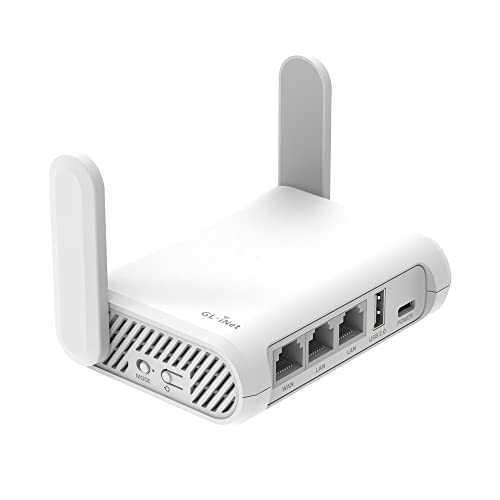
GL.iNet GL-SFT1200 Opal Travel Router — OpenWrt control pick
The Opal is the pick this guide’s introduction promised the control-minded: a pocket router — 145 grams per its listing — running OpenWrt, with AC1200 dual-band WiFi, three gigabit ports, and OpenVPN and WireGuard support spanning more than thirty VPN services. OpenWrt is the point. It is open-source router firmware with a real firewall, real package ecosystem and a web interface that assumes the owner is an adult. Behind your main router, an Opal becomes a hand-built gadget reservation: its own subnet, its own firewall rules deciding exactly which gadgets may talk to the internet, to the house, or to nothing at all.
Concrete IoT uses pile up quickly once that power is in hand. The camera that only ever needs to reach your local recorder can be forbidden the internet outright. The smart television’s gadget cousins can be given a network whose DNS you control. A VPN tunnel can wrap the whole gadget wing for the paranoid, or cover the workbench corner for the merely careful — and our wider guide to the best routers with openvpn explores that tunnel-first philosophy in depth. The Opal’s limits are the travel format’s limits: modest radios, a room-to-flat coverage footprint, and a setup experience that rewards owners who read documentation. It is also, not incidentally, a superb actual travel router, which gives the purchase a second life in a suitcase — much like the wired flexibility celebrated in our roundup of the best travel routers with ethernet ports, where pocket boxes earn their keep in hotel rooms as much as at home.
A worked example makes the value concrete. A reader-grade setup runs like this: the Opal sits behind the main router, broadcasts the gadget SSID, and holds three firewall intentions — gadgets may reach the internet, gadgets may not initiate contact with the main network, and the one recorder on the main network may be reached by the cameras and nothing else. In OpenWrt that is an evening’s honest configuration, documented in settings you can export and back up. When the Opal eventually retires, its replacement inherits the file; the architecture outlives the hardware, which is more than any app-bound router in this guide can promise.
- Standard: WiFi 5, dual-band, AC1200 class per the title
- Firmware: OpenWrt, per the title
- VPN: OpenVPN and WireGuard, 30+ services, per the title
- Ethernet: three gigabit ports, per the title
- Weight: 145 g, per the title
Strengths
- OpenWrt gives firewall and routing control no app-router here can match.
- Three gigabit ports in a pocket box make it a real wired anchor too.
- WireGuard support suits always-on tunnels for a gadget subnet.
Trade-offs
- Coverage is small-space scale; it is a wing router, not a whole-house one.
- OpenWrt’s power arrives with a documentation habit requirement.
- AC1200 radios are a generation behind the WiFi 6 picks in this guide.
Best for: hands-on owners building a firewalled gadget subnet with open-source tools. Not suited for: anyone who wants the network configured by an app in ten minutes flat.
How Should You Tune the 2.4 GHz Band for a Gadget Crowd?
However good the router, four settings decide whether the gadget wing feels solid or haunted. Channel selection comes first. The 2.4 GHz band effectively offers three non-overlapping channels — 1, 6 and 11 in most regions — and a router left on automatic in a dense street may park itself on an overlapping channel shared with two neighbours. For a gadget network, a fixed choice of whichever of the three is quietest locally beats clever automation, because sleepy devices rejoining at 3 a.m. should find the same channel landscape they left. Channel width comes second: the wide 40 MHz mode doubles headline speed and halves reliability in crowded air, while the narrower 20 MHz setting is the seasoned choice for IoT — slower on paper, steadier in a house where forty radios whisper.
Third is the legacy question. Some very old gadgets speak only early WiFi dialects, and a router configured for the newest modes exclusively can refuse them without explanation. Most current routers keep a compatibility posture by default; if a specific ancient device will not join, look for the legacy or compatibility toggle before blaming the gadget. Fourth is transmit power, the counterintuitive one: maximum power makes the router shout, but battery gadgets whisper back, and a conversation where only one side is loud still fails at range. In a small home, medium power with good placement often serves the far sensor better than full power from a worse spot — the network equivalent of moving closer instead of yelling.
None of these settings requires the expensive picks. They require a router whose interface exposes them and an owner willing to change one variable at a time, waiting a day between changes to see the effect. That discipline — change, wait, observe — is the real maintenance skill of a smart home, and it is why the client list matters so much: you cannot observe what you cannot see.
When Is the Answer a Hub Rather Than a Router?
Honesty about categories cuts both ways, so here is the boundary from the other side. If your complaint is that Zigbee bulbs respond slowly or a Thread sensor drops off its mesh, no router in this guide fixes it, because those devices are not on your WiFi at all — they live on a separate low-power mesh run by a hub or border router, and the fix lives in that mesh’s placement and density. If your complaint is that the hub itself keeps vanishing from the app, or that WiFi cameras stutter, that is IP networking again, and this guide applies. Learning to tell the two apart saves real money: roughly, if the device has its own app that talks through a little white box you plugged in once and forgot, suspect the hub layer; if it joined your WiFi password directly, suspect the router layer.
The two layers still meet in one place — the router governs the hub’s own connection to your phone and the cloud — which is why a hub given a reserved address on a stable router behaves better than the same hub adrift in a chaotic address pool. Owners building a house-scale system will end up tending both layers, and the routers above were chosen to make the IP layer the boring one, so attention can go where the interesting problems live.
How Do the Six Picks Stack Up Against Each Other?
| Pick | Best role in an IoT house | Isolation tool | Control style |
|---|---|---|---|
| Tenda RX2L Pro | Main router for a growing gadget household | Guest network and parental rules | Brand app |
| Tenda AC1200 | Dedicated second network for devices | Its own SSID plus guest WiFi | Brand app |
| LNN-AX3000 | Local-only gadget wing without accounts | Separate network under your roof | Browser, no app |
| Ubiquiti UniFi UTR | Managed outpost and gadget quarantine | UniFi network rules | UniFi platform |
| Smart-Gateway MT6000 | Main router that supervises traffic | Filtering and family-safety platform | Mobile app platform |
| GL.iNet GL-SFT1200 Opal | Hand-built firewalled gadget subnet | OpenWrt firewall and subnetting | OpenWrt web interface |
Notice what the table does not contain: a speed column. That omission is the guide’s thesis in miniature. Every pick moves gadget traffic adequately; they differ in how they let you separate, see and discipline that traffic, which is what an IoT network is actually for. If your household’s real problem turns out to be raw coverage rather than organisation, the honest sequel is a mesh conversation, and several picks above can hand over to one without waste.
How Do You Move Your Gadgets Onto Their Own Network?
The migration is a weekend job with a gentle order of operations. First, build the new network before touching a single gadget: set up the second router or the new SSID, name it clearly, and connect your phone to prove it reaches the internet. Second, move the forgiving devices — plugs, bulbs, speakers — in one batch, testing each in its app as you go. Third, move the infrastructure gadgets: hubs, bridges and cameras, checking that any local integrations still find each other, since a hub on the gadget network and a phone on the main network occasionally need a rule or a shared service to stay friendly. Fourth, and last, move anything whose failure would lock you out or leave you in the dark; keep the old network alive for a full week as a fallback before renaming or retiring it.
Two habits make the new arrangement stay healthy. Reserve addresses for the fixed infrastructure — hubs, cameras, the printer, any home server — so the map of the network survives outages and the reconnection storm always lands devices at the addresses other gadgets expect. Consumer routers call this DHCP reservation or static lease, and ten minutes spent on it prevents the classic mystery where the smart display cannot find the hub because the hub moved house numerically overnight. And keep a written inventory, even a notes-app list, of what lives on the gadget network: the day something misbehaves, future-you will be grateful that past-you wrote down which of the forty clients is the boiler sensor. Satellite-fed homes can run this exact architecture behind a dish, incidentally — the segmentation logic is identical to the one in our guide to the best starlink routers, with the gadget wing simply living behind whichever router fronts the connection.
Naming deserves its own paragraph, because it is where migrations are won. Name each device in the router’s client list as you move it — “hallway plug”, “boiler sensor”, “spare-room bulb” — rather than accepting the manufacturer’s cryptic default. Ten seconds per device during the move saves the forensic archaeology later, and a named list doubles as the inventory recommended above. Owners who skip this step own a network they cannot audit, which quietly defeats half the purpose of building the gadget wing in the first place.
What Does a Healthy Gadget Network Look Like a Month Later?
It helps to know what success feels like, because a good IoT network announces itself mostly by silence. A month after a proper setup, the signs are these. The router’s client list reads like a household inventory you recognise — every entry named, nothing anonymous lingering. Devices survive the weekly rhythm of the house: the router’s own scheduled reboot, if you use one, passes without a single gadget needing manual rescue, and the last power flicker cost you nothing but the microwave clock. New purchases join in minutes, because the pairing routine is always the same network, the same password, the same quarantine habit for anything dubious.
The security posture is similarly undramatic. Once a quarter you scroll the client list with a coffee, evict nothing because nothing unknown is there, confirm the firmware is current, and glance at which gadgets have been chattiest — occasionally discovering that a camera points at a wall and uploads its boredom all day, which is a settings fix, not a crisis. That quarterly five minutes is the entire maintenance burden of a well-built gadget network, and it is the standard against which to judge the picks: the best router for your house is the one whose management tools make those five minutes possible, whether that is Tenda’s app, UniFi’s console or OpenWrt’s unglamorous competence.
When a network falls short of this picture, the failure is almost never horsepower. It is an unnamed client list nobody trusts, an address pool sized for the house of three years ago, or gadgets scattered across three networks by historical accident. All three are organisational diseases with organisational cures, and the hardware in this guide is simply the cheapest way to buy the organisation.
What Should You Check Before Buying for a Smart Home?
Count first, and count honestly — include the gadgets still in their boxes in the garage, because they are next month’s clients. Then check your current router’s client list on its busiest evening: if half the names are unrecognisable hexadecimal mysteries, your first purchase criterion is management visibility, and the app-led picks above outrank the minimalist ones. Check the 2.4 GHz geography of your house, too. The far sensor’s problem is often a router imprisoned in a metal networking cabinet in the basement; before buying anything, try the existing router on a shelf in the open and see which complaints evaporate for free.
Finally, decide your trust posture, because it selects between the picks more than any specification does. If your view is that gadgets are appliances and the risk is theoretical, a mainstream router with a guest network is proportionate. If you have read one too many stories about a compromised camera joining a botnet, the segmentation picks — the Opal above all — convert that anxiety into architecture. Neither posture is foolish; buying the vigilant hardware and never configuring it, however, is the worst of both worlds, and it happens often enough to be worth naming here.
One more check, free and decisive: look at how the router you fancy is updated. In the listings and the makers’ pages, look for any statement of automatic firmware updates or a visible update history. A gadget network is a long-lived thing — the router you buy this year will guard devices that have not been invented yet — and a vendor who publishes updates visibly is telling you something true about the next five years. Silence on the subject is also information, and it should weigh accordingly.
What Mistakes Do Smart-Home Owners Make With Routers?
The classic error is band steering naivety: a single combined network name with aggressive steering enabled, and a fleet of 2.4 GHz-only gadgets that pair badly, drop often, or refuse setup entirely because the phone doing the pairing sits on 5 GHz. The fix is a dedicated 2.4 GHz-friendly SSID for gadgets — which the architectures in this guide all provide one way or another. Second comes password-change amnesia: rotating the main WiFi password for good security reasons and spending a weekend re-pairing thirty devices. A separate gadget network with its own rarely-changed password quarantines that chore, which is an underrated argument for segmentation all by itself.
Third is the gadget-count surprise — the router that coped at twenty devices and sags at sixty, discovered the week the smart lighting project finishes. Fourth is hub confusion: buying a smart-home hub expecting it to improve WiFi, or blaming the router for a Zigbee mesh problem that lives on an entirely different radio. And fifth, quietly, is ignoring firmware: an unpatched router guarding forty gadgets is a fence with the gate open, so whichever pick you choose, enable its automatic updates where offered and check in quarterly where not. Café owners face the mirror image of several of these problems with customer devices, handled in our guide to the best routers for cafes.
A sixth mistake belongs to the security-conscious specifically: building the gadget wing and then bridging it back into usefulness — a rule here, an exception there — until the fence is mostly gate. Segmentation works because the default is no; every permitted path should be a deliberate, written-down exception for a named device, like the camera-to-recorder path discussed in the questions below. If the exceptions list grows past what you can recite, the architecture has quietly become decorative, and the honest move is to simplify the rules rather than add more.
Final Recommendation
For most smart homes, the Tenda RX2L Pro is the sane centre of gravity: current WiFi, gigabit ports, WPA3 and an app that keeps the gadget crowd legible, bought once and thought about rarely. Grow into the problem in stages from there. Add the older Tenda AC1200 or the LNN-AX3000 as a dedicated gadget wing when isolation starts to matter more than elegance, choosing between them on whether you prefer an app or a browser and no account. Step up to the GL.iNet Opal when you want the fence built by hand with OpenWrt rules, to the UniFi UTR when your house already speaks UniFi and needs a quarantine outpost, and to the MT6000 when the wish is for one full-size router that watches the whole menagerie itself. The through-line of every route is the same: your gadgets deserve a network designed for their peculiar patience and their peculiar risks — and once they have it, the smart home stops feeling haunted and starts feeling merely, blessedly, automatic.
Frequently Asked Questions
Do I really need a separate network for smart devices?
Need is strong, but the case is practical as much as protective. A separate SSID or second router isolates gadget failures, survives main-network password changes without a re-pairing marathon, and keeps a compromised gadget away from your computers. Many households start with the guest network they already own and graduate to a dedicated wing when the gadget count climbs.
Why do my smart devices only use 2.4 GHz?
Because their makers chose reach and cheap radios over speed they would never use. A sensor sending a few bytes an hour gains nothing from 5 GHz and loses the wall-penetrating range that 2.4 GHz offers. The consequence for you is that 2.4 GHz quality — placement, channel crowding, client patience — is the true IoT specification of any router.
How many devices can a home router actually handle?
Fewer than the box art implies and more than most homes need, with the real limit set by addressing, memory for the client table and how chatty the devices are. Only one pick in this guide prints a figure — the LNN’s 20+ — and we treat all such numbers as orientation, not engineering. A house heading toward a hundred clients should plan segmentation for manageability regardless of any single router’s ceiling.
Will a travel router really run part of my home network?
Yes, within its footprint. The UniFi and GL.iNet picks are small because they are built for a room or a flat, and that is exactly the scale of a gadget wing, a workbench or a quarantine corner. Asking one to cover a whole large house misreads the product; asking it to govern thirty gadgets in its zone is precisely its talent. Many owners buy one for a trip, come home, and find the gadget-wing job waiting for it — the second career is often the more valuable one.
Does WPA3 matter for old smart gadgets?
Indirectly. Many older gadgets predate WPA3 and connect under compatibility modes, so the practical question is whether a router handles a mixed-security crowd gracefully — current routers like the RX2L Pro, which states WPA3 in its listing, are built with that mixed crowd in mind. The upgrade protects your modern devices fully and your old ones as far as they allow.
Should smart cameras live on the gadget network too?
Generally yes, with one consideration. Cameras are among the chattiest and least trusted devices in a smart home, so the gadget wing suits them; but if you run a local recorder on the main network, the camera needs a permitted path to it, which the segmentation picks handle with a rule and the guest-network picks may not. Decide where recordings live first, then place the cameras on whichever network can lawfully reach the recorder.
What is a reconnection storm, and why should I care?
It is the moment after a power cut when every gadget in the house reconnects simultaneously, demanding addresses and attention at once. Routers with cramped address pools and fragile client tables stumble exactly then, leaving a trail of half-connected devices. Headroom and boring stability — this guide’s recurring virtues — are what carry a network through that minute.
Related Guides
Continue with our guide to the best wifi routers parental controls when the gadget network also has to referee children, the best routers with openvpn for the tunnel-building philosophy behind the Opal, and the best affordable routers with vpn support if the budget version of that control is the priority.
Homes that feed a device crowd through a satellite link face a different bottleneck entirely, covered in our roundup of the best starlink routers.


