What's inside
- Key Takeaways
- Quick Picks
- What Separates a Premium Portable From a Merely Expensive One?
- What Do the Best High End Portable Bluetooth Speakers Do With a Room?
- Side by Side: Where Does Each Premium Actually Go?
- How Do You Set Up a Flagship Portable for a Party, a Film Night and a Quiet Sunday?
- Which Details Deserve a Second Look Before the Premium Is Paid?
- How Long Does a Premium Portable Stay Premium?
- When Is the Honest Answer to Buy a Tier Down?
- How Do You Carry, Charge and Store a Flagship Through a Real Trip?
- When Is a Stereo Pair Worth More Than One Bigger Cabinet?
- What Do Buyers Most Often Get Wrong at This Tier?
- Can You Hear the Difference Before You Pay for It?
- Final Recommendation
- Frequently Asked Questions
- Related Guides
As an Amazon Associate I earn from qualifying purchases. This post may contain affiliate links at no extra cost to you.
gizmoverdict.com is reader-supported. When you buy through links on our site, we may earn an affiliate commission.
Where to buy: The best high end portable bluetooth speakers justify their tier with some combination of scale, materials, battery endurance and design intelligence that ordinary portables do not attempt — and the six picks below were chosen on those terms, including one flagship that appears without a link because its verified listings are renewed stock. Each linked pick goes to the listing we checked, and no prices or star ratings appear anywhere in this article.
“High end” needs defining before it needs shopping, because portable audio’s premium tier is not simply louder versions of cheap speakers. At this level the money buys four things in varying proportions. It buys acoustic scale: bigger drivers, real stereo separation, and low end that survives the move outdoors. It buys endurance and hardware: batteries measured in days of use, handles and straps designed for actual carrying, sealing that shrugs off weather. It buys materials and design — the difference between a plastic box that happens to play music and an object a household is pleased to have in the room. And it buys longevity of relevance: inputs, charging standards and build quality that keep the speaker current while lesser units cycle through drawers.
The five linked picks divide that premium four ways, and the sixth pick — Ultimate Ears’ big-room flagship — is discussed in full but deliberately unlinked, because both listings we verified for it are renewed stock. Renewed flagships are a real route into this tier and this guide treats them honestly: the merits get their paragraphs, the caveat gets its own, and the purchase button stays off until a reader has weighed both.
Key Takeaways
- The premium in this tier buys scale, endurance, materials and relevance — judge each pick by which of the four it spends on, not by a single ladder.
- The Bose SoundLink Max and JBL Xtreme 4 are the outdoor athletes: IP67 on the Bose as titled, up to 24 hours plus a Playtime Boost mode on the JBL as titled.
- The Marshall Tufton spends its premium on analogue control and presence — physical bass and treble knobs, 20-plus hours, and a guitar-amp silhouette.
- The Bang & Olufsen Beosound A5 spends its premium on design and modularity, including wireless charging and a build meant to be serviced and kept.
- The Ultimate Ears Hyperboom is covered as a prose-only pick: its verified listings are renewed stock, so it carries no link and a clearly stated caveat.
- The Sony ULT Field 7’s listing title describes a stereo-pair configuration — confirm exactly what the listing includes before ordering.
Quick Picks
| Pick | Badge | Why it earns its place |
|---|---|---|
| Bose SoundLink Max | Best premium all-rounder | Party scale with an audiophile’s manners: IP67, a rope handle, up to 20 hours and a wired AUX input for sources Bluetooth forgot. |
| JBL Xtreme 4 | Best endurance athlete | Up to 24 hours of playtime plus 6 more with Playtime Boost, a shoulder strap and waterproofing for the longest days out. |
| Marshall Tufton | Best analogue soul | Bass and treble controls on the cabinet, 20-plus hours, and a stage-amp design that sounds as deliberate as it looks. |
| Bang & Olufsen Beosound A5 | Best design object | Nordic Weave finish, modular construction and wireless charging — the speaker as furniture that happens to be loud. |
| Sony ULT Field 7 | Best bass-forward party unit | Sony’s ULT line flagship portable with fast pair and multipoint — read the listing’s stereo-pair wording carefully before ordering. |
| Ultimate Ears Hyperboom | Prose-only — renewed listings | The big-room UE flagship, presented without a link because both verified listings are renewed stock. |
What Separates a Premium Portable From a Merely Expensive One?
The screening test was subtraction: remove the badge, the finish and the launch story, and ask what remains that a mid-tier speaker cannot do. What survived, pick by pick, was never a single trick. It was a pattern — output with composure rather than mere loudness, batteries that change how the speaker gets used rather than how it gets advertised, sealing and hardware that survive the life the marketing photographs depict, and at least one idea (a modular build, an analogue control set, a wired input, a boost mode) that shows a design team thinking past the spec sheet. Premium pricing without that pattern is just pricing, and several famous names failed this test and are not on this page.
One more filter was honesty about configuration and condition. A listing whose title describes a stereo pair must be read as a configuration to verify, not assumed to be a single unit; a flagship available only as renewed stock must be labelled as such rather than linked in silence. Both cases occur in this guide, both are flagged in their sections, and both are exactly the kind of detail that separates a buying guide from a catalogue.

Bose SoundLink Max — Best premium all-rounder
Bose’s largest SoundLink is what happens when a company known for restraint decides to build the big one. The title’s inventory is confident: a portable wireless party speaker with IP67 waterproofing, a rope handle, up to 20 hours of playtime, USB-C charging and a built-in 3.5mm AUX input. Read that list as a design philosophy. The sealing and handle say the speaker is meant to live outdoors during events rather than visit them; the endurance says the event can be a weekend; and the AUX socket — a small, unfashionable, deeply practical inclusion — says Bose expects this speaker to serve sources and situations that wireless planning did not foresee.
What the premium buys here, beyond the checklist, is composure at scale. Lesser party speakers achieve volume by shouting; the Max’s party trick is sounding unhurried at levels that fill a terrace, with low end that stays shaped rather than bloated when the music turns bass-heavy. That quality is hard to print in a spec box and easy to hear in the second hour of a party, when shouty speakers have become tiring and this one is still being turned up by guests rather than down. The rope handle, meanwhile, is honest engineering for a speaker of this size — it will be carried between house, garden and car boot weekly, and it is built to be.
Its compromises are the all-rounder’s usual ones. It is not the design object the B&O is, not the endurance champion the JBL claims on paper, and not the analogue experience the Marshall offers; it simply has no weak leg, which at this tier is a rarer achievement than any single superlative. Households buying one premium portable to do everything — parties, garden days, kitchen duty, the occasional event — should start their reading here and make the others argue them away from it.
- Format: portable wireless party speaker, single unit, black
- Battery: up to 20 hours of playtime as titled, USB-C charging
- Sealing: IP67 waterproof as titled
- Inputs: Bluetooth plus built-in 3.5mm AUX input as titled
- Carrying: rope handle as titled
Strengths
- Composure at party volume — the premium quality that survives the second hour.
- The AUX input rescues legacy sources, laptops and DJ controllers without adapters or pairing.
- IP67 sealing plus a proper handle make it genuinely event-proof, not just event-marketed.
Trade-offs
- Party scale means party size; it is carried deliberately, not grabbed absent-mindedly.
- Its styling is functional rather than decorative — the room-dressing brief belongs to the A5.
- Twenty hours is strong, yet the Xtreme 4’s titled endurance plus boost mode outlasts it on paper.
Best for: one-speaker households that host real gatherings and want premium sound without a fragile or fussy object.
Not suited for: design-led interiors wanting a statement piece, or listeners who prioritise the longest possible battery above balance.

JBL Xtreme 4 — Best endurance athlete
The Xtreme 4’s title leads with scale — next-level massive JBL Pro Sound — and follows with the figure that defines it: up to 24 hours of playtime, plus 6 hours more with Playtime Boost, in a waterproof portable with a convenient shoulder strap. Thirty potential hours is not a marginal improvement on the class; it is a change of category. A speaker that plays for thirty hours stops being planned around. It goes to the lake house on Friday and comes home on Sunday still playing; it covers the festival weekend, the long build project, the garden party that becomes two garden parties.
Playtime Boost deserves an honest gloss: boost modes in this class typically trade some sound processing — a leaner low end, chiefly — for endurance, which is the right trade at hour twenty-five of a weekend when the alternative is silence. The shoulder strap, like the Bose’s rope handle, signals intended use: this is a speaker designed to be carried across fields and beaches by one person whose other hand is occupied. JBL’s party lineage also brings the ecosystem habits — linking with compatible speakers — that the listing and manual detail better than a generalisation; buyers planning a pair should confirm compatibility between exact models.
Against the Max, the Xtreme 4’s argument is stamina and a brasher, more exuberant tuning that suits outdoor crowds; the Bose counters with its wired input and a slightly more domesticated composure. Neither is the design piece, and neither pretends to be. If your premium portable’s defining scenes are outdoors and long, the JBL’s title makes the strongest endurance claim in this guide, and the speaker is built like it intends to keep it.
- Format: portable waterproof speaker with shoulder strap, black
- Battery: up to 24 hours of playtime, plus 6 hours with Playtime Boost, as titled
- Sound: massive JBL Pro Sound as titled
- Sealing: waterproof as titled; numeric grade not stated in the listing title
- Inputs: no wired input stated in the listing title — verify on the listing if a cable feed matters
Strengths
- The longest titled endurance here, with a boost mode that extends a weekend into a long weekend.
- A shoulder strap that makes its size a one-person carry across real distances.
- Outdoor-first tuning and build — this is the pick that expects weather and crowds.
Trade-offs
- Boost-mode endurance trades some low-end fullness; the fullest sound lives in the standard mode’s hours.
- No wired input is stated in the title — a small but real gap beside the Bose’s AUX.
- Its exuberant party character is less at home in a quiet, design-led living room.
Best for: long weekends, big outdoor days, festivals, work sites and hosts whose parties outlast ordinary batteries.
Not suited for: interiors-first buyers, or anyone who needs a confirmed wired input from the title alone.

Marshall Tufton — Best analogue soul
The Tufton is the premium portable for people who distrust menus. Its title promises loud stereo sound with bass and treble controls, 20-plus hours of playtime, a design for indoors and outdoors, and a 3.5mm aux input — and the soul of the product is in those physical controls. Knobs you can turn, mid-song, with your eyes closed, to make the music warmer or brighter for the room you are actually in: that is an interaction model the app era abandoned, and the Tufton demonstrates nightly why it should not have. The guitar-amplifier silhouette — black and brass, grille cloth, script badge — is not a costume on top of that idea; it is the same idea expressed visually, that a speaker is an instrument-adjacent object with a presence.
Stereo is the other quiet headline. Most portables in this guide fire from one cabinet in one direction and call the result whatever marketing allows; the Tufton’s title claims loud stereo sound, and its multi-directional design philosophy — sound thrown toward more than one face of the cabinet — gives a room-filling effect that suits its indoor-outdoor brief. Set in the middle of a gathering rather than against a wall, it behaves less like a loudspeaker and more like a small stage. Twenty-plus hours of titled playtime keeps that stage lit for a full day and evening.
The trade-offs are characterful ones. There is no waterproofing claim in the title — indoors and outdoors here means the terrace and the garden party, not the poolside or the downpour, and buyers should confirm weather details on the listing before planning a wet life for it. It is also a substantial object that dresses a room whether the room asked or not. For households whose taste runs to vinyl, valves and objects with knobs, those are not compromises at all; they are the entire point, and no other pick on this page is competing for that heart.
- Format: portable Bluetooth speaker, black and brass
- Sound: loud stereo sound with bass and treble controls as titled
- Battery: 20+ hours of playtime as titled
- Inputs: 3.5mm aux input as titled, plus Bluetooth
- Sealing: designed for indoors and outdoors as titled; no waterproof grade stated in the listing title — verify weather details on the listing
Strengths
- Physical bass and treble knobs — sound shaped by hand, mid-song, without a phone.
- Stereo, room-filling presentation that flatters indoor listening as much as garden duty.
- An aux input for turntables, laptops and older sources, matching its analogue philosophy.
Trade-offs
- No waterproof grade in the title — wet-weather confidence must be verified, not assumed.
- The stage-amp styling is a strong flavour; minimalist rooms may find it insists on being looked at.
- Its talents peak at gatherings and listening sessions rather than poolside or beach punishment.
Best for: listeners who shape sound by ear and hand, and rooms that welcome an object with presence.
Not suited for: poolside duty, minimalists, or buyers who want app-driven everything.
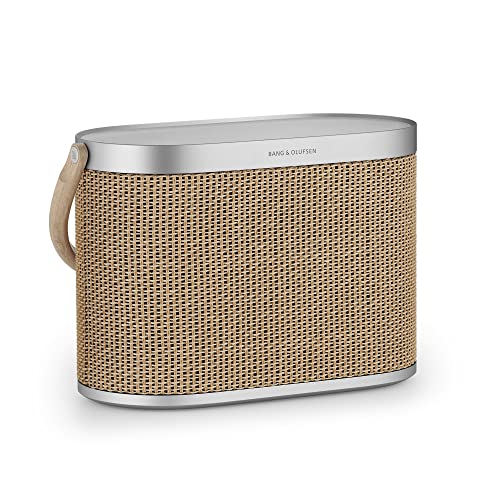
Bang & Olufsen Beosound A5 — Best design object
The Beosound A5 asks a question the other picks do not: what if a portable speaker were designed like furniture — to be kept, serviced and lived with for a decade — rather than like electronics? Its title’s vocabulary is the tell: a portable Bluetooth speaker in a Nordic Weave finish, modular, with wireless charging, loud sound for home and outdoors, long battery life and premium audio. Modular is the word to underline. A speaker whose parts can be replaced and updated is a speaker arguing against the disposable cycle of its whole category, and that argument, plus the materials, is where much of its premium lives.
Wireless charging belongs to the same philosophy: the A5 is meant to rest in the home like a lamp or a chair, topping itself up where it sits, then lift by its handle and go out into the garden as a genuinely portable, genuinely loud speaker. That dual citizenship — furniture at rest, portable in motion — is the hardest brief in this guide, and the A5 is the only pick attempting it at this level of design intent. Its sound is voiced for rooms first: refined, spacious, confident at the moderate volumes beautiful rooms prefer, with enough in reserve for the terrace.
The honest costs are the tier itself and a certain delicacy of expectation. This is the guide’s most premium commitment in qualitative terms, and its woven finish and crafted details ask for a household that treats objects well — it will survive a garden, but it was not designed to be kicked around a building site like the Xtreme. Buyers who equate premium with punishment-proof should look at the athletes above; buyers who equate premium with permanence, materials and design intelligence are looking at the category’s clearest statement of that philosophy.
- Format: portable Bluetooth speaker, Nordic Weave finish
- Design: modular construction as titled — built to be serviced and kept
- Charging: wireless charging as titled, plus conventional charging per the listing
- Battery: long battery life as titled; a specific hour figure is not stated in the listing title — verify on the listing
- Use: loud sound for home and outdoors as titled
Strengths
- Modularity and materials make it the only pick here arguing for a decade of ownership.
- Wireless charging suits its furniture-at-rest life — always topped up, always ready to carry out.
- Design that a room can be built around rather than hidden from.
Trade-offs
- The premium tier’s peak, in qualitative terms — this is a considered purchase, not an impulse.
- Not the punishment pick: building sites, boats and beach storms belong to the sealed athletes.
- No hour figure in the title, so endurance comparisons start with a listing check.
Best for: design-led homes that buy audio rarely and keep it long, listening indoors and on the terrace.
Not suited for: rugged outdoor duty, or buyers whose premium must be measured in battery hours and decibels.

Sony ULT Field 7 — Best bass-forward party unit
Sony’s ULT line is the company’s bass-forward party family, and the Field 7 — listed as the SRSULT70 — is its flagship portable: the title cites X-Balanced speaker design, Bluetooth fast pair, and multipoint connection. Fast pair and multipoint are the unglamorous features that decide weekday satisfaction: the speaker connects to the household’s phones without ceremony, and can stay paired to two devices at once, so the laptop’s film and the phone’s playlist stop fighting over a single connection. In a premium guide full of grand claims, those two conveniences will be used more than any other feature on this page.
The ULT identity centres on low end — the line exists for listeners who feel that portable speakers apologise for bass — delivered through Sony’s X-Balanced driver approach, which aims for punch with clarity rather than boom for its own sake. As the party pick of a house that also lives with its speaker daily, that balance matters: bass-forward at the barbecue, composed at the kitchen counter. Buyers should bring one piece of listing literacy to this pick, flagged plainly: the listing title describes this offering with stereo-pair wording and a two-item note, so confirm exactly what configuration and quantity the listing includes before ordering, and do not assume a single-unit box.
Read with that care, the Field 7 is the pick for the household whose listening is social and bass-led — parties where the low end is the entertainment, film nights that borrow the speaker for the television, and a daily life eased by fast pairing. It is less the design object than the A5 and less the sealed athlete than the Max or Xtreme; its premium is spent on sound character and connection manners, which for many households is the correct shopping list.
- Format: wireless portable speaker, black — listing title describes a stereo-pair configuration; verify contents before ordering
- Sound: X-Balanced speaker design as titled; ULT line bass-forward character
- Connectivity: Bluetooth fast pair and multipoint connection as titled
- Battery: endurance figure not stated in the listing title — verify on the listing
- Sealing: not stated in the listing title — verify weather details on the listing
Strengths
- Fast pair and multipoint remove the daily friction that makes households stop using good speakers.
- Bass-forward ULT character with clarity ambitions — party sound that survives weekday duty.
- Sony’s ecosystem and support stand behind a flagship-tier purchase.
Trade-offs
- The listing’s stereo-pair wording demands a careful read — know what is in the box before paying.
- Key figures (battery, sealing) are absent from the title and must be verified on the listing.
- Bass-led tuning is a taste; listeners who prefer neutrality should audition the Bose first.
Best for: bass-led party households that also live with their speaker daily and juggle several source devices.
Not suited for: buyers wanting every specification confirmed in the title, or a design-object purchase.
Ultimate Ears Hyperboom — Prose-only: the renewed flagship route
The Hyperboom is Ultimate Ears’ big-room flagship — the largest, most powerful speaker the maker of the shower-guide’s little WONDERBOOM has produced, built to fill serious indoor spaces and to anchor gatherings that have outgrown every portable in the UE line below it. On merit it belongs in any high-end portable conversation: it is the UE faithful’s flagship, with the scale to serve as a home’s main party system rather than an accessory to one. It is presented in this guide without a purchase link, for one stated reason: both listings we verified for it are renewed stock.
Renewed, at flagship level, deserves a fuller explanation than a label. A renewed Hyperboom will typically be a returned or refurbished unit, checked and resold at a gentler tier than its new price — which, for a speaker whose new tier sits at this guide’s premium end, is a meaningful difference. What varies is everything a title cannot tell you: the unit’s cosmetic state, its battery’s history, the exact warranty and returns terms its seller offers. None of that makes the route wrong. It makes it a route for deliberate buyers — the kind who read seller terms the way this guide reads titles, confirm the return window, and accept a measure of unit-to-unit variation in exchange for flagship scale at a renewed tier.
Who should take the route? The UE loyalist whose home already runs on the brand’s smaller speakers and who wants the flagship’s room-filling step up; the value-minded host equipping a big room for parties a dozen times a year; the buyer for whom a new flagship’s tier is the only obstacle. Who should not: gift buyers, event professionals whose reputation rides on the night, and anyone who wants the manufacturer’s new-unit warranty without fine print. For the first group, the Hyperboom renewed is this tier’s open secret; for the second, the linked flagships above exist precisely to remove the question marks.
- Format: flagship portable party speaker — the largest in its maker’s line
- Availability: both verified listings are renewed stock — presented without a link for that reason
- Role: big-room and large-gathering sound, the step beyond its maker’s smaller portables
- Battery and sealing: verify figures against the specific renewed listing, which may vary by seller
- Purchase route: renewed channels with clear refurbishment, warranty and returns terms
Strengths
- Flagship scale from a beloved portable line — the big-room answer in the UE ecosystem.
- Renewed availability can place that scale at a gentler tier than any new flagship here.
- A proven party-system design with a long owner community behind it.
Trade-offs
- Renewed means prior life: condition and battery history vary by unit and seller.
- Warranty and returns need active verification rather than assumption.
- No link is offered by design — the fine print is part of this purchase, and it must be read.
Best for: UE loyalists and value-minded hosts who buy renewed deliberately, with the checks described above.
Not suited for: gift purchases, mission-critical events, or buyers who want a new-unit warranty in one click.
What Do the Best High End Portable Bluetooth Speakers Do With a Room?
A premium portable leads two lives, and the room is the harder audience. Outdoors, any competent big speaker sounds impressive for the first ten minutes, because open air forgives roughness and novelty does the rest. Indoors, the same speaker sits in a reflective box with corners that hoard bass, furniture that swallows treble, and listeners close enough to hear every shortcut in the tuning. This is where the money in this guide either proves itself or evaporates. The picks that earn their tier indoors share a trait that rarely appears in marketing: restraint at moderate volume. A speaker voiced only for maximum output tends to sound thick and restless at the levels a kitchen or study actually uses, while the better designs here stay articulate when turned down, which is most of a domestic speaker’s working life.
Placement decides more of the indoor result than any feature list. A large portable pushed into a corner gains free low end and loses clarity in the same move; the same unit pulled a forearm’s length into the room, sitting on something solid rather than a rattling shelf, usually sounds like a class upgrade that cost nothing. The Tufton makes this game easiest, because its physical bass and treble controls let a listener correct for a boomy corner or a dead, carpeted room by hand, in seconds, while listening. The Beosound A5 plays a different room game entirely: it is designed to live in one beautiful spot, charged and ready, sounding refined at conversational levels and looking like it belongs there. The athletes — the SoundLink Max and the Xtreme 4 — are happier moving, and their indoor virtue is headroom: at a party they stay composed long after smaller speakers start to strain.
There is also a stereo question hiding inside every single-cabinet purchase. One cabinet, however good, delivers its sound from one point, and the Field 7’s listing — written in stereo-pair terms — is a reminder that some households would rather have two points of sound than one louder one. Listeners who mostly sit in one chair, in one room, facing the music, should weigh that geometry honestly: a pair of smaller speakers placed apart can image in a way no single flagship can, while a household that carries its music from room to garden to holiday house gets more from one substantial unit that travels. Neither answer is the premium one in the abstract; the premium answer is the one matched to where the listening actually happens.
Side by Side: Where Does Each Premium Actually Go?
| Pick | Premium spent on | Endurance as titled | Wired input | Best habitat |
|---|---|---|---|---|
| Bose SoundLink Max | Balance: scale, sealing and composure in one unit | Up to 20 hours | 3.5mm AUX, stated in the title | Terraces, gardens, event duty |
| JBL Xtreme 4 | Stamina and outdoor scale | Up to 24 hours, plus 6 with Playtime Boost | Not stated in the title | Long weekends, fields, beaches |
| Marshall Tufton | Analogue control and stereo presence | 20+ hours | 3.5mm aux, stated in the title | Listening rooms, garden gatherings |
| Bang & Olufsen Beosound A5 | Materials, modularity and design permanence | Long battery life; figure not stated in the title | Not stated in the title | Design-led homes, terraces |
| Sony ULT Field 7 | Bass character and connection manners | Not stated in the title | Not stated in the title | Party houses, multi-device homes |
| Ultimate Ears Hyperboom | Big-room flagship scale, via renewed stock | Varies by renewed listing | Verify on the specific listing | Large rooms, big gatherings |
Read the table as a map of intentions rather than a league table. Every pick is the wrong purchase for somebody: the Xtreme 4’s stamina is wasted on a speaker that never leaves a flat; the A5’s craftsmanship is wasted on a building site; the Tufton’s knobs are wasted on a household that streams everything and touches nothing. The most useful column is the last one. Premium portables fail their owners not by sounding bad but by being bought for a habitat they were not designed for, and the habitat test — where will this speaker spend eighty percent of its hours? — eliminates more wrong choices than any listening test.
How Do You Set Up a Flagship Portable for a Party, a Film Night and a Quiet Sunday?
Start with the party, because it exposes every weakness. Charge the speaker fully the day before, not the morning of, so a forgotten cable cannot shrink the evening. Place it at roughly ear height when standing — on a sturdy table or stand, not the ground, where legs and furniture eat the sound and the low end couples into the floor. Keep it a little away from walls unless the room is large and the crowd bigger; a gathering of bodies absorbs sound, so a placement that seemed loud in an empty room at noon will feel right at nine in the evening. Decide the source in advance: one phone, one playlist, one person in charge. Premium speakers make pairing easy, and easy pairing makes a party’s music a tug-of-war unless the household agrees beforehand whose device is the evening’s jukebox. The Field 7’s multipoint connection helps here in a specific way — a laptop and a phone can both stay connected, so the film clip someone wants to show does not require a pairing ceremony.
Film night asks for the opposite virtues: closeness, dialogue clarity and a wired feed where one exists. Bluetooth latency varies, and while modern speakers handle video well, the Bose and the Marshall offer the belt-and-braces answer in their AUX inputs — a cable from the television or laptop removes lip-sync doubt entirely. Set the speaker centred under or beside the screen, lower the volume below party instinct, and let the restraint these designs are good at do the work; dialogue lives in the midrange, and the premium tuning in this guide earns its keep precisely there. For the Tufton, a small treble lift from the knob can sharpen voices in a soft-furnished room without touching a menu.
The quiet Sunday is the test nobody advertises and everybody lives. Background listening at low volume reveals whether a big speaker can whisper: some party designs sound thin and bored when turned down, their tuning built for distance. Play something familiar at conversation level while setting up; if the music holds together — bass present but polite, voices natural — the speaker will serve daily life, not just events. Finish every use with the same small ritual: wipe grit and moisture from the cabinet, coil the charging cable loosely, and store the speaker where it will actually be grabbed next time. Premium hardware dies of neglect in cupboards more often than of parties.
Which Details Deserve a Second Look Before the Premium Is Paid?
Charging is the first, because it decides whether a flagship is a pleasure or a chore by its second year. USB-C, stated in the SoundLink Max’s title, means the speaker drinks from the same cables as the household’s phones and laptops; proprietary chargers mean one more brick to lose before a holiday. The A5’s wireless charging answers the same problem from the furniture side — a speaker that tops itself up where it sits is a speaker that is never found empty. Ask, for any pick, what a full charge costs in time and what a forgotten charger costs in options, and weight the answer by how far the speaker travels.
Inputs are the second look. Bluetooth is universal now, which is exactly why the wired sockets on the Bose and the Marshall matter: they are the difference between a speaker that serves only the streaming present and one that also serves the turntable, the old laptop, the projector and the DJ controller. Buyers with any legacy source they love should treat a stated AUX input as a premium feature in its own right, not a footnote. Conversely, the Field 7’s fast pair and multipoint are premium features of the wireless kind, worth real money to a household juggling devices — and worth nothing to a single-phone listener, which is the recurring lesson of this tier: pay for the conveniences your household will use weekly, not the ones that photograph well.
The third look is configuration literacy, and this guide’s own picks supply both lessons. The Field 7’s title speaks of a stereo pair and two items; the Hyperboom’s verified listings are renewed. Neither fact is a trick, and both are printed in plain sight — yet each changes what arrives and what it is worth. Read the exact title, the exact contents line and the exact condition before paying flagship money for anything, and treat a guide that flags these things, as this one does, as doing the job a catalogue cannot.
How Long Does a Premium Portable Stay Premium?
The honest answer is that the battery decides. Every lithium cell in this guide is ageing from its first charge, and a flagship’s fifth year depends less on its drivers — which barely age at all — than on how its battery was treated and whether its maker designed for service. The A5’s modularity is the strongest longevity argument here: a speaker built to be opened, repaired and updated is a speaker whose maker expects it to be kept. For the sealed athletes, longevity is a habits game. Avoid storing any of them fully flat or baking in a hot car; top up before long storage; and remember that endurance figures quoted when new will soften gradually, which is another reason the Xtreme 4’s generous titled hours matter — a battery that starts with headroom stays useful longer.
Software and standards age more kindly. Bluetooth is backward compatible in the ways that matter for music, USB-C is settled, and a 3.5mm socket will outlive every wireless standard in this article. The greater risk is cosmetic and mechanical: straps fray, rope handles wear, woven finishes mark. None of that should frighten a buyer — it should steer the choice. A speaker destined for boats and building sites should be the one whose wear looks like character, the sealed JBL or Bose; a speaker destined for a beautiful room should be the one designed, like the A5, to be maintained rather than merely endured. Premium, in the end, is not the absence of ageing. It is ageing at a pace and in a manner the owner finds acceptable.
When Is the Honest Answer to Buy a Tier Down?
More often than this tier’s marketing admits. A listener whose portable lives on a kitchen counter, playing radio and podcasts at modest volume, will hear almost none of what this guide’s premiums buy — the scale, sealing and stamina are solutions to problems a counter never poses. A household that hosts twice a year should ask whether two rentals, or one mid-tier speaker, serve those evenings better than a flagship that spends fifty weeks as furniture it did not choose for looks. And a buyer whose real constraint is a small flat’s thin walls will find that every pick here has output they are forbidden to use; the money is better spent on the tier below and on the neighbours’ goodwill.
The tier earns its money under specific, nameable conditions: gatherings that regularly outgrow small speakers, outdoor spaces large enough to swallow lesser output, listening habits serious enough to hear composure at volume, and ownership horizons long enough for build quality and serviceability to pay their dividend. If two or more of those describe your household, the premium is not indulgence — it is the correct tool bought once. If none do, the bravest sentence in any buying guide applies: the best high end portable bluetooth speakers are superb, and they are not for you, yet.
How Do You Carry, Charge and Store a Flagship Through a Real Trip?
A premium portable earns its keep on trips, and trips are where premium hardware gets dropped, soaked and left in hot cars. Pack the speaker as the working equipment it is: in the middle of the luggage, wrapped in something soft, with its charging cable in the same bag rather than a different one that may not arrive. The athletes in this guide were built for the journey — a rope handle and a shoulder strap are not styling, they are admissions that these speakers will be carried across car parks and fields by people whose hands are full. Use them, and keep a carabiner or strap loop in the kit for the fence post, branch or beach shelter that becomes the day’s speaker stand.
Charging discipline on the road is simple and widely ignored. Charge fully the night before departure, top up during the long drive or the slow afternoon rather than in a panic before the evening, and never leave any lithium speaker baking in a closed car — heat is the fastest honest way to shorten a flagship’s life. A USB-C pick like the SoundLink Max simplifies all of this, drinking from the same charger as the phones; a speaker with its own brick demands that the brick be treated as part of the speaker, labelled and packed with it. At the destination, agree the speaker’s home — one shelf, one socket — so it is charged where it sleeps and found where it was left. Households lose more premium portables to holiday chaos than to any defect, and the fix is a habit, not a purchase.
When Is a Stereo Pair Worth More Than One Bigger Cabinet?
The Field 7’s listing raises the question in this guide’s own pages, and it deserves a straight answer. Two speakers placed apart do something no single cabinet can: they build a soundstage, a sense that voices and instruments occupy positions in space, which flatters music listened to attentively from a favourite chair. For that listener, in that room, a pair of capable smaller speakers can be the more musical purchase, and the stereo-pair wording on Sony’s listing speaks directly to them. The costs are practical rather than sonic: two units to charge, carry, store and keep in step, and a pairing routine that must survive guests, updates and the occasional sulky connection.
One big cabinet wins the other life — the mobile one. It is a single object to grab, a single battery to manage, a single point of sound that serves a crowd gathered around it rather than a listener seated before it. Parties, gardens, trips and multi-room households belong to the single flagship; dedicated listening corners belong to the pair. The mistake is buying one geometry for the other geometry’s life, and it is an expensive mistake at this tier precisely because both answers sound superb in their own setting. Decide by picturing the speaker’s ordinary Tuesday, not its grandest Saturday: the Tuesday is where the money is spent, and the geometry that serves it is the right one.
What Do Buyers Most Often Get Wrong at This Tier?
The commonest mistake is shopping by the single loudest demonstration. A speaker that wins a thirty-second volume contest in a shop has proven one thing, while ownership asks about the second hour, the low-volume morning and the rainy afternoon. Judge candidates at the volumes and distances of your own rooms, with your own music, for longer than feels polite. The second mistake is ignoring the title’s fine print — assuming a configuration, a quantity or a condition that the listing never promised. This guide flagged a stereo-pair wording and a renewed-only flagship among its own six picks; the wider market is full of both, usually unflagged.
Third, buyers pay for the wrong premium: stamina they will never spend, sealing for weather the speaker will never meet, design for rooms it will never sit in. The habitat question from the comparison section is the antidote. Fourth, they forget the ecosystem of small costs and frictions around a flagship — the charger it needs, the case a traveller will want, the second device fighting for its connection. None is large; together they decide whether a premium speaker is used daily or admired monthly. Finally, gift buyers reach for the renewed flagship because the tier looks generous — and hand the recipient the fine print along with the ribbon. Renewed is a deliberate buyer’s route, as the Hyperboom section argues; it is not a gift strategy.
Can You Hear the Difference Before You Pay for It?
Yes, if the audition is honest. Take three tracks you know by heart — one voice, one bass line, one recording with real space in it — and play them at the volume your room actually uses, from the chair you actually sit in, for longer than a shop assistant finds comfortable. Premium differences live in the details that survive familiarity: a voice that stays a person rather than becoming a texture, a bass line whose notes remain separate at low volume, a quiet passage that does not collapse into hiss and guesswork. Then turn the speaker up once, briefly, and listen for strain rather than loudness; composure under pressure is the flagship trait, and it announces itself in seconds. A pick that passes your three tracks in your room has earned its premium in the only currency that matters, whatever any guide — this one included — says about it.
Final Recommendation
Most households that have read this far should buy the Bose SoundLink Max. It is the pick with no weak leg: sealed for real weather, enduring enough for real weekends, wired for the sources wireless forgot, and composed at the volumes where parties are actually enjoyed. Choose the JBL Xtreme 4 instead when the calendar is a sequence of long outdoor days and stamina outranks every other virtue. Choose the Marshall Tufton when listening is a pleasure taken by hand and ear, in rooms that welcome its presence. Choose the Beosound A5 when the purchase is really about keeping — a decade of service from an object a home is proud of. Choose the Sony ULT Field 7, having read its listing’s configuration wording with care, when bass leads the household’s taste and its devices are many. And let the Hyperboom tempt you only in the deliberate way its section describes. A flagship should end arguments, not start them — pick the one whose premium matches your habitat, and it will still be ending them years from now.
Frequently Asked Questions
Is a high-end portable worth it over a mid-tier speaker?
Only under conditions you can name: big spaces, long gatherings, serious listening, or a long ownership horizon. The premium buys scale, endurance, materials and longevity of relevance. A counter-top listener playing podcasts will hear little of it and should spend less without a moment’s regret.
Which of these picks is best for a large garden?
The Xtreme 4, for stamina and outdoor tuning, with the SoundLink Max close behind and better mannered at moderate volume. Place either at standing ear height, away from the house wall, and remember that open air swallows bass — size and headroom are the honest cures, not maximum volume.
Why is the Hyperboom not linked?
Because both listings verified for it are renewed stock. The speaker is covered on merit, the caveat is stated in its section, and the purchase is left to readers who will check the specific seller’s refurbishment, warranty and returns terms before committing.
What should I verify on the Sony ULT Field 7 listing?
Its configuration. The listing title describes a stereo-pair offering with a two-item note, so confirm exactly what the box contains, and check the battery and sealing figures there too, since the title does not state them.
Do any of these speakers accept a wired source?
Yes — the Bose SoundLink Max and the Marshall Tufton both state a 3.5mm input in their titles, which suits turntables, laptops, projectors and older players. For the other picks, no wired input is stated in the title, so verify on the listing if a cable feed matters to you.
How long will a flagship portable realistically last?
Years, if its battery is treated kindly and its design allows service. Drivers barely age; batteries soften gradually, which favours picks with generous endurance when new and, in the A5’s case, a modular build intended to be repaired and kept.
Related Guides
Readers weighing the Bose route in particular may enjoy our companion coverage of the brand’s outdoor line, and those whose premium budget is really a bathroom budget will find the shower specialists a cheerful contrast. Start with our Bose outdoor speakers guide, continue to our roundup of outdoor speakers for parties and gardens, and finish with our shower speaker picks for small rooms.


