What's inside
- Where to buy
- Key Takeaways
- Quick Picks
- How did we judge the best high end ceiling speakers without a price tag?
- What do premium driver materials and layouts actually change?
- How do the six premium picks divide the work?
- How should a premium ceiling system be planned as a whole?
- What mistakes do premium ceiling buyers make?
- Final Recommendation
- Frequently Asked Questions
- How does calibration change at the premium end?
- Why does brand support weigh so heavily in a built-in product?
- Which rooms justify the premium, and which honestly do not?
- How do premium ceiling speakers age inside a house?
- What should you ask an installer before signing off on a premium system?
- How does the premium ceiling fit a whole-home design language?
- What separates a premium crossover from a basic one, in plain terms?
- How should you audition a tier you cannot hear before cutting?
- Related Guides
As an Amazon Associate I earn from qualifying purchases. This post may contain affiliate links at no extra cost to you.
gizmoverdict.com is reader-supported. When you buy through links on our site, we may earn an affiliate commission.
Where to buy
Six models make the cut here, reaching United States buyers through Amazon by way of brand stores and authorised audio dealers. Anyone shortlisting the best high end ceiling speakers should give the buying units the usual care: the Klipsch and the three Sonance models are sold as pairs, while the two Focal models are priced per single speaker, because their duties, front channels and angled height positions, are counted one at a time. A three-channel Focal front stage is three units; a pair of Sonance speakers for a bedroom is one box.
The best high end ceiling speakers ask a fair question of their buyers: what does the extra money actually purchase, in a product that disappears into a ceiling? This guide’s answer is deliberately unglamorous, because the honest premium in architectural audio is paid for build facts, not for adjectives. Better driver materials that hold their shape at excursion, crossovers built from components chosen for consistency, angled baffles and coaxial layouts that solve the ceiling’s geometry problem, grilles engineered to vanish rather than merely to cover, and manufacturers whose dealer networks, spare parts and design documentation will still exist when the house is redecorated in fifteen years. Every pick below is justified on those grounds, in the open, and none is justified by a price claim or an invented listening test.
One boundary should be drawn before the reviews. The value end of this market is genuinely good, and the general ceiling guide on this site covers it properly; nothing here should be read as claiming a modest speaker sounds broken by comparison. The premium tier earns its existence in rooms with a purpose: a dedicated theater where the front stage happens to live in the ceiling, a architect-designed living space where a visible grille is a defect, a whole house standardised on one invisible system. All six picks are passive and need a receiver or amplifier of commensurate quality, and two of them, the Focals, are specialists for front and height channels rather than general music duty, which their reviews state plainly.
Key Takeaways
- The premium in this tier buys driver materials, crossover quality, angled or coaxial geometry, grille design and brand support, in that order.
- Two picks are specialists: the Focal 100ICLCR5 is an LCR design for front channels, and the Focal 300 ICA6 is an angled coaxial for front or Atmos height duty.
- Four picks are sold as pairs for music and surround positions; the Focals are sold singly because their channels are counted singly.
- Every pick is passive, and a premium ceiling speaker paired with an underpowered or neglected receiver wastes its own engineering.
- Small premium speakers exist: the four-inch Sonance VX42R trades output for near-invisibility in secondary rooms.
- Dealer support and spare-grille availability over a decade are real features in a product built into a house.
Quick Picks
| Model | Badge | The reason it qualifies |
|---|---|---|
| Klipsch RIC-65 | Best premium all-rounder | A pair with Klipsch horn clarity and a flat, paintable magnetic grille that respects finished interiors. |
| Sonance MAG8R | Best large-room music pair | Eight-inch Sonance voicing from the range built for dealer-installed whole-home systems. |
| Sonance VX66R | Best current Sonance design | The Visual Experience series’ 6.5-inch pair, with the line’s grille and driver refinements. |
| Focal 100ICLCR5 | Best ceiling front stage | An LCR-design in-ceiling speaker built to carry left, centre and right channels from above a screen. |
| Focal 300 ICA6 | Best angled premium channel | An angled coaxial design that aims its output at the seats for front or height duty. |
| Sonance VX42R | Best near-invisible premium | A four-inch pair for rooms where the grille must shrink to a shadow and the music stay refined. |
How did we judge the best high end ceiling speakers without a price tag?
We started by excluding the merely expensive. A ceiling speaker enters this guide only if its premium can be pointed at: a named driver material with a known behaviour, a coaxial or angled layout that changes the geometry of the sound, a grille system designed as an object in its own right, or a manufacturer whose architectural lines are installed by professionals as a matter of routine. Models whose upcharge bought only a badge and a glossier box were left to the general guide’s territory, however pleasant they might sound.
The second examination was role clarity. Premium architectural audio divides into honest specialisations: pairs voiced for music across a house, LCR designs that let a theater’s front stage live in the ceiling without surrendering dialogue, and angled designs that serve front or height channels where the listener sits far from the speaker’s axis. A guide that blurred those roles into one ranking would mislead exactly the buyers most willing to spend carefully, so each review below names its pick’s role first and judges it inside that role.
The third examination was ownership over time. A built-in speaker is a fixture, and its manufacturer’s behaviour across a decade, publishing cutout data, keeping grille designs consistent, supporting dealers who can service the system, is a material part of the product. The three brands here, Klipsch, Sonance and Focal, all maintain serious architectural programmes with that infrastructure behind them. That is not a guarantee of anything, but it is a documented fact pattern, and in a tier defined by justification, documented facts are the currency.
What do premium driver materials and layouts actually change?
A woofer cone’s material decides how it behaves when it moves. Inexpensive cones flex and break up at higher levels, adding a roughness the crossover cannot remove; stiffer, better-controlled materials, the treated fibre and composite cones used across this tier, keep their piston shape further into the speaker’s working range, which is heard as cleanliness rather than as any particular tonal colour. Tweeters divide similarly: the premium tier’s domes and horns are chosen for controlled dispersion as much as for extension, because a ceiling speaker’s listeners are always off its axis, and a tweeter whose output collapses off-axis makes a speaker that sounds different from every seat in the room.
Layout is the second material fact. A conventional ceiling speaker fires straight down and asks the room to forgive it. An angled design, like the Focal 300 ICA6, tilts the whole acoustic output toward the listening area, recovering the direct sound that downward firing wastes on the floor. A coaxial layout, where the tweeter sits at the woofer’s centre, makes the two drivers share one acoustic origin, which keeps their blend stable as the listener moves. An LCR layout, like the Focal 100ICLCR5, arranges its drivers for the horizontal responsibilities of a front channel while living in a ceiling cutout. None of these is a styling choice; each is an engineering answer to the ceiling’s one great problem, which is that it is above you.
The grille, finally, is a designed component at this level rather than a cover. Premium grilles are thinner, attach magnetically so they sit without visible fixings, use finer perforation patterns that disappear at conversational distance, and are offered in shapes and trims that let an architect treat them as part of the ceiling’s design language. Painting remains possible and common, but many premium installations leave the grille as manufactured, because its finish was considered rather than merely applied. In a tier where the buyer is often an interior designer as much as a listener, that consideration is a specification, not a garnish.
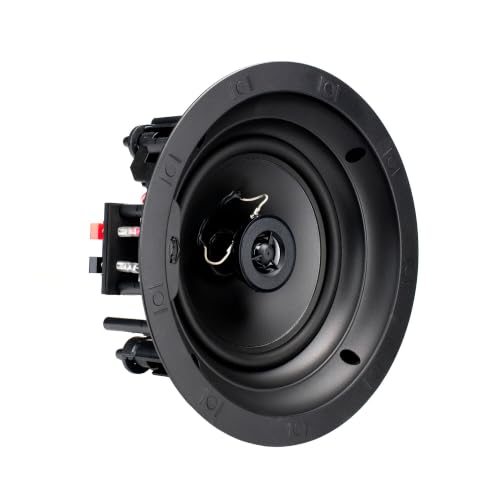
Klipsch RIC-65 — Best premium all-rounder
The RIC-65 is Klipsch’s architectural line speaking in its premium register: a 6.5-inch two-way pair with the brand’s horn-loaded tweeter thinking applied to a ceiling chassis, finished with a flat, low-profile grille that attaches magnetically and paints cleanly. The horn is the substantive point. In a ceiling, projection and controlled dispersion are what carry clarity across a room’s width, and Klipsch has spent decades making horns behave in domestic spaces. The result is a speaker that keeps dialogue and vocal detail organised at the far side of a living room, where lesser ceiling speakers dissolve into ambience.
The pair format and the all-round voicing make this the premium pick with the fewest conditions attached. It serves as a music pair in a principal room, as surround channels behind a stronger front stage, or as the main speakers of a serious bedroom system, and it does each without the special pleading the Focal specialists require. Klipsch’s architectural support, templates, published data and a wide installer base, stands behind it, which matters in a product the house will keep longer than the television. Like everything here it is passive, and it deserves a receiver or amplifier chosen with the same care, because a horn this revealing will describe a poor amplifier’s shortcomings in detail.
Its premium over the general-guide speakers is visible in the small decisions: the grille’s fit, the frame’s rigidity, the consistency between the two speakers in the box. Those are the things a buyer is actually purchasing at this level, a lack of annoyances engineered out one by one. For a household stepping up from basic ceiling audio in its main room and wanting the step to be obvious but uncomplicated, the RIC-65 is the shortest path.
- Format: 6.5-inch two-way in-ceiling pair
- Tweeter: horn-loaded design for controlled dispersion and projection
- Grille: flat, low-profile, magnetic and paintable
- Role: main-room music, surrounds and serious secondary rooms
- Power: passive, pairs best with a quality receiver or amplifier
- Support: full architectural documentation and installer availability
The RIC-65 also illustrates a premium trait that rarely makes a specification sheet: consistency between samples. In a pair, and across the four or six units a larger project might install, tight manufacturing tolerance keeps every speaker sounding like its siblings, which is what makes a multi-room system feel like one instrument. Budget production tolerates wider variation because a single cheap pair hides it; a house full of premium speakers exposes it. Klipsch’s architectural line is built to the tolerance the exposure demands, and that invisible discipline is a fair portion of what the step up purchases.
Strengths
- Horn clarity carries across wide rooms without raised volume.
- Grille and frame finish belong in designed interiors.
- Versatile enough for front, surround or standalone music duty.
Trade-offs
- Revealing treble exposes weak amplifiers and poor sources.
- Fixed-fire layout lacks the Focal angled option’s aim.
- Premium is wasted in rooms used only for background radio.
Best for: main living spaces stepping up to premium ceiling audio without specialisation. Not suited for: front-stage LCR duty or angled height work, which the Focals exist to do.
If the main room is the project, review the RIC-65 pair listing and match its cutout data against your ceiling before the rest of the system is specced around it.

Sonance MAG8R — Best large-room music pair
Sonance effectively invented the architectural speaker category, and the MAG8R comes from the range the company builds for the dealer-installed whole-home market, where speakers are specified by professionals into houses meant to hold them for decades. It is an eight-inch pair, sized for the larger rooms of such houses, with Sonance’s characteristic voicing discipline: the company tunes for the even, unforced sound that background and foreground music in a home both need, rather than for a showroom’s thirty-second thrill.
The eight-inch format in a premium chassis serves a specific physics. Large rooms and high ceilings dilute a small speaker’s output before it reaches the listeners, and the MAG8R’s cone area keeps music composed at the distances a great room imposes, without the amplifier being asked to force the issue. In a whole-home plan it pairs naturally with smaller Sonance models in secondary rooms, holding the family’s sonic character constant from the kitchen to the sitting room, which is the quiet luxury whole-home buyers are actually purchasing.
Support is the other half of this pick’s case. Sonance’s dealer network, installation documentation and long model continuity mean a system built around these speakers can be serviced, extended and matched years later, a claim the value brands cannot make with a straight face. The MAG8R is passive, expects a proper amplifier, and asks for an installer or a confident homeowner who will honour its cutout and placement data. Given those, it is the large-room anchor of this guide.
- Format: 8-inch in-ceiling pair from Sonance’s dealer-oriented range
- Voicing: even, whole-home tuning for music at all levels
- Grille: paintable architectural finish
- Role: principal rooms, great rooms and larger open spaces
- Power: passive, suited to quality multi-room or stereo amplification
- Support: dealer network and long-term model continuity
There is a room type where the MAG8R is not merely suitable but transformative, and it is the kitchen at the heart of an open-plan floor. Such kitchens are large, hard-surfaced and loud with the business of cooking, and music in them must survive refrigeration hum, extraction and conversation without turning sharp. The big Sonance’s even voicing and cone area hold the middle of the room together at those moments, where smaller speakers retreat to the ceiling’s edges. It is unglamorous work, done daily, and it is exactly the work whole-home systems are bought to do.
Strengths
- Cone area keeps large rooms composed without strain.
- Whole-home voicing matches smaller Sonance rooms seamlessly.
- Professional support infrastructure behind the product.
Trade-offs
- Oversized for bedrooms and small studies.
- Its virtues assume a system context, not a single-room dabble.
- Dealer-oriented range can mean less DIY hand-holding.
Best for: larger principal rooms in a Sonance-centred whole-home system. Not suited for: a single small room or a first experiment in ceiling audio.
Planning a whole house rather than a room? Look over the MAG8R pair listing and note its dimensions against your largest room’s ceiling first.

Sonance VX66R — Best current Sonance design
The Visual Experience series is Sonance’s current statement about what an architectural speaker should be, and the VX66R is its 6.5-inch pair. The series’ design effort concentrates on the two things premium buyers can verify with their own eyes and hands: how the speaker meets the ceiling, and how consistently it is built. Grille options in the VX line extend beyond the standard round paintable face, with trim and finish choices intended to let the speaker join a ceiling’s design rather than merely occupy it, and the driver and crossover work underneath reflects the company’s latest thinking on even dispersion from an overhead position.
In a system plan, the VX66R occupies the versatile middle: a principal bedroom, a study where music is listened to rather than overheard, surround positions in a theater whose front stage is stronger still, or the main pair in a smaller premium living room. Its voicing follows the Sonance house discipline of evenness, which suits long listening and mixed content, and its dispersion behaviour is designed for the reality that nobody sits on a ceiling speaker’s axis. Sold as a pair, it keeps whole-room planning simple.
Choosing between this and the MAG8R is a question of size and generation rather than of quality. The MAG8R brings eight-inch scale for big rooms from an established dealer range; the VX66R brings the newest design language at the more common 6.5-inch size. A new whole-home project starting today would reasonably standardise on the VX line where its sizes fit, which is why this pick carries the guide’s current-design badge while its larger sibling carries the large-room one.
- Format: 6.5-inch in-ceiling pair, Visual Experience series
- Design focus: grille and trim options for designed ceilings
- Dispersion: engineered for even off-axis listening below
- Role: principal secondary rooms, surrounds, smaller premium living rooms
- Power: passive, for a quality receiver or multi-room amplifier
- Support: current flagship architectural line with dealer backing
The VX66R’s grille options deserve a practical translation for buyers who have never specced a designed ceiling. Being able to match the speaker’s visible face to the ceiling’s other fittings, in shape, in trim depth, in finish, means the eye reads the ceiling as one composition instead of a surface with apologies dotted across it. Architects charge for that coherence in every other material they specify; the VX line is Sonance acknowledging that a speaker grille is a material too. In a room where the ceiling was designed, that acknowledgment is worth as much as a decibel of anything.
Strengths
- Latest Sonance grille and trim thinking for visible ceilings.
- Even dispersion suits real seating rather than a sweet spot.
- Natural standard for new whole-home Sonance projects.
Trade-offs
- Less cone area than the MAG8R for very large rooms.
- Design options reward a planned purchase, not a rushed one.
- Premium pricing logic applies across the whole VX system.
Best for: new premium installations standardising on Sonance’s current line. Not suited for: the largest rooms, where the eight-inch sibling is the honest choice.
Starting a Sonance system from a clean sheet? Examine the VX66R pair listing and its grille options before deciding the ceiling’s final look.

Focal 100ICLCR5 — Best ceiling front stage
Role first, as promised: the 100ICLCR5 is an LCR speaker, designed to serve as the left, centre or right channel of a home theater front stage from a position in the ceiling. That is a genuinely difficult brief, because front channels carry dialogue and the screen’s action, and a ceiling position fights both. Focal’s answer is a driver layout arranged for the purpose, with its flax-cone woofer technology and an inverted dome tweeter that can be oriented for the channel’s position, so a centre unit above a screen throws its energy toward the viewers rather than into the floorboards in front of the television.
Flax is the material fact at the centre of this pick. Focal builds its reputation on driver engineering, and its flax sandwich cones are prized for combining stiffness with low mass and natural damping, properties that keep a cone behaving as one surface rather than a collection of resonances. In a front channel, that behaviour is heard as dialogue that stays textured and intelligible at low volume and refuses to harden when a soundtrack swells. Three units across the front of a ceiling, each bought singly because each channel is bought singly, give a theater room a front stage with a shared voice and a shared engineering pedigree.
The conditions deserve equal emphasis. This is not a music pair and should not be bought as one; stereo imaging from two LCR units pressed into music duty would waste their design. It asks for a room where the screen wall cannot host speakers, for a receiver with the channels to feed it, and for an installer who will take its orientation guidance seriously. Inside that brief, it solves a problem no general ceiling speaker even attempts, and it solves it with the driver technology of a company whose loudspeakers anchor far more expensive systems than this one.
- Format: in-ceiling LCR-design speaker, sold individually
- Drivers: flax-cone woofer technology with inverted dome tweeter
- Orientation: tweeter arrangement adjustable for left, centre or right duty
- Role: front stage channels above a screen, three units for LCR
- Power: passive, requires dedicated receiver channels per unit
- Fit check: plan all three front positions around the screen and joists together
A word about the centre channel within the 100ICLCR5’s three-unit stage, because it carries the design’s heaviest load. Most film dialogue lives there, and a ceiling centre’s temptation is to let voices rain down with a godlike detachment that breaks the screen illusion. The LCR layout’s orientation options exist to lean that voice toward the screen’s plane, reattaching speech to the faces speaking it. Installers who take the extra minutes to set each unit’s orientation for its specific channel, left, centre and right are not interchangeable here, collect the design’s whole benefit; those who fit all three identically collect about half of it.
Strengths
- Purpose-built for the hardest ceiling job: front dialogue.
- Flax cone behaviour keeps voices clean at all levels.
- Matched three-unit front stage from a single design.
Trade-offs
- Specialist design wasted on background music duty.
- Three single units make the front stage a considered purchase.
- Ceiling front staging still concedes some imaging to ear-level speakers.
Best for: theater rooms whose screens leave no wall or floor room for front speakers. Not suited for: stereo music rooms or casual television corners.
If your front stage must live in the ceiling, study the 100ICLCR5 listing and its orientation guidance, then plan the three positions as one design.

Focal 300 ICA6 — Best angled premium channel
The 300 ICA6 is Focal’s angled answer, and the angle is the product. Its coaxial driver assembly is mounted at a tilt within the ceiling frame, so the speaker’s output leaves the ceiling already aimed toward the listening area instead of travelling straight down and hoping. Coaxial means the tweeter sits at the woofer’s centre, the two sharing an acoustic origin, so the aimed sound arrives coherent rather than as treble from one point and midrange from another. For front channels in a ceiling-only theater, or for Atmos height channels where the mix’s overhead positions deserve genuine direction, this is the most considered geometry in the guide.
The 300 series sits above the 100 series in Focal’s architectural hierarchy, and the step shows in the driver specification and the frame’s engineering rather than in decoration. Sold individually, because front and height channels are counted individually, the ICA6 lets a system designer place exactly the channels the room needs: two as ceiling front speakers flanking a screen, one as a centre, or pairs as heights above a seating area whose position is fixed and known. Its inverted dome tweeter, a Focal signature, is part of the coaxial assembly, so the aim carries the full frequency range with it.
An angled speaker makes one demand in return: the seating must be where the plan says it is. Aim is a commitment, and a room whose furniture migrates will eventually find its speakers eloquently addressing an empty rug. Dedicated rooms, fixed media layouts and designed living spaces meet that condition naturally, and in them the ICA6’s geometry delivers the most direct, least compromised sound a ceiling can offer. That is the premium proposition in its purest form in this entire guide: not louder, not brighter, but aimed.
- Format: angled coaxial in-ceiling speaker, sold individually
- Geometry: tilted driver assembly aims output at the listening area
- Drivers: coaxial layout with Focal inverted dome tweeter
- Role: ceiling front channels or Atmos height channels
- Power: passive, one receiver channel per unit
- Fit check: seating position must be fixed for the aim to pay off
The ICA6’s coaxial aim has a second beneficiary beyond the front stage: the single listener. In a media room arranged around one principal chair, a pair of angled coaxials aimed at that chair produces the most focused overhead-adjacent sound a ceiling can give, because both drivers of each speaker agree about where the listener is. Stereo from the ceiling will never equal stereo from ear-level cabinets, and this guide has said so in every relevant place, but the aimed coaxial narrows the gap to the point where many listeners stop keeping score and simply enjoy the film.
Strengths
- Aimed, coherent output solves the ceiling’s direction problem outright.
- Coaxial design keeps the sound unified as listeners move.
- Equally credible at front-stage and height-channel work.
Trade-offs
- Aim is wasted if the seating layout changes often.
- Per-unit buying makes a full front stage a deliberate budget.
- Overqualified for background music in secondary rooms.
Best for: dedicated theater ceilings and fixed layouts wanting aimed front or height channels. Not suited for: flexible living rooms or whole-house background duty.
With the seating plan settled, check the 300 ICA6 listing for its angle and cutout data, and mark the ceiling from the sofa’s real position.

Sonance VX42R — Best near-invisible premium
The VX42R makes the opposite argument from the MAG8R, in the same design language as the VX66R: that in many rooms the most luxurious speaker is the one nobody can find. At four inches, its grille shrinks toward the size of a downlight, letting it join a ceiling’s lighting pattern almost as one of the fittings. Bathrooms in a premium whole-home system, dressing rooms, hallways, a kitchen’s working end, a bedroom where the larger grilles would crowd a small ceiling: these are its territories, and in them its smallness is not a compromise but the entire point.
Physics sets its terms, and this guide will state them as plainly for a premium pick as for a cheap one. A four-inch driver cannot move the air of its larger siblings, so the VX42R’s world is modest volumes in modest spaces, where its refinement, even dispersion and freedom from harshness at close range are what the listener actually receives. Fed by the same multi-room amplification as the rest of a Sonance system, it keeps the house’s voice consistent into the rooms where a big grille would look absurd, and that consistency across sizes is a system virtue the value tier rarely achieves.
Buy it as part of a design, not as a bargain route into the VX line. A pair of VX42R in a main living room would be an expensive way to under-serve the space, while the same pair in a marble bathroom of a Sonance house is precisely correct. Premium ranges earn their keep by offering the right size at every point of a plan, and this smallest member is the proof that the VX line was planned as a system rather than as a single hero product.
- Format: 4-inch in-ceiling pair, Visual Experience series
- Grille: downlight-scale, designed to blend with lighting layouts
- Role: bathrooms, dressing rooms, hallways and small secondary spaces
- Dispersion: even, close-range refinement over output
- Power: passive, fed by the system’s multi-room amplification
- Fit check: small cutout suits crowded and low ceilings
Small premium speakers change how a house sounds at its edges, which is where daily life mostly happens. The dressing room with the morning news at a murmur, the hallway where a podcast follows you between rooms, the bathroom where a favourite station makes a winter morning kinder: none of these need output, all of them benefit from refinement, and a system that treats them as first-class rooms rather than afterthoughts feels considered in a way guests notice without identifying. The VX42R is the instrument of that consideration, and its place in a whole-home plan is larger than its grille.
Strengths
- Nearly disappears into a designed ceiling’s lighting pattern.
- Keeps a Sonance system’s voice consistent into small rooms.
- Refined at the close, quiet listening its rooms involve.
Trade-offs
- Cannot fill a large room, and should never be asked to.
- Premium cost for a deliberately small speaker requires system thinking.
- Bass is a rumour at this size, as physics requires.
Best for: small, design-sensitive rooms inside a premium whole-home system. Not suited for: any room whose main listening happens here.
For the rooms where the grille must shrink, look at the VX42R pair listing alongside your ceiling’s lighting plan, and spec it as part of the whole design.
How do the six premium picks divide the work?
| Model | Role | Sold as | Defining build fact |
|---|---|---|---|
| Klipsch RIC-65 | All-round premium pair | Pair | Horn-loaded tweeter, magnetic flat grille |
| Sonance MAG8R | Large-room music | Pair | Eight-inch dealer-range design |
| Sonance VX66R | Current-line all-rounder | Pair | Visual Experience grille and trim system |
| Focal 100ICLCR5 | Front LCR channels | Each | Flax cone, LCR driver layout |
| Focal 300 ICA6 | Aimed front or height | Each | Angled coaxial assembly |
| Sonance VX42R | Near-invisible small rooms | Pair | Four-inch downlight-scale format |
The division is the lesson of the tier: premium ceiling audio is not one ladder but a set of tools. Pairs for music, an LCR for the front stage, an angled coaxial for aimed channels, and a miniature for the rooms where discretion outranks output. A system that assigns each tool its own work will outperform a ceiling filled with six of any single pick, however distinguished that pick may be.
How should a premium ceiling system be planned as a whole?
Begin with the rooms’ hierarchy, because premium budgets punish the attempt to make every room equal. Decide which room is the theater, which are the listening rooms and which are the background rooms, and let the speaker sizes follow that ranking: LCR and angled Focals where the screen lives, the larger Sonance or Klipsch pairs where music is an event, the VX42R where sound is a courtesy. Amplification should be planned in the same pass, with channels and quality matched to the ranking, because a premium speaker on a neglected amplifier channel is a sports car on budget tyres.
Then design the ceiling as a ceiling. Grille shapes, sizes and positions belong on the same drawing as the lighting, and at this tier the speakers’ makers supply the trim options to make that drawing coherent. Painting, where chosen, should be specified as thin sprayed coats and done before installation. Wire, finally, should be run generously and documented like the fixture it is, with photographs of every open position. A premium system’s difference from a basic one is felt in these planning hours as much as in any driver material, and skipping them while buying expensive speakers is the tier’s one unforgivable waste.
What mistakes do premium ceiling buyers make?
The first is buying the badge for the wrong room: an LCR specialist humming background radio in a kitchen, or a four-inch miniature straining in a great room, each an excellent product insulted by its assignment. The second is starving the system around the speakers, pairing flagship ceiling units with an entry receiver and bargain wire, then blaming the speakers for the result. The third is ignoring the grille until installation day, when a designed ceiling meets an undesigned circle and the room’s whole point quietly leaks away.
Two more complete the pattern. Skipping professional help where the tier assumes it, particularly for front-stage orientation and whole-home zoning, saves a fee and costs the performance the fee would have protected. And treating the purchase as finished at installation, without calibration, without a listening pass at real volumes in real seats, leaves the last ten percent of a premium system, the part the money most specifically bought, uncollected on the table.
Final Recommendation
Let the room’s job choose the tool. A main living space stepping into the premium tier belongs to the Klipsch RIC-65; a large room in a Sonance house to the MAG8R; a new system standardising on current design to the VX66R; a screen with no wall to spare to three Focal 100ICLCR5 units across the front; aimed front or height channels to the Focal 300 ICA6; and the small, beautiful rooms to the VX42R. Spend on materials, geometry, grilles and support, demand the receipts in build facts rather than adjectives, and the ceiling will repay the scrutiny every time the lights go down.
Frequently Asked Questions
Are premium ceiling speakers worth it over the general guide’s picks?
In rooms with a purpose, yes: the money buys driver materials, geometry that solves the ceiling’s aim problem, grille design and decade-scale support. For background music in ordinary rooms, the general guide’s pairs remain the rational spend.
What is an LCR ceiling speaker?
It is a single in-ceiling speaker designed to serve as any one of the left, centre or right front channels of a theater. Three matching units above a screen form a front stage where wall or floor speakers cannot go.
Why are the Focal picks sold individually?
Because their channels are bought individually: a front stage needs three, a height layout needs two or four, and a centre needs one. Pair packaging would force buyers to purchase speakers their layout does not use.
Can premium ceiling speakers handle Atmos heights?
The angled Focal 300 ICA6 is designed with exactly such aimed duty in mind. The pairs here can also serve as heights, though the dedicated Atmos guide examines aimability across a wider field.
Do these speakers need special amplifiers?
They need good ones rather than special ones: any quality receiver or amplifier with clean power and the right channel count. Premium speakers reveal amplifier shortcomings, so the electronics budget should rise with the speaker budget.
Will a four-inch premium speaker fill my living room?
No, and it is not designed to. The VX42R serves small rooms where discretion matters most. Living rooms should take the 6.5-inch or 8-inch pairs in this guide, sized to the space.
How does calibration change at the premium end?
Premium speakers do not remove the need for calibration; they raise the return on it. A receiver’s room-correction system measures each channel’s distance, level and response, and better speakers respond to that correction more predictably, because their behaviour is consistent rather than approximate. The practical sequence mirrors any good installation, with two additions this tier earns. First, verify orientation and aim physically before measuring, since no correction can redirect a Focal’s angled output after the fact. Second, listen after measuring, at real material and real volume, and adjust by small, documented steps, because the goal at this level is not a flat graph but a room the household loves.
Crossover settings deserve the same care. Premium ceiling speakers still work into a ceiling cavity rather than a designed enclosure, and handing the lowest frequencies to a subwoofer remains correct in a theater context, at a point chosen for the speaker’s size rather than its price. The four-inch VX42R in a music zone wants a different decision from the eight-inch MAG8R, and a system that sets both by the same lazy default wastes the planning that selected them. Premium is a habit of matching decisions to purposes, and calibration is simply where that habit becomes audible.
Finally, give a premium system time before judging it. New rooms, new ceilings and new speakers all present themselves starkly on the first evening, and households routinely soften their assessments across the first month as the sound becomes the room’s normal. The tier’s promise is not a dramatic first impression but a durable rightness, and durability, by definition, cannot be auditioned in an afternoon. Buy on build facts, install with care, calibrate honestly, and then let the system disappear into the house’s life, which is the fate it was engineered for.
Why does brand support weigh so heavily in a built-in product?
A portable speaker that loses its maker’s support becomes an inconvenience; a ceiling speaker that loses its maker’s support becomes a hole with a problem. Replacement grilles after a redecoration, a matching unit when a room is extended, documentation when a new electrician opens the ceiling in a decade: these mundane events are where architectural brands earn their premium, and they are the reason this guide restricted itself to manufacturers with serious, continuing architectural programmes. Klipsch, Sonance and Focal all publish their data, maintain their lines and support the dealers who install them, and those behaviours are verifiable today rather than promised for tomorrow.
Support also shapes the second-hand and renovation markets in ways buyers feel without noticing. A house whose ceiling system is a known Sonance or Focal installation can be described, valued and extended by the next owner’s installer without archaeology. An anonymous system, however pleasant, must be reverse-engineered before it can be improved. In a product category measured in decades, that legibility is a form of value as real as any driver material, and it belongs in the justification every premium purchase owes its buyer.
Which rooms justify the premium, and which honestly do not?
The theater justifies it first, because its demands are the most specific: dialogue that must survive a ceiling position, height effects that must arrive from a direction, a front stage that must agree with itself. The Focals exist for that room, and in that room their specialisation is not indulgence but correctness. The principal living room justifies it second, because it is where a household’s listening actually concentrates, where guests form their impression of the house, and where a designed ceiling is most often part of the architecture. Premium pairs from Klipsch and Sonance were built for exactly that concentration of use and attention.
Main bedrooms and studies justify it on a quieter argument: hours. A room used for two hours of listening a day returns a premium investment in daily increments of pleasure, and the even, unforced character of this tier is specifically the character that long, close listening rewards. Kitchens justify it where they are the home’s social engine and the ceiling was designed rather than merely built. In each case the justification is usage multiplied by time, which is the only arithmetic that has ever made a fixture’s premium sensible.
The honest negative list matters as much. A guest room used six nights a year, a utility room, a child’s bedroom in its toy-loud phase, a rental property: these rooms are served completely by the general guide’s speakers, and premium units installed there purchase nothing their occupants will notice. Saying so is not a concession in a premium guide; it is the guide’s credibility. A tier that claims everything deserves it will be believed about nothing, and the six picks here were chosen to be believed about the rooms they name.
How do premium ceiling speakers age inside a house?
Gracefully, if the installation respected the future. The speakers themselves have no batteries, no firmware and no wireless standards to expire, which makes a passive architectural system one of the longest-lived technologies in a modern home. What ages is everything around them: amplifiers are replaced, streaming sources rotate, rooms are repainted and refurnished. A premium installation anticipates that churn by keeping grilles replaceable and paintable, cutouts standard, wire documented and amplifier channels accessible, so the speakers can serve three generations of electronics without ever leaving the ceiling.
There is also an acoustic sense in which these systems settle. A household tunes its expectations to its rooms over the first year, positions its furniture in conversation with the sound, and stops hearing a system at all, which is the deepest compliment installed audio can receive. Premium engineering aims precisely at that disappearance: nothing fatiguing to notice at hour three, nothing shabby to notice in year five, no grille yellowing against a repainted ceiling in year ten. Buyers evaluating this tier should imagine the tenth year more vividly than the first evening, because the tenth year is what the money is for.
What should you ask an installer before signing off on a premium system?
Ask how the front-stage orientation will be set, if Focals are involved, and accept only an answer that mentions the seating and the screen in the same sentence. Ask where the spare grille and the cutout templates will live, and who keeps the photographs of the open ceiling. Ask which amplifier channels feed which rooms, in writing, and what the plan is when a streaming source changes in five years. Ask how the grilles will be handled during the house’s next repaint, because that day will come and the answer reveals whether the installer thinks in decades or in invoices.
Ask, finally, what the installer would leave out. A professional who can name the item they would cut, the rear pair deferred, the smaller room held at the general tier, is a professional allocating your budget by purpose, which is the entire philosophy of this guide expressed as a hiring test. Premium work is defined as much by its refusals as by its specifications, and a system designed with intelligent omissions will outperform a maximal one in every year of its life. The questions cost an afternoon; the answers govern a fixture.
How does the premium ceiling fit a whole-home design language?
Designed houses treat the ceiling as a fifth wall, with its fittings composed: lights in rhythms, vents placed with intent, and speakers admitted to that composition or excluded from it. The premium tier’s contribution to that discipline is choice: grille sizes that can echo the downlights, trims that sit at the ceiling’s plane without apology, and pairs and singles that let the designer place sound where the room’s life happens rather than where a bargain box’s dimensions dictated. The VX line’s trim system and the Focal frames’ discretion are, in this reading, not cosmetic extras but the price of admission to a designed ceiling.
That integration extends to how the system is controlled and heard. A premium whole-home plan hides its amplification centrally, zones its rooms by how they are lived in, and keeps every room’s voice in the same family so a favourite album does not change personality as the listener carries a coffee from kitchen to study. The six picks here were chosen to be combinable in exactly that spirit: Sonance sizes for the rooms, Klipsch where projection leads, Focal where the screen rules. A ceiling that sounds like one house, and looks like one design, is the tier’s final product.
What separates a premium crossover from a basic one, in plain terms?
Every multi-way speaker contains a crossover, the small network that decides which frequencies go to the woofer and which to the tweeter. In basic speakers that network is built to a price, with components whose values drift with heat and age, and the audible result is a blend that varies subtly between samples and across the years. Premium crossovers spend their money on tolerance and stability: components that measure as specified, hold that specification under load, and keep the two drivers’ handshake at the frequency the designer intended. The listener never sees this network and never should; its entire contribution is that the speaker sounds like its design rather than like an approximation of it.
The same philosophy governs the parts nobody markets. Terminal quality decides whether a connection stays honest for twenty years in a ceiling void. Frame rigidity decides whether the driver’s energy goes into the air or into rattling the mounting. Even the grille’s perforation pattern is an acoustic decision before it is a visual one, since a badly judged pattern veils the tweeter it covers. Premium pricing, honestly spent, is a long list of such unphotogenic decisions made correctly. This guide cannot inspect each one in each pick, but it restricted itself to manufacturers whose reputations rest on making them, which is the buyer’s practical proxy for the whole list.
How should you audition a tier you cannot hear before cutting?
The honest difficulty of architectural audio is that the product cannot be auditioned in its real form before the ceiling is cut, which makes premium buyers dependent on evidence rather than demonstration. The evidence available is better than it first appears. A manufacturer’s floor-standing or bookshelf models share driver technology and voicing philosophy with its architectural line, and listening to those, in a dealer room, with your own music, tells you truthfully whether the house sound suits your ear. Focal’s flax-cone character, Klipsch’s horn presentation and Sonance’s even discipline are all audible in their conventional speakers, and an afternoon spent comparing them is the closest thing to an audition this category allows.
Dealer demonstration rooms with installed architectural systems are the second source, rarer and more valuable, because they restore the geometry as well as the sound. Ask to hear dialogue from a ceiling centre, not just music from a pair, and ask to stand where your own seating would put you relative to the speakers. What you are testing is not whether the system impresses, showrooms always impress, but whether voices stay attached to the screen and whether the sound remains composed when you move. Notes taken on your phone in that room will steer a five-figure decision better than any specification sheet, including the ones in this guide.
Bring to that dealer visit the plan of your own ceiling, with joists, lights and seating marked, because the conversation changes from salesmanship to design the moment a real room is on the table. The installer who engages with the drawing, who moves a position to dodge a duct and defends another against your hesitation, is demonstrating the exact service the premium tier charges for. Choose that person as carefully as any speaker in this guide, and the speakers will take care of themselves.
And keep that marked plan after the installation, filed with the templates and the amplifier’s channel map, because a premium system is a twenty-year conversation with a house, and every future chapter, an extension, a repaint, a new screen, begins from that drawing.
The drawing is also the household’s memory of intent: which positions were compromises forced by a beam, which were chosen freely, and where the wire for a future pair already waits in the void, coiled and labelled, for the room’s next idea.
Related Guides
The sensible-value foundation for all of this is in best ceiling speakers, the height-channel specialisation is developed in best dolby atmos ceiling speakers, and the amplifier-included route for simpler rooms is compared in best bluetooth ceiling speakers.
When the ceiling cannot be cut at all, the surface route is judged in best on wall speakers home theater.


