What's inside
- Where to buy
- Key Takeaways
- Quick Picks
- How did we choose these six watches?
- Which men’s smartwatch fits which kind of day?
- How do the six compare side by side?
- What should a man actually measure before buying?
- How do you set up a men’s smartwatch so it earns its keep?
- What mistakes send men’s smartwatches to the drawer?
- How do screens, cases and straps age over a year of wear?
- What does a typical week look like on each ecosystem?
- Which of these watches suits which sport best?
- Where does the money actually go when you step up a tier?
- What happens to all the data these watches collect?
- How do you decide between the final two on your own shortlist?
- What should you check during the first fortnight of ownership?
- Can one watch really cover work, training and sleep?
- What about buying last year’s model instead?
- Should you wait for the next generation?
- Final Recommendation
- Frequently Asked Questions
- Related Guides
As an Amazon Associate I earn from qualifying purchases. This post may contain affiliate links at no extra cost to you.
gizmoverdict.com is reader-supported. When you buy through links on our site, we may earn an affiliate commission.
Where to buy
Every watch below points to the Amazon listing we checked for this guide, and men’s smartwatch listings are worth a careful second look before you order: case size, band size and the GPS-versus-cellular variant all hide inside dropdown menus, and the watch in the hero photo is not always the configuration in the cart. Confirm the case diameter and the band letter — M/L on the Apple listing, for instance — against your wrist before paying, because a 46mm case on a slim wrist is a different purchase from the same watch on a broad one.
Finding the best mens smartwatches starts with a question that has nothing to do with watches: which phone sits in your pocket? An Apple Watch refuses to pair with anything except an iPhone. A Galaxy Watch does its fullest work beside a Samsung phone and a reduced version of it beside other Android handsets. Garmin and Amazfit watches ask nothing about your phone brand at all. That single fact sorts this six-watch shortlist into camps before a single feature is compared, and it is why this guide leads with platform rather than with screens or sensors. A man who switches phone brands every few years buys differently from a man locked happily into one ecosystem, and both are served here — just by different watches.
After platform comes the honest second question: what will the watch actually do all day? Three of these six are training instruments that also tell the time. One is a phone extension with a fitness sideline. One is a fortnight-between-charges companion for men who hate chargers more than they love apps. One is a budget bruiser that treats a building site as its natural habitat. None of them diagnoses anything: every heart-rate, sleep and oxygen figure in this guide is a wellness estimate produced by a wrist sensor and an algorithm, useful for spotting trends in your own habits and worthless as a medical reading. Buy them as mirrors for your routines, not as instruments of health, and they will not disappoint you.
Key Takeaways
- Phone brand decides first: the Apple Watch Series 12 pairs only with iPhone, the Galaxy Watch 7 favours Samsung handsets, and the two Garmins plus the Amazfit Active Max work across both phone camps.
- The Garmin vivoactive 5 is the balanced everyday trainer of the six — a 42mm case, built-in sports apps and a Sleep Coach, without the bulk of the rugged models.
- The Instinct 3 AMOLED is the pick for men whose work or weekends involve impact, grit and gloves: a metal-reinforced bezel and a built-in flashlight headline its listing.
- Amazfit’s 25-day battery figure for the Active Max is the maker’s number under the maker’s test conditions; even discounted heavily, it outlasts every other watch here by a wide margin.
- The military-style budget watch makes the boldest battery claim of the six and offers the least verifiable specification sheet — judge it on its stated calling, compass and flashlight features alone.
- No watch in this guide measures anything to a clinical standard; treat sleep scores and energy estimates as prompts to reflect on your habits, never as findings about your health.
Quick Picks
| Watch | Badge | Why it is here |
|---|---|---|
| Garmin vivoactive 5 | Best all-round | A 42mm cross-platform trainer with sports apps, Sleep Coach and recovery guidance that disappears under a shirt cuff. |
| Garmin Instinct 3 AMOLED | Best rugged | Reinforced bezel, bright AMOLED panel and a wrist flashlight for men who work and play outdoors. |
| Apple Watch Series 12 46mm | Best for iPhone | The largest current Apple case with the full health, fitness, sleep and safety set — provided your phone is an iPhone. |
| Samsung Galaxy Watch 7 | Best for Samsung phones | A compact 40mm Android watch whose Energy Score and wellness tips lean on Samsung’s phone ecosystem. |
| Amazfit Active Max | Best battery | A 48mm AMOLED watch with offline maps, 4GB of storage and a maker-claimed 25 days between charges. |
| Military Smart Watch for Men | Best budget bruiser | Calls, compass and flashlight in a rugged shell at the budget end, with battery claims to read sceptically. |
How did we choose these six watches?
We built the shortlist around the decisions men actually make at this shelf. Platform compatibility came first, because returning a watch that cannot pair with your phone is the most common and most avoidable failure in this category. Case size came second: the six span 40mm to 48mm, which covers most wrists honestly, and each review states the size plainly so you can rule watches in or out with a tape measure rather than a guess. Third came the split between training depth and smart features — Garmin’s sports apps and recovery metrics at one pole, Apple’s and Samsung’s app ecosystems at the other.
Battery claims were handled with suspicion throughout. Every endurance figure quoted in these reviews is a manufacturer’s number gathered under that manufacturer’s chosen conditions — a dim screen, few GPS sessions, notifications rationed. Real life is harsher, and the reviews say so where the gap matters most. We also refused to repeat any durability certification the listings themselves do not state; the rugged watches here are described by their construction, not by borrowed military test numbers. Finally, each watch had to justify itself to a man who might wear it to work, to training and to bed, because a men’s watch that only suits one of those three lives ends up in a drawer.
Which men’s smartwatch fits which kind of day?

Garmin vivoactive 5 — Best all-round
The vivoactive 5 is what happens when a sports-watch company designs for the whole day instead of the workout hour. Its 42mm case is the modest one in Garmin’s line, sized to slide under a cuff and stay there through meetings, which is precisely where chunkier training watches get taken off and forgotten. The listing leads with round-the-clock health monitoring, built-in sports apps and a Sleep Coach, and that ordering tells the truth about the watch: it is a generalist that tracks your training inside a broader picture of sleep, recovery and daily strain.
Two Garmin ideas do the heavy lifting. Body Battery translates your recent sleep, activity and stress patterns into a single energy estimate you can glance at over coffee — a wellness figure, not a measurement, but a genuinely useful prompt on the mornings it reads low. Workout Benefit and Recovery Time then close the loop after exercise, telling you what a session was for and how long the watch thinks you should wait before the next hard one. Men who train by feel often find this framing more persuasive than raw lap data, because it answers the question they actually ask: was that session worth it, and when can I go again?
- Case: 42mm, black finish as listed
- Positioning: built-in GPS for outdoor pace and distance
- Headline features: Sleep Coach, Body Battery energy monitoring
- Training support: built-in sports apps, Workout Benefit, Recovery Time
- Phone pairing: works with iPhone and Android
Strengths
- A case size that suits office clothing as readily as gym kit, which keeps it on the wrist where its tracking belongs.
- Recovery guidance written in plain outcomes — benefit and rest time — rather than a wall of graphs to interpret.
- Platform neutrality: it survives a phone change in either direction without becoming a paperweight.
Trade-offs
- Touch-first operation is less glove-friendly and less precise with sweaty fingers than the button-driven Garmins.
- Its smartwatch side is thinner than Apple’s or Samsung’s — fewer apps, plainer replies to messages.
- The 42mm case may look small on a very broad wrist, where the Instinct or Active Max fills the space better.
Best for: men who want one watch for training, sleep and the working day, and who may change phone brands. Not suited for: men who want a full app ecosystem on the wrist, or who need physical buttons for gloved, muddy use.

Garmin Instinct 3 AMOLED — Best rugged
The Instinct line has always sold a promise: this watch expects to be knocked about. The third generation keeps the fibre-reinforced case shape and the metal-reinforced bezel named in its listing, then swaps the old monochrome memory-in-pixel screen for a bright AMOLED panel. That swap matters more than it sounds. Maps, message previews and workout fields that were functional-but-drab on earlier Instincts are now legible at a glance in hard sunlight, and the watch stops feeling like a compromise you accept in exchange for toughness.
The built-in flashlight is the feature owners end up evangelising. A wrist light sounds like a gimmick until you are finding a dropped key under a van, walking a dog down an unlit lane, or reading a meter in a dark cupboard with both hands free. Around it, the listing promises the same round-the-clock health monitoring as its sibling and Garmin’s built-in sports apps, so the Instinct 3 is not a dumb shell — it is a full training watch wearing armour. At 45mm it wears big and unapologetic, which on the right wrist is the entire point.
- Case: 45mm, black, metal-reinforced bezel as listed
- Display: AMOLED, a first for this line’s rugged brief
- Headline features: built-in flashlight, rugged design
- Tracking: 24/7 health monitoring per the listing, built-in sports apps
- Phone pairing: works with iPhone and Android
Strengths
- Construction that shrugs at site work, trail falls and gym-bag abuse better than any glass-slab watch here.
- The flashlight earns its place weekly, not yearly — the rare extra feature that becomes a habit.
- AMOLED clarity without surrendering the Instinct identity or Garmin’s training depth.
Trade-offs
- Its tool-watch styling clashes with a suit; this is not the watch for formal dress codes.
- AMOLED brightness costs battery against the older monochrome Instincts under heavy GPS use.
- The chunky case can dig into the wrist during push-ups and bench work for some wearers.
Best for: tradesmen, trail runners, soldiers, climbers and anyone whose current watch died by impact. Not suited for: men wanting a discreet watch for dress shirts, or the deepest app library.

Apple Watch Series 12 46mm — Best for iPhone
Start with the lock on the door: this watch pairs with an iPhone and nothing else, and no discount or gift occasion changes that. Inside the Apple camp, though, the Series 12 in the 46mm case is the complete expression of the idea — the listing pairs the black aluminium case with an M/L black sport band and names health, fitness and sleep tracking, heart-rate monitoring and safety features as its brief. The large case is the one to pick if you read notifications at arm’s length, tap targets with big fingers, or simply have the wrist to carry it.
What Apple sells better than anyone is the absence of friction. The watch unlocks your phone, your phone sets up the watch, messages and calls flow between them without configuration, and the safety features named in the listing sit quietly in the background. Its fitness tracking covers the mainstream thoroughly, and its sleep tracking feeds the same overnight picture the Garmins build — again, wellness estimates from wrist sensors, presented well. The cost of this polish is rhythm: an Apple Watch is a daily-charging device in most men’s real use, a habit Garmin owners find faintly absurd. Decide which tribe you belong to before you buy, because neither side converts.
- Case: 46mm black aluminium, black sport band in M/L as listed
- Configuration: GPS model (no cellular radio in this listing)
- Headline features: health, fitness and sleep tracking, heart rate, safety features
- Phone pairing: iPhone only — this is absolute
- Charging rhythm: plan on daily top-ups in typical use
Strengths
- The smoothest phone partnership in the guide if that phone is an iPhone.
- A big, bright canvas that makes messages, maps and workout fields easy to read mid-stride.
- Safety features and fall-related protections that ride along without daily attention.
Trade-offs
- Completely unusable with an Android phone — not limited, unusable.
- Daily charging collides with sleep tracking; you must find a morning or evening charging window.
- The sport band in the box is functional rather than handsome; most men budget for a second strap.
Best for: iPhone owners who want their watch to be an extension of the phone, with fitness woven through it. Not suited for: Android owners under any circumstances, and men who refuse to charge a watch daily.

Samsung Galaxy Watch 7 — Best for Samsung phones
The Galaxy Watch 7 is the Android answer to the Apple proposition, with an asterisk the listing itself hints at: it is a Samsung-first device. The 40mm Bluetooth model listed here, in green with a US warranty, names an Energy Score, wellness tips, heart-rate tracking, a sleep monitor and fitness tracking among its features. Several of Samsung’s headline health ideas live inside the Samsung Health environment on a Galaxy phone, so the man who pairs this watch with a Pixel or another Android handset gets a good watch, while the man who pairs it with a Galaxy gets the whole design.
The Energy Score deserves a sentence of its own because it shows where this category is heading: a single morning number that compresses sleep, previous activity and heart patterns into a readiness estimate, followed by wellness tips that nudge rather than nag. As with Garmin’s Body Battery, it is an algorithmic estimate — a conversation starter with yourself about how you feel, not a verdict on your body. At 40mm this is also the most compact watch in the six, which makes it the easiest recommendation here for slimmer wrists and for sleeping in, since a small case disturbs a side-sleeper less than a 48mm slab does.
- Case: 40mm, green finish as listed, Bluetooth model
- Headline features: Energy Score and wellness tips
- Tracking: heart rate, sleep monitor, fitness tracking per the listing
- Phone pairing: Android; fullest feature set beside a Samsung Galaxy phone
- Region: US version with manufacturer warranty as listed
Strengths
- The most polished Android-native watch experience, especially inside Samsung’s phone ecosystem.
- A compact case that wears and sleeps comfortably on smaller wrists.
- Morning readiness framing that turns raw tracking into one glanceable judgement.
Trade-offs
- Some features thin out when paired with non-Samsung Android phones — check your handset pairing carefully.
- No path to iPhone at all; Apple owners should stop reading this review.
- Like the Apple Watch, it lives on a short charging leash compared with the Garmins and the Amazfit.
Best for: Galaxy phone owners who want a compact, good-looking watch with readiness scoring. Not suited for: iPhone owners, or men who want a week or more between charges.

Amazfit Active Max — Best battery
The Active Max makes its argument in the listing’s own numbers: a 1.5-inch AMOLED display in a 48mm case, GPS, offline maps, 4GB of storage, more than 170 sport modes, and a battery the maker puts at 25 days. Treat that last figure the way you would treat a car’s official fuel economy — a laboratory best case, achieved with the screen dim, GPS idle and features rationed. Halve it for real life and the watch still outlasts the Apple and Samsung entries many times over, which changes your relationship with it: charging becomes a monthly chore you schedule, not a nightly ritual you obey.
The offline maps are the surprise substance behind the headline. A budget-friendly watch that can show you a route without a phone along is genuinely useful for hikes, city runs in unfamiliar places and travel days when the phone stays in a pocket or a hotel safe. The 4GB of storage holds music or podcasts for phone-free exercise with Bluetooth earbuds. Heart-rate and sleep tracking round out the listing’s promises — wellness estimates again, presented through Amazfit’s app, which works with both iOS and Android. At 48mm this is a big watch that knows it; on a large wrist it looks deliberate, and on a small one it looks borrowed.
- Case: 48mm with a 1.5-inch AMOLED display
- Battery: up to 25 days per the maker’s claim, under the maker’s conditions
- Navigation: GPS with offline maps
- Storage: 4GB for media
- Modes: 170+ sport modes per the listing; water-resistant construction
Strengths
- Endurance that removes charging from your weekly planning altogether.
- Offline maps at a tier of the market where navigation is usually phone-dependent.
- Cross-platform pairing and a very wide spread of sport modes for the curious athlete.
Trade-offs
- The 48mm case overwhelms slim wrists and catches on narrow cuffs.
- The companion app and smart features are less refined than Apple’s or Samsung’s ecosystems.
- The 25-day figure will not survive heavy GPS and always-on display use — plan on less.
Best for: men who travel, hike and train for weeks at a time and loathe carrying chargers. Not suited for: small wrists, or buyers who want the deepest third-party app support.
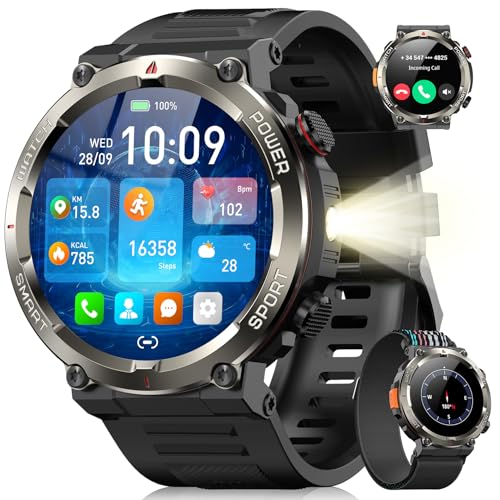
Military Smart Watch for Men — Best budget bruiser
Honesty first: this is a white-label budget watch sold under a descriptive name rather than a watchmaker’s badge, and its listing reaches for the biggest numbers in this guide — up to 100 days of battery, by the maker’s claim. Read that figure as a standby-style best case under gentle use, not a promise about a month of GPS training, because no watch at this end of the market rewrites physics. What the listing does state plainly is a feature set aimed squarely at outdoor and manual work: it can answer and make calls over Bluetooth, carries a flashlight and a compass, tracks heart rate, blood-oxygen estimates and sleep, and ships with two straps.
Judged on those stated features — and only those, since we credit it with no certifications its listing does not claim — it earns its place as the watch you buy when the alternative is destroying something expensive. A bricklayer, a warehouse picker or a keen gardener can strap this on without the background anxiety that accompanies a premium watch near concrete and machinery. Its health figures are the roughest estimates in the guide and should be treated as rough trend indicators at best. The companion apps for watches of this class are typically serviceable rather than lovely, and software updates are a hope rather than a schedule. Within those limits, the proposition is coherent: rugged looks, calling from the wrist, a compass when the phone is buried in a bag, and a price of admission low enough that a cracked screen is an annoyance rather than a disaster.
- Style: rugged military-look case; two straps included per the listing
- Battery: up to 100 days per the maker’s claim — expect far less in active use
- Headline features: Bluetooth answer/make calls, flashlight, compass
- Tracking: heart rate, SpO2 and sleep monitoring as listed — wellness estimates only
- Phone pairing: iPhone and Android per the listing
Strengths
- Wrist calling and a compass at the budget end of the shelf, where both are rare.
- A second strap in the box stretches the value further than a single-band package.
- Cheap enough to wear into genuinely risky environments without flinching.
Trade-offs
- Battery and durability claims are the maker’s own and the least independently verifiable in this guide.
- No brand ecosystem behind it: app polish, updates and long-term support are uncertain.
- Sensor estimates are the crudest here — fine for curiosity, unfit for conclusions.
Best for: manual workers and outdoorsmen who need calls and basic tracking on a watch they can afford to break. Not suited for: athletes who rely on accurate GPS training data, or buyers who value software longevity.
How do the six compare side by side?
| Watch | Case | Phone pairing | Defining strength | Watch out for |
|---|---|---|---|---|
| Garmin vivoactive 5 | 42mm | iPhone and Android | Balanced training plus recovery guidance | Touch-only controls |
| Garmin Instinct 3 AMOLED | 45mm | iPhone and Android | Rugged build with flashlight | Too bold for formal dress |
| Apple Watch Series 12 | 46mm | iPhone only | Deepest phone integration | Daily charging habit |
| Samsung Galaxy Watch 7 | 40mm | Android, best with Samsung | Energy Score in a compact case | Features thin out off Samsung phones |
| Amazfit Active Max | 48mm | iPhone and Android | Offline maps and long endurance | Maker battery figure is a best case |
| Military Smart Watch for Men | Rugged, size unstated | iPhone and Android | Calls, compass and flashlight cheaply | Unverifiable headline claims |
Read the pairing column before the strength column; it eliminates watches faster than any feature comparison can. A Samsung owner shortlists four of the six, an iPhone owner five, and a man planning to jump ecosystems should weight the three cross-platform watches heavily. Then read case size against your wrist measurement, and only then argue about features — because the watch that fits your phone and your wrist will still be worn in a year, and the one that fails either test will not.
What should a man actually measure before buying?
Measure your wrist, then measure the gap between the lugs of a watch you already own and like. Case diameter alone misleads: a 45mm rugged case with short lugs can wear smaller than a slab-sided 44mm fashion case. If you fall between the sizes in this guide, choose by sleeve — men who wear fitted shirts daily should lean smaller, because a watch that fights your cuff every morning gets left on the dresser by March.
Next, audit your charging tolerance honestly. There are two stable personalities in this category: men who already charge a phone nightly and barely notice adding a watch to the ritual, and men who experience every cable as a small defeat. The first group can shop the whole shelf. The second should start at the Amazfit and the Garmins and treat daily-charge watches as rentals they will abandon. Neither personality is wrong; buying against your own is.
Finally, decide what the watch is for in one sentence before you shop: “answer calls on site”, “train for a marathon”, “stop sleeping badly”, “look sharp and count steps”. Each sentence points at a different watch in this guide, and each is a legitimate purchase. The failures happen when a man buys the marathon watch for the building site or the fashion piece for the marathon — the reviews above flag those mismatches pick by pick.
How do you set up a men’s smartwatch so it earns its keep?
Begin by rationing notifications. The single biggest reason men abandon smartwatches is a wrist that buzzes for every email, group chat and app promotion until it feels like a tiny manager. On day one, allow calls, messages from people, calendar alerts and your banking app; silence everything else for a fortnight. You can re-admit apps one at a time when you notice missing them, which will be rarer than you expect.
Wear it to bed for at least two weeks before judging the sleep features. One night’s score is noise; fourteen nights reveal your actual pattern — the late caffeine, the Sunday-night short sleep, the weekend lie-in that leaves you groggier than a weekday alarm. The readiness and energy scores in this guide become useful at exactly that horizon, as comparisons against your own baseline. They are estimates built from wrist signals, so judge them by whether they track how you feel across a month, not by whether any single morning’s number flatters you.
Set one training view and leave it alone. Endless data-field customisation is a hobby disguised as preparation. Pick the screen that shows the three numbers you act on mid-session — for most men that is heart rate, pace or power, and elapsed time — and let the post-workout analysis carry the detail. The watch should disappear during the activity and reappear at the café afterwards.
What mistakes send men’s smartwatches to the drawer?
Buying for a phone you do not own is the classic, and it still happens every week: an Android user receives an Apple Watch as a gift, or a bargain hunter orders a Galaxy Watch for an iPhone household. No workaround exists. Check pairing first, in writing, before any money moves. The second mistake is trusting headline battery numbers as if they were measured in your life. A maker’s figure assumes the maker’s test day; yours includes GPS runs, a bright screen and a hundred notifications, and the gap between those days is where disappointment lives. Buy for the discounted figure and be pleasantly surprised.
Third, men routinely buy the rugged watch for the image and then resent its size at a desk, or buy the slim watch for the office and then baby it through every workout. Both errors come from shopping for a fantasy week instead of a typical one. Fourth: treating wellness estimates as health facts. A watch that suggests your oxygen estimate dipped overnight is showing you an algorithmic guess from a moving wrist sensor; it is a reason to notice how you sleep, never a reason to conclude something is wrong with you — and equally, a good score is no proof that all is well. Fifth, skipping the strap drawer: the band in the box is a starting point, and a leather or metal strap for evenings transforms how a watch like the vivoactive 5 or Galaxy Watch 7 reads at a table.
How do screens, cases and straps age over a year of wear?
A smartwatch lives a harder life than a phone. It is never in a padded pocket; it is on the extremity that swings into door frames, scrapes along brickwork and dips into washing-up bowls. After a year, the differences between these six are written on their cases. Aluminium bodies like the Apple and Samsung entries dent and show bright metal at the wound; that is cosmetic, but men who care about a watch’s face should know it going in. Garmin’s fibre-reinforced polymer cases scuff to a matte grey that reads as patina rather than damage, which is one reason the Instinct line holds its looks in manual trades. The Amazfit’s large flat glass is its vulnerability — a screen protector is a sensible first purchase for a 48mm watch that leads with its face.
Straps age faster than watches. The silicone bands in every box here will shine at the contact points within months and pick up a permanent curve; that is normal and cheap to fix, because every watch in this guide accepts replacement straps in standard widths or the maker’s own quick-release system. Budget two straps into ownership from the start: a breathable sport band for training and sleep, and something — leather, woven nylon, steel — that changes the watch’s register for evenings. The budget military watch’s inclusion of a second strap in the box is, in this light, a genuinely thoughtful touch that the premium brands might copy.
Buttons and crowns tell their own story. Touchscreens fail as interfaces exactly when men need them most: rain, sweat, gloves, cold-numbed fingers. The Garmins answer with button-led control philosophies of varying purity, the Instinct being the most operable in filthy conditions. Apple’s crown and side button handle most navigation with the screen as backup, a workable compromise. If your work involves gloves more than twice a week, weight this paragraph heavily — it will matter more by December than any feature announced at a launch event.
What does a typical week look like on each ecosystem?
Monday morning on the Apple Watch is a briefing: sleep summary, calendar, weather, the rings already judging you. The experience is information-dense and deeply integrated — your boarding pass, your doorbell camera and your message threads all surface without being asked. Men who like being briefed love it. Men who wanted a watch, not a second phone, find the density itself tiring, and no setting fully cures it because the density is the product.
A week on a Garmin is quieter and more athletic in its priorities. The morning report leads with sleep, readiness-style recovery information and the day’s suggested workout; notifications arrive but sit in the cheap seats. The training calendar is the centre of gravity — miss two sessions and the watch’s suggestions adapt around your life rather than scolding it. The trade is real, though: replying to messages is clumsier, paying for coffee from the wrist depends on your bank’s participation in Garmin’s payment system, and there is no cellular lifeline on the models listed here if you leave the phone behind and something goes wrong.
Samsung’s week resembles Apple’s with a Korean accent and a health-coaching streak — the Energy Score becomes a small morning ritual, and the wellness tips push gently toward earlier nights and steadier routines. Amazfit’s week is the most set-and-forget: charge it sometime this month, glance at maps on Saturday’s hike, let the sport modes accumulate. The budget watch’s week is the plainest of all — calls answered on the wrist at the yard, a compass bearing when the phone is in the truck, sleep numbers glanced at and largely ignored — and for its buyer, that plainness is not a compromise but the entire requirement.
None of these ecosystems charges a subscription for the core experience as listed here, which distinguishes this shelf from the tracker world elsewhere in this cluster of guides. What you are choosing between is philosophies: the phone-extension philosophy, the training-instrument philosophy and the appliance philosophy. Men stay happy with a smartwatch when the philosophy matches the reason they strapped it on, and they churn through returns when a beautiful object embodies the wrong one.
Which of these watches suits which sport best?
Running belongs to Garmin’s DNA, and both the vivoactive 5 and the Instinct 3 carry built-in GPS and sports apps that cover road and trail work credibly; the dedicated running shortlist elsewhere in this guide cluster goes deeper on pace-focused models. For the gym, the calculus flips toward size and strap: a 42mm or 40mm watch rides a wrist through bench press and deadlift without catching the bar path, while the 48mm Amazfit and the rugged Instinct can foul a tight lifting glove or a wrist wrap. Lifters also learn to wear the watch a finger higher and a notch tighter, whatever they buy.
Cycling rewards screen size and glanceability — the Instinct’s AMOLED and the Active Max’s 1.5-inch display read fastest at arm’s length on a handlebar — while swimmers should check the water-resistance wording on each listing rather than assuming pool-worthiness from a sporty photograph; several listings here describe water resistance in general terms, and open-water swimmers in particular should buy only where the listing’s own language supports immersion. Golf, racket sports and team games are served adequately by all six through their sport-mode lists, with the honest caveat that a mode’s existence says nothing about the quality of its metrics. Hikers get the clearest differentiation: offline maps on the Amazfit and Garmin’s navigation heritage versus the phone-dependent maps of the Apple and Samsung watches, which are fine on marked trails near signal and noticeably less fine beyond it.
Where does the money actually go when you step up a tier?
Without naming prices, the tiers in this guide buy distinct things, and it helps to know which tier’s goods you personally value. At the budget end, the military-style watch buys presence: a big case, wrist calling and basic tracking, with the savings taken out of sensor refinement, software polish and brand support. The midfield — vivoactive 5, Galaxy Watch 7, Active Max — buys trustworthiness: established companion apps, updates that arrive, accessories that exist, and tracking consistent enough to build habits on. The step to the Series 12 and the Instinct 3 buys integration and construction respectively: Apple’s seamlessness with its phone, Garmin’s armoured case and flashlight. Neither step buys medical accuracy, because no tier sells it; the sensors improve at the margins, while the claims stay wellness-grade throughout.
Ownership costs hide beyond the ticket. Cellular variants elsewhere on the shelf carry a monthly line fee. Replacement straps, screen protectors for the big AMOLED faces, and a second charger for travel or the office all belong in the honest budget. Warranties differ too — the Galaxy Watch 7’s listing names a US manufacturer warranty explicitly, a small line worth weighing for a device worn against the physical world. Men who total these costs before buying rarely feel ambushed afterwards, and the watch that looked expensive sometimes finishes the year as the cheap one.
What happens to all the data these watches collect?
A watch that monitors you around the clock builds a detailed diary: where you ran, when you slept, how your heart behaved at 3 a.m. That diary lives in the maker’s cloud under the maker’s terms, and the six brands here differ in how central that cloud is to the product. Apple’s and Samsung’s health data sits inside phone ecosystems with on-device processing for some features and strong export tools. Garmin’s data lives in its Connect platform, beloved by athletes precisely because it exports freely to training services. Amazfit’s app holds its data in its own account system, and the white-label budget watch’s data lives in a generic companion app whose long-term stewardship is the least certain in this guide.
Practical hygiene is simple. Use a unique password on the health account, turn on two-factor sign-in where offered, and review which third-party apps you have granted access to your workouts once a season. If you sell or gift the watch, factory-reset it and unpair it from the account — a step men forget with watches far more often than with phones. None of this is a reason to avoid the category; the training and sleep insight is the point of owning one. It is a reason to choose a maker whose data home you are comfortable living in for the three or four years the watch will last.
How do you decide between the final two on your own shortlist?
When two watches survive the platform and size filters, the tie is usually broken by a single lived detail rather than a specification. Sleep in the decision if you can: the watch you will wear overnight is the one whose sleep features exist in your life rather than in the brochure, and comfort at 3 a.m. separates the 40mm and 42mm cases from the 48mm one more honestly than any showroom try-on. If sleep does not matter to you, break the tie with the charger test — picture each watch’s charging rhythm inside your actual mornings, and pick the rhythm you can keep on your worst week, not your best.
Break remaining ties by asking which failure you would forgive. Every watch here will eventually annoy you: a missed notification, a GPS trace that wanders in a city canyon, a score that calls you unready on a morning you feel strong. The Apple and Samsung watches fail as phones do, briefly and software-deep. The Garmins fail as instruments do, occasionally opaque about why a number moved. The Amazfit and the budget watch fail as appliances do, with quirks you route around. Forgiveness is personal, and the man who knows his own temper buys the watch whose flaws he can shrug at.
What should you check during the first fortnight of ownership?
The return window is the most underused feature in this category. Fourteen days is enough to learn whether a watch fits your life, but only if you test the things that actually drive abandonment. Wear it for three full nights before deciding the sleep features are for you; the first night lies, because novelty itself lightens sleep, while the third night shows you the truth about case size against a pillow. Take it on your two most typical workouts rather than a heroic one-off — the Tuesday run and the Thursday gym session will tell you more about button feel, strap slip and screen readability than a weekend epic performed for an audience of one.
Test the phone relationship under your real conditions. Answer a call from the wrist in your car, your kitchen and your workplace, and notice where the speaker and microphone stop being adequate. Walk out of Bluetooth range mid-task and see how gracefully the watch behaves — the ecosystems differ here in ways no specification sheet admits. Charge it on your schedule rather than its ideal one: if the battery anxiety appears by day four, it will not fade by month four, and the honest move is to exchange the watch for a longer-legged model while the window is open.
Check the skin under the strap, too. A minority of men react to nickel in case backs, to particular silicone blends, or simply to a watch worn too tight in the name of heart-rate accuracy. Redness that appears in the first week rarely resolves by the second month; swapping the strap material or the wearing position usually fixes it, and knowing that early saves a drawer-bound watch. Finally, glance at the trend lines the watch has drawn — not the daily scores, but the direction of your sleep duration and resting patterns across the fortnight. If the watch has already shown you one true thing about your habits that you did not know, it has justified its place on your wrist; if it has only decorated your days with numbers you ignore, that is data too, and the return window is still open.
Can one watch really cover work, training and sleep?
That is the fantasy this category sells, and the honest answer is: mostly, with one compromise you choose yourself. The watch that covers all three lives must be small enough for a cuff and a pillow, tough enough for the gym, connected enough for the working day and patient enough to do it all between charges. No product here is best at every clause of that sentence. The vivoactive 5 comes closest to the centre of the Venn diagram, which is why it leads this guide — its compromises are evenly spread rather than concentrated. The Instinct 3 sacrifices the boardroom clause, the Series 12 sacrifices the charging clause, the Galaxy Watch 7 asks for a Samsung phone as the price of admission, the Active Max sacrifices discretion, and the budget watch sacrifices refinement.
Men who accept that framing buy well. The mistake is hunting for the watch with no clause sacrificed, because that hunt ends either in paralysis or in a drawer containing three watches, each worn for one life and resented during the other two. Pick the compromise that touches the smallest part of your week. If you wear a suit twice a year, the Instinct’s boldness costs you almost nothing. If you already charge a phone, a tablet and earbuds nightly, the Apple Watch’s appetite is a rounding error. The right men’s smartwatch is not the one with the fewest trade-offs on paper; it is the one whose trade-offs land where you will never step on them.
What about buying last year’s model instead?
A word for the bargain route, because men’s smartwatch shelves are full of previous generations at tempting discounts. The pattern to know: sensors and screens improve gradually, so a one-generation-old Garmin or Galaxy Watch usually keeps most of what made it good, while software support windows shrink quietly in the background. The exception that proves the rule sits in the Apple camp, where older generations on Amazon are very often renewed units rather than new stock — a pattern we examine properly in the Apple-focused guide in this cluster. A renewed watch can be a sound buy, but it is a different purchase from a new one: check the listing’s own wording about condition and warranty, and weigh a shorter support horizon against the saving with your eyes open.
Should you wait for the next generation?
Rarely. This category improves in small, annual steps — a brighter panel here, a refined sensor there — and the watch bought today starts paying you back in sleep insight and training structure tonight. The exceptions are narrow: if a launch event is days away and you would genuinely use the rumoured headline feature, waiting costs little. Otherwise, buy the current watch that fits your phone, your wrist and your charging habits, and let the next generation be someone else’s marginal gain.
Final Recommendation
If your phone is an iPhone and you want the watch to feel like part of it, the Series 12 in 46mm is the straightforward answer, daily charging and all. Android men inside Samsung’s world should take the Galaxy Watch 7 and enjoy the Energy Score’s morning verdict. Everyone else — and especially anyone who trains seriously or changes phones freely — should start with the Garmin pair: the vivoactive 5 for a watch that behaves at work, the Instinct 3 AMOLED for one that behaves on a mountain or a scaffold. The Amazfit Active Max is the traveller’s and the charger-hater’s delight, and the military-style budget watch is the honest disposable for dangerous workdays. For the man still undecided after all that, the vivoactive 5 is the one we would hand him first: it is the watch in this guide least likely to be wrong for the life he actually leads.
Frequently Asked Questions
Can an Apple Watch work with an Android phone at all?
No. There is no supported pairing, no companion app and no workaround that preserves the features you are paying for. Android owners should choose from the Galaxy Watch 7, the two Garmins, the Amazfit or the budget pick in this guide.
How long do these watches really last between charges?
Expect the Apple and Samsung watches to want a daily or near-daily top-up in typical use. The Garmins stretch considerably further depending on GPS use, and the Amazfit’s maker-claimed 25 days should be read as a best case — even heavily discounted, it is measured in weeks rather than days. The budget watch’s 100-day claim is a standby-style figure; active use will cut it dramatically.
Are the health numbers on these watches medical readings?
No. Heart rate, sleep staging, energy scores and oxygen estimates are wellness figures produced by consumer sensors and algorithms. They are useful for spotting patterns in your own routine over weeks. They do not diagnose, rule out or confirm any condition, and a worrying symptom deserves a clinician, not a watch face.
Which of these watches is best for sleeping in?
The compact ones. The 40mm Galaxy Watch 7 and the 42mm vivoactive 5 disturb sleep least, and both build their morning scores from overnight tracking. Whatever you choose, loosen the strap a notch at night and give the skin underneath a break during your morning shower and charge.
Do I need the cellular version of a watch?
Only if you regularly want calls, messages and streaming while your phone is genuinely elsewhere — a run from home, a gym session without pockets. Cellular models need a carrier plan for the watch line, which is an ongoing commitment worth weighing. The GPS models in this guide do everything else beside your phone.
Will a 48mm watch suit a slim wrist?
Usually not. The Amazfit Active Max at 48mm is a statement on a large wrist and an overhang on a small one. Measure across your wrist bone: if the case would extend past both edges, step down to the 42mm vivoactive 5 or the 40mm Galaxy Watch 7 and enjoy the better fit.
Related Guides
Runners will want the dedicated shortlist in our best running smartwatches guide, where GPS training features decide the order. If your household runs on iPhones, the best apple smartwatches roundup walks the SE, Series and Ultra tiers in detail. And if the overnight numbers are what brought you here, the best smartwatches with sleep tracking guide compares the sleep-first designs on comfort and coaching rather than on sport. Buyers whose training runs on playlists should read the best fitness and music smartwatches. Parents shopping the same shelf for their children should start with the best kids smartwatches for texting and calling.



[…] angle. And for a broader everyday shortlist that weighs case size and phone platform first, see the best mens smartwatches guide. The children’s version of the connected wrist is ranked in the best kids smartwatches […]
[…] shelf from the gym side. Men choosing a single everyday watch should also read the best mens smartwatches roundup, where case size and phone platform take priority over pace. And because recovery begins […]