What's inside
- Where to buy
- Key Takeaways
- Quick Picks
- How did we choose projectors for outdoor duty?
- What time should a backyard screening actually start?
- How do you get sound to work in the open air?
- How do you power a garden cinema safely?
- What about breeze, insects and the garden’s other realities?
- The six backyard projectors, reviewed one by one
- Which of these suits which kind of garden?
- How do the six compare side by side?
- How do you run a backyard screening, step by step?
- What mistakes do backyard hosts keep making?
- How does a backyard cinema grow across its first seasons?
- What do these projectors do all winter?
- Final Recommendation
- Frequently Asked Questions
- Related Guides
As an Amazon Associate I earn from qualifying purchases. This post may contain affiliate links at no extra cost to you.
gizmoverdict.com is reader-supported. When you buy through links on our site, we may earn an affiliate commission.
Where to buy
A warm evening, a blank wall or a sheet of screen, and a film under the sky: the best backyard projectors turn a garden into the neighbourhood’s favourite cinema, and the six machines below are the ones we would carry outside from the current Amazon range in the United States. Their names in the Quick Picks table and in each review link to the listings, where the day’s bundle and variant can be confirmed before purchase. One companion purchase is discussed throughout this guide without ever becoming a pick: the screen. A backyard projector needs something to project onto, and the section devoted to screens below treats that choice seriously — as guidance, not as a seventh product, because the right screen depends on your garden’s size, storage and patience in ways no single recommendation can settle.
Backyard projection begins with a truce with the sun. Every machine in this guide is an evening device: the screening starts at dusk, when the light has drained enough for a modest projector to hold a picture, and the films that begin in true darkness look twice as rich as the ones that began in twilight impatience. Brightness claims in this class need the same scepticism this cluster of guides applies everywhere outdoors. Some listings quote a proper ANSI figure, a measured standard you can compare. Others quote unstandardised marketing numbers of heroic size. Where a listing states ANSI, we say so and respect it; where it does not, we treat the number as decoration and judge the machine on its platform, focus mechanics and sound instead.
Weather demands the bluntest paragraph in this guide, so here it is. None of these projectors should be assumed waterproof, weatherproof or even dew-proof, because none of their listings claims a water-resistance rating, and a machine with a fan, a lens and a mains lead is an indoor creature visiting the garden. The correct backyard ritual is therefore a carrying ritual: the projector comes out when the evening starts, sits under whatever shelter the seating enjoys, and goes back inside before the dew settles — every time, without exception for tiredness. Households that build that habit keep their projectors for years. Households that leave a projector out overnight to test the theory own a cautionary tale and a listing for parts.
Key Takeaways
- Screenings start at dusk: every pick here is an evening machine, and the last half hour of daylight is for setup, snacks and anticipation — not for the opening scene.
- Prefer stated ANSI figures where a listing offers one; the 1500 ANSI model in this set publishes the class’s most comparable brightness claim, while vaguer rivals must be judged on other virtues.
- The two Roku TV models — Aurzen’s D1R and the ELEPHAS — bring a licensed streaming platform outside with no dongle dangling in the dark.
- Assume no water resistance anywhere in this guide: no listing claims it, dew is a nightly event, and the projector sleeps indoors or it does not sleep at all.
- Outdoor sound needs help: open air swallows a small speaker’s voice, so a Bluetooth speaker near the screen is the upgrade that makes dialogue survive the garden.
- The screen is companion gear, chosen separately: fixed-frame for a dedicated garden, tripod for flexibility, inflatable for the biggest picture and the fullest storage cupboard.
Quick Picks
| Pick | Badge | Why it earns its place |
|---|---|---|
| Aurzen Roku TV D1R | Roku Goes Outdoors | Roku TV built in with every top app, native 1080P in the listing, Dolby Audio, auto focus and keystone, and zoom for garden distances. |
| ELEPHAS Roku TV Smart Projector | Voice-Friendly Roku Portable | Built-in Roku TV with Alexa and Google Home compatibility and Dolby Audio in a portable mini body for bedroom-to-garden duty. |
| 1500 ANSI Smart Projector | Stated ANSI Brightness | A published 1500 ANSI figure, native 1080P, a 20W Dolby speaker claim, AI calibration and Android TV — the spec-sheet adult of the set. |
| VOPLLS Outdoor 4K Projector | Big Voice, Licensed Netflix | A dual-channel box speaker design, Netflix on board, auto focus and a stand that rotates through a full circle for awkward gardens. |
| Smart Outdoor Projector with Built-in Apps | Apps Inside, Dual Speakers | Built-in apps with major services named, Dolby Audio from dual speakers and auto focus in the P62 Pro’s upgraded frame. |
| Outdoor Movie Projector with Electric Focus | Focus from the Deckchair | Electric focus and a high-brightness pitch for the portable movie night, with 1080P and 4K input support in its listing. |
How did we choose projectors for outdoor duty?
The first filter was the platform, because a backyard has no patience for a laptop-and-adapter ceremony performed by torchlight. Machines with a licensed streaming system inside — Roku TV on two picks, Android TV on one, built-in apps with named services on two more — can be carried out, plugged in and left to entertain, which is the entire social contract of a garden cinema. The second filter was setup mechanics. Gardens are not level, screens are not plumb and projectors sit on whatever table the evening provides, so auto focus and auto keystone graduated from conveniences to necessities; every pick here offers at least one of them, and the reviews note which. Electric focus, on the final pick, earns a special mention because refocusing from a deckchair is the difference between a host who watches the film and a host who works it.
Brightness was judged by the honesty standard this guide announced at the start. A stated ANSI figure counts as evidence. A large unqualified number counts as enthusiasm. No machine was excluded for enthusiasm — the class would be empty — but the reviews distribute their confidence accordingly, and the comparison table marks which claims carry a standard behind them. Sound was judged by outdoor physics: open air gives a speaker nothing to reflect from, so driver size, speaker architecture and the Bluetooth escape route all matter more in a garden than in any bedroom, and the picks with serious speaker claims or dual-speaker designs were credited for aiming at the problem.
What we did not require was ruggedisation, because the class does not offer it at these prices and pretending otherwise would corrupt the whole guide. Instead we required honesty about the carrying ritual and favoured machines whose portable framing — handles, compact bodies, quick setup — suits a device that commutes between house and garden. A backyard projector is not installed; it is deployed, nightly, and the best ones make deployment feel like part of the pleasure rather than a tax on it.
What time should a backyard screening actually start?
Later than you want, and the discipline is worth learning precisely. In high summer, civil dusk can arrive an hour or more after the light feels cinematic to an impatient host, and a projector image shown against a still-blue sky looks like a rumour of a film. The experienced garden host inverts the evening: the projector comes out early for setup in good light, the screen goes up, the speaker is paired, the seating is arranged — and the film itself waits until the sky has genuinely surrendered. Trailers, shorts and the support programme are the traditional bridge content, because they forgive the twilight that the feature film should not be asked to survive.
Season and latitude move the start time more than any specification can. The same garden that screens at nine in June may screen at six in October, and the household that embraces the earlier autumn start gains a second backyard season that the summer-only crowd never meets — cooler air, earlier darkness, blankets promoted from accessory to co-star. Screen size plays its part as well: a smaller image concentrates the projector’s light and can start the evening several minutes earlier than a wall-filling one, which is a real scheduling argument for restraint when the audience is impatient and the solstice is near.
Light discipline in the garden itself completes the picture. A porch light left burning, a kitchen window blazing behind the screen, a neighbour’s security lamp triggered by every moth — each one taxes the image exactly as a lamp taxes a living-room projector, except that outdoors you cannot paint the sky darker. Walk the garden before the first screening with the projector running, find the stray light sources, and negotiate with the ones you own. The ones you do not own are why screens have gain and why seating has a direction. A backyard cinema is a small act of stage management, and dusk is its curtain time.
How do you get sound to work in the open air?
Indoors, walls are a speaker’s unpaid assistants, reflecting and reinforcing its output until a small driver sounds respectable. A garden dismisses those assistants. Sound radiates into open sky, dialogue thins with distance, and the projector’s built-in speaker — wherever it sits in the machine — is usually behind the audience, projecting its voice at the host’s ankles. The near-universal solution in this class is the Bluetooth speaker, placed beneath or beside the screen, so voices arrive from the picture’s direction at a fullness the projector’s own drivers cannot approach. Every pick in this guide carries WiFi and Bluetooth for exactly this arrangement, and the two models with serious internal speaker claims — the 1500 ANSI machine’s 20W Dolby arrangement and the VOPLLS’s dual-channel box speaker — should be read as raising the solo baseline, not abolishing the speaker upgrade for larger gardens.
Volume etiquette is the outdoor variable nobody lists. A garden has no ceiling to contain the film and no walls to muffle it, so your soundtrack is also the street’s soundtrack, and the wise host sets the level for the neighbours’ bedrooms as well as for the back row. Sound also travels further on still, cool evenings — exactly the evenings when the picture is at its best — so the level that seemed modest at dusk can feel generous by the second act, and a quiet mid-film check from the garden gate is a courtesy worth building into the interval. Dialogue clarity at modest volume is the true goal, which argues for a speaker close to the audience’s ears rather than a powerful one far away, and for the centre-heavy mixes that streaming services provide. Late screenings argue for it further. The backyard cinema that survives as a neighbourhood institution is the one whose explosions are felt by its audience and merely suspected by everyone else.
One practical note completes the sound plan: pair and test before dusk. Bluetooth pairing by torchlight, with an audience assembling and a film queued, is a small humiliation the host can schedule away by doing it during setup, in daylight, with the speaker charged — and charging is the operative word, because a wireless speaker that dies at the climax is the garden cinema’s defining technical failure. Wired backup is unfashionable and undefeated: a long audio lead in the kit bag has saved more outdoor film nights than any feature in any listing in this guide.
How do you power a garden cinema safely?
Electricity and gardens have a long, damp history, so this section is written in the plain style the subject deserves. The projector, the speaker charger and any lighting should draw from an outdoor-rated socket where one exists, protected by the residual-current device your home’s outdoor circuit should already have. Where an extension lead must cross the garden, it should be a single, outdoor-rated lead in good condition — never a chain of indoor leads and adapters — routed along edges and fences rather than across the lawn’s walking lines, and never under a rug that is itself getting damp. Connections should sit off the ground, under the same casual shelter the projector enjoys, because a plug resting in wet grass is the one prop this cinema never needs.
Cable discipline is also audience discipline. In the dark, your guests will walk to the house and back along routes they choose themselves, and every lead crossing those routes is a trip hazard with a plug on it. Lay the cable before the seating is arranged, walk the routes yourself, and tape or cover any unavoidable crossing. Battery-powered speakers and the occasional battery projector elsewhere in this cluster of guides reduce the cable count, but the projector itself will almost always want mains power for a full feature, so plan the one lead properly rather than resenting it. The host who spends ten daylight minutes on power and routing buys an evening in which nobody thinks about electricity at all, which is the highest compliment garden wiring can earn.
What about breeze, insects and the garden’s other realities?
A screen outdoors is a sail that shows films. Lightweight tripod screens dance in a breeze that the audience barely notices, inflatable screens flex and sigh against their tethers, and even a fixed frame will find the one loose corner to flap through a quiet scene. The remedies are humble: weight or tie the screen as its maker intends, orient the cinema so the prevailing evening breeze meets the screen’s back rather than its face, and accept that a genuinely windy night is a night the garden has cancelled, whatever the calendar says. A projector image on a moving surface is not a compromise; it is a different, worse medium, and the indoor room will still be there tomorrow.
Insects, meanwhile, regard your projector as a lighthouse and your screen as a landing strip. Moths around the lens are a fact of the format — the light is the attraction — and the mitigations are placement and patience: keep garden lights that draw insects away from the screen’s vicinity, let citronella do its work near the seating rather than near the beam, and expect a few winged extras in the picture on the warmest nights. Most audiences find the occasional moth silhouette closer to charm than to sabotage, and it is certainly the most honest special effect in outdoor cinema. Children, in particular, tend to adopt the moth as an unofficial co-presenter, and more than one family’s screening log — kept on the kit box lid, in pencil — records the insect appearances alongside the films, as though both were programming. The log is a better idea than it sounds, incidentally: by August it tells you which screenings the weather favoured, which films the garden suited, and exactly when the dew began arriving earlier in the evening. Dew, the third reality, has already had its paragraph in this guide’s introduction, and it keeps the final word: when the grass turns cool and damp underfoot, the film is nearly over and the projector’s bedtime has arrived.
The six backyard projectors, reviewed one by one

Aurzen Roku TV D1R — Roku Goes Outdoors
The D1R takes the formula of Aurzen’s indoor Roku mini and dresses it for the garden: Roku TV built in with the top apps, a native 1080P picture stated in the listing, Dolby Audio, auto focus and auto keystone, and zoom. That combination reads like a checklist written by someone who has actually hosted an outdoor screening. The platform removes the dongle problem. The auto focus and keystone remove the crouching-behind-the-projector problem, in the dark, on grass. The zoom — a genuinely uncommon courtesy in this class — loosens the tyranny of distance, letting the projector sit where the table is rather than where the throw arithmetic insists. And the stated native resolution gives the buyer a number that can be believed without translation, which in this category is a form of respect.
As an outdoor citizen, the D1R follows the class rules this guide refuses to bend: it is a portable machine for dry evenings, carried out and carried back, with no water-resistance claim in its listing and none invented here. Its Dolby Audio gives solo sound a fair start, while Bluetooth stands ready for the speaker that bigger gardens will want. Among the six, this is the pick that asks the fewest questions of its host — plug in, let it focus, choose the film — and for the household whose backyard cinema is a weekly pleasure rather than a technical hobby, that ease is not a compromise. It is the entire point, executed properly.
- Platform as listed: Roku TV built in, top apps included
- Resolution as listed: native 1080P FHD
- Setup as listed: auto focus, auto keystone, zoom
- Audio as listed: Dolby Audio, with Bluetooth for a speaker
- Weather note: no water-resistance claim — indoor storage, always
Strengths
- A licensed platform that turns setup into switching on.
- Auto focus, keystone and zoom together forgive the garden’s uneven geometry.
- Native resolution stated plainly, with no support-language translation required.
Trade-offs
- Evening-only brightness, as with every pick here — dusk is the start time.
- Larger gardens will still want a Bluetooth speaker for dialogue at distance.
- Portability cuts both ways: it must be carried in, nightly, without exception.
Best for: households wanting a licensed, low-fuss garden cinema on a weekly rhythm. Not suited for: anyone planning to leave equipment outdoors between screenings.
ELEPHAS Roku TV Smart Projector — Voice-Friendly Roku Portable
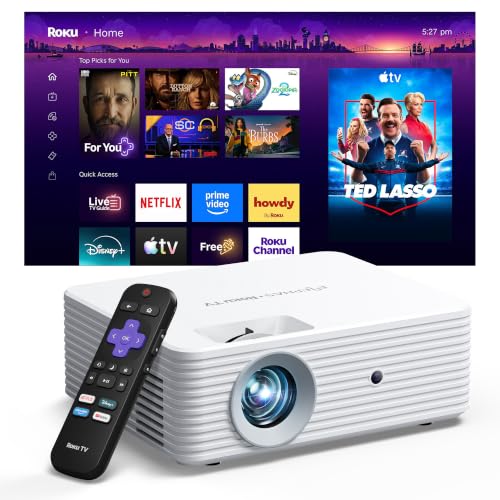
ELEPHAS is one of the mini shelf’s elder names, and this model’s listing pairs its portable hardware with built-in Roku TV, Dolby Audio and compatibility with Alexa and Google Home. The voice-assistant line is easy to skim past and worth pausing on: in a garden, at dusk, with hands full of glasses and blankets, asking a voice assistant to dim the smart lights or pause the film is not a gimmick but an ergonomic feature, and it marks this machine as the one designed to join a smart home’s evening routine rather than merely visit the garden. The Roku platform underneath does the same quiet work as on its Aurzen rival — real apps, familiar menus, updates handled elsewhere.
The listing frames the machine as a portable mini for bedroom and outdoor use, and that dual citizenship is honest: this is a projector that earns its keep across the whole year, indoors through the winter and in the garden through the summer, rather than a specialist that hibernates. Dolby Audio supports its solo voice, Bluetooth offers the speaker upgrade, and the class’s standing caveats apply without exception — brightness belongs to the evening, water resistance is nowhere claimed, and the native-versus-support translation should be applied to its resolution language by reading the listing’s own figures on the day. For a household already speaking to its lights and speakers, the ELEPHAS is the backyard pick that answers back.
- Platform as listed: Roku TV built in
- Voice as listed: compatible with Alexa and Google Home
- Audio as listed: Dolby Audio
- Wireless as listed: WiFi and Bluetooth
- Framing as listed: portable mini for bedroom and outdoor use
Strengths
- Roku’s licensed catalogue with voice-assistant manners for hands-full evenings.
- Year-round dual citizenship, bedroom to garden, justifies its shelf space.
- Dolby Audio gives the solo setup a respectable starting voice.
Trade-offs
- The listing’s framing is portable rather than outdoor-hardened; the carrying ritual applies in full.
- Resolution and brightness language need the class’s usual careful reading.
- Voice features presume a smart home ecosystem that not every garden possesses.
Best for: smart-home households wanting a portable Roku screen for all seasons. Not suited for: buyers wanting a dedicated, leave-it-outside installation.

1500 ANSI Smart Projector — Stated ANSI Brightness
This machine’s listing does something the rest of the shelf mostly avoids: it publishes a brightness figure with a standard attached. Fifteen hundred ANSI lumens is the claim, alongside native 1080P resolution, 4K support in the decoding sense, AI calibration, voice control, a 20W Dolby speaker arrangement, HDR10+, auto focus and keystone, Android TV with built-in apps, and image sizes quoted to 200 inches. Take the claims in order of evidentiary weight. The ANSI figure and the native resolution are the load-bearing ones, and they describe the most powerful honest specification in this guide: a projector whose light output is stated in units a buyer can compare against any other ANSI-quoted machine, indoors or out.
The supporting cast is aimed at the host. AI calibration and auto focus conspire to shorten the dusk setup, voice control keeps hands free, and the 20W speaker claim — a maker figure, to be judged by ear — addresses the garden’s sound problem with more ambition than any rival here except the VOPLLS. Android TV inside means the apps live in the projector, with the catalogue caveat that applies to every unnamed app ecosystem: check your services against the listing. The 200-inch ceiling should be read as optical range; at garden sizes between a modest screen and a generous one, the ANSI output has the headroom to begin at the earlier, brighter edge of dusk. For the buyer who reads specifications the way this guide keeps recommending — standards first, adjectives last — this is the shortlist’s natural leader.
- Brightness as listed: 1,500 ANSI lumens — a measured-standard figure
- Resolution as listed: native 1080P, with 4K support as input decoding
- Audio as listed: 20W Dolby speaker claim
- Setup as listed: AI calibration, auto focus and keystone, voice control
- Platform as listed: Android TV with built-in apps
- Formats as listed: HDR10+
Strengths
- An ANSI brightness figure buyers can actually compare across brands.
- The strongest solo sound claim in the set, aimed at the garden’s open-air problem.
- Calibration automation that shortens the dusk setup ritual considerably.
Trade-offs
- Even 1,500 ANSI lumens is an evening proposition outdoors, not a daylight one.
- The app catalogue of an unnamed ecosystem must be checked against your subscriptions.
- No water resistance is claimed; the indoor-storage rule applies unchanged.
Best for: specification-led buyers and larger gardens that need the light and the voice. Not suited for: daylight dreamers or leave-it-outside planners.
VOPLLS Outdoor 4K Projector — Big Voice, Licensed Netflix
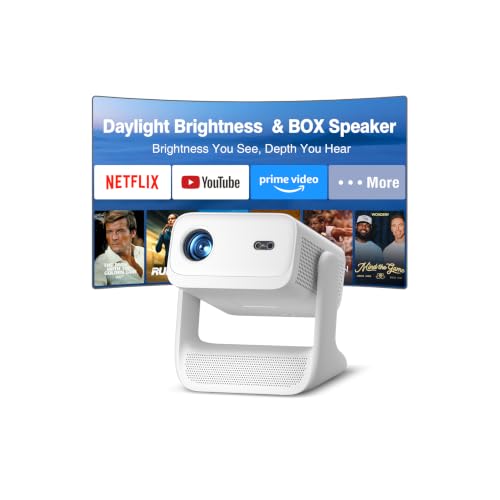
The VOPLLS announces its priorities in brackets at the front of its own listing: an ultra-bright pitch paired with a dual-channel box speaker, followed by Netflix on board, WiFi and Bluetooth, auto focus, auto keystone and a stand that rotates through 360 degrees. Handle the brightness phrase first, with this guide’s standing discipline: the listing’s L-7000 language is a marketing figure, not an ANSI measurement, and it should be weighed as enthusiasm rather than evidence. What can be weighed is the architecture around it. A dual-channel box speaker is a deliberate answer to the garden’s sound problem from a maker that clearly knows where outdoor projectors fail, and licensed Netflix inside removes the commonest app anxiety of the white-label class at a stroke.
The full-circle stand is the other genuinely garden-minded decision, because outdoor placement is improvisation: a wall here, a fence there, a screen hung where the washing line was, and a projector that can aim anywhere without a stack of paperbacks is a projector that finishes setup before the light goes. Auto focus and keystone complete the hands-off brief. Judged as a whole, the VOPLLS is the entertainer of this set — the machine that cares most about sounding big and starting fast — provided its buyer reads the brightness language with the translation this guide supplies and sets the screening at dusk like everyone else. Do that, and its speaker-first design may make it the pick whose audience asks the fewest times what a character just said.
- Audio as listed: dual-channel box speaker design
- Platform as listed: Netflix on board, smart apps
- Setup as listed: auto focus, auto keystone, 360-degree rotatable stand
- Brightness language as listed: marketing figure — not an ANSI measurement
- Wireless as listed: WiFi and Bluetooth
Strengths
- Speaker architecture designed for the open air rather than adapted to it.
- Licensed Netflix removes the app lottery for the commonest service.
- A full-circle stand plus auto setup makes awkward gardens easy.
Trade-offs
- The headline brightness language is unstandardised and must be discounted.
- 4K in this class’s dialect means input support over a lower native picture.
- The carrying-in ritual applies, as it does to every machine in this guide.
Best for: hosts who prioritise sound and a fast, flexible setup for film nights. Not suited for: specification purists who want every number on a standard.

Smart Outdoor Projector with Built-in Apps — Apps Inside, Dual Speakers
Listed as an upgraded P62 Pro, this machine’s pitch is completeness at the white-label tier: built-in apps with major services such as YouTube and Prime Video named in the listing, 4K support in the class’s decoding sense, Dolby Audio delivered by dual speakers, and auto focus with WiFi and Bluetooth. Naming the services is a bigger deal than it sounds. The chronic uncertainty of app-based projectors is whether your particular subscriptions live inside, and a listing that names its headline services lets a buyer answer the question for the two services most households check first — while still, prudently, verifying the rest against the listing on the day.
Dual speakers give its solo voice more body than the single-driver minimum, and auto focus keeps the dusk setup to a power lead and a decision about what to watch. The class caveats assemble as usual: the brightness language is the unstandardised dialect, the native picture lives in the class’s usual range beneath the support wording, and nothing in the listing invites anyone to leave it out in the rain. Within those honestly stated borders, the P62 Pro’s proposition is the white-label one at its most reasonable — everything the evening needs inside one box, at the tier where a second purchase for apps or sound is a choice rather than a necessity. Households that want a single-box garden cinema without platform loyalties will find it the set’s quiet middle path.
- Platform as listed: built-in apps, with YouTube and Prime Video named
- Audio as listed: Dolby Audio, dual speakers
- Setup as listed: auto focus
- Resolution language as listed: 4K support — input decoding, native is lower
- Wireless as listed: WiFi and Bluetooth
Strengths
- Named headline services reduce the app-catalogue gamble.
- Dual speakers give dialogue a fighting chance without extra hardware.
- Auto focus keeps the evening’s setup to minutes.
Trade-offs
- Unnamed parts of the app catalogue still need a listing check.
- Brightness claims follow the class’s unstandardised pattern.
- Not a weatherproof device, whatever the outdoor framing suggests.
Best for: single-box buyers who want the apps and the sound already inside. Not suited for: buyers who need a fully licensed, named platform.

Outdoor Movie Projector with Electric Focus — Focus from the Deckchair
The final pick’s signature is in its name: electric focus, paired in the listing with a high-brightness pitch, a portable home theater framing, and 1080P with 4K input support. Electric focus sounds like a footnote until the first garden screening, when the host — seated, settled, drink in hand — notices the picture is a breath soft and corrects it from the remote instead of crossing the dark garden to kneel by the projector. That small mercy, repeated at every screening, is the kind of feature that separates the machine a household loves from the machine it merely owns. The listing’s gift framing is also honest about the class: these projectors are bought for occasions, birthdays and movie nights, and a machine optimised for the host’s comfort understands its own occasion.
The brightness phrase requires the standard translation — high brightness in this shelf’s dialect is a direction, not a measurement — and the 4K wording means support for a 4K input over the class’s native range, exactly as this guide has read such language throughout. What remains is a portable, evening machine with the host-friendly focus mechanism and the usual WiFi and Bluetooth arrangements for apps and speaker duty. As the set’s closer it makes a neat argument: at the affordable end of backyard projection, the features that matter are the ones that respect the host’s evening, and focus you never have to stand up for is chief among them.
- Focus as listed: electric focus, remote-adjusted
- Resolution as listed: 1080P, with 4K input support
- Brightness language as listed: high-brightness pitch — unstandardised dialect
- Wireless as listed: WiFi and Bluetooth
- Framing as listed: portable movie night projector
Strengths
- Electric focus protects the host’s evening from the projector-tweaking role.
- Portable framing suits the carry-out, carry-in rhythm of garden cinema.
- A straightforward, giftable package for occasional screenings.
Trade-offs
- Brightness is a pitch, not a measurement; dusk discipline still applies.
- Platform details are thinner than the Roku and app-led rivals here.
- Occasional-use framing means heavy users should look up this list.
Best for: occasional hosts and gift-buyers who value the seated, remote-controlled setup. Not suited for: weekly cinema clubs wanting a named platform and published figures.
A Projection Screen — The Companion Every Backyard Needs (Prose-Only)
Prose-only companion gear: no listing link and no single recommended model, because the right screen is a property of your garden, not of this guide. A projector without a surface is a lantern with ambitions, and the garden offers three honest families of surface. The fixed-frame screen is the connoisseur’s answer — a taut, flat, dedicated plane that can live on a fence or a wall where the household is willing to make the cinema a permanent garden feature; it gives the best picture of the three and asks for storage space only in the sense that it never needs any. The tripod screen is the pragmatist’s answer, erected in minutes, forgiving of lawns and patios alike, and stored in a cupboard or garage corner between screenings; its surface is less perfectly taut, and at backyard sizes and dusk light, almost nobody in the audience will ever know.
The inflatable screen is the extrovert’s answer: the largest pictures in the garden world, a blower’s gentle hum as the evening’s overture, and a deflated parcel that demands real storage and real drying discipline, because an inflatable packed away damp is an inflatable being composted. Size the choice by audience and storage rather than by spectacle — a screen the household can erect in ten minutes will host twenty screenings for every one hosted by a screen that takes an hour and a committee. Whichever family you choose, buy it as deliberately as the projector: it is the half of the picture your audience actually looks at, and unlike the projector it will never be upgraded by a firmware update or excused by a platform. This guide teaches the choosing and deliberately sells you nothing, which is the correct relationship between a guide and a garden.
- Fixed-frame: the flattest picture, for gardens that can host a permanent feature
- Tripod: the flexible middle, stored indoors between screenings
- Inflatable: the largest images, with blower noise and drying discipline attached
- Sizing rule: match the screen to the audience and the storage, not to the brochure
Best for: every backyard in this guide, in one of the three families above. Not suited for: projecting onto a dark brick wall and blaming the projector.
Which of these suits which kind of garden?
The small, enclosed garden — high fences, close neighbours, a screen at modest distance — is the natural home of the Roku pair. Distances are short, so modest light output goes further; the audience is near, so built-in sound nearly suffices; and the enclosed sky goes properly dark earlier than an open plot’s. The Aurzen D1R’s zoom earns its keep here, fine-tuning the image to a fence-mounted screen from wherever the patio table stands, while the ELEPHAS suits the same garden when it doubles as the smart home’s evening control point. In a small garden, the cinema’s charm is intimacy, and both machines are built to that scale.
The large, open garden reverses the priorities. Throw distances stretch, the audience spreads, stray light arrives from further away, and the image must be bigger to hold the back row — which is the 1500 ANSI machine’s brief, with its measured brightness claim and its speaker ambition, ideally paired with the largest screen the storage can honestly house. The VOPLLS belongs in this garden too when the audience is big and the host’s priority is that every seat hears the film. The occasional garden — the lawn that hosts three screenings a summer, for birthdays and visiting grandchildren — should buy for the host’s comfort instead: the electric-focus model’s remote mercy or the P62 Pro’s single-box completeness, because a machine used rarely must be effortless every time, or the fourth screening quietly never happens.
How do the six compare side by side?
| Projector | Platform | Brightness basis | Setup signature | Sound story |
|---|---|---|---|---|
| Aurzen Roku TV D1R | Roku TV | Not headline-quoted; native 1080P stated | Auto focus, keystone and zoom | Dolby Audio |
| ELEPHAS Roku TV | Roku TV | Unstandardised class language | Portable mini manners | Dolby Audio, voice-assistant friendly |
| 1500 ANSI Smart Projector | Android TV | 1,500 ANSI — measured standard | AI calibration, auto focus | 20W Dolby speaker claim |
| VOPLLS Outdoor 4K | Netflix on board | Marketing figure, not ANSI | Auto focus, 360-degree stand | Dual-channel box speaker |
| Smart Outdoor Projector P62 Pro | Built-in apps, services named | Unstandardised class language | Auto focus | Dolby Audio, dual speakers |
| Outdoor Movie Projector, Electric Focus | Check the listing | High-brightness pitch, unstandardised | Electric focus by remote | Bluetooth out to your speaker |
The brightness column is the table’s conscience. Exactly one figure in it carries a measurement standard, and the rest are labelled for what they are, because a comparison that ranked these machines by their largest printed number would be comparing adjectives. What can be compared cleanly is everything else: the licensed platforms against the app ecosystems, the zoom and full-circle stands against the gardens they forgive, and the speaker architectures against the open air they must fill. Choose on those columns, start at dusk, and any row of this table will give you a summer of evenings.
How do you run a backyard screening, step by step?
Begin in daylight, an hour before the film. Carry out the screen first and erect it where the audience will sit with the light behind them and the neighbours’ windows considered. Place the projector on a stable table at the distance its image size demands, on a surface that grass cannot wobble. Run one power lead — from an outdoor-rated socket or a properly protected extension — and dress it where feet will not find it in the dark. Power up while the light is still good: let auto focus and keystone do their work, square the image by moving the projector rather than by menu force, and set the size with distance or zoom.
Sound comes next, still in daylight. Pair the Bluetooth speaker, place it at the screen, play a dialogue scene and walk the seating: if the back row cannot follow speech at a neighbourly volume, move the speaker, not the volume knob. Queue the film, set the platform’s downloads or stream to the exact title, and test the first minute. Then feed everyone. The screening itself starts when the sky has properly darkened — trailers or a short first, the feature after — and it ends with the ritual this guide has preached throughout: projector indoors before the dew, screen down and dried if it needs it, speaker on charge. Ten minutes of closing ceremony is the subscription price of a garden cinema that works all summer. Photograph the working setup on the first good night — projector position, screen position, speaker position — and pin the picture inside the kit box; by the third screening you will have forgotten which table height worked, and the photograph will remember it for you with the indifference of all good documentation.
What mistakes do backyard hosts keep making?
Starting the film in twilight is the host’s original sin, committed from kindness — the guests are ready, the food is done — and punished by an opening act nobody can quite see. Second is trusting a marketing brightness figure to repeal the sunset; no number in this class’s dialect changes the time the sky goes dark. Third is assuming outdoor in a product name means weatherproof in fact, and leaving a machine to the dew, the sprinkler or the rain shower that the forecast called unlikely. Fourth is sound placed by convenience — the speaker beside the projector, behind the audience — followed by a volume war with the neighbours that better placement would have prevented entirely.
The quieter errors are logistical. A power lead crossing the garden’s walking line in the dark is an accident being scheduled. A screen erected for the first time by torchlight, with the instructions still in the box, converts setup into theatre of the wrong kind. A streaming plan that depends on the house WiFi reaching the bottom of the garden, untested, will introduce itself at the worst moment — download the film or move the screening within range during setup, while the sun is still up and solutions are still cheap. Every one of these mistakes is made once by somebody each summer; the purpose of this section is to ensure that your household’s once was reading about them.
How does a backyard cinema grow across its first seasons?
Almost nobody’s first screening resembles their tenth, and the upgrade path is worth sketching so that early purchases do not block it. Season one is the projector, a sheet or a borrowed screen, and the speaker from the kitchen. The picture charms, the sound merely serves, and the host keeps a private list of everything the evening lacked. Season two usually spends on the screen, because it is the component the audience actually watches and the one whose improvement — flat, taut, properly sized — flatters the projector they already own. Sound follows, with a dedicated outdoor speaker replacing the borrowed one, placed permanently in the host’s mental map of the garden.
By season three the upgrades turn from hardware to choreography: a stored kit box with the leads, the remote, the speaker and the screen’s fixings travelling together; a setup sequence the host can perform in fifteen minutes; a standing arrangement with the neighbours that has matured into an annual invitation. Notice what never appears on the list — a brighter projector bought to defeat the sunset. The households that last in this hobby are the ones that made peace with dusk in season one and spent their money on the surface, the sound and the ritual. The projector, chosen well from the six above, simply keeps its side of that peace, evening after evening, for as many summers as the carrying ritual is honoured.
What do these projectors do all winter?
A backyard projector bought only for summer is a machine unemployed for two-thirds of its life, and the six here were partly chosen because none of them accepts that contract. Every one is a competent indoor portable the moment the season turns: the Roku pair become bedroom and guest-room screens with their platforms intact, the app-led machines take over a playroom wall, and the electric-focus model discovers that its signature mercy works just as well across a living room as across a lawn. Households that plan this second life from the start — a shelf position indoors, a wall kept plausibly blank — find the purchase price dividing itself across twelve months of evenings instead of twelve weeks.
Winter is also the maintenance season the class quietly needs. A projector that has spent a summer commuting accumulates dust in its vents and stories in its lens; a soft brush, a microfibre cloth and a platform update performed indoors, in daylight, return it to spring condition. The screen deserves the same audit — dried fully before storage, checked for the mildew that a damp garage gifts to fabric, and repaired at leisure rather than at the first screening’s dusk. Ten minutes of winter care is the difference between a garden cinema that reopens like a favourite restaurant and one that reopens like a building site, and it costs nothing but the decision to schedule it.
Final Recommendation
For most gardens, the Aurzen Roku TV D1R is the host’s friendliest route to a weekly cinema: licensed apps, automatic setup and a stated native resolution in a machine that asks nothing of the evening but power and dusk. The 1500 ANSI Smart Projector is the specification-led alternative, and the one larger gardens should audition first for its measured brightness claim and its speaker ambition. The VOPLLS serves the sound-first host, the ELEPHAS the voice-controlled smart home, the P62 Pro the single-box buyer, and the electric-focus model the host who refuses to leave the deckchair. Add a screen chosen for your storage rather than your ego, a speaker placed where the picture lives, and the discipline to bring everything in before the dew, and your garden will do the rest — a projector carried out on a June evening has a way of becoming the reason the whole street hopes for a clear sky.
Frequently Asked Questions
Are any of these projectors waterproof?
None of the listings in this guide claims a water-resistance rating, so the honest answer is to treat every one of them as an indoor device visiting the garden. They come out for the screening, sit under whatever shelter the audience enjoys, and go back inside before dew settles. A projector left outdoors overnight is being stored in the one environment its design never agreed to.
What screen size works in a typical backyard?
The size your projector can fill brightly at dusk from the distance your garden allows — in practice, a generous television-plus image for smaller gardens and a properly cinematic one where the throw distance exists. Bigger is not automatically better outdoors: the largest inflatable screens also catch the most breeze, gather the most stray light and demand the most storage, so size for the audience you host, not the audience you imagine.
Can I project onto a fence, a wall or a sheet?
A smooth, light-coloured wall or fence panel works respectably, and a properly tensioned sheet has hosted a million happy screenings. What ruins the improvisation is texture and movement: brick relief, fence gaps and a sheet breathing in the breeze all tax the picture. A real screen — tripod, fixed or inflatable — is the upgrade every backyard host eventually makes, which is why this guide treats it as companion gear worth choosing well.
How do I keep the neighbours on side?
Sound placement and sound level, in that order. A speaker near the screen, aimed at your audience, delivers clear dialogue at volumes that stay in your garden; a speaker cranked to overcome bad placement tours the whole street. Sensible finishing times and a word of warning before a loud premiere complete the diplomacy — most neighbours, invited once, become defenders of the institution.
Will my home WiFi reach the garden?
Test it during setup, in daylight, with the actual film queued — garden range is a property of your router, your walls and your distance, not of the projector. Where the signal fails, the remedies are to download the film to the platform in advance where the service allows, to move the screening within range, or to feed the projector by cable from a laptop. Discovering the answer at dusk, in front of an audience, is the only wrong method.
Can children run a backyard screening themselves?
With the setup done by an adult — power lead dressed, projector placed, speaker paired — the platforms in this guide are simple enough for older children to drive, and there is real delight in handing a young host the remote for a garden premiere. The non-negotiables stay adult territory: anything involving the mains lead, the decision about weather, and the carrying-in at the end of the night. Teach those three as the family’s standing rules and the backyard cinema becomes one of the better first responsibilities a household can hand down.
What happens when the weather turns mid-film?
The projector comes in first and the discussion happens indoors. A few spots of rain on a lens or into a fan vent can end a machine’s story, so the host’s rule is absolute: equipment before audience comfort, every time. Screens and speakers follow as conditions allow. A garden cinema that protects its projector in the first shower is a garden cinema that screens again next week.
Related Guides
The backyard is one venue among several in this family of guides. Its indoor portable cousins are compared in Best Mini Bluetooth Projectors, while rooms that want the big picture permanently should read Best Home Theater Projectors Short Throw. And because dusk is a brightness negotiation, Best Bright Projectors explains the lumen numbers behind every claim in this guide.



[…] are the portable end of a much larger family. For the garden version of the same evening, Best Backyard Projectors covers outdoor movie nights and the screens that go with them, while Best Home Theater Projectors […]