What's inside
- Key Takeaways
- Quick Picks
- How Did We Choose These Six Starter Bodies?
- What Should a First Mirrorless Camera Actually Do Well?
- Which Starter Body Fits Your Hands, Your Eyes and Your Habits?
- What Does Ownership Cost After the Kit Price?
- How Do the Four Lens Mounts Compare for a Beginner’s Budget?
- When Does Video Change Which Starter Camera You Should Buy?
- Entry Bodies Face to Face: Which Compromises Can You Live With?
- How Should You Put a Starter Camera Through Its Paces in Week One?
- Which Mistakes Do First-Time Buyers Keep Making?
- How Do You Get Sharp, Well-Exposed Photos in Your First Month?
- Final Recommendation
- Frequently Asked Questions
- Related Guides
As an Amazon Associate I earn from qualifying purchases. This post may contain affiliate links at no extra cost to you.
gizmoverdict.com is reader-supported. When you buy through links on our site, we may earn an affiliate commission.
Where to buy: All six cameras below link to listings checked for this guide, and five of the six are sold as kits with a starter zoom in the box, so the link on each pick is the sensible first click before you start pricing bodies and lenses separately. One pick, the Fujifilm, arrives as a bundle with accessories packed by the seller rather than by the factory, and that is flagged where it appears.
The best entry mirrorless cameras share a problem that has nothing to do with image quality: they all promise to be the last camera a beginner needs to think about for years, and they cannot all be right. Every model in this guide takes genuinely good photographs. Sensors in this class stopped being the weak point a generation ago, and a newcomer who buys any of these six and spends the saved money on a second lens and a few weekends of practice will out-shoot a newcomer who buys the most expensive body here and leaves it in a drawer. So the honest question for a first mirrorless camera is not which one is best in the abstract. It is which one’s compromises land in the places you will never look, and which one’s strengths match the photographs you actually intend to take.
That reframing matters because entry-level bodies differ mostly in handling, screens, autofocus temperament and video ceilings rather than in raw stills quality. A camera with a screen that flips fully toward you is a different tool from one with a brighter viewfinder and a screen that only tilts, even when the sensors are near-identical. A body with subject-detection autofocus that finds a dog’s eye without being asked will rescue a beginner’s family album in a way that a slightly sharper kit lens never will. And the lens mount you choose on day one quietly decides what your upgrade path costs in three years, because lenses stay while bodies rotate.
So this guide is organised around intent. The Canon EOS R100 is the simplest route in. The Nikon Z50 II is the keen photographer’s starter body. The Sony ZV-E10 is built for people who will film themselves. The Canon EOS R50 is the step-up kit for households that want both stills and video done well. The Fujifilm X-T30 II is the film-look route, sold here in a seller bundle. And the Sony a6400 is the previous-generation value play: an older body, still sold new, whose autofocus was ahead of its time and whose price now undercuts cameras it can still embarrass.
Key Takeaways
- At this level the mount matters more than the megapixels: you are buying into a lens system, not just a body.
- Every pick here is APS-C, which keeps bodies and lenses small enough that a first camera actually gets carried.
- Screens divide the class: full flip-out screens serve filming and selfies, tilting screens serve waist-level stills, and one pick here has a screen that does neither trick.
- None of the six has in-body stabilisation, so stabilised lenses and sensible shutter speeds carry the load for handheld work.
- The Sony a6400 is a previous-generation body still sold new; its autofocus punches above its age while its screen and battery show it.
- A kit zoom plus one fast prime teaches more photography than any body upgrade in this price band.
Quick Picks
| Pick | Badge | Why it is here |
|---|---|---|
| Canon EOS R100 with RF-S 18-45mm kit | Best overall | The plainest, lightest route into interchangeable lenses, with guided menus that explain settings instead of merely naming them. |
| Nikon Z50 II | Best handling | A photographer’s starter body: proper grip, bright finder, colour presets and the most modern autofocus of the group. |
| Sony ZV-E10 with 16-50mm kit | Best for video starters | Built around filming yourself, with a side-flipping screen, product-showcase focus behaviour and no viewfinder to pay for. |
| Canon EOS R50 with 18-45mm kit | Best step-up kit | The R100’s bigger sibling in spirit: oversampled 4K, subject-detection autofocus and a fully articulating touchscreen. |
| Fujifilm X-T30 II with XC 15-45mm kit bundle | Best film-look starter | Fujifilm’s film simulations and analogue dials in a compact body, sold here as a seller bundle with card, bag and filter extras. |
| Sony a6400 with 16-50mm kit | Previous-gen value | An older body still sold new, with real-time eye autofocus and tracking that newer budget rivals still chase. |
How Did We Choose These Six Starter Bodies?
We started from the way first cameras are actually bought: as kits, at the end of a comparison between two or three tabs, usually with a birthday, a trip or a new baby setting the deadline. That meant every pick had to be available as a working outfit or an easy body-plus-lens pairing, had to come from a lens system with affordable growth room, and had to forgive beginner mistakes rather than punish them. Autofocus that finds faces without menu-diving counted for more than burst speed. Screens were judged on whether a newcomer working alone could frame themselves. Menus were judged on whether the camera explains itself.
We also held a hard line on honesty about generations. Two of these cameras are current models, two are recent, one is a small step older, and the a6400 is a previous-generation design that remains on sale new. Rather than pretend otherwise, each review states where a body sits in its maker’s timeline and what that costs in battery design, screen mechanics or menu polish, because a first camera bought with open eyes gets kept, and one bought on a misunderstanding gets returned.
We also weighted weight itself, in the literal sense. A starter camera’s most important specification is whether it is present when the photograph happens, and every outfit here, body plus kit zoom, can be carried all day without negotiation. That ruled the class as much as any sensor figure: full-frame bargains exist, but their lenses turn a stroll into an expedition, and beginners stop bringing expeditions. Small, light and forgiving is not a compromise in a first camera. It is the design brief.
What Should a First Mirrorless Camera Actually Do Well?
It should make the automatic modes good enough that a beginner’s early photographs succeed, because early success is what turns a purchase into a hobby. That means evaluative metering that handles a backlit child, autofocus that prefers the nearest eye over the nearest fence post, and JPEG colour that looks finished straight out of the camera for the months before its owner learns what a raw file is. All six picks clear that bar, though they flavour it differently: Canon and Nikon lean natural, Sony leans crisp and modern, and Fujifilm offers its film simulations, which are effectively a shelf of finished looks applied at the moment of capture.
It should also leave a door open. A first body that accepts the maker’s full lens range, takes an external microphone, and offers manual controls that reveal themselves gradually will still be useful as a second body years later. Every system here does that, but the cost of the second and third lens differs by mount, and the guide’s per-pick trade-offs note where a system’s affordable glass is plentiful and where it thins out.

Canon EOS R100 with RF-S 18-45mm kit — Best overall
The R100 is Canon’s argument that a first camera should be almost impossible to misuse. It is the lightest body in this guide, its mode dial still carries the scene modes that more expensive cameras have abandoned, and its guided display replaces terse abbreviations with short explanations of what a setting does to the picture. For someone moving up from a phone who has never chosen an aperture on purpose, that teaching layer is worth more than a faster burst rate, because it converts the first month of ownership from guesswork into a short course.
Underneath the friendliness sits a capable stills camera: a 24.1-megapixel APS-C sensor, Dual Pixel autofocus that behaves predictably on faces, and 4K video that is cropped and best treated as an occasional extra rather than a headline feature. The compromises are plainly visible. The rear screen is fixed in place and does not flip for selfies or fold for waist-level shooting, the burst rate is modest, and there is no in-body stabilisation, so the kit zoom’s own stabilisation does the steadying. Photographers who know they will shoot mostly stills, mostly through the viewfinder, will barely notice any of that.
Consider who thrives with it: a parent upgrading from a phone for school concerts and holidays, a student handed a first real camera, a small-business owner photographing stock for a shop page. In each case the R100’s job is to disappear, and its small size is the feature that keeps it in the bag rather than on the shelf. Paired later with Canon’s inexpensive RF-S primes or a longer zoom for sports day, it grows just far enough; the owner who eventually wants articulating screens and faster video will trade up inside the same mount, keeping every lens.
- Sensor: 24.1MP APS-C CMOS
- Kit lens: RF-S 18-45mm F4.5-6.3 IS STM, stabilised
- Video: 4K with a crop; Full HD for everyday filming
- Screen: fixed 3-inch touchscreen, no flip or tilt
- Stabilisation: lens-based only
- Connectivity: Wi-Fi and Bluetooth for phone transfer
Strengths
- Guided menus that explain settings in plain language as you change them.
- The smallest, lightest outfit here, so it genuinely goes in a jacket pocket bag.
- Canon’s colour and face autofocus make first-month JPEGs look finished.
Trade-offs
- A fixed screen shuts out self-filming and awkward-angle framing tricks.
- 4K video is cropped and contrast-detect slow, so video-first buyers should look elsewhere in this guide.
- No in-body stabilisation means unstabilised prime lenses need care at dusk.
Best for: first-time buyers who shoot stills, want the camera to teach them, and value small size over video features.
Not suited for: solo creators filming themselves, since the screen never turns to face the person in front of the lens.

Nikon Z50 II — Best handling
The Z50 II is the pick for the beginner who already suspects they are a photographer. Nikon gave it a deep grip that fills the hand properly, a bright electronic viewfinder, and the EXPEED 7 generation of subject-detection autofocus that recognises people, animals and vehicles and holds an eye the way Nikon’s professional bodies do. It also carries one-touch picture controls and colour presets aimed at creators who want a look without editing software, plus a fully articulating touchscreen for the filming it will inevitably be asked to do.
Its 20.9-megapixel sensor is the lowest count in this guide and the fact is close to irrelevant: it is a clean, modern sensor whose files print and crop perfectly well for any beginner purpose, and its high-ISO behaviour is tidy. Video runs to 4K60 with a crop at the top rate, and the body feels like the one here most likely to still be someone’s main camera in four years. What it lacks is in-body stabilisation and a deep native DX lens shelf; Nikon’s Z DX range is growing but remains the slimmest of the four systems represented here, so check that the lenses you dream about exist in DX form before committing.
The Z50 II also rewards a beginner who shoots moving subjects early: children on bicycles, dogs at the park, a sibling’s football match. Subject detection that simply refuses to let go of an eye removes the single largest cause of ruined beginner photographs, and its product-shot and portrait modes borrow the colour science Nikon tunes for its professional line. It is the one camera here we would hand to someone who said the words “I want to learn properly” and meant them, because its controls, its finder and its focusing all scale with the owner’s ambition instead of capping it.
- Sensor: 20.9MP APS-C (DX) CMOS
- Processor generation: EXPEED 7 with subject-detection AF
- Video: 4K up to 60p (cropped at 60p)
- Screen: fully articulating touchscreen
- Stabilisation: lens-based only
- Extras: built-in colour presets and creator picture controls
Strengths
- Autofocus subject detection borrowed from Nikon’s flagship line, unusual at this level.
- Grip, dials and viewfinder feel like a photographer’s tool rather than an appliance.
- Articulating screen and presets make it a credible hybrid for stills and clips.
Trade-offs
- The native DX lens range is the smallest here, so future glass may cost more.
- Stabilisation depends on the lens, and some DX zooms lack it entirely.
- Lowest pixel count of the six, which matters only to heavy croppers.
Best for: keen beginners who frame through a viewfinder, shoot family and wildlife, and plan to grow with one body.
Not suited for: lens collectors on a budget, because the affordable native glass shelf is still the thinnest of these systems.

Sony ZV-E10 with 16-50mm kit — Best for video starters
The ZV-E10 starts from a different question: what if the beginner’s first camera is mainly for filming themselves talking, unboxing, teaching or playing? Sony’s answer removes the viewfinder entirely, puts the screen on a side hinge so it flips fully forward without a cable fouling it, adds a product-showcase mode that shifts focus to an object held up to the lens, and builds in background-defocus and skin-smoothing touches that a new presenter appreciates. Its 24.2-megapixel sensor records 4K30 that is downsampled and noticeably crisper than the class average, and its 425-point autofocus with real-time eye tracking was designed for exactly the one-person production this camera serves.
The stills side is competent rather than inspired: the same sensor takes fine photographs, but composing through a rear screen in bright sun is nobody’s favourite afternoon, and there is a stabiliser built into the body is absent, so walking footage leans on the lens and on electronic correction that crops the frame. Battery life is from Sony’s smaller pack generation and a spare is a sensible early purchase. None of that dents its purpose. As a first filming camera that also takes family photographs, it is the most honestly specialised tool in this guide.
Its ecosystem argument deserves emphasis, because a filming beginner’s second purchase is rarely a lens; it is a microphone, then a small light, then perhaps a gimbal. The ZV-E10’s standard shoe, its microphone input and its headphone-free but workable monitoring route fit that shopping list without adapters or cages. Sony’s menu of picture profiles also leaves a growth path: shoot flat, learn to grade, and the same body produces footage that cuts acceptably beside much pricier cameras, which is why so many working creators began on exactly this model and kept it as a second angle.
- Sensor: 24.2MP APS-C CMOS
- Video: 4K up to 30p, oversampled; Full HD slow motion
- Autofocus: 425 points with real-time eye AF for people and animals
- Screen: side-hinged, fully articulating touchscreen
- Viewfinder: none
- Stabilisation: electronic and lens-based; no in-body system
Strengths
- Flip screen, tally lamp and product-showcase focus make solo filming straightforward.
- Sony’s E-mount has the deepest affordable lens catalogue of any system here.
- Microphone input and a proper hot shoe welcome a first audio upgrade.
Trade-offs
- No viewfinder at all, which stills shooters will miss within a week.
- Rolling shutter shows in fast pans, a known trait of this sensor generation.
- Small battery means a spare belongs in the bag from the start.
Best for: new YouTubers, tutors and sellers who film themselves and want focus and framing handled.
Not suited for: viewfinder traditionalists and outdoor stills shooters working in hard sunlight.

Canon EOS R50 with 18-45mm kit — Best step-up kit
Think of the R50 as the camera the R100’s owner graduates to, sold early to buyers who already know they want both stills and video done properly. Its 24.2-megapixel sensor pairs with Canon’s DIGIC X processor, which brings subject-detection autofocus that distinguishes people, animals and vehicles, and 4K30 video oversampled from 6K that looks a class above the R100’s cropped 4K. The screen fully articulates, the touch interface is the friendliest here alongside the R100’s, and the body stays small enough to remain a take-anywhere camera rather than a special-occasion one.
It is also the natural answer for households: one camera that a parent can hand to a teenager for a school project, then use for a holiday film, then trust at a wedding. The honest limits are a modest buffer for long bursts, a smaller battery than Canon’s bigger bodies, no in-body stabilisation, and an RF-S lens shelf that, while growing, still trails Sony’s E-mount for cheap primes. Buyers who know the difference between this and the R100 and can name a reason for it, usually video, should buy this one first and skip the upgrade step entirely.
There is a subtler strength worth naming: the R50’s autofocus in video. Continuous focus that glides between a face and a held-up object without hunting is the feature that makes home films watchable, and Canon’s implementation here is calm in a way that older budget bodies never managed. Add the camera’s ability to hand footage to a phone quickly for editing apps, and it fits the way families actually publish now, which is from the sofa the same evening rather than from a desktop a month later.
- Sensor: 24.2MP APS-C CMOS with DIGIC X processor
- Video: 4K30 oversampled from 6K; Full HD at higher frame rates
- Autofocus: Dual Pixel CMOS AF II with subject detection
- Screen: fully articulating touchscreen
- Stabilisation: lens-based only
- Burst: up to 15 frames per second with the electronic shutter
Strengths
- Oversampled 4K and modern subject detection in a genuinely small body.
- Canon menus and touch controls are the easiest here to learn from zero.
- Strong resale and a growing RF-S lens range protect the investment.
Trade-offs
- Buffer depth limits long action sequences shot in raw.
- The kit zoom’s aperture is dim for interiors, and the body adds no stabilisation of its own.
- Single card slot, standard for the class but worth knowing.
Best for: families and upgraders who want one camera fluent in both stills and respectable video.
Not suited for: sports shooters stringing together long raw bursts from the sideline.
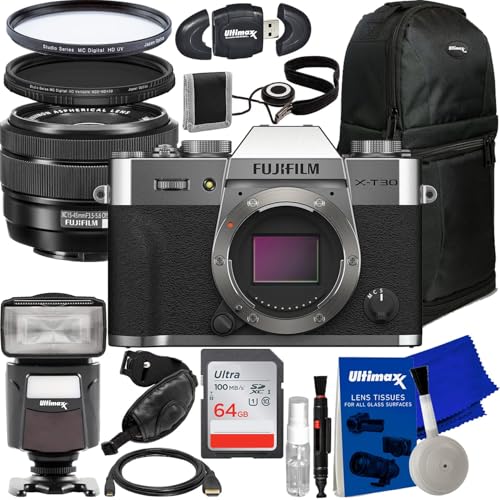
Fujifilm X-T30 II with XC 15-45mm kit bundle — Best film-look starter
The X-T30 II sells a feeling the others cannot: photographs that look like they were shot on film stocks, produced in-camera by Fujifilm’s simulations, from a small silver body with real dials for shutter speed and exposure compensation. Its 26.1-megapixel X-Trans sensor is a generation older than Fujifilm’s newest, and its autofocus is a step behind the subject-detection systems elsewhere here, but for portraits, streets, cafés and travel, the images it makes straight out of camera have a finished character that beginners usually spend a year of editing learning to imitate.
One listing note deserves plain words: this pick is sold as a seller-assembled bundle, pairing the camera and XC 15-45mm power-zoom lens with a memory card, a sling bag, a variable neutral-density filter and further small accessories, twenty-three pieces in the seller’s count. The camera and lens are the substance; treat the extras as a starter drawer of useful bits rather than as added camera value, and check the bundle contents on the listing before ordering. The camera itself tilts its screen rather than flipping it, records 4K30, and lacks in-body stabilisation, so it is a stills-first instrument with video as a sideline, the reverse of the Sony above.
Who falls for this camera tends to stay fallen. The dials make exposure a physical habit, shutter speed under the right thumb, compensation under the left, and the film simulations invite experimentation that costs nothing: shoot the same street in a chrome look, a soft portrait look and a monochrome, and learn what rendering does to a scene. For a beginner whose interest is the photograph as an object rather than the camera as a gadget, no other pick here teaches taste as quickly, and Fujifilm’s compact primes, bought one birthday at a time, complete the experience.
- Sensor: 26.1MP APS-C X-Trans CMOS 4
- Kit lens: XC 15-45mm OIS power zoom, stabilised
- Video: 4K up to 30p
- Screen: tilting touchscreen, no forward flip
- Stabilisation: lens-based only
- Bundle: seller-packed card, bag, variable ND filter and accessories
Strengths
- Film simulations deliver finished, characterful JPEGs with zero editing.
- Physical dials teach exposure by touch and slow the photographer down usefully.
- Fujifilm’s X-mount has a deep bench of compact, affordable prime lenses.
Trade-offs
- Autofocus tracking trails the Canon, Nikon and Sony picks on erratic subjects.
- Tilting screen cannot face forward for self-filming.
- Bundle accessories vary in quality; the value sits in the camera and lens.
Best for: beginners drawn to a film look, street and travel stills, and learning exposure on real dials.
Not suited for: vloggers who must see themselves, and parents chasing toddlers with autofocus as the safety net.

Sony a6400 with 16-50mm kit — Previous-gen value
Here is the guide’s deliberate anachronism, framed exactly as it should be: the a6400 is a previous-generation body that Sony still sells new, and it earns its place because its autofocus system, real-time eye AF and real-time tracking, was the class benchmark when it launched and remains better than the focusing on many newer budget bodies. Its 24.2-megapixel sensor is a known quantity with clean files, its magnesium body is weather-sealed to a degree none of the others here match, and it slips into the deepest lens ecosystem in this guide at a price the newer bodies cannot touch.
The age shows in specific, nameable places rather than in image quality. The touchscreen is mostly for focus-point placement rather than full menu control, the screen flips up over the top of the body where a shoe-mounted microphone can block it, the battery is the smaller older pack, and there is stabilisation lives in the lens rather than the body. Video is 4K30 with noticeable rolling shutter. A buyer who photographs people, pets and events, and who would rather spend the saving on a fast prime lens, gets the best value equation in this guide. A buyer who films themselves daily should take the ZV-E10 or R50 instead and not romanticise the discount.
It is also, quietly, the best travel body of the six for a stills photographer: the sealed magnesium shell shrugs at drizzle and dust, the viewfinder is a proper one, and the whole outfit with the small power zoom weighs little more than a paperback. Owners who shoot raw will find the files flexible, and the camera’s customisable controls let an experienced hand set it up like a larger Sony. Bought at its current standing in the range, with the saving spent on glass, it is the pick most likely to be described by its owner, two years on, as the smart purchase.
- Sensor: 24.2MP APS-C CMOS
- Autofocus: real-time Eye AF and real-time tracking, 425 points
- Video: 4K up to 30p
- Screen: tilts up 180 degrees for self-framing, down for high angles
- Body: magnesium alloy with dust and moisture resistance
- Stabilisation: lens-based only
Strengths
- Eye autofocus and subject tracking that still embarrass newer budget rivals.
- The toughest build here, with sealing the others leave to higher tiers.
- Price leaves room in the same budget for a fast prime, the best upgrade of all.
Trade-offs
- Flip-up screen is blocked by a hot-shoe microphone when filming yourself.
- Older battery and largely touch-free menus date the experience.
- Its battery is the older, smaller pack, so heavy days need the spare sooner.
Best for: stills-led buyers photographing people and pets who want flagship-grade focusing at a starter price.
Not suited for: mic-on-camera self-filmmakers, for whom the screen geometry fights the audio setup.
Which Starter Body Fits Your Hands, Your Eyes and Your Habits?
Specification sheets ignore the body holding the camera, and beginners pay for the omission. Small hands and cold weather both favour the Z50 II and R50, whose grips give fingers something to close around, while the R100 and X-T30 II rely more on the strap and the second hand. None of these cameras is heavy, but the distribution differs: the Fujifilm carries its weight in the dials and metal top plate and feels dense rather than large, the Sonys feel like instruments, and the little Canon feels like it could be forgotten in a coat, which for some owners is the entire point.
Glasses wearers should think about viewfinders specifically. The Z50 II’s finder is the most comfortable here with spectacles, with enough eye relief to see the whole frame; the R50 and a6400 are workable; the X-T30 II’s smaller finder asks glasses wearers to press closer; and the ZV-E10, having no finder at all, settles the question by removing it, which some glasses wearers genuinely prefer in bright light when a big screen and a hood or shade can be managed. Left-eyed shooters, who put their left eye to the finder and their nose across the screen, should favour bodies whose touch focus can be limited to a corner zone, as the Canons allow, so a nose does not keep choosing focus points uninvited.
Habits matter as much as anatomy. A beginner who shoots one-handed while holding a child’s hand, a lead or a coffee will get more from reliable face detection and a deep grip than from any dial layout. A beginner who shoots landscapes from a tripod at dawn will barely touch autofocus and should weight screen tilt, the Fujifilm’s strength, and battery behaviour in the cold. Matching the camera to the life is the whole skill of choosing in this class, because the sensors have already done their part of the bargain.
What Does Ownership Cost After the Kit Price?
The sticker on the kit is the beginning of the spending, and a realistic first-year budget helps a beginner choose between these six more honestly than any feature list. Every owner here will buy a spare battery, and the cost and capacity of that battery differ by generation: the newer Canon and Nikon bodies sip power through modern processors, while the a6400 and ZV-E10 use Sony’s smaller, older pack design, which is cheaper per unit but needs replacing sooner in a day’s shooting. A fast memory card sized for 4K video, a reader for the computer, and a bag that fits the camera with its kit lens mounted rather than dismantled are the other near-universal purchases, and together they add a noticeable fraction to a starter budget that nobody mentions at the till.
Then come the system costs, which is where the mount discussion stops being abstract. A protective filter, a second lens, an external flash or microphone: each is priced by the ecosystem you joined. Sony owners find the deepest second-hand market, which quietly halves the cost of experimentation; Fujifilm owners find lenses hold their value so well that buying used saves less but selling on loses less; Canon and Nikon owners sit between, with official refurbished channels worth checking. None of this should frighten a beginner off any system here. It should simply be counted, because the camera that looks cheapest as a kit is not always the cheapest camera to own for three years, and the a6400’s low entry price, paired with that deep used market, is precisely why it survives in this guide against newer rivals.
How Do the Four Lens Mounts Compare for a Beginner’s Budget?
Every camera in this guide is a key to a different walled garden, and the gardens are not equally stocked. Sony’s E-mount is the oldest mirrorless system here and the most crowded: Sony’s own affordable primes and zooms compete with a deep bench of third-party lenses from makers who have supported the mount for a decade, so almost any focal length a beginner could want exists at a gentle price, new or used. For the ZV-E10 and the a6400, that depth is a genuine long-term discount on the whole hobby.
Canon’s RF mount is younger and more tightly controlled, which shows in the RF-S shelf: the kit zooms are good, the compact primes are arriving steadily, and prices on the essentials are fair, but the third-party choice APS-C buyers enjoy on E-mount is still thinner. Nikon’s Z DX range is the smallest of the four, though what exists, the retractable kit zoom, the wide zoom, the long telephoto, is well chosen, and the full-frame Z lenses all fit and work, at full-frame prices. Fujifilm’s X-mount is the connoisseur’s shelf: an unusually complete set of small, characterful primes built for exactly these sensors, rarely the cheapest option, almost always the one owners keep.
One more route deserves a mention for the budget-minded: adapting older lenses. Every system here can mount its maker’s earlier DSLR lenses through an official adapter, and the second-hand shelves are full of excellent glass at beginner prices. The Canons and Nikons adapt their own DSLR ranges with full autofocus in most cases, Sony’s mount has a long history of adapted use, and Fujifilm owners often adapt manual vintage lenses for the pleasure of it. Adapters add bulk and one more thing to buy, so treat the route as a bonus for enthusiasts rather than a plan for a first month, but know that it exists before assuming a mount’s catalogue is only what is sold new today.
The practical advice follows from that map. Price your second lens before you buy your first body. If it is a fast standard prime for portraits, all four systems serve you, at four different prices. If it is a long telephoto for a child’s sport or a garden bird table, Sony and Canon make it easy, Nikon makes it possible, and Fujifilm makes it lovely but dearer. A beginner who does that one sum in advance almost never regrets the mount they chose, because the regret in camera systems is never about the body; it is about the lens that does not exist or cannot be afforded in year two.
When Does Video Change Which Starter Camera You Should Buy?
Stills-first beginners can safely treat video as a tiebreaker, but the moment filming becomes weekly, three features reorder this entire guide. The first is the screen: a side-hinged screen that faces forward without cables crossing it, as on the ZV-E10 and R50, is the difference between framing yourself confidently and guessing. The second is continuous autofocus behaviour in video, where Canon’s and Sony’s implementations here glide rather than hunt, while the X-T30 II and the a6400, for different reasons, ask more of the operator. The third is heat and record limits on long takes: a school play or a full match is a different demand from a three-minute clip, and buyers with ceremonies in mind should test record behaviour on the listing details and plan around shorter segments.
Audio deserves its own sentence in any video decision, because viewers forgive soft pictures and never forgive bad sound. Every pick here except the most basic configurations accepts an external microphone path of some kind, but the ease differs: the ZV-E10 was designed around it, the R50 and Z50 II handle it gracefully, and the a6400’s flip-up screen punishes the obvious shoe-mounted arrangement. A beginner filming people talking should rank microphone practicality alongside sensor size, and in this guide that ranking quietly promotes the two newest hybrid bodies over the older bargains.
Finally, be honest about editing. Oversampled 4K from the R50 and ZV-E10 looks superb and fills cards and hard drives at a pace that surprises new owners. Full HD from any of these cameras, shot carefully, still looks fine on the screens families actually watch. The right starter video setup is the one whose files you will actually process, and there is no shame in the smaller format while the habit forms.
Entry Bodies Face to Face: Which Compromises Can You Live With?
| Camera | Sensor | Screen style | Video ceiling | Defining strength | Watch out for |
|---|---|---|---|---|---|
| Canon EOS R100 kit | 24.1MP APS-C | Fixed | 4K cropped | Guided menus, lightest body | No flip screen, no IBIS |
| Nikon Z50 II | 20.9MP APS-C | Fully articulating | 4K60 cropped | Flagship-style subject detection | Smallest native lens shelf |
| Sony ZV-E10 kit | 24.2MP APS-C | Side flip-out | 4K30 oversampled | Solo-filming features | No viewfinder |
| Canon EOS R50 kit | 24.2MP APS-C | Fully articulating | 4K30 oversampled | Best stills-video balance | Shallow burst buffer |
| Fujifilm X-T30 II bundle | 26.1MP APS-C | Tilting | 4K30 | Film simulations, real dials | Bundle extras vary; older AF |
| Sony a6400 kit | 24.2MP APS-C | Flip-up | 4K30 | Eye AF and tracking, sealed body | Screen blocked by shoe mic |
Read the table by the column that matches your life. If the screen column matters most, your shortlist is the Z50 II, the ZV-E10 and the R50, and the choice between them is really about whether a viewfinder matters to you. If the last column is empty of anything you care about, you have found your camera, and it is often the cheapest one in the row.
How Should You Put a Starter Camera Through Its Paces in Week One?
New owners tend to test a camera on the cat and a sunset, conclude it is wonderful, and discover its limits at the first event that matters. A better first week is deliberate. Photograph a person walking toward you in ordinary room light and count how many frames hold the eye; that single test reveals more about these six autofocus systems than a month of landscapes. Film yourself speaking for two minutes with the camera on a stack of books, then watch the footage at full size and listen to the built-in audio; you will know immediately whether an external microphone belongs on the shopping list and whether the screen arrangement suits your room. Shoot the same dim interior at each ISO step and look at the files at full magnification, so that later, in a real candlelit restaurant, your ceiling for acceptable grain is a decision you have already made rather than a disappointment you are having.
Finish the week with logistics rather than pictures. Time how long a full battery lasts in your real pattern of shooting, learn the camera’s phone-transfer route until it is boring, format the card in the camera rather than the computer, and set the file numbering and copyright fields once. Owners who do this unglamorous work in week one describe their camera as reliable; owners who skip it describe the same camera as temperamental. The difference is rarely the hardware, and it is the cheapest performance upgrade available to any of these six bodies.
Which Mistakes Do First-Time Buyers Keep Making?
The first is buying the body with the longest specification sheet and the kit lens with the shortest future. A starter zoom is a teaching instrument; the photographs that make a beginner fall for the hobby usually arrive with the first fast prime, an inexpensive lens that opens wide, blurs backgrounds and works at dusk. Budget for that lens when you buy the body, whichever body it is. The second mistake is choosing a system for a feature used twice, stabilisation for a safari that has not been booked, 4K60 for a channel that has not been started, while ignoring the screen and grip used every single outing.
The third mistake is treating the kit as finished. A spare battery, a card reader, a strap that does not saw at the neck and a bag that fits the camera with a lens mounted are not accessories in the upsell sense; they are the difference between a camera that is ready and a camera that is charging. A related trap is judging the camera by its first charge. Batteries arrive partly charged, firmware sometimes updates on day one, and a beginner’s first evening of menu exploration drains more power than a day of shooting; several of these bodies get returned as faulty by owners who never gave them a full charge and a fair week. The fourth mistake is generational confusion: assuming the newest body is automatically the right one. The a6400 in this guide is the standing counterexample, and the honest way to shop this class is to ask what each year’s model actually changed, screen, battery, menus, autofocus, and pay only for the changes you will feel.
How Do You Get Sharp, Well-Exposed Photos in Your First Month?
Start on the camera’s intelligent automatic mode without embarrassment and study what it chooses: the readouts after each shot teach the relationship between shutter speed, aperture and ISO faster than any manual. Then move one dial at a time. Aperture priority for a week of portraits and still life teaches depth of field. Shutter priority for a weekend of children, dogs and street scenes teaches motion. Keep the autofocus set to its face or eye mode for people and its zone mode for everything else, and half-press to lock focus before recomposing only once you understand why the camera sometimes prefers the fence.
Composition repays attention earlier than technique does. These cameras all offer a grid overlay and a level; turn both on. Put horizons on the lower or upper third line rather than through the middle, leave space in front of a face or a moving subject rather than behind it, and move your feet before you touch the zoom, because the kit zooms here are at their best in the middle of their range and because a step forward changes a photograph more than a setting does. None of that requires talent. It requires noticing, and noticing is trainable in a way that gear purchases are not.
Two habits repay learning immediately. The first is checking the shutter speed the camera has chosen in dim light and raising ISO deliberately when it falls below the reciprocal of your focal length, because no stabilisation in these bodies rescues a slow shutter on a moving subject. The second is shooting the same scene at several exposures and reviewing at full magnification that evening; a beginner who reviews honestly for a month improves faster than one who shoots ten thousand frames unexamined. Every camera here supports that loop. The hobby is in the loop, not the logo.
Final Recommendation
For the broadest first-camera answer, take the Canon EOS R50 kit: it is the body here with no disqualifying weakness, fluent at stills and video, easy to learn and easy to hand to someone else. If your photography will be mostly stills and mostly yours, the Nikon Z50 II is the enthusiast’s choice and the Fujifilm X-T30 II the romantic’s. If the camera is really a filming studio that occasionally takes photographs, the ZV-E10 is the honest tool. If the budget is firm, the R100 teaches gently for less, and the a6400, bought knowingly as the older design, returns the best focusing in the class for the money. Choose the mount whose lenses you can afford next, because a first camera is a down payment on a system, and the photographs you will be proudest of are probably two lenses and two winters away.
Frequently Asked Questions
Is 20.9 megapixels on the Nikon Z50 II enough, when rivals offer 24 or 26?
For prints up to large wall sizes, social sharing and sensible cropping, yes. The difference between 21 and 24 megapixels is a few percent in each dimension, invisible outside test charts. What a beginner feels instead is autofocus behaviour and high-ISO cleanliness, where the Z50 II is thoroughly modern. Only photographers who crop aggressively, birders filling the frame from a distance, should weight the count heavily, and they will outgrow every body in this guide equally.
Do I need in-body stabilisation in a first camera?
It helps for unstabilised prime lenses and slow handheld stills, but its absence here is manageable: every kit lens in this guide is stabilised, and video shooters can lean on lens and electronic correction. Treat it as a reason to prefer a stabilised lens when you buy your second one, not as a reason to leave this price class, where no body offers it.
Which of these is best if I will mostly film my child growing up?
The Canon EOS R50, with the Nikon Z50 II close behind. Both track faces and eyes reliably, both have screens that articulate for low angles at floor level, and both record 4K that will look respectable on a future television. The ZV-E10 focuses beautifully too, but its design assumes the subject is the person holding the camera.
Why is an older camera like the a6400 in a current guide at all?
Because it is still sold new, still supported by the deepest lens range here, and still focuses on eyes better than several newer budget bodies. Previous-generation picks are how informed buyers save money; the review states plainly where its age shows, in screen mechanics, battery and menus, so the saving is a decision rather than a surprise.
Should I buy a body alone and a better lens instead of a kit?
Only if you already know the focal lengths you live at. For a true beginner the kit zoom is a cheap way to discover them: after a few months your own files will show whether you shoot wide, standard or long, and that evidence should choose your first prime. The Fujifilm bundle and the two-lens thinking elsewhere in this guide follow the same logic.
Are these cameras too complicated for someone who has only used a phone?
No, and the gap is smaller than the dials suggest. Every pick here has a fully automatic mode that handles exposure and focus competently from the first frame, and the R100 in particular explains its own settings as you explore them. The honest learning curve is about two weekends: one spent in automatic modes studying what the camera chose, and one spent taking deliberate control of a single variable at a time. Buyers who want the phone experience permanently, with no learning at all, are the one group who should reconsider whether an interchangeable-lens camera is the right purchase.
Can a beginner really feel the difference between these autofocus systems?
Yes, in the keeper rate on moving people. Photograph children or pets with each approach and the subject-detection bodies, the Z50 II, R50, ZV-E10 and a6400, return noticeably more frames with the eye in focus than the older contrast-assisted systems. For static subjects, portraits posed, landscapes, food, the difference vanishes, which is why the X-T30 II remains recommendable: its owners rarely shoot the subjects where its focusing trails.
What is the first accessory actually worth buying?
A spare battery, whichever camera you choose, followed by a fast prime lens once your files tell you your favourite focal length. Cards, bags and filters matter, but a dead battery ends a day and a fast prime changes what your photographs can look like; the order of purchases should reflect that.
Related Guides
When the starter body has settled in, our guide to the most capable full-frame mirrorless cameras for growers shows where these systems lead, while readers torn between small bodies for travel should see our compact mirrorless camera roundup for everyday carry, and anyone planning to shoot after dark can continue with the mirrorless cameras that handle low light best.
Related guides
- Best 3D Art Tablets
- Best Canon Point and Shoot Digital Cameras: PowerShot Picks From Pocket Compacts to Travel Zooms
- Best Balancing Stabilizers for Mirrorless Cameras: Payload, Balancing and Native Vertical Shooting
- Best Basic Phones Camera Buyers Can Trust: Flip Phones and Simple Handsets That Still Take a Photograph



[…] Readers stepping up from smaller sensors may want our entry-level mirrorless picks for first-time buyers as the before picture, low-light specialists should continue to the mirrorless bodies that see in the dark best, and Fujifilm-curious shoppers can detour through the Fuji mirrorless range explained pick by pick. […]
[…] shoppers comparing formats should weigh our full-frame mirrorless selection for step-up buyers before deciding APS-C is enough, small-body fans can cross-check the X-M5 and X-T50 against the […]