What's inside
- Key Takeaways
- Quick Picks
- How Did We Rank One Maker’s Plug-In Family?
- What Does EasyMesh Change About Living with an Extender?
- Why Does Every Pick Here Have an Ethernet Port?
- How Should You Place a Plug-In Extender When the Sockets Are Wrong?
- What Happens to These Extenders When You Change Routers?
- How Do TP-Link’s Six Plug-In Extenders Compare Side by Side?
- What Mistakes Do TP-Link Extender Buyers Keep Making?
- What Should You Expect from Throughput at the Far End?
- How Does Tether Compare with the Browser Setup of Older Extenders?
- How Do These Extenders Treat Smart-Home Devices and Security?
- Should You Buy a Deco Mesh System Instead of an Extender?
- What Should You Do When a TP-Link Extender Misbehaves?
- Final Recommendation
- Frequently Asked Questions
- Related Guides
As an Amazon Associate I earn from qualifying purchases. This post may contain affiliate links at no extra cost to you.
gizmoverdict.com is reader-supported. When you buy through links on our site, we may earn an affiliate commission.
Where to buy: TP-Link plug-in range extenders take every slot below, each one verified in this site’s product pool. One caution is printed here rather than buried: a renewed listing for a close relative of the lead pick circulates widely, and it is deliberately not the listing linked in this guide; check the condition line of any TP-Link extender before paying.
The best tp link wifi extenders share a design philosophy that this guide should name at the outset, because it explains the whole range. TP-Link builds extenders the way it builds routers for the mainstream: plug-in bodies, an app called Tether that treats setup as a guided errand, and a mesh standard called EasyMesh that lets the extender stop being a repeater and become a citizen of the network when the router cooperates. Six models earned places here, all of them wall-plug extenders from the RE line, spanning WiFi 6 flagships down to a dual-band AC1200 unit that remains the range’s quiet bestseller for undemanding rooms.
A boundary needs drawing before the picks, because TP-Link’s catalogue blurs it in search results. The company also sells the EAP line of ceiling and outdoor access points, professional hardware that expects cabling and a controller, and those products sometimes surface when shoppers search for extenders. They are not in this guide, by design: this is a guide to plug-in extenders that a household installs in minutes, and the EAP family answers a different question in a different building. Readers whose problem genuinely needs an access point will find that conversation in the PoE guide within this series.
The numbers quoted follow this site’s standing rule. Coverage areas and device counts in TP-Link’s listings are the manufacturer’s own figures from ideal, open test conditions, and the AX class numbers sum the theoretical maximum rates of both bands. They are used here to compare TP-Link’s models with each other, the one job they can honestly do, and never as a survey of what your walls will permit.
It is worth pausing on why this brand, of all brands, attracts a dedicated guide. TP-Link’s extenders are the default recommendation in so many households because the company sells networking the way appliance makers sell kettles: everywhere, at every tier, with a setup routine a neighbour can talk you through. That ubiquity creates its own risks, chiefly the near-twin listings and the generational layering this guide keeps flagging, and it creates its own reward, which is that whatever tier a household chooses, the app, the vocabulary and the upgrade path remain the same language spoken at different volumes.
Key Takeaways
- All six picks are plug-in RE-series extenders; the professional EAP access points are a separate family and excluded.
- EasyMesh turns these extenders into single-name mesh nodes when paired with a compatible TP-Link router.
- The RE615X is the range’s balanced centre; a renewed RE605X listing circulates and is not the linked pick.
- Every model here carries an Ethernet port, useful for wiring one device in the rescued room.
- Maker coverage and speed figures are ideal-condition claims for comparing within the range only.
- Tether’s placement guidance is the feature beginners will actually use, and it is genuinely helpful.
Quick Picks
| Pick | Badge | Why it earns its place |
|---|---|---|
| TP-Link RE615X | The range’s balanced centre | AX1800 WiFi 6, EasyMesh, an Ethernet port and app placement grading in one plug-in body. |
| TP-Link RE715X | AX3000 flagship plug-in | The strongest extender in the RE line, with EasyMesh and an Ethernet port for busy wings. |
| TP-Link RE515X | AX1500 middleweight | A WiFi 6 plug-in with Ethernet and EasyMesh for homes that do not need AX3000 headroom. |
| TP-Link RE500X | OneMesh-era AX1500 | An AX1500 extender with a gigabit port and access-point mode, at home with OneMesh routers. |
| TP-Link RE550 | AC1900 with gigabit port | A WiFi 5 plug-in whose gigabit Ethernet and three-antenna design suit a fixed media corner. |
| TP-Link RE315 | AC1200 easygoing extender | A dual-band plug-in with one Ethernet port and EasyMesh compatibility for gentle duties. |
How Did We Rank One Maker’s Plug-In Family?
The ranking questions were behavioural before they were numerical. First, what does the extender become in the home: a mesh node under the existing name when EasyMesh is available, or a repeater with a suffixed network, and how gracefully does it handle the households that will never own a compatible router? Second, what does its Ethernet port do, since TP-Link fits one across this range and its speed and modes vary. Third, how much wireless class does the target household genuinely spend, given that an extender’s ceiling is set by the router and the internet service long before it is set by the badge?
TP-Link’s generational layering also had to be untangled. The range carries two mesh dialects, the older OneMesh and the current EasyMesh, which is an industry standard rather than a house brand, and the listings do not always shout which dialect a given model speaks. Picks were placed with their dialect stated, because a household building toward mesh should buy the dialect its next router will speak, and that is EasyMesh for anything bought today.
Finally, listing hygiene mattered in this brand more than most. TP-Link’s extender shelf includes renewed units of popular models sold alongside new ones under near-identical titles. Each pick in this guide is the new listing verified in the pool, and where a renewed sibling is famous enough to confuse, the guide says so at the pick itself rather than in a footnote.
A word about what was left out, since a brand guide’s exclusions are part of its evidence. TP-Link sells smaller single-band and entry dual-band extenders below the RE315’s station, and they were excluded not as bad products but as answers to a question this guide’s readers are not asking: their savings are small, their compromises in crowded modern air are large, and the RE315 already marks the floor at which a recommendation stays honest for a household with streaming and calls in its daily life. Ranges should be read by their floors as much as their flagships, and this floor was chosen deliberately.
What Does EasyMesh Change About Living with an Extender?
In plain repeater mode, a TP-Link extender creates an extended copy of the network, and life proceeds under repeater rules: devices may need the suffixed name taught to them, and movement between zones involves reconnection rather than roaming. EasyMesh, available when the router is a compatible TP-Link model, dissolves that arrangement. The extender joins as a mesh node, the network keeps one name, and the system steers devices between router and extender as their owners move, with settings administered centrally instead of box by box.
The practical difference is felt in the boundary zone, the hallway, the stair turn, the kitchen doorway, where repeater households learn to expect a stutter and mesh households notice nothing. It is also felt at administration time: a password change or a channel decision made once propagates, rather than being re-enacted at each box with a browser and a prayer. For a household already running or planning a TP-Link router, that difference justifies choosing from the EasyMesh models in this list even when a cheaper repeater matches them on paper.
Households with another brand’s router should not feel excluded from this guide. Every pick works as a conventional extender with any router, and several of them, the RE615X chief among them, are recommended in exactly that role elsewhere in this series. EasyMesh is a dividend paid to brand-loyal homes, not a toll charged to everyone else.
One nuance of the standard deserves plain words, because listings blur it. EasyMesh is an industry specification, so in principle an EasyMesh extender can join an EasyMesh network built on another maker’s certified router. In practice, certification levels and firmware enthusiasm vary, and the combinations this guide can vouch for are the TP-Link pairings the range was tested around. A household mixing brands under the EasyMesh banner should treat the first installation as an experiment with a promising hypothesis, keep the receipt, and let the boundary-zone walk deliver the verdict.
Why Does Every Pick Here Have an Ethernet Port?
TP-Link fits a wired port across this extender range, and it earns its keep in two distinct jobs that buyers should keep separate. The commoner job is client duty: a device in the rescued room, a desktop, a console, an older smart television, a printer, plugs into the extender and joins the network over the extender’s wireless link home. The device inherits the extender’s placement and antennas, and the room’s wireless air loses one demanding talker.
The rarer job, supported in access-point mode on models that offer it, inverts the relationship: a wired network connection feeds the extender, which then broadcasts Wi-Fi from a spot the router cannot reach. That is the arrangement for a room already blessed with a cable, a garden office wired during a renovation, a converted garage with a data point, and it converts the extender from a repeater into a small access point with repeater simplicity. Where a model offers the mode, this guide notes it at the pick, because for the right house it is the whole reason to buy.
Port speed divides the range quietly. Gigabit ports on the RE500X and RE550 serve a wired device at full mainstream pace, while a basic port on the humbler models still outruns the wireless link that feeds it in most real placements. Read the port as part of the placement plan: an extender sited within cable reach of the rescued room’s desk or television stand is worth two sited by specification alone.
A worked example makes the hierarchy concrete. A study at the end of a flat needs a desktop, a printer and video calls served. The wireless answer alone gives the desktop and the calls a share of repeated airtime and leaves the printer to its own feeble radio. The port changes the cast: the desktop wires into the extender and stops competing, the printer wires in beside it through a small switch if needed, and the calls inherit cleaner air on a network suddenly carrying one demanding client instead of three. Nothing about the extender’s specification changed; the installation simply used the feature the range includes at every tier, which is why this guide treats the port as a headline rather than a footnote.

TP-Link RE615X — The range’s balanced centre
The RE615X is the extender TP-Link’s current range is organised around. Its listing describes an AX1800 WiFi 6 plug-in claiming up to 2,100 square feet and sixty-four devices, with an Ethernet port, app-based setup and EasyMesh support. Discount the coverage figure to the manufacturer’s ideal, as this guide does throughout, and the substance remains the most complete mainstream package in the line: modern radios, mesh citizenship when the router allows, placement grading in the Tether app, and a wired port for the rescued room’s most deserving device.
The Tether experience is central to its ranking. The app locates the unit, joins it to the network, and then grades candidate placements by the quality of the link home, addressing the single most common extender failure, the dead-zone socket, before it happens. In EasyMesh homes the RE615X disappears into the system under the existing name; in any other home it works as a well-mannered AX1800 repeater. Both lives are respectable, and the second is the one most buyers will actually lead.
A naming caution belongs to this pick more than any other in the guide. The RE605X, a close relative one digit away, circulates widely as a renewed listing, and it is not the model linked here; the RE615X in this guide is the current new listing from the verified pool. Check the model code and the condition line with equal care, because the two units differ in exactly the ways a hurried glance misses. Buy the right one, and this is the TP-Link extender most households should simply default to.
Its afterlife in the home is worth picturing, because extenders are judged over years. The RE615X that begins as the rescue for a nursery camera graduates to the spare room when the household upgrades its router, and its EasyMesh support means the graduation can be a promotion into the new system rather than a retirement. Products that remain useful across a router change are rarer in this category than they should be, and that continuity, more than any single specification, is why this model anchors both this guide and the wider extender series it belongs to.
- Mesh: EasyMesh with compatible TP-Link routers
- Wi-Fi class: AX1800 WiFi 6, dual band
- Maker’s coverage claim: Up to 2,100 sq. ft., ideal conditions
- Port: Ethernet port for a wired end device
- Setup: Tether app with placement grading
Strengths
- The complete mainstream package in one plug-in body
- Placement grading prevents the classic installation error
- Equally at home as mesh node or plain repeater
Trade-offs
- Coverage headline invites the usual discount
- Model-code confusion with a renewed sibling demands care
- AX1800 ceiling is shared across a busy wing
Best for: the default TP-Link choice for a home with one or two weak rooms
Not suited for: a buyer who will not double-check the model code at checkout

TP-Link RE715X — AX3000 flagship plug-in
The RE715X is the RE line’s flagship, sold in its listing as an AX3000 WiFi 6 extender claiming up to 2,400 square feet and sixty-four devices, with an Ethernet port, app setup and EasyMesh. The AX3000 class buys its headroom mainly on the 5GHz band, which is where a busy wing’s traffic concentrates, and the flagship’s natural habitat is the landing or corridor serving several rooms whose occupants stream, game and call through the same evening hours.
Its listing carries an editorial accolade, which this guide notes and then sets aside, because the case for the RE715X stands on capacity rather than applause. In an EasyMesh home it is the node you deploy where the network works hardest; behind any other router it is a high-capacity repeater whose extra class shows when the extended zone fills with simultaneous demand. The Ethernet port completes the flagship brief by giving that busy zone a wired escape valve for its single greediest device.
Restraint is the counter-argument, and it is a good one. Behind a modest router or a slow internet tier, the RE715X’s headroom is unspendable, and the RE615X delivers the identical daily experience for less. The flagship also inherits the plug-in family’s physics: it lives where the sockets are, and a household whose only halfway socket crouches behind a bookcase should solve placement before paying for class. Buy it for measured evening congestion, not for the number on the front.
The congestion it cures has a recognisable signature, and naming it helps buyers self-diagnose. Signal bars in the target rooms look healthy, speed tests at midday look respectable, and yet the evening brings buffering wheels and calls that smear, because the extender’s shared airtime, not its reach, is the exhausted resource. That is the RE715X’s exact brief: same geography, more airtime. Households whose problem is bars rather than evenings should save the difference and buy placement, patience and the RE615X.
- Wi-Fi class: AX3000 WiFi 6, dual band
- Maker’s coverage claim: Up to 2,400 sq. ft., ideal conditions
- Mesh: EasyMesh with compatible TP-Link routers
- Port: Ethernet port, per listing
- Role: High-capacity node for busy zones
Strengths
- The RE line’s greatest wireless headroom
- EasyMesh citizenship at flagship capacity
- Ethernet escape valve for the zone’s greediest device
Trade-offs
- Premium unspendable behind a modest router
- Plug-in placement limits remain entirely in force
- Over-specified for a single quiet bedroom
Best for: a busy landing serving several simultaneous streaming rooms
Not suited for: a gentle household whose congestion problem does not exist

TP-Link RE515X — AX1500 middleweight
The RE515X occupies the range’s sensible middle. Its listing describes an AX1500 WiFi 6 extender claiming up to 1,800 square feet and sixty-four devices, with an Ethernet port, app setup and EasyMesh support. AX1500 trims the 5GHz headroom of the models above it, and in exchange asks less of the household’s budget, a trade whose wisdom depends entirely on how many demanding devices share the extended zone at the worst hour of the day.
For the commonest real scenario, one bedroom or a small study rescued for streaming, browsing and calls, the RE515X’s class is not a compromise anyone will perceive, because the internet service feeding it is usually the ceiling long before its radios are. Its EasyMesh support preserves the upgrade story that makes this range attractive: paired with a compatible router it behaves as a mesh node under one name, and the household that later needs more can promote the busy zone to an RE715X and redeploy this unit to gentler duty.
Its position in the list is therefore a compliment about fit rather than a consolation. The RE515X is the pick for buyers who measured their actual demand instead of their anxieties, and who would rather spend the difference on the next router. Households should only skip it upward when the evening census of the target zone genuinely runs to several simultaneous streams and calls; skip it downward to the RE315 when the zone’s ambitions are smaller still and WiFi 6 itself is negotiable.
There is a quiet financial logic to this tier that deserves respect. The price distance between the RE515X and the RE615X is small enough that many buyers round up reflexively, yet the honest census of a single streaming bedroom cannot spend the difference, and money unspent on radio headroom is money available for the cable, the socket adapter or the next router, all of which the household will feel. Middleweight picks exist to reward buyers who measure, and this one rewards them with the full Tether and EasyMesh experience rather than a stripped economy variant.
- Wi-Fi class: AX1500 WiFi 6, dual band
- Maker’s coverage claim: Up to 1,800 sq. ft., ideal conditions
- Mesh: EasyMesh with compatible TP-Link routers
- Port: Ethernet port, per listing
- Setup: Tether app guided flow
Strengths
- WiFi 6 and EasyMesh at a middleweight commitment
- Correctly sized for the commonest rescue scenarios
- Redeploys gracefully when a busier zone upgrades
Trade-offs
- Less 5GHz headroom for crowded evening zones
- Sits close to two siblings; choosing requires the census
- Same plug-in placement physics as the flagships
Best for: one streaming bedroom or study, honestly censused
Not suited for: a multi-room wing at full evening stretch

TP-Link RE500X — OneMesh-era AX1500
The RE500X represents the previous mesh dialect in this range, and its listing is candid about the arrangement: an AX1500 WiFi 6 extender covering up to 1,500 square feet and twenty-five devices in the maker’s framing, with a gigabit Ethernet port, app setup, access-point mode and OneMesh compatibility. For the large installed base of OneMesh routers, this is the extender that joins their system as it was designed to be joined, and that installed base is the entire reason for its place here.
Its access-point mode deserves the spotlight the RE615X’s EasyMesh usually steals. Fed by an Ethernet cable, the RE500X stops repeating and starts originating Wi-Fi at the far end of a wired run, which is the superior architecture wherever a cable exists. Garden offices and converted garages with a data point are its home turf, and in that role its AX1500 class delivers steadier service than any repeater at any class repeating through two walls.
New buyers building a fresh TP-Link system should nonetheless look up-list to the EasyMesh models, because OneMesh is the dialect of the previous generation and the range’s future speaks the standard. The RE500X is a pick for OneMesh households completing their system and for wired-mode households exploiting its AP talent, and judged inside those two briefs it is not a legacy compromise but the correct tool, at a price that often undercuts its successors for reasons of fashion rather than function.
OneMesh households should also hear the reassurance plainly: their system is not obsolete, merely completed. A router and extender speaking OneMesh together deliver the single-name, steered experience that mesh buyers want, and the RE500X remains in production’s long tail precisely because that installed base is large and satisfied. The dialect question only bites at the moment of building anew, and conflating the two moments is how good equipment gets replaced a generation early.
- Wi-Fi class: AX1500 WiFi 6, dual band
- Maker’s coverage claim: Up to 1,500 sq. ft., ideal conditions
- Mesh dialect: OneMesh with compatible TP-Link routers
- Port: Gigabit Ethernet, with access-point mode
- Setup: Tether app guided flow
Strengths
- The right node for the large OneMesh installed base
- Access-point mode excels wherever a cable exists
- Gigabit port at a previous-generation price
Trade-offs
- OneMesh is the older dialect; new systems should speak EasyMesh
- Smallest device scope among the WiFi 6 picks
- Mesh benefits depend on the specific router pairing
Best for: a OneMesh household, or any home with a cable run to feed it
Not suited for: a fresh build that should start on EasyMesh instead

TP-Link RE550 — AC1900 with gigabit port
The RE550 is the WiFi 5 entry in this list, and it survives the generational cut on the strength of its wired side and its antennas. Its listing describes an AC1900 extender claiming up to 2,200 square feet and thirty-two devices, with a gigabit Ethernet port, app setup and EasyMesh compatibility. The three-antenna design, unfashionable in an age of sealed slabs, buys real link quality at distance, because antennas that can be angled can be aimed at the router’s reality rather than the designer’s photograph.
Its home is the fixed media corner: the television, console and streaming box cluster in the room the router forgot. There, the RE550’s gigabit port wires the greediest device directly, its radios serve the room’s phones and tablets at WiFi 5 pace, which for streaming duty remains entirely sufficient, and nobody roams anywhere because the audience is seated. Judged as a room-serving appliance rather than a network citizen, it is complete.
The boundaries are generational and should be respected. WiFi 6 devices extended through it lose the newer standard’s efficiency in crowded air, and households planning a WiFi 6 router imminently should buy from the AX models above to avoid purchasing the same rescue twice. As a deliberate, present-tense solution for a seated room with wired appetites, though, the RE550 earns its seat in a WiFi 6 list the honest way: by being better at its specific job than the newer models are.
The external antennas carry one more practical gift: diagnosis. A household can rotate an antenna, watch the link indicator respond, and learn something true about its own walls in a way a sealed unit never teaches. That tactility suits the RE550’s whole character, a tool for a room rather than a jewel for a shelf, and owners who enjoy understanding their installations will find it the most companionable model in this list, even as they acknowledge its generation.
- Wi-Fi class: AC1900 WiFi 5, dual band
- Maker’s coverage claim: Up to 2,200 sq. ft., ideal conditions
- Port: Gigabit Ethernet port
- Design: Three adjustable external antennas
- Mesh: EasyMesh compatible, per listing
Strengths
- Gigabit port serves a media corner’s greediest device
- Adjustable antennas aim at real-world router positions
- WiFi 5 pace remains sufficient for seated streaming rooms
Trade-offs
- WiFi 6 devices lose their efficiency advantages through it
- Bulkiest presence in a list of discreet plug-ins
- A soon-to-upgrade household would buy the rescue twice
Best for: a fixed television and console corner in a forgotten room
Not suited for: a household on the verge of a WiFi 6 router upgrade
TP-Link RE315 — AC1200 easygoing extender
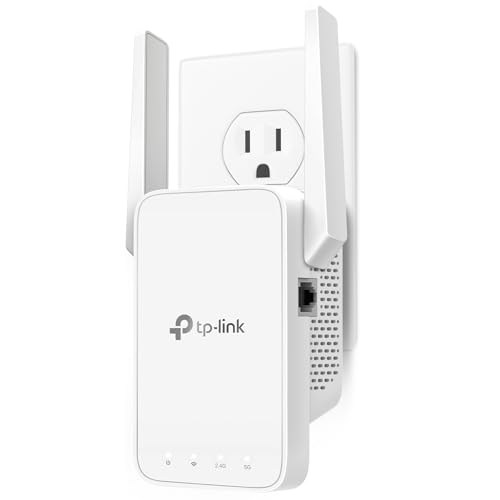
The RE315 closes the list as the range’s easygoing dual-band plug-in. Its listing describes an AC1200 extender claiming up to 1,600 square feet and thirty-two devices, with one Ethernet port and EasyMesh compatibility. AC1200 is the class of the previous decade’s mainstream, and the RE315 wears it without pretence: this is an extender for the spare room, the kitchen’s far corner, the rental flat, the relative’s house you are informally responsible for.
Its virtues are the humble ones that decide real installations. It is small, it sets up through the same Tether routine as its expensive siblings, its single Ethernet port rescues the one wired device every spare room seems to contain, and its EasyMesh compatibility means a compatible router can adopt it into polite single-name service. For browsing, music, a television streaming at ordinary resolutions and the smart plug behind the sofa, its class is not a limitation that daily life will ever expose.
The exclusions follow from the same honesty. A household working from home through it daily, on calls that cannot stutter, should buy the WiFi 6 models above, whose radios and efficiency were designed for exactly that contention. The RE315 is the extender you buy when the requirement is that a room works, not that it flies, and TP-Link’s range is more trustworthy for containing such a model without embarrassment. Not every rescue is an emergency, and this is the pick for the ones that are not.
Landlords and family administrators, the people who install networks in homes they do not live in, form a quiet constituency for this model. Its setup can be completed, photographed and left behind with confidence, its app routine can be talked through over the phone months later, and its modest class discourages no one. A range is judged by its flagships in public and by its humblest honest model in private, and the RE315 is the reason this range’s private reputation is good.
It also makes an unusually sensible gift, a sentence rarely writable about networking hardware. A parent or relative with one sulking room does not need a flagship and will not maintain one; they need a small box, a familiar app routine during one visit, and a network that simply reaches the chair where they read. The RE315 is sized to that act of quiet technical kindness, and its presence at the bottom of this list is a ranking of scope, not of worth.
- Wi-Fi class: AC1200 WiFi 5, dual band
- Maker’s coverage claim: Up to 1,600 sq. ft., ideal conditions
- Port: One Ethernet port
- Mesh: EasyMesh compatible, per listing
- Setup: Tether app guided flow
Strengths
- The range’s gentlest commitment for gentle duties
- Same Tether setup polish as the flagship models
- Ethernet port included even at this level
Trade-offs
- AC1200 class is the previous decade’s mainstream
- Daily work-from-home calls deserve the AX models
- Single port where siblings offer gigabit specification
Best for: a spare room, rental flat or relative’s house needing simple coverage
Not suited for: a full-time home office that lives on video calls
How Should You Place a Plug-In Extender When the Sockets Are Wrong?
Plug-in extenders live where the building’s electrician left sockets, and the two maps, radio and wiring, rarely agree. The discipline that reconciles them is a short survey with the Tether app: test the halfway sockets in order of radio quality, and note which of the good ones also sits at a usable height, clear of furniture, within cable reach of the room’s wired device if it has one. The best socket is the best compromise among those three claims, and it is almost never the socket inside the dead room that instinct reaches for first.
Two placement traps are specific to this form factor. The first is the socket behind the sofa or the bookcase, where the unit’s radios are muffled by the very furniture the room is arranged around; a short, safe extension to a visible socket on the same wall often transforms the link. The second is the multiway adapter tower, where an extender sharing a strip with chargers and lamps sits in electrical noise and physical clutter; extenders belong directly in a wall socket wherever the building permits, breathing their own air.
Height deserves its sentence. Radio at waist height or above generally sees over the furniture layer that fills the first metre of most rooms, while floor-level sockets fire their signal into sofa bases and cabinet plinths. TP-Link cannot choose your sockets for you, but the app’s grading makes the experiment cheap: three sockets, five minutes each, and the house itself tells you where its extender wants to live.
What Happens to These Extenders When You Change Routers?
Router replacement is the moment extender purchases reveal their foresight, and this range was designed with that moment in view. A repeater-mode unit simply needs its setup run again against the new network, a five-minute Tether errand. An EasyMesh unit behind a new EasyMesh TP-Link router rejoins as a citizen of the new system, carrying its role across the change. The awkward case is the household leaving TP-Link entirely, whose extenders revert to repeater duty behind the new brand, functional but demoted, and that demotion should be priced into any decision to switch ecosystems.
Firmware continuity softens the transition further. TP-Link maintains the current RE line with updates delivered through the same app the household already uses, so an extender bought today is unlikely to become the network’s forgotten appliance. The discipline asked of the owner is minimal: accept updates when offered, and re-run the placement grading after any router change, because the new router’s antennas redraw the map the old grading described.
There is a planning corollary for buyers at the start of a system rather than the middle. If a TP-Link router is likely within the year, buy the extender from the EasyMesh tier now and run it as a repeater until the router arrives; the unit appreciates in behaviour without being replaced. Few technology purchases offer that kind of forward compatibility at this price, and it is a structural reason this brand’s extender range rewards loyalty more honestly than most.
How Do TP-Link’s Six Plug-In Extenders Compare Side by Side?
| Pick | Wi-Fi class | Mesh dialect | Ethernet | Best zone |
|---|---|---|---|---|
| TP-Link RE615X | AX1800 | EasyMesh | Yes | General rescue |
| TP-Link RE715X | AX3000 | EasyMesh | Yes | Busy wing |
| TP-Link RE515X | AX1500 | EasyMesh | Yes | Single streaming room |
| TP-Link RE500X | AX1500 | OneMesh | Gigabit, AP mode | Wired far room |
| TP-Link RE550 | AC1900 | EasyMesh compatible | Gigabit | Media corner |
| TP-Link RE315 | AC1200 | EasyMesh compatible | One port | Spare room |
Two columns do the deciding. The mesh dialect column matters if a TP-Link router is present or planned, because it determines whether the extender becomes a citizen or remains a guest. The best-zone column matters more, because it encodes the census of the room being rescued, and a correctly censused AX1500 will always out-serve a hopefully purchased AX3000 in a room that never asked for it.
What Mistakes Do TP-Link Extender Buyers Keep Making?
The signature mistake in this brand is the near-twin purchase: ordering the renewed RE605X believing it to be the RE615X, or vice versa, because the titles differ by one digit and a condition line. The defence costs ten seconds, reading the model code in the listing title and the condition statement beneath it, and this guide repeats the warning because the confusion is structural rather than careless. Marketplace shelves place the two side by side precisely because they are easy to mistake.
The second mistake is expecting EasyMesh behaviour from a mixed-brand pairing. EasyMesh is a standard, but the router must support it too, and a TP-Link extender behind another maker’s non-EasyMesh router is a repeater, with repeater naming and repeater manners. Households that bought expecting mesh from the pairing alone blame the extender for a missing feature of the system, and the fix, when mesh truly matters, sits in the router decision rather than in any extender setting.
Third, buyers waste the Ethernet port by siting the extender for radio alone. The port’s value is realised only when the unit lands within cable reach of the room’s desk or media stack, so the placement walk should carry a tape measure as well as a phone. A socket that hears the router slightly worse but reaches the television’s cable may be the better installation in every way the household will ever feel.
A fourth mistake belongs to the specification sheet: treating the device-count claims, sixty-four on several of these models, as a promise about simultaneous heavy use. The count describes associations, devices known to the extender, most of them quiet smart-home clients sipping occasional data. Six simultaneous video streams are a different census entirely, and households should count their loud devices, not their total devices, when choosing between the AX1500 and AX3000 tiers.
What Should You Expect from Throughput at the Far End?
Every extender in this guide repeats traffic wirelessly in its standard mode, and the single-radio reality applies to TP-Link’s range exactly as it does to every rival: the far end receives a fraction of the router-room pace, because the same radios divide their time between listening and speaking. In practical terms a healthy installation delivers enough for high-definition streaming, calls and browsing with room to spare, while a speed test in the rescued room will always lose an argument with a speed test beside the router. Both facts can be true, and households that internalise them stop returning working equipment.
The variables that move the far-end figure are placement first, band second and class third. A well-sited RE515X will out-deliver a badly sited RE715X, because the flagship’s extra class cannot recover a link home that arrives as static. On 5GHz the rescued room near the extender feels closest to router-room life; on 2.4GHz it gains reach and loses pace, which suits the smart devices that live at the edges. The Ethernet port, where a wired device can use it, sidesteps the whole negotiation for that device, which is why this guide keeps returning to it as the range’s underpriced feature.
Gaming and large file work deserve their standing footnote. An extender’s added latency and shared airtime are poor ingredients for competitive play or for shuttling huge files to a far desk, and no model in this list changes that arithmetic. The honest architectures for those jobs are a cable, an access point fed by a cable, or the RE500X’s wired mode where a run already exists. Everything else in domestic life, which is to say nearly everything, is served well by the six plug-ins above when they are placed with the respect the physics asks for.
How Does Tether Compare with the Browser Setup of Older Extenders?
Owners upgrading from an older extender generation will notice the change of cockpit. The browser wizard, with its temporary network, its admin password on a sticker and its eleven patient screens, has been replaced across this range by the Tether app’s shorter path: discover, join, place, update. The gain is not merely minutes. The app retains the installation’s state, shows the link home as a living figure rather than a setup-day memory, and delivers firmware prompts to a screen the household actually opens.
The trade is dependence on a phone and an account where the older ritual needed only a browser, and households that prize independence from apps should weigh that honestly; the WPS button remains available on these models for the pairing step, though the placement intelligence lives in the app. For the mainstream buyer this guide addresses, the app’s guidance is worth more than the ritual’s independence, because the mistakes extenders die by are placement mistakes, and placement is precisely what the app supervises.
There is also a household-politics dividend. An installation documented inside an app can be inspected by whichever member of the family drew the technical short straw this year, without locating the sticker, the browser bookmark or the password notebook. Shared visibility is a modest feature that prevents the extender from becoming one person’s mysterious appliance, and over a five-year service life that modesty compounds.
How Do These Extenders Treat Smart-Home Devices and Security?
The quiet population of the modern home, plugs, bulbs, cameras and speakers, lives disproportionately in the zones extenders rescue, and it lives on 2.4GHz. Every model in this guide serves that band, so the question is not compatibility but administration: in repeater mode, each smart device must be taught the extender’s network name during its own setup, which rewards households that install the extender before commissioning the gadgets. In EasyMesh mode the lesson vanishes, because the name the gadgets learned at the router is the name everywhere, and devices attach to whichever source hears them best.
Security follows the router’s standard through the extension. The WiFi 6 models here support WPA3 where the router offers it, alongside the WPA2 that the whole range speaks, so an extender never needs to be the reason a household weakens its settings. The discipline that matters is updating: Tether surfaces firmware for these models in the same place it surfaces everything else, and an extender kept current is a citizen in good standing rather than the forgotten outpost of the network’s defences.
Guest arrangements deserve one clarification, since visitors often sleep in the rescued room. The router’s guest network policy governs the household’s hospitality, and extender behaviour toward guest traffic follows the mode in use, so households that rely on a guest name should test it in the extended zone during the first week rather than discovering its manners with a visitor standing in the doorway holding a phone. A two-minute test then is the whole cost of certainty.
Should You Buy a Deco Mesh System Instead of an Extender?
TP-Link itself poses this question, since its Deco mesh systems sit one shelf up from the RE range and promise to abolish the extender’s compromises entirely: nodes designed together, one name, wired or wireless backhaul, a router replaced rather than assisted. The honest answer depends on how many zones hurt and how healthy the existing router is. One or two weak rooms behind a good router is extender territory, and replacing the whole network to cure a bedroom is surgery out of proportion to the diagnosis.
The calculus flips when the weak rooms multiply, when the router is itself ageing, or when the household is moving and building fresh. Then the extender’s virtues, cheapness, continuity, the network name everyone knows, invert into liabilities, because each extender is another repeater’s compromise administered separately. Deco’s coherence is worth its price exactly when the count of compromises passes two, and TP-Link households enjoy the unusual comfort that both answers come from the same maker with the same app accent.
There is a respectable middle path this guide has already implied: extend now with an EasyMesh model, and if the house later votes for Deco, the extender’s service was bought cheaply and its lessons, where the dead zones live, transfer directly to node placement. Few purchases de-risk a bigger one so neatly. The mistake is only in pretending the two products are rivals; in TP-Link’s own architecture they are chapters of the same story, and the reader’s floor plan decides which chapter the household is in.
What Should You Do When a TP-Link Extender Misbehaves?
Troubleshooting these units rewards a fixed order, because their failures have a short list of usual authors. Begin with the link home: open Tether and read what the extender hears from the router, since a degraded link explains nearly every symptom that arrives as slowness, stutter or disappearance. If the link has worsened without the extender moving, suspect the environment, a new piece of furniture, a neighbour’s network newly loud on the same channel, a router relocated by another household member with tidier instincts than radio sense.
Next, separate the extender’s health from the network’s. A device that connects happily beside the router but sulks in the rescued room is reporting geography, not defect. A unit that drops every client simultaneously, including wired ones, is reporting itself or its power supply, and a different wall socket is a legitimate diagnostic before any reset is contemplated. The reset button remains the last instrument, not the first: it returns the unit to first-day state, which cures corrupted settings and destroys good ones with perfect impartiality.
Keep the household’s memory in the app rather than in folklore. Tether holds the configuration’s visible state, and a screenshot of the settled installation, its placement grade, its attached devices, its firmware level, turns next year’s mystery into a comparison exercise. Extenders fail quietly and are diagnosed loudly; a small archive of what good looked like is the cheapest calm a household can buy in this category.
Final Recommendation
Default to the RE615X; it is the current range’s centre of gravity and the correct answer for the largest number of TP-Link households. Step up to the RE715X when the target zone’s evening census proves congestion, step sideways to the RE515X when the census proves the opposite, and choose the RE500X when a OneMesh router or a waiting Ethernet cable defines the installation. Let the RE550 serve the seated media corner and the RE315 the gentle spare room, and the RE family will have been used the way its designers tiered it: not as a ladder of worth, but as a set of fitted tools. The household that buys this way, by census and by socket rather than by headline, will find its extender so unremarkable in daily life that it forgets the purchase entirely, and in this category that amnesia is the sound of a guide having done its work.
If one sentence survives the shopping trip, let it be the model-code sentence: the RE615X linked here is the current new listing, its renewed near-twin is a different purchase, and ten seconds spent reading the title and condition line is the cheapest insurance in this entire category. Beyond that, trust the census of your own rooms over the claims on any carton, place the unit where the app tells you the router still sounds healthy, and the TP-Link you bring home will do the unglamorous, essential thing this product family exists to do.
Frequently Asked Questions
What is the difference between OneMesh and EasyMesh?
OneMesh is TP-Link’s earlier proprietary mesh system, supported by its routers and extenders of that generation such as the RE500X. EasyMesh is the newer, standardised approach used by the current RE models, designed to interoperate across supporting products. A new TP-Link build should choose EasyMesh; an existing OneMesh household should complete its system with OneMesh models.
Will a TP-Link extender work with a different brand of router?
Yes, in conventional extender mode every pick here works with any router brand. The mesh behaviours are the brand-dependent part: EasyMesh and OneMesh citizenship require a compatible TP-Link router. Buyers with another brand’s router should judge these models as repeaters, a role in which the RE615X in particular is recommended across this series. Nothing about the pairing locks the household in, either: the same extender that repeats for a rival router today can be adopted into a TP-Link mesh tomorrow, which is part of why this range holds its value through households’ changing allegiances.
Is the RE605X the same as the RE615X?
No. They are close relatives with different model codes, and the RE605X listing that circulates widely is a renewed unit, while the RE615X linked in this guide is the current new listing from the verified pool. Check both the model code and the condition line before ordering either, since the resemblance is close enough to catch hurried buyers.
Can I plug a games console into the extender’s Ethernet port?
Yes, and for a console in a rescued room it is often the best connection available: the console rides the extender’s wireless link, which is usually stronger than the console’s own Wi-Fi from that spot, and it frees the room’s airtime for other devices. Expect the extender’s inherent repeating latency, which suits most gaming and all streaming, while competitive players should still prefer a true cable where one can be run.
Why are the professional EAP models not in this guide?
Because they are access points, not plug-in extenders: they expect Ethernet cabling, often Power over Ethernet, and management through TP-Link’s Omada system, which is a professional installation pattern. Households with that infrastructure should read the PoE guide in this series, where the EAP models are assessed in their proper role.
How many TP-Link extenders can one house use?
Two is the comfortable pattern, each placed within strong reach of the router and serving its own zone. Beyond two problem zones, the household is describing a mesh system rather than an extender purchase, and TP-Link’s own Deco range exists for exactly that admission. If two extenders are deployed, give each its own conversation with the router rather than chaining the second through the first; daisy-chained repeating compounds the throughput penalty and is the arrangement most likely to make a good product feel like a bad one.
Related Guides
For the professional cabled alternative, see Best Gigabit Routers for the wired backbone, and compare Best AC1200 Gigabit Routers with Best Tri-Band Wireless Routers when the router itself is next on the list.


