What's inside
- Key Takeaways
- Quick Picks
- How Did We Choose in a One-Family Category?
- Why Did the Crank Desk Nearly Disappear?
- How Much Work Is Cranking, Really?
- The Crank Family at Three Sizes, Plus the Honest Alternatives
- How Do You Live With a Crank Desk Well?
- Crank, Pneumatic or Electric: The Ten-Minute Decision
- Where Do Crank Desks Still Outnumber Motors?
- What Should You Check on a Used Crank Desk?
- How Does a Crank Desk Fit a Household, Not Just a Worker?
- What Does a Crank Desk Teach a Household About Enough?
- How Should You Place a Crank Desk in the Room?
- How Do You Wind Well? Technique for a Decade of Cranking
- What Do the Alternatives Teach Us About the Crank?
- Comparison Table
- What Mistakes Do Crank Desk Buyers Make?
- Final Recommendation
- Frequently Asked Questions
- Related Guides
As an Amazon Associate I earn from qualifying purchases. This post may contain affiliate links at no extra cost to you.
gizmoverdict.com is reader-supported. When you buy through links on our site, we may earn an affiliate commission.
Where to buy: Three of the picks below are true crank desks from the one family that still makes them, one is a pneumatic counterweight, and two are manual-lift alternatives labelled as such — each links to a listing verified in this site’s product pool.
The best crank standing desks come with a disclosure most guides would bury, so this one will lead with it: the modern crank desk market is, to a first approximation, one family of frames. Search honestly for a new hand-crank standing desk today and you will meet the same VIVO design at different widths, over and over, because the industry’s centre of gravity moved to motors a decade ago and the crank survived as a speciality — for off-grid rooms, for buyers who distrust electronics in furniture, for anyone who wants a desk that will still adjust in twenty years with nothing to plug in and nothing to burn out. This guide reviews that family at its three sizes, and then does something more useful than pretending rivals exist: it fields the pneumatic and manual-lift alternatives a crank shopper should genuinely cross-shop.
Why would anyone choose winding in the age of presets? Because a crank desk asks the building for nothing, fails at nothing electronic, costs its owner effort instead of electricity, and suits the large class of workers whose posture pattern is two long stands and two long sits a day rather than a hourly migration. For that pattern, the crank’s toll — a deliberate half-minute of winding, a few times daily — is trivial, and its virtues compound quietly for years.
The honesty rules for this guide are strict. The three VIVO desks share one frame design and one 110-pound rating, and the reviews will not manufacture differences the products do not have; they differ in size, top construction and finish, and that is what the reviews judge. The H7 Plus is pneumatic, not a crank, and the two converters at the end are manual alternatives, not desks at all — each is labelled, because a guide that pads a thin category with disguised substitutes has told you its first lie before the table loads.
Key Takeaways
- The new crank desk market is essentially one frame family — VIVO’s — offered at 43, 60 and 71 inches, each rated at 110 pounds with a foldable hand crank.
- All three crank picks share the same mechanism and rating; the real differences are width, top construction (one-piece at 43 and 60, three-piece at 71) and finish.
- A crank desk needs no power, has no controller to fail, and suits two-postures-a-day workers — frequent changers should buy electric or pneumatic instead.
- The FlexiSpot H7 Plus is this guide’s pneumatic counterweight: cordless and far quicker to adjust, but a 40-inch moderate-load surface with no crank at all.
- Two manual converters close the guide, clearly labelled as desk-top risers rather than desks, for readers whose real problem is an existing desk.
- The foldable crank matters: it tucks away after winding instead of jutting into the room to catch hips, chairs and cardigans.
Quick Picks
| Pick | Badge | Why it is here |
|---|---|---|
| VIVO Manual Crank Standing Desk 43×24, White | Crank desk — compact size | The family frame at its smallest: a 43-inch one-piece white top, 110 pounds of capacity and the foldable crank, for small rooms that still want a real desk. |
| VIVO Manual Crank Standing Desk 60×24, Vintage Brown | Crank desk — the mainstream size | Sixty inches of one-piece vintage brown top on the family frame: the crank desk most buyers picture, at the size most rooms can host. |
| VIVO Manual Crank Standing Desk 71×30, Reclaimed Wood | Crank desk — the largest size | Seventy-one by thirty inches of reclaimed-wood-look surface on the crank frame — proof the mechanism scales, with a three-piece top as the honest trade. |
| FLEXISPOT H7 Plus Mobile Standing Desk | Not a crank — the pneumatic counterweight | No crank, no motor: a gas-lift 40-inch desk that floats between 27.6 and 45 inches in seconds, for cordless buyers who change height often. |
| VIVO Standing Desk Converter 36 | Not a desk — manual riser alternative | A 36-inch hand-lift riser rated at 33 pounds that turns your existing desk into the standing desk — included for readers whose furniture was never the problem. |
| Mount-It! Standing Desk Converter with Dual Monitor Mounts | Not a desk — riser with screens on mounts | A 36-inch gas-spring riser with two monitor mounts included — the manual alternative for dual-screen setups on desks that must stay. |
How Did We Choose in a One-Family Category?
We started by verifying the category’s shape rather than assuming it. The verified product pool for this site — the same pool every guide here draws from — contains exactly one crank desk design: VIVO’s manual frame, in three sizes. Rather than invent variety, we took all three sizes as picks, because for a crank buyer the size decision is the decision, and because a frame’s behaviour at 43 inches and at 71 is a legitimate comparison. The remaining slots went to the alternatives an honest salesperson would put on the floor next to the cranks: a pneumatic desk for the cordless buyer who changes height often, and two manual converters for the reader who realises their desk was never the problem.
Labelling discipline governed everything. The H7 Plus is introduced as pneumatic in its badge, its review and the comparison table; the converters are introduced as converters. A reader who finishes this guide believing they bought a crank desk when they bought a riser would be a failure of this page, not of the reader.
Figures come only from the verified listing titles: the shared 110-pound rating, the foldable crank, the one-piece tops on the 43 and 60, the three-piece extra-deep top on the 71, and the H7 Plus’s 27.6-to-45-inch pneumatic range. Where the listings are silent — winding turns per inch, for instance — the reviews describe the effort qualitatively, the way an owner would.
Why Did the Crank Desk Nearly Disappear?
The crank desk did not fail; it was outcompeted on convenience at the exact moment motors became cheap. A decade ago a motorised frame was a serious purchase and a crank was the rational economy. Then dual-motor frames flooded down in price, memory controllers became standard, and the crank’s remaining advantages — no power, no electronics, mechanical longevity — applied to a minority of rooms and temperaments. Manufacturers consolidated, lines were discontinued, and the category contracted to the design that sold steadily enough to survive: the VIVO family reviewed here, which persists because its niche is real even if it is narrow.
That history has practical consequences a buyer should know. Parts and accessories for crank desks are a thinner market than for electric frames; you are buying into the surviving line, not a thriving ecosystem. Resale is likewise thinner. None of this argues against buying one — the surviving design is proven precisely because it outlasted the shakeout — but it argues for buying with open eyes, the way you would buy any mature, specialised tool.
The niche itself deserves respect rather than nostalgia. Workshops and garden studios without spare sockets, classrooms and market setups that move, households that keep furniture for decades and distrust sealed electronics, workers whose day naturally divides into long postures — for all of these, the crank is not a compromise awaiting an upgrade. It is the correct mechanism, still standing after the fashion moved on.
How Much Work Is Cranking, Really?
Set expectations with a clock rather than an adjective. Travelling between a sitting and a standing height on a geared crank frame is a deliberate winding session — think in terms of half a minute of steady turning rather than a button’s few seconds, with the effort closer to winding a well-made winch than to any gym activity. The gearing does the lifting; your arm does the scheduling. At the top and bottom of the range the desk simply stops being interested in going further, and the foldable crank then tucks out of the way, which owners consistently name as the detail they appreciate most in daily life.
The arithmetic that matters is weekly, not per-change. Two changes a day is perhaps five minutes of winding a week — nothing. Eight changes a day approaches half an hour a week of standing at the desk turning a handle instead of working, and adds friction at exactly the moments a posture change should be thoughtless. That is why this guide keeps returning to rhythm: the crank does not punish effort, it punishes frequency. Be honest about which worker you are, and the mechanism chooses itself.
One more lived detail: cranking is a two-handed-height, stand-up task — you cannot adjust the desk from your chair mid-call the way a preset allows. Owners build the change into natural breaks, kettle trips and phone calls taken standing, and report that the ritual becomes part of the day’s punctuation. If your work has no punctuation, buy the motor.
The Crank Family at Three Sizes, Plus the Honest Alternatives
Three genuine crank desks first — same frame, same rating, three sizes and finishes — then the pneumatic counterweight and two manual risers, each labelled for exactly what it is.

VIVO Manual Crank Standing Desk 43×24, White — Crank desk — compact size
The 43-inch VIVO is the crank idea at its most domestic. The top is a solid one-piece slab in white, 43 by 24 inches — enough for a laptop and a monitor, or one generous screen with elbow room — and beneath it sits the family mechanism: the geared frame, the 110-pound rating, and the crank that folds away when the winding is done. In a small room the white finish and the absence of any cable to a socket make this the least visually demanding standing desk in this entire batch of guides; it reads as a plain table that happens to have a handle.
Small size flatters the crank mechanism, because the lift is light and the whole ritual stays quick. This is the pick for the spare room, the student’s bedroom-desk that must serve homework sitting and project work standing, the studio corner where power outlets are spoken for. Its ceiling is the family ceiling plus acreage: 110 pounds is plenty here, but two large monitors and a tower would crowd the surface before they challenged the rating. Within its brief — a real, complete, cordless desk for a small room — it is not a compromise at all.
The white 43 has one more habitat worth naming: the rented room where the desk is also the household’s only table-class surface. Because the VIVO needs no socket and leaves no marks, it can be a study desk in term time and — lowered, cleared, the crank folded — simply a table when the room’s life changes for the holidays. Electric desks can do this too, but they trail a cable and a controller into every photograph of the room. The little crank desk’s talent is disappearing into domestic life between its working hours, and small rooms reward disappearance above almost any feature.
It is also, quietly, the easiest of the three sizes to live with while deciding whether the crank life is yours at all — small enough to move rooms, complete enough to judge the mechanism honestly, and the size most likely to be claimed by another member of the household if your own verdict ever changes.
- Desktop: 43 x 24 inches, white, solid one-piece
- Mechanism: foldable hand crank
- Load rating: 110 lbs (per listing title)
- Frame: black
Strengths
- Complete cordless desk at a genuinely compact size
- One-piece top — no seam at this width
- White finish disappears into small, bright rooms
Trade-offs
- One-screen-plus-laptop surface at most
- No presets, no motor — every change is winding
- Thin category means a thin accessories market
Best for: Small rooms, students and spare-room offices that want a real desk with no plug.
Not suited for: Dual-large-monitor setups, which need the 60 or a motor.

VIVO Manual Crank Standing Desk 60×24, Vintage Brown — Crank desk — the mainstream size
If the crank category has a flagship, it is this one: the 60-by-24-inch model with the solid one-piece top in vintage brown. Sixty inches is the width at which a crank desk stops being an appliance and becomes the room’s main desk — two monitors sit naturally, a laptop can join them, and the surface still holds a notebook and a lamp. The rating remains the family’s 110 pounds, the crank remains foldable, and the brown finish gives the desk a warmer, more traditional presence than its white sibling, suiting rooms with wooden furniture where white would look like equipment.
This is also the size where the crank’s character is most fairly judged. The winding is a real ritual at this scale — a full-size desk making a full journey — and owners divide exactly as the framework in this guide predicts: the two-posture workers call it nothing, the frequent changers call it a chore. The desk itself is blameless in both reports. For a permanent home office with no appetite for motors, controllers or cables, the 60 in vintage brown is the crank purchase we would make, and the one whose owners seem least interested in ever replacing it.
Owners of the 60 develop a telltale habit: they stop thinking of the desk as adjustable at all, and start thinking of the room as having two desks — the morning desk and the afternoon desk — that happen to share a top. That mental shift is the crank pattern working as designed. The desk is not a machine for changing posture on a whim; it is furniture with two honest heights, visited in turn, and the winding is simply the walk between them. Buyers who arrive expecting that biography are the ones still praising the desk in year five.
A closing thought on the 60’s finish, because owners mention it unprompted: vintage brown photographs warmly, hides the evidence of work kindly, and pairs with the black frame in a way that reads as intentional rather than assembled. In a category reduced to one family, finish and size are the personality available — and this configuration, the mainstream size in the warm finish, is the one that looks most like the desk its owners describe wanting when they started shopping.
- Desktop: 60 x 24 inches, vintage brown, solid one-piece
- Mechanism: foldable hand crank
- Load rating: 110 lbs (per listing title)
- Frame: black
Strengths
- Full-size one-piece surface for two monitors
- Warm finish suits traditional rooms
- The category’s most proven configuration
Trade-offs
- Winding a full-size desk is a deliberate act, every time
- 110 pounds excludes the heaviest tower arrays
- Black frame only — the brown top carries the warmth alone
Best for: A permanent, motor-free home office running two monitors and two postures a day.
Not suited for: Hourly posture changers, whatever their principles.
VIVO Manual Crank Standing Desk 71×30, Reclaimed Wood — Crank desk — the largest size
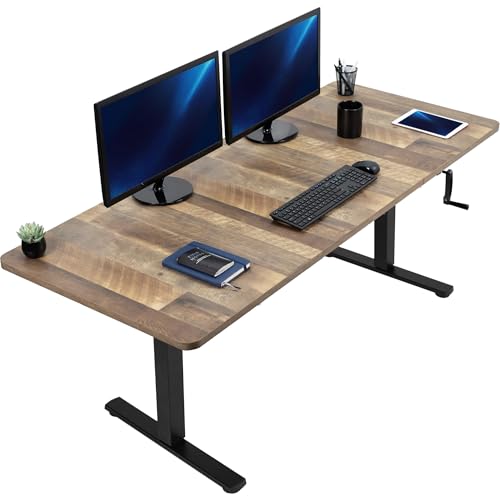
The 71-inch VIVO is the guide’s most surprising object: a genuinely large desk — 71 by 30 inches, the deepest top in this crank family — lifted entirely by a hand crank. It exists for the buyer who wants acreage without electricity: two large monitors, a laptop, drawing or drafting space, room to spread a project and still have a desk left over. The reclaimed wood finish suits the scale, giving the surface the character of a workshop bench or a farmhouse table rather than an office product, and the 110-pound family rating still governs what may live on it.
One construction fact must be stated as plainly as the pool states it: at this width the top is three pieces, not one. A joined top at 71 inches is normal engineering — single slabs at this size warp, weigh and cost — and in use the seams sit beneath monitor stands and desk mats for most owners. But a buyer dreaming of one unbroken wooden expanse should know before delivery, and should also plan clamp placements away from the joints. Judged with that known, the 71 is a remarkable artefact: the biggest honest crank desk in the modern market, from the only family still making them.
A note on the joined top, from owners rather than from the listing: the seams are most visible in the first week and least visible under the objects a 71-inch desk naturally accumulates — a monitor stand here, a desk mat there, the drawing board across the middle. What does not fade is the acreage’s effect on work. Thirty inches of depth at seventy-one of width is workshop geometry, and makers who spread a project across it describe the same experience as a good bench: the work stays out, in view, in progress, because there is finally room for “in progress” to be a place rather than a pile.
Big, cordless and unhurried: the 71 is the crank idea at its most confident, and its owners tend to speak of it the way people speak of a good workbench — as a fixture of the room’s life rather than a product in it.
- Desktop: 71 x 30 inches, reclaimed wood finish, three-piece
- Mechanism: foldable hand crank
- Load rating: 110 lbs (per listing title)
- Frame: black
- Depth: extra-deep top
Strengths
- Huge, deep surface — the largest crank desk here
- Reclaimed-wood character suits workshops and studios
- Scales the cordless idea to a full workstation
Trade-offs
- Three-piece top — seams exist and clamps should avoid joints
- Raising 71 inches by hand is the family’s biggest ritual
- 110-pound rating is easier to approach at this acreage
Best for: Makers, drafters and wide-workstation owners who refuse motors on principle or by wiring.
Not suited for: Anyone who wants an unbroken one-piece slab, or who changes height hourly.

FLEXISPOT H7 Plus Mobile Standing Desk — Not a crank — the pneumatic counterweight
This pick is in a crank guide for one reason: it is the desk a crank shopper should test their decision against. The H7 Plus is pneumatic — a gas-assisted lift in a dual-column frame under a one-piece 40-inch top — so it shares the crank’s defining virtue, total independence from power, while removing the crank’s defining cost, the winding. Adjustment takes seconds and a light hand, the desk is mobile, and its range runs from 27.6 to 45 inches. If your objection to motors was the cord and the electronics rather than a love of winding itself, this desk answers your actual objection better than a crank does.
The counterweight has its own limits, and they are why the cranks above still exist. Forty inches is a one-screen surface, the gas lift is built for moderate loads, and there is nothing like the VIVO frame’s 110-pound, 71-inch capacity in the pneumatic world at this level. A buyer who needs a big, load-bearing, decades-long desk should crank. A buyer who needs a cordless desk that changes height as thoughtlessly as a chair should float. This guide’s loyalty is to the reader’s room, not to a mechanism, and the H7 is here so the comparison happens before the purchase rather than after it.
The comparison every cordless shopper should actually run is a week’s diary, not a spec sheet. Note each time you would have changed height, and whether the change was a whim or a need. Whims — a call taken standing, a stretch of reading upright — are where the H7’s seconds-long float earns its place, because a crank would have taxed each whim into extinction. Needs — the morning stand, the afternoon sit — are where the crank’s ritual costs nothing. Most diaries show a mixture, and the mixture’s proportions, not anyone’s review, should pick the mechanism.
- Desktop: 40 inches, one-piece
- Mechanism: pneumatic gas lift — NOT a crank
- Height range: 27.6 to 45 inches (per listing title)
- Design: dual-column, mobile, cordless, white
Strengths
- Cordless like a crank, but adjusts in seconds
- Mobile — serves several spots in a room
- Honest sitting-to-standing range
Trade-offs
- 40-inch, moderate-load surface only
- No presets and no crank — a different mechanism entirely
- Cannot match the VIVO 71’s acreage or rating
Best for: Cordless buyers whose real wish is frequent, effortless changes.
Not suited for: Anyone who specifically wants a crank’s load, size or mechanical simplicity.

VIVO Standing Desk Converter 36 — Not a desk — manual riser alternative
Label first, as promised: this is not a crank desk, and it is not a desk. It is a converter — a 36-inch platform with a wide keyboard tray that sits on your current desk and raises your workstation by hand. It earns its place at the end of a crank guide because a share of crank shoppers are not really shopping for a mechanism; they are shopping for standing work without buying furniture, often because the desk they own is built in, borrowed or beloved. For them, winding a riser’s squeeze handles a few times a day delivers the posture at a fraction of a desk’s cost and none of its upheaval.
Its limits are the converter family’s: 33 pounds of workstation, the stability of whatever it stands on, and a platform thickness that changes your sitting geometry until you adjust your chair for it. It will not give you a new desk’s acreage or a crank frame’s load rating, and it is not pretending to. As the honest off-ramp for readers who arrived wanting a crank and leave realising they wanted their own desk raised, it closes this guide the way it should be closed — with the truth about what each object is.
One more reader belongs to this pick: the worker whose desk is provided and unchangeable — the office with fixed furniture, the workshop bench that is part of the building, the family desk that predates everyone’s opinions. For them the converter is not an alternative to a crank desk; it is the only standing option the building permits, and its hand lift is philosophically a crank’s cousin — human-powered, socket-free, honest. The label in its badge stands, because accuracy matters, but so does kinship, and this riser is the crank family’s closest relative by temperament.
- Platform: 36-inch top with wide keyboard tray
- Mechanism: manual lift — a riser, not a crank desk
- Load rating: 33 lbs (per listing title)
- Format: sits on an existing desk
Strengths
- Standing work without replacing any furniture
- Installs and removes in minutes
- Wide tray keeps hands together at height
Trade-offs
- Only 33 pounds, and only the workstation travels
- Inherits the desk beneath it, wobble included
- Adds thickness to your sitting height
Best for: Readers whose real brief was “raise my desk”, not “buy a mechanism”.
Not suited for: Anyone who came for a complete desk — the three VIVOs above are those.
Mount-It! Standing Desk Converter with Dual Monitor Mounts — Not a desk — riser with screens on mounts
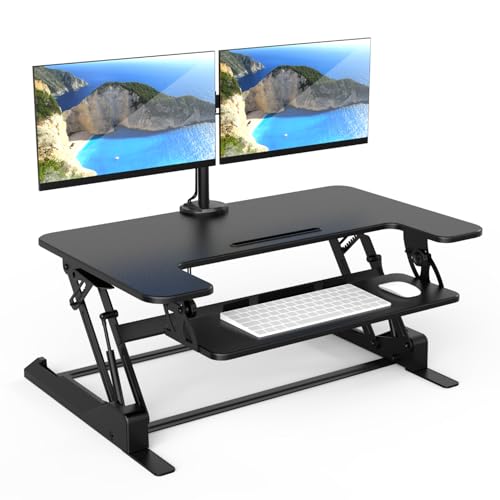
The second labelled alternative takes the converter idea and fixes its oldest annoyance. Mount-It!’s 36-inch riser includes two monitor mounts, so dual screens ride on arms at your eye line instead of eating the platform with their stands, and a gas spring keeps the hand lift manageable with the screens aboard. Like the VIVO converter beside it, this is a riser for an existing desk — no legs, no crank, no claim to be furniture — and it is here because dual-screen owners are the readers most likely to be cross-shopping a crank desk for a workstation that a riser could serve without touching the desk beneath.
The conditions are a monitor’s mounting points and a slightly more involved first setup, since arms must be fitted and tensioned where stands merely stand. In exchange, the workstation travels as one unit and the platform stays clear for keyboard, notebook and elbows. If your desk is a keeper and your screens can mount, this is the most engineered manual alternative in the guide; if your screens cannot mount, the flat-topped VIVO converter above is your riser, and the three cranks above that are your desks.
The Mount-It! also serves a reader the crank desks cannot: the dual-screen worker in a furnished rental, where the desk is the landlord’s and drilling a frame into the room’s life is not an option. Mounts on a riser give that reader the floating-screen arrangement usually reserved for owned offices with arms clamped to owned desks. It is included here, at the end of a crank guide, as a reminder that the category’s true subject was never the handle — it is standing work without electricity’s infrastructure, and this riser, gas-sprung and hand-lifted, is squarely in that tradition.
- Platform: 36 inches wide
- Included: 2 monitor mounts
- Lift: manual with gas spring
- Format: converter — sits on an existing desk
Strengths
- Screens float on mounts, platform stays clear
- Gas spring keeps the loaded lift light
- Dual-screen workstations travel as one unit
Trade-offs
- Monitors need compatible mounting points
- Setup is a fitting job, not a placement
- Still a riser: 36 inches of platform, desk inherited
Best for: Dual-screen owners with mountable monitors and a desk worth keeping.
Not suited for: Single-screen users, or anyone actually shopping for furniture.
How Do You Live With a Crank Desk Well?
Build the winding into the day’s existing hinges. Crank owners who thrive treat the change as part of a break that already exists: wind up when the kettle goes on, wind down when lunch ends, wind up for the afternoon’s calls. The desk then changes height exactly as often as the day naturally pauses, and the mechanism’s effort disappears into rituals you were performing anyway. Owners who fight the desk — trying to adjust it mid-task, mid-call, mid-thought — are the ones who conclude it is tiresome, and they are usually right about their pattern rather than about the desk.
Keep the crank’s path sacred. The handle sweeps a circle at the desk’s side, and anything stored in that circle — a bin, a bag, a chair pushed in carelessly — turns every adjustment into a small furniture negotiation. Choose the crank’s side with your room’s traffic in mind, fold it away after every use, and the mechanism stays invisible between its moments. Lubrication and fastener checks, once or twice a year, are the whole maintenance liturgy; a mechanism with no controller asks almost nothing, and giving it that almost-nothing is why these frames outlive their electronic cousins.
Load it like you mean to keep it. The 110-pound rating is a ceiling, not a target, and a crank frame lifting 70 pounds of monitors and books will feel willing for a decade, while one straining at its limit will feel old in a year. Put the tower on the floor or a side stand if your array is heavy — the desk will thank you at every winding, in the only language it speaks, which is ease.
Crank, Pneumatic or Electric: The Ten-Minute Decision
Ask three questions in order. First: does the spot have power to spare, permanently? If not, the contest is crank versus pneumatic, and the second question decides it — how big and heavy is the workstation? A wide or heavily loaded setup belongs on the VIVO frame, because gas lifts at this level serve compact, moderate surfaces like the H7’s 40 inches. A light setup in a powerless spot floats pneumatic and changes height in seconds.
Third question, for the powered rooms: how often will you honestly change? Twice a day makes the crank a perfectly rational economy even beside a socket — no controller, no standby draw, nothing to fail. Many times a day makes the electric desk’s presets the only mechanism that will not tax the habit, and the money difference buys back its cost in posture changes actually taken. There is no fourth question about fashion; the crank’s unfashionableness is precisely what its owners are paying to ignore.
Notice what this decision tree never asks: which mechanism is best. Each is best at a coordinate of load, power and frequency, and the map in this guide — three cranks, one pneumatic counterweight, two risers for the furniture-keepers — is drawn so your coordinate has a named destination whichever way the answers fall.
Where Do Crank Desks Still Outnumber Motors?
Walk through the places desks work hardest and the crank’s survival stops looking like nostalgia. School workshops keep manual benches because thirty students and thirty controllers are a maintenance department’s nightmare, while one geared frame per bench simply endures. Market traders and exhibition builders use cordless adjustable tables because the pitch has no socket and the day has no patience. Garden studios, allotments’ bothies, narrowboats, off-grid cabins — the geography of unreliable power is larger than the electronics industry likes to picture, and in all of it the adjustable surface that works is the one that asks for a hand.
Film and photography sets offer a stranger example: surfaces that must rise and fall in silence, near microphones, without a motor’s whir entering the take. A crank or a gas lift moves in the acoustic shadow that electrics cannot. None of these habitats will ever trend, and that is precisely the category’s security — the VIVO family survives not by competing with motors for the mainstream office, but by serving the archipelago of places motors cannot go.
For the home buyer, the lesson of the archipelago is diagnostic. If your room belongs to it — power-poor, silence-hungry, frequently moved, or simply expected to outlive its electronics — the crank is not the eccentric choice. It is the local technology, proven in harder places than a spare bedroom.
What Should You Check on a Used Crank Desk?
Because the category is thin new, many crank buyers meet it second-hand, and a used crank frame rewards a specific inspection. Turn the crank through the full range with weight on the top — a stack of books approximates a workstation — and feel for the two honest faults: a gritty patch in the travel, which suggests wear or dirt in the drive, and a point where the effort suddenly changes, which suggests something bent. A sound frame winds with boring consistency from bottom to top, and boring is the highest praise a used mechanism can earn.
Check the top’s joints if it is a joined model, the feet’s levellers, and that the crank itself — the foldable handle — is present and folds as designed; a missing crank on a used listing converts a bargain into a project, since the handle is the one part with no substitute in a kitchen drawer. Ask, too, what the desk carried. A frame that spent five years under a laptop is a different purchase from one that spent them at its rating’s ceiling under a tower, and the answer is usually visible in the top’s surface if not in the seller’s memory.
None of this inspection requires expertise — a quarter of an hour, a stack of books and the willingness to wind. The crank’s mechanical transparency is its second-hand virtue: unlike a used electric desk, whose controller’s remaining life is a sealed guess, a crank frame shows you its whole condition in one full journey up and down.
How Does a Crank Desk Fit a Household, Not Just a Worker?
A crank desk in a home acquires users the way a piano does. Children old enough to be trusted with the handle regard winding as the desk’s best feature and will adjust it for visitors with ceremony; partners borrow it for standing tasks — wrapping, sorting, repairing — that no one buys a desk for but everyone uses one for. The mechanism’s simplicity is what makes the sharing frictionless: there are no presets to overwrite, no controller to explain, nothing a borrower can misconfigure. The desk returns from every loan exactly as capable as it left.
Households also discover the crank’s outage manners. In a power cut, the electric desks in a home become fixed furniture at whatever height they were caught, while the crank desk continues its whole repertoire by lamplight. It is a small thing until the evening it is the only adjustable surface in a dark house with work to finish, and owners remember that evening out of all proportion to its length — the way one remembers which torch worked.
Finally, the household timescale suits the mechanism. Homes keep tables for decades and appliances for years, and a crank desk is filed, correctly, with the tables. It will be moved, lent, inherited and re-purposed without a thought for its compatibility with anything, because it is compatible with every building that has a floor. That is the deepest sense in which the category survives: not as a product line, but as a kind of furniture.
What Does a Crank Desk Teach a Household About Enough?
There is a reason crank owners sound mildly philosophical in surveys, and it is not the winding. A crank desk is a deliberate refusal of a small convenience in exchange for a set of durabilities — and living with that refusal, daily, recalibrates what its owner asks of other objects. The desk does everything it promised on the day it arrived, asks for nothing the grid provides, and will do the same in twenty years. In a house filling with objects that demand accounts, updates and subscriptions, a major piece of furniture that demands nothing is not merely convenient. It is restful.
That restfulness should not be oversold into a lifestyle sermon, and this guide will not sell it. The crank is a mechanism, not a virtue, and for the frequent changer it is simply the wrong mechanism wearing virtue’s clothes. But for the buyer whose temperament it matches, the desk’s sufficiency is a real feature that no specification table captures: enough height range, enough capacity, enough speed — enough, full stop, in a category addicted to more.
Perhaps that is the honest epitaph for the category’s contraction, too. The crank desk did not lose because it was worse. It lost because the market’s centre wanted more — more speed, more memory, more automation — and the buyers who wanted enough were always a minority. Minorities keep categories alive at exactly the size they need, which is why one family, three sizes and no apologies turns out to be a stable shape for a market.
How Should You Place a Crank Desk in the Room?
Placement rules for a crank desk begin with the handle’s geography. The crank lives on one side of the frame and sweeps its circle there, so that side needs a standing person’s worth of clear floor and a wall distance that lets an arm work without choreography. Right-handed and left-handed households will have opinions; the desk is indifferent, but the room should not be — place the crank side toward the room’s natural approach, not into a corner’s dead angle, or every adjustment begins with a small journey around the furniture.
The second rule is light. A cordless desk is free to sit where the window is rather than where the socket is, and that freedom is the crank’s placement dividend — spend it. A desk under a window, standing height in the morning sun, is a different instrument from the same desk in a corner, and no other full desk in this batch of guides can claim the spot without a cable negotiation. The third rule is the floor’s level: a manual frame reports an uneven floor exactly as an electric one does, and levelling its feet on day one is the whole difference between a desk that feels machined and one that feels homemade.
Finally, give the desk a view of its own future. Crank desks stay in houses for decades and migrate between rooms and owners; a placement that blocks a doorway’s swing or a radiator’s breath will be renegotiated by the household long before the mechanism is. Place it like furniture, not like equipment, and it will be treated — and kept — like furniture.
How Do You Wind Well? Technique for a Decade of Cranking
A small technique section, offered without embarrassment, because a motion repeated thousands of times deserves to be done well. Stand square to the desk’s crank side, feet planted, and wind with the whole arm in a smooth circle rather than with the wrist’s flick — the gearing rewards rhythm and punishes hurry with a choppy, effortful travel. Keep the pace conversational. A crank desk raised calmly arrives at the top with its load settled; a crank desk raced arrives with everything aboard still trembling, and the difference is entirely in the operator.
Wind to the height, not past it. Every frame has a natural end to its travel in each direction, and forcing the handle against that stop is the one genuinely harmful habit available to a crank owner — the mechanism’s equivalent of slamming a door. Learn where your desk’s stops live, ease off as you approach them, and the gearing will return the courtesy for decades. Marking a favourite height costs nothing: a pencil line on the wall behind the desk, a notch of tape on the frame, and the winding ends at the same place every time — the manual owner’s preset, older than electricity and nearly as accurate.
Finally, fold the crank. Every time. The folded handle is the desk at rest, the room safe for hips and chairs, the mechanism declaring itself finished. Owners who build the fold into the ritual’s last motion never think about it again; owners who skip it are reminded, eventually, by a cardigan. Small disciplines are the whole maintenance philosophy of this category, and this is the smallest and the best.
What Do the Alternatives Teach Us About the Crank?
Spending a guide in the company of rivals clarifies what the crank actually is. Against the pneumatic H7, the crank is revealed as the load-bearer and the permanence play: slower by a minute, stronger by a category, and built for decades rather than for movement. Against the converters, it is revealed as furniture — the thing itself rather than an addition to the thing — with all the presence and all the commitment that furniture implies. Against the electric desks in this site’s other guides, it is revealed as the mechanism of self-reliance: the only one whose entire operation can be explained to a child in one sentence and repaired, in principle, by a person with ordinary tools.
None of those revelations demotes the rivals, which is the point of fielding them honestly. The H7’s float, the riser’s reversibility and the motor’s memory are real goods, and a crank buyer who has weighed them and still chooses the handle has made the strongest purchase in the guide — a preference that survived comparison. Guides that hide the alternatives produce buyers who discover them later, as doubts. This one would rather produce a crank owner who has already met the alternatives, at full strength, and wound the handle anyway.
Comparison Table
Read the mechanism column before anything else: three rows are crank desks, one is pneumatic, and two are risers — the table keeps the labels as honest as the reviews do.
| Pick | Desktop | Mechanism | Defining trait |
|---|---|---|---|
| VIVO Manual Crank Standing Desk 43×24, White | 43 x 24 in | Hand crank | 110 lbs, one-piece white top |
| VIVO Manual Crank Standing Desk 60×24, Vintage Brown | 60 x 24 in | Hand crank | 110 lbs, one-piece vintage brown |
| VIVO Manual Crank Standing Desk 71×30, Reclaimed Wood | 71 x 30 in | Hand crank | 110 lbs, three-piece deep top |
| FLEXISPOT H7 Plus Mobile Standing Desk | 40 in top | Pneumatic (not crank) | Cordless counterweight, 27.6–45 in |
| VIVO Standing Desk Converter 36 | 36 in platform | Manual converter (not a desk) | 33 lbs riser alternative |
| Mount-It! Standing Desk Converter with Dual Monitor Mounts | 36 in platform | Manual converter, gas spring | Dual mounts included (not a desk) |
What Mistakes Do Crank Desk Buyers Make?
The first mistake is buying a crank for an electric life. A buyer charmed by mechanical purity who actually changes posture six times a day will, by spring, own a fixed desk with a handle — the most expensive kind of fixed desk. Count your honest changes before you romanticise the winding. The second mistake is the reverse snobbery: assuming the category must have hidden rivals and burning weeks hunting for a second crank brand, when the market’s honest answer is one surviving family at three sizes.
Third, buyers load a crank frame to its ceiling and then review its character. A geared lift near 110 pounds feels like labour; the same frame at 70 feels like quality. Keep the tower off the surface if your array is heavy. Fourth, the crank’s swing circle gets furnished — bins and bags migrate into it — and every adjustment becomes a negotiation with the room. And fifth, people compare the 71’s joined top with a one-piece slab as if VIVO had been careless, when three pieces at that width is the engineering that makes the size possible at all; judge it as a joined top, fairly, and it judges well.
Final Recommendation
If a crank is truly your mechanism, the size is the decision: the 43 for small rooms, the 60 in vintage brown for the mainstream two-monitor office, the 71 for acreage and depth. If the winding itself was never the attraction — only the cordlessness was — the H7 Plus floats where the crank winds, and if the desk beneath you was never the problem, the two risers will raise your workstation and leave your furniture in peace.
There is a particular satisfaction in equipment that will work in twenty years exactly as it works today, asking for nothing but a hand and half a minute — and on the mornings the power is out and the crank desk rises anyway, its owners tend to feel the category never really disappeared at all.
Frequently Asked Questions
Are there other brands of crank standing desk?
In the current new market, effectively one family dominates: the VIVO manual frame sold at 43, 60 and 71 inches, which is why this guide reviews its three sizes rather than inventing rival variety. Older and discontinued lines appear second-hand, but among verified new listings, the crank category is this family plus the manual alternatives covered here.
How long does it take to crank a desk from sitting to standing?
Think in terms of a deliberate half-minute of steady winding rather than the few seconds of a motor. The gearing keeps the effort moderate — it is a scheduling cost, not a strength test — and the foldable crank tucks away when the journey is done.
How much weight can a crank desk hold?
The VIVO family in this guide is rated at 110 pounds in each listing, covering the desktop and everything on it. Two monitors, a laptop and books sit comfortably within it; a heavy tower plus arms argues for keeping the tower on the floor or choosing a higher-rated electric frame.
Crank or pneumatic — which cordless desk should I choose?
Size and load decide. The crank family offers complete desks up to 71 inches at a 110-pound rating; the pneumatic H7 Plus offers a 40-inch mobile surface that adjusts in seconds with moderate loads. Big and heavy goes crank; small and frequently changed goes pneumatic.
Does a crank desk need any maintenance?
Very little: an occasional check of fasteners and a rare touch of lubricant on the moving parts is the whole liturgy. There is no controller, motor or battery to age, which is the core of the category’s longevity argument.
Can I convert a crank desk to electric later?
Not within this guide’s products — the VIVO crank frame is a manual design. If you suspect you will want presets within a few years, buy the electric desk now; the honest path is choosing the mechanism your future self will still enjoy, and this site’s automatic desk guide covers that purchase.
Related Guides
Keep reading with Best AM4 CPU Coolers: Keeping a Great Platform Cool, Quiet and Alive Best Affordable HD Webcams: The Cheapest Tier That Still Does the Whole Job Best Smart Doorbell Cameras: Battery vs Wired, Local vs Cloud, Alexa vs Google.



[…] reading with Best Chairs for Gaming Sessions: Six Chairs Judged at Hour Four Best Slim Doorbell Cameras: Narrow Bodies for Tight Door Frames Best Audio USB Headsets: Clean Signal, Honest Surround, Six Real USB […]